Big Advantages of Trading with the Wave Principle

Plus: Discover Where to Place “Protective Stops”

By Elliott Wave International

What advantages does the Wave Principle offer to traders?

Here’s one of the big advantages of using the Wave Principle when trading: you can increase your understanding of how current price action relates to the market’s larger trend.

Other tools fall short in this regard. Several trend-following indicators such as oscillators and sentiment measures have their strong points, yet they generally fail to reveal the maturity of a trend. Moreover, these technical approaches to trading are not as useful in establishing price targets as the Wave Principle.

Here’s another big advantage of using the Wave Principle in your trading, which comes directly from the free eBook “How the Wave Principle Can Improve Your Trading”

“Technical studies can pick out many trading opportunities, but the Wave Principle helps traders discern which ones have the highest probability of being successful.”

Indeed, this valuable free eBook shows you how to identify and exploit the market’s price pattern, as shown in the Elliott wave structure below:

The Wave Principle also helps you to identify price levels where you may want to place protective stops.

“…although the Wave Principle is highly regarded as an analytical tool, many traders abandon it when they trade in real-time — mainly because they don’t think it provides the defined rules and guidelines of a typical trading system.

But not so fast — although the Wave Principle isn’t a trading “system,” its built-in rules do show you where to place protective stops in real-time trading.”
“How the Wave Principle Can Improve Your Trading”

Before you attempt to identify price levels for protective or trailing stops, you should first become familiar with these three rules of the Wave Principle:

  • Wave 2 can never retrace more than 100 percent of wave 1
  • Wave 4 may never end in the price territory of wave 1
  • Wave 3 may never be the shortest impulse wave of waves 1, 3, and 5

The details and specific instructions for placing protective and trailing stops are in the BONUS section of the free eBook, How the Wave Principle Can Improve Your Trading.”

Here’s what you’ll learn:

  • How the Wave Principle provides you with price targets
  • How it gives you specific “points of ruin”: At what point does a trade fail?
  • What specific trading opportunities the Wave Principle offers you
  • How to use the Wave Principle to set protective stops

Keep reading this free lesson now.

This article was syndicated by Elliott Wave International and was originally published under the headline Big Advantages of Trading with the Wave Principle. EWI is the world’s largest market forecasting firm. Its staff of full-time analysts led by Chartered Market Technician Robert Prechter provides 24-hour-a-day market analysis to institutional and private investors around the world.

Stockholm or Bust: Sweden’s Powerhouse Economy

By Greg Holden

A variety of articles have analyzed the rising strength of the Swedish krona (SEK) to point of exhaustion. A key aspect emphasized, though – as is usual in this global economic environment – is caution. But is caution warranted when it comes to Sweden?

Let’s evaluate the claim.

Sweden’s krona is rising at a more-than-healthy rate. The USD/SEK has moved from 8.1311 last June to as low as 6.3614 today. The EUR/SEK witnessed a similar price movement from as high as 10.2695 in November 2009 to today’s current price of 8.8760.

The fear with this rising strength comes when viewing Sweden’s concurrent economic growth, which rose 7.3% year-on-year in Q4 2010. Analysts have been forecasting a gouging effect from the rising SEK, which will eventually pull down on Swedish exports and dampening growth.

This claim was made starting from late-2010, but has yet to bear any signs of occurring as expected.

In fact, Sweden’s economic growth appears dissonant with what is happening elsewhere in the world. As the Wall Street Journal recently pointed out, Sweden doesn’t face many of the same problems as other global economies. Sweden faces no sovereign debt crisis like Europe; no deflationary fears like Japan; no unemployment or budgetary problems like the United States; nor fears of an over-strengthened currency by its central bank, like Switzerland.

Indeed, the Riksbank actually raised interest rates to 1.5% in 2010, with an expectation to reach 3.0% by Dec. 2011. Swedish Finance Minister Anders Borg also told reporters lately that Sweden’s government is expecting growth of 4.8% in 2011, an upward adjustment from the previous expectation of 3.7%.

It appears that an apt metaphor for Sweden’s trajectory is to view all global economies as being in a race to normalcy, with Sweden finishing first in Q4 2010. The prize is unprecedented growth lasting as long as the other global economies continue the race.

The next logical question to ask, in regards to the caution urged by speculators, then, is “How close are the other economies to finishing?”

Forex Market Analysis provided by ForexYard.

© 2006 by FxYard Ltd

Disclaimer: Trading Foreign Exchange carries a high level of risk and may not be suitable for all investors. There is a possibility that you could sustain a loss of all of your investment and therefore you should not invest money that you cannot afford to lose. You should be aware of all the risks associated with Foreign Exchange trading.

Forex Daily Market Commentary: NZD recovered some lost ground against the dollar

By GCI Forex Research

FUNDAMENTAL OUTLOOK at 0800 GMT (EDT +0400)

USD

FX markets were largely range-bound until the end of the Asia session, although the NZD recovered some lost ground against the dollar, and the CHF sold off against both the euro and the dollar as Europe walked in. EURUSD traded 1.3956-1.3989, USDJPY 82.16-82.38. The S&P 500 finished -0.83% lower, and Asian equities are broadly flat at the time of writing.
Fed officials were unchanged in their assessments. Atlanta Fed President Lockhart sounded relatively neutral again as he is cautious about extending bond purchases after June, though new risks call for flexibility. Lockhart also cautioned on the US fiscal situation. Dallas Fed President Fisher remained doubtful on QE2 and will not back further support for the economy beyond it. Fisher mentioned they could curtail the program should something emerge to indicate QE2 is no longer necessary. Chicago Fed President Evans, a noted dove, does not see the need to taper asset purchases. In the near term, the dollar faces a rockier path as the pick-up in hawkish rhetoric from other G10 central banks contrasts with the cautious Fed. The dollar could particularly struggle versus the euro and sterling given hawkish ECB and BoE rhetoric, and we have adjusted our 1m forecasts to reflect this.

EUR

EU Commissioner Rehn said that policymakers should look into possibly reducing interest rates on Greece and Ireland’s rescue packages and also into the issue of loan maturities. Rehn also said the new bank stress tests would be more rigorous and uniform and the Euro-area summit would undertake “bold, substantial decisions”.
Moody’s downgraded Greece by 3 notches to B1 with negative outlook. The ratings agency cited implementation risks to fiscal reforms and concerns over revenue collection as the key concerns but Greek debt is already considered as sub-investment grade and the euro remains driven by ECB policy expectations.
In response to Trichet’s comments, our analysts now also expect a rate hike in April. From a yield perspective we expect the EUR to remain well supported for the time being.

GBP

Ben Broadbent has been chosen to replace Andrew Sentance on the Bank of England’s MPC. His appointment is due to take effect after the May meeting. While he might not be as hawkish as Sentance, previous research suggests that he sits firmly in the hawkish camp so the loss of Sentance will not be as significant as the market initially presumed. The key swing votes lie with Tucker and Fisher.

CHF

The seasonally-adjusted unemployment rate fell to 3.4% in February, in line with consensus expectations.

TECHNICAL OUTLOOK
AUDUSD holds below 1.0202.
EURUSD BULLISH Momentum is positive; expect gains to target 1.4086 ahead of 1.4282.
Near-term support is defined at 1.3862.
USDJPY BEARISH Initial support defined at 81.57; a break here would expose 81.13/80.93 support area. Resistance is at 83.07.
GBPUSD BULLISH Rise through 1.6344/79 would expose 1.6458, while support at 1.6072 holds.
USDCHF BEARISH Focus is on 0.9200; move below this would open 0.8951 next. Near-term resistance at 0.9392.
AUDUSD BULLISH Upside potential holds below 1.0202, break of this would expose key resistance 1.0256. Near-term support is at 1.0076.
USDCAD BEARISH Bearish outlook is intact with focus on 0.9684. Resistance is at 0.9800.
EURCHF NEUTRAL 1.3138 and 1.2788 mark the near term directional triggers.
EURGBP BULLISH Break of 0.8619 exposes 0.8654/72 resistance area. Near-term support is at 0.8566.
EURJPY BULLISH Look for gains towards 116.00/65 zone. Initial support is defined at 114.19, previous high.

Forex Daily Market Commentary provided by GCI Financial Ltd.

GCI Financial Ltd (”GCI”) is a regulated securities and commodities trading firm, specializing in online Foreign Exchange (”Forex”) brokerage. GCI executes billions of dollars per month in foreign exchange transactions alone. In addition to Forex, GCI is a primary market maker in Contracts for Difference (”CFDs”) on shares, indices and futures, and offers one of the fastest growing online CFD trading services. GCI has over 10,000 clients worldwide, including individual traders, institutions, and money managers. GCI provides an advanced, secure, and comprehensive online trading system. Client funds are insured and held in a separate customer account. In addition, GCI Financial Ltd maintains Net Capital in excess of minimum regulatory requirements.

DISCLAIMER: GCI’s Daily Market Commentary is provided for informational purposes only. The information contained in these reports is gathered from reputable news sources and is not intended to be U.S.ed as investment advice. GCI assumes no responsibility or liability from gains or losses incurred by the information herein contained.

GBP/CHF Bouncing Off 1.5000 Support Line

By Greg Holden

The GBP/CHF has recently found solid support at the 1.5000 price level. Technical indicators, and the pair’s general trend, now seem to suggest a steady upward movement is expected.

The Pound/Swiss has been trading within a general downtrend since July 2007, when the price was peaking just under the 2.5000 level. The rapid plummet in value starting approximately around mid-November of last year has formed what appears to be an intermediate consolidation trend.

The price looks to be narrowing towards a focal point, located in the vicinity of 1.5350.

The oscillators on the chart below suggest that there may still be some laxity in the price and traders may therefore still see some further dips in value as the 1.5000 level is tested once more. However, these same oscillators do support the upward notion occurring in the next several hours.

As you can see on the chart, the Stochastic (slow) and MACD are only hours away from completing a bullish cross, supporting the imminent bullishness of the pair.

The upward target for traders to aim for within such a consolidation range will be somewhere within reach of the downward sloping trend line, near 1.5400. After which, the pair should see another mild decline as the consolidation trend clamors towards its spear-tip near 1.5350.

Forex Market Analysis provided by ForexYard.

© 2006 by FxYard Ltd

Disclaimer: Trading Foreign Exchange carries a high level of risk and may not be suitable for all investors. There is a possibility that you could sustain a loss of all of your investment and therefore you should not invest money that you cannot afford to lose. You should be aware of all the risks associated with Foreign Exchange trading.
EUR/USD Hits New 4-Month High

Source: ForexYard

The euro rose to a four-month high against the U.S. dollar on Monday, on steady buying by Middle East accounts. It also appears to have been boosted by favorable interest rate differentials. The EUR reversed earlier losses made after Moody’s downgraded Greece’s sovereign ratings and assigned it a negative outlook.

Economic News

USD – U.S. Dollar Continues to Struggle

The U.S. dollar fell against the EUR and CAD as a surge in the price of raw materials prompted demand for assets linked to growth. As a result, the EUR/USD shot up over 80 pips before correcting itself. Currently the pair is trading around the 1.3980 level. Similarly, the USD/CAD pair fell almost 40 pips, pushing the oft-traded currency pair to 0.9729.

In addition, the dollar fell against the euro as news of a possible euro zone interest rate hike next month continues to draw investors to the 17-nation currency. However, by noon-trading yesterday the dollar managed to erase all of its losses after oil prices eased back from almost $107 barrel. Crude oil is currently trading below $105 a barrel.

The greenback also remained under broad selling pressure on expectations that U.S. interest rates will stay at very low levels for some time. Low rates reduce the attractiveness of U.S. assets and ease demand for the dollars to buy them.

Investors may look for the unusual price volatility to continue in the EUR/USD as the pair attempts to stabilize and find new support and resistance lines. Large price jumps such as these are not commonplace and present terrific opportunities to take advantage of the price swings for large profitable gains.

EUR – EUR Reaches 4-Month High vs. USD

The euro jumped to a four-month high against the U.S. dollar on Monday as expectations of a euro zone interest rate hike next month helped it vault back above $1.40, before correcting itself to 1.3970, and as investors shrugged off a ratings downgrade of Greece.

The euro also rose after an index measuring European investor confidence rose to a 3-and-a-half year high. The index, which measures sentiment in the euro region, increased to 17.1 for March from 16.7 in February, Limburg, a German-based Sentix research institute, said today.

Traders have started to focus more on fundamentals such as economic growth and short-term interest rates. That shift, just getting underway, could take the shine off the soaring EUR in the coming months. A stronger currency is important to the euro zone because it entices foreign investors to Treasury debt that finances the nation’s record budget deficit. The downside is that it may restrain profit growth at companies with international sales by making European exports more expensive.

JPY – Yen Higher vs. Major Currency Pairs

The Japanese yen experienced a bullish trading session yesterday, as it appreciated against most of its major currency pairs. The JPY extended gains versus the EUR during yesterday’s trading session and closed at 88.75. The yen also saw bullishness against the GBP as it jumped around 70 pips and closed at 133.25.

Further strengthening could be seen in the yen if other nations begin to raise interest rates in order to ward off inflation. This could potentially wreak havoc on the Japanese economy by making Japanese exports relatively more expensive when compared to their foreign counterparts.

As for today, traders have very little fundamental news emanating from Japan as the only indicator being released is the Core Machinery report. Analysts forecast the figure to increase from its previous reading. This indicator typically generates small amounts of volatility. However, the EUR appears to be clutching the reins of today’s market. Traders would be wise to note its future direction as it usually carries a heavy impact on the other currencies.

Crude Oil – Crude Oil Falls 1%

Crude Oil prices fell more than 1% on Monday to around $104.90 a barrel, reversing steep early gains as traders assessed efforts to stem the conflict in Libya and took profits in Brent’s unprecedented premium to U.S. futures.

Trading was volatile, with investors first reacting to attacks by Libyan ruler Muammar Gaddafi’s supporters to retake an oil hub from rebels. Then selling kicked in on a report that Gaddafi was seeking a deal to secure a safe exit.

As for today, traders should first and foremost follow the developments in the Middle East, as this issue will continue to impact oil prices in the near future. Traders are also advised to follow the Canadian Housing Starts report, which is scheduled for today at 13:15 GMT, as this report tends to have a direct impact on the market and a correlation with oil prices.

Technical News

EUR/USD

The pair has recorded much bullish behavior in the past several days. However, the technical data indicates that this trend may reverse anytime soon. For example, the daily chart’s RSI signals that a bearish reversal is imminent. Going short with tight stops might be a wise choice.

GBP/USD

The pair has been range-trading for a while now, with no specific direction. The daily chart’s Stochastic (slow) is providing us with mixed signals. All oscillators on the 4-hour chart do not provide a clear direction either. Waiting for a clearer sign on the hourlies might be a good strategy today.

USD/JPY

The daily chart is showing mixed signals with its RSI fluctuating in neutral territory. However, there is a bullish cross forming on the 8-hour chart’s Stochastic (slow) indicating a bullish correction might take place in the nearest future. In that case traders are advised to swing in after the breach takes place.

USD/CHF

The USD/CHF has gone increasingly bearish in the past 3 weeks, and currently stands at the 0.9270 level. The daily chart’s Stochastic (slow) supports this currency cross to fall further today. However, the 8-hour chart’s Stochastic (slow) signals that a bullish reversal will take place today. Entering the pair when the signs are clearer seems to be the wise choice today.

The Wild Card

EUR/GBP

This pair’s sustained upward movement has finally pushed its price into the over-bought territory on the 8-hour chart’s RSI. Not only that, but there actually appears to be a bearish cross on the Stochastic (slow), pointing to an imminent downward correction. Forex traders have the opportunity to wait for the downward breach on the hourlies and go short in order to ride out the impending wave.

Forex Market Analysis provided by ForexYard.

© 2006 by FxYard Ltd

Disclaimer: Trading Foreign Exchange carries a high level of risk and may not be suitable for all investors. There is a possibility that you could sustain a loss of all of your investment and therefore you should not invest money that you cannot afford to lose. You should be aware of all the risks associated with Foreign Exchange trading.

AUD/USD: Australia Business Confidence Rises

By GCI Forex Research

AUD USDAUDUSD Movement

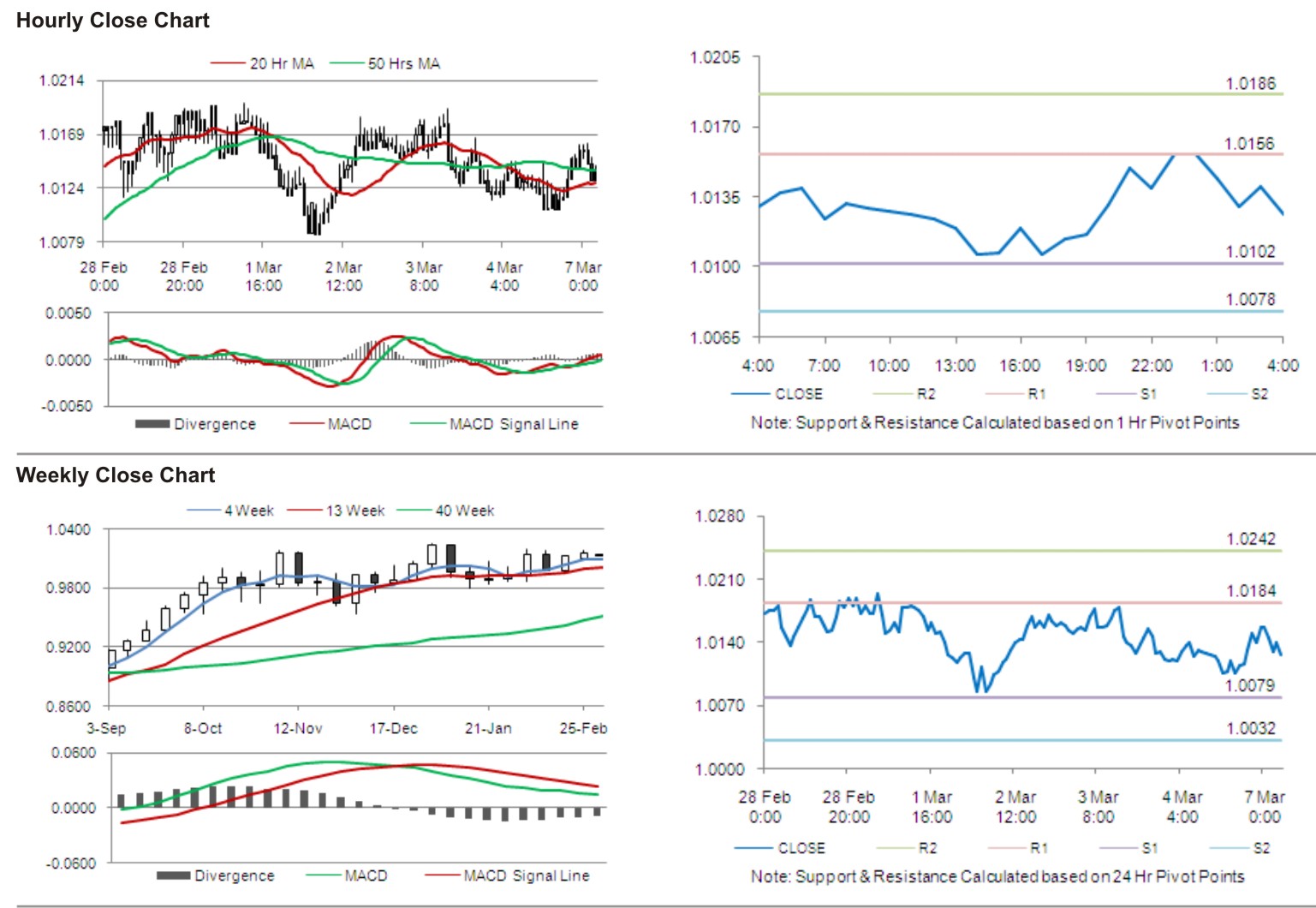
For the 24 hours to 23:00 GMT, AUD weakened 0.37% against the USD to close at 1.0118.

According to a monthly survey by The National Australia Bank, Australian business confidence rose to 14 points in February, from a reading of 4 in January. The NAB’s Business Conditions Index rose 2 points and reached -4 points in February 2011, even as confidence picked up sharply.

In the Asian session at 4:00GMT, the pair is trading at 1.0123, 0.05% higher from the New York session close.

LME Copper prices declined 1.3% or $130.0/MT to $9,840.3/ MT. Aluminium prices declined 0.8% or $21.8/ MT to $2,565.8/ MT.

The pair is expected to find first short term resistance at 1.0174, with the next resistance levels at 1.0224 and 1.0313, subsequently. The first support for the pair is seen at 1.0085, followed by next supports at 1.0046 and 0.9957 respectively.

Economic releases such as Westpac Consumer Confidence are expected to be the key indicators to determine future trading trends in the currency pair.

The currency pair is showing convergence with its 20 Hr and 50 Hr moving averages.

Forex Daily Market Commentary provided by GCI Financial Ltd.

GCI Financial Ltd (”GCI”) is a regulated securities and commodities trading firm, specializing in online Foreign Exchange (”Forex”) brokerage. GCI executes billions of dollars per month in foreign exchange transactions alone. In addition to Forex, GCI is a primary market maker in Contracts for Difference (”CFDs”) on shares, indices and futures, and offers one of the fastest growing online CFD trading services. GCI has over 10,000 clients worldwide, including individual traders, institutions, and money managers. GCI provides an advanced, secure, and comprehensive online trading system. Client funds are insured and held in a separate customer account. In addition, GCI Financial Ltd maintains Net Capital in excess of minimum regulatory requirements.

DISCLAIMER: GCI’s Daily Market Commentary is provided for informational purposes only. The information contained in these reports is gathered from reputable news sources and is not intended to be U.S.ed as investment advice. GCI assumes no responsibility or liability from gains or losses incurred by the information herein contained.

Stockholm or Bust: Sweden’s Powerhouse Economy

printprofile

A variety of articles have analyzed the rising strength of the Swedish krona (SEK) to point of exhaustion. A key aspect emphasized, though – as is usual in this global economic environment – is caution. But is caution warranted when it comes to Sweden?

Let’s evaluate the claim.

Sweden’s krona is rising at a more-than-healthy rate. The USD/SEK has moved from 8.1311 last June to as low as 6.3614 today. The EUR/SEK witnessed a similar price movement from as high as 10.2695 in November 2009 to today’s current price of 8.8760.

The fear with this rising strength comes when viewing Sweden’s concurrent economic growth, which rose 7.3% year-on-year in Q4 2010. Analysts have been forecasting a gouging effect from the rising SEK, which will eventually pull down on Swedish exports and dampening growth.

This claim was made starting from late-2010, but has yet to bear any signs of occurring as expected.

In fact, Sweden’s economic growth appears dissonant with what is happening elsewhere in the world. As the Wall Street Journal recently pointed out, Sweden doesn’t face many of the same problems as other global economies. Sweden faces no sovereign debt crisis like Europe; no deflationary fears like Japan; no unemployment or budgetary problems like the United States; nor fears of an over-strengthened currency by its central bank, like Switzerland.

Indeed, the Riksbank actually raised interest rates to 1.5% in 2010, with an expectation to reach 3.0% by Dec. 2011. Swedish Finance Minister Anders Borg also told reporters lately that Sweden’s government is expecting growth of 4.8% in 2011, an upward adjustment from the previous expectation of 3.7%.

It appears that an apt metaphor for Sweden’s trajectory is to view all global economies as being in a race to normalcy, with Sweden finishing first in Q4 2010. The prize is unprecedented growth lasting as long as the other global economies continue the race.

The next logical question to ask, in regards to the caution urged by speculators, then, is “How close are the other economies to finishing?”

Events to affect the trading of Japanese Yen for the Current Week

The US dollar gained 0.74 percent versus the Japanese Yen in last week to close at 82.28 on Friday. The pair USD/JPY is expected to find support at 81.71 while the pair is likely to find resistance at 83.07 which also happens to be day’s high on last Friday.

List of events that could affect the trading of the pair USD/JPY in the current week are as follows:-

Today Japan released their official report on bank lending and M2 money stock. The country also released a comprehensive report on its current account balance. United States is expected to publish its official report on consumer credit today which is a key measure of consumer confidence.

On Tuesday March 8th, 2011 official data on core machinery orders will be reported by Japan while Governor of Central Bank of Japan Mr. Masaaki Shirakawa will give a speech in Frankfurt. United States is expected to report data on economic optimism on Tuesday.

On Wednesday March 9th 2011official data on crude oil inventories will be reported by United States while Japan will report its gross domestic product for the fourth quarter which is regarded as the key measure of economic activity.

On March 10th, 2011 the key data on jobless claims will be published in United States. A comprehensive report on US trade balance will also be released on Thursday. In Japan initial data on machine tool orders will be reported.

On Friday March 11th, 2011 data on retail sales will be reported. Moreover key data on consumer sentiments and inflation expectations will also be published by University of Michigan.

About the Author

Daily forex trading news written by Rehan from DailyForexTrade.com

Weekly Outlook for the Pair GBP/USD

List of major events that could affect the trading of the pair GBP/USD for the week ending March 11th, 2011 are as follows:

Today official data on consumer credit was published in United States. On Tuesday March 8th, 2011 data on retail sales and house prices will be released in United Kingdom while United States will report its official report on economic optimism.

On Wednesday March 9th, 2011official report on UK’s trade balance will be published which shows the difference between country’s imported and exported goods in the last month. In United States report on crude oil inventories will be published.

On March 10th, 2011official report on manufacturing production will be released in United Kingdom which is regarded as the major indicator of economic progress. Moreover Bank of England will announce its future plans for the key lending rate.

United States will report its key data on initial jobless claims on Thursday along with comprehensive report on country’s trade balance.

On March 11th, 2011Governer Bank of England Mervyn King will make a public speech which will be followed closely to assess the future direction of UK’s monetary policy. Official report on producer price inflation will also be released in United Kingdom.

In United States several reports will be published which will include data on retail sales, data on business inventories and detailed reports on consumer sentiments and inflation expectations which will be published by University of Michigan. The respective reports represent the key data for measuring overall country’s economic progress.

About the Author

Daily forex trading news written by Rehan from DailyForexTrade.com

Red Alert On Globe Telecom, Inc. (GLO)

globe telecoms inc., GLO philippine stocks, jaime zobel de ayala, ron acoba, head and shoulders, daily stock picks, stock market trading

Don’t say that I did not warn you: Ayala Corporation – led Globe Telecom, Inc. or GLO in the Philippine Stock Exchange looks to be headed for a steep fall. Let me show you why.

Back in February 17, 2011, I already raised the red flag on GLO when it was still trading above the neckline of a massive head and shoulders formation (kindly see my previous post here). Since that time, GLO’s situation went worse as it slipped and eventually broke below the PHP 700.00 support (where the neckline lies) last on February 23. For awhile, GLO attempted to rally back above PHP 700.00 but the selling pressure on that level was too great. Again, GLO fell below it as it closed at PHP 664.00 last Friday.

Now, GLO could still reverse its bad future if it is able to rebound above the PHP 700.00 marker in the days to come. But it will take a lot of buying interest for it to go over that area since it is a price level that held for more than 10 years. And given these times of risk aversion due to the political tension in Egypt, it is unlikely that the market will buy into the equities markets and specifically into GLO with such confidence. So with GLO’s recent move, it is now quite possible that it will fall even lower. Based on its chart, its next level of support is around PHP 400.00. Its downside target meanwhile is much lower, given the height of the pattern. That’s why its scary. Therefore, it is best to just avoid this stock. Better yet, why not short it if your broker will allow you to do so.

More on LaidTrades.com