AUD/USD Rally Impending

By Greg Holden

A brief look over our technical charts reveals a possible opportunity to earn a quick buck on the AUD/USD.

The pair has been trading within an ascending wedge formation since October 2010. As the latest downturn has pushed the price of the AUD/USD to its lower trend line, the pair should rally sometime in the near future.

Our oscillators do not appear to be signaling this impending move very strongly, which means some dips in value could yet occur.

Looking at the chart below, the Stochastic (slow), while in a descending price pattern, has not yet entered the over-sold region, nor formed the necessary bullish cross to indicate an impending uptick. Nevertheless, the oscillator is rapidly approaching this point which means we could see it fully developed in the next day or two.

Moreover, the MACD is also showing some mixed signals. While this indicator is signaling bearish crosses, they appear to be just slightly above the 0 line, meaning the downward pressure is perhaps too weak to make a solid impact.

Overall, the ascending wedge pattern is the strongest technical force in this pair, it appears, and the lower trend line should have the most impact on its price for technical traders.

As such, traders may want to get in on the price action after the AUD/USD bounces off the 1.0050 price line and rallies back towards 1.0200 (and possibly 1.0300) within its currently tightening range.

AUD/USD – Daily Chart

Forex Market Analysis provided by ForexYard.

© 2006 by FxYard Ltd

Disclaimer: Trading Foreign Exchange carries a high level of risk and may not be suitable for all investors. There is a possibility that you could sustain a loss of all of your investment and therefore you should not invest money that you cannot afford to lose. You should be aware of all the risks associated with Foreign Exchange trading.

Forex Daily Market Commentary: The dollar continues to strengthen gradually

By GCI Forex Research

FUNDAMENTAL OUTLOOK at 0800 GMT (EDT +0400)

USD

The dollar continued to strengthen gradually during the Asia session. The absence of news, combined with the prevalence of short dollar positions, suggests that an unwind of overstretched positions was likely at work over the past 24 hours. EURUSD traded between 1.3873 and 1.3924 and USDJPY between 82.61 and 82.94. Asian equities are marginally ahead at the time of writing, while the S&P 500 had closed up 0.89%.
There are no top-tier releases in the US ahead so positioning and external factors will likely continue to drive currencies. Our 1m forecasts, which we revised earlier in the week, reflect that sentiment favours the currencies of hawkish central banks in the near term, but we maintain our 3m forecasts on the basis of an improving US economy and continuing Eurozone debt worries.

EUR

Greek and Irish bonds remain under pressure, with their 2y spreads relative to Germany well above the rest of the Eurozone. S&P said it also sees more downgrades for Eurozone countries, though the ratings agency did not elaborate.
German factory orders grew faster than expected in January at +16.0% y/y and +2.9% m/m, compared to consensus expectations of +15.6% y/y and +2.5% m/m respectively.
ECB Governing Council member Nowotny said that the ECB is strictly keeping to the goal of price stability. Inflation is not seen as a threat if second-round price effects can be contained. He also said that the ECB never pre-commits to interest rates, although did acknowledge that “strong vigilance” is seen as a code word in the markets.

CHF

After the unemployment rate fell for February, the upcoming CPI release now takes centre stage. We look for an increase in both m/m and y/y CPI, though slightly below consensus (0.2% m/m vs. cons. 0.3% m/m, 0.3% y/y vs. cons. 0.4% y/y). An upward surprise on CPI could lend support to CHF but might not be enough to shake the SNB out of their current stance. Relative central bank tightening expectations continue to favour EURCHF upside.

AUD

More Australian economic data from January was released overnight. The latest data show more signs of strain as a result of the flooding in Queensland. Our Australian economists note that consumer confidence has fallen to a nine- month low, and the value of housing finance (excluding refinancing) dropped by 6.4% – the sharpest fall since March 2008.

NZD

Our analysts expect the RBNZ to cut the OCR by 50bp. Given that the consensus is only looking for a smaller 25bp cut, the NZD is likely to come under selling pressure immediately after the policy announcement. Clearly the policy statement is also likely to be highly influential, and any suggestion from Governor Bollard that he might consider easing policy further in the future is likely to add to any downside pressure on NZD.

TECHNICAL OUTLOOK
EURGBP 0.8654/72 resistance.
EURUSD BULLISH Focus is on 1.3989 yesterday’s high, move above this would open up 1.4036/86 area next. Support is defined at 1.3833.
USDJPY NEUTRAL Recovery from 81.57 signals potential for gains towards 83.07/41 zone. Short-term support defined at 81.95.
GBPUSD NEUTRAL Pull back from 1.6344 has turned the model to neutral; break of this level is required for resumption of uptrend. Near-term support is at 1.6072.
USDCHF BEARISH Support at 0.9200 holds, move below this would open 0.8951 next. Near-term resistance at 0.9392.
AUDUSD NEUTRAL Initial resistance is at 1.0202, break of this would expose key resistance 1.0256. Near-term support is at 1.0002.
USDCAD BEARISH Bearish outlook is intact; support zone is at 0.9700/0.9684. Resistance is defined at 0.9776.
EURCHF BULLISH Focus is on 1.3138, break of this level would expose 1.3205. Support at 1.2788 holds.
EURGBP BULLISH Outlook remains bullish with focus on 0.8654/72 resistance area. Near-term support is at 0.8566.
EURJPY BULLISH While support at 114.19 holds, the cross targets 116.00/65 resistance zone.

Forex Daily Market Commentary provided by GCI Financial Ltd.

GCI Financial Ltd (”GCI”) is a regulated securities and commodities trading firm, specializing in online Foreign Exchange (”Forex”) brokerage. GCI executes billions of dollars per month in foreign exchange transactions alone. In addition to Forex, GCI is a primary market maker in Contracts for Difference (”CFDs”) on shares, indices and futures, and offers one of the fastest growing online CFD trading services. GCI has over 10,000 clients worldwide, including individual traders, institutions, and money managers. GCI provides an advanced, secure, and comprehensive online trading system. Client funds are insured and held in a separate customer account. In addition, GCI Financial Ltd maintains Net Capital in excess of minimum regulatory requirements.

DISCLAIMER: GCI’s Daily Market Commentary is provided for informational purposes only. The information contained in these reports is gathered from reputable news sources and is not intended to be U.S.ed as investment advice. GCI assumes no responsibility or liability from gains or losses incurred by the information herein contained.

The End Of SM Investment Corporation’s Rally?

SM invesyments corporation, SM philippine stocks, henry sy, ron acoba, descending channel, daily stock picks, stock market trading

Filipino-Chinese Tycoon Henry Sy’s investment holding firm, SM Investments Corporation (SMIC) or SM in the Philippine Stock Exchange earned a net income amounting to PHP 18.40 billion pesos in 2010 which was 15% higher than the previous year. SM’s better-than-expected corporate earnings result carried the price of its shares from an opening of PHP 461.00 last March 3 to a closing of PHP 509.50 today (March 8). The increase in SM’s income can be attributed mainly to the its retail business (34%),  financial services (30%), shopping malls (20%), and its real-estate business (13%). Robust consumer spending generally boosted every sector of its businesses. If you remember, the economic condition last year picked up due to the increase in government spending and the resurgence of market confidence.

The country’s outlook for this year, however, is a bit subdued. The threat of inflation due to rising commodity prices is increasing by the day. Market confidence is likewise being diminished by the ongoing political unrest in the Middle East, causing foreign investors to shy away from the riskier investment like equities. With the PSEi generally trekking a downward slope, any rally in any individual security could likely be met by a similar if not a stronger sell-off. Anyway, as with most businesses, SM’s growth is dependent on consumer spending. Consumer spending for the whole of this year could be slower than last year due to the reasons stated. Such could therefore reflect on the stock as well. But I could be wrong and in this case, I hope that I am. It’s still the first quarter of the year so a lot of things can still happen.

Technically, the shares of SMIC rallied strongly from PHP 461.00 last March 3 to a closing of PHP 509.50 today after seeing a 15% jump in the company’s profit in 2010. But if you check out SM’s chart above, it has been trading within a descending channel since it peaked at PHP 589.00 on November 5, 2010. Today’s move sent it right at its 130-moving average and the channel’s resistance which could both act as a wall to stop it from moving higher. A failure to move past PHP 515.00 could send it back down PHP 450.00. A break above PHP 515.00, on the other hand, could push it north towards 550.00 Philippine Peso.

More on LaidTrades.com

Ayala Land’s (ALI) Range-Bound Descent

Ayala Land, Inc. or ALI in the Philippine Stock Exchange is one of the largest real-estate developers in the country. Its stocks have been rallying the past few days from a low of 14.12 Philippine Peso last Wednesday until today’s high PHP 15.80. However, ALI is on a 5-month downtrend and could further head lower until it reverses its short-term course. If you notice, the stocks have been descending in a range-bound fashion and even respected the resistance during earlier’s trading session. As for the descending channel‘s  bias, the MACD at a negative level and the price below the 100 and 200 moving averages, the stocks could continue to drop and if it does, the immediate support could be PHP 14.12. Then the next support after that is the PHP 13.70 price mark. On the flip-side, a breakout from the descending channel could propel the stocks higher to tap the PHP 15.46 resistance. Once that level gets breached, the next resistance could be PHP 15.90.

The Middle East tension has been a reason for the stock markets to decline and commodities to rise. Libya, being one of the world’s 10 richest oil-producing countries, is a big player in the global oil supply chain. With the ongoing uprising in their country, their leader, Muammar al-Gaddafi, seized its oil supply operations and this left a big impact in the world oil market. Oil prices shot up as the demand outweighed the supply. This is one reason why many investors have been pulling out their money in the stock markets and move it to oil.

More on LaidTrades.com

EUR/AUD- Technical Tip

By Anton Eljwizat

A bullish movement of the EUR/AUD cross hasn’t received much support as of late. Below, I will demonstrate that the EUR/AUD pair has already commenced a downward trend for today, as a bearish cross has taken place on the Slow Stochastic. In addition, the Relative Strength Index indicates that the price of this cross currently floats in the overbought territory, signaling down pressure. Traders are strongly advised to take advantage of the trend at an early stage. Therefore, why not open short positions at an excellent price?

EUR-AUD 9-3-2011

Forex Market Analysis provided by ForexYard.

© 2006 by FxYard Ltd

Disclaimer: Trading Foreign Exchange carries a high level of risk and may not be suitable for all investors. There is a possibility that you could sustain a loss of all of your investment and therefore you should not invest money that you cannot afford to lose. You should be aware of all the risks associated with Foreign Exchange trading.

Silver: Silver succumbs to profit-booking in Asian session

By GCI Forex Research

Silver prices rose 0.45% to USD 36.03 per ounce during the 24 hours ending 23:00GMT.

In the Asian session at 4:00GMT, silver is trading at USD 35.94 per ounce, 0.25% lower, from 23:00GMT.

The first level of short term resistance on the upside is at 36.43, followed by 36.93. The pair is expected to find support at 35.55, with the subsequent support level at 35.17.

The pair is showing convergence with its 20 Hr and 50 Hr moving averages.

Forex Daily Market Commentary provided by GCI Financial Ltd.

GCI Financial Ltd (”GCI”) is a regulated securities and commodities trading firm, specializing in online Foreign Exchange (”Forex”) brokerage. GCI executes billions of dollars per month in foreign exchange transactions alone. In addition to Forex, GCI is a primary market maker in Contracts for Difference (”CFDs”) on shares, indices and futures, and offers one of the fastest growing online CFD trading services. GCI has over 10,000 clients worldwide, including individual traders, institutions, and money managers. GCI provides an advanced, secure, and comprehensive online trading system. Client funds are insured and held in a separate customer account. In addition, GCI Financial Ltd maintains Net Capital in excess of minimum regulatory requirements.

DISCLAIMER: GCI’s Daily Market Commentary is provided for informational purposes only. The information contained in these reports is gathered from reputable news sources and is not intended to be U.S.ed as investment advice. GCI assumes no responsibility or liability from gains or losses incurred by the information herein contained.

EUR Sees Bearishness in Overnight Trading

Source: ForexYard

Euro zone debt concerns are once again back in the news and have led to a steep drop for the 17-nation single currency in overnight trading. The EUR/USD has dropped over 100 pips in the last 24 hours, and is currently trading below the 1.3900 level. Today, a lack of significant euro-zone news is unlikely to help the currency correct its losses.

Economic News

USD – US Dollar Reverses Downward Trend

Yesterday saw the US dollar break out of the downward trend it had been stuck in for the last several weeks. Analysts attributed the reversal to renewed concerns over euro-zone sovereign debt which has caused investors to revert back to the greenback. In addition, speculation that the Fed may soon be coming off its policy of quantitative easing helped lift the dollar.

The EUR/USD dropped significantly yesterday and throughout the overnight session, and is currently trading just below the 1.3900 level. Furthermore, the last 24 hours have seen the greenback move up around 60 pips vs. the Japanese yen. Currently the USD/JPY is trading at 82.81. Even the USD/CHF, which just recently hit a new record low, recorded significant gains. The pair, currently trading at 0.9355, has gone up close to 100 pips since yesterday.

Today, a lack of significant US news means that dollar values are likely to be determined by any announcements regarding debt in the euro zone. For now, most analysts are saying that the debt worries are more significant than the hawkish statements regarding European interest rates made last week. If so, the dollar is likely to see another potentially bullish trading day today.

EUR – European Debt Back in the News

The recent downgrading of Greece’s credit rating helped remind investors that the sovereign debt worries that plagued the euro not so long ago are far from over. Analysts are warning that debt concerns are likely to weigh down on the 17-nation single currency for the near future. The euro zone’s inability to combat its fiscal problems seems to outweigh last week’s comments by the president of the European Central Bank (ECB) regarding a possible interest rate hike as early as next month.

The euro dropped against virtually all of its main currency rivals yesterday, most notably the US dollar and British pound. The EUR/USD, which had risen past the 1.3400 level late last week, has taken a sharp bearish turn and is currently trading around the 1.3893 level. The EUR/GBP had dropped as low as 0.8588 yesterday, before moving up to its current level of 0.8596.

Today, traders are warned that any further mention of euro-zone debt is likely to bring the currency farther down against the dollar. Until the ECB develops a concrete plan to address the numerous fiscal problems in the peripheral euro-zone countries, the euro is unlikely to see a sustained bullish move.

JPY – Yen Takes Losses against Dollar and Sterling

The safe-haven yen lost some of its appeal yesterday as rumors began to circulate that the Fed may begin coming off its policy of quantitative easing in the near future. While no concrete plan has been announced, the mere mention of the idea caused the Japanese currency to tumble against several of its main rivals.

The USD/JPY, which had been trading below the 82.00 level earlier this week, received a significant boost yesterday and is now approaching 82.90. Meanwhile, the GBP/JPY has gone up over 80 pips in the last 24 hours and is currently trading around the 133.90 level.

Today, yen traders are advised to follow any announcements from the US regarding future moves on interest rates and quantitative easing. Even though a plan is not likely to be unveiled today, yesterday demonstrated how dramatic even the mention of a change in policy can be in the forex market.

Crude Oil – Oil Drops Slightly in Overnight Session

Crude oil began to come off its recent highs throughout the day yesterday and into the overnight session. Analysts attribute the drop to decreased demand in the US due to high prices. Currently, crude oil is trading at $104.51 a barrel, down from $105.75 yesterday afternoon.

Today, prices could drop further following the release of the US Crude Oil Inventories figure at 15:30 GMT. Analysts are predicting a surplus in US stockpiles which if true, is likely to be seen as another sign of reduced demand in the world’s largest oil consuming nation.

That being said, traders should pay attention to any developments in Libya. The fighting in that country continues to have a dramatic effect on the price of oil. Until a degree of calm is brought to the region, the price of oil is unlikely to drop significantly.

Technical News

EUR/USD

A bearish cross on the daily chart’s Slow Stochastic indicates that the pair’s recent downward trend still has room to grow. Furthermore, the Relative Strength Index on the same chart is currently in the overbought zone. Traders are advised to short their positions today.

GBP/USD

Technical indicators on the 8-hour chart are showing that the pair is oversold and may see an upward correction today. The Williams Percent Range and Relative Strength Index are both showing signs of an impending bullish move. Traders may want to go long with tight stops today.

USD/JPY

Technical indicators are providing mixed signals for this pair. The 8-hour chart’s William Percent Range is currently in overbought territory. At the same time, the daily chart’s MACD has formed a bullish cross. Traders may want to take a wait and see approach for this pair today.

USD/CHF

The 8-hour chart’s Relative Strength Index and Williams Percent Range have crossed into overbought territory, indicating a downward correction is likely to occur in the near future. Going short with tight stops may turn out to be a profitable strategy today.

The Wild Card

USD/CAD

The 8-hour chart’s Bollinger Bands have tightened, indicating that a price shift is going to occur in the near future. In addition, the daily chart’s Williams Percent Range and Relative Strength Index are in the oversold zone, indicating that the price shift is likely to be bullish. Now may be a good time for forex traders to open up long positions before the upward breach occurs.

Forex Market Analysis provided by ForexYard.

© 2006 by FxYard Ltd

Disclaimer: Trading Foreign Exchange carries a high level of risk and may not be suitable for all investors. There is a possibility that you could sustain a loss of all of your investment and therefore you should not invest money that you cannot afford to lose. You should be aware of all the risks associated with Foreign Exchange trading.

Crude Oil May See Correction Today

printprofile

The euro halted its recent bullish streak yesterday, as investor concerns regarding euro zone debt outweighed the recent hawkishness regarding interest rates in the region. The EUR/USD dropped well over 100 pips yesterday and is currently trading below the 1.3900 level.

Today, traders will want to pay attention to the commodities markets as global news continues to affect prices, particularly with regards to crude oil.

Here is a roundup of the day’s main news:

15:30 GMT- US Crude Oil Inventories

The persistent violence throughout Libya has led to a sharp increase in the price of crude oil in recent weeks. While crude is still trading at well over $100 a barrel, there is evidence that today’s US inventories figure may start to bring prices down.

US oil reserves are forecasted to come in at 0.8M, a sharp increase over last week’s figure of -0.4M. There is a growing consensus that demand for oil has gone down in the US due to rising prices. If today’s figure comes in as predicted, that notion would be supported and could result in a downward correction for oil in afternoon trading.

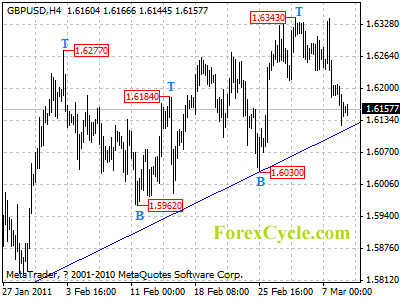
GBPUSD’s fall extended to 1.6125

GBPUSD’s fall from 1.6343 extended to as low as 1.6125. Deeper decline towards the rising trend line on 4-hour chart is still possible later today. Uptrend could be expected to resume after touching the trend line. On the other side, a clear break below the trend line support will indicate that lengthier consolidation of uptrend from 1.5344 is underway, then the next target would be at 1.6000 zone.

gbpusd

Daily FX Analysis

Investing in “Food Inc.”

By Jared Levy, Editor, Smart Investing Daily, taipanpublishinggroup.com

When we think of food in general, especially prepared foods, most of us don’t realize the effort, enormity, complexity and cost that go into a bag of potato chips or Doritos, a fresh glass of orange juice, or the prepared cuts of poultry or meat that might be sitting prepackaged in your fridge at the moment.

Companies like Tyson Foods, Hormel, Sanderson Farms and Pilgrim’s Pride, to name a few, actually grow or raise their own crops and livestock in addition to preparing and packaging and finally selling to distributors like Wal-Mart, Kroger, Safeway and other stores. They produce immense quantities of food! Tyson Foods alone produced 41.4 million chickens, 139,400 head of beef and 393,300 head of pork, per WEEK on average last year. Their profits can come under attack from higher input costs and reduced consumer spending.

Then there are other companies that don’t farm, but rather purchase raw or semi-processed commodities like corn, wheat, rice, dairy, beef and poultry from a company like Archer Daniels Midland (ADM:NYSE) and then create their own packaged foods for us to consume. These companies are generally more susceptible to changes in commodity costs.

Small changes in the price of grains and meats can have massive effects on the profitability of the aforementioned companies, but also can cause adverse effects in areas you wouldn’t think of… more on that in a minute.

Why Are Food Prices Rising?

A Growing Problem

The world consumes on a massive scale, and it is only getting worse. According to the USDA, population growth rates in most developing countries remain above those in the rest of the world and are projected to account for 82% of world population growth by 2020. Although total growth population seems to be slowing, global demand for proteins is on the rise, causing unusual demand for some areas.

Corn for Fuel

Crude oil is now topping $100 a barrel and alternative fuel for the over 900 million cars on the road is needed. Whether you’re in favor of alternative fuels or not, corn is expected to remain the primary feedstock for U.S. ethanol production during the next 10 years, eventually equaling 36% of total corn production in the U.S. (as per the USDA).

The European Union (EU) is currently projected to run 60% of its vehicles on biodiesel by 2020.

Corn is the No. 1 crop grown here in the U.S.; we are also the world’s No. 1 consumer of corn.

Weak U.S. Dollar

Many of the commodities mentioned are traded and quoted in U.S. dollars. Continued monetary easing and weaker dollar trends move prices higher. There are several scenarios that can play themselves out over time when it comes to currency. For now, a weak dollar is driving exports and prices of commodities here in the U.S. and abroad.

Natural Disaster, Disease

A fellow trader and friend used to say, “we plant the seed, nature grows the seed, we eat the seed.” When nature fails to grow our seeds or inhibits us from harvesting what we have sown, there can be supply constraints. The droughts in Russia and foot-and-mouth disease in South Korea are just a few of the tragedies that can add to price pressure and food scarcity.

(Investing doesn’t have to be complicated. Sign up for Smart Investing Daily and let me and my fellow editor Sara Nunnally simplify the stock market for you with our easy-to-understand investment articles.)

Commodity Price Effects on Food Companies and Other Industries

Kent Lucas discussed the need for major changes in food output and indicated the need for greater efficiency. Until that happens, there is a long road ahead for many hungry people around the world in addition to many related industries, given the inflationary outlook offered by many experts.

As food prices rise, the first blow comes to the producers and retailers of the foodstuffs because their input costs to feed their grains, cattle and chickens move higher. While this is happening, they try to keep consumer prices as low and stable as possible, which can reduce their profit margins. The same will go for the retail grocers to an extent, although they tend to adjust prices faster to account for input costs and have a different cost structure.

When higher retail prices hit the consumer, spending budgets for the lower and middle classes can be affected, hurting discretionary stocks. So watch out for the companies that only sell stuff we don’t need. This sector is likely to be stifled by rising food costs.

In addition to the cost increases we are seeing here, prices all around the world are higher. In the U.K., food prices on average were 9.8% higher compared to last year.

Clothing Materials

Clothing has not been discussed enough, in my opinion. Cotton has risen 400%, from about 50 cents to over $2.05 per pound, in about a year. Considering that it takes about 1.6 pounds of cotton to make a pair of jeans, a company like True Religion Apparel (TRLG:NASDAQ) and others like it who manufacture tens of thousands of jeans and other garments could feel those effects.

Cotton prices are expected to remain high over the next several months even with an increase in cotton planting this year.

Even polyester garments are affected by higher commodity costs; the synthetic material is derived from crude oil and liquid natural gas.

Where Can You Profit?

Stick with the seed and fertilizer companies like Monsanto (MON:NYSE), Mosaic (MOS:NYSE), CF Industries (CF:NYSE) and Agrium, Inc. (AGU:NYSE). Their products and services will be an integral part of the “food revolution” and are an essential element in farming.

You can look to some Midwest banks with caution — there are a couple publicly traded banks that lend to farmers in that region of the U.S., such as Marshall & Ilsley Corp. (MI:NYSE), MidWestOne Financial Group, Inc. (MOFG:NASDAQ) and Bank of the Ozarks (OZRK:NASDAQ). These banks do have exposure elsewhere, but agriculture loans are an important part of their business.

Many experts and farmers believe there is still upside to crop and farm prices, but even with prices expected to sustain themselves, we must not forget history. There was a major farm bubble in the 1970s and subsequent crash in the ’80s. But back then farmers were loading up on debt and backing that debt with their farms (remember “bet the farm”?), but according to the USDA, farmers’ average debt is about one-third of what it was back then.

Whatever investment you select, make sure you do your homework and never put all of your eggs (or any other commodity) in one basket.

Editor’s Note: The Under-Crisis… Things are about to change drastically in the U.S. and around the world. But it may not be the reason you think. There’s a growing crisis creeping just under the surface of our nation’s financial problems. When this “under-crisis” finally breaks through the surface, expect all hell to break loose.

Find out where the real danger lies in this eye-opening report.

About the Author

Jared Levy is Co-Editor of Smart Investing Daily, a free e-letter dedicated to guiding investors through the world of finance in order to make smart investing decisions. His passion is teaching the public how to successfully trade and invest while keeping risk low.

Jared has spent the past 15 years of his career in the finance and options industry, working as a retail money manager, a floor specialist for Fortune 1000 companies, and most recently a senior derivatives strategist. He was one of the Philadelphia Stock Exchange’s youngest-ever members to become a market maker on three major U.S. exchanges.

He has been featured in several industry publications and won an Emmy for his daily video “Trader Cast.” Jared serves as a CNBC Fast Money contributor and has appeared on Bloomberg, Fox Business, CNN Radio, Wall Street Journal radio and is regularly quoted by Reuters, The Wall Street Journal and Yahoo! Finance, among other publications.