FOREX: Large Currency Speculators add to Dollar shorts. Euro and Swiss Franc long positions rise

By CountingPips.com

The latest Commitments of Traders (COT) report, released on Friday by the Commodity Futures Trading Commission (CFTC), showed that futures speculators continued to add to their short positions of the US dollar against the other major currencies. Non-commercial futures positions, those taken by hedge funds and large speculators, were overall net short the US dollar by $35.36 billion against other major currencies as of the March 8th data release. This is a rise from a total short position of $34.9 billion on March 1st, according to the CFTC data and calculations by Reuters which calculates the dollar positions against the euro, British pound, Japanese yen, Australian dollar, Canadian dollar and the Swiss franc.

This week’s notable changes included euro positions increasing to their highest level since December 2007 while Swiss franc and Canadian dollar positions rose to their highest levels in over a year.

EuroFx: Currency speculators added to their net long positions for the euro against the U.S. dollar for a third consecutive week. Futures positions in the euro rose to a total of 62,294 long positions as of March 8th following a total of 51,308 long positions on March 1st.

euro cot

The COT report is published every Friday by the Commodity Futures Trading Commission (CFTC) and shows futures positions as of the previous Tuesday. It can be a useful tool for traders to gauge investor sentiment and to look for potential changes in the direction of a currency or commodity. Each currency contract is a quote for that currency directly against the U.S. dollar, where as a net short amount of contracts means that more speculators are betting that currency to fall against the dollar and net long position expect that currency to rise versus the dollar. The graphs overlay the forex spot closing price of each Tuesday when COT trader positions are reported for each corresponding spot currency pair.

GBP: Speculators increased their net long British pound sterling bets following two straight weeks of declines. Sterling long positions rose to a total of 33,906 long positions after totaling 25,809 long positions as of March 8th.

pound sterling

JPY: The Japanese yen net contracts decreased as of March 8th to a total of 16,656 long contracts following a total of 41,274 net long contracts reported on March 1st.


CHF: Swiss franc long positions rose for a fourth consecutive week to a total of 23,661 long contracts, according to the COT data as of March 8th. Franc contracts totaled a net of 18,017 long contracts on March 1st. This is the highest level for franc positions since late 2009.


CAD: The Canadian dollar positions rose for a second straight week to their highest position in over a year. CAD net contracts advanced to a total of 77,544 net long contracts on March 8 after registering 72,827 net longs on March 1st.


AUD: The Australian dollar long positions increased for a third consecutive week. AUD contracts totaled a net amount of 73,695 long contracts as of March 8th after AUD positions had totaled 71,853 net long contracts on March 1st.


NZD: New Zealand dollar futures positions headed lower for a fourth straight week to a total of 4,346 long positions as of March 8th. NZD large speculator long positions had dipped the previous week to a total of 7,411 long contracts on March 1st.


MXN: Mexican peso long contracts rebounded after a decrease last week to a total of 113,165 net long contracts as of March 8th. MXN positions had fallen to 97,202 net long contracts on March 1st.


COT Data Summary as of March 8, 2011
Large Speculators Net Positions vs. the US Dollar

Euro: +62,294
British pound sterling: +33,906
Japanese yen: +16,656
Swiss franc: +23,661
Canadian dollar: +77,544
Australian dollar: +73,695
New Zealand dollar: +4,346
Mexican peso: +113,165

Further COT Resources from around the web:
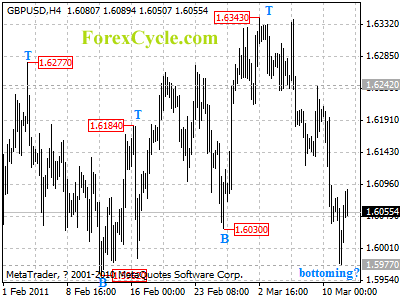
GBPUSD rebounded from 1.5977

Being contained by 1.5962 support, GBPUSD rebounded from 1.5977, suggesting that a cycle bottom is being formed on 4-hour chart. Further rise would likely be seen later today, and next target would be at 1.6150 area. Key support is at 1.5962, a breakdown below this level will indicate that the longer term uptrend from 1.5344 (Dec 28, 2010 low) had completed at 1.6343 already, then the following downward movement could bring price to 1.5400 zone.

gbpusd

Daily Forex Analysis

Gold and Silver Surge

By James McKee

The fear of continued conflict in Libya alongside the possibility of it spreading to other countries has sparked a wave of fear in the investment world and many are seeking refuge in the gold and silver markets. It is a well-known fact that gold and silver do not appreciate in value, however they do not lose value either so when a currency loses value it takes more of that currency to purchase gold or silver. The rising cost of both of these precious metals signifies a fast dropping confidence in the US dollar that is bringing its value down exponentially.

The Libyan conflict has gone from some citizens seeking a regime change to an all out bloody revolution complete with military warfare and civilian casualties. There have already been hundreds killed and the dead are mounting and Gaddafi continues to insist that he holds Libya and that he will not give up control under any circumstances. This has lead the opposition to openly express their desire to keep up the fight by any means necessary. This could mean civil war for Libya causing further damage to major currencies and driving up the cost of gold even further.

The value of gold signifies a drop in not only the value of a currency but also the value in that currency. As gold becomes worth more in USD’s it drops in value on the forex market against other major currencies (most of the time). This is not true of all countries however because some (such as Australia) enjoy a unique relationship with gold. Much like those countries who are closer to the oil supply experience far less of a boost in cost since they do not have to pay nearly as much for it to be transported. Pay close attention to the cost of gold in coming days as it will be a sign of things to come.

About the Author

Author is a Forex trader and financial analyst residing in Denver, Colorado. To stay up to date on all the latest developments in the financial world and beyond be sure to check out the forex exchange rates regularly

Why You Should Consider Promoting Two Tier Forex Affiliate Programs

By James Woolley

The forex trading niche is one that attracts an awful lot of affiliates because with so many products on sale and so much demand for these products, there are some big commissions to be made. However very few people actually end up making serious amounts of money from their own affiliate marketing efforts, which leads them on to two tier forex affiliate programs.

Two tier affiliate programs are available in every niche, not just the forex niche. Nevertheless they enable you to not only make affiliate commissions yourself, but also to refer other affiliates and earn commissions from every sale that they generate as well.

So for example you may find that a forex company will pay you 20% for every sale that you generate yourself, and maybe 5 or 10% for every sale that one of your referred affiliates generates. Therefore if you bring in a lot of affiliate marketers, you can expect to earn some huge commissions in the long run.

Indeed many people find that after a while they are making more from their second tier than they are from their own marketing efforts. Therefore they don’t really have to do anything. They can just sit back and let their affiliates do all the work for them. It really is a great way of earning some passive income.

Before you get too carried away, however, it is worth remembering a few things. First of all you could bring in maybe 100 affiliates, but if you think that all of these people are going to generate lots of sales, then I think you are going to be disappointed.

You have to remember that the vast majority of affiliates never make any money. So out of these 100 people, you can expect maybe 10% of these people to generate any sales at all, and maybe a handful of these people to make some serious sales.

Therefore when encouraging people to join your two tier affiliate programs, you have two options. You can either sign up as many people as you possibly can in the hope that some of them are bound to do well, or you can go after other website and blog owners and just target those people who are more likely to be able to generate some decent sales.

The point is that recruiting affiliates can be a very profitable business. However you have to try and get at least a few decent marketers on board, otherwise you are unlikely to make any real passive income. If you do manage to do this, then there are big rewards on offer and you can of course make even more money if you promote products yourself. So on the whole it is definitely worth looking at two tier forex affiliate programs.

About the Author

James Woolley is both a forex trader and an affiliate marketer. Click here to discover which affiliate programs he regards as being the best forex affiliate programs.

Stocks & Gold Analysis: Coming to a Tipping Point, What Direction Next?

By Chris Vermeulen, thegoldandoilguy.com/

The past couple weeks have been choppy in the equities market. While the strong intraday moves are great for day traders, it is extremely difficult for swing/position traders who normally hold positions for 3-60 days in length, which is my focus with this newsletter. That being said, we are reaching a do or die point for the equities market and next week there should be a strong move out of this trading range.

On the volume side of things, we have been seeing distribution taking place. Heavy volume continues to step into the market unloading large amounts of shares. The interesting part is that the majority of traders are bullish and sentiment levels are at extremes. Also, we are seeing the retail trader enter the market… What does this mean? It means we must trade very cautious and large positions on the long side shouldn’t be taken. The selling volume and extreme bullish sentiment are warning us that a correction is near.

There are a few things I watch to identifying trend reversals and they are accumulation or distribution of shares, Extreme sentiment readings, Market internals/breadth, and if the price relative to the 20 SMA. Currently we are seeing all the signs of a reversal to the down side, but it has yet to be confirmed.

My trading buddy JW Jones who focuses strictly on Options Trading has been cleaning up with the current volatility making 21%, 50% and 67% returns on his last threes trades. This guy loves volatility and always seems to put together an option play with very little risk yet big upside potential.

Let’s take a look at a couple charts…

SP500 60 minute chart going back 2 months
This chart shows a possible trend reversal unfolding. We are seeing distribution selling, lower prices with the current price trading under a key resistance level. Also my internal/sentiment indicators are showing waves of buying/bullish market action which is quickly met with strong selling pulling prices back down.

Trading during trend reversals is difficult because the potential downside risk is higher when entering a position. If traded, only small positions should be taken until a trend is established, then you can build/add to your position on pullbacks or bounces depending on the direction in your favor.

My current bias is for lower prices in the coming days, but until we break above February’s high or Last week’s low with strong volume it’s a little more of a guessing game. If we see the SP500 rise early next week and fill the gap and the market internal indicators show extreme short term overbought conditions, it will make for another great low risk shorting opportunity. Shorting just under a key resistance level means the protective stop is only 1-2% away from our entry point and makes for a solid 1:3 risk/reward ratio. On the flip side, if the market has a strong rally and closes above the key resistance level then the tables will have turned and a new up trend should start.

Gold 60 Minute Chart going back 2 months
Gold has had a nice push up in the past few weeks due to the issues in the Middle East. We saw this yellow metal make a new high but has since pulled back down and could have another move lower in the coming week. The $1380-1390 level should act as a strong support zone. The daily and 60 minute chart both show support at that area. Silver is in the same boat. Keep an eye this…

Weekend Trend Analysis:
In short, stocks and commodities are nearing a tipping point and there should be a large move in either direction starting this week if all goes according to plan. The big question is which way are prices going to go? My current bias is for more downside until we see a good washout in the market. It could be 2-8% lower from where the market closed on Friday. After that I think a grind higher into May could easily take place but we will see how the charts unfold going forward.

Each week there seems to be some type of surprise economic, political or natural disaster of some sort making trading not only tougher to trade but riskier because price swings are large. Keep trading to a minimum and small for now.

Get these reports sent to your inbox each Sunday & Wednesday: http://www.thegoldandoilguy.com/trade-money-emotions.php

Chris Vermeulen

Exiting a Difficult ES E-Mini Trade

By David Adams

There are a number of proscribed methodologies for exiting an e-mini trade, but sometimes the best laid plans seem to go awry. Generally speaking, I pay close attention to the Average True Range and existing support and resistance when considering a trade entry. In most cases these measures can assure a reasonably predictable range to expect on the profit side. On the other hand, the ES e-mini can as unpredictable as a wild bear. There are no guarantees, and a trade proceeding along a nice profitable path can quickly reverse field and become a nightmare, if you let it.

In theory stops are fairly easy to pick out and implement. An actual trading, you can throw theory out the window because the markets care little about your theory or what you expect to happen. The tendency of markets to be less than predictable is a major component that all traders must take into consideration. The last thing any trader desires is to end up 10 or 12 ticks on the wrong side of a trade. In short, exiting trades can be a dicey endeavor and things do not always proceed as planned.

So what do you do to handle that volatility?

• It’s important to understand that the market can change directions, even mid-trend, and turn against you. You must have a plan for this eventuality.
• One of the most important factors in this conundrum is to learn to act quickly and decisively. It is common to watch traders let their trade slide into negative territory, hoping it will return to profitability, only to have the trade continue into negative territory until it hits the traders stop loss. This is the worst of all eventualities.
• While I am in a trade, I pay close attention to current support and resistance and market internal indicators so that I can observe the general direction, or change of direction, the market may pursue.
• When I perceive that a trade is not going to materialize in the fashion I have envisioned, I am quick to exit the trade and look for a new and better trade to enter.
• This line of thinking can sometimes be maddening, because a small change in direction a reverse back into positive territory and end up being a positive gainer. I have no problem with this, as my primary goal is preservation a capital and when I perceive imminent risk I would rather err on the side of safety versus the potential for letting a trade run into my stop losses.

It is been my observation that one of the toughest trades most new and inexperienced traders face is cutting losses. This is not hard to understand, as most traders enter a trade with the expectation of making money. But that is where the difficulties begin; what a trader wants and what the market offers are two very different concepts. The market cares nothing about what and individual trader expects in his or her trade; the market is a soulless being and only reflects the general consensus of the millions of traders who are currently active trading. Still, it is very difficult for a trader to let go of his or her expectations and he or she will tend to hang on to the bitter end in an effort to reach those goals.

A better approach is to observe what the market is offering and gauge your trades accordingly. I have no trouble taking a $50 loss in lieu of being stopped out for $400 or $500. Yet it is not uncommon to see a trade that has drawn far into negative territory, only to return to breakeven, but watch a trader hang on to that trade in hopes that it will continue in his predetermined direction. Here he or she will refuse to trade out of the trade because their expectation is for that big winner. Invariably, the market moves opposite their expectation and they suffer a major loss.

In summary, it is essential to maintain flexibility in your exit strategy. While many trades will go according to plan, there are some trades that simply will not go according to plan and the trader needs to make adjustments to his or her thinking to minimize loss. These adjustments may entail taking a very small loss and exiting the trade. We have pointed out that many traders are loath to take a small loss and will hang on to a trade, despite obvious market indications, to the bitter end. Trades that have gone the wrong way, even on the best setups, take special management to minimize loss, and there is no good reason to allow you to be stopped out with a large loss when that loss could have easily been minimized earlier in the trading process. In short, expectations for a trade often indicate an emotional attachment to a trading position and a failure to observe what the market is actually offering, good or bad. Your ability to adjust to market conditions during a trade will greatly affect your profitability in the trading profession.

About the Author

Real Live Trading Doesn’t Lie. Spend several days in my trading room and see if you can benefit from a fresh and unique view on trading e-mini contracts. Sign up for your free trading experience by clicking here

Trading Currency Pairs – What You Need To Know About

By Cedric Welsch

The art of ignorance is not always bliss and knowledge is not deemed power without a reason. Currency markets optimize these idioms in the best possible way. Novices looking at currency pairs assume that how currencies posted against each other storm the brain ever. Yet only the pair currencies are enough to create doubts in leveraging speculators, mistrust in margin playing traders and fear in long term investors and such is the power of global currencies.

It is important to be laced with the adequate Fundamental Analysis and Technical Analysis weapons prior to entering this sphere. While both these lines of thinking have been quite in opposition to each other, it is true that a joint study can bring great results. Technical analysis deals with tracking the data of the recent past to evaluate the price movement at a given point in time. Price and volumes are closely associated by technical analysts and they believe in reading various Bollinger patterns, Candle stick data for bringing out the closest areas of resistance and the expected time frame of support. The fundamental analysts believe that such a line of thought is hogwash and currencies go for a random walk and can be unpredictable in their movement.

The fundamental analysts look at the earnings, dividends, ROI and fresh products and Research and Development tools launched by a currency to gather its stature. This means that they believe that currency with a good earning graph in recent times would be less prone to a volatile attack.

Having said this and explained the above two precepts in contrast lights, it is important to suggest that both the analyses believe in the potency of informational news on pair currencies. An earthquake in Japan can create a tremor in Nikkei and a typhoon devastating Florida can bring the Wall Street crashing. The central idea is to change the pips that you had decided to post after any informational news that you receive. Such news should have a global significance and it shall not be contained by any territory or restricted place on earth.

You can learn all about the currencies through market experts, portfolio holding managers, investment strategists and even the softwares and bots that work over the Meta trader platforms 4. However, it is important to be grounded through some currency education course that can be attended over the virtual medium or over the traditional institutes.

About the Author

Regulated fx news releases are very helpful to you. Even good broker forex review information must not be ignored.

Rising Oil Prices – Why They Can Be Bad News For Your Shares

By James Woolley

The ongoing crisis in Libya is all over the news at the moment, and it is obviously terrible for the millions of people whose lives are affected. However it also affects all of us to some extent because the troubles in this part of the world are pushing the oil price higher and higher.

This means that we are all having to pay more to fill up our cars, and it is also affecting a lot of people who currently hold shares. You may not think that the rising price of crude oil could have a direct impact on your various holdings, but sadly this is not necessarily the case.

Not many investing courses, and that includes some very good training courses, do not talk about oil prices or indeed commodities in general. However the truth is that it is often the case that when oil continues trading higher, the overall stock market will fall. Therefore even your very best stocks may get dragged lower.

Not only that, but some companies will be directly impacted by these higher prices. So even if the wider market does not fall, they may still see their own share price fall as a result because they can obviously expect to see their profits being hit in the future.

This could affect obvious types of companies such as airlines and travel firms, but it could also have an impact on a wide variety of different companies. When you think about it lots of companies have delivery and distribution costs, so a higher oil price will end up being passed on to them at some point.

This is why it is often a good idea to try and protect your share portfolio in some way. So for instance you could invest in a few companies who stand to gain from a rising oil price, such as oil companies, or you could open a long position on the price of crude oil through a futures contract or spread betting position.

You could also look to buy exchange traded funds that track the price of crude oil, if you think the price is likely to continue going higher. There are a variety of different courses that teach you how to trade ETFs, but they are fairly easy to understand because you can buy and sell them just like ordinary stocks.

Anyway the point is that rising oil prices can have a negative impact on your share portfolio, and sometimes regardless of which particular companies you are invested in. However all is not lost because you can always take steps to hedge yourself should the price of oil continue to move higher.

About the Author

Click here to read a full review of the Stock Trading Nitty Gritty course and to read a full Portfolio Prophet review to learn about how you can successfully trade ETFs.

Spain Drags Down The Euro

By James McKee

Spain’s newest attempts to fix their banking problems have resulted in the country being downgraded by Moody’s from an Aa2 rating to Aa1. This comes as no big surprise to many analysts who have seen Spain on the decline for some time now much like Greece or Italy. Spain is experiencing similar banking troubles to those seen in Ireland which is having a catastrophic impact on the country’s economy. This in turn has had a serious downturn effect on the Euro, bringing it from 1.3850 to 1.3820 in a matter of hours as news of Spain spread through the market.

The forex exchange has seen much instability where the Euro is concerned over recent months due to the EU’s nature of propping up the countries contained within it. Greece, Italy and Ireland have all had a staggeringly negative effect upon the EU as a whole, leading Germany to impose austerity measures upon countries that are being bailed out. This has created a gap between those countries in the EU that are doing well financially and those that are not. While no member of the EU is where they want to be there are certainly some winners and losers in the current situation.

Some have said that the EU needs to be dissolved in order for any European country to be able to enjoy long-term survival financially. If the EU does not begin taking careful steps to safeguard their economy now then the storms brewing on the horizon will certainly hit Europe and bring about serious turmoil. The USD and EUR are both going to be seeing some dark days ahead due not only to the necessary austerity measures being imposed but also the continuing crisis erupting in the Middle East which no one is certain will end any time soon.

About the Author

Author is a Forex trader and financial analyst residing in Denver, Colorado. To stay up to date on all the latest developments in the financial world and beyond be sure to check out the forex exchange rates regularly

How To Time Your Exit Point When Investing In Stocks

By James Woolley

For most people who buy and sell stocks, the goal is simply to sell their stocks for more than they paid for them. However the reality is that you have to have a better plan than that. You need to think about when you will actually sell your shares, and what kind of profit target you hope to achieve.

There is no right or wrong answer here. Some people will have certain profit targets in mind such as 10%, 20% or 50%, for instance, but there is one rule you absolutely must adhere to.

You have to try and bank profits that more than compensate for any losses that you may incur. For example it is a very risky strategy to look for 10% gains from each trade if you are prepared to accept losses in the region of 20% or more to achieve these gains.

If you fail to do this, then your winning trades will end up being wiped out by one or two trades that go badly wrong. Unfortunately this can happen to anyone because even the very best companies can issue profit warnings out of nowhere, and the share price can plunge in a matter of seconds.

Another idea you may wish to adopt with regards to the timing of your exit points is to simply hold on to stocks forever, just like Warren Buffett does. Now I wouldn’t necessarily recommend you do this with every kind of company you invest in, because you may pick up a few duds. However there are some stocks that are worth holding on to for years and years.

These are basically the large market-leading stocks that have long and established records of dividend growth and earnings growth. So I’m thinking of the likes of Walmart in the US and Tesco in the UK. If you invest in these stocks, you can expect the share price to continue going up in the long run, albeit with a few fluctuations when the wider stock market falls at times of uncertainty.

So therefore it is hardly worth dipping in and out of these stocks all the time. It is better to simply buy at an opportune moment, ie when the stock appears to be trading at a bargain price, and hold on to it forever. That way you will hopefully benefit from ongoing capital growth as well as a stable and growing dividend payment each year, which you can then reinvest for even greater returns.

The point is that there is no correct answer as regards the best time to sell shares. However you should always ensure that your profits more than compensate for your losing trades, and you should consider never selling at all if you have good quality growth stocks in your portfolio.

About the Author

Click here to read a full review of Zecco, one of the leading online stock brokers, and to read a full Portfolio Prophet review to find out more about the new course that teaches you how to successfully trade ETFs.