Condo Hotel Investment: Turn-Key, Hassle-Free, Double-Digit Yields In A Proven And Fast-Expanding Market

Panama City, Panama:

Dear Live and Invest Overseas Reader,

I was reminded of the simplicity of investing in a condo-hotel unit during my most recent trip to Medellin, Colombia, where I toured such a unit in a completed hotel. This unit is currently available directly from the developer, as the original buyer couldn’t complete the sale. The hotel is already up and running, making this particular property especially attractive. The developer wants to move it quickly, of course…and the buyer would be investing in a very turn-key asset. My Marketwatch members will hear more about this apartment and other current rental investment opportunities in Medellin next week.

Meantime, another interesting condo-hotel opportunity is currently available in Panama City. I alerted Marketwatch members to this project a year ago, when it was being offered at launch prices. The project is still in pre-construction sales, but prices have been increased as sales have been made. Still, this is a good opportunity for someone looking for a relatively hassle-free real estate investment in this market.

The condo-hotel concept is straightforward. You buy the unit, and the management company takes care of renting and maintaining the property. The pricing can seem confusing. You can’t compare condo-hotel pricing in any market with regular retail apartment pricing in that market. You’re not buying a simple apartment.

You’re buying a furnished hotel unit, including standard hotel furniture, fixtures, and systems, including, for example, television and phone systems, sometimes concierge systems, mini-bar fridge, etc., meaning, again, that you can’t compare condo-hotel units with regular apartments, even on a per-square-meter basis.

When considering a condo-hotel investment, you have to look at the numbers, specifically the projected yield on the invested amount. And you have to look at the target market for the hotel.

The condo-hotel in Panama that I’m alerting you to here is called Unicorn. The developer behind it has impressed me by putting in place the right mix of location, room product, and amenities. The projected net yield to owners is in the 10% to 11% range using conservative room and occupancy rates. Generally speaking, you want to get about US$1 of ADR (average daily rate) out of a hotel room for every US$1,000 the room cost to put into service. At that rate, a hotel will make a profit, assuming reasonable operating costs and occupancy rates.

Occupancy rates in Panama hotels have been relatively high the last few years…into the 80+% range for most hotels. Typically, large flag hotels are profitable if their occupancy is at least 65%. Unicorn has used 60% the first year for their projections, rather than the current market occupancies, increasing that rate in their projections to 75% in year three.

Unicorn will target the business traveler with their all-suite hotel. Panama City is a market attracting a large and growing volume of executive travelers who return regularly over some extended period (for an assignment or a particular project). Typically, these travelers like to stay in the same hotel, for convenience, comfort, and familiarity.

Business travelers usually come into town for a day to a week, but longer-term stays for executives in transition can also be accommodated by the design of the Unicorn suites.

The location of the hotel is convenient to the business and banking district, but not right in the middle of it, meaning it’s not as noisy as that part of the city can be during the day.

Unicorn will have typical hotel amenities, including a restaurant with room service, a bar, a pool, a gym, and conference rooms. Everything will be managed through a hotel management company so that owners don’t have to worry about the operations of the hotel or the management of their individual units.

Prices start at US$240,188 for the 47-square-meter suite and US$258,563 for the 50-square-meter suite. All of the 61-square-meter units have been sold or reserved.

Work through those numbers, and you arrive at a per-square-meter price of a bit more than US$5,000. If these were apartments, they’d be overpriced, but, remember, they’re not. They are hotel rooms…furnished hotel rooms with amenities, facilities, and fixtures that you don’t get with an apartment. And you’re buying for investment, meaning the yield projections and how they will be achieved are what you need to compare to other opportunities you might be considering.

In this case, getting a double-digit net yield with no management hassles to worry about yourself is a good deal.

Furthermore, as the project in Panama, where bank financing is available to foreigners, you can get a loan for 70% of the purchase price if you qualify, making the cash requirements for investment even more attractive.

For more details on Unicorn, you can get in touch here.

Lief Simon

———-

This Ain’t Easy

The personal and financial benefits and advantages of a new life in a new country are many and can be extraordinary. You can figure out how to position yourself to enjoy them on your own, in time…or you can get help.

For the first time ever, we’ve created an exclusive opportunity:

Live Overseas Personal Consulting

This is the best offer of help you’re ever likely to receive. If you’re ready to make your move, we’re ready, too. We’ll work with you, one-on-one, to get you from where you are now to wherever you’re dreaming you’d like to be. It won’t always be easy, but, with our help, it’ll be far easier than it ever could be otherwise. And a lot of fun, too.

This never-before-made-available, one-of-a-kind, one-on-one hand-holding service could be just what you’ve been looking for to get you from where you are now to where you dream you’d like to be.

Go Here Now To Learn More

———-

Article courtesy of:

Kathleen Peddicord

Founder and Publisher Live and Invest Overseas

http://www.liveandinvestoverseas.com

—————————————————————————————————————————————
See More of Kathleen’s Special Reports:

Forex Economic Calendar: May 19, 2011

By CountingPips.com

Important News Releases – May 19, 2011

01:00 New Zealand consumer confidence index
08:30 United Kingdom Retail Sales
09:00 Swiss ZEW Survey
12:30 United States initial jobless claims/continuing claims
13:45 Eurozone ECB Trichet Speech
13:45 United States consumer comfort index
14:00 United States existing-home sales
14:00 United States Philadelphia Fed Survey
14:00 United States Leading Indicator Index
14:30 Canada BOC Review

Full Economic Calendar

Mesirow’s Swonk Expects Fed to Raise Rates in Early 2012

May 18 (Bloomberg) — Diane Swonk, chief economist at Mesirow Financial Inc., talks about the minutes of the April 26-27 meeting of the Federal Reserve’s policy-setting Federal Open Market Committee and the outlook for central bank monetary policy. Fed policy makers began to coalesce last month on a strategy to reverse record monetary stimulus by first ending their reinvestment policy and later raising interest rates and selling assets. Swonk speaks with Mark Crumpton and Michael McKee on Bloomberg Television’s “Bottom Line.” (Source: Bloomberg)

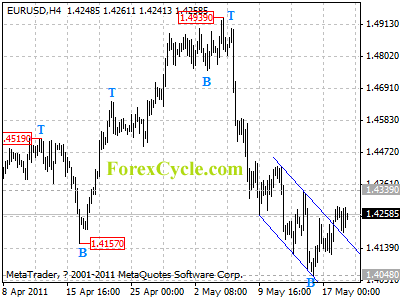
EURUSD has formed a cycle bottom at 1.4048

EURUSD has formed a cycle bottom at 1.4048 on 4-hour chart. Range trading between 1.4048 and 1.4339 would likely be seen in a couple of days. Key resistance is at 1.5339, a break above this level will indicate that the downward movement from 1.4939 had completed at 1.4048 already, then the following upward move could bring price back to 1.4500-1.4600 area. However, as long as 1.4339 resistance holds, the price action from1.4048 is treated as consolidation of downtrend from 1.4939, another fall towards 1.3800 is still possible after consolidation.

eurusd

Daily Forex Forecast

Daily Wrap: 5/18/2011

Stocks held on to most of their earlier gains as investors digested a Fed announcement at 2 o’clock this afternoon. The Fed reportedly said raising interest rates to curb inflation was discussed at its meeting in April, but will not have to start anytime soon.

Forex Update: US Dollar mixed in trading. Stocks, Gold rise

By CountingPips.com

The US Dollar has been mixed in forex trading today against most of the major currencies on a day with little economic data released from the US. The dollar has lost ground to the New Zealand dollar and the Canadian dollar while gaining against the Japanese yen, British pound sterling and the Swiss franc. The dollar has been virtually unchanged on the day versus the euro and the Australian dollar, according to currency data at the end of the US session.

The US stock markets, meanwhile, had a winning session today with the Dow gaining by approximately 80 points, the Nasdaq increasing 31 points and the S&P 500 up by over 11 points.

In commodities, Oil traded slightly lower to the $99.80 level while gold futures rose by $17.20 to $1497.00 per ounce.

Economic news releases today showed that the US FOMC minutes indicated the Federal Reserve Committee was deliberating on the best timing and procedure to exit their quantitative easing program and zero interest rate policy to work towards more of a  normalization in policies. The QE policy is scheduled to expire in June.

David Song, currency analyst at DailyFx.com, commented on the release saying, “The majority of the FOMC said they favored raising the benchmark interest rate before unwinding its asset purchases, with the group debating a possible exit strategy at the policy meeting earlier this month. However, the Fed went onto say that the recent discussion should not be interpreted as an imminent tightening in monetary policy as the committee continues to see a “moderate” recovery in the world’s largest economy. The minutes revealed that QE3 remains off the table unless there’s a marked shift in the economic outlook, and noted that the first step to normalizing monetary policy would be to cease MBS reinvestment.”

Looking ahead to tomorrow and the important news releases:

01:00 New Zealand consumer confidence index
08:30 United Kingdom Retail Sales
09:00 Swiss ZEW Survey
12:30 United States initial jobless claims/continuing claims
13:45 Eurozone ECB Trichet Speech
13:45 United States consumer comfort index
14:00 United States existing-home sales
14:00 United States Philadelphia Fed Survey
14:00 United States Leading Indicator Index
14:30 Canada BOC Review

No Load Mutual Funds: Investment Hype vs. Investment Help

By Ulli G. Niemann

With the internet such a huge part of our daily lives, many investors have access to a wide range of instant investment information.

Whether you’re into stocks, bonds, mutual funds, futures or options, there are tons of electronic investment newsletters offering to turn your small stake into a giant fortune. All you need to do is subscribe and watch your portfolio soar.

Yeah, right!

As a practicing investment advisor specializing in no load mutual funds, I have received my share of e-mails from disillusioned subscribers wanting to know how to better evaluate newsletter services.

While there are no absolutes, I can give you a few pointers that might help you make a better decision:

1. Stay away from the most obvious hype. Ads promising to turn your $10,000 into $1 million in 2 years by buying this incredible stock or hot commodity are not promoting investing – they are selling gambling. Follow the “If it sounds too good to be true, it usually is” rule.

2. Most mutual fund newsletters won’t make those outlandish claims, but some of them are still pushing the truth as far as they can. So try to get a free issue or two to examine. If you can’t get a sample, check if they have a trial period? How about a money back guarantee? If not, pay with your credit card. These days you’re pretty well protected by this payment method even if the newsletter doesn’t offer a satisfaction guarantee.

3. Consider the editor as well as the disclaimer notes. Is he or she only publishing a newsletter? Or is he also an investment advisor with a practice?

Why would that last point matter? I may be biased, but I believe that you get far better advice from a writer who also is in the trenches every day investing their own as well as their clients’ portfolios. They would have far better insights as to what works and what doesn’t than someone who has the theory down but no practical experience.

4. Look at the investment recommendations. Are they suggesting you buy into a certain orientation such as mid cap, small cap or large value? Or are they picking specific investments based on a variety of technical indicators?

In my no-load mutual fund practice I use specific recommendations, even for my free newsletter subscribers. They are first based on my trend tracking indicator giving us the green light and secondarily on the selection of mutual funds based on momentum analysis.

The more specific the recommendations, the better, because that allows you to follow along either just on paper (which you should do at first) or with your actual portfolio.

5. Are they recommending when to sell a mutual fund either because of gains or to limit your losses? This to me is the most important issue. If there is no plan in place for getting out, how will you ever know when to sell? This has been the greatest downfall of most publishers (and investors!) since the bear market of 2000 – not selling even if market conditions dictate it would be in your best interest to do so.

The advice of most newsletter services can make you money in bull markets. However, with the continuation of the bear market still a distinct possibility, be sure to look at any newsletter’s investment advice record since 2000.

For many people investing is an emotional issue. The pendulum swings between fear of loss and greed for greater returns. If a complete methodology for buying and selling is offered in a newsletter, such as one I advocate, be sure that it fits your emotional make up.

There is no sense in following an investment approach, which may have merits, if it means sleepless nights for you. You won’t stick with it for the long term – and long-term investing is essential for making your portfolio grow and prosper.

So, the bottom line is to look for a newsletter that:

  • does not promise the moon,
  • has a track record through up and down markets, and
  • recommends an approach that not only is compatible for your investment style but also has an exit strategy so you can capitalize on your gains — in the bank, not only on paper.

Following these guidelines may not make you rich, but it will help you avoid some bad advice.

© Ulli G. Niemann


Ulli Niemann is an investment advisor and has been writing about objective, methodical approaches to investing for over 10 years. He eluded the bear market of 2000 and has helped countless people make better investment decisions. To find out more about his approach and his FREE Newsletter, please visit: www.successful-investment.com.

“Duct Tape” and the Ultimate Key to Success

American cartoonist and inventor Rube Goldberg was famous for turning the simple into the mind-numbingly complex. He invented hysterically absurd systems for doing the simplest tasks. Take, for example, the “self-operating napkin”:

“The “Self-Operating Napkin” is activated when the soup spoon (A) is raised to mouth, pulling string (B) and thereby jerking ladle (C) which throws cracker (D) past parrot (E). Parrot jumps after cracker and perch (F) tilts, upsetting seeds (G) into pail (H). Extra weight in pail pulls cord (I), which opens and lights automatic cigar lighter (J), setting off skyrocket (K) which causes sickle (L) to cut string (M) and allow pendulum with attached napkin to swing back and forth, thereby wiping chin.”

Thirteen steps to wipe your mouth. Pretty ridiculous, huh?

Still, you’d be surprised by how many entrepreneurs fall victim to something similar. They think that by implementing a complex, detailed strategy, they’re moving toward success. They think a successful business needs to be a more intricate one.

But more moving parts do not necessarily make a business better. In fact, adding more and more complexity makes accomplishing your goals more challenging, more time-consuming, and more resource-draining.

Albert Einstein once said: “Everything should be made as simple as possible, but not simpler.”

The flip side of that your business should be as complex as it needs to be – but no more. In fact, the simpler your strategies at the outset, the better. I’ll explain why in just a minute.

**** Advertisement ****

“Underground” Video Gets 10 Million Viewers

A really disturbing video has recently become an Internet sensation…

It has been viewed more than 10 million viewers in the last four months.

If you care at all about our once-great country, I strongly encourage you to check this out, and prepare yourself, before the situation gets any worse.

You can watch the full video, free of charge, here.

The Allure of the Complex

Have you ever been to a magic shop? The guy behind the counter will invariably show you a trick. It’ll amaze you. Astound you! You absolutely have to know how it’s done. So you buy it and drive home, all the while thinking how incredible the illusion is and how cool it’ll be to wow your friends.

But when you get home and pull out the instructions, you discover how simple the trick really is. You think to yourself, “How in the world could this fool anybody?”

But it fooled you at the magic shop.

In business, as with magic tricks, complexity is all about tactics – “How” to execute a strategy. And tactics must always be secondary. You must understand “What” you’re trying to do before “How.”

When you’re considering a strategy to implement, the key is to start out as simply as possible. Ask yourself, “What’s the easiest, fastest, cheapest, simplest way to know if this project is even worth pursuing in the first place?

The Dangers of Adding vs. Subtracting

When you fall in the love with the complex, you run the risk of spending more time learning than earning. Building knowledge instead of your business. Analyzing instead of taking action. It means more work, more hours spent strategizing and developing, and making less progress toward your goal. No matter how much efficiency you think it may add, no matter how much you may think it saves you, complexity always adds to your bottom line costs.

The more complex things are in your business, the more sluggish you are at getting things done. When you work on your own, you can usually get things done relatively quickly. The bigger your organization, the more people you have to wait for before moving forward. It’s not necessarily bad, but it is reality.

And there’s another threat. When you focus obsessively on creating a bigger and more complex system, you naturally shift your focus from your goal to the path to achieve it. You start focusing on the “How” instead of the “What.” It misdirects all your efforts and resources.

That undermines your business at every level. How can you possibly achieve a goal when your efforts aren’t directed toward it? When you’re obsession becomes building a massive system instead of a massively profitable business?

The bottom line here is that building a successful business is all about speed. Speed to create products, speed to get them to market, speed to get feedback and analyze results, and then – and only then – the speed to leverage what’s working into a profit center.

Complexity kills speed.

Are You in Love With the Complex?

Ask yourself this:

“In an effort to make my business more productive, am I more likely to add more steps or options to it or am I more likely to strip something out of it?”

Most people will likely answer “add” to that question. For one simple reason. It’s far easier to add than it is to take away.

Take a hard look at the actions you’ve taken in the past. Beyond the start-up, how big has your business grown? Not in terms of revenue and customers but in terms of tasks and workload.

If you’re honest with yourself, you’ll find your answer right there.

It’s counterintuitive, but many entrepreneurs have the delusion that the bigger, the more complex a business is, the more successful it is.

But the more complex anything is… the more complex it is. Period. More complex does not mean better. What more complex does mean is more demanding.

In a nutshell, complexity slows your progress, and progress is far more important than perfection.

How to Break That Dangerous Attraction

Fixing the problem starts with asking yourself two questions whenever you’re considering a new project.

Question #1: What is the absolute minimum I need to achieve my goals with this project?

Be thorough. Include everything that applies. Things like “product development” and “marketing and lead generation” and “conversion and fulfillment.”

Question #2: “How can I offer my prospects a ‘duct-taped’ version first?”

You don’t want to roll out a slick, polished product only to watch it fail. So what can you “duct tape” together first? What’s the minimum you can give your prospects that will deliver your message and bring you solid, quantifiable feedback?

By focusing your efforts in this way, you’ll see a vast improvement in the performance of your business – no matter what level it’s at.

If you’re working on your own, you’ll be more productive and have more time for other business-building projects. If you’re working with a team, you’ll find they become more productive as well. Efficiency goes up and costs go down as you eliminate the unnecessary actions you were previously supporting.

[Ed. Note: Rich Schefren, founder of Strategic Profits, is offering a new course for struggling online entrepreneurs. It outlines the same strategies that his first 25 coaching clients used to bring in a total of $142 million in two years. And Rich used those strategies himself to bring in $7 million in sales at Strategic Profits – in just 18 months.

There are only 100 FREE spots available for this online course, “7 Steps That Quickly Create Online Businesses With Unstoppable Income.” So register now.]


This article appears courtesy of Early To Rise, a free newsletter dedicated to creating wealth and success through inspiration and practical, proven advice. For a complimentary subscription, visit http://www.earlytorise.com.

Officials Now Say Greek Debt Restructure Possible

For the first time since the depth of the European debt crisis first came to light, officials are now openly discussing the possibility of debt restructuring as part of the solution. Jean-Claude Juncker who presides over the Eurogroup consisting of finance ministers from the seventeen Eurozone members, slammed the rumor mill into top gear Tuesday when he said some form of restructuring of Greece’s debt was likely.

Juncker did note that Greece was expected to first pay down its debt by about fifty billion euros (US$70.6 billion). Once this requirement has been met however, Juncker said it was possible that the remaining debt could be restructured in a way to reduce Greece’s burden in paying back the rest of the debt.

Note however, that Juncker is not suggesting a deal that would forgive any of Greece’s outstanding debt. Rather, Juncker gave rise to the possibility of delaying payment as some securities reach maturity. Greek officials confirmed they may seek this option with Labor Minister Louka Katseli suggesting it could be possible to delay payment for some government-issued securities but only for those debt-holders open to the idea.

This approach is actually known as “re-profiling” and involves swapping short-term debt for longer-dated securities. The change in the maturity date results in a revision (i.e. “re-profiling”) of the yield curve for the securities and when conducted with the permission of the debt holder, re-profiling is not considered a credit even or a default on the original debt.

This “soft restructuring” as it was described by Greece’s Deputy Foreign Minister, is intended to differentiate between a complete abdication of debt and responsibilities and simply easing the conditions by which the debt must be repaid. Despite this, French Economy Minister Christine Lagarde was quick to voice opposition to any form of Greek debt restructuring. Lagard said that any action that could potentially harm the value of the euro was unacceptable.

Legarde’s hostility can be partly explained by the implications a re-profiling of Greece’s debt could have on other troubled Eurozone economies. Keep in mind that Greece was the first to accept a bail-out when it received 110 billion euros (US$155.5 billion) early last year; Ireland soon followed suite, and earlier this week, it was announced that Portugal would be provided with 78 billion euros (US$110.2 billion) in emergency funding. Does this mean we can expect these countries to also consider restructuring / re-profiling to deal with their debt burdens?

Finally, Juncker took great care to communicate that he did not foresee a “larger” restructuring that would presumably include an investor haircut. For now at least, it appears that some investors may be asked to delay payout, but investor assets appear free from the threat of a reduced payment.

Scott Boyd is a currency analyst and a regular contributor to the OANDA MarketPulse FX blog