Forex: Large Currency Speculators bet in favor of the US Dollar last week. Trim Euro, Pound positions

By CountingPips.com

The latest Commitments of Traders (COT) report, released on Friday by the Commodity Futures Trading Commission (CFTC), showed that large futures speculators decreased their short positions against the US dollar and bet against the euro for a third straight week. Non-commercial futures positions, those taken by hedge funds and large speculators, were overall net short the US dollar by $13.02 billion against other major currencies as of May 24th. The data is a decline from the total short position of $20.01 billion on May 17th, according to the CFTC data and calculations by Reuters which calculates the dollar positions against the euro, British pound, Japanese yen, Australian dollar, Canadian dollar and the Swiss franc.

This week’s notable changes were British pound sterling positions declining further on the short side while Australian dollar positions edged higher after declining for six straight weeks.

EuroFx: Currency speculators decreased their net long positions for the euro against the U.S. dollar for a third consecutive week as of May 24th. Euro futures positions declined to a total of 19,129  long contracts following a total of 41,645 long positions on May 17th. Euro positions had marked the highest level since July 2007 on May 11th with 99,516.

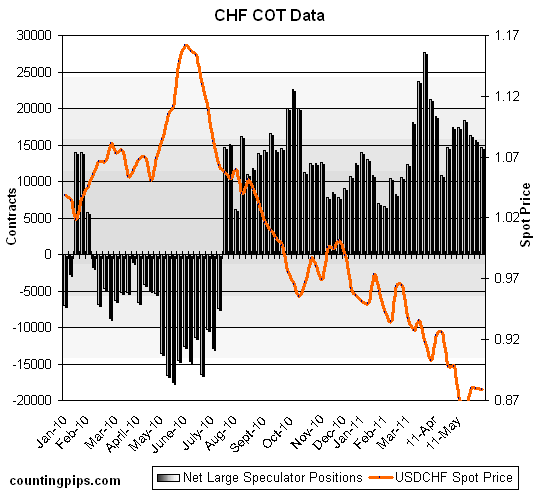
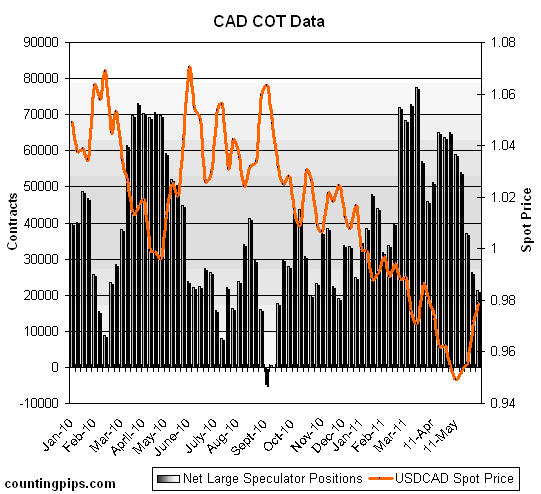
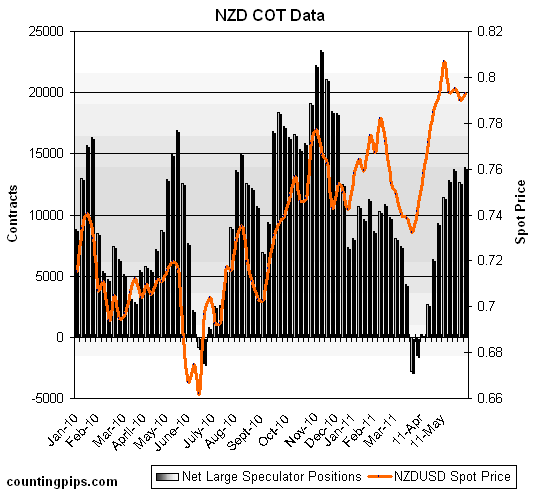
The COT report is published every Friday by the Commodity Futures Trading Commission (CFTC) and shows futures positions as of the previous Tuesday. It can be a useful tool for traders to gauge investor sentiment and to look for potential changes in the direction of a currency or commodity. Each currency contract is a quote for that currency directly against the U.S. dollar, where as a net short amount of contracts means that more speculators are betting that currency to fall against the dollar and net long position expect that currency to rise versus the dollar. The graphs overlay the forex spot closing price of each Tuesday when COT trader positions are reported for each corresponding spot currency pair.

GBP: British pound sterling positions edged lower for the fourth straight week as of May 24th and continued lower on the short side. Pound contracts fell to a total of 14,143 net short positions following a decline the week before to a total of 928 short contracts on May 17th. This marks the British pounds lowest speculative positions since September 2010 when short positions numbered 16,060.


JPY: The Japanese yen net contracts dipped lower after increasing for four consecutive weeks through May 17th. Yen positions decreased to a total of 8,006 net long contracts reported on May 24th following a total of 15,373 net long contracts on May 17th.


CHF: Swiss franc long positions edged lower for a third consecutive week. Franc positions fell to a total of 14,725 net long contracts following a net of 15,661 long contracts on May 17th.

CAD: The Canadian dollar positions declined lower for a fifth consecutive week to a total of 21,277 contracts as of May 24th. CAD net contracts had fallen to a total of 26,291 net long contracts on May 17th.

AUD: The Australian dollar long positions reversed and edged higher after declining for the six straight weeks. AUD contracts increased to a total net amount of 53,043 long contracts as of May 24th. AUD positions had totaled 50,919 net long contracts on May 17th.


NZD: New Zealand dollar futures positions rose to the highest level since December after a decrease the previous week. NZD contracts advanced to a total of 13,876 long positions as of May 24th from a total of 12,624 long contracts on May 17th.

MXN: Mexican peso long contracts increased higher after falling for four straight weeks. MXN contracts rose to 108,681 net long contracts as of May 24th from a total of 104,912 long contracts as of May 17th.


COT Data Summary as of May 24, 2011
Large Speculators Net Positions vs. the US Dollar

EUR: +19,129
GBP: -14,143
JPY: +8,006
CHF: +14,725
CAD: +21,277
AUD: +53,043
NZD: +13,876
MXN: +108,681


A Brief Explanation On What Currency Trading Really Is

By Cedric Welsch

Forex trading is unchartered territory for many people looking to earn from an investment. Many treat it as a financial transaction that is too exotic (and risky) for their taste. The truth is that forex trading is actually a type of investment that is well understood by traders around the world. To give you a better understanding about how forex works, here is forex trading explained:

What is forex trading?

Forex trading is simply the trading of the world’s currencies as they change in value. It is akin to pitting one currency against another and benefiting from their difference. The term ‘forex’ comes from the words Foreign Exchange and is generally used to refer to the foreign exchange market. Because currencies are exchanged or traded in order for countries to be able to do business with each other, traders can leverage the differences in the currencies to earn a profit.

Forex trading began in the 1970s and has grown to be the largest market in the world, with trade amounting to at least US$1 trillion dollars everyday. That is the kind of money that gets moved on a daily basis.

Forex trading is usually done through a broker, although there are also facilities that allow trading to be done online by the investors themselves.

How forex trading works

Foreign exchange requires the trading of currency pairs, such as the US$ against the Euro or the US$ against the Japanese Yen. A EUR/USD pair may have a currency quote of say, 1.312. In this pair, Euro is the base currency and is worth 1 unit while the US dollar is the quote currency. Using the above example, 1Euro will buy 1.312 US$. To make money, the investor will have to wait until one currency appreciates or depreciates relative to the other. If the Euro appreciates to 1.313 and the trader invested $100,000, he or she can earn a profit of $100. If, for example, the Euro fell, he or she will lose the equivalent amount.

Many people prefer trading in forex instead of stocks because the forex market offers more flexibility. It is a 24-hour market that usually begins on Sunday and trades until Friday. This availability allows people to trade as often as they like and to change their trading schedule as they see fit. It is also a very liquid market, allowing traders to open positions and close them in just a few seconds since there is no absence of sellers and buyers. Since virtually any currency can be traded, investors and individuals can choose which currency combinations they want.

A caveat: while it may seem very easy, forex trading can be quite complicated and it is recommended that you learn everything you can about the market before buying or selling anything. This will help improve your chances, use your knowledge for leverage and earn a profit.

About the Author

Do not belittle the capacity of the forex industry to make you a rich business person someday.
There is certain magic in fx trading that makes even the commoner to amass profits quick.

Forex Currency Correlations

Forex Currency Correlations

The Swiss Franc is enjoying it’s safe haven status and looking strong on the 4 hour, daily and weekly timeframe versus the other major currencies.

Both EUR/CHF and USD/CHF have seen record lows recently and could easily decline further.  Retail traders will no doubt be looking to pick a bottom but institutional traders are pushing price to new lows.

The New Zealand dollar has also also gained this week and is the highest ranking currency on 4 hour and daily according to the forex currency correlation charts.  The Aussie dollar also has my attention heading into this coming week.   As always withthis way of trading, I will favour all of these currencies for long trades if I can trade them against the weaker ones highlighted below.

At the negative end of the charts the CAD and US dollar are currently the weakest and therefore I will potentially be aiming to sell these currencies if a relevant opportunity comes.

If you are interested in learning more about this way of analysing currency strength see this forex currency correlation strength post.


USD Bearish as America Celebrates Memorial Day

Source: ForexYard

With the United States on holiday Monday, currency traders are likely to witness a relatively thin trading environment. Though debt concerns loom in the euro zone, and industrial production falters globally, the higher yielding assets like the GBP and EUR appear positioned to gain despite poor fundamentals. This trend appears to have little opposition as dollar traders shift substantial value into other assets.

Economic News

USD – Dollar Traders Weighing Momentum at Start of NFP Week

The US dollar has continued to plummet since Friday as dollar bears continued to move out of the greenback in exchange for higher yielding currencies. The Fed’s record low interest rates will likely persist for the foreseeable future, according to recent FOMC reports, and the dollar is expected to see little support this week as a result.

The EUR/USD rose to a nine-day high Friday, reaching towards 1.4320 before settling slightly lower. The GBP/USD witnessed a similar bull run, climbing to an 18-day high of 1.6513. The USD/JPY joined the chorus, despite weak fundamentals in Japan, and fell to a two-week low of 80.80 from the recent high of 82.21 seen last Tuesday.

Today, with the United States on holiday for Memorial Day, the Canadian economy will be one of the few major global economies releasing data sets on Monday. The most impactful figure being published will be the GDP report for America’s northern giant, set to be released at 13:30 GMT. With global industry faltering these past few weeks, the GDP report from such industrial economies may get released somewhat below expectations, driving more investors into the safety of the USD. With Non-Farm Payrolls (NFP) this Friday, the week should be exciting for forex traders.

EUR – EUR Continues to Post Gains

The euro has been a top performer against the US dollar following last week’s detrimental downshift in greenback values. The EUR began the middle of last week strongly bullish and has since tapered off mildly, but still maintains its momentum; albeit weakly.

With Great Britain and the United States on holiday Monday, currency traders will likely be witnessing a relatively thin trading environment today. Though debt concerns loom in the euro zone, and industrial production falters globally, the higher yielding assets like the GBP and EUR appear positioned to gain despite poor fundamentals. This trend appears to have little opposition as dollar traders shift substantial value into other assets.

As for Monday, the euro looks to be gaining against the greenback as traders are largely absent from the region to shift investments, but global traders are still bullish on Europe as the USD remains in freefall. Canada will publish its GDP data today, which should be the most relevant data release on the day. These factors, however, will likely be outweighed by the shift in sentiment towards the buck. Look for long positions on the EUR to continue through this week unless this week’s employment figures or monetary policies yield shocking results.

JPY – Japanese Yen Moving Upward as Data Supports Growth

The USD/JPY has been trading lower recently as investors flee the greenback. After reaching upwards of 82.21 on Tuesday, the pair quickly dropped to a two-week low of 80.80 as of this morning. Japan’s economy has published several positive figures over the last week, much of which has helped establish the yen’s recent bullishness. Whether it will be enough to reverse much of the negative sentiment surrounding Japan is yet to be determined.

The yen suffers from its own economic concerns, while shifts in consumer sentiment have helped lift yen values against a number of its rivals. Last week’s data, however, provided a ray of light which caused a secondary shift towards the yen for reasons other than safety. The USD/JPY looks to be continuing this movement for the foreseeable future as a result, especially given the massive shift away from the US dollar which is helping to lift the island currency.

Oil – Crude Oil Prices Steady Near $100 a Barrel

Oil prices held steady this morning with the $100 price level acting as a firm footing for this commodity. US oil stockpiles rose a half a million barrels last week, beating expectations and helping to hold the value of light, sweet crude steady near its current mark. The price of black gold has been trading within a consolidation pattern these past several days and traders are beginning to anticipate a breach sometime this week.

The value of the US dollar versus the euro in recent trading has also dropped towards a nine-day low of 1.4300, which has helped support oil prices. With today’s steady sideways movement, traders appear likely to see oil reaching a decision point this week. Whether oil traders decide to lift oil prices from a buy-in on physical assets, or pull away from oil out of a perceived glut, is something traders will bear witness to this week.

Technical News

EUR/USD

The failure of the EUR/USD to move below its 100-day moving average may be a telling sign that the price declines in May have subsided. While the price action remains capped below the 50-day moving average at 1.4350, a close above this level would put the bulls back in the driver’s seat with a target at the May high of 1.4940. However, traders should not overlook the monthly and weekly charts’ stochastics which remain rolling lower. A break below two key levels at the 100-day moving average at 1.4020 and the support at 1.3970 could open the door to 1.3860 as well as the 200-day moving average at 1.3705.

GBP/USD

Cable received a strong bounce higher at a level that coincided with the rising trend line off of the May 2010 low. As such momentum has swung back in favor of the pound. Rising weekly stochastics support further gains. Resistance is found at 1.6520 followed by the April high at 1.6750. A breach here would target the August 2008 high at1.7040. To the downside, support comes in at 1.6000 followed by the trend line at 1.6120. Below the trend line the March low at 1.5935 comes into play.

USD/JPY

The yen’s rally failed to breach the 82.25 resistance as well as the 100-day moving average before the pair turned sharply lower while making a significant close below the rising trend line. Falling daily stochastics point to further declines in the pair. Therefore traders should be short on the USD/JPY with initial support at 80.35 followed by the May low at 79.50. A breach here would expose the pre-intervention low at 76.10. A move to the upside and the pair may encounter initial resistance at the previous trend line which comes in at 81.90, followed by 82.25, and retracement targets from the April to May move at 82.50 and 83.25.

USD/CHF

In almost textbook like fashion, the USD/CHF rose as high as the trend line off of the February high only to encounter resistance and plummet, ending the week at a new all-time low at 0.8464. A retracement back to the falling trend line would offer traders better levels at which to enter the trend with a stop above one of the resistance levels near 0.8890 and 0.8945.

The Wild Card

Gold

Spot gold prices have come off of their early May lows and continue to rally higher while making a strong close into the weekend. forex traders should be targeting the all-time high at $1,576 with a stop loss order placed below the near-term support level at $1,514.

Forex Market Analysis provided by ForexYard.

© 2006 by FxYard Ltd

Disclaimer: Trading Foreign Exchange carries a high level of risk and may not be suitable for all investors. There is a possibility that you could sustain a loss of all of your investment and therefore you should not invest money that you cannot afford to lose. You should be aware of all the risks associated with Foreign Exchange trading.

E-Mini Trading: Candlesticks Are Great, But I Prefer Renko Bars

By David Adams

I’ve been spending some time in recent articles describing different e-mini charting techniques. Specifically, we have been looking at different methodologies to display raw price data. We have discussed candlestick charting, range bar charting, and tick charts. This article will deal with one of my favorite topics and most used charting technique. We will be discussing Renko bars.

My e-mini trading style is devoted exclusively to scalping, or carving out small chunks of price movement in a broader trend. As a scalper, I try to limit the parameters and variables that traders with longer investment horizons must take into consideration. In short, I am interested in momentum and, more specifically, price action. Renko charts are unique in that they deal only with price; there is no consideration is given to volume or time.

Renko charts have their basis in Japanese futures trading and are considered to date back several centuries. The term “Renko” comes from the Japanese word “Renga” which means brick, and have been popular among Forex traders in recent years. The Renko system resembles stacked bricks when they are forming in a trend. I have been using them for several years to trade e-mini contracts with great success. Let’s take a close look at some of the unique characteristics of Renko system.

• The size of each Renko brick is determined by the e-mini trader.
• If prices are very inactive, or static, there may be very little movement in the Renko bricks.
• The Renko trading system are use to track trends and filter out extraneous market noise.
• Unlike range bars, Renko bricks to generate a brick only when the price has moved the predetermined number of ticks in a single direction.
• Renko bricks can be calculated at the start of a new brick or at the close of a new brick.

Now let’s get down to some of the basics in using the Renko systems in an e-mini scalping system. One of the most difficult jobs I have as a trading educator is discouraging students from taking trades during periods of market noise. (Market noise is a period of time when the market is going through normal backing and filling operations and not trending.) By using the Renko system, market noise (which is sometimes referred to as a period of consolidation) is filtered out because consolidating markets exhibit very little directionality in price. When using Renko bars, consolidation periods appear as several Renko bricks; this is in sharp contrast to a traditional candlestick chart where consolidation periods appear as an extended grouping of a very tightly spaced candlestick bars. (candlestick charts are generally based upon a time variable) During periods of narrow range bound price action, Renko bricks will only will add new bricks when the price action has moved the trader specified period of time in one direction. In short, most of the noise prevalent in time-based candlestick charts or multidirectional range charts is eliminated.

In my trading, I typically use either 4 or 5 tick Renko charts. It is not uncommon for me to experiment with these tick settings to determine which setting gives me the clearest view of the actual price action occurring on the chart I am observing. Further, I will generally allow at least two bricks to form in one direction before I consider taking a trade in the direction in which the bricks are moving. There are several generally accepted ways to identify directionality when using Renko bars. Some systems draw hollow bricks when the market action is moving to the upside and solid bricks when the market action is moving to the downside. In my trading, I use the traditional red and green coloration unique to candlesticks to indicate the market directionality. Red Renko bricks indicate the market is moving to the downside, and green bricks indicate the market is moving to the upside. Further, I have found it is most effective to calculate Renko bricks at the close of the bar, as opposed to the beginning of the bar. This is, of course, a matter of personal preference; but I find that using the closing price fits well with my trading system which requires me to initiate trades only at the close of a bar.

In summary, we have only touched a few of the advantages that the Renko system offer. We have noted that this system is ideal for identifying trends and minimizing market noise. Further, we have identified some specific settings where an e-mini trader can begin and emphasized that adjusting the Renko tick settings from time to time may make the trends clearer and easier to understand. Of course, specific tick settings with Renko bars should be set at an e-mini trader’s discretion. Finally, I have emphasized that in my trading using the scalping style, the Rinko system is ideal because I am very trend oriented and Renko bars are priced based and were designed to identify trends based on price, not time or volume.

As a quick note, information about Renko bars can be difficult to find and time should be spent practicing with this system before implementing it with your live trading. In the end though, I suspect most e-mini traders will find the Renko system is a superior methodology to implement into their scalping strategy.


About the Author

Real Live Trading Doesn’t Lie. Spend several days in my trading room and see if you can benefit from a fresh and unique view on trading e-mini contracts. Sign up for your free trading experience by clicking here

Dollar Declining as FX Markets Look Past Greek Debt Crisis

printprofile

Greece remains the key question going forward though towards the end of last week the debt crisis was beginning to weaken its impact on the FX markets and the euro.

Talks between the EU and the IMF were continuing as scheduled and should end within the next few days. The German newspaper Der Spiegel reported the EU may withhold a 50B euro package for Greece should the indebted nation fail to reach its proposed austerity measures.

While the question over Greece remains unanswered, markets may have come to the conclusion that new funds will be provided to the indebted nation and Greece will eventually undertake a restructuring of its sovereign debt. Should the Greek situation be put on the back burner, this may allow for the euro to rally in the near term as the underlying fundamentals between the euro and the dollar have not changed over the month of May when the EUR/USD declined 3.5%. EU interest rates are still expected to rise while the Fed continues its QEII program into June. A close above the 50-day moving average at 1.4350 would put the bulls back in the driver’s seat with a target at the May high of 1.4940.

The dollar is on its back foot again versus the G10 currencies following a week of disappointing data releases. Lower than forecasted durable goods orders, disappointing GDP, and a steep decline in pending home sales on Friday all point to a US economy that is not firing on all cylinders. Given the downturn in US data releases, the dollar could continue to be sold versus the G10 currencies in the near term.

Read more forex trading news on our forex blog.

Understanding The Currency Exchange System And How Currencies Are Being Exchanged

By Cedric Welsch

The term “currency exchange” refers to the way money is valued between different economic systems. Currency is a reference to the money supply of a nation. It generally refers to the physical aspect, such as dollar bills or coins. This is exchanged for goods and services. The non-physical aspects of currency are those that exist via bank systems, such as purchases with credit or debit cards.

Each country has a currency system. This is the system for buying and selling goods. The worth, or value of money in the system differs from place to place. Economists understand the finer parts this while people with little economic experience may not fully comprehend what makes one dollar worth more than another.

A strong economy in a country will make the money more valuable than that of a weaker economy. This is part of the reason that the U.S. dollar is valued at a greater rate than the currency of a country such as Jamaica. If a country is wealthier, chances are their money will be valued at a greater amount than a country that is not a major world power.

When you look up the currency exchange between two countries, you should see what one is valued to the other. Some websites allow you to calculate the exchange of a total sum. If you are considering moving to another location and want to compare the rate of rent, you can take the new rent amount and enter it into a converter. This will give you the exchange for what you will be looking at. This is a good starting point at figuring out the approximate difference in values.

Even if you are not looking at a big move, traveling can require you to do a currency exchange. You may wonder how far your dollar will go in another country or have to figure out the hotel bill where you will be staying. You can do this online, or figure out a mental system to convert the monies. If you are in the country with money for your home country, you may decide to convert that to the local dollar. You can do this at many banks or money exchange locations.

Having a basic understand of currency exchange is a good idea even if you do not plan on traveling. Just knowing the basic ways in which economies work and differ can help you follow what’s going on in the world.

About the Author

It can be a bit scary for the beginning trader to take as much fx news as possible all at once. Although a highly factual broker forex review is very accessible, traders still ignore some of them.