Euro and Sterling Bounce Back

printprofile

The dollar was down across the board as the greenback gave back most of its late day gains from yesterday.

The euro recovered its losses and then some versus the dollar after yesterday’s rating downgrade of Greece by Moody’s. Helping to bring the euro off of its lows today were comments made by ECB President Trichet who spoke of further fiscal intervention in the euro zone and a decent Spanish bond auction. Liquidity was noticeably tighter with public holidays in France and Germany which may have helped ease the euro off of its lows. The jump in the EUR/USD this morning moved the pair above the 50% retracement level from the May decline at 1.4450. The next test will come at 1.4570 from the 61.8% retracement. To the downside the 1.4350 level may prove to be supportive.

Sterling came off of its low for the day after better than expected construction PMI numbers. The GBP/USD failed to move below support at 1.6300 and climbed as high as 1.6416. The pound could continue to move higher but the real test of sterling’s momentum will come at the 1.6515-50 resistance zone.

The yen is stronger versus the dollar after Japanese Prime Minister Kan avoided defeat in a vote of no confidence. However, sources say he will chose not to fulfill his entire term in office. The 80.60 support level has held this week but a breach here would allow the USD/JPY to decline to the next support at 80.35. Resistance is found at 81.75 and at 82.20.

After yesterday’s sharp drop in US equities the early price action from this morning should not be confused with the “risk-on” nomenclature. The Nikkei is down- 1.70% while the London FTSE is lower by -0.75%. Crude oil is marginally higher as the commodity treads water just above $100 a barrel.

US data releases this week have done little to support the greenback as highlighted by yesterday’s weak ADP job numbers and the recent trend of weak US economic data feeding into USD buying is beginning show cracks. Economists have begun lowering their forecasts’ for Friday’s NFP jobs report. Storm clouds are beginning to form over the head of the US economy given the Fed’s QEII program is due to end next month and little has been proposed on the policy front to address the recent US slowdown. The payrolls report tomorrow may intensify the negative sentiment.

Read more forex trading news on our forex blog.

EUR/SEK – Triangle Consolidation Pattern

printprofile

The EUR/SEK is consolidating in a triangle chart pattern. Based on the long term trend of the pair the next move may be to the downside.

From February to early April the euro came off of its lows versus the Swedish krona only to consolidate its gains in a defined triangle chart pattern. Moving to the weekly chart it is apparent that the long term trend of the pair is to the downside. Therefore, traders may see the EUR/SEK to break below the rising lower boundary of the triangle pattern which comes in today at 8.8750. Initial resistance is found at the mid-March and April lows at 8.8550, followed by 8.7875, and finally at the March low at 8.700.

However, should the EUR/SEK break out higher from the consolidation pattern resistance would be found at the May high of 9.0730 and the April high of 9.1220.

Read more forex trading news on our forex blog.

EURSEK

US Housing Prices at Low Point; Rental Prices Soaring

printprofile

Analyses viewing the housing sector of the US economy have recently begun to factor in rental prices as a gauge of inflation. The move away from buying houses as an investment has sunk the value of homes across the country, but rental prices have taken off as a byproduct of this shift in housing behavior.

The Federal Reserve’s policy of maintaining low interest rates through to mid-2012 is partially considered using housing data as a prime element of consumer spending, inflation and sentiment towards investing. But rental prices are only one aspect of home values and their soaring increase, in some areas almost doubling, are beginning to take a toll on consumers. If the issue is pushed further, movement may be seen on interest rates sooner than expected; but so far, analysts aren’t holding their breath.

Read more forex trading news on our forex blog.
Aussie Retail Sales Up; Trade Surplus Muted

printprofile

The Australian economy posted solid gains in retail sales this morning concurrent with a report which showed the nation’s trade balance falling short of expectations. With yesterday’s shrinkage in the Australian GDP, traders have finally begun to weigh in on the Australian dollar’s (AUD) value.

Though the Aussie was able to withstand sell pressure early in the day Wednesday, by late afternoon trading the currency was sinking against its counterparts. A shift into safe-haven investments late yesterday also helped drive the Aussie further down considering its relatively higher yield. The triple whammy of weak GDP, muted growth in trade surplus and a shift into safe-havens have so far put significant pressure on the AUD in this week’s trading.

Read more forex trading news on our forex blog.

Complimentary eBook teaches you how to apply Moving Averages to your trading or investing

Elliott Wave International (EWI) has just released a free 10-page trading eBook: How You Can Find High-Probability Trading Opportunities Using Moving Averages, by Senior Analyst Jeffrey Kennedy.

Moving averages are one of the most widely-used methods of technical analysis because they are simple to use, and they work. Now you can learn how to apply them to your trading and investing in this free eBook. Let EWI’s Jeffrey Kennedy teach you step-by-step how moving averages can help you find high-probability trading opportunities.

Jeffrey’s trading eBooks have been downloaded thousands of times because he knows how to take complex trading methods and teach them in a way you can immediately understand and apply. You’ll be amazed at how quickly you can benefit from Moving Averages with just this quick, 10-page lesson.

Improve your trading and investing with Moving Averages!

Download Your Free eBook Now.

(Don’t miss out. It’s only available until June 13, 2011.)

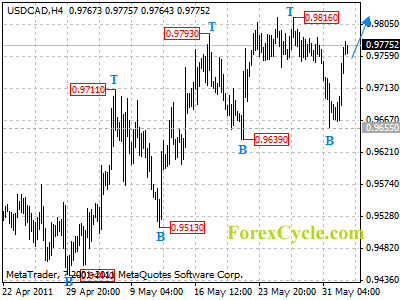
USDCAD rebounded strongly from 0.9655

Being contained by 0.9639 support, USDCAD rebounded strongly from 0.9655, suggesting that a cycle bottom has been formed on 4-hour chart. Now the rise from 0.9655 would possibly be resumption of uptrend from 0.9444. Further rise towards 0.9816 could be seen later today, a break above this level could signal resumption of uptrend, then next target would be at 0.9900 area. Key support is now at 0.9655, only break below this level could indicate that the upward move from 0.9444 is complete.

usdcad

Forex Signals

Find a Methodology and Minimize Investment Madness

By Ulli G. Niemann

There are many reasons to be investing these days, and too much opportunity to not have your money working for you. However, I believe the majority of people dread having to deal with investment matters, and tend to jump into purchases and then hold their breath hoping for the best. After a long day at work and taking care of the family, it’s hard to get excited about reading up on your 401(k) options, Morningstar ratings and fund performances.

If this sounds like you, there are basically 3 choices.

1.      You can have your investments professionally managed,

2.      you can continue as you have in the past & keep your fingers crossed,

3.      or you can find a methodology that objectifies the investing process (that’s buying and selling investments) and helps you maximize your long-term results.

To determine if you need help managing your investments(and this doesn’t necessarily mean having to pay for advice) you might want to ask yourself these questions:

Do I really have the time and interest to follow the market closely on a daily basis?

Have I done well in the past managing my own investments?

Do I really want to add another layer of work and responsibility onto an already busy schedule?

If you’re like most people, you would answer yes to some and no to others, so how do you decide? If you think you could have or should have done better with your investments, then you need some help. Don’t feel bad. Having counseled hundreds of people over the past 15 years I can honestly say that everybody needs some help, whether they are aware of it or not.

Why? This could come as a surprise, but, in fact, your financial life is a lot shorter than your physical life?

Most people who end up investing don’t really start working and making money until they are about 25 years old. Considering the average retirement age of 65, this gives you only 40 years to save and invest wisely.

If you make a poor investment decision, such as trying to stay fully invested during a bear market, you could lose big both in terms of diminished dollars and wasted time.

To drive home this important point, let me give you an actual example involving my own portfolio. For ease of illustration I have adjusted the beginning portfolio balance to $10,000.

During the period from 1/25/91 to 10/13/00 my $10,000 investment grew to $37,840, which is a 14.67% compounded annual return.

On 10/13/00, based on a methodology I was following, I liquidated all of my domestic mutual fund positions and moved 100% to the safety of my money market account. Thanks to this move, my portfolio retained 100% of its value on that date.

As we now know with hindsight, most people held on to their investment positions and have so far lost on average 50% to 60% of the value of their portfolios. For this example let us use 50%.

If I had held onto my position, my portfolio would be down to $18,920. Last time I hit that level on the way up was in 1995.

In other words, not only would I have lost 50% of my portfolio I would have lost even more by having used up 20% (8 years) of my total financial life.

How can you avoid mistakes like that in the future? Spend a little of your valuable research time looking for investment methodologies that allow you to side-step bear markets and let you move back in during bull markets. In other words, invest your time looking at methodologies instead of investments themselves. This will lay the foundation for more effective use of your money and time.

If you find a methodology that you like, and it matches your investment philosophy, stick with it for the long term. It should have the aspect of telling you when to get out of, as well as when to get into, an investment.

I suggest you follow these broad guidelines:

  • Don’t be afraid to take a small loss to avoid bigger disasters.
  • Stay away from commissioned sales people (because they have incentives other than your best interests), and if you use an advisor, be sure he or she is fee based.
  • Above all, don’t get overwhelmed by news, rumors and predictions that are irrelevant to your strategy.

If you take this advice, I guarantee that pretty soon sleepless nights will be a thing of the past and you’ll be on your way to more confidently and successfully (that means profitably) managing your investments.

© Ulli G. Niemann


Ulli Niemann is an investment advisor and has been writing about objective, methodical approaches to investing for over 10 years. He eluded the bear market of 2000 and has helped countless people make better investment decisions. To find out more about his approach and his FREE Newsletter, please visit: www.successful-investment.com.

This Crude Oil Secret Was Worth Keeping…

oil pumpMy friend Blair Morse really knows how to keep a secret. We just spent four days holed up in France for our editorial meeting, and he never said a word to me about this secret investigation he’s been on.

When I read his open letter, I was flabbergasted.

Now, I don’t use that word lightly. I’m not trying to make this investigation out to be more than it is. I’ve been on the researching and investigating side of a couple of stories in the commodities sector.

I spent a week in Denmark learning about an island that uses wind power as a currency. I flew 14 hours to South Africa to find out how the country’s mining industry was doing after all the power problems.

This was something I hadn’t heard.

So while we normally feature a guest article on Wednesdays, I had to share with you this letter in which Blair explains the investigation he’s secretly been conducting.

Let me set the scene for you…

Crude oil prices are climbing again. They were back above $100 a barrel even before yesterday’s $2 jump. And even at $100 a barrel, crude oil prices are still $30 higher than this time last year.

That’s a significant run higher. But the jump in prices is not entirely because of the U.S. dollar.

(Sign up for Smart Investing Daily and let me and fellow editor Jared Levy simplify the market for you with our easy-to-understand articles.)

As the U.S. dollar loses value, things priced in dollars get more expensive. This is inflation. But with things like gold and crude oil, traders push up prices even higher. There are two reasons why this happens. First, gold and oil are natural hedges against a falling U.S. dollar. What that means is that gold and oil are assets that help preserve your wealth and retain their value against inflation.

Second, if traders feel like these commodities are going to be more expensive in the future, they’re willing to pay a little bit more now to acquire more gold or crude oil.

We’ve seen both of these factors pushing crude oil prices higher. But they are only part of the reason prices have jumped 43% over the last year.

The other reason is China.

Let me give you a snippet of Blair’s letter to better explain.

According to reports out of China, there is limited oil supply left — and that number is falling fast.

Last November, Paul Ting, a Chinese energy consultant, told The Wall Street Journal:

The real story in China is that there’s massive shortages right now. China has experienced seven consecutive months of [fuel] inventory drawdowns. We’re talking about massive, massive drawdowns.

If the oil in China dries up, it could lead to economic meltdown…

Factories would close their doors. China’s now-infamous growth would come to a screeching halt. Millions of newly unemployed workers would fill the streets.

Chinese citizens would face severe fuel shortages and price shocks.

It’s a safe bet mass protests would follow…

Everything China’s worked for over the past 20 years could be lost.

The Chinese government is acutely aware of the dangerous game they are playing. Those massive fuel drawdowns can only last so much longer.

But Blair’s investigation found out what China’s planning to do about this supply shortage… how the country has been secretly building an oil colony that will dwarf all its other crude oil operations in places like Sudan and Libya.

He didn’t tell me personally what the Chinese have been planning. In fact, he’s only told one person about his findings. That’s how sensitive the situation is.

He told New Growth Investor editor Zach Scheidt.

China is already importing more than half of its oil, and consumption is expected to double from 4.3 million barrels a day in 2009 to 9.6 million barrels a day in 2011. It’s crucial that China finds more crude oil. This growing crisis is creating an opportunity for investors.

Read this letter from Blair for just how crazy this scene could get, and then learn how Zach can turn this crisis into a great chance at profits.

I think you’ll find that this secret was worth keeping…

Article brought to you by Taipan Publishing Group. Additional valuable content can be syndicated via our News RSS feed. Republish without charge. Required: Author attribution, links back to original content or www.taipanpublishinggroup.com.

{jtagstpg} {authorstpg}

Other Related Sources:

  • Oil Prices Surge Above $100 a Barrel
  • How to Get the U.S. Dollar to Stop Stealing Your Commodity Profits
  • China Overreaching for Crude Oil