EURUSD stays in a rising price channel

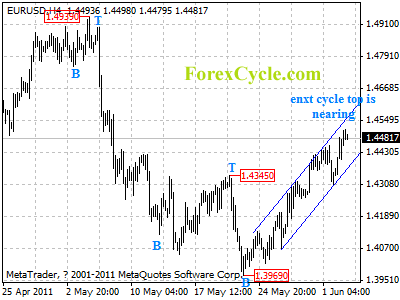
EURUSD stays in a rising price channel on 4-hour chart, and remains in uptrend from 1.3969. As long as the channel support holds, uptrend could be expected to continue and next target would be at 1.4550. However, a clear break below the lower border of the channel will indicate that a cycle top has been formed and the rise from 1.3969 has completed, then the following downward move could bring price back to test 1.3969 support.

eurusd

Forex Blog

How to Protect Capital without Gold!

By Adam Hewison

Today, I decided to do a video to show you how you can protect your capital using something other than gold.

In this new, never before seen, 7 minute video, you will see exactly what we’re looking at and how you can protect your nest egg very easily using tools that you may or may not be familiar with.

It would seem as though the financial markets, particularly certain financial stocks, are incredibly vulnerable. The erratic recovery we saw from the lows in March of 2009 maybe in jeopardy. In fact, with many financial stocks making new lows for the year, it does not augur well for the future.

Also, there’s been a lot of prognostication about the end of America as you know it. “Kiss America Goodbye,” and “The Death of America,” are just a few of the wild headlines that are out there. This video takes you to the next level and offers you a concrete path on what to do to protect your capital and nest egg.

All the best in every success in your future,

Adam Hewison,
President of INO.com and Co-founder of MarketClub.com


Consumers Still In Wait-and-See Mode

The latest feedback on the state of the U.S. economy does little to boost confidence in the overall health of the world’s largest market. Growth for the first quarter fell far short of expectations registering a paltry 1.8 percent. For the previous three months, the economy expanded by a robust 3.1 percent but this trend is clearly on the decline.

Certainly the U.S. has faced recessions in the past and has suffered through sustained cycles of low growth but in each of these cases, there was always a secret weapon held in reserve – the might of the American consumer. Historically, the buying power of U.S. consumers accounts for about 70 percent of the total economy and there was always a sense that as soon as people started spending again, recovery was all but assured.

This time though, it feels very different; and not even the continuation of record low interest rates have proved tempting enough to entice consumers to open up their wallets.

There are a couple of reasons why this is so. Firstly, there has been very little improvement in the employment outlook. Prior to the recession, unemployment was in the range of 4.5 percent – after the onset of the crisis in late 2007 however, unemployment rose steadily peaking at 10.1 percent in October, 2009. A year and a half later, unemployment has improved only marginally to 9 percent and even this is in jeopardy based on the decline in the latest Institute for Supply Management’s factory index reading.

The true number of unemployed is actually much higher of course. The official survey used to arrive at the unemployment rate considers only those who reported that they were actively looking for work. Those that have quit looking, or those working part-time but would like to be full-time, are not counted as unemployed.

Regardless of the method to determine the unemployment rate, the simple fact is that the current unemployment rate remains double the rate considered “full” employment prior to the recession. On the plus side, the economy is finally creating new jobs; but at the anemic rate it is doing so, it will take several years to recover the jobs lost since 2007.

In May, just 38,000 new positions were created compared to April’s 244,000. Even those that are working are feeling vulnerable and in a bid to protect themselves, consumers are spending less while saving more.

The other factor hampering consumer spending is the rise in inflation. Driven by higher energy and food costs, these essentials are taking a greater chunk of total income leaving less for the non-essentials. Since January, inflation has been on a steady rise from 1.6 percent at the beginning of the year, to 3.2 percent in April.

The Consumer Price Index was up 0.4 percent in April with gasoline prices jumping 3.3 percent for the month. On a more positive note, commodity prices have retreated somewhat and the expectation is that inflation will ease as a result. While this will be welcomed by consumers, until we see a significant improvement in employment, it will take more than a slight easing in inflation to convince consumers to crank up the spending.

Scott Boyd is a currency analyst and a regular contributor to the OANDA MarketPulse FX blog

Forex Update: Weekly Jobless Claims decline by 6,000. Dollar lower. Stocks, Commodities fall

By CountingPips.com

U.S. weekly jobless claims decreased by less than expected in the week that ended on May 28th, according to a release by the U.S. Labor Department today. New jobless claims fell by 6,000 workers to a total of 422,000 unemployed workers following the previous week’s 428,000 initial jobless claims. The 4-week moving average of unemployed workers decreased by 14,000 workers from the previous week to a total of 425,500.

Market forecasts were expecting jobless claims to edge down to 417,000 workers for the week.

Meanwhile, workers seeking continuing claims for unemployment benefits for the week ending May 21st also decreased for the week. Continuing claims declined by 1,000 workers to a total of 3,711,000 unemployed workers. The four week moving average of continuing claims decreased by 10,000 workers to a total of 3,737,750.

US Dollar trades mostly lower. Stocks, Commodities under pressure today

The U.S. dollar has been mostly lower in trading in the forex markets while the American stock markets have been slightly down on the day. The dollar has fallen versus the euro, Australian dollar, British pound sterling and the Japanese yen, according to currency data in the afternoon of the US trading session. The American currency has been trading close to unchanged on the day against the Swiss franc, New Zealand dollar and the Canadian dollar.

The U.S. stock markets, meanwhile, have been lower today with the Dow Jones dropping around 40 points, the Nasdaq trading nearly unchanged while the S&P 500 is down by over 2 points at time of writing.

In commodities, oil has moved lower to the $99.94 per barrel level while gold futures have fallen by $13.40 to trade at the $1,529.00 per ounce level.

How This Rumor Will Affect Your Gold Investments

sara_nunnally150x150-2On Tuesday, Jared talked to you about buying gold in euros. If you haven’t read his article, take a few minutes after you read today’s Smart Investing Daily. It might change how you look at his idea.

There’s a rumor floating around. We’ve talked about it here before, but from a worst-case scenario point of view.

Now the mainstream financial news media is talking about it.

I’m talking about the rumor that the Federal Reserve is thinking about another round of quantitative easing. Quantitative easing is when the Fed buys government debt in order to inject more dollars into the economy.

Think of the economy like an ultra-marathon runner… those half-mad guys who run distances of 50 miles or more in a single event. Right now, our runner is bonking out. He’s cramping up and hitting a wall, and he’s running up hill.

If he doesn’t get a chance to rest soon, he’ll collapse.

But instead of getting a rest, he’s cramming power bars and energy gels, just to try and make it up this hill.

The problem is it’s too late. Those power bars will do nothing but sit like lead in his stomach.

The quantitative-easing “power bars” aren’t giving our economy any energy. In fact, all the Federal Reserve is doing is tying a weight around our ankles. The second round of the Fed’s bond-buying program shifted talk from deflation to inflation — from paying less for things to paying more.

But we’ve had a string of horrible economic reports, and now folks are starting to talk about a third round of quantitative easing.

From a Reuters article, titled “Analysis: Third time’s the charm? Whispers of QE3 emerge”:

“The U.S. economy is hitting the brakes at exactly the wrong time for the Federal Reserve,” said Douglas Borthwick, managing director at Faros Trading in Stamford, Connecticut.

“With the expected end of QE2 within reach, the U.S. economy is in a situation where its only form of life support is about to be ripped away from it.”

Look, we all know how important this race is… If our economy can’t make it up the hill, the costs are going to be hugely painful.

But if the Fed keeps forcing bond-buying power bars down our economy’s throat, we’re going to end up running off the side of a cliff. These power bars are going to push us into an era of sharply higher inflation.

We’ve seen the start of this already.

Traditionally, commodities are the first things to climb, and we’ve all been suffering under higher gas and food prices. This should be an early warning that more inflation is coming.

Some investors are already packing up and heading for higher ground.

Again, from Reuters…

Investors stampeded out of stocks and into bonds on Wednesday as dismal U.S. economic data led the S&P 500 to its worst day in 10 months and benchmark Treasury yields fell below 3.0 percent the first time since December.

But I told you a couple weeks ago that bonds might not be the place you want to set up camp. The thing to remember is that bonds aren’t the only asset that investors run to when they’re scared.

I probably sound like a broken record, but I can’t emphasize enough how important it is to have gold in your portfolio. We’ve been right on this account so far, and I remember talking to a local business man about it in mid-winter.

He asked, “Gold’s the thing to buy right now, isn’t it?” Gold was sitting at about $1,330 an ounce. I told him what I told you guys back in late January… That gold could bounce much higher.

Yesterday, gold closed at $1,540 an ounce. And I’m going on record saying that we could get another strong price move this month.

That second round of quantitative easing is about to close. The Fed is slated to finish buying $600 billion in government debt in June. And with the economy getting weaker and weaker, we could see a major market hiccup.

Gold will go ballistic.

We’ve given you a number of ways to get gold into your portfolio. We’ve talked about one company, Goldcorp (GG:NYSE).

I first mentioned this gold mining company back in late January, and since then, the company has climbed more than 22%. I think there’s still a lot more potential with GG, too.

In my initial assessment, I said GG could climb as high as $48.94, its former 52-week high. But the company has already climbed well past that. If you’re sitting on gains with GG, we’d love to hear about them. You can send us an email at [email protected].

GG has climbed as high as $56.20, and has dipped back to about $48. This should be a support point for another move higher as gold prices continue to pop. We’re keeping an eye on GG, and any dips below $48 might be cause to cut and run with 20% gains.

We’ve also talked extensively about the SPDR Gold Trust ETF (GLD:NYSE). Jared highlighted this ETF in his article on Tuesday.

And as I told you at the beginning of this article, you might want to go back and look at Jared’s idea with fresh eyes now that rumors of QE3 are hitting the financial mainstream. The economy (and the dollar) is bonking out. Now might be the perfect time to consider other options.

Editor’s Note: You know, gold isn’t the only precious metal you should be considering when adding “safe havens” to your portfolio. Silver has had a lot more punch in recent months, and the time is ripe for another round of profits with this other precious metal.

I was just reading about a key report that talks about silver mining discoveries that help investors gain the lion’s share of profits once those discoveries hit the news. Not a lot of people know about this report, but you can learn more about it here.

Article brought to you by Taipan Publishing Group. Additional valuable content can be syndicated via our News RSS feed. Republish without charge. Required: Author attribution, links back to original content or www.taipanpublishinggroup.com.

{jtagstpg} {authorstpg}

Other Related Sources:

  • How to Get the U.S. Dollar to Stop Stealing Your Commodity Profits
  • Do Not Buy Government Bonds
  • The Price of Gold Breaks Key Support Point
  • The True Products of Quantitative Easing
  • Market Sentiment and Volume Reach Extreme Panic Levels

    By Chris Vermeulen, thegoldandoilguy.com

    It was a crazy session as the stock market slid over 2% on heavy volume. This type of price action means fear has taken control of masses and they are unloading (selling their stocks) in anticipation of much lower prices.

    Trading off extreme levels of fear can be very rewarding if done right. That’s because fear is the most powerful reaction we as humans have and it’s somewhat predictable. Fear can make people do crazy and or stupid things and it’s these extreme reaction which investors do in the market that lead to great trading opportunities. Buying into fear and selling into greed is what I focus on.

    Gold and Silver Showing Greed and Fear
    For example, if we take a look at the 4 hour chart of gold and silver you will see how investments which have a large amount of speculation like Silver move the opposite to what other related investments like gold are doing.

    The first chart which is gold, shows how today’s fear had investors moving into this shiny safe haven. Silver on the other hand has been the investment of choice for every Tom, Dick and Harry trying to play the popular headline investment. So on a day like today when prices start to slide in the stock market these speculative holders of silver get scared and dump (sell) their position in stocks and silver. The problem with silver is that the market is still small and its does not take many people hitting the sell button to send it 5% lower which is what took place today. This is one sign which is telling me traders are getting scared of a market selloff.

    Evidence #2 Showing Signs Of Fear
    These data points below clearly show sellers were in control today. I like to look at the NYSE because it holds all the big brand name stocks which the masses like to buy when they feel lucky. So when I see this many traders selling and so few buying I know the masses are dumping shares and going to a cash.

    The NASDAQ had 10 shares being sold to every one share being bought which is half the fear level of what the NYSE and that makes good sense. The NASDAQ has many smaller companies which the masses just don’t know about or own so there was not as much selling taking place on that exchange. So brand name stocks getting dumped all at once is another sign of extreme fear hitting the market.

    Evidence #3 Showing Signs Of Fear
    This chart below provides the momentum of the market. I think of it as the rubber band effect. If the market selling momentum is strong enough then it pulls this indicator down to a level which it cannot go much further before it gives way and moves back a neutral or positive extreme level. This little hidden gem of an indicator can help time entry and exit points with ease once you understand it. Currently its telling us that a pause or bounce is likely to happen tomorrow.

    Evidence #4 Showing Signs of Fear and an Oversold Market Condition
    Take a look at the 10 minute SPY (SP500) chart below. Simple visual analysis shows that today’s strong selling which has brought the market down into a support zone should provide a pause or a bounce very soon. The question is how big will the bounce or rally be?

    Given all the confirming is looking ready for a bounce and I feel we could be nearing not a bounce but an intermediate bottom and higher prices going forward. But if we break strongly below this support level then all bets are off and much lower prices should occur.

    Mid-Week Trading Conclusion:
    In short, today’s sharp move lower has put the market in a short term oversold condition. Meaning, a bounce is very likely to take place within the next 1-3 sessions. With the masses selling all their positions in stocks and commodities it generally takes 1-3 days after a day like this for the selling pressure to dissipate and for value buyers to step back into the market providing support.

    I think both stocks and commodities will strengthen in the next few days and we will see if the market can get some traction and start a new rally. But until everyone has sold out of the market giving their shares to the big money (smart money) at a sharp discount I feel we have a rough road ahead.

    Get these trading reports free each week here: http://www.thegoldandoilguy.com/trade-money-emotions.php

    Chris Vermeulen

    EUR/USD Slammed by Greece Downgrade

    Source: ForexYard

    The EUR/USD fell from its three-week high yesterday, sinking downwards of 1.4340 before flattening out in today’s morning session. A technical barrier that was triggered near 1.4450 ended up pushing the pair lower yesterday and a downgrade of Greece’s bond rating by Moody’s Investor Services added insult to injury. Bearish sentiment appears to be winning out as of this morning.

    Economic News

    USD – Yesterday’s USD Gains Erased as Traders Seek Safety

    The US dollar (USD) halted its resurgence against most currencies yesterday as traders sought safety following a downgrade of Greece by Moody’s Investor Services. Positive news regarding Greece’s debt woes helped the euro (EUR) initially hold its ground against the USD’s resurgence Tuesday but yesterday’s news has pushed the pair back to 1.4350 from its 3-week high of 1.4458.

    The shift into safe-haven assets like the Swiss franc (CHF) and Japanese yen (JPY) carries an ill wind for global growth assessments which have begun anticipating faster growth in the second half of 2011. Weak fundamentals out of the US and other leading economies have some analysts a bit skeptical nowadays, especially with ADP’s non-farm employment change report yesterday showing sluggishness.

    Today, the United States is scheduled to release a series of significant data sets. The most impactful figure being published will be the weekly unemployment claims report, set to be released at 13:30 GMT. With a week focused on employment in the United States, this report may transfer over to recent consumer sentiment, but traders are also in a holding pattern ahead of tomorrow’s NFP report. Forex traders may be withholding funds today ahead of such important economic news as a result.

    EUR – Another Greece Downgrade Sinks EUR Values

    The EUR/USD fell from its three-week high yesterday, sinking downwards of 1.4340 before flattening out in today’s morning session. A technical cap that was triggered near 1.4450 ended up pushing the pair lower later in the day and a downgrade of Greece’s bond rating by Moody’s Investor Services added insult to injury.

    The euro (EUR) now appears to be slumping against all of its currency rivals as traders are seeking safety in the Swiss franc (CHF) and Japanese yen (JPY).

    Although the euro has been a top performer against the other major currencies lately, the ratings downgrade was a sharp blow to the recent uptick in the region’s currency values. Coupled with the poor fundamental data out of the United States, traders have taken the cue to move away from higher yields and into safety prior to tomorrow’s NFP report out of the US.

    As for Thursday, the euro looks to be continuing its losses as a shift in sentiment is not likely to fully play out with an expected thin trading environment. Most of Europe will be on holiday in observance of Ascension Day, and global investors are also hesitant to invest prior to tomorrow’s NFP figure.

    JPY – Japanese Yen Pares Losses as Risk Aversion Jumps

    The Japanese yen, which took a sharp dive yesterday against most of the other major currencies, pared most of those losses in yesterday’s late trading sessions after Moody’s Investor Services downgraded Greece’s bond rating. Yen pairs and crosses were last seen moving in a direction favorable to the JPY as the shift in risk aversion has helped boost safe-havens like the yen and Swiss franc (CHF).

    Yen traders have been weighing risk sentiment lately, attempting to decipher the direction of the economy during this news heavy week. With Friday’s Non-Farm Payrolls (NFP) ahead, much can be said about the increase in speculative shifts taking place in the market right now. Last week’s data provided a temporary bullish uptick for the island currency, but Tuesday’s news from Moody’s about reviewing Japan’s bond rating reversed much of this sentiment until yesterday’s shift in risk appetite.

    Oil – Oil Prices Plummet as USD Surges vs. EUR

    Oil prices pushed beyond $103 a barrel yesterday after investors viewed the recent downward correction as a natural process to help get prices in line with supply. However, a shift in risk sentiment which favored the US dollar (USD) against the euro (EUR) has helped drop commodity values after investors shifted into safer assets. The Swiss franc (CHF) and Japanese yen (JPY) are on the rise and physical assets usually would jump with heightened risk aversion, but the positive movement of the dollar asserted itself over the value of oil.

    The decision point anticipated since Monday appears to have been reached yesterday morning, but technical forces appeared to have tested the recent jump and found it wanting. Whether oil traders decide to lift oil prices again will depend on manufacturing and industrial growth figures out of the major global economies. Employment also appears to be a top priority in this growth sentiment and oil traders are eyeing this week’s NFP data out of the United States to verify their revamped growth schedule for oil prices, especially with Europe on holiday today.

    Technical News

    EUR/USD

    The pair has twice failed to establish a beachhead above 1.4450, a level that coincides with the 50% retracement of the May move lower. Resistance is found at 1.4570 from the 61.8% retracement target followed by 1.4750 from the late April and early May lows. A breach here would target the May high at 1.4940. 1.4250 should serve as the initial support level followed by 1.4140 from the rising support line off of the May low and the 100-day moving average at 1.4060.

    GBP/USD

    After a failure to close above the 1.6515 resistance level the pair declined sharply and found support near the 50-day moving average at 1.6325. A break below 1.6300 would perhaps then test the rising trend line off of the May 2010 low at 1.6140. Below the trend line the March low at 1.5935 comes into play.

    USD/JPY

    The yen’s rally failed to breach the 82.25 resistance as well as the 100-day moving average before the pair turned sharply lower while making a significant close below the rising trend line from the May low. Falling daily stochastics point to further declines in the pair. Therefore traders may look to be short on the USD/JPY with initial support at 80.70 and 80.35, followed by the May low at 79.50. A breach here would expose the pre-intervention low at 76.10. A move to the upside and the pair may encounter initial resistance at the previous trend line which comes in at 81.95, followed by 82.25, and retracement targets from the April to May move at 82.50 and 83.25.

    USD/CHF

    In almost textbook like fashion, the USD/CHF rose as high as 0.8890, a level that coincides with the trend line off of the February high only to encounter resistance and plummet, ending the week at a new all-time low at 0.8464. This level should serve as initial support for the USD/CHF, followed by 0.8400. A retracement back to the falling trend line would offer traders better levels at which to enter the trend with a stop above one of the resistance levels near 0.8890 and 0.8945.

    The Wild Card

    Gold

    Gold prices continue to rally as the technicals point to further potential gains with the Momentum-14 indicator rising sharply higher. Forex traders may want to be long on spot gold with an initial target at the all-time high of $1,577 with a protective stop below the support level at $1,514.

    Forex Market Analysis provided by ForexYard.

    © 2006 by FxYard Ltd

    Disclaimer: Trading Foreign Exchange carries a high level of risk and may not be suitable for all investors. There is a possibility that you could sustain a loss of all of your investment and therefore you should not invest money that you cannot afford to lose. You should be aware of all the risks associated with Foreign Exchange trading.