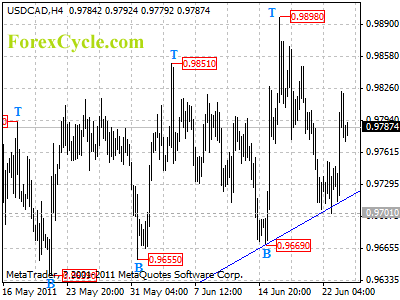
USDCAD rebounded from 0.9701

Being supported by the uptrend line from 0.9444 to 0.9669, USDCAD rebounded from 0.9701. Range trading between 0.9669 and 0.9898 would likely be seen in a couple of days. As long as 0.9669 key support holds, the price action in the range is treated as consolidation of uptrend from 0.9444, and one more rise towards 1.0000 is still possible after consolidation. However, a breakdown below 0.9669 will indicate that the uptrend from 0.9444 had completed at 0.9898 already, then the following downward move could bring price to 0.9500-0.9550 area.

usdcad

Daily Forex Forecast

When You Trade and Invest, Why Use the Wave Principle?

By Elliott Wave International

The question: Why use the Wave Principle when trading or investing?

The answer: To avoid the herd that usually loses money in the markets.

The explanation: Herding makes it difficult to follow the most useful trading advice to buy low and sell high. More often than not, what really happens is that you hear about a stock or an index and decide to buy it because it’s in the news. Why is it in the news? Usually because the price has been going higher. Lots of people in the financial media say that it’s doing well, so you decide to “get in now” — even though you know the shares are not at a low. After all, why would people talk up the stock if it were headed down? And you wouldn’t really want to buy a stock other people were selling … would you?

Once you buy, one of these three things usually happens:

  1. The stock or index continues up for a brief time. You manage to hold on until just after it turns down, and sell so that you get out near the top. (You didn’t buy low, but you sold it for more than you paid and made some money.)
  2. It goes up and then down, and then up and down again — and again — while you agonize. You read whatever you can find to help decide whether to stay in or get out. You finally get out about where you got in. (You neither bought low nor sold high, nor did you make any money.)
  3. It turns down after you purchase it. And it keeps drifting down until you can’t stand it anymore. So you sell. (You bought high and sold low; depending on how long you held it, you lost a little or a lot of money.)

The outcome: Either you win small, you come out even (except for brokerage fees), or you lose either big or small. What happened to the simple and elegant idea of buying low and selling high? Well, that idea vanished in the labyrinth of your quickly turning, emotional mind. When it comes to real-time decisions, it seems nearly impossible to do what you know you should to do to make the most money. The irrational mind beats out the rational mind. Welcome to the world of herding.

Elliott Wave International’s educational guru, Wayne Gorman, explains it this way in the Elliott Wave Crash Course:

“The process is being driven by an emotional, unconscious response by investors who look at the market subjectively and impulsively and who must make decisions under conditions of ignorance and uncertainty.… Most people tend to engage in what we call herding. They follow the actions of others, whether those others are on the right side of the market or not.

“The result is that prices move up and down according to investors’ optimism and pessimism. Investors use the news to rationalize their emotional decisions, and most people lose money.”

Even the big boys do it. Stock mutual funds tout their investing know-how, yet this chart shows that they also succumb to buying at tops when prices are high and selling at lows. It compares 40 years of the S&P 500’s price moves with the changes in stock mutual funds’ cash vs. assets ratio. When the percentage of cash is low, it means that the funds are buying stocks and keeping less cash (marked as “Bought” on the chart). When the percentage of cash is high, they are selling stocks and converting to cash (marked as “Sold” on the chart).

Gorman again: “Notice that funds are heavily invested in stocks at top of markets and little invested in stocks at major bottom. This pattern tends to repeat itself over time — and results in losses.”

The better way to do it: The Wave Principle, on the other hand, provides rules and guidelines to help you avoid the herd of investors, particularly as they react to the latest news. You can see patterns in price charts and decide when a market may be about to turn up or down; you can also plan when to trade or invest with some objectivity.

If you would like to get the full story on why it’s worthwhile using the Wave Principle to trade and invest, then watch the first video in the Elliott Wave Crash Course, called, Why Use the Wave Principle?How to view the video: All you need to do is become a member of Club EWI. There is no cost, and there aren’t any strings attached. Yes, I’d like to view “Why Use the Wave Principle?

This article was syndicated by Elliott Wave International and was originally published under the headline When You Trade and Invest, Why Use the Wave Principle?. EWI is the world’s largest market forecasting firm. Its staff of full-time analysts led by Chartered Market Technician Robert Prechter provides 24-hour-a-day market analysis to institutional and private investors around the world.

No Load Mutual Funds or Exchange Traded Funds (ETFs)?

By Ulli G. Niemann

If you are fed up with early redemption charges and ever increasing mutual fund management fees on top of bad-performing fund managers, read on. There is a quiet revolution going on in the no-load mutual fund industry and you, the individual investor, may benefit from it greatly.

I am referring to Exchange Traded Funds (ETFs), which have been around for years, but have grown tremendously since their inception. There are currently over 100 choices with around $10 billion in assets.

In a nutshell, an ETF is a specific kind of no-load mutual fund that you might consider to be a basket of stocks. ETFs are diversified like mutual funds, only they trade like stocks. They are cheap to trade (as low as $8.00) and don’t hit you with any short-term redemption fees. And they offer investing opportunities across the board.

ETFs track every index under the sun including the S&P 500, the Nasdaq 100, The Russell 2000 and many others. Available through any discount broker, they basically fall into one of three categories: broad-based U.S. indexes, sectors and international.

The have esoteric names such as iShares, StreetTracks, HOLDRs and SPYDRs. The difference is in the index they are tracking and the company marketing them. You will see big name companies offering them, like the American Stock Exchange, Barclay’s Global Investors, Vanguard, and State Street Global Investors.

In my newsletter I track the currently most appropriate ETFs for you to consider. For more detailed information you can visit these web sites:

www.nasdaq.com

www.amex.com

www.ishares.com

In addition to inexpensive trades and no short-term redemption fees, how else can ETFs save you money vs. no load mutual funds? One way is on their annual management fees. That fee for ETFs is in the area of 0.45% vs. 1.5% on average for no load mutual funds. The fees charged by discount brokers are so low they almost can be disregarded, usually less than 0.1% of the transaction.

For example, I have used ETFs for some managed account clients during my last Buy cycle, which started on 4/29/03, and paid $27 for a $28,000 order – and that wasn’t even with the cheapest discount broker.

So, if these ETFs are so great, why hasn’t your broker or financial planner recommended them to you? Simple! Brokers, and those advisors working on commissions, don’t make money on ETFs; no commissions up front or hidden on the back end. It’s simply not in their interest to promote them.

With all the positives for the investor, there is one disadvantage, which may not be applicable to you unless you are a hot shot no load mutual fund picker. It is that in any given economic environment really super performing mutual funds can outperform the indexes, but an ETF can never outperform the index it’s tied to. You would need to look at your own investment record to know whether this is a downside for you.

Here’s a real life example from my advisory practice. My trend tracking indicator signaled a Buy on 4/29/03. Based on my momentum indicators I chose 5 no load mutual funds and 4 ETFs. Over the following 3 months my ETFs gained anywhere from +10.02% to +22.36%, while my no load mutual funds gained from +9.15% to +36.35%. If you’re fortunate enough to make a superior selection you will outperform an ETF. Of course, that presumes you picked a very successful fund as compared to only a moderately successful ETF.

A word of caution! Just because ETFs are cheap and easy to buy doesn’t mean they will guarantee you a profit. You can lose money with them just as easily as you do with no-load mutual funds. You still need to make sure you have a disciplined methodology in place to help you get into and out of the market. If you don’t, you’re gambling no matter what you invest in.

Having gotten the disclaimer out of the way, hopefully these insights into ETFs will broaden your perspective on ways you can prosper in your investments.

© Ulli G. Niemann


Ulli Niemann is an investment advisor and has been writing about objective, methodical approaches to investing for over 10 years. He eluded the bear market of 2000 and has helped countless people make better investment decisions. To find out more about his approach and his FREE Newsletter, please visit: www.successful-investment.com.

What’s Your Constraint?

By Early To Rise

The starting point of great success has always been the same. It is to dream big dreams. There is nothing more important than to begin by fantasizing about what you can become, have, and do.

But there are obstacles along the way to achieving those dreams.

Business management expert Elihu Goldratt explains this with what he calls the “Theory of Constraints.” In accomplishing any goal, he says, there is a bottleneck that serves as a constraint on the process. This constraint sets the speed at which you achieve the goal. But he has found that if you concentrate on eliminating that limitation, you can speed up the process.

Let’s say you want to double your income. What is the limiting factor that’s holding you back and slowing you down?

Well, you know that your income is a direct reward for the quality and quantity of the services you render to the world. This tells you that if you want to double your income, you have to double the quality and quantity of what you do for that income. Or you have to make a change so that your time is worth twice as much.

Let me give you an example…

A friend of mine is one of the highest-paid commission-based professionals in the United States. One of his goals was to double his income in three to five years. When he analyzed his client base, he discovered that only a fraction of them contributed the majority of his profits. He also found that the amount of time he spent on a high-profit client was pretty much the same as the amount of time he spent on a low-profit client.

So he very carefully, politely, and strategically handed off the low-profit clients to other professionals in his industry.

He then put together a profile of his top clients and began looking exclusively for new clients who fit that profile. And by taking on only clients who could become major contributors to his profits, instead of doubling his income in three to five years, he doubled it the first year!

Find Out Why This Mystery Man Has the Major Networks Worried

He came over to the US from England just a few years ago, with nothing but a suitcase. No contacts. No established business. Nothing.

This “online wealth activator” put him on his feet. Today, he earns over $12,000 per month as a direct result.

Even major television networks are worried that this “online wealth activator” could spell disaster for them in the not-too-distant future.

To learn more about this “mystery man” and why he has major networks worried, click here.

Three Keys to Living Without Limits

So what is holding you back? Is it your level of education or skill? Is it your current occupation or job? Is it your environment or health? What is setting the speed for achieving your goals?

Remember, whatever you have learned, you can unlearn. Whatever situation you have gotten yourself into, you can probably get yourself out of.

To live without limiting what you can achieve, you must recognize your constraints and then act to expunge them. To do that, you need clarity, competence, and concentration.

#1. Clarity

Clarity means that you are absolutely clear about who you are, what you want, and where you’re going. You write down your goals and make plans to accomplish them. You set priorities and do something every day to move yourself forward.

The more progress you make toward accomplishing what’s important to you, the more self-confidence you have and the more convinced you become that you have no limits.

# 2. Competence

Competence means that you begin to become very good in your chosen field. You dedicate yourself to continuous learning. You never stop growing. You realize that excellence is a moving target. And you make a commitment to do something every day that enables you to become better and better.

# 3. Concentration

Concentration means having the discipline to focus on one thing, the most important thing, and stay with it until it’s complete.

It’s knowing exactly what you want to be, have, and do. It’s persevering, without diversion or distraction, in a straight line toward the things that can make a real difference in your life.

When you allow yourself to dream big dreams, abandon the activities that are taking up too much of your time, and focus your energies on alleviating your constraints, you start to feel an incredible sense of power. As you focus on doing what you love to do and becoming excellent in a few areas, you begin to think in terms of possibilities rather than impossibilities. And you move ever closer to the realization of your full potential.

[Ed. Note: Go here to read Brian Tracy’s FREE special report, “Discovering Your Talents.”

In this report, success expert, coach, and bestselling author Brian Tracy reveals the exact strategy he uses to produce more income, more leisure time, and more fulfillment and enjoyment in his life.

Whatever you’re doing today, it’s nowhere near what you’re really capable of. So download Brian’s free special report NOW to unleash your FULL potential!]


This article appears courtesy of Early To Rise, a free newsletter dedicated to creating wealth and success through inspiration and practical, proven advice. For a complimentary subscription, visit http://www.earlytorise.com.

Uganda Central Bank to Start Inflation Targeting

The Bank of Uganda announced that it would commence inflation targeting in the fiscal year through June 2012, with an annual inflation target of 7% during the first 3 years.  The Bank also said it would begin using the 7-day repo rate to influence inflation, rather than adjusting money supply.  The Bank commented: “We are making a shift from using quantities to inflation targeting,”.


The new initiative will commence in full in July this year, with the bank commencing repurchase operations and announcing interest rates.  On the 22nd of June the Bank's rediscount rate was 15.03%, and the bank rate was 16.03% according to the Bank's website.  Uganda reported annual headline inflation of 16% in May this year, up from 14.1% in April, while core inflation was 11.3% in May and 9.7% in April.


Czech National Bank Holds Interest Rate at 0.75%

The Ceska Narodni Banka (CNB) held the two-week repurchase rate unchanged at 0.75%.  The Bank also maintained the the discount rate unchanged at 0.25% and the Lombard rate at 1.75%. The Bank said: "Headline and monetary-policy relevant inflation will be close to the inflation target over the monetary policy horizon.  Consistent with the forecast is broad stability of market interest rates in the near future and a gradual rise in rates starting in 2011 Q4.  Risks to the forecast are balanced for monetary-policy relevant inflation."


The Czech central bank also held the repurchase rate unchanged at its May meeting this year, its last change was a 25 basis point cut in May 2010.  The Czech Republic reported annual inflation of 2% in May, up from 1.6% in April, and 1.7% in March this year, and above the Bank's official inflation target of 2%.  

www.CentralBankNews.info

Hundreds Of Common Individuals Are Now Using Forex Trading As A Full Time Income

By Cedric Welsch

In the past getting employment involved searching through the situations vacant columns, compiling resumes and submitting to job interviews. The situation has now changed. There are many new opportunities to find employment on the Internet and be self employed. Trading forex is one of these.

Automation and computer technology have altered the employment scenario in the twenty-first century. Many jobs formerly done by human beings are now performed automatically or by computer technology. The large corporations that used to provide employment for whole towns and villages now have fewer job opportunities and new employment avenues have to take up the slack.

Many of these new employment opportunities are generated by the Internet. For those who refuse to embrace the new technology the pool is emptying rapidly. Many people have an emotional resistance to computer technology, perhaps generated by fear. It is difficult to adapt at the rate that the new technology develops.

However, the Internet generates jobs that do not always require high levels of programming knowledge or skill. For example, Internet entrepreneurs have taken opportunities to make short cuts for novices. There are even sites that make it easy to construct websites without programming skills. Online sites for buying and selling foreign exchange are other examples.

The forex is the biggest and most volatile in the world. It is possible to make huge amounts in minutes. Some people have made such vast amounts that monthly income amounts like salaries no longer have any significance for them. It is possible for anyone who starts forex trading to end up in the same enviable situation.

The reality that gives food for thought is that the risk of losing slightly outweighs the chance of winning. This is because brokers take a cut of every trade. Of those who start about ninety percent lose money and stop. One needs strong discipline, a winning strategy and absolute determination.

Employees need trading and experiences before they can be expected to perform adequately. In self employment training is even more significant since success will be sweeter and failure more bitter. Automated trading systems may take away some of the stress of decision making but will not guarantee success. Training course are also available. They will help but are not infallible.

Trading forex is stimulating, exciting and challenging, like playing an earnest game. One needs to be alert and aware. News must be followed and acted upon. Prices must also be tracked with a view to finding exact entry and exit points in a world wide market that is full of noise and movement. It will keep an old person young, and provide experiences that make a young person feel mature.

About the Author

The arrival of different forex trading schemes makes the business very complicated today.
That is why you should be able to develop a currency trading technique that is simply effective.

Turkish Central Bank Holds Interest Rate at 6.25%

The Monetary Policy Committee of the Central Bank of the Republic of Turkey held its 1-week repo rate steady at 6.25%.  The Bank also held the overnight borrowing and lending rates unchanged at 1.50% and 9.00% respectively.  The Bank said: "Overall, in order to contain the risks towards price stability and financial stability, the Committee has decided to monitor the tightening impact of the existing policy mix and take additional measures along the same lines, if needed,"


The central bank also held the interest rate unchanged during its May meeting this year. Turkey recorded a surge in annual consumer price inflation of 7.2% in May, up from 4.26% in April, and 3.99% in March, and above the Bank's full year inflation target of 5.5%.

www.CentralBankNews.info

Boost in China Consumption Could Mean Higher Corn Prices

corn pricesI have to issue a major correction from last Thursday’s Smart Investing Daily article. In it, I said that the PowerShares DB Agriculture ETF (DBA:NYSE) was mostly made up of coffee futures. This is not the case.

I relied on Yahoo! Finance’s information on the ETF’s holdings, which claimed to be accurate as of May 31, 2011. Here’s a screenshot.

Yahoo Finance: DBA Holdings Listed
View Larger Image

I should have looked closer. There are some futures in there with an expiration of 2010. I sincerely apologize for the mistake. Thank you Smart Investing Daily reader J.U. for correcting me.

Corn Prices and Corn Consumption

So let’s go back to DBA, and the iPath Dow Jones UBS Grains ETN (JJG:NYSE) we talked about last Thursday…

But let’s talk about them in the light of a BusinessWeek.com article from Monday. Here’s an excerpt:

Corn purchases are accelerating as droughts and floods limit output gains in everything from soybeans to wheat, driving the Standard & Poor’s Agriculture Index of eight commodities 60 percent higher in 12 months. China, the world’s second-biggest consumer after the U.S., will use 47 percent more than a decade ago, adding an amount greater than the entire crop of Brazil, the third-largest producer.

You read that right… China’s corn consumption has grown more than the entire corn harvest of Brazil!

In the face of record corn harvests, the world is still “eating” more than its making.

(I put eating in quotes because this includes corn used for feed and fuel, which, as you all know, I’ll be more than happy to talk to you about at a later date…)

The USDA says the world will grow 866.2 million metric tons of corn — up 5.6%. Corn consumption, however, could be as high as 871.7 million metric tons.

This shortfall has analysts predicting corn prices at $9 a bushel by the end of the year. Any kind of hiccup in supply would send corn prices this high in a jiffy, pun intended. And we’re already seeing some major threats. There have been episodes of “extreme” weather in key states.

Things like flooding, severe storms and abnormally high temperatures have already hampered planting.

So what does this mean for investment vehicles like DBA and JJG? It could mean profits… but we’ll have to wait and see.

Here’s a time frame to keep in mind. Rabo AgriFinance says that July and August are key months for corn crops. Up until now, the group says, “More things have gone wrong than have gone right.”

We could see more short-term weakness for both DBA and JJG until we know more about the corn crops. But we don’t have long to wait.

I told you on Saturday to watch for prices to break below $51 for JJG. This point needs to provide price support for JJG in order to justify still holding it in your investment portfolio. If this level is maintained, you may want to keep holding.

Let’s keep an eye on DBA, too. There might be another point where DBA would be a good asset. I’ll certainly keep giving you updates on this ETF as we head into summer.

There’s another connection to higher corn prices, though, that I want you to know about.

Crude Oil and Corn Prices

We’ve witnessed unparalleled uprisings around the world because of sky-high food prices. Food inflation isn’t just making the Chinese government boost interest rates; it’s causing poor and hungry people to overthrow governments.

We saw this in Tunisia and Egypt. We’re still seeing conflict in Libya and Yemen, Syria and Bahrain. We even saw protests in Iran and Saudi Arabia.

These countries have something major in common. Crude oil.

Whether or not they produce crude oil, the nature of unrest in the Middle East makes oil prices jump. How else — in the face of worldwide economic troubles and a 6.2% slump in demand compared to 2007 — can oil prices be sustained above $90 a barrel?

None of these issues are going away soon. And we’ve already seen the cracks in the Middle East widen. On Monday, June 13, I told you how OPEC is having trouble maintaining its unity. By acting together, this crude oil cartel can have a strong effect on oil prices by controlling production.

But at its most recent meeting, the group came away heavily divided. Western allies like Saudi Arabia wanted to increase production, but other countries joined forces to stop the boost in quotas.

This kind of infighting spells trouble — both for stability in the Middle East and for crude oil prices.

Things could get ugly… Or uglier. A lot of folks think the unrest in the Middle East and North Africa is drying up.

This couldn’t be further from the truth. And your own investment portfolio and standard of living could be in the crosshairs, unless you’re prepared.

Written by Sara Nunnally for Taipan Publishing Group. Additional valuable content can be syndicated via our News RSS feed. Republish without charge. Required: Author attribution, links back to original content or www.taipanpublishinggroup.com.

How I Navigate Trades In a Tricky Financial Market

stock market analysisIf you are like me, you are nervous about the future of our economy. What happens to the stock market after QE2 ends and we are left with a cheap U.S. dollar, low home prices, and high food and energy costs? Not to mention high unemployment and spotty top-line growth for many American companies?

Some are even calling for a repeat of 2008… scary!

We will come out of this. But the question is not only when, but how volatile will the exit be? How do you trade and invest in such a confusing landscape?

To compound the problem, we live in an age of information overload. All that chatter creates noise and hides the truth behind the action.

How Do You Trade With So Much Uncertainty in the Financial Markets?

In Burton G. Malkiel’s book A Random Walk Down Wall Street, he pointed out three potential flaws in fundamental analysis:

  1. Information and analysis may be incorrect.
    In gathering objective data, we may rely on many different sources to aggregate, sort or help us interpret data. During this process, data points may be bad, misinterpreted or miscategorized.
  2. Analysts’ forward estimates of value may be incorrect.
    Analysts must make certain assumptions. Even with quality, organized, objective data, the analyst must make a subjective forecast that is dependent on a multitude of factors, none of which have to come to fruition and even if they do, the market may have already priced in that data.
  3. The financial market doesn’t have to “find” estimated value.
    So let’s assume that your thesis and the analyst’s thesis is correct and that all of your assumptions become reality — your stock of choice may still decline in value. Perhaps because the “market” wants more from the company, maybe where value today is a P/E of 15, six months from now, the market thinks 10 is the right number (that might equal a drop in the stock’s price).

This is not to discourage you or make you think that all fundamental analysis is bunk; you must have a strong fundamental foundation. More importantly, these flaws are the precise reason I became an options trader.

We don’t have to be “exactly” right to profit.

You do not have to be a visionary or have an immense wealth of knowledge to trade the financial markets. In fact, overthinking can prevent you from not only making a trade, but also exiting a winning or losing trade. Either way the consequences are catastrophic.

If you have a strong conviction about a stock, don’t be afraid to act — remember, professionals and the media can be wrong.

Invest in What You Know

This is key if you are a newbie or unfamiliar with certain concepts or economic data.

Investing in companies that you have faith in or know really well and believe will thrive is certainly a method that has been proven to be somewhat successful over the longer term (10 or more years). Although his market-timing skills come up short, this is one of Warren Buffett’s mantras and has made him one of the most successful investors in history.

Simplify the Headlines and Look Around You

When it comes to my own investing, I look out of my proverbial window to make predictions in my little world. I look for trends and concepts I can comprehend. If I don’t fully understand something, I learn everything I can about it or stay away from it.

Because the stock market generally leads the way in and out of economic cycles, you need to put its movements into context. The movements, whether up or down, need to be supported by facts.

Think of economic data, consumer sentiment and corporate earnings strength as the “legs” of a table, which represents the stock market. The less support you have from your indicators, the less sturdy the table. As stocks move higher and higher the table becomes heavier and heavier, requiring more and more support.

If the market has been rallying and seems overbought, the failure of one or more of these legs can be catastrophic.

(Sign up for Smart Investing Daily and let me and fellow editor Sara Nunnally simplify the market for you with our easy-to-understand articles.)

Don’t Believe the Hype — Well, Not All of the Time

I am intrigued and amused at the same time when I hear analysts make extremely specific predictions about a stock’s price. How can a single individual accurately predict the emotions and actions of millions of people? What is more feasible is making an estimation and taking or giving odds where appropriate.

To an extent, I am guilty of this as well. In many of my appearances on CNBC for example, I speak with such conviction, not because I am trying to mislead anyone, but rather because I want to offer a firm, believable rationale that is the basis for my method of investing and risk management. Without it, I would never make the trade myself.

You see, no rationale, theory or method is flawless or without error. In playing the market game, the key is having a method that you can follow and rules that you can adhere to and that make sense to you. The rules can be bent, but your method and plan should tell you precisely how much they will bend.

The difficulty is finding the perfect balance between understanding the beliefs and behavior of market participants and combining that with the fundamental story of the individual stock. In other words, does the fundamental story and predictions coincide with the value the market has given to the company (price/earnings)?

Have a Plan!

Before entering a trade, you must decide how long you will maintain that opinion and what will cause it to change. Then once you are in the trade, you should be able, at any given moment, to act on a signal (in profit or loss) to exit that trade.

The most common issue with retail investors is that they are often either too late to finally make their trades or they lack conviction in that trade to maintain their position and stick to their plans (if they even have one at all).

I am a believer in investing and I believe in investing in quality companies that have demonstrated not only growth, but adaptability and viability over the long term with good future prospects. Companies that possess these qualities (think Apple, Google) can be strong candidates for longer-term investments when markets are volatile.

Editor’s Note: The outlook for the economy isn’t good, but right now you could obtain a unique source of extra income… No need to get a second job, go back to school or work extra hours to potentially collect weekly income tips. This secret could consistently earn you extra money. Read on for the full details in this free report.

Article brought to you by Taipan Publishing Group. Additional valuable content can be syndicated via our News RSS feed. Republish without charge. Required: Author attribution, links back to original content or www.taipanpublishinggroup.com.

{loadposition sidarticles}

{jtagstpg} {authorstpg}

Other Related Sources:

  • Profit From Understanding This Financial Market Secret
  • Does Technical Analysis Really Work?
  • How to Determine Fair Market Value of a Business