Dollar up as UK Manufacturing Falls

printprofile

The dollar was up versus sterling and the safe haven yen and Swiss franc following disappointing UK PMI data. Weak US PMI data would likely feed into additional USD strength heading into the holiday weekend and slow the market commentary about a rebound in risky assets.

UK manufacturing PMI declined to 51.3 on consensus forecasts of 52.2. The negative tone of the report was emphasized by the reduction of last month’s numbers to 52.0 from 52.1. With UK manufacturing slipping this ends a dreadful week of UK economic data that began with a larger increase to the current account deficit and a flat HPI index. Sterling was down at the 1.60 level and for the day and really failed to capitalize in the “risk-on” environment. Next week’s UK interest rate decision and MPC notes could reflect the committee’s deteriorating assessment of the UK economy. Sterling may have further downside and a close below the March low at 1.5935 would put the bears in charge.

The euro is even versus the dollar but up in the crosses as traders unwind short bets against the 17-nation currency, particularly in the EUR/CHF which has rallied 3.7% this week. Expectations that the EU/IMF may transfer the 5th tranche of the Greek bailout as early as this weekend has offered the euro support and has the safe-haven Swiss franc and Japanese yen trading lower versus the dollar. Euro zone PMI was flat and did little to support the currency. The EUR/USD hasn’t been able to overcome the falling resistance line from the May and June highs and a failure today might reduce the momentum behind the recent move.

Today’s US PMI data will do a lot to reinforce/discredit the “risk-on” talking heads who site a short term rally in risky assets such as US equities and crude oil while general safe-havens such as gold has pulled back. Next week’s jobs report is also key.

Read more forex trading news on our forex blog.

EUR/USD at 3-Wk High as Greece Fears Ease

By ForexYard

The EUR/USD was seen moving towards a three week high of 1.4570 yesterday after bullish economic reports pushed many investors away from the safe-haven greenback. Yesterday’s bullish PMI data from Chicago helped add to the trend of risk seeking, but the primary source behind the movement was the easing of fears across Europe as Greece passed its austerity budget in parliament.

Economic News

USD – USD Declining as Traders Seek Higher Yields

The US dollar was seen in decline yesterday as traders began to seek riskier assets following several upbeat economic data releases and speculation that Greece would be saved temporarily from a default on its debt. The EUR/USD was seen moving towards a three week high of 1.4570 yesterday after bullish economic reports pushed many investors away from the safe haven greenback.

Yesterday’s bullish PMI data from Chicago helped add to the trend of risk seeking, but the primary source behind the movement was the easing of fears across Europe as Greece passed its austerity budget in parliament. The passed measure allows Greece to obtain the next allotment of funding from the IMF. The EUR, GBP, and AUD were each rising against the US dollar throughout Thursday’s session as a result.

With another heavy news day expected today, traders are sure to see heightened volatility. Most significantly, the US economy will be publishing its ISM Manufacturing PMI figures alongside data on consumer sentiment, construction spending, and total vehicle sales. Most investors continue to focus on the easing of debt woes in Europe and this may continue to push safe havens like the USD lower against its primary currency rivals.

EUR – EUR Moving Strongly Bullish after Greece Fears Ease

The 17-nation EUR found strength yesterday following news of heightened risk appetite across the embattled region. With Greece voting in favor of the austerity budget, investors began to shift their portfolios to higher yielding. The EUR/USD moved to a 3-week high near 1.4570 while the euro saw similarly strong gains against other safe haven currencies like the Japanese yen and Swiss franc.

An optimistic economic news day Thursday kept volatility heightened as investors attempted to digest the results of the Greek budget vote, which passed amid violent protests around the country’s capitol. The market jubilation at the news of a passed budget helped riskier assets climb throughout the latter half of the day and eased fears that the region may face a severe debt contagion.

With today’s heavy news day ahead, traders will want to pay attention to the shifts in risk sentiment following yesterday’s euphoric highs. Given the relatively fewer economic indicators being published in the euro zone today, the possibility exists for current sentiment to get turned around. On tap this morning in the euro zone will be the 9:00 GMT publication of several minor reports followed by the 10:00 GMT release of the region’s unemployment rate which is expected to hold steady at 9.9%.

JPY – Japanese Yen Mixed ahead of Tankan Manufacturing Data

The Japanese yen was seen trading with mixed results against most of its currency rivals yesterday as investors moved towards higher yielding assets in Europe and the Pacific. Japan’s economy has published several positive figures over the last week, much of which has helped establish the yen’s recent bullishness. With the recent news of Greece passing its austerity budget, eased tensions are leading investors away from safe havens like the yen.

While the yen suffers from its own economic concerns, shifts in consumer sentiment have helped lift yen values against a number of its rivals. Expected today are the highly significant reports on the country’s manufacturing sector, which was seen in heavy decline since the March earthquake and tsunami. If the manufacturing sector can reveal returned growth, the yen’s values could see a bump despite the return of risk appetite.

Oil – Hopes of Increased Fuel Demand Stabilizes Oil Prices

Crude Oil prices held steady near $94 a barrel Thursday as sentiment appeared to favor a pause in the downturn seen across global industry. Data releases out of Europe and the US yesterday were driving many investors back into riskier assets as most reports suggested a return of steady growth in global inflationary figures and manufacturing.

As investors sought higher yields, the value of crude oil, which was seen plummeting all of last week, rose to a weekly high near $95 a barrel. A sudden jump in EUR values due to yesterday’s risk hungry environment has helped many investors ram up their long-taking positions on physical assets. If Crude Oil sentiment can hold steady this week, oil prices may continue to find support near its current price and beyond.

Technical News

EUR/USD

Momentum has now turned lower as falling stochastics appear on the monthly, weekly, and daily charts. Initial support comes in at the June low of 1.4075 and the May low of 1.3970. A break here and technical traders will target the 200-day moving average at 1.3860. While the 8 cent decline from the May high is a sharp drop, traders should keep in mind that the correction the pair is currently undergoing is just that, a correction. Buyers may be lurking at the rising trend line from the June 2010 low. Resistance comes in at the recent high of 1.4440 where the 50-day and 20-day moving averages are floating.

GBP/USD

The pair has broken a significant technical barrier at the neckline from a head and shoulders pattern which measures a target at 1.5370. Monthly and weekly stochastics are turning lower so traders may expect further declines. Support is located at the March low at 1.5935 followed by the late January low at 1.5750. To the upside the neckline from the head and shoulders pattern at 1.6120 could offer traders a level to enter short as many times in a head and shoulders chart pattern the pair will revert back to the neckline only to head lower from there.

USD/JPY

Yen bears are making a stand at the 80 level. A previously broken trend line from the April high comes in at this level and will also support the bears. However, once this last bastion of support is broken the fallout could be similar the price action in March. Should the move higher continue, resistance is found at 81 and 81.75.

USD/CHF

The previous resistance at 0.8550 held and the all-time low at 0.8325 is continually being pressured so a break here may be in the works. An absence of supports or trend lines below this level makes it difficult to predict how low the pair could go.

The Wild Card

EUR/CHF

Short EUR/CHF trades are being unwound as a temporary solution for the Greek debt crisis takes shape. The pair is currently testing the trend line from its April high and may have further room to appreciate. Forex traders may look to jump back into the downtrend at one of the key resistance levels from the June 1st high of 1.2315 or at 1.2470.

Forex Market Analysis provided by ForexYard.

© 2006 by FxYard Ltd

Disclaimer: Trading Foreign Exchange carries a high level of risk and may not be suitable for all investors. There is a possibility that you could sustain a loss of all of your investment and therefore you should not invest money that you cannot afford to lose. You should be aware of all the risks associated with Foreign Exchange trading.

 

India and Vietnam As Business Prospects

By Chris Devonshire-Ellis

For a long time, the issue with India has always been its infrastructure. Second, endemic corruption and third, bureaucracy. In fact, all of the problems associated with each of these exist. However the key to understanding India lies in the degree of the issue. In terms of infrastructure, it’s a no-brainer. India’s infrastructure needs, and is getting, a major overhaul. In terms of getting finance into the literally thousands of medium-big ticket projects that are going on, India’s Government is offering shares and financing in these projects to foreign investors. Often packaged under the term “Public-Private Partnerships”, these spell out how foreign investors can enter into these projects, obtain funding, and participate in the reconstruction of the country. We wrote about this extensively in this issue of India Briefing Magazine. In short, foreign investors involved in infrastructure development–engineers, contractors, architects, materials suppliers and so on–all need to get into the India Market much as they did in China. The opportunity is now.

Concerning corruption, in India, it is endemic. However much of the impact on foreign businesses exists with the “baksheesh” request–a small “bribe” more often akin to giving a tip for processing a document. Typically running at just a few hundred rupees (a matter of cents), it is annoying, yet all pervasive. Concerning large-scale corruption, there is of course collusion between government officials and businesses–as occurs in all governments. Yet, India does maintain press freedom, and if caught, such protagonists can expect a literal trial by public fire. By contrast, the Communist Party sweeps much of what goes on in China under the rug. India’s bureaucracy is also not as bad as it’s painted–we know this first-hand as we run five offices assisting foreign investors in the country. Filings for the establishment of foreign invested offices, factories and so on are a daily occurrence for our firm. Just as one example, compared to China, it takes one step less in India to set up a representative office. The bureaucratic difficulties associated with doing business in India are over-hyped.

India also has a number of other things going for it. Its working population is young and accordingly much less expensive than China, and add-on expenses such as social welfare payments are at just 20 percent of China’s levels. India’s reforms are also gathering pace–a reduction in both corporate income tax and individual income tax is expected this year–which is a move that will reduce the levels of both from 45 percent down to 30 percent. That makes India highly competitive to China in terms of both labor costs and income tax.

Finally, there’s the matter of India’s own middle class. India has a huge middle class and a taste for foreign goods. India’s population is quickly catching up with China’s, and whereas China’s myth of a billion consumers has been around for centuries, India’s close match to this market size, coupled with an economy that is becoming more open rather than closed, means foreign businesses in India have not just an opportunity to conduct cheap manufacturing, but also sell to the local market. In this regard, as export manufacturing costs make China prohibitive, India is now one of the few countries where both cheap labor and a wealthy consumer class go hand in hand. Our China-India 2011 comparison , which includes labor costs, taxes and so on can be downloaded for free and provides much additional data concerning these perspectives.

Read the rest of this story by Chris Devonshire-Ellis.

About the Author

This story was written for Chris Devonshire-Ellis for the China business news site, China-Briefing.com.

China’s Green Energy Plans

By Dezan Shira

One of the most significant messages that emerged from the Annual Sessions of China’s National People’s Congress this month was undoubtedly the importance and urgency to create a “green” China – one where sustainable development will be the top priority and one which will be fully compatible with China’s economic plans for growth.

China’s new 12th Five Year Plan (FYP), hailed as the “Greenest FYP in China’s History,” contains a series of social and economic objectives to be achieved by 2015, of which one-third are targets relating to natural resources and environmental issues, aiming to build sustainable development practices into Chinese industries.

The new targets are no less ambitious than those from the last FYP, where the government managed to successfully reduce China’s energy intensity by 20 percent from 2006 to 2010. The new targets, signed off by the NPC and the State Party earlier this month, intend to lower energy intensity by a further 16 percent over the next five years. Other equally impressive goals arising from the Annual Sessions include China’s goal to boost the proportion of non-fossil fuels in overall primary energy use from the current 8 percent up to 11.4 percent; to cut CO2 emission by 17 percent overall; and to reduce major pollutant emissions, such as heavy metal and chemical waste from manufacturing processes, by around 8 percent to 10 percent.

As the world’s largest energy consumer, the Chinese government is now raising the bar in pursuing sustainable industries in response to growing international pressures while at the same time trying to ensure continuing domestic expansions across its sectors. A few days after the 12th FYP was approved, a new circular on renewable energy architecture was already issued with specific targets to increase renewable energy constructions and to strengthen quality control in this area. By investing in its own renewable energy sector, not only does it demonstrate to the world that China is committed to environmental protection, it is also a smart move by the country’s leadership to protect their own interests, seeing as the more energy China can produce internally, the more self-reliant the Chinese manufacturing industries can become. According to reports, a projected RMB3.9 trillion will be invested in key sectors identified for growth in the next five years, including industries such as clean energy and environmental protection.

Although traditionally it had been relatively difficult for foreign investors to get involved in the renewable energy market, it is possible that new avenues could be opening up in this sector as China pushes forward with the new environmentally-friendly FYP. In order to restructure and upgrade Chinese industries with the new targets in mind, authorities have recognized that there is a need for foreign input in terms of new investment and technologies in these areas.

“China should accelerate its economic transformation by utilizing fast-growing foreign investment to develop its high-tech, service and advanced-agricultural industries, all of which are crucial to its long-term economic development,” said Huo Jianguo, director of Chinese Academy of International Trade and Economic Cooperation – the official research institute run by the Ministry of Commerce. Huo also predicted that the expected developments in high-end manufacturing industries like clean energy, environmental protection and service industries, for example, will become the “new drivers of the country’s economy.”

Separately, at a recent news conference following the Annual Sessions, Premier Wen Jiabao further indicated that the government is currently working on detailed policies which would promote the development of the private economy, building on foundations laid last year by the government when 36 new guidelines were introduced to improve the fairness in competition and transparency in the private industry. While it is unclear whether “private economy” mentioned here includes foreign enterprises, it is certain that the changes under discussion would have some impacts on foreign investors – particularly those already incorporated in the market under joint venture projects.

Unsurprisingly, the new FYP has yielded mixed reviews from the international audience. Some, like the environmental organization The Climate Group, are welcoming and optimistic on receiving the news.

“It is hugely symbolic that China is putting green growth at the core of its national development plan and should be a wake-up call to Europe and North America policy-makers that a clean tech race is well under way,” said the group’s CEO, adding, “this will ensure the country remains a major global hub for clean energy technologies for years to come.”

However, similar to the reactions received by the plan’s predecessors, many have once again criticized its unoriginality, over-ambitious goals and lack of details in the strategies released thus far. With other parts of the FYP seemingly contradictory to its green targets – like recent proposals for China to build 45 new airports over the next five years, or by still considering nuclear power as a form of “clean” energy in expansion plans moving forward – the skepticism received is not entirely unfounded.

In spite of the above, the fact remains that in the past, one way of another, the Chinese government has managed to achieve equally controversial targets, even if that meant using unconventional methods such as organized power cuts in selected cities for days at a time or shutting down factories at the last minute to meet deadlines, as was witnessed during the last FYP period. At such an early stage, it is difficult to predict the exact measures that will be adopted by the Chinese government this time. However, when taken into account the Chinese government’s determination not to “lose face” and to honor its promises to the world, one would be wise not to jump to quick conclusions, at least not just yet.

About the Author

This article about China’s next five year plan, was written for the China business news site, China-Briefing.com.

The site is contributed to by the China business advisory firm, Dezan Shira & Associates.

PMI Numbers to Highlight Growth Risks

printprofile

With the Greek debt crisis pushed to the back burner markets will turn their attention to economic data beginning with the PMI releases due out later today from the UK and the US as well as next Friday’s jobs report. The PMI data are likely to show a pullback in manufacturing which could damper this week’s relief rally.

Today’s Economic Events:

UK – Manufacturing PMI – 08:30 GMT
Expectations: 52.2. Previous: 52.1.
While the euro has rallied versus dollar the appreciation for cable has been much milder. The GBP/USD has pulled back to the neckline from the head and shoulders pattern which comes in today at 1.6105. A surprising uptick in the PMI survey could take cable higher back to its previous trend line from the May 2010 low at 1.6270 but weak UK PMI data would likely keep sterling on its back foot with support at the March low of 1.5940.

USD – ISM manufacturing PMI – 14:00 GMT
Expectations: 51.9. Previous: 53.5.
While the survey is expected to remain above the 50 expansion/contraction level the key data point has declined in the last 4-consecutive months and this month’s should be no different. A worse than expected survey would likely force economists to revise their Q2 GDP forecasts lower, thus bringing a bid to the USD on lower growth expectations. A strong report would strengthen the euro as the EUR/USD continues to flirt with falling resistance line from the May high. A close above this resistance would likely take the pair to test the 1.4700. To the downside 1.4440 may be supportive and below that the rising support line from the May low comes in today at 1.4125.

Read more forex trading news on our forex blog.

Online Forex Trading Platform – Can It Really Help The Common Forex Trader?

By Cedric Welsch

Foreign exchange is a wonderful way to make money on the Internet. However, finding an excellent Forex trading platform is essential to you success. There is no need to move to New York just to be able to trade. Thanks to the Internet, anyone can trade currencies anywhere around the world without having to travel. In fact, you can get yourself updated on the latest currency trends by watching or reading Forex news online. So if you want to enter the currency trade arena, find an excellent Forex trading platform offering these benefits:

Free Demo Account in Real Time

Before you decide to trade with real money, it is important to learn how to use the platform and how the system works. In order to do this, you must gain access to real time trading using a demo account. The demo account is usually provided for free, which means that you can download the software and trade in real time using virtual money. Using fake cash allows you to learn how to trade without having to risk a lot of cash as you practice. Keep in mind that getting enough experience allows you to gain insight into winning and losing. Just be on the alert for Forex scam. Do your homework and find out if the platform is legit or not before even using it.

Unlimited Access to Tutorials and Other Educational Materials

Playing the currencies game does not always result in a win. Making profit from Forex entails understanding how the system works, when to buy, and when to sell. Excellent trading platforms offer tutorials and other educational material that may prove useful in your decision making. As long as you keep your losses at a minimum and your winnings at maximum, you can make a good profit.

Forex Trading Tools

Forex is a numbers game and anyone with access to accurate numbers has the upper hand. Evaluate the tools provided in the trading platform. It should provide charts, graphs, and any other tool you can use to evaluate the movement of currency pairs. By having a visual representation of the rise and fall of currencies, you can make a well-guided decision.

As soon as you find an excellent Forex trading platform, practice smartly using the demo account. Develop your own strategies and never stop practicing. As soon as you are confident enough to trade, open a real account and start making money.

About the Author

It is about time that beginning traders do forex research in a way that would much professionals.
The debilitating impact of scams is just unacceptable, that is why traders need a forex scam review.

GBPUSD dropped from 1.6118

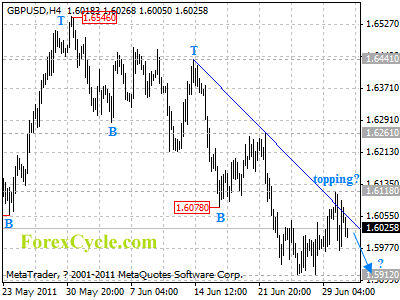
After touching the downtrend line from 1.6441 to 1.6261, GBPUSD dropped from 1.6118. Now the fall from 1.6118 would possibly be resumption of downtrend from 1.6546. Deeper decline to test 1.5912 previous low support is expected later today, a breakdown below this level will signal resumption of downtrend, then next target would be at 1.5700. Resistance is at 1.6118, only break above this level could indicate that lengthier consolidation of downtrend is underway.

gbpusd

Forex Signals

Three of the Best Dividend Investments in the World

Three of the Best Dividend Investments in the World

by Carl Delfeld, Investment U Senior Analyst
Thursday, June 30, 2011: Issue #1546

When I was with a Wall Street firm, it was common for stockbrokers to mock investors who focused on income.

Traditionally, income meant bonds… And in the old days many bonds came with coupons, which investors clipped and then cashed… And nothing was worse than being labeled a “coupon clipper.” But today, bond investors do have it even worse.

  • One-year Treasuries yield nearly 0.19% right now.
  • Meanwhile, inflation just hit 3.6%, according to the latest estimates from the Bureau of Labor Statistics.

That means you’re actually losing purchasing power by “collecting income” from one-year Treasuries right now.

So if you’re looking to add to your income portfolio, what’s an investor to do?

Outperforming Bonds and More Stable Than High-Growth Stocks

In a word: dividends.

Dividend-paying stocks are not only outperforming in terms of bonds… They tend to be more stable than high-growth stocks. And in uncertain times like these, that’s an important consideration.

The question is: Where can you find the best dividends in the world today?

For the answer, you need to look overseas… Here’s what I mean…

Going Global for Strong Dividend Yields

Companies overseas offer a great opportunity to bolster your dividend portfolio.

Take Asia, for example.

In 2010, companies in the MSCI Asia-Pacific Index paid out almost as many dividends as those listed in the S&P 500.

And according to Matthews Funds, from 2002 to 2009, Asian companies grew dividends at a compound annual growth rate of 18%, compared to 10% for the S&P 500. Japan, China, Australia, Taiwan and Hong Kong are the biggest dividend payers in the region.

Europe also offers some strong opportunities:

  • France Telecom (NYSE: FTE) offers an 8.9% dividend yield.
  • British American Tobacco (AMEX: BTI) has a 4.2% dividend yield and a 17% annual dividend growth rate over the past five years.

All of these are worth considering.

But my favorite dividend investments right now aren’t stocks. They’re exchange-traded funds (ETFs).

These investment vehicles offer instant diversification, low costs, strong profits tied to emerging market growth, and still provide yields that crush bonds.

My Three Favorite Global Dividend ETF Investments

Here are my three favorite dividend ETFs right now…

  • DIVIDEND ETF #1: The brand new Global X SuperDividend ETF (NYSE: SDIV) tracks the performance of 100 equally weighted dividend companies from around the world. SDIV provides good diversification with exposure to REITs (22%), consumer discretionary stocks (16%), telecommunications (16%), financial services (10%), utilities (8%), banking (5%), consumer staples (5%), energy (5%), industrials (5%), insurance (3%), technology (3%), and health care (2%).Nearly 32% of the companies in the basket are U.S.-based, 24% in Australia, 10% in Great Britain, 6% in Canada and 4% in Singapore, among others. In addition, the fund currently pays out 4.08% annually.
  • DIVIDEND ETF #2: Second, consider one of my long-time favorite ETFs, the PowerShares International Dividend Achievers Portfolio (NYSE: PID). To become a part of this exclusive basket, companies must have a record of increasing their dividends for five consecutive years. The United Kingdom and Canada comprise 50% of its holdings. U.S. companies make up a mere 6%. The fund has risen steadily up 8.16% over the last 12 months and is currently returning an annual yield of 2.81%.
  • DIVIDEND ETF #3: Finally, if you’d like more Asia and emerging-market exposure, purchase WisdomTree’s Emerging Market Equity Income ETF (NYSE: DEM). DEM has 20% exposure to Taiwan and 20% to Brazil. Telecom companies make up a majority of the companies in the basket. You can expect it to distribute dividend income in the area of 5% annually.

With this global triple play, your stock portfolio will get a welcome shot of income – and global diversification.

Good investing,

Carl Delfeld