Gap: Shrinking in America, Growing in China

By The Sizemore Letter

For The Gap (NYSE: $GPS), it is the best of times…and it is the worst of times.  The company just announced that it plans to close 189 of its namesake stores across the United States.  This amounts to a full 21 percent of its American stores.

At the same time, The Gap intends to triple its presence in China by opening 45 new stores. This follows the company’s broader strategy of shrinking its U.S. presence and looking for growth instead overseas.

The Gap has faced sluggish sales in the United States for years.  Some of this is due to the whims of fashion, but there is also a larger story to tell.  Like so many other companies, The Gap has come to realize that the American consumer—that seemingly unstoppable engine that has powered the global economy for decades—is no longer firing on all cylinders.  Growth, if it is to be found, will be found overseas.

There are several factors at work, any one of which deserves an article—or even a book—of its own to explain.  The first and most obvious is the state of the economy.  While I do not see a “double dip recession” in the near future, I do believe that we are in the early years of a Japanese-style slow-motion depression.  Americans—like the Japanese before them—experienced a debt-fueled real estate bubble and consumption binge.   And Americans—again like the Japanese before them—can look forward to a prolonged hangover in which the debts are slowly paid down.

The U.S. banks were quicker to write off their bad loans than their Japanese counterparts, but most are hardly eager to extend new loans.  And even if they wanted to, it’s not entirely clear they’d have a lot of borrowers.

Demographics are also decidedly negative.  The Baby Boomers, as the largest and richest generation in history, were the force behind the consumer boom of the past 30 years.  But as the Boomers approach their retirement years, they are far more interested in saving rather than spending.

Against this backdrop, it shouldn’t be surprising that The Gap and other American companies are looking elsewhere for growth.

In The Sizemore Investment Letter, we also look abroad for growth.  One of my favorite strategies is finding American and European companies with big exposure to emerging markets that have seen their stock prices sink due to concerns about their home markets.  I call it “Emerging Markets Lite.”

The quintessential Emerging Market Lite investment is the Spanish telecommunications company Telefónica (NYSE: $TEF).  Fears of a spreading European sovereign debt crisis have taken their toll on Spanish stocks.  The broader Spanish Ibex index trades for 7 times earnings, as does Telefónica.

The problem with this is that Telefónica is not really a Spanish stock.  Only about a third of its revenues come from its home market, while fully 40 percent comes from the fast-growing markets of Latin America.

Unlike their rich-world peers, emerging market consumers are not burdened with excessive debts.  They have years or decades of spending growth ahead of them.   The Gap figured this out a long time ago and has restructured its business accordingly.

I’m not recommending you buy shares of The Gap today.  But I do recommend you invest in companies following The Gap’s strategy.

If you liked this article by Sizemore Insights, you’d probably enjoy The Sizemore Investment Letter, our premium members-only newsletter. Click here for more information.

Peter Schiff: Prepare for QE3; Look to Foreign Currencies

Peter Schiff: Prepare for QE3; Look to Foreign Currencies

by Garrett Baldwin, Investment U Executive Editor
Friday, October 14, 2011: Issue #1621

High volatility… European uncertainty… Long-term prospects looking difficult for the dollar… The Feds are throwing ideas at the wall and hoping something sticks. Investors, meanwhile, remain nervous. That’s why Investment U is always reaching out to the most well-known figures in finance to get their take on current events and the markets.

In the most recent segment of the Investment U Interview Series, we sat down with Peter Schiff. The CEO and Chief Global Strategist of Euro Pacific Capital and Euro Pacific Precious Metals, Peter is the coauthor of a new report, Peter Schiff and Axel Merk’s Five Favorite Currencies for the Next Five Years (available for free below).

An outspoken critic of the Federal Reserve and government intervention, Peter is well versed in the Austrian School of economics and perhaps best known for his early predictions of the housing crisis. On October 11, we sat down with him to discuss his concerns about government regulation, the Occupy Wall Street movement, and his outlook on the dollar and other currencies in the coming years.

Investment U: Thank you, Peter, for your time. We’ll jump right in. Tell us, what do you see for the dollar in 2012 and beyond?

Peter Schiff: I think the dollar is headed lower. In the short run, or recently, we’ve had a rally in the dollar from the lows because people are more concerned about problems in the Eurozone than they are about problems in America. Even though, the American problems are more immediate and more overwhelming than the European problems.

At least temporarily, we’ve benefited from the perception of safety, even if that perception is at odds with reality. And the world has been focusing on the growth story not being as robust as many had first thought. Therefore, people are taking off the bets that they’ve made for a strong economy, whether it’s betting on stocks, commodities, metals, or oil. And taking down those bets is premature, because the commodity story was not simply about growth. It was about inflation. The inflation story is getting bigger and bigger as economies like the U.S. try to create inflation to create growth. They’re not going to get the growth, but they will get the inflation.

But there is a growth story that is still not fully appreciated in the emerging markets. There, the growth is real and will continue. And so you’re going to see growth in the emerging markets and inflation, which is a good environment for commodities and precious metals, and a bad environment for the dollar.

Investment U: In your report, Five Favorite Currencies for the Next Five Years, you say that if you had the choice between euros and dollars, “I’d take euros every day.” Has that sentiment changed at all given the uncertainties in Greece and Brussels?

Schiff: No. If those were the only two choices, I would pick the euro. But fortunately, those are not the only two choices. And I don’t own the euro. I own other currencies that I think are in better positions than both the euro and the dollar. But in the beauty contest between the euro and the dollar, the euro is less ugly.

Investment U: In the same report, which you coauthored with Axel Merk [the Founder of Merk Investments], you say that there is a great opportunity to own a North American currency, it’s just not the U.S. dollar.

It’s the Canadian dollar. What is it about Canada that makes its currency a favorable investment?

Schiff: The fundamentals are much better in Canada than they are here. They have a positive balance of trade. They have a lot of natural resources, particularly energy and mining related, which are going to be more valuable. They’re in a position to dramatically increase their exports to emerging markets, particularly to countries like China. So I see Canada benefiting from these emerging markets growing and prospering.

Certainly, Canada will [also] be the beneficiary of a lot of talent that leaves America. For a lot of Americans who are looking for opportunities abroad — or are trying to escape high taxes and high regulations and lack of opportunity in America — an easy place to find them is Canada.

And they might benefit from a brain-drain from the United States. Some of the more hardworking, entrepreneurial, more motivated people, instead of going to Canada to flee the draft, they go up to Canada to flee big government and taxes, regulation and inflation.

That will work to Canada’s advantage.

Investment U: In a recent interview with Yahoo!, you said, the reason we can’t grow the economy is because “government is in the way. There are no jobs because there is no recovery.”

So, two important questions come from this. One, how are jobs created? And what needs to be done in order to stifle unemployment?

Schiff: Jobs are created by businessmen, by entrepreneurs trying to make money for themselves. And in trying to make money, they discover that they can make even more money if they hire people. In fact, businessmen generally have what their employees lack, which is capital. And labor is most productive when it is combined with capital.

And most people don’t have their own capital, and so they can earn more money by selling their labor to people who do have capital. So, the answer to your question as far as where jobs come from, they come from profits, capital, and the motivation and the ability to generate a profit.

Businessmen combine their capital with somebody else’s labor to generate a profit. If you want more jobs, you need more capital. You need more profits. You need more entrepreneurs. Unfortunately, we’re not getting that. The government wants to raise taxes on the entrepreneurs, on the businessmen, depriving them of capital.

In the meantime, the government is borrowing all the capital and spending it on more government, where it’s guaranteeing student loans or mortgages. And so, money that should go into growing business is growing government instead, or propping up universities, banks, or whoever is the recipient of the government guarantee. The government is siphoning capital from where it needs to be to where it’s politically popular, and that is stifling job creation.

Of course, part of the problem is the regulations. In order to hire somebody, you have to make a profit. Nobody is going to hire somebody if they lose money in the process. But the government makes it more expensive to hire people because of all the rules and regulations attached to every hire. If you hire somebody in this country, there are all sorts of special taxes you have to pay specifically because you hired [that person]. That increases the cost of labor and it makes it less likely for businesses to hire.

In fact, I think today one of the goals of a lot of small businesses is to hire as few people as possible. If you can run a business and hire nobody, that’s what you’re going to do, because the government has made it so expensive and risky to hire. That is the wrong thing to do. We want to encourage job creation, not stifle it.

Investment U: Occupy Wall Street protesters have been in the news lately. Do you think they are targeting the right people in their protests?

Schiff: Well, I think they are right to be frustrated. They are right to be protesting what’s happening, but they’re expressing their anger in the wrong direction.

Wall Street is a symptom of what’s going on; the cause is Washington.

They shouldn’t be occupying Wall Street. They should be occupying Washington. They should be on Pennsylvania Avenue protesting Congress, the White House, the Federal Reserve. That’s the problem, not Wall Street. Because if there was no government, there would have been no bailouts. You can’t blame Wall Street for asking for a bailout.

After all, that’s what the March on Washington people want. They want the government to bail them out. But the problem isn’t that Wall Street asked for a bailout, the problem is that Washington gave it to them. Washington should have let the banks fail. That would have been capitalism. The irony of it is, the March on Washington movement is an anti-capitalist movement. They’re protesting capitalism, but what they’re really protesting is crony capitalism.

If we had capitalism, none of the banks would have been bailed out. In fact, if we had capitalism, none of the problems that caused the banks to fail and need the bailouts would have existed in the first place. Capitalism would have prevented all this stuff from happening. [We have] a lack of capitalism. [What we have is] crony capitalism. It’s government interference and meddling in the economy that prevents capitalism from working. And that’s what has caused all the problems, and what the protestors are protesting.

Investment U:  Speaking of government intervention, what do you see will be the end result of the Fed’s Operation Twist?

Schiff: Well, it’s going to put the screws on the economy. It’s going to hurt quite a bit. It’s not going to grow the economy. In fact, if anything it’s going to further subject the banking sector to additional losses. That is the problem. Yes, they have temporarily brought down long-term rates, but that’s squeezing the spread that these banks are operating off of.

And so ultimately it weakens the banking sector, and it paves the way to QE3. All-out QE3 is coming, because, again, this didn’t work, but when they first announced it, the initial reaction was a drop in oil prices, a rise in the dollar. And this might create an environment in which the Fed can claim that there’s no inflation, that the danger is deflation. And it creates a smokescreen under which it can do what it wanted to do all along, which is just create more inflation, print more money, buy more government debt and stimulate.

Investment U: Do you think Treasuries are in a bubble?

Schiff: It’s all part of the overall government bubble. That’s where all the cheap credit is flowing these days. First, it went into the stock market. That bubble bust. Then it went into the real estate market. That bubble burst. And now it’s in government. Government is growing rapidly now. All this money is financing big government. But the bigger the government is, the weaker the economy is, because it’s crushing the economy. The productive sector has to support the non-productive government sector. And the more resources the government drains from the economy, the weaker the economy gets. That’s the source of our misery. That’s the source of this recession. It’s government sapping the life out of the economy, with regulations, taxation, money printing, micro-management.

What we need is a real dose of freedom, capitalism. We need to re-embrace the principles upon which the country was founded, and go back to sound money. And only then will we be able to start solving our problems.

Investment U Do you foresee any trigger point in the treasury market where that bubble would burst?

Schiff:  Oh, sure. What the trigger point is, I don’t know. There are a whole bunch of things that could go wrong. It’s a big bubble. There are a lot of pins. It’s going to find one eventually.

But I do believe that it will be very abrupt. I think when the dollar collapses, it will happen very rapidly. When the bond bubble bursts, the air is going to come gushing out. It’s not going to give a lot of people time to reverse their position.

And then we’re going to have the real crisis in America. That’s when we’re going to have to finally deal with reality. Right now, we’re able to postpone the pain because rates are still low. The government doesn’t have to make any cuts because it can keep borrowing. But what happens when it can’t keep borrowing? What happens when high interest rates prohibit that? Then it’s either got to slash government spending. It’s got to allow banks to fail and not bail them out, including the depositors. It has to level with people on Social Security and Medicare and let them know that they’re not going to get what’s been promised.

Or the government is going to try to solve everything with a printing press, in which case it’s the dollar that gets destroyed. It doesn’t just fall precipitously, it loses almost all of its value, and we have [massive] hyper-inflation, which would be the worst possible outcome. And I hope we avoid that. But that is the direction that we’re headed unless we make a sharp turn. But making that sharp turn is not going to be easy, and there is going to be a lot of short-term pain associated with doing the right thing.

Investment U: You’ve been very successful given your forecast of the mortgage crisis. My question is a little bit more challenging. How do you translate that forecast, that knowledge into gains?

Schiff: Well, we had people who, based on my recommendations, shorted the mortgages themselves in 2006. We helped set up a hedge fund that did just that. And so people were able to make a lot of money if they got into that fund or if they got into funds that were similar to the one that we had. Also, people were able to short the banks and short the mortgage lenders. And so there were people who were able to take that forecast and immediately profit from it if they timed it right.

Of course, I also recommended things like gold and silver, which didn’t pay off immediately. In 2008, gold prices went down, but they’re double what they were now – then. So people still made money on precious metals. And of course if they bought precious metals, years earlier, had they bought them in 2002, 2003, 2004, even though 2008 was a down year – or at least the second half was. They’ve more than recouped that.

So, people have been able to profit, certainly from the advice to get out of the dollar. The dollar is quite a bit lower than it was when I first started telling people to get rid of it based on these forecasts. Even though it’s higher than it was a month ago, it’s much lower than it was years ago. And the dollar will continue to fall.

So, for people to understand the forecast, the correct investment strategy becomes obvious. You never know how it’s going to fare in the short run, month to month, quarter to quarter. It’s difficult to figure out when the dollar will rise or fall, or when stocks will rise or fall. But overall, if you understand the big picture, then understanding the long-term trends becomes a lot easier. And it’s a lot easier for people to profit if they understand them.

There are certainly people who can come in at a bad time and end up losing money following these strategies. It’s because they don’t necessarily understand them, and so they don’t have the courage or the conviction to ride out the times when the markets might be moving against them.

Investment U: What do you say to the charge that if you’re bullish or bearish long enough, that eventually you’ll be right?

Schiff: Well, I don’t necessarily agree with that. It depends on what it is. When it comes to inflation, if you don’t adjust for inflation – prices are rising every year. And so I suppose if you’re bullish on something in nominal terms and you wait long enough, the price is going to go up in depreciated currency. But what it is going to do in terms of real money? That’s a different story. A lot of people will try to discredit me by saying, “Well, Peter Schiff is a stopped clock. He’s been bearish for years.” I have been bearish for years, and I’ve been correct to have been bearish.

Now, being bearish didn’t necessarily mean I’ve said stock prices would always go down. In fact, I’ve said stock prices would probably go up. But that’s because you’re measuring them in a currency that’s going down even faster. What I’ve been saying for years is that stocks would lose value in terms of gold. And they have. For 10 years, the stock market has lost considerable value expressed in gold. So, I think to have been bearish of stocks in terms of gold over the last decade has been the right thing to do.

Yes, I was bearish about the real estate market in 2002, 2003 and 2004, because I understood it was a bubble. Just because it took a while for the bubble to burst didn’t mean I was wrong by pointing out the bubble as early as I did. It simply validated my understanding. I knew it for what it was the minute I saw it. And of course, by 2005 I saw the enormity of the bubble, and that’s when I really began forecasting a complete collapse of our banking system when the bubble burst, because I knew the damage that would be done to our financial institutions that had all this real estate as collateral for all these loans. When real estate prices dropped to the degree that I believed they would drop, that these banks would all be insolvent and that it would usher in this massive collapse.

I have been pointing these out for a long time. It doesn’t make me a stopped clock. It just means I understand the fundamentals.

Investment U: Thank you again for your time, Peter.

That concludes our conversation with Peter Schiff, CEO and Chief Global Strategist of Euro Pacific Capital and Euro Pacific Precious Metals. To access the report Peter Schiff’s and Axel Merk’s Five Favorite Currencies for the Next Five Years, Click Here Now.

A reminder, Peter is the host of a live radio show every weekday at 10 AM EST at www.schiffradio.com. Listeners are invited to call in and chat. However, if they are unable to listen live, the show loops 24 hours a day. Readers are also invited to visit his site www.europac.net to access Peter’s recent books and a list of his favorite readings.

Good investing,

Garrett Baldwin

Article by Investment U

PepsiCo Rises on Third-Quarter Earnings

PepsiCo Rises on Third-Quarter Earnings

by Jason Jenkins, Investment U Research
Friday, October 14, 2011

PepsiCo Inc.’s (NYSE: PEP) third-quarter profit rose four percent due to higher prices and rising sales of its snacks and beverages – especially overseas.

Wall Street seemingly approves of the third-quarter EPS and revenue numbers, which came in above analyst predictions. Here are the highlights that made everyone so giddy:

  • The company reported Wednesday that it earned $2 billion, or $1.25 per share, for the period ended September 3. That’s up from $1.92 billion, or $1.19 per share, a year ago.
  • Earnings were $1.31 per share. Analysts surveyed by FactSet expected $1.30 per share.
  • PepsiCo’s stock added $0.55 to $61.50 in premarket trading.
  • Revenue climbed 13 percent to $17.58 billion. That topped analyst expectations for $17.11 billion in revenue.
  • For the past five quarters, net income has increased 1.7 percent on average year over year.
  • PepsiCo has averaged revenue growth of 26.2 percent over the past five quarters.

The Current Climate for Multinationals

PepsiCo, like many multinational stocks, was recently trying to find the right mix during this period of global economic uncertainty. It found its recipe for success in this international economic environment by raising prices and promoting growth in emerging markets.

Many other multinational consumer brands – including McDonald’s (NYSE: MCD) and Nike, Inc. (NYSE: NKE) – increased prices in an attempt to offset their rising costs for ingredients, packaging and transportation. Also, to a larger degree, multinationals are reliant on emerging markets to bolster performance. Domestic consumption was stagnant due to the current U.S. economy coupled with a 9.1-percent unemployment rate.

Global Markets Crucial to 3Q Numbers

PepsiCo European markets reported a 37-percent revenue increase due to higher prices and the addition of Russian juice and dairy company Wimm-Bill-Dann. The combination of revenue for Asia, the Middle East and Africa rose 25 percent on increased prices and volume growth stemming particularly from emerging markets.

The Latin America Foods division, led by Brazil and Mexico, posted a 19-percent increase in revenue. Overall, global snacks volume increased by eight percent and worldwide beverage volume climbed four percent. As stated in its release, PepsiCo’s volume gains were driven by growth in emerging markets. For the full year, PepsiCo maintained its forecast for high single-digit earnings growth.

Investor’s Take

PepsiCo is definitely taking advantage of global demand from emerging economies, racking up annual revenue growth of about 24 percent in those same markets.

And with no clear view of how this market is going to work out, what you should be looking for is a formula to reduce risk – gaining the best possible return for the lowest amount of risk. PepsiCo has raised dividends 39 years in a row and its stock yields 3.4 percent.

The combination of international growth and dividend income could make Pepsi a solid play in this environment.

Good investing,

Jason Jenkins

Article by Investment U

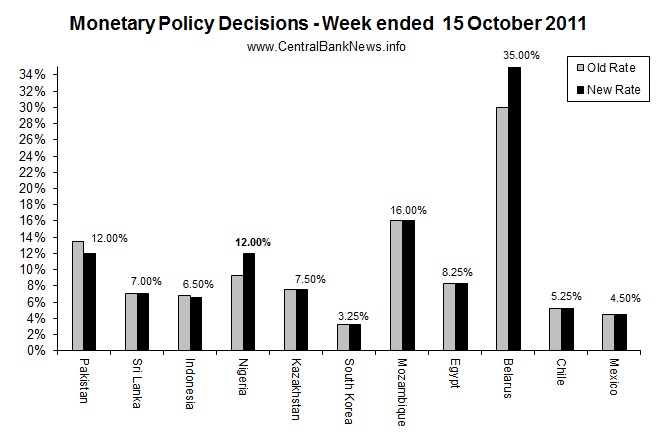
Monetary Policy Week in Review – 15 October 2011

The past week in monetary policy featured monetary policy decisions from 12 central banks around the world.  Those that increased interest rates were: Nigeria +275bps to 12.00% and Belarus +500bps to 35.00%.  Meanwhile those that reduced interest rates were: Pakistan -150bps to 12.00%, and Indonesia -25bps to 6.50%.  Those that held interest rates unchanged included: Sri Lanka 7.00%, Kazakhstan 7.50%, South Korea 3.25%, Mozambique 16.00%, Egypt 8.25%, Chile 5.25%, and Mexico 4.50%.  The Monetary Authority of Singapore also eased monetary policy settings, noting that it would continue with a policy of modest and gradual appreciation of its currency.

Monetary Policy Week in Review


Following are some of the key quotes from the central banks that meet over the past week:

  • Central Bank of Nigeria (increased rate +275bps to 12.00%): The global economic horizon remains highly uncertain, with the signs getting more ominous as policy makers find it increasingly difficult to take the necessary economic decisions that may avert a new wave of  recession.”
  • Bank Indonesia (cut interest rate -25bps o 6.50%): “We are bringing the policy rate to a level that is more reasonable,” further noting “we saw the 6.75 percent rate as too high, unless we estimated inflation next year to be very high.”
  • Bank of Korea (held rate at 3.25%): “Based on currently available information, the Committee considers that, while emerging market economies have shown favorable performances, major advanced economies have exhibited signs of sluggishness. Going forward the Committee forecasts that the global economy will show a recovery, albeit a moderate one; nevertheless, the Committee judges that downside risks to growth have expanded.”
  • Monetary Authority of Singapore (eased policy): “Given the stresses and fragility in the advanced economies, the prospects for growth in Singapore’s major trading partners have deteriorated.  With the slowdown in demand, growth in the Singapore economy could fall below its potential rate of 3-5%.  Thus, core inflation should ease next year, although headline inflation could stay elevated in the near term reflecting the higher imputed rental cost of owner-occupied housing.
  • National Bank of Belarus (increased rate +500bps to 35%): “The move is next step in the consistent implementation of the general economic policy of the National Bank and the Government aimed at macroeconomic stabilization, reducing the pressure on the Belarusian ruble exchange rate and reducing inflation.  The National Bank jointly with the Government of the Republic of Belarus will continue the adoption of stabilization measures in the light of internal and external economic developments.”
  • State Bank of Pakistan (cut rate -150bps to 12.00%): “There is a decline in CPI inflation and government borrowing from SBP is lower than its end-June level. Led by consistent inflow of workers’ remittances the external current account position is comfortable though there has been some decline in SBP’s foreign exchange reserves. Importantly, concerns regarding  weak private sector credit growth and  falling real private investment expenditures remain along with a likelihood of rise in real interest rates.”


Looking at the central bank calendar, next week will see more emerging market central bank action, with the main event looking to be Brazil – last month Brazil unexpectedly cut interest rates, so the market will be watching that decision closely.  Other than policy meetings there’s also the Reserve Bank of Australia’s October meeting minutes, Ben Bernanke speaks in Boston, the US Fed puts its Beige Book Economic Survey report out, and the Bank of England publishes the minutes from its most recent meeting.

  • THB – Thailand (Bank of Thailand) expected to hold at 3.50% on the 19th of Oct
  • NOK – Norway (Norges Bank) expected to hold at 2.25% on the 19th of Oct
  • BRL – Brazil (Banco Central do Brasil) may cut 25bps from 12.00% on the 19th of Oct
  • PHP – Philippines (Bangko Sentral ng Pilipinas) expected to hold at 4.50% on the 20t of Oct
  • TRY – Turkey (Central Bank of the Republic of Turkey) expected to hold at 5.75% on the 20th of Oct

Belarus Central Bank Lifts Rate 500bps to 35.00%

Belarus Monetary Policy Interest Rate

The National Bank of the Republic of Belarus raised its refinancing rate by 500 basis points to 35.00% from 30.00%.  The Bank said [translated]: “The move is next step in the consistent implementation of the general economic policy of the National Bank and the Government aimed at macroeconomic stabilization, reducing the pressure on the Belarusian ruble exchange rate and reducing inflation.  The National Bank jointly with the Government of the Republic of Belarus will continue the adoption of stabilization measures in the light of internal and external economic developments.”

The latest move marks a continued string of aggressive rate increases, with the Bank previously raising the refinancing rate by 300bps to 30%, 500 basis points to 27% and 200 basis points to 22%.  The total amount of increases since the start of the year is now 2450 basis points.  Belarus reported consumer price inflation of 36.2% in the year to June, according to the National Statistic Committee, meanwhile the government is forecasting 2011 inflation of as much as 39%.  


The Bank also said in a separate announcement that interest rates on liquidity management operations would also increase, with the overnight deposit rate rising to 25% and the overnight credit rate rising to 50%.  The move “aims to enhance the impact of interest rate policy on the economy, restrictions on lending activity and stabilize the currency market.”

The USD-Belarussian ruble (BYR) exchange rate has doubled on the black market, rising to as much as 7,000 per dollar (approx. 6,000 in July), and currently trades around 8750 (5350 this time last month) against the US dollar, according to quotes from Yahoo Finance.

www.CentralBankNews.info

Banco de Mexico Keeps Interest Rate at 4.50%

The Banco de Mexico held its overnight interest rate target steady at 4.50%.  In its monetary policy statement the Bank noted: “the current monetary policy posture is conducive to achieve the 3.0% inflation objective.”  Further commenting: “However, we will remain alert to the prospects for world economic growth and its possible implications for the Mexican economy, which, in the context of great monetary slack in the principal advanced economies could as a result make it appropriate to relax monetary policy.”

The Mexican central bank also kept the overnight interest rate target steady at 4.50% at its August meeting.  Mexico reported annual inflation of 3.14% in September, compared to 3.42% in August, while inflation was 3.28% at the end of June, 3.4% April and 3% in March, and within the Bank’s inflation target range of 3% +/- 1%. 

The Mexican economy grew 3.3% (4.6% in Q1) year on year in Q2 this year, up 1.1% (0.5% in Q1) from the previous quarter, compared to GDP growth of 5.4% in 2010.  The Mexican peso (MXN) is down almost 10% against the US dollar so far this year, and the USDMXN exchange rate last traded around 13.26.

Banco Central de Chile Keeps Interest Rate at 5.25%

The Banco Central de Chile kept its monetary policy interest rate steady at 5.25%.  The Bank noted: “Domestically, output and demand show signs of moderation. In the case of output, the slowdown is more pronounced than was assumed in the Monetary Policy Report’s baseline scenario; the opposite occurs with demand. Labor market conditions remain tight. CPI inflation rates have hovered around 3% y-o-y, while core inflation measures remain contained. Inflation expectations are close to the target. “

Chile’s central bank previously also kept the monetary policy interest rate unchanged at 5.25% at its September meeting.  The Bank last raised its monetary policy interest rate by 25 basis points to 5.25% at its June meeting this year.  Chile reported annual consumer price inflation of 3.3% in September, compared to 3.2% in August, 2.9% in July, 3.4% in June, 3.3% in May and 3.2% in April this year; within the Bank’s inflation target of 2-4%.  


The Chilean economy grew 8.4% in the first half of 2011, driven by strong domestic demand; full year GDP growth is expected around 6.5%, while inflation is seen around 4% by the end of the year.  The Chilean Peso (CLP) has weakened about 9% against the US dollar so far this year, while the USDCLP exchange rate last traded around 499.

Have the Bears Taken Over?

By MoneyMorning.com.au

‘I have a feeling we are going to see lower prices before you could call the low of the bear market.’
Slipstream Trader, Murray Dawes 7 October 2011


Is Murray right?

Could be. A leading bearish indicator – we’ll show you in a minute – has reached a five year peak. When bearish indicators peak it suggests stocks could be heading for a fall.

This shouldn’t come as a surprise.

Since the April highs of this year, the Dow Jones Industrial Average has lost more than 6%. The S&P 500 is 8% worse off. And the S&P/ASX 200 is down more than 11%.

Data compiled for Bloomberg News showed ‘borrowed shares’ rose to 11.6% in September, almost 2% higher than July.

This is important because in order for short sellers to short sell, they must first borrow the shares. So knowing the amount of borrowed shares gives a good guide to how much stock is being short sold.

That should be enough to alarm the bulls. Because the larger the amount of short selling, the more ‘bearish’ the market outlook.

To put it in perspective, the 2% increase in short selling is the biggest increase since 2006. Bloomberg’s report found ‘US short sales are rising at the second-fastest pace on record after the 2008 financial crisis.’

And according to the New York Stock Exchange, short selling has jumped from 3.5% in July to 4.1%.

Some analysts don’t know which way to look


So, which way is the market headed?

Filippo Garbarino, a managing director at Frontwave Capital says, ‘The market is so undervalued right now, it’s kind of hard to take a short position. But at the same time given the economy, it is hard to be long’.

And then there’s this from Eden Chen, at Lightmark Capital, ‘It’s very difficult to say with certainty whether being long or short right now is a good idea because things can quickly change.’

In other words, they don’t know!

Anyone can see the market is trending down. But what you want to know is what you should do about it?

Using the technical information


Technical analyst, Murray Dawes, has been wary of the lack of market direction.

When discussing the technical aspects of the S&P 500, in his free weekly market update, Murray warned that if ‘…there’s a quick sell off from back under the 10-day moving average… we can get bearish again. But right now the market is holding well up above that 10-day moving average, it’s in a short-term uptrend.’

He added, ‘A move back under… 1230, that would be the area that I’m looking to enter with my short [trades]. That would be the perfect trading opportunity. Where we are right now is a bit of no man’s land.’

As for the ASX200, he says it could move higher. But don’t expect it to last long.

Murray says:

‘Last week I was saying that there was a chance that if the market did take off to the upside we could see even a move back up to the 200 moving average which is up around 4450…

‘[But] we have to be a little wary that the shift in momentum in the last week or two has been quite dramatic. This could carry on for a bit longer before falling over.’

In other words, this is a traders’ market… and a volatile market.

And that means there are plenty of opportunities to trade the market long or short.

Shae.
Editor, Money Weekend

P.S. To check out Murray’s latest free weekly market update on YouTube, click here…


Have the Bears Taken Over?

Three Tips to Help You Succeed in Trading

By Warren Seah

Trading can be a bit precarious. For so many, it’s an incessant accumulation of frustrations– the trade may not always go in your favor, you foolishly bought into some “expert’s” advice, you’re unsure whether you should close a losing trade or sustain it. It’s a business where your success will be nebulous. If you follow these five tips that I prescribe, however, you will have the upper hand.

Have Sufficient Capital

A general rule: You can never have too much capital to start with; you can, however, have too little. Think of trading as building muscle. You can’t effectively build muscle (wealth) without the right amount of body mass (capital.) Your efforts will be scrawny, weak. To start with, it’s best to have about $100,000. If you don’t have that, try for $50,000-75,000. Why this much? The more money you put in your trades, the more money you will get in return.

Manage your Risk

This is a biggie. Through the management of your risk, you will sink or swim. It’s here that you either grow the capital that you have or deplete it entirely. Unfortunately, many traders commit the latter. It’s Money Management 101. As a rule, you do not invest too much on one trade (too much would be as little as .) When you put all of your eggs into one basket, you’re bound to lose. Also, you might want to put a stop loss on your trades. This protects from massive loss that can literally render your account barren. This is a common tool of risk managements; if used, you will be grateful for its practicality.

Know What you’re Using

If you look on most traders’ charts, you will see a byzantine network of indicators and patterns, often packaged together as a convoluted, distorted mess. If asked how this helps them in their trading, many will struggle to find the answer. Do not overpopulate your chart with useless appendages and accessories. You won’t need them. For instance, a good indicator is a triangle chart pattern. It, as its name infers, finds patterns in trades (ie trends, the direction of the trade, the overall interest of other traders.) Triangle chart patterns will track the journey of a trend with the ascending, descending, and symmetrical triangles.

If used sparingly, indicators such as these will benefit the trader who seeks more clarity in his chart.

In closing, it always helps to have a trading plan or strategy. Adopt or create a trading style or method, test it out, make adjustments and alterations. If it can produce the results you want, don’t stray away from it. Deter human emotion from the trading process (fear, excitement.) This is a business, a precarious one. But, if treaded carefully, it can yield awesome results.

About the Author

Warren Seah

What if you just couldn’t trade forex effectively with a day time job?

I know how hard it can be to trade forex manually, but if you want to really be successfully trading your own unique manual system, you need to learn a single method that works amazingly well.

This method is simple to pick up and it works like an automated trade exit tool. Yes, you can now select the forex exit strategy and the tool will manage your trade and exit with profit. You can read how to do it in my free report here: Mt4 Expert Advisor

Don’t give up hope, it’s NOT impossible. Triangle Chart Patterns will expand your trading capabilities to greater trading success learn more by clicking the link.

The S&P 500 is Getting Close to a Top

JW Jones – www.OptionsTradingSignals.com

The past few months have been very difficult to navigate for retail investors and institutional money managers. The huge week to week price swings and increased volatility have made the current market conditions exceptionally difficult to maneuver. Day traders are about the only group of market participants that outperform during periods such as we have seen since the beginning of August.

Before I jump into the analysis, I would like to point out to readers that the S&P 500 Index (SPX) has rallied from 1,075 on October 4th to 1224.50 on October 14th. The S&P 500 has rallied almost 150 handles or 14% from the lows to Friday’s close in 10 calendar days. As an options trader and a market participant, I trade the market that I see, not the market that I want. With that said, ask yourself this question: Does a healthy financial construct rally 14% in 10 calendar days?

To put the recent price action into perspective, since the beginning of the year 2000 the S&P 500 would have had a poor track record on an annualized basis when compared to the past 10 calendar days’ trough to peak performance. Only in the years 2003, 2006, 2009, & 2010 would an investor have been able to best the previous 10 calendar days’ performance (Performance data courtesy of Wikipedia). The most amazing thing about the recent price action is that the S&P 500 Index is still underwater for the year even after rallying roughly 14%.

At this point two scenarios are likely to play out. One scenario involves a rally on the S&P 500 towards the key 1,250 – 1,270 resistance zone which is outlined on the chart below. The recent price action in the S&P 500 has been volatile and at this point it has gone nearly parabolic. The daily chart of the S&P 500 Index is shown below:

SPY Option Trade

The resistance level shown in the chart above outlines the key 1,250 – 1,270 resistance zone that will be tested if the S&P 500 can breakout above the 1,230 resistance level. However, it is critical for traders to recognize that probabilities are starting to favor the short side. Let me explain.

If the S&P 500 is able to rally into the 1,250 – 1,270 level it would represent a gain of less than 4%. The bears will vigorously defend the S&P 1,250 – 1,270 resistance zone and it is unlikely that price action will be able to take out that resistance zone on the first breakout attempt.

With only 4% upside, the odds of some sort of correction are favorable at this point in time. Whether the correction begins early next week or whether we have to wait until the key resistance zone is tested, sellers will step back into the driver’s seat in the not-so-distant future.

McClellan Oscillator

A few data points that exemplify the overbought status of the S&P 500 are shown below. The first indicator is the McClellan Oscillator that my trading buddy Chris Vermeulen pointed out to me.

Options and the McClellan Oscillator

50 Period Moving Average Momentum Chart

The momentum chart shown below courtesy of www.barchart.com illustrates the number of domestic equities trading above their key 50 period moving averages:

50 Period Moving Averages and Options

Both charts above are warning signs that this rally is starting to get a bit overheated. I would point out that the past two times the McClellan Oscillator and the momentum chart peaked a nasty selloff occurred shortly thereafter. The one point that I would like to make clear to readers is that each time both indicators peaked prices eventually went much lower.

The evidence would lead astute traders to believe a top was near. The more arduous details about the future of the S&P 500’s price action revolve around where the topping formation will be. Will the S&P 500 find resistance on a second test of the key 1,230 resistance level?

The other scenario would involve higher prices next week that eventually reach the key 1,260 – 1,270 area on the S&P 500. Will price work roughly 4% higher before confirming a top at the key breakdown level that initiated the selloff back in August?

Conclusion

I am of the opinion that a topping formation or pattern is likely near, but the location of the top is unknown to me presently. More importantly the forthcoming selloff resolution will be very telling about the current trend of the marketplace.

The most constructive price action that we could see would be a selloff that results in a higher low on the daily chart. If that type of price action plays out a new bullish run could begin. However, if we form a top and price action breaks down below recent lows it would not be surprising to see another lower low form which would put the trend squarely in favor of the bears.

The most important aspect of coming weeks will not necessarily be where a top forms, but if and when a selloff begins. Ultimately the depth, momentum, and ferocity of the selloff are more important than where the topping pattern begins.

At this point I have no purely directional trades on the books, but I am developing a laundry list of shorts that make sense. After all, volatility has declined quite a bit and puts are starting to get a whole lot cheaper!

In closing, a top is likely in the cards in the near future. However, the strength and momentum of the forthcoming selloff will tell the real story about the future direction of stock prices. The next few weeks should be quite interesting!!

Subscribers of OTS have pocketed more than 150% return in the past two months. If you’d like to stay ahead of the market using My Low Risk Option Strategies and Trades check out OTS at www.OptionsTradingSignals.com and take advantage of our free occasional trade ideas or a 66% coupon to sign up for daily market analysis, videos and Option Trades each week.

JW Jones – www.OptionsTradingSignals.com

This material should not be considered investment advice. J.W. Jones is not a registered investment advisor. Under no circumstances should any content from this article or the OptionsTradingSignals.com website be used or interpreted as a recommendation to buy or sell any type of security or commodity contract. This material is not a solicitation for a trading approach to financial markets. Any investment decisions must in all cases be made by the reader or by his or her registered investment advisor. This information is for educational purposes only.