By MoneyMorning.com.au
“I hate Christmas”, an old pal of ours used to say.
It’s not that he was a Scrooge. It’s not even that he was surly… or didn’t like people.
In fact, he was as generous, friendly and approachable as they come.
But there was one thing about Christmas he didn’t like… it would make him grumpy and irritable.
What he hated were the part-time Christmas drinkers.
The folks who wouldn’t go near a pub for 360 days of the year. But on the five days before Christmas they would hog the bar… sit in the best seats… and um and ah while ordering a Babycham or Pimms and lemonade.
Once these part-timers left – not to be seen for another 360 days – our old pal was happy again. (Or at least, not as unhappy).
There’s a similar group in the market that annoys us just as much.
In this case it’s the part-time gold trader. Flitting in, making and losing a fortune… and then flitting out again. Bloomberg BusinessWeek reports:
“…the slump in equities spurred some investors to sell their gold to cover losses.”
That kind of reporting annoys your editor.
The report implies that all those selling gold are in profit. And by inference, everyone who is selling gold has bought it using 100% cash.
But let’s get something straight. Gold is just as much at the mercy of easy credit and speculation as any other investment. To think otherwise is naïve.
And to think investors are handing in fully-paid-for gold bars in exchange for cash so they can pay off stock losses is… just plain dumb. We’ll explain why in a moment.
The reason we suggest you buy gold and silver a bit at a time is because the price is volatile. This week alone, gold has lost over $100… or nearly 1%. It doesn’t sound much. But for the leveraged part-timers, it’s huge.
In contrast, for the cash buyer of gold it’s not a big deal. In fact, for a cash buyer it represents the chance to buy a bit more. In fact, we’d say, if you haven’t yet bought your December allocation of gold, why not buy it today?
Unless you think it’ll be a bit cheaper tomorrow of course…
Gold Suffering from Leverage
But cash buyers aren’t the investors who typically sell to cover losses on the stock market.
The investors who are selling gold are those who borrowed to buy it. That means the lower gold price is just as much about traders bailing out of losing trades as it is about locking in gains on winning trades.
For example: one gold futures contract on the U.S. Comex exchange covers 100 ounces of gold. Last week the contract had an underlying value of USD$174,000… today that same contract has an underlying value of USD$162,600.
That’s a loss of USD$11,400. As it happens the initial margin for a gold futures contract (the amount you have to deposit into a futures account to buy or sell a futures contract) is USD$11,475.
In other words, if it wasn’t for futures exchanges having systems to lower the chances of traders losing their entire account balance, gold futures buyers would have been wiped out.
Not only that, but for a trader leveraged to the maximum, it would only take the gold price falling USD$30 for it to trigger a margin call (that’s where the trader has to tip more cash into their account, or sell some of their futures contracts to cover the margin on their loan).
When you consider the gold price has fallen USD$120 in a week, it doesn’t take Einstein to work out it will put pressure on a trader’s bank balance.
So rather than speculators selling gold to pay for stock losses, odds are they’re selling to cut losses from their super-leveraged gold positions.
The big question is: what’s the outlook for gold now?
Well, this is where it gets really interesting. And if you’re a long-term gold buyer, it’s probably the message you want to hear…
Gold Going Down… Further to Go?
Near term, the gold price looks to be heading lower. We asked Slipstream Trader, Murray Dawes for his thoughts. Here’s what he told us:
“Gold has been in an incredibly steady uptrend for years. We haven’t seen a retest of the 200-day moving average since the 2008-2009 crash. With the European Central Bank and the U.S. Federal Reserve pouring water on hopes of money printing in the near future, we may be on the cusp of another retest of the 200-day moving average in the short term at USD$1,600… therefore I expect to see a dip towards this area in coming weeks that could clear out any weak longs and prepare us for the next leg up.”
[Ed note: by the way, Murray has just posted his latest free weekly stock market update on YouTube. You can watch it by clicking this market update…] link.
Here’s the gold chart below:
We agree with Murray. But we’ll go one step further. To your editor’s untrained technical eye, USD$1,600 is the level to watch for. And after that, USD$1,500 is the next stop.
You’re probably thinking, “Why’s that good for gold buyers? Don’t they want it to go to $5,000 an ounce?!”
We’re sure they do. But anyone who knows anything about investing knows the path from A to B is rarely in a straight line.
What we’re potentially seeing now is the gold crash. Remember, it was above USD$1,900 just a few months ago. Today it’s about 14% lower. If it falls to USD$1,500 that would mean a 22% drop from the high.
That’s a crash in anyone’s book.
But here’s the thing. That’s what makes this even more of a buyers’ market for gold. As Bloomberg BusinessWeek notes:
“Open interest, or contracts outstanding, in gold futures traded on the Comex exchange in New York, fell to 427,756 contracts, from 546,601 in July…”
To us it says traders aren’t taking profits to cover losses on stock trades. But rather it tells us traders are locking in profits (those who short sold gold) and losses, and those new traders aren’t yet ready to make big bets on the next direction for gold.
The Gold Dip You’ve Waited For
If that attitude continues, you could see gold move into a holding pattern… where it drifts lower for a bit… then higher for a bit… and so on. Similar to what you see in all markets after a boom and bust.
It happens in the stock market. It happened in overseas housing markets. It’ll happen in the Aussie housing market (once the crash ends). And it’s set to happen in the gold market too.
In other words, the part-timers are leaving the market… Just like the Christmas drinkers who leave the pub to find other things to do.
Investors who bought in hoping for big short-term gains (gold to $5,000) are disappointed by the lack of price movement. So they get bored and look elsewhere. They’re the part-time gold investors… the fair-weather crowd.
But for the genuine gold buyers it’s an opportunity to sit back, watch the market and keep buying gold. If you are a genuine gold investor, then rather than heading for the exits today – and potentially the next few months – this could be the price dip you’ve been waiting for.
Cheers.
Kris
P.S. Just as now is a great time to top up on gold, if our old pal, Dr. Alex Cowie is right, now is a great time to stock up on cheap gold and silver stocks too. If you haven’t seen it yet, make sure you watch the Doc’s latest research presentation for he says are the six best resource investments for 2012. Click here for details…
Related Articles
Special Report: Six Extraordinary Resource Investment Opportunities for 2012
How to Buy Gold and Silver
The Only Gold and Silver Stocks to Buy
The Secret Aussie ‘Bank Run’ is a Sign to Buy Gold
Why Gold Should Become Your ‘Stay Rich’ Asset
From the Archives…
How to Turn Paper Money into Silver and Gold
2011-12-09 – Kris Sayce
Will Silver Break Through $50 an Ounce in 2012
2011-12-08 – Dr. Alex Cowie
Investing in the Market for Survival and Prosperity
2011-12-07 – Aaron Tyrrell
China, the U.S. and the Scramble for Commodities
2011-12-06 – Dr. Alex Cowie
Santa Claus: A Market Rally Not Worth the Risk
2011-12-05 – Kris Sayce
For editorial enquiries and feedback, email [email protected]

Is This the Gold Buying Dip You’ve Waited For?
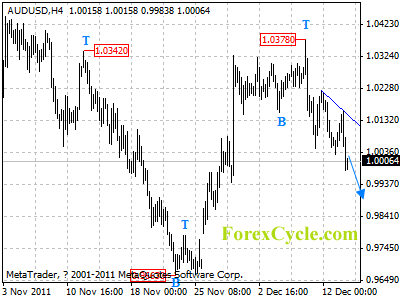
AUDUSD remains in downtrend from 1.0378, and the fall has extended to as low as 0.9979. Further decline could be seen after a minor consolidation and next target would be at 0.9800 area. Resistance is at the downward trend line on 4-hour chart, only a clear break above the trend line could indicate that the fall from 1.0378 is complete.
Forex Signals
By The Sizemore Letter
Charles Sizemore recently gave his thoughts on Whole Foods (NYSE: $WFM) t0 MarketWatch writer Matt Andrejczak (see “Whole Foods Shareholders Big Payday“)
Whole Foods, bolstered by stronger cash flows, is again paying a dividend, hiking it last month 40% to 56 cents a share on an annual basis. That’s less than a 1% yield but something nonetheless.
Some investors say they like Whole Foods market position but think the stock is getting too pricy. Charles Sizemore, who runs Sizemore Capital Management, said Whole Foods is benefiting from Baby Boomer shoppers seeking healthier foods as well as stable incomes of wealthier Americans.
“I like the company, but I’m not crazy about the stock,” Sizemore commented.
Whole Foods trades at roughly 30 times its 2012 estimated profit of $2.27 a share, according to FactSet’s latest analyst survey. Kroger (NYSE: $KR) and Safeway (NYSE: $SWY) trade around 11 times next year’s earnings.
Whole Foods has a lot going for it and benefits from several macro themes followed by the Sizemore Investment Letter. The first is the aging of America. As the Baby Boomers age, they are taking their health a lot more seriously, and part of this is having a healthier diet, including more natural, organic food. This is a theme that will likely have some staying power.
The other theme is the divergence of the “Two Americas.” Working class and younger Americans have taken the brunt of the recession and slow growth. But highly-educated and wealthier Americans are doing just fine for the most part. The luxury goods sector is highly attractive, and Whole Foods can be considered “luxury food.” Tying into this theme is a growing appreciation of environmentalism and all things “green,” and Whole Foods appeals to these sentiments.
The grocery business is a tough, low margin business to be in, but Whole Foods is making it work by going high end, which in groceries means organic.
But a great business does not necessarily make a good stock. And as explained in the MarketWatch article, Whole Foods is simply too expensive at current prices.
If you liked this article by Sizemore Insights, you’d probably enjoy The Sizemore Investment Letter, our premium members-only newsletter. Click here for more information.


