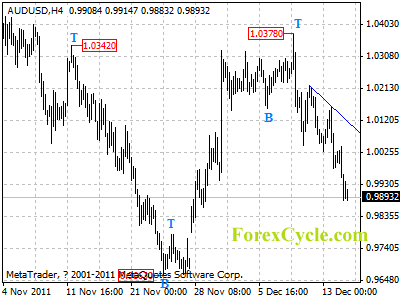
AUDUSD continued its downward move

AUDUSD continued its downward movement from 1.0378, and the fall extended to as low as 0.9883. Further decline could be seen in a couple of days, and next target would be at 0.9800 area. Resistance is at 1.0050 followed by the downward trend line on 4-hour chart, as long as the trend line resistance holds, downtrend will continue.

audusd

Daily Forex Forecast

Investing in Africa’s Solar Energy Dawn

Investing in Africa’s Solar Energy Dawn

by David Fessler, Investment U Senior Analyst
Thursday, December 15, 2011

Barring any hurricanes, windstorms, or heavy, wet, fall snowstorms, this week my 10-kilowatt (kW) solar array should go live. It will be fun to watch my electrical meter run backwards. It will do that at varying speeds, depending how much sun is shining on any given day.

My installer tells me my system will produce power even on cloudy days, just not as much. Given my current electrical load, it will pay for itself in about eight to 10 years.

If I can get my family to stop leaving lights, computers, TVs and other power-sucking appliances on, the payback will be even quicker.

My decision to install solar was a personal one. It’s not entirely based on the economics of the payback. My personal views have nothing to do with the viability of the solar market as a whole. Nor are they a reflection of the investment opportunities that may or may not be represented in the sector, which is what I’m writing about here.

Slow Out of the Starting Gate

It’s no secret that photovoltaic solar generation had a rocky start in the United States. Controversial subsidies have many critics raising their eyebrows. Like Europe, we are besieged by political and economic uncertainty.

Over the past couple of years, plummeting panel prices were the death knell for many would-be panel makers. In addition, cheap natural gas kept solar looking expensive. Not exactly great news for solar panel makers and installers.

Unlike this we-don’t-have-a-national-energy-policy country, many emerging market countries do. For them, building solar into their grids makes a lot of sense. Particularly with panel prices dropping 40 percent in the last year alone.

For the solar market to reach financial viability, there’s one continent that’s going to drive the bulk of the demand that will make it happen.

This place has some great things going for it:

  • Perfect geographical location for solar power generation (lots of sun, all the time)
  • Energy poverty: scarcity of energy production of any kind
  • 587 million of the one billion who live there have little or no electricity
  • A woefully underdeveloped – and in some places non-existent – power grid

This is also a place where payback on solar-generated electricity can come within months or even weeks. There are several reasons for this.

According to the International Energy Agency (IEA), about 85 percent of those 587 million people without electricity live in rural areas. To them, solar – despite its premium costs in developed countries – looks very cost-competitive when compared to other sources of generation.

Where is This Place, Anyway?

I’m talking about Africa. Solar energy developers are tilling fertile ground in Africa’s vast sunbelts. The reason is that most of what little electricity is produced in Africa comes from coal, oil and natural gas.

Much of the power that’s generated is incredibly expensive: about $1 per kilowatt-hour for decentralized diesel generators operating off-grid. This compares to just $0.20 per kilowatt-hour for solar.

No wonder solar companies are flocking there in droves. On the sunny, southwest coast, Namibia is very interested in solar. With a population of just two million, Namibia currently relies almost totally on coal imported from South Africa to meet its energy needs.

Right now, Namibia has inked an agreement with an American-based investment group to build a 500-megawatt (mW) solar photovoltaic power plant near the capital city of Windhoek. The project is expected to cost between $1.6 and $2 billion dollars. Africa Energy Corporation was created to specifically to finance the project.

In Morocco, the World Bank approved a $297-million loan for the country’s first concentrated solar power plant at Ouarzazate. Its initial design capacity is 500 mW, with the capability to grow to 2,000 mW by 2020.

Ouarzazate is being viewed as the proving ground for the much larger Desertec Industrial Initiative. Desertec, if implemented in its full design, will supply all of the power needs of North Africa and much of Southern Europe by 2050.

Finally, in South Africa, Spanish solar developer Abengoa was awarded the rights to build two concentrated solar power (CSP) farms in the country. With investments totaling $1.3 billion, the two CSP farms will be the first of their kind in the country.

How to Play Africa’s Solar Dawn

With a lot of the money – and ultimately the equipment – coming out of the United States, it’s almost a sure bet that American solar panel makers like First Solar, Inc. (Nasdaq: FSLR) and SunPower Corporation (Nasdaq: SPWR) will benefit on the photovoltaic side.

BrightSource Energy, Inc., currently a private company, might also be contracted to provide similar CSP plants (similar to its 370-mW Ivanpah project in the United States) in Africa.

While no specific panel manufacturers have been named, it’s a good bet that the two mentioned above will play a part in Africa’s sunny solar future. That could be the saving grace for an industry that just can’t seem to get firmly on the road to profitability.

Good Investing,

David Fessler

Article by Investment U

Subbaraman Sees 60% Global Growth From China, India

Dec. 14 (Bloomberg) — Robert Subbaraman, chief economist for Asia excluding Japan at Nomura Holdings Inc. in Hong Kong, talks about the region’s economies. Subbaraman also discusses Europe’s sovereign debt crisis and the U.S. economy. He speaks with Susan Li, Rishaad Salamat, Mia Saini and Zeb Eckert on Bloomberg Television’s “Asia Edge.” (Source: Bloomberg)

Netflix: SEC Investigation Or Being Bought By Verizon?

Netflix: SEC Investigation Or Being Bought By Verizon?

by Justin Dove, Investment U Research
Wednesday, December 14, 2011

It’s been quite the interesting year for Netflix (Nasdaq: NFLX).

The stock lasted more than half of the year as a high-flyer, touching its 52-week high of $304.79 in the middle of July.

Then management got gully and overestimated the loyalty of its customer base…

After hiking up its rates and limiting its service, Netflix’s stock fell off a cliff. Pushed further by a horrendous market through the second half of the year, Netflix stock is hovering around $70 a share.

We Called It

We called the fact that Netflix was overpriced back in July, but I’m not sure anyone knew that it would fall so far, so quickly. Anyone could see that a P/E of 180 was expensive and that earnings and the price would have to eventually converge at some point. But while most thought that the earnings would eventually catch up to the price – or at least close to it – the price fell all the way down to the earnings.

But now, five months later, Netflix is at an interesting crossroads. Two developments in the news are making Netflix a very interesting company to watch:

  • Verizon (NYSE: VZ) is rumored to be strongly interested in acquiring Netflix. It would likely add the streaming video service to its FiOS TV product to beef up its on-demand service. According to a Bloomberg source, “Verizon may kick off a bidding war for streaming-video pioneer Netflix that could result in a sale by Easter for about $4.6 billion.” But just as investors were snapping up the stock earlier this week, came this news…
  • According to Disclosure Insight, Netflix is now facing a possible SEC investigation. The disclosure stated that: “In a letter dated 1-Dec-11, we received information from the SEC suggesting this company was involved in unspecified SEC investigative activity. We found no disclosure of the same as of this date.”

Takeover Rumors May Mean Netflix is Cheap

Right now Netflix has a much more reasonable price to earnings of 15.90 with an EPS of 4.40. And since many investors are steering clear because of such poor management decisions and this newly discovered possible SEC investigation, it’s an interesting contrarian stock to watch.

While the stock could still fall a bit further – especially with an investigation by the SEC – it appears with such a low valuation compared to earnings that the floor isn’t too far below.

And with rumors circulating that Verizon or another company may pay up to a $1-billion premium on its current market cap, it could be a nice bargain.

Granted, rumors surrounding a Netflix takeover have come and gone without much action over the past few years. But the latest rumors may be a good clue to investors, that Netflix appears cheap at current valuations and a possibly a good buy for a large company such as Verizon. If a company such as Verizon is doing its due diligence in looking at a possibly buy, maybe investors should, too.

Good Investing,

Justin Dove

Article by Investment U

The Father of Modern Investing… Is a Fraud?

Written by Andrew Snyder, Editorial Director, Inside Investing Daily, insideinvestingdaily.com

The so-called experts will say one thing… but do another. If you want to be a successful investor, you need to know one thing. They’re all liars.

You can’t buy a degree in finance without sitting through a few lectures on the father of modern investing. We’re told Harry Markowitz is a genius. His Modern Portfolio Theory was supposed to give us more return with less risk… Wall Street’s version of paradise.

I had a professor who would blush anytime his name was mentioned.

The only problem is — and it’s a big one — Markowitz doesn’t use his own theory. He’s got a chapter in every one of my old textbooks… yet even he won’t put it into practice.

It’s like a president who wins a Peace Prize and drops bombs on Libya, Afghanistan, Iraq and Pakistan… crazy, huh?

In a decade-old story for Money magazine, Markowitz spilled the beans.

“I have half of my money in stocks, and I’ve got half of my money in bonds,” he said. It was almost the exact opposite of the theory he spewed across academia.

A year later, The Wall Street Journal called him on his contradiction. His response was laughable…

“I visualized my grief if the stock market went way up and I wasn’t in it — or if it went way down and I was completely in it,” he said. “My intention was to minimize my future regret.”

One word… fraud.

This guy virtually invented the business plan of every financial advisory firm in the country, yet when it comes to his own money… it’s do as I say not as I do.

Thanks to Markowitz, we hear it all the time: Diversify.

But what does it mean? Should we follow the steps of this so-called expert and split our financial fate 50/50? Or should we step outside the convention and let the academics and shysters have their neat little pie charts?

You know my answer.

Diversification does not mean grab a handful of blue chips, a few small caps and a couple of stiff bonds. All we have to do is look back three years to see the fallacy in that plan.

What we need to do is diversify our strategy.

Stocks and bonds are great. I own a bunch.

But I also have a stake in a small business. I get royalty income. And I own land. In other words, if Wall Street crumbles… life goes on.

If you are a Safe Haven Investor subscriber, you already know why I like land so much (you also know the best place in the world to buy it right now).

Land is one of the easiest and safest ways to diversify. With one transaction, you can own a low-risk asset anywhere in the world… in any currency.

In western Iowa, for example, a new record was broken last Wednesday. A 74-acre chunk of farmland sold for $20,000 per acre… the highest price yet.

The same day, one landowner sold a parcel for $10,450 per acre… twice what he paid for it just two years ago.

If you followed in the steps of Markowitz — an equal cut of stocks and bonds — you’re missing out on what is one of the largest opportunities of the next four years.

The bottom line to all of this is you have been fed one lie after another. On Wall Street and in Washington, they’re preaching… but they ain’t practicin’.

They tell us (and sometimes force us) to do one thing, while they do the opposite. Once you understand their game, you can get out of it.

Tomorrow, we’ll blow the cover on the ETF scam.

Editor’s Note: The Associated Press just released a story that shows why 2011 was one of the best years ever for American farmers. Their profits spiked by nearly 30%. With an opportunity this big, I’m willing to bet your local senator couldn’t resist the temptation. To see what I’m talking about… follow the link.


Helium to Become Primary Drilling Target

Helium to Become Primary Drilling Target

by Ryan Fitzwater, Investment U Research
Wednesday, December 14, 2011

Every day headlines and articles are dominated by natural gas and oil drilling news. But many are ignoring what could sneak into energy column space in the future… helium.

Helium, which is currently a byproduct of natural gas production, could actually switch to a primary drilling target in the next few years. Why? Simple economics: the U.S. helium supply is declining, and demand is increasing.

Helium isn’t just for birthday party balloons and making your voice sound like a Munchkin; it has many scientific and industrial applications that you might not be familiar with.

With a low density, high thermal conductivity, low boiling point, inertness and low solubility, helium can serve many purposes.

Currently the healthcare industry is the largest consumer of helium. The gas is used in MRI machines to cool superconducting magnets, and would not function without the gas.

Wind tunnels and impulse facilities use helium due to its inertness, and silicon growing is possible because helium is used as a protective gas. It’s also used in semiconductor manufacturing and NASA rockets.

And of course, all modern airships – like the Goodyear Blimp – use helium to make them float, since the element is lighter than air.

A Brief History

During World War I, the United States became interested in helium to replace the extremely flammable hydrogen for use in military blimps and airships.

After the war, the first commercial helium plant was brought online in 1921, in the Petrolia field near Wichita Falls, Texas. After the Petrolia field was depleted, a bigger plant was built on the Cliffside field in Amarillo, Texas, in 1929 and has been the epicenter for the helium industry ever since.

Up until the 1950s, helium was primarily used in military airships, but once engineers discovered more applications for helium (breathing mixtures and arc welding) demand experienced a significant increase.

Helium’s increase in demand was so large that it caused Congress to pass the Helium Act of 1960. The Cold War also played a part in the development of the Act because the gas was considered a strategic resource.

The Helium Act was designed mainly for the United States to buy – using barrowed money – and store helium in the Cliffside field for future use. The Act also had incentives for private natural gas producers to remove helium from natural gas and sell it to the government. This would give private producers a reason to save valuable helium that would otherwise be wasted.

A decade after the Act was passed the helium storage in Cliffside was suspended due to excess supply, which had also produced a debt.

Fast-forward to 1996 and you had President Bill Clinton signing the Helium Privatization Act, getting the government out of production and placing the helium industry in private hands.

The 1996 act was created to sell, by 2015, the majority of the remaining helium stored in Cliffside, in a hope of decreasing the debt incurred by the Helium Act of 1960.

Back to the Present

Since 2000, U.S. helium extraction has been declining – surprising since natural gas drilling has substantially grown over that same period of time.

So why is there a problem?

The Helium Privatization Act. The act was designed to sell off the remaining Cliffside helium reserves by 2015, and in order to meet this deadline, the government had been selling helium at extremely low prices.

Because of this “helium liquidation sale” it became too cheap for numerous natural gas producers to care about extracting it and too cheap for many who use it for industrial applications to recycle it.

And while all of this created a temporary flood in supply, the future will not be the same if production continues to be stagnant.

Helium’s Future

Current National Research Council (NRC) estimates have the world running out of helium in 30 years or less – this is if current production continues its trend. And the NRC believes that the United States might become a net importer of helium in the next decade.

The good news is that, over a year ago, the Bureau of Land Management created a new methodology for calculating the price of Federal Crude Helium.

Instead of selling helium reserves at the low cost established by the 1996 Privatization Act, it now sells it at market price that’s based on current supply and demand principles. This is for open market sales only – those made to the government continue to be sold at the minimum defined by the Act.

But the fact remains that helium suppliers are experiencing a reduction in production and only one new plant is on pace to come online in the United States over the next three years.

Helium prices have already doubled over the last five years. And as U.S. reserves are depleted and supply dwindles, helium prices will continue to rise.

The United States consumes 39 percent of the global helium demand, and while it’s currently the world’s top supplier it might not be for long.

Overseas in Russia, Algeria and Qatar, plants are coming online to provide supplies to Asia and emerging markets as U.S. exports slow down.

Investors should keep an eye on Air Products and Chemicals, Inc. (NYSE: APD), which sells, distributes and produces gas products, including helium. As helium supplies begin to diminish, higher prices should help boost the company’s bottom-line.

Good investing,

Ryan Fitzwater

Article by Investment U
Uptrend & 200-Day Average “Highly Significant” for Gold as “Liquidation” & “Caution” Drive New 7-Week Low

London Gold Market Report
from Adrian Ash
BullionVault
Weds 14 Dec., 08:45EST

THE PRICE OF GOLD fell back to new 7-week lows in London on Wednesday, giving back a 1% rally from Asian trade as world stock markets and commodity prices also fell after the US Federal Reserve kept its monetary policy unchanged on Tuesday.

Dollar investors saw the price to buy gold dip below $1624 per ounce – down over 5% from last weekend – as copper prices sank to a 2-week low and US crude oil fell through $100 per barrel.

Silver prices fell to their lowest point in 10 weeks, dropping through the $30-level first seen in November 2010.

Persisting with its $400 billion switch into longer-dated US Treasury bonds, the Fed on Wednesday also repeated its vow – first made in Dec. 2008 – to keep short-term US rates at “exceptionally low levels” for the foreseeable future, “at least through mid-2013”.

“Some macro hedge funds are liquidating gold holdings and taking profits in a difficult year,” says James Steel at bullion-bank HSBC.

“As trading volume typically drops toward year-end, we expect increasingly volatile price swings.”

“We have the beginnings of a real bear market, and the death of a bull [in gold],” reckons Dennis Gartman, author of the eponymous $5,000-a-year investment letter, who began advising subscribers not to buy gold in August according to Bloomberg.

“So much damage has been done to the psychology of the market in the past week and so many late longs have been caught off guard that we think wholesale liquidation, and perhaps forced liquidation, shall be the outcome.”

The volume of gold bullion held to back shares, however, in the New York-listed GLD exchange-traded trust was unchanged Tuesday, equal to $67.8 billion and keeping world ETF holdings near the all-time record set last week.

Over in Hong Kong this morning, “There is a lot of talk about 200-day moving average,” said one dealer’s note – “only 1-2% away from current spot gold.”

“The gold price has not broken below this moving average since 2009,” says a London dealer. “It is therefore a highly significant level of support, and a breach would be very bearish indeed.”

Analysis by BullionVault this morning put the average gold price of the last 200 sessions at $1610.

Joining the price’s low points since Lehman Brothers collapsed in late 2008, gold’s uptrend now comes in just below at $1600 per ounce – “the level held repeatedly in the volatile Sept-Oct. period,” says another wholesale dealer.

On the data front Wednesday, Eurozone industrial production showed a 0.1% drop in Oct. from Sept., defying analyst forecasts of a rise in the value of manufacturing, mining and utilities output.

UK unemployment held flat at 8.3% of the working-age population last month, but average wages for those in work grew just 2.0% from a year earlier. Consumer price inflation was 4.8%.

Money-supply growth in China – the world’s fastest-growing major economy, and now the second largest consumer market for physical gold – showed a slight slowdown, with the M2 measure of currency in circulation and bank deposits rising 12.7% year-on-year, just below analyst forecasts.

“Consumers should look to buy the dips in gold,” reckons a note from Standard Chartered bank, pointing to strong Asian demand to buy gold.

“Any [price] weakness is likely to be short-lived and problems in the global economy will be supportive over the medium term.”

The Euro currency today fell through $1.30 for the first time since January, buoying
the price for Eurozone investors wanting to buy gold above €40,200 per kilo.

Italy this morning had to pay a post-Euro record of 6.47% to borrow 5-year money, after German chancellor Merkel yesterday blocked any increase in the Eurozone’s €500 billion “stability mechanism” fund.

“As long as the Dollar is gaining, at least until the end of the year, gold will not be in the best position and will remain under pressure,” says Nikos Kavalis, a commodities strategist at RBS in London, speaking to Reuters.

“The market is tending to want to see things from a cautious point of view. We are near the end of the year and no one wants to be particularly heroic.”

Adrian Ash
BullionVault

Gold price chart, no delay   |   Buy gold online at live prices

Formerly City correspondent for The Daily Reckoning in London and head of editorial at the UK’s leading financial advisory for private investors, Adrian Ash is head of research at BullionVault – winner of the Queen’s Award for Enterprise Innovation, 2009 and now backed by the World Gold Council market-development and research body – where you can buy gold today vaulted in Zurich on $3 spreads and 0.8% dealing fees.

(c) BullionVault 2011

Please Note: This article is to inform your thinking, not lead it. Only you can decide the best place for your money, and any decision you make will put your money at risk. Information or data included here may have already been overtaken by events – and must be verified elsewhere – should you choose to act on it.

Sinha Favors U.S. Dollar in 2012 on `Safe Haven Flows’ (Video)

Dec. 14 (Bloomberg) — Adarsh Sinha, head of strategy for Group of 10 foreign exchange at Bank of America Merrill Lynch in Hong Kong, talks about the outlook for global currencies, their exposure to Europe’s debt crisis and trading strategy. Sinha speaks with Rishaad Salamat on Bloomberg Television’s “On the Move Asia.” (Source: Bloomberg)