Ball (BLL) was upgraded today by JP Morgan (JPM) from neutral to overweight as the firm believes the beverage can business will outperform other pcakaging markets. Shares are higher by 2.4 percent.

Ball (BLL) was upgraded today by JP Morgan (JPM) from neutral to overweight as the firm believes the beverage can business will outperform other pcakaging markets. Shares are higher by 2.4 percent.
The markets opened higher, despite signs of weakness in the US economy from the jobs and retail sector, but stocks were trading flat for most of the day. More people filed for unemployment benefits than expected last week, to the highest level in six weeks, according to the Labor Department.

Forex & Financial Market Update: Levels & Technical Analysis
In trading on Thursday, transportation services shares were relative laggards, down on the day by about 1.4%. Helping drag down the group were shares of Zipcar (ZIP), down about 4.2% and shares of Bristow Group (BRS) off about 1.2% on the day.

In trading on Thursday, precious metals shares were relative leaders, up on the day by about 1.2%. Leading the group were shares of Golden Minerals (AUMN), up about 6% and shares of Kimber Resources (KBX) up about 5.6% on the day.


Indonesia’s central bank, Bank Indonesia, kept the BI reference rate unchanged at 6.00%. Bank Indonesia Governor, Darmin Nasution, said: “Board of Governors views that current BI rate is still consistent with inflation targets, financial system stability, and remains conducive to propel domestic economic expansion amidst global economic uncertainty. In 2011, Indonesian economy showed strong performance with low inflation, higher economic growth, stable exchange rate, and stable financial system. The achievement was supported by various policies implemented by Bank Indonesia and the government. Going forward, Bank Indonesia will monitor closely the worsening global economic condition. Regarding the policy, Bank Indonesia will continue to strengthen monetary and macro-prudential policy mix, as well as coordination with the government.”
Previously the Bank cut the interest rate by 50 basis points at its November meeting, and also cut the key monetary policy rate (the BI Rate) by 25 basis points to 6.50% at its October meeting. Previously the Bank raised the BI rate by 25 basis points to the current 6.75% in February 2011. Indonesia reported annual inflation of 4.1% in November, down slightly from 4.61% in September, compared o 4.79% in August and July, 4.61% in June, 5.98% in May, 6.16% in April, and 6.65% in March, and just inside the inflation target of 5% +/-1% in 2011 (which changes to 4.5% +/-1% in 2012).
Bank Governor Nasution previously said the Bank expects “inflation next year [2012] will be below 5%”. Bank Indonesia has previously forecast GDP growth of 6.3-6.8% in 2011 and 6.4-6.9% in 2012 for the Indonesian economy, meanwhile Indonesia reported annual GDP growth of 6.5% in the June quarter last year.
The Indonesian Rupiah (IDR) has weakened by about 1% against the US dollar over the past year, and the USDIDR exchange rate last traded around 9,157.

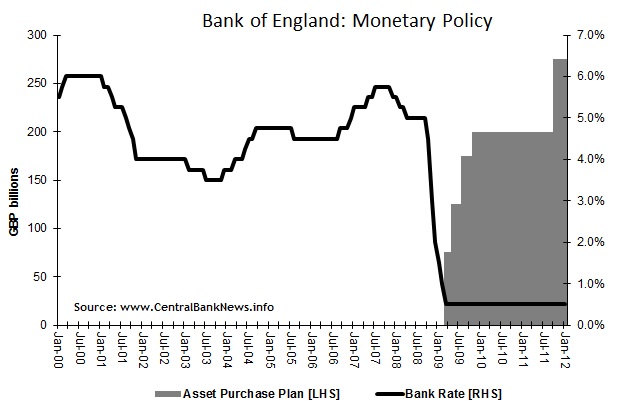
The Bank of England (BoE) held the Bank Rate at a record low stimulatory level of 0.50%, and continued with its Asset Purchase Program (Quantitative Easing) target of GBP 275 billion, after increasing it by 75 billion at its October meeting. On its asset purchase program, the Bank said: “The Committee expects the announced programme of asset purchases to take until early February to complete. The scale of the programme will be kept under review.” The Bank releases its minutes on the 25th of January.
The Bank also held the official Bank Rate unchanged at 0.50% at its December meeting last year; the rate has remained on hold since March 2009, when the Bank reduced the interest rate by 50 basis points to 0.50%. The United Kingdom reported annual consumer price inflation of 5.2% in September, 4.5% in August, and 4.4% in July, and still above the Bank’s inflation target of 2.00%.

Tractor Supply (TSCO) issued revised guidance, raising its 2011 earnings forecast to a range of of $2.97 to $2.99 per share, up from $2.85 to $2.89 per share. The company said that sales for its fourth quarter were 20.1% higher to $1.24 billion, while same store sales increased 7.6% versus 13.1 percent in the same period last year.

The European Central Bank (ECB) held its Main refinancing operations rate unchanged at 1.00%. ECB governor, Mario Draghi, said: “Inflation is likely to stay above 2% for several months to come, before declining to below 2%. At the same time, the underlying pace of monetary expansion remains moderate. As expected, ongoing financial market tensions continue to dampen economic activity in the euro area, while, according to some recent survey indicators, there are tentative signs of a stabilisation in activity at low levels. The economic outlook remains subject to high uncertainty and substantial downside risks. In such an environment, cost, wage and price pressures in the euro area should remain modest and inflation rates should develop in line with price stability over the policy-relevant horizon. “
The ECB previously announced (making no changes to this time) a series of measures “to support bank lending and money market activity”. These measures included longer-term refinancing operations (LTROs), reduction in the reserve ratio to 1% from 2% presently, and increasing collateral availability through reducing the rating threshold for asset-backed securities (ABS), and allowing national central banks to accept bank loans as collateral. Essentially the moves are designed to prevent a freezing up of credit markets and liquidity akin to that seen during the global financial crisis.
Previously the ECB also cut the interest rate by 25 basis points at its November and December meetings. The ECB last increased the interest rates by 25 basis points at its July meeting; pausing in May and June, after raising the rate by 25 basis points to 1.25% in April last year. The Euro Area reported annual HICP inflation of 3% in November and October and September, 2.5% in August and July, 2.7% in June (same as May) and above the Bank’s inflation target of maintaining inflation below, but close to, 2% over the medium term.
The Euro Area reported quarterly GDP growth in the September quarter of 0.2% (1.4% y/y); the same as the June quarter of 0.2%, following a 0.8% increase in the March quarter, and a 0.3% increase in the December quarter of 2010. The Euro (EUR) has weakened by about 5% against the US dollar over the past year, while the EURUSD exchange rate last traded around 1.28

Source: ForexYard

The EUR/USD turned bullish on Thursday, as the combination of a successful Spanish bond auction and the European Central Bank’s decision not to lower euro-zone interest rates helped turn investors onto the common currency. Analysts were quick to warn that the overall trend for the pair is still strongly bearish and the gains can be partly attributed to traders correcting the huge euro sell-off in the last few weeks.
Thursday also saw the release of several important US indicators that came in below expectations. Both the Retail Sales and Core Retail Sales figures proved to be disappointing , while a higher than forecasted number of Americans filed for unemployment benefits last week. The news cast doubts on the strength of the US economic recovery. How traders will react to the poor economic data will likely depend on US indicators set to be released today.
On Friday, traders will want to pay attention to the US Trade Balance and Prelim UoM Consumer Sentiment figures. While the Trade Balance figure is forecasted to come in slightly worse than last month, the Consumer Sentiment figure is expected to increase slightly. Positive news is likely to help the USD against its main safe-haven currency rivals, especially the yen and Swiss franc, to close out the week.
Forex Market Analysis provided by ForexYard.
© 2006 by FxYard Ltd
Disclaimer: Trading Foreign Exchange carries a high level of risk and may not be suitable for all investors. There is a possibility that you could sustain a loss of all of your investment and therefore you should not invest money that you cannot afford to lose. You should be aware of all the risks associated with Foreign Exchange trading.
