Jan. 13 (Bloomberg) — Switzerland’s central bank returned to profit last year as the valuation of gold holdings and foreign currency reserves helped bolster earnings. Simone Meier reports from Zurich on Bloomberg Television’s “Countdown.”
Forex CT 13-1-12 Video News Update & Outlook
Video courtesy of ForexCT – A leading Australian forex broker, liscensed by the Australian Securities & Investments Commission, offers the MetaTrader4 and PROfit Platform to retail traders. Other services include Segregated Accounts, Trading workshops, Tutorials, and Commodities trading.
EUR Sees Gains Following Spanish Bond Auction
Source: ForexYard
The euro pared recent losses against its main currency rivals on Thursday, following a successful Spanish bond auction. The EUR/USD climbed well above the 1.2700 level, while the EUR/JPY saw steady gains throughout the day. Today, US news is forecasted to generate some market volatility. Traders will want to pay attention to the US Trade Balance and Prelim UoM Consumer Sentiment figures for clues as to what direction the markets will take to close out the week.
Economic News
USD – Dollar Stages Downward Correction against Euro
The EUR/USD turned bullish on Thursday, as the combination of a successful Spanish bond auction and the European Central Bank’s decision not to lower euro-zone interest rates helped turn investors onto the common currency. Analysts were quick to warn that the overall trend for the pair is still strongly bearish and the gains can be partly attributed to traders correcting the huge euro sell-off in the last few weeks.
Thursday also saw the release of several important US indicators that came in below expectations. Both the Retail Sales and Core Retail Sales figures proved to be disappointing , while a higher than forecasted number of Americans filed for unemployment benefits last week. The news cast doubts on the strength of the US economic recovery. How traders will react to the poor economic data will likely depend on US indicators set to be released today.
Today, traders will want to pay attention to the US Trade Balance and Prelim UoM Consumer Sentiment figures. While the Trade Balance figure is forecasted to come in slightly worse than last month, the Consumer Sentiment figure is expected to increase slightly. Positive news is likely to help the USD against its main safe-haven currency rivals, especially the yen and Swiss franc, to close out the week.
EUR – Euro-zone bond auction gives EUR Slight Boost
The euro saw some positive upward movement yesterday, following a successful Spanish bond auction which boosted investor confidence in riskier currencies. The EUR/USD approached the 1.2800 level, while the EUR/JPY came off an 11-year low reached earlier in the week. While the common currency saw a largely bullish day on Thursday, analysts were quick to warn that these gains were largely incidental and that a significant upward correction is unlikely to occur in the near future.
Today, traders will want to pay attention to the on-going developments in the euro-zone. Investors are largely pessimistic that a solution to the euro-zone debt crisis can be found. Until a plan is implemented, it seems less and less likely that the euro will reverse trends. Any further negative euro-zone news may cause the currency to slip to new lows.
CHF – Franc Gains on USD as Traders Return to Safe-Havens
The Swiss franc moved up against most of its main currency rivals on Thursday, as investors returned to safe-haven currencies following disappointing US economic news. The USD/CHF tumbled following the release of the US Retails Sales and Unemployment Claims figures. Similarly, the EUR/CHF maintained its overall bearish trend.
Today, traders will want to pay attention to US economic indicators, specifically the Trade Balance and Prelim UoM Consumer Sentiment figures. Should either of them disappoint and come in below expectations, the franc may see another bullish day to close out the week.
Crude Oil – Oil Sees Gains Following Bullish EUR Reversal
Crude oil climbed well above the $102 a barrel level on Thursday. The commodity received a healthy boost after positive euro-zone data helped boost demand for oil among international buyers. Oil typically turns bullish when the euro increases in value, and international buyers can afford to purchase more.
Whether oil can maintain these gains to close out the week largely depends on news out of the euro-zone. Any positive developments with regards to the euro-zone debt crisis will likely keep the commodity at or above its current levels. In addition, continued tensions in the Middle East are forecasted to keep oil above the $100 level, as supply side worries tend to drive up prices.
Technical News
EUR/USD
A bullish cross on the daily chart’s Stochastic Slow is a sign that upward movement may occur in the near future. This theory is supported by the Relative Strength Index on the same chart, which has drifted into the oversold zone. Traders may want to go long in their positions today.
GBP/USD
The Williams Percent Range on the weekly chart has dipped well into the oversold region, indicating that bullish movement may be on the horizon. Additionally, the Relative Strength Index is hovering close to the 20 level. Going long may be the preferred strategy today.
USD/JPY
Technical indicators are still providing mixed signals for this currency pair. While the Relative Strength Index on the 8-hour chart is in oversold territory, most other indicators are in the neutral zone. Taking a wait-and-see approach may be the preferred strategy today.
USD/CHF
The daily chart’s Williams Percent Range has drifted above the -20 level, indicating that bearish movement may occur in the near future. Traders may want to go short in their positions before any downward correction.
The Wild Card
AUD/NZD
Daily chart technical indicators are showing a possible bullish correction for this pair in the near future. The Relative Strength Index is right on the border of being oversold, while a bullish cross has formed on the Stochastic Slow. Forex traders may want to go long in their positions before an upward correction takes place.
Forex Market Analysis provided by ForexYard.
© 2006 by FxYard Ltd
Disclaimer: Trading Foreign Exchange carries a high level of risk and may not be suitable for all investors. There is a possibility that you could sustain a loss of all of your investment and therefore you should not invest money that you cannot afford to lose. You should be aware of all the risks associated with Foreign Exchange trading.
Markets and The Madness of Crowds
By MoneyMorning.com.au
Yes, I know that markets are irrational.
I read Charles Mackay’s 1841 classic, “Extraordinary Popular Delusions and the Madness of Crowds” long before it ever became fashionable.
Even so, when you think about it, 2011 must set some kind of record.
As investors, that means we need to decide whether this madness will continue in 2012 and which direction to take.
Take the madness in the bond world, for instance.
Long-term bonds of a country with an out-of-control budget deficit and a worrying trade deficit are currently yielding 1.6% below inflation.
In other words, year after year, investors are willing to pay 1.6% of their capital to hold them. On top of that, investors have been so keen on this miserable asset in 2011 they have bid up its price by no less than 26%.
Conversely, China is revolutionising the world economy.
Year after year, China puts up growth rates of 8% or more, and the latest data suggest that will continue throughout 2012.
What’s more, Chinese stocks stand on a bargain-basement price-to-earnings (P/E) ratio of less than 8-times earnings. Yet, in 2011, investors shunned these bargains, giving the Chinese market a pathetic return of minus-22%.
It’s Madness I Tell You
Do you see what I mean when I talk about irrational?
To a Martian, these statistics would be proof that earthly markets had lost their collective minds. That’s not just a random walk – it’s a deliberate stroll that will destroy your wealth.
For investors, it raises the question of how long this irrationality is going to last. Will this extreme irrationality persist in 2012, or will it reverse?
The first conclusion to be drawn is that current markets are unhealthy, and largely the product of government meddling.
Western governments have been pumping money into the global economy since 2008, and running budget deficits larger than ever before in peacetime. Meanwhile, the Chinese government has been engaging in massive “stimulus” itself, but financing it through the banking system.
When you look at current markets as massively distorted, the right conclusion becomes clear: [US] Treasury bonds are a bubble, inflated by massive money printing worldwide and the troubles in Europe.
And while they may have done well in 2011, they are likely to reverse sharply sometime in 2012. Therefore, Treasury bonds should be avoided at all costs.
As for the Chinese economy, it is facing severe headwinds due to massive problems in the banking system that will make some kind of crash and recession inevitable.
There’s always gold.
It may have fallen out of favor recently, as T-bond prices have soared even higher, but it looks a much better safe haven to me.
U.S. Federal Reserve Chairman Ben S. Bernanke has said he’s not increasing interest rates until the middle of 2013, the Bank of England has announced a huge new bond buying program, the European Central Bank (ECB) is certainly not going to tighten any time soon and Japan also looks unlikely to do so.
All that money has to go somewhere, and gold looks the obvious beneficiary.
Martin Hutchinson is a Contributing Editor to Money Morning (USA).
Publisher’s Note: This is an edited version of an article that first appeared in Money Morning (USA)
From the Archives…
A Story of Sell-Offs & Super Spikes by a Stock Market Trader
2012-01-07 – Murray Dawes
Why BHP Will Be the First Victim of China’s Economic Collapse
2012-01-06 – Kris Sayce
The Sun Starts to Set on China’s Economy
2012-01-05 – Kris Sayce
New Year’s Eve 2029: Will the Australian Stock Market Lose a Decade of Growth?
2012-01-03 – Kris Sayce
How to Buy Gold and Silver
2011-12-11 – Dr Alex Cowie
For editorial enquiries and feedback, email [email protected]
South Korea Central Bank Keeps Repo Rate at 3.25%
The Bank of Korea held its 7-day repurchase rate steady at 3.25%. The Bank said: “In Korea, exports have kept up their steady increase, but domestic demand has been subdued with consumption and construction investment decreasing from the previous month. On the employment front, the number of persons employed has sustained its large scale of increase, led by the private sector. The Committee anticipates that domestic economic growth will gradually return to its long-term trend level going forward, after remaining subdued for some time due mostly to the impact of external risk factors.”
At its Decmber meeting the Bank of Korea also held the interest rate unchanged at 3.25%, after increasing the 7-day repurchase rate by 25 basis points to 3.25% at its June meeting. South Korea reported a steady consumer price inflation of 4.2% in November, compared to 3.9% in October, 4.3% in September, 5.3% in August, 4.7% in July 4.4% in June, 4.1% in May, and 4.2% in April.
The inflation rate is currently just above the Bank’s inflation target of 2%-4% through 2012. The South Korean economy grew 0.7% in Q3 (0.9% in Q2), placing annual GDP growth at 3.4% (3.4% in Q2). The South Korean Won (KRW) has weakened by about 3% over the past year against the US dollar, while the USDKRW exchange rate last traded around 1,149.

Central Bank of Chile Cuts Rate 25bps to 5.00%
The Banco Central de Chile cut its monetary policy interest rate by 25 basis points to 5.00% from 5.25% previously. The Bank noted: “Domestically, output and demand have evolved in line with forecasts in the latest Monetary Policy Report. The labor market is still tight. The money market has normalized, while financing conditions for some agents are tighter than a few months ago. December’s headline and core inflation was higher than expected due to the prices of perishables and other foods and the lagged incidence of the peso depreciation in the fourth quarter of 2011. Inflation expectations remain near the target.”
Chile’s central bank previously kept the monetary policy interest rate unchanged at 5.25% at its December meeting. The Bank last raised its monetary policy interest rate by 25 basis points to 5.25% at its June meeting last year. Chile reported annual consumer price inflation of 3.7% in October, compared to 3.3% in September, 3.2% in August, 2.9% in July, 3.4% in June, 3.3% in May and 3.2% in April last year; within the Bank’s inflation target of 2-4%.
The Chilean economy grew 8.4% in the first half of 2011, driven by strong domestic demand; full year GDP growth is expected around 6.5%. The Chilean Peso (CLP) has weakened about 2% against the US dollar over the past year, while the USDCLP exchange rate last traded around 501.

Prepare Your Portfolio for Eurozone Money Printing
By MoneyMorning.com.au
Even Germany is feeling the eurozone’s pain now.
Initial estimates suggest that the German economy probably shrank in the fourth quarter of 2011. If it shrinks again this quarter, then that’d be a technical recession.
It shouldn’t really come as a surprise. You can’t sit in the middle of all that chaos and panic and expect to get away unscathed. And with global demand for exports weakening, Germany’s main growth driver is suffering too.
The bad news is that this will all have a nasty knock-on effect to the rest of the world. The good news – if there is any – is that it might just lead to the eurozone crisis being resolved more rapidly…
Continue reading “Prepare Your Portfolio for Eurozone Money Printing”
Why Fallen Commodity Prices Mean This Sector is Worth a Punt
By MoneyMorning.com.au
“Australia is set for a $112 billion infrastructure boom as the nation adds ports and railways to feed China and India’s appetite for coal and iron ore.” – Bloomberg News
As Bloomberg reports, this is to back-up the $232 billion going into Australian resources projects. All up, that’s $343 billion.
Surely it’s possible to make a buck or two from that.
There is -and funnily enough by taking advantage of fallen commodity prices. We’ll show you how in a moment.
First, look at this chart:

Source: CMC Markets Stockbroking
It’s the S&P/ASX 300 Metals & Mining Index.
As you can see, from early 2007 to mid-2008, the Index almost doubled. Over the next six months it halved. Then it took another two years to double again as the market recovered.
Yet since early last year, commodity prices have gone down again. In fact, one of Diggers & Drillers editor Dr. Alex Cowie’s favourite commodities – tin – has slumped 42% since March 2011…
Commodities Looking Cheap
But as the Doc told your editor this morning:
“The London Metal Exchange warehouse stock is down to just 11,000 tonnes. That’s unusually low. Stock piles are down 40% in just three months. So I expect tin to rally from here, and my two tin stocks to go with it.”
So, with all those dollars gushing into the Australian resources industry, why the heck have resources stocks fallen?
It’s all to do with investor expectations.
You see, even though $343 billion is a lot of money, the market already knows about it. In fact, it’s partly why the market took off leading up to 2008 and again from 2009 to 2011.
In other words, it’s old news. So these dollars are already accounted for in company valuations. Add to that falling commodity prices and it’s bad news for commodity stocks.
The following chart of the CRB Commodity Index shows how commodities have done since last September:

Source: crbtrader.com
The main reason the Aussie market failed to keep up with the rising U.S. market last year is due to falling commodity prices.
And this has obviously meant falling resources stocks.
But that’s the past. What about the outlook for commodity-based stocks. Well, this is where it gets interesting…
Another Commodity Surge Coming
Our bet is the U.S. and European central banks will print more money this year. They’re already making noises about how successful the last efforts were. So it’s only a matter of time before both central banks reveal their plans.
For instance, Agence France Presse reports the following from Mario Draghi, chief of the European Central Bank:
“We have seen several… positive developments. The more time that passes since we had the first three-year, long-term refinancing operation, the more we see signs that it has been an effective policy measure.”
This follows on from the comments we printed earlier this week from Federal Reserve Bank of San Francisco President, John Williams. He sees a “strong” case for the U.S. Fed to buy more bonds this year.
To us that means another spurt of commodity speculation this year. Prices have dropped. And although they could fall further, they’re at a level where we believe they’re worth a punt.
So, where should you stick your cash?
Our preference is still energy (oil and gas stocks) and strategic metal stocks (e.g. rare earths). These are genuine bull market stocks. And when commodity prices take off again, these stocks should move quickly.
But there’s another sector we’re seriously looking at too…
A Rise to Follow the Fall?
Not just because of rising commodity prices, but because of how much these stocks have fallen… and that’s the resources services stocks.
Those are the companies that don’t actually dig the stuff up or drill for things. Instead, they provide the back-up… the “tools of the trade”: drill bits, temporary accommodation, rigs, power infrastructure, and so on.
Stocks in this sector have taken a beating. And many are back to a level that makes them worth looking at again. Like all small-cap punts, these will be high risk.
But if as we expect, central banks print more, and China stimulates its economy again, it’s possible we’ll see another huge commodity stock boom this year. And after a big fall these are stocks that could benefit the most.
You wouldn’t want to bet your house on it, because the subsequent fall will be just as big. But if you set aside a small part of your portfolio for speculative punts, this could be where you’ll get some of the biggest returns.
Cheers.
Kris
P.S. So, when will the European Central Bank (ECB) print more money? In today’s other article “Prepare Your Portfolio for Eurozone Money Printing,” UK Money Morning Editor John Stepek gives his view on the problems facing the ECB. And the actions investors can take to protect themselves…
Related Articles
Special Report: Six Extraordinary Resource Investment Opportunities for 2012
The Only Gold and Silver Stocks to Buy
Why Fallen Commodity Prices Mean This Sector is Worth a Punt
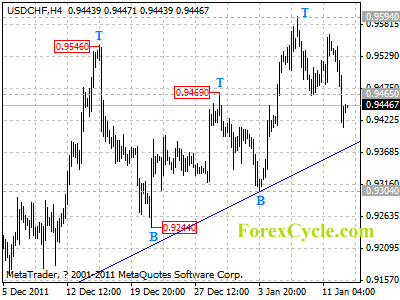
USDCHF continued its downward move
USDCHF continued its downward move from 0.9594, and the fall extended to as low as 0.9411. Further fall to test the support of the upward trend line from 0.9066 to 0.9304 is expected later today, as long as the trend line support holds, the price action from 0.9594 is treated as consolidation of uptrend from 0.8569 (Oct 27, 2011 low), another rise towards 1.0000 is still possible. However, a clear break below the trend line will suggest that the rise from 0.8569 has completed at 0.9594 already, then the following downward movement could bring price back to 0.8850 area.
Ultra Clean Holdings Sees Prelim Sales And EPS Above Estimates
Ultra Clean Holdings (NASDAQ:UCTT) announced that its preliminary Q4 EPS would exceed the high end of the guidance given in late October of break even to $0.02, vs. consensus estimates of $0.0.1.The company said it sees Q4 prelim revenue of $85 million – $86 million, vs. its previous guidance of $75 million to $80 million, vs. consensus estimates of $79 million.The company is scheduled to present at Needham Growth Conference today at 3:30 PM and reports its Q4 results on February 13th.Ultra Clean (NASDAQ:UCTT) has potential upside of 6.4% based on a current price of $6.05 and an average consensus analyst price target of $6.44.

