Britain’s finance minister Georger Osborne and his Japanese counterpart, Jun Azumi, stay focused on the euro zone crisis.

Britain’s finance minister Georger Osborne and his Japanese counterpart, Jun Azumi, stay focused on the euro zone crisis.
As high-paying finance jobs disappear in Europe and the US, many young bankers have been looking to Asia. But the grass isn’t always so green on the other side of the pasture, reports Jon Gordon.

Indonesia’s central bank, Bank Indonesia, widened its interest rate corridor for interbank funding (the deposit facility rate) to 200 basis points below the Bank Indonesia rate, from 150bps previously – effectively easing monetary policy settings. The Bank said [translated]: “This is done as a step to strengthen the liquidity management of banks, by encouraging banks to transact with each other, while expected to improve the efficiency of banking. This decision is effective from Wednesday, January 18, 2012.”
The Bank held its rate unchanged at its January meeting, and cut the interest rate by 50 basis points at its November 2011 meeting, and also cut the key monetary policy rate (the BI Rate) by 25 basis points to 6.50% at its October meeting. Previously the Bank raised the BI rate by 25 basis points to the current 6.75% in February 2011. Indonesia reported annual inflation of 4.1% in November, down slightly from 4.61% in September, compared o 4.79% in August and July, 4.61% in June, 5.98% in May, 6.16% in April, and 6.65% in March, and just inside the inflation target of 5% +/-1% in 2011 (which changes to 4.5% +/-1% in 2012).
Bank Governor Nasution previously said the Bank expects “inflation next year [2012] will be below 5%”. Bank Indonesia has previously forecast GDP growth of 6.3-6.8% in 2011 and 6.4-6.9% in 2012 for the Indonesian economy, meanwhile Indonesia reported annual GDP growth of 6.5% in the June quarter last year. The Indonesian Rupiah (IDR) has weakened by about 1% against the US dollar over the past year, and the USDIDR exchange rate last traded around 9,118.

By MoneyMorning.com.au
How often do you reckon a successful stock trader gets it right? 60%, 70%, 80% of the time?
Not a chance!
Most stock market traders don’t get anything near that sort of hit rate. At least not the stock traders I talk to. Many of the best traders have a hit rate of well under 50%. Sometimes as low as 20%!
But they still make money overall.
This all comes down to what’s probably the most important lesson you can learn as a stock market trader. That is: maximise your winners and minimise your losers.
Even if you don’t consider yourself a stock trader, keep reading. This is for long-term investors, too. In my experience, many stock market trading concepts can be incredibly useful for your long-term investment approach. Especially this one…
Imagine you’re learning to ski. You’re descending nervously down the slope when things start to go wrong. You’re building up speed and you’re going too fast to put in a turn. That’s when most sensible novices sit down – a self-induced fall you might call it. If not, you end up gathering pace and setting yourself up for an almighty wipe-out.
That’s kind of what I’m talking about here. When your losses start to gather pace, you need to get out of the trade. A calculated crash – and minimised loss – means you can get up and have another go.
In terms of stock market trading, what we’re talking about is setting relatively tight stop-losses. A stop-loss is basically an instruction with your stockbroker to quit your trade if it hits a predetermined level. It quite literally ‘stops’ your loss from escalating.
My colleague John C Burford often refers to his 3% rule. Never put more than 3% of your cash at risk with any one stock market trade. Work out where that loss is and place your stop there.
The only thing I’d add is that your stop should also relate to the stock’s volatility and trading range.
Now clearly such a tight wealth preservation strategy could trigger a lot of stop-losses. As a successful stock trader, you’re going to have to accept not just the occasional loss, but a lot of them.
That’s why most investors don’t make for good traders. Most can’t accept that in this game you never progress further than the ‘novice’ level. The most common shortcoming for a stock trader is that he thinks he’s an expert. He’s not going to sit down before he falls down – and he sets himself up for a serious wipe-out.
But of course you’re never going to get rich by just cashing in losses…
To make up for your losing stock trades, you’re going to have to make sure you squeeze some serious profits out of your winners. This is tougher than it sounds.
With a stock moving up, emotions run high. There’s a very real danger of getting trigger happy… glued to your monitor, with your hand on the mouse, it’s all too easy to snatch a quick profit. “You’ll never go broke cashing in a profit” is dangerous advice.
What you want to do is make the most of the momentum. Ride your winning trades until you’re confident the trend has reached the end. A trailing stop-loss could be great way of doing that. You keep moving your stop-loss up as the price goes up, selling once the stock drops a certain amount below its high.
The point is, minimise your losses and let your winners run.
Bengt Saelensminde
Contributing Editor, Money Morning (UK)
Publisher’s Note: This is an edited version of an article that first appeared in Money Morning (UK).
Minimising losses and letting the winners run is part of what makes Murray Dawes a successful trader. Remember to check out Murray’s latest free stock market update video on YouTube by clicking this stock market update link.
From the Archives…
Why Fallen Commodity Prices Mean This Sector is Worth a Punt
2012-01-13 – Kris Sayce
Why Australian Banks Are a “Suckers” Investment You Should Avoid
2012-01-12 – Greg Canavan
The Fed’s Funny Money Merry Go Round
2012-01-11 – Kris Sayce
Silver Price Ready to Explode
2012-01-10 – Dr. Alex Cowie
Will the Gold Bull Keep Running in 2012?
2012-01-09 – Dr. Alex Cowie
By MoneyMorning.com.au
Since 29 June 2001 (when they first began to measure it), the ASX financials index (ASX: XFJ) has lost 6.47%.
Some bank stocks in the financials index, like Commonwealth Bank of Australia (ASX:CBA) for instance, are up. CBA is up around 64.22%. But to even it out, other stocks in the index have gone down just as much.
It’s like an apothecary scale…
Some of the stocks are winners. Some are losers. And they balance each other out. Yes. It’s boring.
What is interesting is what might happen next…
As you will see on the chart below, this index has returned to an important level.

XFJ spent most of 2003 stuck in a range right on this level – the 4000 level. Then it started a massive run that saw it hit 7500. That was roughly an 87.5% gain at the time… And if it were to do it again, it would still be roughly an 87.5% gain on today’s price.
So the question is, will it happen again?
The position of the banks today is different from what it was in 2003. Back then, as you can see in the chart on the left below, credit was growing at a rate of around 15%…
Growth in housing debt was at a 15-year high… Personal debt was at a 3-year high… And business debt was just starting its mammoth rise… There seemed no end to credit growth in sight.
Financial shares reflected this. As you saw before, they gained 87.5%. But today things are different…
As you can see on the chart to the right, credit growth is plumbing near 20-year lows.
Housing credit is at its lowest point since 1981. Business credit growth is at its lowest rate since 1991.
And as a recent report from the Sydney Morning Herald shows, personal debt… Aussie credit card debt… hit a record high of $50 billion in November 2011. The report says…
‘The amount of credit card debt owed by Australians has increased sharply over the past decade, blowing out by more than 30 cent in the past five years alone.
‘However, the use of credit cards has slowed in the past year as consumers grew more cautious. The average credit card balance has edged up by only 1 per cent in the past year.’
So, what could happen next?
The index is trading back in the same range it was stuck in between mid-2001 and mid-2004. Right now it’s at the mid-point between the recent high and low. And that suggests it’s set to break out, to one side or the other.
Maybe that means, right now, if you’re a trader, bank stocks could be a way for you to turn a quick profit… providing you can pick which way they’re going to break out from the current range – up or down.
Aaron Tyrrell
Editor, Money Morning
P.S. Slipstream Trader, Murray Dawes uses charts to try and work out where the market will move next. In other words, he doesn’t care whether the market goes up or down. As long as it moves he’s always confident he can make money for his traders. As it happens, Murray has a view on the Aussie banking sector and has just taken part profits in one of the trades. If you’d like to get a taste for how he analyses the markets, check out his free weekly stock market update on YouTube by clicking this stock market update link.
P.P.S Click on trader for the No 1 lesson you must learn to trade successfully…
From the Archives…
Why Fallen Commodity Prices Mean This Sector is Worth a Punt
2012-01-13 – Kris Sayce
Why Australian Banks Are a “Suckers” Investment You Should Avoid
2012-01-12 – Greg Canavan
The Fed’s Funny Money Merry Go Round
2012-01-11 – Kris Sayce
Silver Price Ready to Explode
2012-01-10 – Dr. Alex Cowie
Will the Gold Bull Keep Running in 2012?
2012-01-09 – Dr. Alex Cowie
Could $50 Billion In Unpaid Credit Card Debt Drag Aussie Bank Stocks To A Record Low?
By MoneyMorning.com.au
Last week Japan’s Inpex Corp made a final decision to build a $32 billion liquefied natural gas terminal near Darwin.
Now natural gas price is back to the 2009 low… below USD$3 per mmBtu (million British thermal units). And a long way from the 2005 peak of USD$16 per mmBtu.
Yet despite the low gas price, energy companies keep investing big bucks in the industry.
The reason is simple: gas is plentiful… and companies discover more of it all the time. If you’re investing in a gas explorer, that’s just what you want. You want to look for a resource that’s easy to find and in high demand.
Natural gas ticks those boxes.
And on top of that, natural gas is in high demand because it’s the only true alternative to oil as a viable energy source.
Of course, a low natural gas price does present some problems for gas explorers and producers. If the price sinks too low it could have an impact on some of the high-cost projects.
But so far that hasn’t been a problem.
And with so many new discoveries… some of which are using new recovery methods (such as the shale gas industry, something we’ve covered in Australian Small-Cap Investigator), it would take a big upset in the energy industry for it to knock the gas industry for six.
The U.S. Energy Information Administration says that U.S. natural gas production could increase by 30% over the next 20 years… Couple that with the high oil price and it gives you a clue to where the energy market is heading – and that’s to more demand for natural gas.
As we see it, the only outcome that could dent the demand for natural gas is if the oil price falls and a series of new oil discoveries is made.
But if recent history is anything to go by it’s clear that the age of oil is coming to a close. And the age of natural gas is only beginning.
Cheers.
Kris.
Related Articles
Special Report: Six Extraordinary Resource Investment Opportunities for 2012
How Global Oil Supplies Could Fall 40% Overnight
The Markets Rally Like It’s 2008
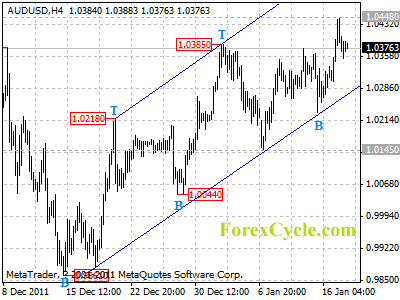
AUDUSD broke above 1.0385 resistance and continued its upward movement from 0.9861. Further rise is expected after a minor consolidation, and next target would be at 1.0500 area. Support is now at 1.0300, as long as this level holds, uptrend could be expected to continue, however, a breakdown below this level will indicate that a cycle top has been formed at 1.0448 on 4-hour chart, then deeper decline to test 1.0145 key support could be seen.
Watch Alexa von Tobel spend ‘2.5 minutes with genConnect’ on financial resolutions, creating a budget and getting out of debt in 2012.

Watch LearnVest Founder Alexa von Tobel spend ‘2.5 Minutes With genConnect’ on great ways people can be generous and take care of those in need this holiday season without sacrificing your financial stability

Diamond Foods Incorporated (DMND) maintained its quarterly dividend of 4.5 cents per share. The dividend will be payable on February 2, 2012, to stockholders of record as of January 24, 2012.


