Jan. 27 (Bloomberg) — Polish central bank Governor Marek Belka discusses the outlook for Poland’s economy, the zloty and the banking system. He speaks with Maryam Nemazee on Bloomberg Television’s “The Pulse” at the World Economic Forum’s annual meeting in Davos, Switzerland. (Source: Bloomberg)
Trade Interceptor released Kindle Fire forex trading App for currency investors
Trade Interceptor released a free forex trading application for Kindle Fire, which allows currency investors to trade with multiple brokers from a single interface, set price alarms and use a large range of technical analysis indicators and studies.
27 January 2012. Trade Interceptor, the fastest growing forex trading platform on the Apple and Android stores, released a free trading application for Amazon Kindle Fire, which allows traders to stay connected to the forex markets and trade currencies from anywhere, at anytime. The new Kindle Fire app offers advanced forex trading capabilities including the possibility to receive real-time currency prices from various feed providers, trade with various forex brokers, set price alerts, receive real-time currency news, watch multiple charts updated in real-time, and use a wide range of technical indicators, graphical tools and studies. The application can be downloaded for free on the Amazon Appstore.

Kindle Fire is a Full Color 7″ Multi-touch Display available on Amazon for $199.
For those who don’t have an Amazon US account, it is possible to install Trade Interceptor app on Kindle Fire devices following the instructions on Trade Interceptor download page.
“Our objective is to give forex traders the possibility to trade currencies at anytime, from anywhere, with the broker they like, using the most popular mobile and tablet devices. Kindle Fire is a very performing tablet, perfectly adapted to mobile forex trading, available at a very competitive price” explains Rodolfo Festa Bianchet, CEO of Riflexo, the software company which develops Trade Interceptor.
Trade Interceptor forex trading platform provides live prices and trading capabilities for over 120 currency pairs and CFD instruments. Advanced forex trading functionalities include Touch-Chart-Trading TM, chart order management and server-side alerts. Subscribers can use over 80 technical analysis indicators as well as advanced interactive studies.
Trade Interceptor is powered by Riflexo, a Sofia-based software company, which has been developing real-time trading solutions for financial institutions and professional traders for the last 11 years.
Rodolfo Festa Bianchet, Riflexo’s CEO, is among the 5 nominees for the “FX Person of the Year 2011” award, an event which pays tribute to a person, a team of people and a project that positively contributed to make the Forex world better in 2011, with a particular focus on innovation and quality.
—
About Riflexo
Riflexo Jsc. is in the business of providing software solutions and services to clients around the world. The company has strong track records in the development of financial, real-time, and mobile applications. Riflexo also developed a JDO implementation for the management of persistent data, teaming-up with world technology leaders to create standard-based applications. The company’s objective is to offer high quality and cost-effective software solutions, based on standard technologies and delivered on time, which meet today’s most advanced development needs.
Forex CT 27-1-12 Video News Update & Outlook
Video courtesy of ForexCT – A leading Australian forex broker, liscensed by the Australian Securities & Investments Commission, offers the MetaTrader4 and PROfit Platform to retail traders. Other services include Segregated Accounts, Trading workshops, Tutorials, and Commodities trading.
EUR Bullish as Investors Shift Focus to Fed Decision
Source: ForexYard
The euro staged a strong upward correction throughout the day yesterday, as investors shifted focus away from the euro-zone crisis to a recent decision from the US Federal Reserve. The Fed announced earlier in the week that US interest rates would remain at their current levels for at least the next two years. The news brought the EUR/USD to a five-week high, at 1.3175. Today, traders will want to pay attention to the US Advance GDP figure. A positive reading may give the USD a temporary boost to close out the week.
Economic News
USD – Fed Decision Turns USD Bearish
The US dollar turned overwhelmingly bearish throughout yesterday’s trading session, following the Fed announcement that US interest rates would remain at their current levels for at least the next two years. The greenback took further losses after the weekly US Unemployment Claims came in higher than forecasted. The news brought the EUR/USD to a five-week high, while the USD/JPY reversed gains made earlier in the week and tumbled close to 80 pips.
As we close out the week, analysts are forecasting the USD to maintain its current bearish trend. The surprising decision from the Fed caused investors to question the pace of the US economic recovery. This sentiment was reinforced by several economic indicators out of the US yesterday that came in below expectations. Traders will want to note the results of the Advance GDP figure today, scheduled to be released at 13:30 GMT. A positive number may give the dollar a temporary boost before markets close.
Traders will not want to forget that next week the US will release its monthly Non-Farm Payrolls (NFP) figure. The NFP is widely considered the leading economic indicator on the forex calendar and consistently leads to market volatility. Should the NFP show further growth in the US employment sector, riskier currencies like the euro may see upward movement.
EUR – Positive Greek News Sends EUR/USD to Five-Week High
News that Greece is closer to concluding an agreement with its creditors on a debt swap deal helped send the euro higher against most of its main currency rivals during yesterday’s trading. The EUR/USD peaked at 1.3175 during European trading, a five-week high. The euro was also helped by news which led investors to believe that the US economic recovery was not proceeding as quickly as once thought.
Whether the euro will be able to maintain its bullish trend to close out the week will likely be determined by several economic indicators set to be released today. Traders will want to pay close attention to the US Advance GDP figure, set to be released at 13:30 GMT. Should the indicator come in below expectations, the euro may see a boost as a result. Furthermore, any positive news regarding Greece is likely to help the common currency ahead of markets closing for the weekend.
JPY – Yen Recoups Earlier Losses against USD
The Japanese yen was able to bounce back against the US dollar during yesterday’s trading session. The USD/JPY pair shot up earlier in the week, following news that Japan had logged its first trade deficit in over 30-years. That news was overshadowed by the US Federal Reserve Decision to maintain the current, near-zero interest rates for at least the next two years. The USD/JPY pair dropped close to 80 pips during the European trading session.
Today, the US Advance GDP figure is likely to dictate the direction the USD/JPY will take, with a positive figure likely to boost the dollar to close out the week. Against the euro, the yen may see downward movement if further positive news regarding Greece’s debt swap is released.
Crude Oil – Oil Once Again Above $100 a Barrel
The price of crude oil shot up yesterday, following positive European news that helped turn investors on to commodities. Typically the oil becomes more attractive to international investors when the euro increases in value. Yesterday was no exception, as the price of crude once again shot up to over $100 a barrel.
Today, traders will want to pay attention to the direction the euro takes as it is likely to dictate where the price of oil will head. Any further developments in Greece’s attempt to close a debt swap deal will likely lead to positive gains for oil as trading closes for the weekend.
Technical News
EUR/USD
Technical indicators are showing that this pair has entered the overbought zone and may see a downward correction. The daily chart’s Williams Percent Range has hit the -20 level, indicating that a downward breach could occur. Traders may want to go short in their positions.
GBP/USD
A bearish cross has formed on the daily chart’s Stochastic Slow, indicating that a downward correction may take place in the near future. In addition, the Williams Percent Range on the same chart is well above the -20 level and pointing down. Going short may be the preferable choice for now.
USD/JPY
Following the spike the pair saw in recent trading, technical indicators are now showing that a downward correction could take place in the near future. The 8-hour chart’s Relative Strength Index is already well into the overbought zone, while the Stochastic Slow has formed a bearish cross. Short positions may be preferable.
USD/CHF
Most technical indicators are showing this pair range trading, meaning that no defined trend is forecasted at the moment. Traders will want to pay attention to the technical indicators on the daily chart, as a better picture is likely to present itself in the near future. Taking a wait and see approach for this pair is advised.
The Wild Card
Gold
After a steady increase in the price of gold over the last few weeks, technical indicators are now showing that a downward correction may occur in the near future. A bearish cross has formed on the daily chart’s Slow Stochastic, while the Relative Strength Index on the same chart has drifted into the overbought zone. Forex traders may want to go short in their positions today.
Forex Market Analysis provided by ForexYard.
© 2006 by FxYard Ltd
Disclaimer: Trading Foreign Exchange carries a high level of risk and may not be suitable for all investors. There is a possibility that you could sustain a loss of all of your investment and therefore you should not invest money that you cannot afford to lose. You should be aware of all the risks associated with Foreign Exchange trading.
Recession Fears Could Delay UK Deficit Reduction Plans
On Wednesday, the Office for National Statistics (ONS) revealed that the UK economy contracted by 0.2 percent for the final quarter of 2011. Economists had predicted a slight increase of 0.1 percent for the last three months of the year.
Despite the feeble ending to the year, the latest ONS data shows overall growth for 2011 was a mediocre, but still positive, 0.9 percent. Still, this level of expansion is well below the Bank of England’s 2 percent growth target and there is a real concern that the economy will continue to shrink during the first half of 2012.
This could hardly come at a worse time for the British government. Like many of its G8 counterparts, the UK is faced with the dilemma of promoting growth, while at the same time, keeping a lid on spending. In fact, government spending was a central theme in the 2010 election and resulted in a coalition government led by Conservative Prime Minister David Cameron together with the Liberal Democrats.
The new government came to power on a promise to address the country’s out-of-control spending which few would argue was not already well beyond a crisis point. And that is actually saying something as Great Britain has a long history of deficits.
In fairness, some of this debt was accumulated as part of the effort to fight two major wars, but even in peace time, Britain typically spends more than it earns. During the 1970s and 1980s, high levels of inflation forced the government to rely on borrowing to maintain spending programs. In the span of those two decades alone, total debt rose from £33.1 billion ($51.6 billion) in 1970 to £197.4 billion ($308.0 billion) by 1988.
Since then, Britain has actually increased its reliance on deficit financing. By 1997 total public debt was £352 billion ($549 billion), but by the end of 2009, debt had once again more than doubled and has now broken through the £1 trillion ($1.6 trillion) barrier.
Britain’s 2011 deficit is expected to be in the range of £150 billion ($234 billion), making it only marginally better than the previous year’s deficit of £170 billion ($234 billion) despite a full year of government spending cuts. The country’s debt to GDP ratio is still nearly 80 percent and with weaker growth expected in the coming year, this statistic could worsen.
Both the Bank of England and the International Monetary Fund (IMF) recently downgraded earlier growth projections for 2012. The IMF slashed its prediction by a full percentage point and now expects the British economy to expand by only 0.6 percent this year.
Eurozone Crisis and Austerity Measures
With its close proximity and trade ties with Europe, Britain is heavily exposed to the uncertainty arising from the Eurozone debt crisis. In late November, the Organization for Economic Development and Cooperation (OECD) released a stark statement warning that the UK will almost certainly face another recession in the first half of 2012 because of the turmoil in the Eurozone. Britain has already recorded one quarter of negative growth – should the first quarter of 2012 also be negative, the OECD’s prophecy will come true.
While there is little the government can do with respect to solving the Eurozone issue, it will be interesting to see if the government moderates its drive to eliminate the deficit in deference to the slowing economy. Reducing the deficit is necessary, but it is impossible to dramatically slash spending without impacting growth. With growth already on the decline, it may be advisable for the government to moderate its spending reduction plans at least until the economy gathers strength.
Article by forexblog.oanda.com
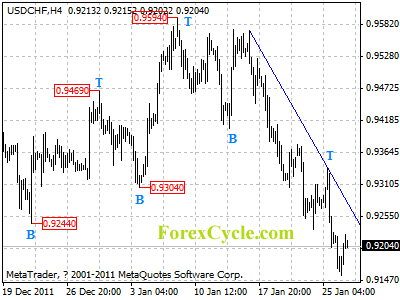
USDCHF’s downward movement extended to 0.9156
USDCHF’s downward movement from 0.9594 extended to as low as 0.9156. Resistance is now at the downward trend line on 4-hour chart, as long as the trend line resistance holds, downtrend could be expected to continue, and next target would be at 0.9050 area. On the upside, a clear break above the trend line will indicate that a cycle bottom is being formed on 4-hour chart, then consolidation of downtrend could be seen to follow.
Unloved US Tech Giant Could Be A Great Buy
By MoneyMorning.com.au
Turn your computer on and there’s one word I can almost guarantee you’ll see: Microsoft.
It’s the world’s top software company. For positively ages, the company’s Windows operating system has been the industry standard for the PC business.
So you’d think that Microsoft (Nasdaq: MSFT) shares would have been a rip-roaring success in recent years. Yet the complete opposite is true.
Since the dotcom boom at the turn of the millennium, the company’s stock price has halved. Many people now shun Microsoft as being at best a very boring investment.
The good news is, this could be about to change for the better…
How Microsoft Fell From Grace
January can be a pretty miserable month. But for US stock market watchers, it does have one redeeming feature. It’s the first quarterly ‘earnings season’ of the year. In other words, it’s when America’s finest companies update us on how business has been.
So far, the latest earnings season has gone pretty well. Most firms’ profits have beaten analysts’ forecasts. That in itself is no great shock. Managements have become very good at giving investors ‘guidance’ on future earnings which – surprise, surprise – they then succeed in beating.
But when one of the firms that’s growing sales faster than expected is US software giant Microsoft, it’s well worth taking notice.
Why? Because this is a company that’s widely viewed as being ‘past it’.
Windows is no longer the driving force that it used to be. As Preston Gralla says for Computerworld, Windows’ “glory days are clearly gone”.
On top of that, the PC market is having a tough time, due to the recent flooding in Thailand, which has disrupted supplies of equipment. And analysts are fretting, among other things, that Microsoft can’t compete with rival Google on web searching tools and smart phones.
Yet Microsoft’s overall revenues for the last three months of 2011 rose by 5% versus the same period last year. In other words, the firm must have found something else to take up the growth baton.
Looking at the details – I’ll keep it brief – Windows-related revenues dropped by 6% on last year. But the Online Services Division’s sales grew by 10% year-on-year. Sales at the Server & Tools unit rose by 11%. And the Entertainment and Devices Division enjoyed a 15% rise in sales thanks to its Xbox operations.
Not bad for a company that’s ‘past it’.
In short, Microsoft keeps on finding ways to deliver the goods when it comes to sales figures. As Laurence Latif says in The Inquirer, these numbers “are pretty impressive for a company that has been painted as being in crisis”.
Sure, the firms’ profits in the last quarter were down a fraction on 2011. But history shows that’s nothing to get too concerned about. Take a look at this chart.

Source: Bloomberg
This shows Microsoft’s earnings per share (EPS) from continuing operations over the last 20 years. Sure, there have been one or two hiccups. But broadly, we’re looking at a picture of a progressive profit growth. Since 2000, EPS has trebled.
And that’s where it gets interesting. Because normally, strongly rising EPS should boost a company’s value. But in fact, over that same period, as I mentioned above, Microsoft’s share price has fallen in half. That’s because rising earnings have been more than offset by gloomy investors becoming less willing to pay up for those earnings, which has driven down the price/earnings ratio.
That spells opportunity for canny investors.
Microsoft Is Cheap
Nowadays, Microsoft has become like a utility, rather along the lines of an electricity or gas provider. Windows has a virtual monopoly. It would be too costly for either computer suppliers or users to switch to anything else. So Microsoft’s operating system will be a ‘cash cow’ for the foreseeable future.
What’s more, the company isn’t standing still. Over the coming year, it plans to launch several new products, including the latest operating system Windows 8. And the management is optimistic about the future.
Yet despite this, the stock has fallen so far out of favour with investors that it’s now downright cheap. On a current year price earnings (p/e) ratio of just over ten, Microsoft shares now offer outstanding value for a business with such a vice-like grip over its own market.
And there’s another benefit here for new buyers of the stock. Like other utilities, Microsoft is now rewarding its shareholders with a decent income stream.
Since 2005, the company has hiked its dividend pay-out by 150%. While that only leaves the prospective yield at around 2.5%, there’s plenty of scope for future dividend growth. Not only is Microsoft producing oodles of cash, it’s already very well minted. At the end of last year, the balance sheet contained a cash hoard totalling $40bn.
Add it all up, and you have just the sort of solid defensive stock that makes complete investment sense in today’s tricky market.
David Stevenson
Associate Editor, MoneyWeek (UK)
Publisher’s Note: This is an edited version of an article that first appeared in Money Morning (UK)
From the Archives…
Are ASX Energy Index Stocks Worth The Risk?
2012-01-20 – Aaron Tyrrell
Why the World Bank Wants Your Money
2012-01-19 – Kris Sayce
Could $50 Billion In Unpaid Credit Card Debt Drag Aussie Bank Stocks To A Record Low?
2012-01-18 – Aaron Tyrrell
The US-China Power Struggle… and What it Could Mean For Oil and Australian Energy Stocks
2012-01-17 – Dr. Alex Cowie
How Global Oil Supplies Could Fall 40% Overnight
Is There a Reason You’re Not Using the 90/10 Strategy?
By MoneyMorning.com.au
Six years.
That’s how long it will have been from the financial meltdown in 2008 until the U.S. Federal Reserve plans to start raising interest rates.
That’s what they say this month.
Of course, it was only a few months ago the Fed said it would start raising rates in 2013. Now it won’t likely happen until 2014… at the earliest.
The bad news is markets will stay volatile. The good news is you’ll have plenty of chances to buy stocks at cheap prices. The only question is, how should you do it?
Well, that’s easy. You do what the old pro hedge fund managers used to do…
Back to 2005 Prices
For the past three-and-a-half years we’ve suggested a simple strategy: hold cash and gold for safety. Quality dividend-paying stocks for income. And small-cap stocks for growth.
We suggest this strategy because if you don’t keep your assets secure, market volatility could see 20% or more wiped off your savings.
You only have to look at the S&P/ASX 200 in 2011. Investors who bought “safe” stocks at the start of the year are down nearly 20% today. Naturally, the buy-and-hold mob will tell you to just hold in there… things will be fine.
But how long should you have to wait?
Today, the main blue-chip index is back to where it was in 2005. Buy-and-hold investors have waited seven years. For nothing. And we assume they didn’t sell at the peak in 2007 because… well… they’re buy-and-hold investors.
And what about those poor souls who bought in 2007? They’re down 40%. They haven’t even had the chance to make a profit yet. And odds are they won’t for a few more years… unless they change things.
In the old days hedge funds and capital protected funds used a pretty simple strategy. (Although they’re probably more “sophisticated” now.)
It was designed to make sure investors in the fund couldn’t lose money. It was almost fool-proof. The last thing these funds wanted was to blow up their clients. Because that would mean losing clients money. And if the client lost money, they may have closed their account and that would hurt the fund managers’ pay cheque.
But if they could just make sure the client didn’t lose money, they would be half way to making money for the client and making stacks for themselves.
Hedge Funds Aren’t What They Used To Be
As we say, things are probably different now. We’ve seen some of the hedge fund performance tables for 2011 and they don’t look pretty.
Even one of the world’s biggest hedge fund managers – John Paulson – had a terrible year.
According to a Bloomberg News report last November:
“Paulson’s main fund, the Advantage Plus Fund, which seeks to profit from corporate events such as takeovers and bankruptcies and uses leverage to amplify returns, reduced its year-to-date loss to 44 percent.”
Paulson’s fund manages USD$30 billion… or it does today. Doubtless it managed nearly twice that at the start of the year, before the losses.
Clearly Paulson and most other hedge fund managers aren’t using the 90/10 Strategy.
That’s a shame. Because the concept is simple. In fact, it’s so simple you can start using it today. So, what is it? Well, it works like this…
To protect and guarantee investor returns, hedge funds would take 90% of the client’s cash (say $90,000) and put it into a government bond. If the bond paid a 3.5% yield, after three years the client’s bond investment would be worth just over $100,000. They’ve broken even.
But what about the other 10% ($10,000) the client invested at the start?
That’s where the fund manager was smart. They would take this cash and – for want of a better term – use leverage to punt on the markets. It could be anything: stocks, currencies, commodities or even high-risk bonds.
If they made the right bets it would mean big returns for clients and big fees for the hedge fund guys.
Sounds great right? Even better, you don’t need to be a big hedge fund client to put this strategy into practice. Because it’s something you can start today, with your own 90/10 Strategy.
Your Personal 90/10 Strategy
You start off putting 90% of your savings into “safe” assets.
Around half this amount should go into cash and term deposits. Put some in a high interest online bank account and the rest in a couple of term deposits (for instance a one-year and two-year term deposit). When they mature, reinvest for the same period.
With the rest, split this between good quality dividend stocks for income (if available, take part in the dividend reinvestment plan if you don’t need the income now) and precious metals (gold is our favourite, but we like silver too).
That’s the 90 of the 90/10 Strategy (we said this was simple). Now for the 10…
This is where old hedge fund managers leveraged into high-risk/high-return plays. You can do this too. And like the hedge fund guys, you don’t have to choose one type of investment.
Our personal choice is small-cap stocks. Simply because you get the benefit of leverage if the stock goes up, but you know your maximum loss if the stock goes down. And the great thing with small-caps, you can start with as little as $500.
That means even if you’ve only got $5,000 in savings, you can invest like a hedge fund today. Like this…
- Stick $3,000 in a high interest bank account and/or term deposit
- Buy $1,000-worth of a good dividend paying stock
- Buy about one-quarter of an ounce of gold (or about 15 ounces of silver)
- Buy one high-risk/high-return small-cap stock for potentially explosive gains
It’s simple. Then for every $5,000 you save, just repeat the steps above.
If you’re not investing using the 90/10 Strategy you should stop and ask why. In our view there’s no reason you shouldn’t use it. Once you’re convinced it’s right for you, drop everything and start implementing the 90/10 Strategy today.
It’s the best way of keeping your money safe while still benefiting from volatile markets.
Cheers.
Kris.
Related Articles
Special Report: Six Extraordinary Resource Investment Opportunities for 2012
How To Cash In As Investors Flee Emerging Markets
Why Fallen Commodity Prices Mean This Sector is Worth a Punt
Daily Market Wrap: January 26, 2012
It was a mixed day for the markets with stocks traded mostly flat, but drifting lower later in the day, as the latest jobless numbers suggest an improvement in the employment picture, but that was offset by disappointing numbers from the housing sector. The Labor Department is reporting a gain of 21,000 in weekly jobless claims last week, to a seasonally adjusted 377,000, while economists had expected claims to rise to 370,000.

Analyst Moves: CVD, ETFC
Covance (CVD) was downgraded today by Goldman Sachs (GS) from buy to neutral with a price target of $46 due to higher operating costs and unstable demand trends. Shares are lower by about eight percent.

