Resmed (RMD) was upgraded today by Deutsche Bank (DB) from hold to buy with a $32 price target, as mask sales remain strong. Shares are higher by about 10.2 percent.

Resmed (RMD) was upgraded today by Deutsche Bank (DB) from hold to buy with a $32 price target, as mask sales remain strong. Shares are higher by about 10.2 percent.
Parker Hannifin Corporation (PH) announced its quarterly dividend of 39 cents per share, an increase of about 5% over its prior dividend in November of 37 cents. The dividend is on payable March 2, 2012 to shareholders of record as of February 10, 2012 and is the Company’s 247th consecutive quarterly dividend, resulting in a total distribution to shareholders of approximately $59 million.


The Hong Kong Monetary Authority kept its base rate steady at 0.50% following the decision of the US Federal Reserve to leave the fed funds rate unchanged at 0-0.25% until late 2014. The HKMA said (according to WSJ) the Fed forecasts “reflect the still-soft outlook of the U.S economy, which is weighed by a weak job market, a depressed housing market, the need for long-term fiscal consolidation as well as the lingering sovereign debt crisis in Europe.” Adding: “In such an uncertain environment… we would like to remind the public to be careful and avoid over-stretching themselves financially,”

By Paul Tracy, DividendOpportunities.com
It pays a yield of 10.5%. And it’s one of the most unique dividend payers on the market.
It’s not a regular business — it doesn’t have thousands of employees or millions of dollars worth of equipment — and it doesn’t have complex operations that take a PhD to understand or track.
In fact, I think it’s one of the simplest investments on the market. It has only one mission — take in royalties from dozens of oil wells and pay them out to investors.
If you’re a regular Dividend Opportunities reader, you’ll remember when I first told you about SandRidge Mississippian Trust (NYSE: SDT) just a few weeks ago.
As a royalty trust, SDT owns a stake in dozens of wells run by its parent company, SandRidge Energy (NYSE: SD). SandRidge Energy takes care of the drilling, production, marketing, and selling of the oil and gas produced (production is split roughly 50/50 between oil and gas). The royalty trust — SDT — is passive in the relationship. It doesn’t have to do a thing. In return for the initial investment when it went public, its investors get a cut of all the oil and natural gas sold from the wells.
In the latest quarter, the oil produced from those wells allowed SDT to pay a distribution of $0.82 per unit, giving a forward yield of 10.5% at today’s price.
But that double-digit yield is just part of the story…
 You see, I picked up shares of SDT for my Top 10 Stocks advisory back in early October (subsequently, I also named the stock as one of my Top 10 Stocks for 2012). I bought the shares at just over $20. Three months later the shares trade above $31 — a gain of more than 50% in price alone.
I’ll admit, a 50% gain in three months — especially from a stock paying a double-digit yield — is uncommon. But this trust was seeing a setup that’s pretty rare. Remember, the trust’s production is half oil, half natural gas. Meanwhile it has hedged about 60% of its projected revenues through 2015. Therefore, you’d expect the trust to move with oil and natural gas prices, but not move as much as those commodities.
But when I bought the stock for Top 10 Stocks back in October, SDT has fallen more than both oil or gas during the previous two months.
To me, that fall in the trust’s shares — and the subsequent rise — illustrates one of the most important lessons for making money in the short term with income stocks…
You can use the sell-offs in some thinly-traded income stocks to lock in abnormally high yields and see significant capital gains.
Mention income stocks to most investors, and they picture companies like Johnson & Johnson (NYSE: JNJ) or AT&T (NYSE: T) — enormous companies with millions of shareholders that pay yields usually in the 3-4% range.
But when you start to dig into the income field, you see there is an entire corner of the market that most people don’t know about. Take SDT for example — despite yielding more than 10%, the stock trades 180,000 shares per day. That’s what AT&T trades in just minutes.
Why is that important? Since many of these income stocks are unknown to most investors, they trade fewer shares. Just a few thousand people selling their shares can lead to a sell-off and some very attractive prices and higher yields for new investors.
Take SDT. Despite paying a double-digit yield and having much of its production hedged, the shares fell more than oil and gas prices when the broader market saw a sell-off in September. There was nothing wrong with the stock — short-sighted investors simply sold whatever they owned to get out of the market. That exaggerated the move down… giving investors a chance to lock in a higher yield and setting themselves up for strong gains once things calmed down. You know the rest of the story.
It’s one of the best tricks I’ve found for making serious gains on high-yield stocks in a short time. The opportunity to buy these dips doesn’t happen often — I see it just a couple of times a year at most — and it usually comes amid a broader market sell-off. And nothing is guaranteed, even if you buy on a dip.
But the 50% gain in one of our Top 10 Stocks for 2012 shows how lucrative it can be when you have the chance to lock in high yields from solid stocks unfairly tarnished by no fault of their own.
[Note: I’d love to tell you more about my Top 10 Stocks for 2012, including SDT. One stock has raised dividends 110% in five years… another has $8.25 per share in cash (45% of its share price)… another yields 8.0% while it has nearly doubled its net income year-over-year. These are the types of investments that make up my Top 10 Stocks for 2012 report.
To learn more about these top picks for the coming year, visit this link.]
All the best,

Paul Tracy
StreetAuthority Co-founder, Chief Strategist — Top 10 Stocks
P.S. — Don’t miss a single issue! Add our address, [email protected], to your Address Book or Safe List. For instructions, go here.
Disclosure: Paul Tracy owns shares of SDT. StreetAuthority owns shares of SDT as part of the company’s various “real money” portfolios. In accordance with company policies, StreetAuthority always provides readers with at least 48 hours advance notice before buying or selling any securities in any “real money” model portfolio.
Join the ‘’5% Club’’ of Forex Winners –
It’s a well stated fact that only 5% of traders make consistent money from the Forex market. With the vast liquidity and high number of participants, it’s surprising to see only a small percentage of traders being consistently profitable. Contrary to what many unsuccessful traders may believe the‘5% club’ are really not doing anything different to them. They’re not using any unknown techniques, complex systems/strategies nor have some kind of special knowledge that allows them to consistently make money. They simply have the discipline, patience and right mindset needed to be a successful trader. Joining the 5% club is not as difficult as one may think. ‘Membership’ is unrestricted and open to anyone willing to do what it takes to become consistently profitable.
The 5% of forex winners do not all use the same system/strategy, or necessarily share the same market outlook; however two things they do all have in common are patience and discipline. Ask any successful forex trader and they’ll likely attribute a lot of their success to either being patient, disciplined or both. Being a great market analyst, either technical or fundamental, has little relevance unless the trader knows how to implement what the charts/news are telling them in a proper manner.
Similarly to the 5% of forex winners, the 95% who comprise of mainly unsuccessful traders share similar attributes. Unlike the 5% club, they lack the discipline and patience required to produce consistent positive results. It’s not uncommon to find excellent market analysts struggling to claw their way out of the 95% of unsuccessful traders.
 Discipline –
Every trader in the 5% club is a master of discipline. These disciplined traders are not born overnight and for the majority, the practice of discipline can be a long painstaking road; however with time, effort and patience, the discipline these traders practice becomes second nature.
Successful traders have a well detailed forex trading plan which includes the rules they follow for their system/strategy, the amount they areprepared to risk per trade and the risk : reward ratio they wish to follow. Traders in the 5% club rarely ‘bend’ the rules for their plan and are disciplined enough to know that if a trade is not inline with the rules of their plan they simply won’t take it.
Forex winners never overtrade. A common mistake made by the 95% of unsuccessful traders is overtrading. A large proportion of unsuccessful traders feel they need to be trading 24/5 in order to turn a handsome profit. Disciplined traders in the 5% club are astute and never fall into the trap of overtrading. They understand trading is a ‘long game’ and are disciplined enough to wait for set ups which conform to their trading plans.
Patience –
Successful traders understand that a great part of their success can be directly attributed to their patient outlooks. The 5% club understand trading is not a race and never ‘jump the gun’, always waiting for the market to produce trading opportunities that conform to their trading plans.
Patient traders trade like fishermen, reacting to what the market does as opposed to predicting what the market is going to do. They trade what they see, not what they want to see or what they want to believe.
Successful forex traders have truly understood that trading is a ‘long game’ and never chase quick money or instant success. They have accepted that to be part of the 5% club of forex winners is no easy feat and success is measured over a substantial period of time years, (not days/weeks/months).
Joining the ‘5% club’ –
As previously mentioned ‘membership’ to the 5% club of forex winners is unrestricted and open to anyone willing to do what it takes to be a successful trader. Although not an easy task, successful trading can be achieved by any trader open to changing or fine tuning the way they approach the markets. Being an excellent market analyst or having a highly profitable strategy is not necessarily a ticket to success. It can be said that successful trading is more psychological than technical/analytical. One thing every trader in the 5% club has is common is they are all realists. They’re not dreaming of ‘one day quitting their jobs’ and making millions from trading. They are true to themselves and have genuinely accepted that being patient and disciplined puts the odds of success in their favor.
Ford Motor Company (F) reported a profit of $13.62 billion, or $3.40 per share in the fourth quarter, representing the eleventh straight quarter of profitability. Revenue increased by six percent to $34.6 billion.

by Alexander Green, Investment U Chief Investment Strategist
Friday, January 27, 2012: Issue #1695
The stock market gyrated so wildly in 2011 that many investors finally threw in the towel.
How else can we read the massive equity fund redemptions that occurred in the second half of last year?
But, apparently, the market has taken its anti-anxiety medication. After last year’s gut-wrenching swings, U.S. stocks have been surprisingly tranquil. For 13 straight days, the Dow has moved up or down less than 100 points.
This is good news for bullish traders and bad news for those who have been making money trading the VIX. Let me explain…
The VIX is the ticker symbol for the CBOE Market Volatility Index, a popular measure of volatility in S&P 500 index options. According to The Wall Street Journal, this so-called “fear gauge” has fallen 20% to levels unseen in six months.
Why? One reason is that the U.S. economy appears to be getting back on its feet. Despite all the pessimism in the Eurozone, U.S. corporations are busy reporting yet another quarter of all-time record profits. (Just how long will mom-and-pop investors ignore this salient point?)
The Dow is up almost 500 points for the month. Fund companies report that money is flowing back into equities again. Yet the calm makes some investors nervous. I hear many analysts crying out that the market is about to plunge again.
Deluded, Ignorant, or Both
Let’s start with the straightforward declaration that anyone who claims to know “what the market is going to do next” is, by definition, someone who is ignorant, deluded, or both. The market will rise or fall next week or next month based on next week’s or next month’s news. Yesterday’s news has already been discounted. (As Legg Mason’s Bill Miller likes to say, “If it’s in the papers, in the price.)
Moreover, there’s no historical evidence to show that a market pause generally precedes a correction. And the data go back pretty far.
For example, market analyst Mark Hulbert has loaded the Dow’s daily returns – all the way back to its creation in 1896 – into his statistical software. For each trade date since, he calculated the Dow’s trailing volatility and then looked to see if the stock market performed any different following periods of low volatility than it did at all other times.
The short answer? Nope. He came up empty. Perhaps that’s the reason for the old Wall Street saw: “Never sell a dull market short.”
There are two things to conclude here:
Sure, a spike in oil prices, a hedge fund blow-up or a nasty surprise from across the pond could change that in a nanosecond. But bolts out of the blue are just one of the many short-term hazards of trading and investing.
For now, the market is taking a breather. But that doesn’t mean it isn’t about to get a second wind.
Good Investing,
Alexander Green
Article by Investment U
by David Fessler, Investment U’s Energy and Infrastructure Specialist
Friday, January 27, 2012
The Organization for Economic Co-operation and Development (OECD), headquartered in Paris, was formed in 1961.
Twenty countries are charter members. Fourteen more have been added since it was formed. You can see the entire list of 34 member countries here, and the dates they joined.
Its mission, according to its website, is to “promote policies that will improve the economic and social well-being of people around the world.”
Apparently, it’s accomplished its mission a little too well. You see, the “haves” (us) are about to switch place with the “have-nots.” If you’re reading this, you’re likely in the former, heading to the latter.
How do I know? Simple: One look at the chart below, put out recently by the International Energy Agency (IEA), tells all. Oil consumption from emerging market countries (have-nots) is just about to eclipse that of the old world (haves).
Check it out:
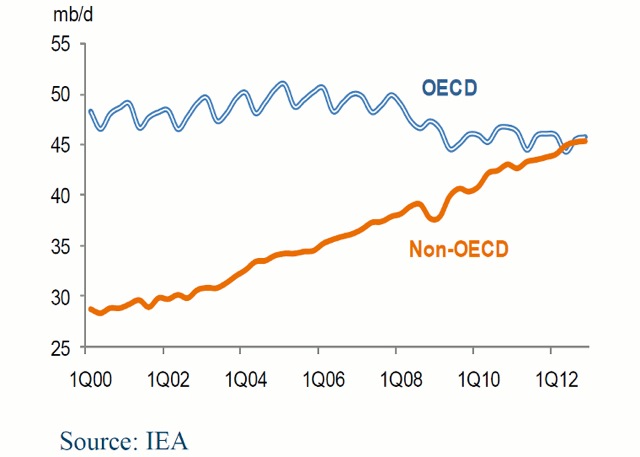
This is the only chart you need to look at to know that unless you have your own oil well in your backyard, you’re soon going to experience pain at the pump.
Global Oil Consumption is Changing
Oil demand from OECD countries (the haves) has declined for the fifth time in the last six years. It’s on track to decline again this year. On the other hand, demand from non-OECD countries (the have-nots) is up a whopping 15% in just the last three years. That rate of growth is expected to continue.
It may take a year or two, but it will be the likes of which you have never seen before. And that’s completely discounting any geopolitical events. They’ll make matters even worse and could cause it to happen much sooner.
How do I know? Simple: Economic growth requires energy. Transportation is a big part of economic growth, allowing goods produced to be moved around, and services required to be provided.
Most of the world’s goods in countries that are old world (us) or rapidly growing emerging market countries, move by trucks, ships, trains and planes. They all use vast amounts of oil.
So it stands to reason that an emerging market country – that’s experiencing rapid economic growth – is rapidly increasing its use of oil.
What a surprise; that’s precisely what’s happening. It’s clear as a bell when you stare at the above chart for a second or two.
Many economists figure oil is the culprit creating the global imbalances behind much of the world’s financial woes. If you understand the key role oil plays in any country’s economy, it’s hard to argue the point.
Bank of America Merrill Lynch sounded a dire alarm in its 2012 energy outlook, stating the current growth path of crude simply isn’t sustainable:
“Whether a recession in Southern Europe frees up some oil for China and India to grow on, or whether high energy prices rip through energy sensitive emerging markets such as Turkey, we believe the current path for oil is unsustainable and something has to give.”
A New World Oil Order
The bottom line is this: Right now, oil dictates countries’ fortunes. Without it, or if it becomes prohibitively expensive, economic growth grinds to a halt.
My prediction is that those countries that have oil are eventually going to realize this, and slowly start to curtail exports, just like China has with rare earths. They’ll want to keep an increasing percentage of what oil they do have for their own use.
What will it mean for OECD countries? Depending on fossil fuels for the future simply isn’t a sustainable path, regardless of one’s stance on the whole global warming issue.
In short, rapidly increasing oil prices will force these countries to switch to other sources of energy. Natural gas, solar, wind, geothermal and sustainable biofuels will begin to slowly replace dwindling supplies of oil over the next 10 to 20 years.
If OECD countries are smart, clearly a debatable point, they’ll squarely focus on securing domestic energy supplies for their future sustainability. Especially if they want to remain “haves.”
Good Investing,
David Fessler
Article by Investment U
London Gold Market Report
from Ben Traynor
BullionVault
Friday 27 January 2012, 08:30 EST
WHOLESALE MARKET gold prices were headed for their biggest one-week rise since the start of December Friday lunchtime in London, climbing back through $1720 an ounce – a weekly gain of over 3%.
Silver prices meantime hovered around $33.60 per ounce – 4.2% up on last week’s close – while other stocks and commodities were broadly flat and US Treasury bond prices slipped.
A day earlier, gold prices hit a 7-week high at $1730 per ounce before easing in Friday’s Asian session.
“Lack of physical demand partly explains the inability of gold to make a sustained move beyond the $1730 level,” says Standard bank commodities strategist Marc Ground, citing this week’s Chinese Lunar New Year holiday as impacting demand from China, Singapore, Malaysia and Indonesia.
“[But] while slowing physical demand might provide some resistance during price rallies, we do not feel that it would be the cause of prices moving significantly lower.”
“The [physical] market has been like a yo-yo,” one Singapore dealer tells newswire Reuters.
“I think it’s a good time to buy gold…but clients are all cautious. They are doing enough to roll their money but keeping it all for the possibility of buying back.”
“Maybe it’s better to wait until Monday,” reckons another Singapore dealer.
“The Chinese market reopens and [we will] see whether they will buy some more gold or they will take profits.”
Based on PM London Fix prices, gold by Friday lunchtime looked set for its biggest weekly gain since the week ended December 2 last year.
That week saw gold’s biggest single-day Fix-to-Fix gain of recent months, when gold prices rose 2.5% on 30 November last year. Between that day’s AM and PM Fix, six of the world’s central banks announced a co-ordinated move lower the cost of Dollar funding for to the banking system.
This week meantime saw the Federal Reserve’s Federal Open Market Committee begin publishing members’ interest rate projections on Wednesday. The majority of FOMC members expect rates to remain at or below 1% until at least the end of 2014.
“The market attitude towards gold for most of January could be summed up in two words: cautious optimism,” says the latest precious metals note from UBS.
“Investors were reluctant to add to positions aggressively as memories of the disappointment in Q4 lingered…A fresh catalyst was needed and we think the FOMC outcome on Wednesday fit the bill.
More accommodative policy is a very good foundation for gold to build on the next move higher.”
Between Wednesday’s London PM Fix and Thursday’s AM Fix – during which time the Fed made its announcement – gold prices gained 3.8%. Notwithstanding the New Year break, this was the biggest Fix-to-Fix gain since September 27.
That rise in gold prices coincided with reports that European policymakers were preparing a move to recapitalize the continent’s banks – though the reported proposals were not adopted.
European leaders meantime are “just about to close a deal on private sector involvement between the Greek government and the private-sector community,” European commissioner for economic and monetary affairs Olli Rehn said Friday, speaking at the World Economic Forum in Davos, Switzerland.
A Greek deal would pave the way for Greece’s second bailout, agreed last October and worth €130 billion – without which Greece will not be able to repay €14.5 billion of maturing debt on March 20.
Iran – which was earlier this week hit by fresh sanctions on oil, diamond and gold dealing – has said that it may immediately halt its oil exports to Europe to pre-empt a European Union ban due to come into force July 1. Greece is thought to import around one third of its oil from Iran.
Two weeks after ratings agency Standard & Poor’s downgraded them to junk status, yields on 10-Yeat Portuguese government bonds hit their highest levels since the crisis began Friday morning when they traded at 15.4% – almost double the yield on equivalent Irish debt.
Portugal’s 5-Year bond yields breached 20%.
“It makes it impossible for Portugal to access debt markets in 2013,” says JPMorgan rate strategist Nikolaos Panigirtzoglou.
“It’s a country that still relies on the official sector in terms of financing its current account deficit and repayments and this makes it certain that we’re going to get a second bailout for Portugal later this year.”
“The market is asking whether Portugal is really just like Greece,” adds Richard Batty, strategy director at Standard Life Investments.
A survey published this morning by British free newspaper Metro finds that 68% of British people believe the Euro will collapse.
French bank Societe Generale’s latest Hedge Fund Watch also finds that hedge funds are shorting the single currency “like never before”, the Financial Times Alphaville blog reports.
The Euro however rallied against the Dollar Friday morning, breaking back through $1.31.
Euro gold prices were flat Friday morning, holding above €42150 per kilo (€1310 per ounce) – still a 1.7% gain for the week.
Gold value calculator | Buy gold online at live prices
Editor of Gold News, the analysis and investment research site from world-leading gold ownership service BullionVault, Ben Traynor was formerly editor of the Fleet Street Letter, the UK’s longest-running investment letter. A Cambridge economics graduate, he is a professional writer and editor with a specialist interest in monetary economics.
(c) BullionVault 2011
Please Note: This article is to inform your thinking, not lead it. Only you can decide the best place for your money, and any decision you make will put your money at risk. Information or data included here may have already been overtaken by events – and must be verified elsewhere – should you choose to act on it.
