The Commodities Supercycle

The rise of commodities may not be a fad.

Instead, it may be a product of social behavior and theory. I present to you the premise of the “commodity supercycle.”

The concept is more than vague investor intuition; its theory is based on the work of twentieth-century economists who studied the result of demographic shifts in populations. These shifts resulted in specific effects regarding the demand for basic commodities.

Economist Simon Kuznets, the 1971 Nobel Prize winner, did research on emerging markets that led him to discover that 20-year cycles arise in countries with policies to expand infrastructure – which generates a substantial increase in the demand for resources. He uses the United States in the 1950s as an example with the creation of President Eisenhower’s U.S. interstate highway system. This same cycle has been seen in the past decade in China, India, Brazil, Russia and other emerging markets.

A Growing World Population

On average, these emerging markets are increasing infrastructure spending at about 10% annually as population growth and desire for improved standards of living are fulfilled. A growing world population coupled with finite raw materials will equal higher commodity prices. The impact of the commodity supercycle on gold is a tendency for gold, precious metals and other tangible assets, such as rare coins, to rise as the demand for commodities rises. Gold is up from $250 in 2000 to over $1,700 currently. Silver was $4 in 2000. Need I say more?

Now, how do we apply this to the markets? We know that equities move in cycles. If in one decade, equities crash, the next decade stocks boom. Commodities also move in long-term bull and bear cycles. But we must take into account that the long-term cyclical movements often contain short-term cyclical movements.

Only Half the Way Through

These cycles can be traced back to the eighteenth century. The average bull run has lasted over 20 years, with average cumulative gains of 293%. The secular bull market of the mid-1960s to the early 1980s was followed by a bear market that ended when the latest upswing began in 2001. Generally, commodity supercycles last 20 to 25 years.

According to renowned global commodities analyst and investor Jim Rogers, the current supercycle began in 2000. This means that we’re only halfway through this latest bull market.

The commodities supercycle has become an essential gauge for investors as commodities, especially gold, have turned out to be a natural hedge against a weak dollar and high inflation. Therefore, commodities investment has become a major turning point for several countries, banks, investors and the everyday individual.

People have found a number of reasons to consider an investment in commodities or commodity-based equities, be it through an actively managed natural resources fund or a passive vehicle like an index fund or exchange-traded fund. If prices for fuel or other commodities rise, one way to hedge against the impact of that price increase is to invest in those commodities.

So to some, there is a method behind the madness – and it has social science behind it.

Good Investing,

Jason Jenkins

Article by Investment U

Combining Complementing Technical Analysis Indicators- ADX and RSI with MACD

In this article we will see how the Average Directional Index (ADX) and Moving averages may indicate that we can take a trading position and Relative Strength Index (RSI) and MACD crossover to indicate the entry/exit point.

In Forex trading the volatility in general is quite high and the trends can change very dynamically. Uptrend to sideways move to downtrend to uptrend may take place even during one life cycle of a trade. Of course we are not talking about trades where we enter and close within hours.

Combining selected technical indicators comes in handy is such dynamically changing markets.

It is always better to combine the chosen technical indicators for the trading decisions. While we talk about combining we are not talking about selecting similar indicators to cross check on each other.

Before we take our trading decisions, we need to analyze the Trend situation:

– Is it a strong trend?
– Is the trend becoming stronger?
– Is the trend becoming weaker?
– Is the market running sideways without a clear trend
– It has been a trend but a reversal may be on the way
– A break out from the sideways movement is probable

Trend identification is one of the important starting points before taking a position.

How to identify the trend:

ADX: ADX above 25 and rising
EMA (for uptrend): The prices closing above Moving Average (say 5 to 20 periods for short term trading and 20 to 60 periods for medium term trades). So the price action is above the moving average line and we have a rising moving average line. And this shows a uptrend. ADX being the same if price action was below the MA line and if the moving average line was dropping then it would have indicated a downtrend.

Now once we identify the trend situation we need to decide on the entry and possible exit. Apart from entry we also need to think about stop-loss levels and targets for taking profit. Let’s start with entry point.

As far as entry point is concerned we can use various crossover methods like cross over of MACD with MACD signal line or shorter period SMA (simple moving average)or EMA (exponential moving average) crossover with longer period of the corresponding moving average line. But lets bring in RSI (Relative Strength Index) here. RSI indicates overbought (hence probable selling levels) and oversold (hence probable buying levels). But will overbought and oversold indications work when the trend is very strong? Well the answer would be “Not”. But if we apply RSI with the knowledge of the trend as mentioned above then we may be able to take better decisions.

So let’s see how to combine technical indicators. We are talking about combining the indicators which we have mentioned above i.e. ADX, Moving Averages and RSI.

Lets consider the following scenarios:

– Strong trend
– Trend becoming stronger
– Trend becoming weaker
– Market is running sideways
– A reversal may be on the way
– A break out from the sideways movement is probable

1) Strong trend:

ADX is above 30 and rising further. Price action is continuously over 20 periods EMA and EMA line is rising.

The above indicates a strong uptrend. We can not wait for oversold and overbought signals from oscillators such as RSI in strong trends as the price can be in overbought area for long in strong uptrend and vice versa.  So how to go about entering the market in such situation?

1) Entry: Buy when RSI (Relative Strength Index) goes to the range of 68/71.

2) Exit: Exit the buy position i.e. take profit when ADX stops rising and/or RSI drops below 50 and/or price action closes below the 20 days EMA. The take-profit targets mentioned are indicative as the exit depends on market situation/volatility and the decisions need to be dynamic. In strong trends it is advisable to use trailing stop-losses and rising take-profit levels.

3) Stop-Loss: As mentioned above its is better to use trailing stop-losses. Stop-losses levels even with trailing levels would depend upon the volatility. if the price movement is quite volatile then the stop-loss margins would be wide. We may decide to put a stop loss a few pips below the previous candle’s low. We can also use SAR (stop and reverse) indicator to indicate the stop-loss levels. As mentioned if the market is very volatile then the stop-loss margin has to be more otherwise even if upward movement continues, the narrow stop-loss margin may close the position with a loss.  .

2) Trend getting stronger:
(lets consider an uptrend)

ADX is above 25 and rising. Price is closing over 20 periods EMA and EMA line is rising. This gives an indication that its an uptrend and the trend may become stronger.

1) Entry: Buy when RSI (Relative Strength Index) goes below 50 mark.

2) Exit: Exit or take profit when ADX stops rising and/or RSI goes below 40/42 and/or price action closes below the 14 days EMA. The take-profit targets mentioned are indicative as the exit also depends on various factors and market situation/volatility and the decisions need to be dynamic.

3) Stop-Loss orders: Use trailing stop-losses. Stop-losses would depend upon the volatility. if the price action is very volatile then the stop-loss would be wide. It could be a few pips below the previous candle’s low. As mentioned if the market is very volatile then the stop-loss margin should not be very close to the entry level otherwise even if upward movement continues, the narrow stop-loss margin can close the position with a loss, if price takes some corrective action. Stop loss could be a few pips below the previous candle’s low. As mentioned in above example we can use SAR to indicate the stop-loss levels.

3) Trend getting weaker:

ADX is above 25 but not rising. The 20-period EMA is getting flatter.

1) Entry: Buy when RSI (Relative Strength Index) goes below 50.
2) Exit: Exit or take profit price closes below 14-period EMA. The take-profit targets mentioned are indicative as the exit also depends on various factors and market situation and volatility and the decisions need to be dynamic.
3) Stop-Loss orders: Use trailing stop-losses. Stop-losses would depend upon the volatility. if the price movement is quite volatile then the stop-loss would be wide. It could be a few pips below the previous candle’s low.

In the above examples we have considered an uptrend. During the downtrend we can take short-positions when the EMA line is dropping down and price action remains below EMA, which is opposite to uptrend. ADX readings should remain same as above example because ADX reading only indicates the strength of the trend but not the direction. And we can take short-position when RSI (Relative Strength Index) moves over 50 mark. You may please also check other forex technical analysis indicators at ForexAbode.


USD/JPY Hits 3-Month Low amid Poor US News

Source: ForexYard

The USD/JPY hit a fresh 3-month low today, as worse than expected news out of the US continued to weigh down on the pair. Rumors have begun circulating that the Bank of Japan (BOJ) may soon intervene in the currency market to limit yen growth. Today, traders will want to once again monitor US economic indicators. Specifically, the weekly US Unemployment Claims figure and a testimony from the Fed Chairman are likely to create market volatility.

Economic News

USD – Dollar Continues to Tumble against Main Currency Rivals

The combination of better than expected euro-zone news and a poor US ADP Non-Farm Employment Change figure caused the USD to extend its bearish trend throughout the day yesterday. The EUR/USD shot up well over 100 pips during the European trading session, and once again broke the 1.3200 level before staging a slight downward correction. Meanwhile the USD/JPY hit a fresh three-month low earlier in the day. Rumors began to circulate that the Bank of Japan would soon intervene in the market place after the pair dropped as low as 76.02 earlier in the day.

Turning to today, a speech from Fed Chairman Bernanke is likely to generate significant market volatility. Following the last speech from the Fed Chairman the dollar took heavy losses against its main currency rivals. While it is not yet known what Bernanke will say, the dollar may fall further unless he is able to boost investor confidence in the US economic recovery.

Traders will also want to remember that the all important US Non-Farm Payrolls figure is set to be released on Friday. The indicator is widely considered to be the most important news event on the economic calendar, and large shifts in the market place are guaranteed to occur. The USD may come under renewed pressure if the payrolls figure comes in below expectations.

EUR – Positive Euro-Zone Data Boosts Common Currency

Positive euro-zone manufacturing data, combined with fresh hopes that Greece will soon come to a debt swap agreement with its creditors, boosted risk taking in the markets yesterday. The euro saw gains across the board as a result, and the EUR/USD once again crossed the psychologically significant 1.3200 level. The EUR/JPY, which had only recently hit record lows, jumped over 100 pips over the course of the day.

In addition to any announcements out of the euro-zone today, traders will also want to pay attention to a batch of US news that is likely to generate market volatility. A speech from the US Fed Chairman at 15:00 GMT is likely to generate the biggest market movements. Any comments which reinforce the idea that the US economic recovery is stalling are likely to give the euro an additional boost ahead of the all important US Non-Farm Payrolls on Friday. Traders will also want to note the weekly US Unemployment Claims figure, as it is also likely to give clues as to the state of the US economy.

JPY – BOJ Intervention Possible after USD/JPY Drops to 3-Month Low

Investor concerns that the Bank of Japan (BOJ) would soon move in to influence the markets were reinforced yesterday, after the USD/JPY dropped to a fresh three-month low during European trading. The BOJ has been known to intervene when the yen gets too strong. The Japanese economy is largely export based, and a strong currency tends to have adverse effects on economic growth.

Turning to today, traders will want to pay attention to US news which is likely to impact the USD/JPY pair. Unless the news set to be released comes in better than expected, the greenback may continue to fall, in which case the possibility of a BOJ intervention may be more and more likely.

Gold – Gold Continues to Climb amid Increase in Risk Taking

Gold maintained its upward trend throughout the day yesterday, as positive euro-zone news led to an increase in risk taking in the market place. The precious metal touched the $1750 an ounce level before staging a mild correction later in the day.

Turning to today, the price of gold will largely be influenced by US news. Should the news result in further gains for the euro and other riskier currencies in late day trading, gold may be able to extend its recent bullish momentum. On the other hand, should US news come in better than expected, the dollar could see some gains which may cause gold to retreat to close out the week.

Technical News

EUR/USD

After steadily increasing in recent days, technical indicators are now showing that this pair may see a downward correction in the near future. The daily chart’s Williams Percent Range is currently at the -10 level, while the Relative Strength Index has drifted above 70. Going short may be the preferred strategy today.

GBP/USD

Technical indicators are showing that this pair is in overbought territory and could see a bearish correction shortly. A bearish cross has formed on the daily chart’s Stochastic Slow, while the Relative Strength Index on the same chart is well into the overbought zone. Going short could prove to be the wise choice.

USD/JPY

While a bullish cross has formed on the daily chart’s Stochastic Slow, indicating impending upward movement, the Relative Strength Index on the same chart is in neutral territory. Traders may want to take a wait and see approach for this pair, as a clearer trend may present itself later on.

USD/CHF

Technical indicators on the daily chart show this pair trading in oversold territory, which is typically a sign of impending upward movement. The Williams Percent Range has drifted below the -90 level, while the Relative Strength Index is at 20. Opening long positions may be the wise choice.

The Wild Card

AUD/CHF

The Bollinger Bands on the daily chart are narrowing, in a sign that a price shift could occur in the near future. The Stochastic Slow on the 8-hour chart has formed a bearish cross, meaning that the movement could be downward. Forex traders may want to take this opportunity to open short positions ahead of a possible downward breach.

Forex Market Analysis provided by ForexYard.

© 2006 by FxYard Ltd

Disclaimer: Trading Foreign Exchange carries a high level of risk and may not be suitable for all investors. There is a possibility that you could sustain a loss of all of your investment and therefore you should not invest money that you cannot afford to lose. You should be aware of all the risks associated with Foreign Exchange trading.


Turkcell: Benefiting from an Emerging Markets Rally

By The Sizemore Letter

You know that you’re up against some fierce competition when a stock you recommend is up by more than double the S&P 500’s return and yet you’re in 5th place.  Yet such is life in early 2012.

Turkcell (NYSE: $TKC), my pick for the InvestorPlace “10 Best Stocks for 2012” contest, is off to a great start.  Through February 1, the stock was up 12 percent for the year, compared to the 5.5 percent gains in the S&P 500.

With the January rally in industrials and materials firms, Caterpillar (NYSE: $CAT) and Alcoa (NYSE: $AA) jumped out to an early start, up 22 percent and 18 percent, respectively.  Long-time Sizemore Investment Letter recommendation Microsoft (Nasdaq: $MSFT) has also enjoyed a nice bounce this year, up 15 percent.  But the real winner so far has been medical device maker Mako Pharmaceutical (Nasdaq: $MAKO), up a remarkable 44 percent.

The best performing stocks on the list are some of the most cyclical, and I am quite happy to see that.  It means that investor risk appetites are returning.   Barring a major blowup coming out of Europe, I expect this to continue and I recommend that investors maintain over-weighted positions in the beaten-down markets of Europe and emerging markets.

2011 was a bad year for emerging markets in general and Turkish stocks in particular, and the strong start to 2012 leads me to believe the rout is officially over.  All things in life are fleeting, and perhaps nothing more so than stock market gains.  Still, buying shares of world-class companies when their prices are temporarily depressed is as close to a fool-proof investment strategy as I have ever seen, and the 2011 emerging market bear market has given us a great opportunity in Turkcell.

Vote for Turkcell

Apparently, republican presidential candidate Mitt Romney agrees. Upon releasing his tax returns to public scrutiny, it was revealed that the former Massachusetts governor is a Turkcell shareholder.

In past articles, I written about the virtues of following the trades of other investors (see “When in Doubt, Follow the Greats”).  I’m not so sure Mr. Romney qualifies, but his ownership of the shares certainly raises their profile.

In other news, Turkcell confirmed recent media reports saying it is interested in acquiring Bulgarian telecom operator Vivacom.   An expanded presence in Bulgaria would be a natural growth strategy for Turkcell.  In addition to expanding in its home market, which is still far from saturated, Turkcell continues to establish itself as a leading telecom provider in Eastern Europe and the Middle East.  Turkcell faces stiff competition for assets and new consumers in these markets from Britain’s Vodafone (NYSE: $VOD), among others, though the company has repeatedly proven that it can compete against its much larger rivals.

2012 is off to a great start, and I expect it to be a very profitable year for emerging market investors.


Not Much of a Debate: Inflation is Part of the US Plan

By MoneyMorning.com.au

Forget about lost decades. Forecasts that we’ll be turning Japanese couldn’t be further from the truth.

Here’s why.

It’s simple, really. Deflation is not in the interest of anybody in power, so it’s very unlikely to happen.

The U.S. Federal Reserve’s policy move to target inflation just re-emphasises this point.

That’s not to say deflation is a bad thing for everybody.

For savers and those living on fixed incomes, deflation would be a very good thing indeed.

Their income would gradually increase in real terms, and their savings would become steadily more valuable. Holders of Treasury bonds would also gain mightily from deflation.

However, the very people who would gain from deflation are not in power.

The People’s Bank of China can’t vote in the U.S. (yet!), Ron Paul is not president, and there is not an organised and powerful savers’ political movement. After all, this is not Germany or Japan!

Meanwhile, in the real world, the U.S. government is spending far more than it takes in, and US debt is rising to dangerous levels. This has been happening on a bipartisan basis since at least 2001.

The Tea Party may have elected a Congress committed to reducing spending, but none of the battles of 2011 actually reduced spending – they just slowed the rate of growth somewhat.

Since much of the debt is borrowed long-term at low interest rates, the best way to reduce its burden on future generations is to encourage inflation.

Savers may lose out on the deal, but to those in Washington, the idea of inflating our way out of debt is irresistible.

Of course, sometimes we can depend on an independent central bank to resist this temptation. But at present, Fed Chairman Ben Bernanke is committed to near-zero interest rates in his fight against deflation.

Now you don’t have to be a conspiracy theorist to realise that, if the power structure is committed to at least moderate inflation, inflation is what you are going to get.

In fact, it is already brewing.

Keep Your Eye on the Money Supply

One of the more reliable signs of future inflation, at least in the medium term, is monetary growth.

In the last year, the St. Louis Fed’s Money of Zero Maturity, the nearest counterpart to the old broad-money M3, has risen by 9.5%, while the slightly narrower M2 has risen by 9.8%.

As for the monetary base, which monetary theory tells us is supposed to be the most accurate inflation indicator of them all, that’s up 29.9%. What’s more, there is no sign of M2 and M3 slowing down.

This 9% to 10% increase in the money supply is compared to a current rise in nominal gross domestic product (GDP) of about 5%. (That’s including some acceleration in 2011′s fourth quarter over earlier in the year.)

Since monetary “velocity” tends to increase continually with modern payment systems, that is far more money growth than you need to currently run the economy.

So the real puzzle is not whether we will get inflation, but why we don’t have it now.

After all, interest rates have been near zero for more than three years now, and the money supply was rising faster than the economy for many years before that.

By all accounts, prices should be higher — but they are not.

Inflation Pressures Begin to Build


Part of the answer is found overseas.

The main factor suppressing inflation since the middle 1990s has been the Internet and modern telecoms. These have made it much easier to source products in low-wage countries.

So today we buy our clothes from China, whereas 20 years ago many of these same items were made in the U.S. The result has been about a 20% decline in apparel prices since their peak in 1993.

With this effect on consumer goods, and Moore’s Law making technology-based goods cheaper and better all the time, even the rise in oil prices from about $10 per barrel in 1998 to about $100 today has been easily absorbed.

So the extra money that is sloshing around the world has pushed up commodity and energy prices, but has had much less of an effect on consumer prices.

However, there are signs that the price-suppressing effect of emerging markets manufacturing is coming to an end.

Chinese wages are rising rapidly, the currency has risen against the dollar, and China’s balance of trade surplus has almost disappeared.

In fact, consumer price inflation worldwide began trending up in 2011. Now that commodity prices are rising again – as you would expect with expansionary money policy worldwide -2012 inflation pressures are beginning to build.

And now even Ben Bernanke finally weighed in last week as he tipped the scales even more decisively towards inflation.

By promising to keep interest rates at zero until the end of 2014, Bernanke has insured that interest rates almost certainly will remain below the inflation rate for the next three years.

That alone will cause inflation to rise, so we can expect the upward pressure on prices to continue.

So forget about deflation, since it will be vigorously resisted by the Obama Administration, Congress, and the Bernanke-led Fed. Inflation will keep heading higher from here.

In fact, by Election Day in November, inflation could be at troubling levels.

As for turning Japanese? …. I don’t think so.

Martin Hutchinson
Global Investing Strategist, Money Morning (USA)

Publisher’s Note: This article originally appeared in Money Morning (USA)

From the Archives…

Is There a Reason You’re Not Using the 90/10 Strategy?
2012-01-27 – Kris Sayce

In the Market or Under the Mattress?
2012-01-26 – Keith Fitz-Gerald

What if the Australian Dollar Was a Stock?
2012-01-25 – Kris Sayce

Why Tungsten and Other Strategic Metals Could Prove Good Investments
2012-01-24 – Dr. Alex Cowie

Will These Commodities Help You Claim The Best Investment Gains Of 2012?
2012-01-23 – Dr. Alex Cowie


Not Much of a Debate: Inflation is Part of the US Plan

Why Your Money is Better Off in Stocks Than in the Housing Market in 2012

By MoneyMorning.com.au

If you read the mainstream you probably think it’s bad news for Australia if house prices keep falling.

That it’ll be bad for the banks (which it will be). And that the entire Aussie economy will grind to a halt.

But what if that doesn’t matter?

What if falling house prices is actually a good thing?

In a moment we’ll explain why bad news for the housing market could mean good news for stocks


But first, some in the mainstream still can’t accept what’s happening.

In today’s the Age, Ian Verrender writes:

“Rather than the much-heralded assault on the Australian residential housing market, as has been predicted for the past five years by an ever-increasing host of international and domestic doomsayers, we are instead witnessing an orderly retreat.”

Arguing against a house price crash is so 2009.

Perhaps Mr. Verrender should look at the latest press release from RP Data. Especially the following chart:

change in dwelling values
Click here to enlarge

Source: RP Data


Tell buyers in Brisbane, Melbourne, Hobart, Adelaide, Perth and Darwin prices haven’t crashed. Remember it wasn’t so long ago the mainstream told you Aussie house prices can’t fall.

Borrowing 101


In reality, the crash started long ago and is in full flight now. It’s wreaking havoc on those who expected to make a killing buying a house two years ago.

But now they’re learning Borrowing 101 the hard way. They’ve found out leverage is a double-edged sword. You benefit when prices rise. But you lose when prices fall. For the poor souls who bought at the peak, using a 90-95% mortgage, they’re already in negative equity.

In fact, a buyer needs prices to rise at least 10% in the first year just to break even – after factoring in buying costs and mortgage costs. So when prices fall 8.7% (as they have in Brisbane), it’s a big deal.

Because now those buyers need the price to rise at least 20% to get back to square one. And the more time passes without prices going up, the worse it gets. The knock-on effect is others will fall into negative equity too.

This is something most of the so-called property experts don’t get. They’re too busy with their fancy spreadsheets and economic models to fathom the impact of falling credit.

But failure to understand credit isn’t their biggest mistake. Their biggest mistake is to think housing drives economic progress.

It doesn’t.

Housing is the reward for economic progress.

Or that’s how it should be.

Too Many Cakes

Except the credit bubble distorted the market. Rather than working hard to achieve the reward, credit has allowed consumers to get the reward first with the promise they’ll earn it later with hard work.

Trouble is, with so much effort going into building the reward, they forget about the rest of the economy. We liken it to an athlete stuffing his face with cream cakes before the race because he’s so certain he’ll win. Only, when it comes to running the race, with a belly full of cake, the athlete is no longer in the right shape to win.

That’s what happened to the U.K and U.S. housing markets. And it happened to the Aussie housing market too.

With so many resources going into building houses and apartments… and so much bank lending going towards housing… real businesses miss out.

But now, with falling house prices, could this actually spell good news for Aussie businesses and stocks? If so, it could mean higher stock prices and bigger returns on your investments.

Think about it…

You could see a shift towards stocks if investors wake up to the idea that housing is an expensive investment and that returns aren’t guaranteed.

If you’re an investor who’s concerned about the future, do you really want to take out a six-figure mortgage and pay tens of thousands of dollars in buying and holding costs? Or would you rather stick cash in the bank and take a few speculative punts on the stock market?

Stocks to Do Better Than Housing This Year

And consider this: is it a coincidence that U.S. home prices keep falling even though the U.S. stock market has more than doubled since March 2009?

Of course, central bank money-printing and low interest rates have played a large part in boosting stock prices.

But why didn’t it boost house prices? Simple, because housing is expensive and investors lost faith in the ability to make a buck from it.

Now, “Australia is different”, you’re always told. Because, in Australia, the Reserve Bank of Australia (RBA) can lower interest rates to stop house prices falling, boost demand and push prices up.

So far that hasn’t happened. In fact, the latest home sales numbers show the RBA’s last two interest rate cuts haven’t helped the Aussie housing market.

As even the housing bulls at CommSec note…

“New home sales fell by 4.9 per cent in December and was holding just shy of the 11-year lows reached in September.”

If what happened in the U.S (and U.K.) is anything to go by, there’s a good chance the same pattern will repeat here: investors will stay clear of expensive housing and buy stocks instead.

Remember, interest rates are low because central bankers want to stimulate the economy… because investors, consumers and businesses are cautious.

And as long as that continues (and it seems set to) it’s unlikely consumers will borrow large amounts of money to buy risky, illiquid and over-priced housing…

Not when you can buy dividend paying stocks that pay an income stream and growth stocks that you don’t need to borrow a fortune to buy.

Already Aussie investors are unknowingly following the lead from overseas. They’re getting tired of falling bank deposit rates and are instead looking at the risky and liquid but not over-priced shares in the stock market.

As far as 2012 goes, there’s no argument. The more house prices fall, the better it is for stocks.

Cheers.
Kris.

Related Articles

The Conference of the Year for Australian Investors

Are ASX Energy Index Stocks Worth The Risk?

Will These Commodities Help You Claim The Best Investment Gains Of 2012?


Why Your Money is Better Off in Stocks Than in the Housing Market in 2012

Applying Fibonacci to Stock Market Patterns

It’s easier than you might think!

By Elliott Wave International

Patterns are everywhere. We see them in the ebb and flow of the tide, the petals of a flower, or the shape of a seashell. If we look closely, we can see patterns in almost everything around us. The price movements of financial markets are also patterned, and Elliott wave analysis gives you the tools to interpret those patterns.

The Fibonacci sequence is vital to Elliott wave analysis — as a matter of fact, R.N. Elliott wrote that the Fibonacci sequence provides the mathematical basis of the Wave Principle. Once you understand the Fibonacci sequence, it’s easy to apply it to the markets you trade.

The following excerpt is from a new eBook from Elliott Wave International Senior Tutorial Instructor Wayne Gorman: How You Can Use Fibonacci to Improve Your Trading. Wayne explains how the Fibonacci sequence is derived and how it can be used to understand market behavior.

Learn how you can download the entire 14-page eBook below.


The Golden Ratio and the Golden Spiral

Let’s start with a refresher on Fibonacci numbers. If we start at 0 and then go to the next whole integer number, which is 1, and add 0 to 1, that gives us the second 1. If we then take that number 1 and add it again to the previous number, which is of course 1, we have 1 plus 1 equals 2. If we add 2 to its previous number of 1, then 1 plus 2 gives us 3, and so on. 2 plus 3 gives us 5, and we can do this all the way to infinity. This series of numbers, and the way we arrive at these numbers, is called the Fibonacci sequence. We refer to a series of numbers derived this way as Fibonacci numbers.

We can go back to the beginning and divide one number by its adjacent number — so 1�1 is 1.0, 1�2 is .5, 2�3 is .667, and so on. If we keep doing that all the way to infinity, that ratio approaches the number .618. This is called the Golden Ratio, represented by the Greek letter phi (pronounced “fie”). It is an irrational number, which means that it cannot be represented by a fraction of whole integers. The inverse of .618 is 1.618. So, in other words, if we carry the series forward and take the inverse of each of these numbers, that ratio also approaches 1.618. The Golden Ratio, .618, is the only number that will also be equal to its inverse when added to 1. So, in other words, 1 plus .618 is 1.618, and the inverse of .618 is also 1.618.

This is a diagram of the Golden Spiral. The Golden Spiral is a type of logarithmic spiral that is made up of a number of Fibonacci relationships, or more specifically, a number of Golden Ratios. For example, if we take a specific arc and divide it by its diameter, that will also give us the Golden Ratio 1.618. We can take, for example, arc WY and divide it by its diameter of WY. That produces the multiple 1.618. Certain arcs are also related by the ratio of 1.618. If we take the arc XY and divide that by arc WX, we get 1.618. If we take radius 1 (r1), compare it with the next radius of an arc that�s at a 90� angle with r1, which is r2, and divide r2 by r1, we also get 1.618.

Fibonacci-Based Behavior in Financial Markets

We can visualize that the stock market or financial markets are actually spiraling outward in a sense. This is a diagram of the stock market whereby the top of each successive wave of higher degree (in terms of the Wave Principle) becomes the touch point of an exponential expansion or logarithmic spiral. We can actually visualize the market in this sense, and we will see later on, in terms of Fibonacci ratios and multiples, how this unfolds.

This is a diagram of the Elliott wave pattern. It is a typical diagram showing us the higher degree in Roman numerals with wave I up (motive) and wave II down (corrective). One of the connections to Fibonacci ratios and numbers is that with Elliott wave, if we look at how many waves there are within each wave, we end up with Fibonacci numbers.


Learn How You Can Use Fibonacci to Improve Your Trading

If you’d like to learn more about Fibonacci and how to apply it to your trading strategy, download the entire 14-page free eBook, How You Can Use Fibonacci to Improve Your Trading.

EWI Senior Tutorial Instructor Wayne Gorman explains:

  • The Golden Spiral, the Golden Ratio, and the Golden Section
  • How to use Fibonacci Ratios/Multiples in forecasting
  • How to identify market targets and turning points in the markets you trade
  • And more!

See how easy it is to use Fibonacci in your trading. Download your free eBook today >>

This article was syndicated by Elliott Wave International and was originally published under the headline Applying Fibonacci to Stock Market Patterns. EWI is the world’s largest market forecasting firm. Its staff of full-time analysts led by Chartered Market Technician Robert Prechter provides 24-hour-a-day market analysis to institutional and private investors around the world.


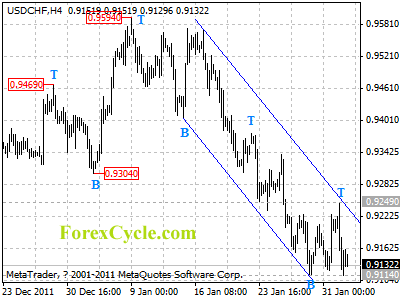
USDCHF stays in a downward price channel

USDCHF stays in a downward price channel on 4-hour chart, and remains in downtrend from 0.9594, the price action in the range between 0.9114 and 0.9249 is treated as consolidation of downtrend. As long as the channel resistance holds, we’d expect downtrend to resume, and another fall towards 0.8900 is still possible. Key resistance is at 0.9350, only break above this level could signal completion of the downward movement.

usdchf

Daily Forex Forecast

The Rich Getting Richer: Facebook and the Biggest IPO Tease in the History of IPO’s

Facebook- with quite possibly the biggest IPO tease in the history ofIPO’s is said to be filing tomorrow. At this point people are sayingits inevitable. And what does that mean for some of the big stakeinvestors at Facebook? – Well, it looks like the rich are about to getricer. Lets look at what people would make out with – Zuckerberg isestimated to own about 20% of the company, that would be worth roughly$20 billion dollars. Accel Parterns – the first venture capital fundto invest in Facebook – sold part of its stake, but still has a 10% ofthe pie, that’s about $10 billion dollars. Greylock – anotherinvestment firm 1.5 billion, again, these are are of course allestimates. Co founder Dustin Moscovitz slated for 5 billion. PeterThiel of Paypal, his stake estimated at 2.3 billion. Yuri Millner ofRussias Digital Sky Technologies $4 billion. Bonos venture capitalfund, Elevation Partners 1.7 billion,Shawn Parker 3.4 billion. And don’t forget this will turn an estimated1000 employees at facebook – into millionaires. A lot of peoplelooking to get rich with this IPO. One potential downside forFacebook in this IPO is that they have been able to hire a lot of toptalent, hiring top people away from Apple and Google because they wereable to offer equity – and now that won’t be able to offer an equitystake to potential employees once they IPO, that could be a potentialchallenge Facebook will have to deal with in terms of attractingtalent in the future.