Russia Behind Bulgarian Anti-Fracking Protests?

Pity the poor Eastern Europeans. Fifty years under the domination of their massive Soviet eastern neighbor then the collapse of Communism there two decades ago offered undreamed of opportunities to join both the European Union and NATO.

But they still remain dependent on the Russian Federation for the majority of their oil and gas needs, and the new capitalists in Moscow do not hesitate to charge the highest prices possible.

According a number of East European nations, particularly Poland and Bulgaria, are actively investigating the possibility of establishing hydraulic fracturing (“fracking”) operations on their territory to develop an indigenous natural gas industry and undercut the Russian Federation’s state-owned natural gas monopoly Gazprom.

Mindful however of the possible negative environmental effects of fracking last month 166 members of the Bulgarian National Assembly’s 240 parliamentarians voted to impose an indefinite ban on shale gas exploration and extraction in Bulgaria using hydraulic fracturing or other similar technology.

Now a hard-hitting editorial in the Trud newspaper by Ivan Sotirov entitled, “Russian Lobby Against Shale Gas,” accuses pro-Russian Bulgarian supporters of fomenting protests against shale gas operations in the country.

Commenting that “nightmare” protest rallies against fracking have taken place in the capital’s Sofia streets Sotirov wrote of their effects, “The ostensibly rightist majority at the National Assembly has capitulated, without any serious arguments, to this pseudo-civic pressure, and has adopted a moratorium on prospecting and extracting shale gas in Bulgaria. In other words, the National Assembly has banned Bulgaria from learning whether it has shale gas deposits – information which could have released us from the total energy dependence on Russia. The majority in the National Assembly has allowed the Bulgarian Socialist Party (BSP), the Movement for Rights and Freedoms (DPS), and several semi self-disintegrating mini-parties to insult the Minister of Energy (Traycho Traykov), who has been appointed by the same confused and helpless majority… It has been inadmissible for the chairman of the Union of Democratic Forces (Martin Dimitrov) and rightist deputies to support this decision, which contradicts the Bulgarian national interest and protects our total energy dependence on Russia. In addition, all this has been done without any serious motivation because the campaign against the shale gas prospecting has been based on cheap manipulations and lies. This has been an attempt to disguise a political issue as a purely ecological matter.”

Writing about the campaign as one of disinformation Sotirov continues, “The first lie has been that experiments with a new technology will be conducted in Bulgaria. This is totally untrue… Second – the so-called defenders of environment protection among the politicians have not cited even a single example of a serious case of pollution after fracking.”

Finally, Sotirov names names: “Noted chiefs of the Sixth Department (of State Security – the Communist era secret service), led by Dimitur Ivanov – Mityo the Gestapo and the supporters of (former President) Georgi Purvanov’s Grand Slam (the ‘Belene’ Nuclear Power Plant construction, the ‘South Stream’ (natural gas pipeline to export Gazprom gas) project, and the ‘Burgas-Alexandroupolis’ oil pipeline project, are among the protestors against shale gas prospecting…

Sotirov concludes, “The most shameful fact is the realization that after 22 years of democracy Bulgaria’s policy continues to be dictated by oligarchic pro-Russian circles, which, hiding behind nationalistic and ecological rhetoric have not allowed a single serious strategic Western investor to set a foot in Bulgaria. The question is when somebody will finally stop them.”

Why would Bulgarian pro-Russian interests do such a thing?

Could it be that because of a long-term contract, Gazprom delivers more than 90 percent of the natural gas consumed in Bulgaria?

Or that last November it was announced that Gazprom will enter Bulgaria’s retail fuel market by buying gas stations in the country through its Serbian unit Naftna Industrija Srbije?

Or that, according to Gazprom CEO Aleksei Millter, addressing Gazprom’s Annual General Shareholders Meeting on 30 June 2011, during his presentation “Gazprom: New Horizons,” outlined a series pf projected natural gas pipelines across Bulgaria to deepen Gazprom’s market share in Eastern and Central Europe?

Or that in December 2010 Gazprom acquired a 50 percent stake in the South Stream Bulgaria AD pipeline project?

Or the fact that the natural gas contract between Bulgaria and Gazprom expires later this year?

Or that Gazprom is forecasting its consolidated net profit for 2011 at $40 billion, or 25 percent more than in 2010?

Nah, surely none of the above – Bulgarian parliamentarians are only being good custodians of the country’s environment, surely.

Source: http://oilprice.com/Energy/Natural-Gas/Russia-Behind-Bulgarian-Anti-Fracking-Protests.html

By. John C.K. Daly of Oilprice.com



Chrysler Currently In Talks For Auto-Lending With Banks

The Wall Street Journal reports that Chrysler is in talk with plenty of major lenders including JP Morgan (NYSE:JPM) and Ally Financial about starting an in-house consumer and dealer auto-lending and loan operation through a joint venture.Chrysler has used Ally as its preferred leader for loans and leasing, but the contract is scheduled to end in 2013.JPMorgan Chase (NYSE:JPM) has potential upside of 19.7% based on a current price of $38.17 and an average consensus analyst price target of $45.7.

A Buy Signal for Petrobras (NYSE: PBR)?


Petrobras (NYSE: PBR)

It was a clear sell signal for Enron.

I worked with Enron during the early 1990s on some energy projects in Asia. They were smart, aggressive, swashbuckling types who could also turn on the Texas charm at the drop of a hat.

The Chairman, Ken Lay, primarily handled the power broker side of the business, schmoozing with world leaders and politicos.

Rich Kinder, Enron’s President, was the straight-talking lawyer and detail man who kept the train on the tracks.

But in 1996, Enron’s board decided not to give the top job to Kinder.

He promptly resigned to go into the hard asset pipeline business he preferred. McKinsey guru Jeff Skilling was selected to fill Kinder’s job with a mandate to plunge into the energy trading business.

You know the rest of the story…

But the lesson here is that who is at the top of big complex companies like Enron is a big deal. Corporate leadership changes can sometimes provide buy or sell signals.

This brings me to Brazil’s Petrobras (NYSE: PBR).

The Largest Company in Latin America

Brazil is a big deal in Latin America, representing 40% of the region’s entire economic output. In some ways, it offers a better bet for investors than China since it’s a democracy offering not only a surging middle class but also abundant natural resources.

And Brazil has the largest company in Latin America – resource-rich Petrobras.

David Fessler writes and speaks about Petrobras often, and points out that the company has the potential to become the largest energy company in the world.

Petrobras CFO Almir Barbassa agrees, and in an interview with Forbes, said he expects the company’s oil production rate to match Exxon Mobil. Petrobras also discovered an unbelievable amount of deep-water reserves of both natural gas and oil.

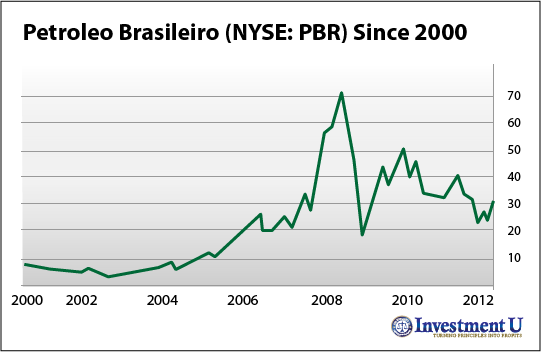
So why is its stock trading way below its $70 high in 2008 and quite a ways from the $50 price it opened in 2010?

A Buy Signal for Petrobras (NYSE: PBR)

In my opinion, it’s because the company is being mismanaged by government appointed executives.

Mr. Sergio Gabrielli has been CEO since 2005. An economics professor with little oil and gas experience, he’s leaving this week to pursue “politics.”

His biggest mistake was the high-handed $70-billion public offering announced in early 2010. While it raised some capital from private investors, the government grabbed $42.5 billion in shares in exchange for “giving” the company the right to develop some reserves.

This brought the government’s ownership up from 40% to 48%.

Diluted private shareholders expressed their disappointment by the only vote they have – selling the stock.

The new CEO taking the helm today is a well-respected technocrat steeped in the energy business – Maria das Gracas Silva Foster.

While a confidant of Brazil’s president, she’s expected to be less political and more business. And as current head of Petrobras’ gas and energy group, she knows the business inside and out, plus how to manage the bureaucracy.

Could she be a Rich Kinder?

As you can see, Petrobras has recently begun an upward trend.

My advice?

Jump onboard now with a 15% trailing sell stop in case our hopes of much better management are dashed.

Good Investing,

Carl Delfeld

Article by Investment U

Three Formulas for Finding Value Stocks


finding value stocks

Despite positive news lately, there’s a lot going on in the markets right now, and it isn’t good. The most terrifying aspect of all is that the doom and gloom is spread worldwide.

Europe is a mess right now. Two of its four largest economies teeter on disaster. Meanwhile, Greece is the troubled teenager who knows he needs to get his act together but continues to find himself in bad situations. Germany and France are still experiencing menial growth…

Eurozone authorities recognize there’s a problem, but it may be a too little too late.

Then the United States has its own problems.

Our Central Bank has come under fire for its “quantitative easing” monetary policy, which was primarily ineffective. Its latest initiative of flattening the yield curve may prove detrimental to long-term investment. The dysfunction of Washington policymakers is well noted and, finally, there’s that $14-trillion national debt thing.

Even from peaks earlier this year, Japanese markets are down over 20% due to natural disasters.

In times like these, it’s wise to go bargain shopping. Good companies sometimes get dragged down along with the ebbs and flows of a volatile market. For no fault of their own, they may be undervalued.

Morningstar’s Buyback List

One indication that a stock is undervalued is a company buyback. A few months ago, I wrote about Warren Buffet’s buyback announcement of Berkshire Hathaway’s Class A and B Shares (NYSE: BRK.ANYSE: BRK.B). In September, Berkshire Hathaway’s board approved a plan to buy back the company’s stock, an indication that Buffett believed the stock was undervalued.

Morningstar reported a list of other companies whose Board of Directors are likely to or have given the “okay” to buy back stock. Here is a list of four companies mentioned:

  1. CSX Corp. (NYSE: CSX)
  2. Union Pacific Corp. (NYSE: UNP)
  3. Norfolk Southern Corp. (NYSE: NSC)
  4. United Parcel Service Inc. (NYSE: UPS)

Is There a Formula for Finding These Companies?

In fact, there are several…

Morningstar reports that to find firms in the position for a possible buyback, you can look for stocks trading at their 52-week lows with low debt – this would be measured by the total debt to total equity where the lower the number, the better – and high cash balances as measured by cash-long term debt/market capitalization.

Another option for determining possible buyback opportunities, according to Michelle Swartzentruber, a research analyst with Morningstar, would be able to identify companies that have enough cash left over to do buybacks even after paying off debt.

And a third option would be to look for stocks with strong balance sheets, strong sales growth and better-than-average dividend yields.

Even when the 24/7 news cycle is reporting doom and gloom, it doesn’t mean that every stock in the market is rubbish. As in any heap of rubbish, you can always find something valuable if you know where to look.

Good Investing,

Jason Jenkins

Article by Investment U

KISS your way to Forex freedom

KISS your way to Forex Freedom –kiss


Being a widely used acronym, the K.I.S.S. principle, if used correctly, can be used by FX traders for consistent success. K.I.S.S. stands for Keep ISimple Stupid. Although we’re not saying traders are stupid, the keep it simple part of the acronym is a beneficial principle to follow.

Trading need not be as complicated or frustrating as many make it. It can be said that a trader’s best friend is simplicity. A simple approach is often the most effective approach, generally leading to successful and consistent trading.

Many traders fall into the trap of over analyzing and complicating the markets with complex indicators and strategies. Apart from trading blind (no analysis/gambling), price action trading is one of, if not the most, simple ways to approach and trade the markets. Price action trading consists of the trader using the most basic aspects of trading; The Price. No lagging indicators or complex mathematical formulas are used to predict the markets next move. The trader simply uses the only real information they need to successfully trade; The Price.

By conducing simple analysis of what is currently happening in the markets, the trader can react to these price changes by either, placing a trade, or deciding to sit on his or her hands (often the best trades!) and waiting for the next set up.

The KISS principle does not only relate to analysis and trading, but can and should be applied to the traders overall approach to the FX market. A simplistic approach should be applied to the traders: forex plan, money management and trading psychology.

keep_it_simple_stupidA simple forex trading plan comprises of basic but critical rules the trader follows in order for successful trading. The traders plan includes, the rules they follow for entering and exiting the market (their system/strategy), along with how much they are prepared to risk in order to find out if the market movies in their direction. Successful traders always have a hard copy of their trading plan with them at all times while analyzing/trading the markets. Their simple approach reminds them that their plan can quite easily be lost if its ‘stuck in their head somewhere’, whereas keeping a hard copy in a visible location is hard to dismiss. The traders plan should be simple yet effective or short and sweet cutting out needless information and noise.

Trading psychology is possibly the most important aspect that determines a trader’s long term success. A simple psychological approach requires the trader to trade without emotion. Leaving his or her emotions at the door is easier said than done, however once a simple approach is applied to this important aspect of trading, a traders longevity is often improved.

Physically kissing your way to forex freedom is impossible, however remembering to follow the K.I.S.S. principle while trading can dramatically improve a trader’s success. Novice traders often find themselves engulfed in the newest system, or EA to hit the market, constantly switching from one idea to the next, painstakingly searching for the ‘holy grail’ of trading. Unfortunately they soon realize there is no such thing and their constant impatience leads only one way… failure. A simplistic approach may sound like a boring way to trade to some people, however, to the lucky few traders who consistently make money the KISS principle is their ‘holy grail’.

Albert Einstein once said ‘’Make everything as simple as possible, but not simpler’’. Although he was not a trader, I’m sure you’d agree he was a pretty smart guy…

Article by vantage-fx.com

Earnings Wrap: AKAM, SIRI

Akamai (AKAM) shares surged this morning after the company reportedly posted better than expected 4th quarter earnings. GAAP net income for the 4th quarter increased 42% over last year to $0.33 per diluted share.

Pepsi Reports Earnings

Pepsico (PEP) shares dropped in early trading this morning after the company forecast 5% lower core constant currency EPS for 2012 over last year. This is due to several strategic and macroeconomic factors.