EUR/USD Outlook- Feb 13, 2012

Last week EUR/USD went as high as 1.3322 but dropped sharply from there to touch 1.3155 and closed for the week at 1.3197.

eur-usd

Initially for the coming week we will stay neutral and will watch for the break below the support expected near 1.3120 and then 1.3080 to expect further downward move and on the upside any break over the expected resistance near 1.3280 to expect further upward move to retest the recent 1.3322.

Euro movements can be very sensitive to any new updates and hence change of sentiments from Euro region. A small change of sentiments can cause some unexpected volatile moves and hence a very careful approach is required while trading with EUR/USD and Euro crosses.

On the downside if a firm break takes place below 1.3080 then we would expect EUR/USD to retest the recent low of 1.3027 and any break below but more importantly 1.3020 and 1.3000 psychological level will change the near-term outlook to bearish. But even in that case we would expect frequent supports near 1.2960 and 1.2930. Any firm break below 1.2920 should lead the way towards 1.2840 support and possibly further down.

On the upside, if EURUSD manages a break over 1.3080, as mentioned above, we will expect a retest of the recent 1.3322. A break over this recent high will change the focus again towards upside and that should take EURUSD towards the resistance zone of 1.3430 to 1.3485 resistance zone. Please note that 1.3434 represents the Fibonacci 50% retracement of the above mentioned move. Not only this, but the range of 1.3430 to 1.3550 had proved to be a very strong resistance zone during November 30th to December 9th, 2011. The psychological resistance of 1.3500 would also come into picture at those levels. However a break above this will bring up the possibilities of a test to 1.3620.

You may also check the weekly eur/usd forecast/Outlook and daily euro/usd  analysis at ForexAbode.

Other Techinicals:

1) ADX: Daily +DI line moved below -DI line once again and very weakly. There have been very frequent crossovers recently. ADX is well below 25 and is dropping (approx 12.00).

2) MACD: Daily MACD line remains over the signal line but started running flat with frequent touch downs with the signal line. Currently it is touching the signal line though has not moved below it as yet. 4-hourly MACD line’s last crossover signal was moving below the signal line.

3) Ichimoku Cloud: 2 weeks back Tenkan-Sen had crossed over Kijun-sen to give a weak bullish signal (you may please check our Ichimoku cloud page under technical analysis). The upward move had broken over the resistance of the upper edge of the cloud but then the price action, once again, had moved within the cloud. It found support well above the Kijun-sen level and moved above the cloud. Weekly closing was little above Tenkan-sen level. The gap between Tenkan-sen and Kijun sen has narrowed down. Over all the bullish configuration but indicating a loss of upward momentum.

Value Investing – Three Simple Rules for Picking Stocks

By MoneyMorning.com.au

On Friday, one of our colleagues mentioned he’d re-read Ben Graham’s value investing bible, The Intelligent Investor.

It got us thinking about the timeless principles of value investing again. And marvelling at how you can adapt them to suit any market.

Which is just as well…


Because from around 9:45 this morning, we watched the Greeks vote for austerity. Again.

They had to. Otherwise, Greek default.

But in case you missed it, the price of the bailout has jumped from $130 billion to $210 billion, too. Where did that extra $80 billion come from? Check out Zerohedge.com for the answer.

A few of our friends are turning away from stocks and moving into fixed-income investments. They’d rather miss out on share price gains than risk losing what they’ve already got.

Whether that mirrors your own investing strategy or not, we don’t know. (Like to let us know what you think/how you’re investing in this market? Email [email protected] … put ‘My Strategy’ in the subject line.)

But deserting the stock market just because things look scary isn’t always the best idea. Because that’s when the savviest investors find some of the stock market’s best valued stocks. All you have to do is follow these 3 timeless value investing principles. After all, they’ve worked for Warren Buffett.

Rule #1: Value the business, not the share


This is the number one rule of value investing. Focus on the company, not the stock.

That is, don’t worry about who is buying what – or how much a stock is climbing, or falling. It’s just noise.

You really need to look to invest in strong businesses that have sound fundamentals…

  • A solid business plan that brings in money
  • A product/service that is in demand today and probably still will be tomorrow
  • A manager that knows how to spend money the right way – that is, a manager who invests a lot of money in resources that will bring in more money rather than a reckless spender

Rule #2: Always invest with a margin of safety


If you want to make money on stocks, the simplest way is to pay LESS than what a share is worth… like buying a share worth $1 for 80 cents.

This is where good old-fashioned balance sheet analysis comes in.

The market capitalisation of a company is the value the market puts on a company. That is the number of shares on issue multiplied by the share price.

In an ideal world, a business that earns profits of $1 million a year and has $1 million in assets would have a market cap of $2 million.

But in reality, this never happens.

Earnings estimates, bullish stock price predictions cause people to buy and sell shares for almost no other reason than the hope that the stock will go up or down.

And that makes it possible for you to find ‘unpopular’ stocks that the market undervalues. I.e. a company with assets and earnings equal to, say, $20 million, but a market cap of $16 million.

That gap between the real value of the company and its perceived value is your margin of safety. And you often find it when people are feeling negative about stocks in a certain sector. (Like retail stocks before Christmas, for example.)

Rule #3: Focus on ‘fair range’ not precise value


You really only need basic math skills to work out a company’s intrinsic value… As long as you know which figures to look at…

But you need to accept you’ll probably NEVER estimate the ‘intrinsic value’ of a company to the exact cent.

No matter how much data you have about a company’s profitability and the macro outlook, you’ll probably NEVER get the intrinsic value spot on…

But you can do the next best thing…

And that is estimate a precise range of fair value… 20% above and below your best, most accurate estimate.

Once you pinpoint that ‘fair range’, you’re almost mathematically guaranteed your investments will make gains and avoid losses. Because it gives you the margin of safety that can help ensure you’re buying quality stocks at sensible prices.

Follow these simple rules and you’re on your way to almost mathematically guaranteed gains.

To find out more about how value investors are playing this market, click here.

Aaron Tyrrell
Editor, Money Morning

strong>From the Archives…

Picking the Big Investment Story for 2012
2012-02-10 – Kris Sayce

Attention: If You Have Australian Bank Stocks – Sell Them Now
2012-02-09 – Kris Sayce

Why This Bearish Indicator Means it’s Time to BUY Stocks
2012-02-08 – Kris Sayce

Why The RBA Uses The Terms of Trade Indicator… And Why You Should Too
2012-02-07 – Greg Canavan

Why the US Unemployment Rate is a Slippery Statistic
2012-02-06 – Dr. Alex Cowie


Value Investing – Three Simple Rules for Picking Stocks

Health, Wealth and Stealth Inflation in the Great Food Swindle

By MoneyMorning.com.au

Having good health, especially as you get older, is a form of enrichment. And if you’ve been to a doctor/specialist/hospital recently, you’ll know maintaining your health is not cheap.

If you’re interested in improving your health, or if you’re feeling sick, depressed or just lethargic, read on – this might be the most important essay you read all year.


But first:

Since the October lows, many global stock indexes are up about 20%. This really is some rally. But it’s still a bear market rally. Meaning the longer it goes on, the bigger the correction when it happens.

Stocks are not going up because the global economy is getting healthier. Businesses are paying off debt instead of expanding. Companies are laying people off instead of hiring. Banks are deleveraging instead of lending.

What you’re seeing in the markets right now – pure and simple – is central-bank-engineered asset inflation. It’s unsustainable.

So here’s the million-dollar question for Aussie investors: how do you successfully invest in a market with deflation as the over-riding influence, but punctuated by bouts of inflationary euphoria? Can you even make returns in such a market?
Over the Christmas break we did some serious thinking on this issue. We took some time on the beach (when it wasn’t raining) to relax…to step back from the rescue plans and bailouts… and focus on what’s REALLY going to matter for Australian investors this year.

The result is a report you can receive – here.

What we’ve come up with aren’t direct recommendations. They’re warnings. Or rather they’re three big mistakes we think many Australian investors will make this year that will lose them money.

We think you’ll find it good reading – and hopefully it will help you make some good investing decisions this year.

And now, from the health of the economy to the health of your colon…

We bring up the topic of health after recently watching a cracker of a show called ‘Fat, Sick and Nearly Dead’. It’s been around for a year or so. But this was the first time we’d seen it on TV.

It’s a documentary about a Sydney bloke named Joe Cross. Joe is an entrepreneur. He spent most of his early years focussing on building wealth. He worked hard and, judging from his physique, ate pretty hard too. By the age of 40, Joe was nearly 140 kilo’s and battling a rare autoimmune disease called chronic urticaria.

As a result he was necking the powerful steroid, prednisone, daily. If you’ve heard of this drug, you’ll know it has some nasty long-term side effects.

Joe realised he was in trouble. He needed to do something about it. So he went to America and put himself on a (medically supervised) diet of nothing but vegetable and fruit juice for 60 days.

The results were amazing. He dropped about 45 kg. More importantly he dropped the chronic urticaria and got off the prednisone. While that sounds impressive, there’s another character in the documentary whose story will blow you away.

By cutting out processed foods, which are full of sugar and fat, Joe (and the other bloke) restored their health. It required a lifestyle change. But they were on their way to an early grave and had no other choice. They don’t live on juice now of course. But they needed a circuit breaker and it worked.

Fancy that. By eating food provided by nature, we become healthy. By eating food processed to within an inch of its life, we slowly kill ourselves. Most of the food sitting on supermarket shelves has minimal nutritional value. In order to extend the shelf life, most of the nutrients are killed in the process.

Our diets are full of sugar, fat and sodium. These things are long-term, silent killers. And the unhealthier society becomes, the more national healthcare systems buckle under the, err…weight of the cost of looking after a sick nation.

Demand for drugs goes through the roof. Western nations are over medicated. The pharmaceutical companies make a bundle from treating the symptoms, not the cause. We waste billions of dollars going around in circles.

We’ve got a theory about how things have got to this point. It involves central banks, excess credit and stealth inflation.

But first, there’s a personal element to this. So we’ll slip into the first person…

A few years ago I suffered from a major bout of eczema. I had it pretty bad as a kid, but it went away…forgotten about.

Then, a number of highly stressful events brought it back. Face, head, eyelids, ears…I was an itching, weeping mess…and very miserable.

Several trips to the doctor yielded numerous prescription ointments. I got a referral to a highly paid skin specialist who gave me samples of branded moisturiser creams and told me to keep up with the prescription ointments. Cheers for that.

Thinking I might be allergic to certain foods, I arranged a blood test through the health system. Because my skin reacted to dust mites, the genius doctor advised me to thoroughly air out my room. Apparently it wasn’t eczema, I was allergic to dust mites. Thank you taxpayer.

Things got worse and my doctor prescribed prednisone. This stuff cleared up the eczema within hours. But you had to keep taking it. And as I said earlier, this is a nasty drug.

At a decent cost, the health care system attacked the symptom, not the cause. I was throwing hundreds of dollars at the problem for no result.

Feeling increasingly miserable, I decided to see a naturopath. I was put on a strict diet for 6 weeks. No booze, no coffee, no bread or wheat, no meat…just lots of water, fresh fruit and vegetables. After a month my eczema had gone. Completely disappeared.

The moral of the story? Modern living can make you sick. Nature, not prescription drugs, can make you better.

So why is the food we eat slowly killing us? Why is the ‘market’ providing consumers with a choice that is actually harmful to them? That’s not how capitalism is supposed to work, right?

No it’s not.

Here’s our theory as to why things have gone wrong.

For the past few decades, central banks have held the price of credit artificially low. This has created excess credit, which translates into increased demand or purchasing power.

But the benefits of this credit boom, in general, have not accrued to the middle and working classes. Yes they have become wealthier. But they have had to increase their debt considerably to display that wealth.

The abundance of credit and resultant financialisation and globalisation of economies around the world put the focus on cutting costs. It became about achieving ‘economies of scale’ – a fancy term for bigger is better and cheaper. Nowhere was that more prevalent than in the production and distribution of food.

This reorganisation of resources and the economic structure of food production didn’t lead to lower prices AND a better product. That’s the hallmark of real technological improvement and genuine capitalism in action.

Instead, it led to lower prices and a reduction in food quality. The government agencies that compile inflation data just looked at the price, not the deteriorating quality. As a result, CPI inflation remained low. This kept interest rates low and allowed the credit boom to continue.

In industries where there were real technological improvements like computing, the statistician made a ‘hedonic adjustment’ to account for the improvement. The result? Very low inflation all around.

This made central bankers look like geniuses. And the middle class thought they were becoming wealthier because debt was cheap and allowed them to have ‘stuff’ they couldn’t previously afford by taking on more and more debt.

Low inflation – known as the great moderation – is a fraud. We’ve had doctored low consumer inflation numbers at the expense of our food quality.

In the meantime, Australia and the US have been vying for the gold medal for the fattest nation on earth.

Maybe it’s just a coincidence that obesity has become a major societal issue at the same time as the global credit bubble expanded. Maybe, but we doubt it. The West has many economic problems associated with debt. It also has many health-related issues.

You might think the link is a tenuous one. But if you think about it hard enough, it’s there.

Greg Canavan
Editor, Sound Money. Sound Investments.

Publisher’s Note: This is an edited version of an article that first appeared in The Daily Reckoning Australia.

Greg Canavan will be appearing at After America: the Port Phillip Publishing Investment Symposium, March 14th-16th at Sydney’s Intercontinental Hotel. Greg has also identified three ways careless investors could lose money this year… and how you can avoid falling into this trap. To see Greg’s special report and take out a no obligation trial subscription, click here…


Health, Wealth and Stealth Inflation in the Great Food Swindle

Building With New BRICS

By MoneyMorning.com.au

[Ed Note: Benjamin Graham, if he was alive today, would no doubt be very pleased that his treasured principle “margin of safety” has entered investing vocabulary. It has done so to the point many probably don’t know it came from him, but somehow it still got to them. The same thing happened to Jim O’Neill, who coined the term BRICS – an acronym that turned into a noun.

Jim O’Neill has a new book, The Growth Map, exploring investing and business opportunities in emerging markets. David Thomas, a keynote speaker at “After America”, does the same thing for a living. With thirty years of experience, David says there is plenty of profit to be made in the BRICS – as those attending “After America” will discover. David kindly allowed us to republish this blog entry, where he shares some introductory thoughts on the topic.]

The rapid economic decline of the US and western Europe, fuelled by indecisive and frightened politicians, massive debt and a bloated sense of entitlement, has accelerated the process (first predicted by Jim O’Neill of Goldman Sachs as early as 2001, and now referred to as “the end of the great divergence” by Niall Ferguson in his recent TED lecture in Edinburgh) of transforming the global economy to one which is dominated by four countries – Brazil, Russia, India and China (The “BRIC” countries). Not far behind, although starting from a much lower base, is Continental Africa, referred to as the “last great emerging market” in our most recent issue of Insights.

What we don’t know, and is very hard to predict at the moment, is how painful this transition will be. Will Germany accept the horrible reality of a $2 trillion deficit in southern Europe and take decisive action by paying a figure which represents two-thirds of their total GDP into the system to save Greece and other ailing economies, and prop up the banks that will become insolvent in the event of a sovereign default? Or will the politicians prefer the “death by a thousand cuts” approach which has prevailed so far?

Will the US face up to its own insolvency (with its total debt now at 100% of GDP and rising) and make serious and meaningful cuts to its Federal Budget? Or are we simply putting off the day when the US faces its own major debt crisis which will be too large for any other country to rescue and lead to a deep and painful global recession? As each day goes by it isn’t hard to paint a very pessimistic scenario for the future, despite the hope that sense will eventually prevail. Volatile investment markets simply reflect the confusion, fear and panic that exists throughout the investment community.

Unfortunately, this all happened much sooner than it was meant to! The BRICs are still relatively small economies (though growing rapidly) and are nowhere near ready to prop up the whole global economy. In any case, they are all going through their own internal transformations so as to be able to maintain economic growth despite the absence of the American consumer, the engine that has fuelled global growth for the last 50 years or more.

The key BRIC trends to be following to feel confident and optimistic about the future are as follows:

BRIC Domestic Consumption

China’s transition from an export driven economy to one which is dominated by domestic consumption (with urbanisation, rising wages and the development of a world class services industry as key drivers) is the focus of the 12th Five Year Plan and was the subject of the July issue of Insights. India’s economy is already dominated by strong domestic spending, and Brazil’s wealth of resources, agriculture and renewable energy offers a high degree of self-sufficiency.

However, Russia has the largest consumer class amongst the BRIC countries, the highest GDP per capita, the lowest level of debt, and now leads the whole of Europe in the sale of key consumables e.g. pharmaceuticals, mobile phones, broadband and even beer (catching up with Vodka as the beverage of choice amongst Russians!). According to the recently released Forbes survey of billionaires, Moscow has more billionaires (79) than any other city in the world (the closest is New York with 58) and Russia accounts for a third of Europe’s 300 billionaires, and 15 of the world’s 100 richest people. Not surprisingly, retail sales in Moscow now exceed Paris and London, and by 2025 the consumer market in Russia, which is now approx. 142 million, is expected to be larger than Germany’s, one of Europe’s largest markets.

Intra-BRIC trade

The recent BRICS Leaders Meeting in China in April 2011 laid the tracks for greater “intra-BRIC” trade and investment co-operation in the years ahead. This is vital to the global economy and should be occupying the minds of all forward thinking business leaders and entrepreneurs.

With a combined GDP of $8.7 trillion in 2010, the BRIC economies already account for 45% of global economic growth, and the combined BRIC share of world trade increased from 6.9% in 1999 to approx. 14.2% in 2008. Furthermore, BRIC collective trade with the world increased almost six times from $790 billion in 1999 to $4.4 trillion in 2008.

Intra-BRIC trade, or trade among the BRIC members, has accounted for the fastest growth rate in global trade in the last decade, and is expected to continue as the BRIC economies become more dominant. According to the IMF, intra-BRIC trade, which is valued at more than $170 billion, has grown at the rate of 30% p.a. since 1999 and now accounts for 8% of global trade. During the 10-year period up to 2009, intra-BRIC trade increased nine fold compared to global trade, which only doubled over the same period.

In recent years, Intra-BRIC trade has been mainly characterised by Russia and Brazil supplying natural resources to satisfy the industrial and infrastructural needs of India and China. However, this is likely to change. Watch out for more investment and trade deals between the BRICs as they create their own trading bloc and invest in each other’s capabilities.

Strong BRIC Leadership

You have to admit that western style democracy is looking pretty sick at the moment! With hung parliaments all around the world, short parliamentary terms, continuous electioneering, disengaged and disgruntled voters, and career politicians looking after their own interests, the will to engage in structural reform and long term planning has virtually disappeared. It is not surprising that the west is in such a mess!

In contrast, the political systems of China and Russia (now with the prospect of Putin serving as President until 2024, having first been elected President in 2000) look remarkably strong, stable and effective, despite the way they are portrayed in the western media. And Brazil’s recent economic success can largely be credited to the successful 8 year terms of two reforming, pragmatic and popular Presidents, Fernando Henrique Cardoso and Luiz Inacio Lula da Silva.

The question now is whether India, the largest democracy in the world, will be able to remove the stifling influence of Government bureaucracy and consensus to allow their entrepreneurial culture to thrive. India’s growth rate of 10% p.a. would be much higher with decent infrastructure and less Government interference, and the hope is that India’s reforming Prime Minister, Manmohan Singh and his successors can be allowed to finish the job of transforming India into a modern economy.

With its young demographics, entrepreneurial flair, technological excellence and strong domestic demand, India will surely reach its true potential and demonstrate that democracy (famously referred to by Churchill as “the worst form of government except all those other forms that have been tried”) is still alive and well!

BRIC Innovation

Here lies the big question for the BRICs to address….and for the US and the developed world to ponder. Will the next Steve Jobs be Chinese? Will Bangalore in India take over where Silicon Valley left off? Will Brazil become the world’s clean source of food, energy and transportation? Will Russia put the first man on Mars?

It’s too early to know for sure, but the BRICs benefit from “latecomers advantage”. The opportunity to leapfrog technological advances, capitalise on knowledge and past experiences, tap into existing networks and, above all, learn from the mistakes of those who have gone before. They also have the funds to spend on research and equipment which is rapidly running out in the west.

So, here lies the key to the future. As so eloquently put by Seth Godin in his recent blog entry, The forever recession (and the coming revolution), “the future is about gigs and assets and art and an ever-shifting series of partnerships and projects”. It’s not a zero sum game…we can innovate and they can innovate…the rest can be outsourced or ignored. Let’s fix the debt problems quickly, take the pain, start again and get on with the innovating! The BRICs will lead the way…we all must follow.

David Thomas
Contributing Writer, Money Morning

Publisher’s Note: David Thomas is a BRIC Expert, Speaker, Entrepreneur and Thought Leader. He is a keynote speaker at After America: the Port Phillip Publishing Investment Symposium, March 14th-16th at Sydney’s Intercontinental Hotel. He blogs here.


Building With New BRICS

AUD/CAD Weekly outlook 13 Feb – 17 Feb

Last week saw the pair initially continuing with its recent and well established bullish momentum. The second half of the week however, saw the market giving way to the bears, with the pair falling for much of Wednesday, Thursday and Friday resulting in a bearish pin bar on the weekly timeframe.

Our analysis for the Aussie against the Loonie in early January suggested we’d see a push higher in the following weeks towards the 1.0600 area and beyond. We did indeed see the market playing out the way we anticipated with the initial target area being comfortable reached.

With last weeks price action on the weekly charts the pair is suggesting we may see a pull back before the bulls continue to push the pair back higher.

audcadweeklyoutlook13feb17feb

Price in the middle part of last year found strong resistance at the 1.0540 area with at least 3 attempts to break though and 3 rejections. We did finally break though in Oct/Nov of last year however quickly retraced back below. January saw the market once again breaking though this area, however unlike last time, the price managed to hold and continue pushing higher.

Last weeks bearish pin’s suggestion of a pull back could once again see the market gravitating towards the 1.0540 area. However this time we’d be likely to see this area holding as support before a continuation of the current trend.

We’ll be looking to take a short term sell towards the new support area at 1.0540. However, with the market producing price action on the weekly TF, we’ll look to enter at a slightly higher price than where we closed on Friday. A possible 50% retracement of last weeks pin could prove to be a better entry with a stop just above the high of the pin.

Article by vantage-fx.com

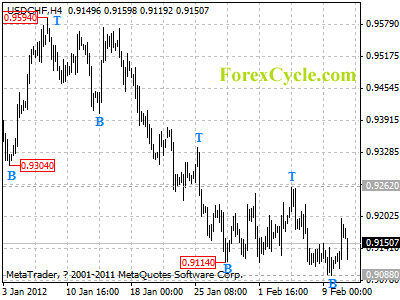
USDCHF has formed a cycle bottom at 0.9088

USDCHF has formed a cycle bottom at 0.9088 on 4-hour chart. Range trading between 0.9088 and 0.9262 would likely be seen in a couple of days. Key resistance is at 0.9262, as long as this level holds, the price action in the range is treated as consolidation of the downtrend from 0.9594, and one more fall towards 0.9000 is still possible. However, a break above 0.9262 will indicate that the downtrend from 0.9594 has completed at 0.9088 already, then further rise towards 0.9594 previous high could be seen.

usdchf

Daily Forex Analysis

Currency Futures: Forex Speculators cut Dollar Long Positions as Canadian Loonie positions turn long while Kiwi surges

By CountingPips.com

The latest Commitments of Traders (COT) report, released on Friday by the Commodity Futures Trading Commission (CFTC), showed that large futures speculators decreased their US dollar long positions last week and Euro short positions improved for the second straight week off their record low level.

Non-commercial futures traders, usually hedge funds and large speculators, decreased their total US dollar long positions to $10.63 billion on February 7th from a total long position of $14.22 billion on January 31st, according to the CFTC COT data and calculations by Reuters which calculates the dollar positions against the euro, British pound, Japanese yen, Australian dollar, Canadian dollar and the Swiss franc.

Individual Currencies:

EuroFX: Currency speculators decreased their Euro short positions for a second consecutive week as of February 7th after registering a new record high for euro short bets on January 24th. Euro net short positions totaled 140,593 short bets against the euro currency from the previous week’s total of 157,546 net short contracts.


The COT report is published every Friday by the Commodity Futures Trading Commission (CFTC) and shows futures positions as of the previous Tuesday. It can be a useful tool for traders to gauge investor sentiment and to look for potential changes in the direction of a currency or commodity. Each currency contract is a quote for that currency directly against the U.S. dollar, where as a net short amount of contracts means that more speculators are betting that currency to fall against the dollar and net long position expect that currency to rise versus the dollar. The graphs overlay the forex spot closing price of each Tuesday when COT trader positions are reported for each corresponding spot currency pair.

GBP: British pound sterling positions declined after two weeks of improvement, according to the data as of February 7th. British pound positions saw a total of 33,122 short positions on February 7th following a total of 26,214 net short positions registered on January 31st.

JPY: The Japanese yen net long speculative contracts dipped last week after increasing the previous week, according to the latest data on February 7th. Yen long positions fell to a total of 55,171 net long contracts reported on February 7th following a total of 56,669 net long contracts that were reported on January 31st. Yen speculative positions are still just below their highest level in over a year that was registered on January 10th when contracts surpassed the August 2nd level of 58,833 contracts.

CHF: Swiss franc speculators slightly decreased their short bets against the Swiss currency for a third consecutive week as of February 7th. Speculator positions for the Swiss currency futures numbered a total of 9,795 net short contracts on February 7th following a total of 11,222 net short contracts as of January 31st. Swiss contracts had been on the short side by more than 10,000 contracts for six consecutive weeks before last week’s slight turnaround.

CAD: Canadian dollar positions surged higher and crossed over to a total long position for the first time since the beginning of September. Canadian dollar positions rose to a total of 2,184 net long contracts as of February 7th following a total of 19,409  short contracts reported on January 31st. CAD positions are now at their highest position since September 6th when long contracts equaled 2,081.

AUD: The Australian dollar long positions dipped slightly after increasing for six consecutive weeks. Australian dollar positions decreased to a total net amount of 75,095 long contracts on February 7th after totaling 78,044 net long contracts reported as of January 31st. The AUD speculative positions were at their highest level on January 31st since July 26th when Australian dollar long positions totaled 81,438.

NZD: New Zealand dollar futures speculator positions surged higher and advanced for a seventh consecutive week through February 7th. NZD contracts increased to a total of 23,335 net long contracts as of February 7th following a total of 14,797 net long contracts on January 31st. NZD positions have now risen for seven straight weeks from the December 20th low standing and to the highest level since August 2nd when net long contracts equaled 24,126.

MXN: Mexican peso speculative contracts improved for a fifth consecutive week and rose to the best position since August 9th against the US dollar. Peso long positions numbered a total of 34,107 net long speculative positions as of February 7th following a total of 21,481 long contracts that were reported on January 31st. Peso contracts crossed over into a positive long position on January 24th for the first time since September 6th and now has been on the long side for three consecutive weeks.

COT Currency Data Summary as of February 7, 2012
Large Speculators Net Positions vs. the US Dollar

EUR -140593
GBP -33122
JPY +55171
CHF -9795
CAD +2184
AUD +75095
NZD +23335
MXN +34107

Other COT Trading Resources:

Trading Forex Using the COT Report


Amazon.com To Announce Deal With Viacom For Online Video Service

Amazon.com (NASDAQ:AMZN) plans to announce a deal with Viacom (NYSE:VIA) to launch an online subscription service this week, according to Reuters.The move comes in the wake of hints Viacom CEO Philippe Dauman made last week on a CC.Reuters reported that the deal would be unveiled as soon as this week.Amazon.com (NASDAQ:AMZN) has potential upside of 27.8% based on a current price of $184.19 and an average consensus analyst price target of $235.44.

Greek Woes Snap 5 Week Rally

U.S. stocks fell, snapping a five- week-rally for the S & P 500. This happening amid concern that the plans to help Greece avoid default are unraveling. Additionally, confidence among American consumers dropped more than forecast.Citigroup Inc. (C) and Bank of America Corp. (BAC) dropped almost a percent, to pace declines among financial companies. Commodity producers retreated as Freeport-McMoRan. (FCX), Alcoa Inc. (AA) and Halliburton Co. (HAL) decreased almost a percent. First Solar Inc. (FSLR), the biggest maker of thin-film solar panels, tumbled 8.3 percent after permitting issues delayed a U.S. loan guarantee for a power plant in California.

Pakistan Central Bank Holds Interest Rate at 12.00%

tweetmeme_style = ‘compact’;

The State Bank of Pakistan maintained its discount rate unchanged at 12.00%.  The Bank said: “In conclusion, despite moderate aggregate demand, pressure on rupee liquidity is likely to continue due to uncertain foreign inflows and substantial government borrowings to finance the fiscal deficit. Moreover, inflationary pressures have not eased significantly. It must be emphasized that sustainable economic recovery over the medium term would call for a sizable increase in both the domestic and foreign private investment in the economy. For this to happen, the business confidence needs to be revived by reducing uncertainties due to energy shortages.”

Pakistan’s central bank last cut the discount rate by 150 basis points in October last year, and 50 basis points to 13.50% at its July meeting.  Pakistan reported annual inflation of 10.1% in January, compared to 10.46% in September, 11.56% in August, 13.77% in July, 13.92% in June, 13.23% in May, and 13.04% in April.  The Pakistani government previously announced an inflation target of 12 percent for fiscal 2012, with a desired path for inflation of 9.5% and 8% in the subsequent 2 years.  

The Pakistani Rupee (PKR) has depreciated about 7% against the US dollar over the past year, and the USDPKR exchange rate last traded around 90.8.  The Karachi Stock Exchange KSE100 Index is up 8.7% over the past year, last trading around 12,232.

www.CentralBankNews.info