Euro Crisis “Still Supporting Gold” as Germany’s Concerns Grow over Greece’s Second Bailout

London Gold Market Report
from Ben Traynor
BullionVault
Wednesday 15 February 2012, 09:00 EST

SPOT MARKET gold prices rose to $1732 per ounce Wednesday lunchtime in London, slightly above where they started the week, as European stock markets dipped amid ongoing uncertainty over Greece’s second bailout.

Silver prices tested $34 per ounce – 1% above last Friday’s close.

“Critical support [for gold prices] is in the $1706 area and we would be bearish if this level fails to hold,” says the latest technical analysis from bullion bank Scotia Mocatta.

“Resistance is last week’s high around $1752.”

Euro gold prices meantime jumped to €42,528 per kilo (€1322 per ounce), as the Euro fell sharply against the Dollar Wednesday lunchtime, after German finance minister Wolfgang Schaeuble expressed concern over whether Greece can be given its second bailout.

“I have doubts that all conditions have been fulfilled,” Schaeuble told a German radio station. Schaeuble has also revealed that European policymakers are still awaiting a debt sustainability report on Greece, according to The Telegraph.

Eurozone finance ministers postponed a meeting scheduled for today, at which it was hoped they might sign off the bailout. Jean-Claude Juncker, chairman of the Eurogroup of single currency finance ministers, says more work is needed for Greece to meet a requirement to find €325 million of additional deficit cuts.

“Furthermore,” added Juncker on Tuesday, “I did not yet receive the required political assurances from the leaders of the Greek coalition parties on the implementation of the program.”

Antonis Samaras, leader of Greece’s New Democracy party and widely tipped to be next prime minister, has suggested he could seek to renegotiate any deal if he is elected in April’s elections.

Before then, Greek government bonds worth €14.5 billion mature on March 20. Greece will not be able to meet these repayments unless European leaders sign off the €130 billion rescue package.

A Greek default would have “devastating consequences”, according to European Commissioner on Economic and Monetary Affairs Olli Rehn – who yesterday also told Spain’s government it needs to be specific about its deficit-cutting measures.

The Eurozone however is “better prepared than two years ago” for a Greek default, Schaeuble said at the start of this week.

“We are getting closer to default,” a senior Eurozone official tells the Financial Times.
“Germany, Finland and the Netherlands are losing patience.”

Greece’s economy shrank 7% year-on-year to the fourth quarter of 2011, official government data published Tuesday show. French bank BNP Paribas meantime has written down the net present value of its Greek debt holdings by 75%, according to Q4 2011 results published today.

The fall in the Euro reversed gains made during Wednesday’s Asian session, following comments from Chinese premier Wen Jiabao.

“China is ready to get more deeply involved in participating in solving the European debt issue,” Wen told a joint press conference held in Beijing with Herman van Rompuy, president of the European Council.

The Eurozone economy as a whole shrank by 0.3% in Q4 on a seasonally adjusted basis, according to figures from Eurostat this morning.

“In the long run, the Eurozone debt crisis is still supportive of gold,” says Hou Xinqiang, analyst at Jinrui Futures in Shenzhen, China.

Here in the UK, the economy is “moving in the right direction”, according to Bank of England governor Mervyn King’s opening remarks at today’s Inflation Report press conference.

Britain’s unemployment rate meantime remains at 8.4%, according to data released by the Office for National Statistics on Wednesday.

“Moving to a world of steady growth, inflation close to our 2% target, and a more normal level of interest rates, will take time,” King warned this morning.

Responding to suggestions that quantitative easing isn’t working – and that the Bank is targeting the wrong assets by buying UK government Gilts – King defended the policy, saying that buying any assets for which there is no demand would be “the definition of a subsidy”.

The Bank of England expanded its quantitative easing program from £275 to £325 earlier this month. The Bank of Japan meantime, which first adopted QE over a decade ago, announced yesterday that it too was increasing the size of its asset purchase program.

Iran’s Oil Ministry meantime has denied a report made by Tehran-based English language broadcaster Press TV that it has shut off oil exports to France, Portugal, Italy, Greece, the Netherlands and Spain. The European Union last month joined the US in imposing sanctions on Iran.

Over in New York, hedge fund Paulson & Co. cut its stake in world’s largest gold ETF the SPDR Gold Trust (ticker GLD) by 15% in Q4 2011, according to SEC filings. In the same period, Soros Fund management boosted its holdings of GLD shares by 77%. The overall volume of gold bullion held to back GLD shares rose nearly 2% in Q4.

The Shanghai Futures Exchange has announced it will lower its gold trading margins with effect from March 1.

“The exchange’s move is aimed at boosting trading at a time when volatility seems to have been tamed,” says Zuo Xichao at research firm Beijing Antaike Information Development.

“Lower margin requirements will make these investments easier and more attractive because trading now requires less money to be locked up.”

Daily volatility in gold prices has halved since hitting its highest level in three years last September.

Ben Traynor
BullionVault

Gold value calculator   |   Buy gold online at live prices

Editor of Gold News, the analysis and investment research site from world-leading gold ownership service BullionVault, Ben Traynor was formerly editor of the Fleet Street Letter, the UK’s longest-running investment letter. A Cambridge economics graduate, he is a professional writer and editor with a specialist interest in monetary economics.

(c) BullionVault 2011

Please Note: This article is to inform your thinking, not lead it. Only you can decide the best place for your money, and any decision you make will put your money at risk. Information or data included here may have already been overtaken by events – and must be verified elsewhere – should you choose to act on it.




Greenback Outperforms Yen

Source: ForexYard

printprofile

The USD has steadily moved out ahead of the Japanese yen this afternoon. The USD/JPY has hit a 3 1/2 month high and experienced flat trading at 78.49. This can be attributed to a number of factors, including recent announcements from the Bank of Japan. The BoJ recently implemented monetary easing steps which analysts have suggested may have contributed the stop-loss buying of the USD.

Also affecting the earlier rise in the USD is the ongoing economic recovery in the United States.  Figures from the U.S. continue to support the fact that the recovery is slowly but surely taking hold. Japanese trade deficit may very well be an influential factor as well. As the day continues, traders will have to monitor how these factors continue to influence the strength of the USD or, conversely, the weakness of the yen.

Forex Market Analysis provided by ForexYard.

© 2006 by FxYard Ltd

Disclaimer: Trading Foreign Exchange carries a high level of risk and may not be suitable for all investors. There is a possibility that you could sustain a loss of all of your investment and therefore you should not invest money that you cannot afford to lose. You should be aware of all the risks associated with Foreign Exchange trading.

Kotecha Says Yen May Fall to 85 Versus Dollar This Year

Feb. 15 (Bloomberg) — Mitul Kotecha, Credit Agricole’s Hong Kong-based head of global currency strategy, talks about the yen. Kotecha also discusses Europe’s sovereign debt crisis and its implications for the euro and China’s yuan. He speaks with Susan Li, Rishaad Salamat, Mia Saini, and David Ingles on Bloomberg Television’s “Asia Edge.” (Source: Bloomberg)

The Secret to Long-Term Investing


Long-Term Investing

If you’re investing in the hopes to get rich quick, it’s time to reconsider.

The truth is, 9.9 times out of 10, real wealth – the kind that allows generations of families to live like kings and queens – is built slowly over time.

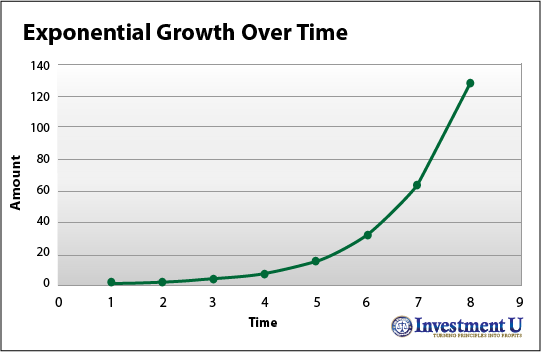
One chart can easily show how it pays to invest for the long term. It’s called an exponential growth chart, or “hockey stick” chart:

Exponential growth of investments over time

And understanding this chart should completely change the way you think about investing for the future.

Investing for the Long Haul

According to Dr. Chris Martenson, a former Fortune 300 executive, “Anything that steadily increases in size as a proportion of its current size” will give you “a chart that looks like… a hockey stick.”

In other words, as long as you can average more growth than not in your investment portfolio, you will experience exponential growth over time.

For investors, it’s easy to see why this kind of growth is a great thing.

Turning $10,000 into $1 Million

Let’s say you’re 25 years old and you only have $10,000 to invest with. You average just around 7% growth annually in your investment portfolio.

Thanks to compounding growth, at 7% growth, you’d double your portfolio every 10 years.

That means, after 10 years, your portfolio would total $20,000. After 30 years, it would be $40,000. After 40 years, it would be $80,000. And so on.

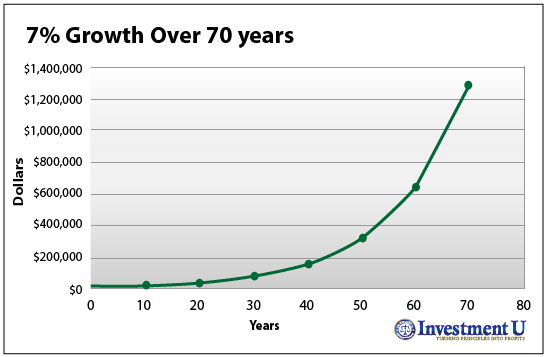
Over the course of your investment career, here’s what your portfolio would look like simply averaging 7% growth per year:

The long-term investor's secret weapon

It’s important to realize what happens after 40 years of growing $10,000 at 7% per year. Although it takes 40 years to grow your portfolio to just $180,000, it takes just little more than 25 years to earn the remaining $820,000.

This compounding effect is why it’s so important to invest for the long haul. And it should help you make better investment decisions for the rest of your life.

Good Investing,

Mike Kapsch

Article by Investment U

Japan Sees QE


By TraderVox.com

Looks like Valentine’s Day wasn’t only for lovers as the bank of Japan presented the Japanese economy with a present yesterday. Though the Bank of Japan left its interest rates near zero percent yesterday, the central bank shocked the markets by announcing not only an increase in its asset purchases, but also a new inflation outlook.

The Bank of Japan (BOJ)'s first surprise was its decision to adopt a 1.0% target for its CPI. Apparently, the central bank is hoping that adopting the Fed's move of an inflation target would increase confidence amid the country's unclear economic outlook.

Market participants have been worrying about the Japanese economy, especially since the BOJ recently downgraded its economic forecasts from a 0.3% growth to a 0.4% contraction come 2012. Unsurprisingly, the euro zone debt issue and the yen's increased strength ranked high among the central bank's issues.

Until the inflation target is reached though, the BOJ plans will continue to follow through on economic growth through a relatively easing monetary policy. In fact, the BOJ also said yesterday that it would bring in an additional 10 trillion yen into its asset purchasing program, which would boost the size of the program to a total of 65 trillion yen.

From the way the yen pairs reacted, it seems that investors are taking the BOJ seriously. The yen weakened across the board following the announcement, with USD/JPY jumping 34 pips in the first 30 minutes and closed 86 pips above opening price.

 QE, even though it is aimed to stimulate the economic growth, is usually considered bad

Why is this?

Quantitative easing is a method for the currency by which a central bank increases cash supply in the economy by printing new money. The newly-printed money is then used to flood the market with capital in an effort to stoke lending and increase the amount of money in circulation. Unfortunately, by virtue of basic supply and demand, a rise in money supply usually erodes the value of each unit of currency, which might lead inflation.

That being said, I believe that the expansion of the BOJ's asset purchase program, together with their currency intervention policy, will continue to put downside pressure on the yen. Technical analysis also supports this, as the USD/JPY daily chart is showing some signs of reversal.

Article provided TraderVox.com
Tradervox.com is a Forex News Portal that provides real-time news and analysis relating to the Currency Markets.
News and analysis are produced throughout the day by our in-house staff.
Follow us on twitter: www.twitter.com/tradervox

Madison Square Garden Shares Climb as Lin’s Success Helps Drive Knicks Sales

Sales of Knicks merchandise are higher than any other team in the NBA since February 4, with Jeremy Lin’s jersey being the league’s top online seller in that time, as the surprising ascent of the point guard has helped the team’s record and the share price of team parent Madison Square Garden (NASDAQ:MSG), Bloomberg reported earlier.In late morning trade, shares of MSG are up about 3.5% to $32.23.

All Eyes on Euro-Zone Meeting Today

Source: ForexYard

Yesterday was fairly hectic for euro traders after the credit downgrade of several EU countries sent the common currency tumbling. The EUR saw a brief upward correction during mid-day trading after the release of a better than expected German ZEW Economic Sentiment figure. Today, investors will be eagerly awaiting any news out of a meeting of euro-zone finance ministers. Traders can expect heavy volatility, as the meeting is expected to determine whether Greece will receive the bailout package it needs to avoid defaulting on its debt.

Economic News

USD – USD Capitalizes on Euro-Zone, Japanese News

The US dollar was largely bullish throughout yesterday’s trading session, as news out of both Europe and Japan sent investors to the safe-haven currency. Following the credit downgrade of several EU countries, the euro tumbled against the greenback, dropping as low as 1.3126 before staging a mild upward correction. Against the yen, the dollar was boosted after the Bank of Japan announced that it was increasing its asset-buying program in an attempt to strengthen Japan’s economy.

Turning to tomorrow, traders will want to pay close attention to the meeting of euro-zone finance ministers. The meeting will finally determine whether Greece receives its bailout package or not. If the news out of the meeting is positive, investors are likely to move their funds back to the euro which could cause the dollar to stage a reversal.

Additionally, the US TIC Long-Term Purchases figure, scheduled to be released at 14:00 GMT, has the potential to generate some market activity. Should the figure come in above the forecasted level of 62.3B, the greenback may be able to extend today’s gains. At the same time, if the indicator comes in below expectations, the dollar may see a downward correction.

EUR – Euro-Zone Meeting May Lead to Heavy Trading Day

The euro tumbled against virtually all of its main currency rivals yesterday, following the credit downgrade of several EU countries. While the move by Moody’s Investors Service was not unexpected, investors still responded to the news by reverting back to safe-haven assets. The EUR/USD dropped as low as 1.3126, while against the Japanese yen, the common currency fell to 101.81.

The euro saw some relief later in the day, after the German ZEW Economic Sentiment came in well above the expected level. While the indicator led to moderate gains for the euro, the currency was not able to sustain its bullish momentum and eventually dropped again.

Turning to today, the main news event is likely to be a meeting of euro-zone finance ministers. The meeting will determine whether Greece will finally receive an EU bailout package it needs to avoid defaulting on its debt. While most analysts are convinced that the bailout will be approved, Greece still has to show how it plans to make additional budget cuts before any decision is made. Additionally, not all analysts are convinced that even with the bailout Greece will be able to avoid default. Regardless, tomorrow’s trading is likely to be heavily influenced by the meeting. Positive news may lead to a boost for the euro.

JPY – BOJ Actions Cause Yen to Drop

The Bank of Japan (BOJ) surprised many investors yesterday, after it announced that it was increasing its asset-buying program by 10 trillion yen. The move caused the yen to tumble throughout the day. The BOJ has often moved in to weaken the value of the yen in order to boost Japan’s export driven economy. As a result of the move, the USD/JPY shot up close to 100 pips throughout the European session. Meanwhile, the EUR/JPY, despite falling the previous night, was able to rebound and cross the 103.00 level.

Turning to today, traders will want to monitor any euro-zone developments for signs of investor risk appetite. Should positive Greek news be released, the yen could see some losses as riskier currencies are likely to move up. At the same time, even if Greece receives a bailout package, it is still not entirely certain that the money will be enough for the debt-strapped country. If investors continue to think that Greece could still default on its debt, safe-haven currencies like the yen may see a boost.

Crude Oil – Middle East Tensions Lead to Increase in Price of Oil

The price of crude oil spiked during yesterday’s trading session, reaching as high as $101.81 a barrel, before staging a slight downward reversal. Escalating tensions in the Middle East were largely to blame for oil’s bullish trend. Supply side fears are growing as threats from the West to boycott Iranian oil are being matched by Iranian threats to limit exports.

Turning to today, traders will want to continue monitoring the situation in the Middle East. Any increase in rhetoric from Iran is likely to cause the price of oil to go up once again. In addition, should a bailout agreement for Greece finally be reached, riskier assets like crude oil may move up as a result.

Technical News

EUR/USD

The weekly chart’s Stochastic Slow is currently forming a bearish cross, indicating that downward movement could occur for this pair in the near future. This theory is supported by the daily chart’s Williams Percent Range, which is hovering close to the overbought zone. Traders may want to go short in their positions.

GBP/USD

A bearish cross on the weekly chart’s Stochastic Slow indicates that downward movement may occur in the coming days. That being said, most other long-term technical indicators show that this pair is range trading at the moment. Traders may want to take a wait-and-see approach, as a clearer picture may present itself later in the week.

USD/JPY

Most technical indicators on the daily chart show that this pair is overbought and could see a downward correction in the near future. These include the Relative Strength Index, which has cross above 70, and the Williams Percent Range, which is at -10. Going short may be the preferred strategy for this pair.

USD/CHF

The daily chart’s MACD/OsMA has formed a bullish cross, which typically means that upward movement could occur in the near future. This theory is supported by the Stochastic Slow on the weekly chart. Traders may want to go long in their positions for this pair.

The Wild Card

GBP/CAD

Technical indicators are showing that this pair has crossed into oversold territory, and could see a bullish correction in the near future. The Stochastic Slow on the 8-hour chart is currently forming a bullish cross, while the Williams Percent Range on the daily chart is currently at -90. Forex traders may want to go long in their positions today.

Forex Market Analysis provided by ForexYard.

© 2006 by FxYard Ltd

Disclaimer: Trading Foreign Exchange carries a high level of risk and may not be suitable for all investors. There is a possibility that you could sustain a loss of all of your investment and therefore you should not invest money that you cannot afford to lose. You should be aware of all the risks associated with Foreign Exchange trading.


France Experiences Unexpected Growth

Source: ForexYard

printprofile

As fourth quarter GDP numbers came in from around the EU, France presented a pleasant surprise with unexpected growth. As it stands, France is Europe’s second largest economy after Germany. The fourth quarter revealed growth of 0.2% and presented a stark contrast to the struggles of other European economies. Moody’s downgrade of several euro zone countries yesterday, including Spain, Portugal, and Italy, certainly hurt investor confidence and did nothing to turn around the economic downturn in Spain. France’s growth could help stave off an overall recession in the euro zone after the fourth quarter saw French companies investing and consumers spending.

Forex Market Analysis provided by ForexYard.

© 2006 by FxYard Ltd

Disclaimer: Trading Foreign Exchange carries a high level of risk and may not be suitable for all investors. There is a possibility that you could sustain a loss of all of your investment and therefore you should not invest money that you cannot afford to lose. You should be aware of all the risks associated with Foreign Exchange trading.

German GDP Numbers Released

Source: ForexYard

printprofile

Germany released its GDP numbers this morning and revealed that fourth quarter shrinkage was not as severe as some forecasts predicted. German GDP was down 0.2% after growing by 0.6% in the third quarter of last year. While the news is certainly nothing to celebrate, many analysts are confident in the overall health of the German economy. Unemployment levels remain at their lowest point in two decades and the country is still the main player on the European stage.

There still remains the looming Greek debt crisis that threatens to hamper several economies in the euro zone, as we have seen with Spain and Belgium being dragged down into economic downturns. However, German ministers expressed their confidence that their economy would have the durability to withstand such risks.

Forex Market Analysis provided by ForexYard.

© 2006 by FxYard Ltd

Disclaimer: Trading Foreign Exchange carries a high level of risk and may not be suitable for all investors. There is a possibility that you could sustain a loss of all of your investment and therefore you should not invest money that you cannot afford to lose. You should be aware of all the risks associated with Foreign Exchange trading.