Procter & Gamble Sells Pringles To Kellogg For $2.7 Billion

Procter & Gamble (NYSE:PG) announced an agreement to sell its Pringles business to Kellogg (NYSE:K) in a deal valued at approximately $2.7 billion.Kellogg said it will take on $2 billion in debt to finance the purchase of the Pringles unit from P&G.Kellogg expects the deal to be accretive to earnings by $0.08 – $0.10 per share before costs in 2012.P&G had in April 2011 reached an agreement to sell the unit to Diamond Foods (NASDAQ:DMND) for $1.5 billion.P&G expects an after tax gain on the transaction of $1.4 billion – $1.5 billion, or $0.47 – $0.50 per share.

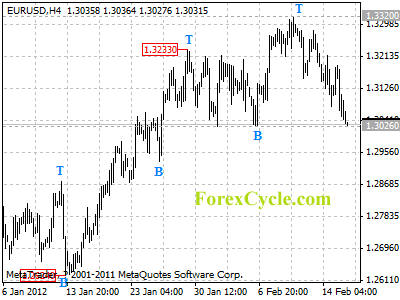
EURUSD is facing 1.3026 support

EURUSD is facing 1.3026 support, a breakdown below this level will confirm that the rise from 1.2624 had completed at 1.3320 already, then deeper decline towards 1.2624 previous low could be seen. On the other side, as long as 1.3026 key support holds, the price action in the trading range between 1.3026 and 1.3320 is treated as consolidation of the uptrend, and one more rise towards 1.3500 is still possible.

eurusd

Daily Forex Forecast

A Two-Bar Pattern that Points to Trade Setups

By Elliott Wave International

Some people like to get outside on the weekends, maybe playing tennis or working in the yard. Some people like to visit their friends or cook a big meal or go out to see a movie. And some people who are passionate about their work — such as Elliott Wave International’s futures analyst Jeffrey Kennedy — like to stare at hundreds of price charts on their computer screen to find patterns that point to trade setups. We used to worry for his health but not anymore, because he’s been doing it for years and he comes up with some neat stuff. A case in point is his discovery of a two-bar pattern that he named the Popgun. Find out more in this excerpt from the Club EWI eBook, How to Use Bar Patterns to Spot Trade Setups.

The Popgun
I’m no doubt dating myself, but when I was a kid, I had a popgun — the old-fashioned kind with a cork and string (no fake Star Wars light saber for me). You pulled the trigger, and the cork popped out of the barrel attached to a string. If you were like me, you immediately attached a longer string to improve the popgun’s reach. Why the reminiscing? Because “Popgun” is the name of a bar pattern I would like to share with you this month. And it’s the path of the cork (out and back) that made me think of the name for this pattern.

The Popgun is a two-bar pattern composed of an outside bar preceded by an inside bar. (Quick refresher course: An outside bar occurs when the range of a bar encompasses the previous bar and an inside bar is a price bar whose range is encompassed by the previous bar.) In Chart 1 (Coffee), I have circled two Popguns.

So what’s so special about the Popgun? It introduces swift, tradable moves in price. More importantly, once the moves end, they are significantly retraced, just like the popgun cork going out and back. As you can see in Chart 2 [not shown], prices advance sharply following the Popgun, and then the move is significantly retraced. In Chart 3 [not shown], we see the same thing again but to the downside: prices fall dramatically after the Popgun, and then a sizable correction develops.

How can we incorporate this bar pattern into our Elliott wave analysis? The best way is to understand where Popguns show up in the wave patterns. I have noticed that Popguns tend to occur prior to impulse waves — waves one, three and five. But, remember, waves A and C of corrective wave patterns are also technically impulse waves. So Popguns can occur prior to those moves as well.

As with all my work, I rely on a pattern only if it applies across all time frames and markets. To illustrate, I have included two charts of Sirius Satellite Radio (SIRI) that show this pattern works equally well on 60-minute and weekly charts. Notice that the Popgun on the 60-minute chart [not shown] preceded a small third wave advance. Now look at the weekly chart [not shown] to see what three Popguns introduced (from left to right), wave C of a flat correction, wave 5 of (3) and wave C of (4).

Find out How to Use Bar Patterns to Spot Trade Setups

In this comprehensive 15-page eBook, Jeffrey provides each pattern with a definition, illustrations of its form, lessons on its application and how to incorporate it into Elliott wave analysis, historical examples of its occurrence in major commodity markets, and ultimately — compelling proof of how it identified swift and sizable moves.

Download the free, 15-page eBook today >>

This article was syndicated by Elliott Wave International and was originally published under the headline A Two-Bar Pattern that Points to Trade Setups. EWI is the world’s largest market forecasting firm. Its staff of full-time analysts led by Chartered Market Technician Robert Prechter provides 24-hour-a-day market analysis to institutional and private investors around the world.


Wednesday 2/15 Insider Buying Report: D, HBHC

Bargain hunters are wise to pay careful attention to insider buying, because although there are many various reasons for an insider to sell a stock, presumably the only reason they would use their hard-earned dollars to make a purchase, is that they expect to make money. Today we look at two noteworthy recent insider buys.

17 Stocks Yielding 12%-Plus

By Paul Tracy, DividendOpportunities.com

Let’s be honest. When you hear about a stock that yields 12% or more, your first thought should be that the company is probably a basket case that can’t even turn a profit. If it’s offering a yield that sounds too good to be true, it probably is.

And you’d be right most of the time. Usually, yields are this high because a company’s share price is falling — signaling underlying problems in its business. A lower share price gives a higher dividend yield. That means profitable companies paying yields this high should be rare.

In fact, my staff and I recently ran the numbers. When we looked only at the companies that turned a profit over the past year, we found just 17 U.S. common stocks paying yields of more than 12%. Here, you can see them for yourself:

Ticker Company Yield
IVRInvesco Mortgage21.6%
AGNCAmerican Capital19.0%
CYSCYS Investments16.8%
RSOResource Capital16.7%
FTRFrontier Communications16.6%
CIMChimera Investment16.4%
TWO Two Harbors16.2%
AIArlington Asset Investment14.9%
MFAMFA Financial14.6%
ANHAnworth Mortgage14.3%
NLYAnnaly Capital14.2%
HTSHatteras Financial13.9%
OTTOtelco13.5%
CMOCapstead Mortgage13.2%
CXSCrexus Investment12.5%
DXDynex Capital12.2%
GNIGreat Northern Iron Ore12.2%
As of February 6, 2012. Source: Bloomberg

But did you know there are actually hundreds of 12%-plus yields out there from profitable companies? The difference is that many investors just don’t know where to find them.

That’s because the majority of the world’s highest yields aren’t being paid by U.S. companies. My recent search found 210 additional stocks out there yielding 12% or more… all coming from international-based companies.

That means many income investors are essentially missing out on 92% of the highest yields before they even get started.

I’ve researched this topic for years. And the fact is, foreign companies are simply paying higher yields across the board.

Take a look at the table to the right.

You can see the difference between what we get from U.S. companies and what’s available from international companies. Keep in mind that I only looked at the common stocks of companies that were profitable over the past year.

As Judy Sarayan, a fund manager at mega-investment firm Eaton Vance explained, “There’s a much stronger dividend culture abroad… individual investors play a larger role in those markets, and they have always demanded more dividends.”

On a macro scale, the difference is striking. While the average yield for all stocks in the S&P 500 is just 2.0%, Germany’s average yield is 3.6%… Brazil’s average yield is 3.6%… the United Kingdom yields the same… Australia yields 4.7%… New Zealand pays 4.8%.

But where you really start to see a dramatic difference is when you look at some individual examples of higher yields abroad.

Take banks, for instance. Here at home, Bank of America (NYSE: BAC) used to pay investors $2.56 per share before the financial crisis. That represented a yield of more than 6.0%.

Of course, we all know what happened next. Today, BAC pays a laughable $0.01 (yes, one penny) each quarter.

But it’s a completely different story outside the United States.

Santiago, Chile-based Corpbanca SA (NYSE: BCA) is a perfect example.

Chile’s largest bank, Corpbanca offers commercial and retail banking through more than 100 offices. The bank also offers mutual fund management, insurance, and securities brokerages through a network of subsidiaries. Not only have the shares soared over the past five years, but dividends now total $1.66 per share each year. That gives the stock a yield of over 7.0% at recent prices, and you can buy it on the New York Stock Exchange.

It’s the same thing for utilities. They are one of the best places to search for yields in the U.S. Duke Energy (NYSE: DUK) pays a yield of about 4.5%. But even that is topped by international utility stocks like Germany’s E.ON AG (OTC: EONGY).

E.ON AG is the world’s largest energy provider. It serves over 26 million customers and employs more than 75,000 people. Its shares pay investors $2.16 a year, for a yield of 10%… that’s about twice as much income as the average utility here in the U.S.

Still, most U.S. investors are simply unaware that they’re missing out on high yields like these.

I want to make something clear, though. I don’t think you should drop everything and put every dollar you have into international high-yielders. Truth is, the size and scope of the U.S. market makes it a great place to search for income investments.

But limiting yourself to only U.S. stocks is like going to a restaurant and limiting your options to just one side of the menu. Sure you can find something you like… but wouldn’t you rather see all the options?

And one more thing — not every one of the 210 stocks is available stateside, but don’t worry, you can buy many of these without even leaving the U.S. markets.

I have more details — including several names and ticker symbols — in a presentation I recently put together. You can visit this link to read it now.

All the best,

Paul Tracy
StreetAuthority Co-founder, Chief Investment Strategist — High-Yield International

P.S.Remember, you can learn more about investing in high-yielding international stocks — including several names and ticker symbols — by reading this presentation.

Disclosure:  Neither Paul Tracy nor StreetAuthority own shares of the securities mentioned in this article. In accordance with company policies, StreetAuthority always provides readers with at least 48 hours advance notice before buying or selling any securities in any “real money” model portfolio. Members of our staff are restricted from buying or selling any securities for two weeks after being featured in our advisories or on our website, as monitored by our compliance officer.

Euro plunges on the threats of delay in Greek deal


By TraderVox.com

The problems for Euro are far from getting addressed. The meeting of Euro zone officials turned out to be nightmare for the bloc currency. Euro zone leaders are mulling over the complete or partial delay of the bailout package to the Greece till the elections in April. The pair is printing fresh low of 1.3062. It is a one week low. The support on the downside may be seen at 1.3020 and 1.2980. The resistance may be seen at 1.3110 and above at 1.3190. The slide in Euro has also seen in other Euro crosses. EUR/JPY has fallen below 103 levels.

The sterling pound also felt the heat of possible delay of Greek deal. It again went below 1.5700 levels and printed a fresh low of 1.5670. It is currently trading around 1.5685, virtually flat for the day. The support may be seen at 1.5660 and 1.5600. The resistance may be seen at 1.5700 and above at 1.5730.

Yen gained against the US dollar during the US session to form a low of 78.19. It has come off the lows and is trading around 78.32, down about 0.10%. The support may be seen at 78.20 and below at 78. The resistance may be seen at 78.40 and above at 78.70.

Following the correlation, US dollar gained against the Swiss frank following the Greek delay. It has come above the 0.9200 and printed a high of 0.9239. The pair is trading near the high around 0.9225, up about 0.30%. The resistance may be seen at 0.9250 and 0.9300. The support may be seen at 0.9200 and below at 0.9150.

Australian dollar has retracted the gain of the day and is currently trading around 1.0728, up about 0.35% for the day. The support may be seen 1.0700. The resistance may be seen at 1.0750.

The dollar index has rocketed above 79.50 and is currently trading around 79.66 near the high of 79.72. The euphoria of the Chinese help to Europe was clearly overshadowed by the possible delay in Greek deal. A bridge loan has to be facilitated to Greece to avoid the default in March.

Article provided TraderVox.com
Tradervox.com is a Forex News Portal that provides real-time news and analysis relating to the Currency Markets.
News and analysis are produced throughout the day by our in-house staff.
Follow us on twitter: www.twitter.com/tradervox

The Coming Bubble in MLPs


The Coming Bubble in MLPs

It was difficult to make a buck in 2011. Those who had a job thanked their lucky stars.

And if you had some capital to invest, trying to turn a profit was just brutal. The Dow was up 5.5% for the year, but it sure didn’t feel like it. The S&P 500 finished almost exactly where it ended 2010. In fact, it was just 0.04 points away from the final 2010 number. The Nasdaq was down 1.8%.

Gold gained 10%, but went through some wild swings, punishing investors who jumped on the bandwagon.

And if you wanted to simply sit back and collect interest, good luck. Money markets, CDs and savings accounts yielded next to nothing. Treasuries weren’t much better.

So it’s no surprise that investors started to rediscover dividend-paying stocks as the one place they could make a few dollars.

I expect that trend to continue in a big way this year. In fact, in December, I made several predictions for 2012. Among them, MLPs (master limited partnerships) would become trendy.

The more I think about it, the more I’m convinced this class of stocks will not only be trendy, but become white hot to the point where pundits will be using the “B” word – “bubble.”

Several factors will lead to the “bubblicious” gains in these stocks, which are usually energy related.

  1. Investors’ desperate search for income – Dividend stocks were all the rage in 2011 as investors tried to get yield anywhere they could find it. MLPs typically have yields above 5% since they must distribute all of their income back to unit-holders in order to avoid corporate taxes. The result is a yield that’s greater than the typical dividend-paying stock.
  1. Energy experts Dave Fessler and Matt Carr expect energy prices to rise in 2012 – For some MLPs, the price of oil and gas doesn’t matter as they simply transport the stuff from point A to point B. For others it does, and higher prices mean higher profits and higher payouts to unit-holders.
  1. Tax deferred strategy – Most, if not all, of MLPs’ distributions are usually not taxed by the IRS as ordinary dividends. Instead, they’re treated as a return of capital. This lowers your cost basis, which could increase your capital gains when you sell the stock. But while you’re collecting the cash distribution, you won’t be taxed on the distribution in the year you receive it. That can be attractive, particularly those in higher tax brackets.
  1. Media frenzy – For all of the above reasons, I expect MLPs to get hot in 2012. The media will surely notice. Soon, you’ll see MLPs being talked about in the mainstream financial press, which will lead to more interest by investors, which will cause the stocks to go higher, which will generate more media attention.

I think the sector will get so hot, you’ll first see the naysayers come out, and then the believers forcefully defend their beloved MLPs. At some point the sector will drop and the bears will say, “I told you so.”

But their satisfaction will only last until the face-ripping rally that will come next as investors jump in on the newly created buying opportunity. The stragglers will keep the rally going, as they don’t want to be left out of the next great thing.

All of this attention will lead to utterances of the “B” word by the end of the year.

But a bubble isn’t always a bad thing – if you’re in early enough and get out when things get frothy.

If you’re interested in MLPs, take a look at companies like Williams Partners (NYSE: WPZ), Enbridge Energy (NYSE: EEP) and Buckeye Partners (NYSE: BPL)

I’m very bullish on MLPs right now. With those higher than average yields, if 2012 is a repeat of last year, MLPs might be one of the few places to make some real money this year.

Good Investing,

Marc Lichtenfeld

Article by Investment U

Euro rises against the Yen as China Promises Help for the Euro-zone


By TraderVox.com

For the first time in four days, euro showed some gains against the dollar after China promised to give help to solve the debt crisis. This has eased the pressure on the currency as the debt crisis continues with Greece seeking to secure a second bailout. The 17-nation currency rose to its highest level against the yen; to a level it had reached two months ago.

A report showing that the gross domestic product for the European nations was not as low as it had been estimated by many analysts. Another currency that rose tremendously against the yen is the New Zealand dollar which rose to a six month high after the nation’s retail sales increased for the fourth quarter.

The weakening of the yen against major currencies is also as a result of the government’s intervention to weaken the currency. The euro had some good news from China when news emerged that the country would be offering help to ease the debt crisis in the region. The Governor of the People’s Bank of China Zbhou Xiaochuan said that the nation is going to invest in Europe’s bailout funds.

Further, the country indicated intentions of sustaining its holdings of euro asset which came as a relief for the eurozone. China has the largest foreign-exchange reserves totaling to $3.18 trillion. In his statement, the Governor indicated that the country was looking to diversify its foreign holdings from US dollar dominated holdings. These comments by the governor have prompted the increasing bid for the risk assets which has seen the euro gain considerably.

According to the European Union’s statistics, the GDP of the 17 nation region fell by only 0.3 percent against an estimate of 0.4 percent. Moreover, the region’s second largest economy, France, grew by 0.2 percent which was also unexpected. These unexpected results have also added to the 17-nations currency increased performance against the major currencies in the world. However, the failure to hold a meeting in Brussels by the regions finance ministers is a bad sign for the successful conclusion of the Greece crisis. These sentiments were echoed by the Italian Prime Minister Mario Monti.

Article provided TraderVox.com
Tradervox.com is a Forex News Portal that provides real-time news and analysis relating to the Currency Markets.
News and analysis are produced throughout the day by our in-house staff.
Follow us on twitter: www.twitter.com/tradervox

Understanding Securitization


Understanding Securitization

There are many aspects to the housing market that the average American investor is unaware of.

Lately there have been articles, such as the recent ProPublica and NPR piece, “Freddie Mac Bets Against American Homeowners,” that with the proper due diligence would not have been news.

But to understand this fully, a few subjects must be covered. Let’s begin with one of the main cogs of the housing market since 1970.

Definition of Securitization

The process of securitization is a very intricate and delicate system that involves a number of steps and individuals. The first step occurs when a borrower obtains a loan from a lender. These loans can consist of any consumer contract that produces a cash flow through the collection of principal and interest payments, for example mortgages, student loans, car loans and even credit cards.

The lender or originator of the loan then sells the loan to an issuer, and when the borrower begins making monthly payments on their loan, the money is processed through a servicer to the issuer. A number of these loans are pooled together by loan type and risk, and structured into a marketable debt security.

The debt securities can take the form of bonds, pass-through securities or collateralized mortgage obligations. The process of securitization allows illiquid assets, whose value is uncertain and not easily quickly converted into money, to be pooled together and sold to investors. The investors are paid by the principal and interest payments generated by the assets in the pool. Therefore, the assets are characterized as secured because they’re collateralized by the asset.

Securitization Created the Modern-Day Mortgage System

Before securitization, banks had to hold loans until they matured or were paid off. By combining mortgages into one large pool, the issuer can divide the large pool into smaller pieces based on each individual mortgage’s inherent risk of default and then sell those smaller pieces to investors.

The process creates liquidity by letting smaller investors purchase shares in a larger asset pool. Without the securitization of mortgages, retail investors would not be able to afford to buy into a large pool of mortgages.

Securitization, therefore, has been recognized as a successful financial mechanism that allowed investors to allocate capital more efficiently, to access diverse and cost effective funding sources, and better manage business risks. If managed correctly, securitization is a financial process that can help businesses and investors see a return on investments while showing very little risk on their balance sheet.

Rather than holding whole loans on a balance sheet, companies were encouraged to hold securitized assets such as mortgage-backed securities.

As previously noted, the securitization process began over 40 years ago and was used to pool together a wide array of assets.

For the historical success that securitization enjoyed in the market place, why was it at the center of the current financial crisis?

When taking an in-depth look, the securitization process itself wasn’t the problem. Instead, it was the influx of bad assets into the private mortgage backed securities market.

So stay tuned, as my next article will tackle how securitization factored into the housing bubble and subsequent “Great Recession.”

Good Investing,

Jason Jenkins

Article by Investment U

Apple still on course to hit $600/share?


View the Investment U Video Archive

In focus this week: the big fertilizer question, Potash or Mosaic; AAPL could trounce Samsung; gas pressure on coal; and the SITFA.

If you follow my IU articles, you know I am huge fan of AAPL and am looking for $600 on the stock. I called for $600 when the stock was at $380.

A recent Journal article has just added fuel to the $600 fire

Samsung and AAPL have turned the smartphone market into a two-horse race. The Journal called it a Sea Biscuit and War Admiral match-up.

Right now they are neck and neck. This past quarter AAPL sold 23.9 millions phones and Samsung sold 23.5 million.

Samsung has an edge with a global distribution network second only to Nokia and they both have low-end and high-end phones. In fact, Samsung has a greater variety of phones that AAPL does not

But hold on! AAPL was able to beat Samsung in sales with no low-end phone at all. If, as the Journal suggested, AAPL were to introduce a low-end model, they could conceivably blow away Samsung.

As I have said before, AAPL has done the best sales job I have ever seen. Add that to their branding, technology and retail operation and you have a real juggernaut.

AAPL at $600, you heard it here first!

Gas Pressure on Coal

The incredibly low natural gas prices we have seen, the result of the huge amounts of shale gas production, are putting pressure on coal miners.

Gas powered electrical generation, as you would assume, has increased as gas prices have dropped. In the last 12 months, 24% of electricity came from gas and 42% from coal.

That’s up from 18% for gas and almost 50% from coal in just the last decade. In just the last three years, gas use has jumped almost 3% and coal has dropped about 6%.

Some big coal producers, Alpha Natural Resources for one, have announced cut backs to cope with the shift to gas-powered electricity.

Thirty-nine percent of all electrical generating plants in the U.S. are gas fired, while only 31% use coal. But, the coal plants had been used much more than gas. That’s changing.

While coal still has a big export market, their biggest customer is the EU, which isn’t setting anything on fire right now.

Central Appalachian coal prices have dropped 15.4% this year alone, following gas prices almost exactly.

The Journal called it a race to the bottom.

But the real unknown here, or maybe it isn’t too unknown, is the effect new regulations for cleaner burning electrical plants will have on coal use. Many coal plants have to be shut down completely to meet the new regs.

Coal doesn’t look like it has too many breaks coming and it could be bad news for coal miners.

Fertilizer

Most investors don’t realize that farmers worldwide have no choice but to use potash as a fertilizer. They can skip a year or two, but any longer than that and their production can drop by as much as 30%.

That’s how dependent food production is on potash. Add to that the fact that the world is consuming about 10% more food every year than it produces, and farmers will have to produce as much food in the next 10 years as they in the past 50, and the case for potash fertilizer come into sharper focus.

The two big players are Mosaic, MOS, and Potash of Saskatchewan, POT. POT just happens to have the same name as the fertilizer itself.

At first glance, MOS seems to have the nod as the best play, but a recent Seeking Alpha article says POT is the big winner here.

POT is expected to grow 78.4% in 2011 and another 13.5% next year.

A very conservative estimate puts this stock at about $55 from its current price of $46.

Mosaic, on the other hand, has some very good numbers, but not quite as lofty as POT. MOS is expected to grow by about 11.2% this year and 8.9% next.

Despite very tough times for the past three years, POT has managed to post some amazing numbers, but not so amazing when you consider that their customers have no choice but to use their product.

POT has a larger market share, is safer, less volatile and has a higher dividend than any of its competitors. It is the obvious choice.

SITFA

Finally, the SITFA award goes to a bunch of bureaucrats in India who were sitting on a license that a local snake charmer had applied for.

It seems the snake charmer wanted a small piece of land for his snakes, and according to him, the local government bureaucrats were waiting for a bribe before they would approve it.

So, the snake charmer pulled his only trump card and dumped a bag of poisonous snakes, cobras included, into the office of the of the local paper pushers.

To say all hell broke loose would an understatement. According to the news report, snakes started climbing on desks and chairs and hundreds of people ran for their lives.

My parents always advised me not to get in any spitting contests with snakes. I guess that includes snake charmers, as well.

But at least we know one way to get bureaucrats off their duffs.

There has been no sign of the snake charmer since he dropped off his bag of snakes.

Article by Investment U