Euro Rallies vs. USD to Finish Week

Source: ForexYard

The euro hit a three-week high vs. the US dollar on Friday, following a disappointing US housing figure. The New Home Sales figure came in at 313K, well below the 326K analysts had been forecasting. The EUR/USD moved up as a result, reaching as high as 1.3282 before staging a slight downward correction to close out the week at 1.3268. Turning to today, traders will want to note the US Pending Home Sales figure, scheduled to be released at 14:00 GMT. Should the figure come in below the forecasted 1.0%, the euro may be able to extend its bullish run against the USD.

Economic News

USD – Dollar Turns Bearish amid Disappointing Housing Data

The dollar fell against most of its main currency rivals on Friday, following the release of a disappointing housing statistic. While most other sectors of the US economy have shown continuous growth in recent months, housing remains a potential obstacle for the economic recovery. The EUR/USD shot up to a three-week high during the afternoon session on Friday, reaching as high as 1.3282. Against the yen, the dollar dropped as low as 81.95 before correcting itself. The USD/JPY closed out the week at 82.32.

Turning to today, traders will want to monitor several pieces of news out of the US. First, a speech from Fed Chairman Bernanke, scheduled to take place at 12:00 GMT, may generate market volatility should he offer clues as to any future increase in US interest rates. Following the speech, the US will be releasing the Pending Home Sales figure. Should the figure come in below the forecasted 1.0%, the greenback may extend its bearish trend.

Later in the week, a number of potentially significant US indicators are expected to generate heavy activity in the markets. Tuesday’s CB Consumer Confidence report may help the dollar recoup some of its recent losses if it comes in at or above the forecasted 70.5. On Wednesday, analysts are predicting a significant increase in the Core Durable Goods figure over last month. If true, it would signal a boost in the US manufacturing sector, and may help the dollar.

EUR – Euro-Zone Bond Auctions Set to Impact EUR

The euro was able to reverse its recent bearish trend against the dollar on Friday, and closed out the week just below a three-week high. That being said, the common currency had a mixed session against its other main currency rivals. The EUR/JPY, which had reached 109.81 during the morning session, fell over the course of the day to close out the week at 109.24. Against the British pound, the euro saw mild gains on Friday. The EUR/GBP moved up close to 20 pips throughout the day and to finish the week at 0.8359.

Turning to today, euro traders will want to note the result of the German Ifo Business Climate, set to be released at 8:00 GMT. As the euro-zone’s biggest economy, German indicators tend to have a significant impact on the euro. Today’s indicator is considered particularly significant, and could lead to heavy market volatility.

Later in the week, bond auctions from both Spain and Italy are likely to give investors a better idea of how the euro-zone economic recovery is progressing. Spain and Italy are considered two of the weaker economies in the euro-zone. Should either of the bond auctions not go as well as predicted, the euro may see losses as a result.

AUD – Aussie Stages Recovery on Friday

After tumbling throughout last week, the Australian dollar was able to stage a mild recovery during Friday’s session. Riskier currencies, like the AUD, turned overwhelmingly bearish last week, as euro-zone growth fears combined with negative Chinese economic indicators drove investors to safe-haven assets. That being said, the AUD/USD did see fairly significant gains on Friday, gaining close to 100 pips to close out the week at 1.0466.

Turning to this week, euro-zone news may determine whether the aussie is able to extend its recent gains. Today’s German Ifo Business Climate, which is forecasted to come slightly above last month’s, may generate risk taking in the market, which could help the AUD. Any gains could be temporary though, as bond auctions later in the week from two of the euro-zone’s weaker economies may cause investors to revert back to safe-havens.

Crude Oil – Crude Oil Sees Gains to Close Week

Crude oil moved up throughout Friday’s session, reaching as high as $107.37 a barrel before staging a downward correction to close out the day at $106.77. Overall, the commodity was up more than $1 for the day. Analysts attributed crude’s bullish session to a disappointing US housing figure, which caused the greenback to fall against several of its main currency rivals. Typically, a weak dollar means that commodities, like oil, become cheaper for international buyers, which eventually leads to an increase in prices.

Turning to this week, the direction oil takes will likely depend on news out of the euro-zone. Specifically, bond auctions out of Spain and Italy, which may signal a further slow-down in the euro-zone economic recovery, could cause investors to revert their funds back to safe-haven assets. In such a case, the price of crude oil could drop.

Technical News

EUR/USD

The Bollinger Bands on the weekly chart appear to be narrowing, indicating that a price shift could occur in the coming days. The Williams Percent Range on the daily chart is in overbought territory, signaling that the shift could be downwards. Traders may want to go short in their positions ahead of a possible bearish correction.

GBP/USD

Most long term technical indicators show this pair in neutral territory, meaning that no major shift in price is expected at this time. That being said, traders will want to keep an eye on the MACD/OsMA on the daily chart. It looks like a bearish cross may be forming. If so, it may be a sign of a possible impending downward correction.

USD/JPY

The weekly chart’s Relative Strength Index is hovering right around the overbought zone, indicating that this pair could see downward movement. This theory is supported by the Williams Percent Range on the same chart, which is currently at -20. Traders may want to go short in their positions ahead of a possible downward correction.

USD/CHF

While the Williams Percent Range on the daily chart is currently in the oversold region, which is typically a sign of impending upward movement, most other technical indicators are in neutral territory at this time. Traders may want to take a wait and see approach for this pair, as a clearer picture may present itself later on.

The Wild Card

EUR/NOK

The daily chart’s Slow Stochastic has formed a bearish cross, meaning that this pair could see downward movement in the near future. In addition, the Williams Percent Range is trading in the overbought zone, which is typically a sign of an impending downward correction. Forex traders may want to go short in their positions today.

Forex Market Analysis provided by ForexYard.

© 2006 by FxYard Ltd

Disclaimer: Trading Foreign Exchange carries a high level of risk and may not be suitable for all investors. There is a possibility that you could sustain a loss of all of your investment and therefore you should not invest money that you cannot afford to lose. You should be aware of all the risks associated with Foreign Exchange trading.


EUR/USD Weekly Outlook- Mar 26, 2012

eur-usd


For the next week the most important point to watch for is a break above the resistance level of 1.3293 and then 1.3300. Any decisive break of these resistances should bring further upward move toward first 1.3355 and then towards the range of 1.3470/1.3485. The mentioned resistance represents the resistance since March 9th and also the upper edge resistance of daily Ichimoku cloud.

On the other side a failure of this resistance should take EUR/USD to retest the recent 1.3134 and any decisive break below will turn our focus for deeper moves towards the psychological support of 1.3000.

The outlook this week is very short as the focus is closely for the break of the above mentioned resistance. Please note that even such upward move will not make our overall outlook bullish for the currency pair and we will take it just as a consolidation. EUR/USD is between two strong psychological level of 1.3000 and 1.3500 and may have some volatile moves without showing a real trend till a decisive break of either side takes place.

Further Readings:

1) EUR/USD forecast.

2) Daily technical EUR/USD Analysis.

3) GBP/USD Outlook.


Article by forexabode.com

AUD/USD Weekly Outlook- Mar 26, 2012

aud usd

AUDUSD went as low as 1.0336 or a little below Fibonacci 50% retracement of the upward move during December 26th to March 1st before recovering to 1.0482 and closing for the week at 1.0468.

For the next week if AUDUSD breaks over 1.0490/1.0500 then we would expect some more upward correction towards the range of 1.0540/1.0560. There is We would expect a resistance in this zone which would represent 22-day and 55-day EMA resistance as well as Kijun-sen resistance (1.0540) of daily Ichimoku cloud. Even if this resistance is broken, we would expect strong resistance near 1.0600.We would expect further downward move from there. On the downside a break of 1.0336 should target 1.0220 or little below the 61.8% retracement of the above mentioned upward move during December 26th to March 1st.

However, if AUDUSD breaks above 1.0636 then our above mentioned outlook will start changing towards a focus of upward moves and the confirmation of this will come with a break over 1.0670/1.0680.

Further Readings:

1) AUD/USD Forecast for weekly outlook of the currency pair.

2) Daily AUD/USD analysis.

3) USD/CHF outlook.


Article by forexabode.com

South Pacific Currencies Show Mixed Performance


By TraderVox.com

Tradervox (Dublin) -Despite a surplus report from the Statistics New Zealand showing that for the Month of February the country registered NZ$161 million surplus, the kiwi slightly declined against the dollar. However, on close scrutiny, this figure looks deceiving since the export volume declined by 6.9 percent which has resulted to the low demand for the Kiwi. Declines in exports were fueled by the declining petroleum and aluminum sales; further, there has been decline in exports to New Zealand’s major trading partners.

According to the report, petroleum exports dropped by 53 percent while the aluminum exports declined by 74 percent. Exports to Japan dipped by 42 percent. Japan is New Zealand’s major trading partner. The kiwi could not break the 0.8200 resistance level after the report as it dropped to 0.8160 against the greenback. The kiwi advanced against the yen by 0.1 percent to settle at 67.43 yen.

The Australian dollar climbed against the yen prior to a US report expected to report an increase in consumer confidence to a near a year high. The kiwi and the Aussie have climbed against the greenback this year due to an increase in demand of currencies linked to commodities. According to a senior analyst in Tokyo, the kiwi and the Aussie are getting their support from the elevated commodity prices; hence they have been able to withstand positive reports from the US.

The Australian dollar increased by 0.2 percent against the yen to settle at 86.37 at the close of trading in Sydney. The Aussie declined against the buck dropping from 1.0467 to 1.0443. The Aussie has however advanced 2.3 percent against the US dollar since the start of this year. The New Zealand dollar has increased 4.9 percent against the greenback.

The positive commodity prices and the positive reports from the euro area have prompted an increase in the south pacific currencies since the start of the year. However, recent concerns from China and Japan economies have forced the two south pacific currencies to pare their gains, even though marginally.

Disclaimer
Tradervox.com is not giving advice nor is qualified or licensed to provide financial advice. You must seek guidance from your personal advisors before acting on this information. While we try to ensure that all of the information provided on this website is kept up-to-date and accurate we accept no responsibility for any use made of the information provided. Opinions expressed at Tradervox.com are those of the individual authors and do not necessarily represent the opinion of Tradervox.com or its management. 

Article provided by TraderVox.com
Tradervox.com is a Forex News Portal that provides real-time news and analysis relating to the Currency Markets.
News and analysis are produced throughout the day by our in-house staff.
Follow us on twitter: www.twitter.com/tradervox

Euro defends 1.3200 support


By TraderVox.com

Tradervox (Dublin) – Euro started the week with the plunge as it threatens the break of 1.3200 levels. It is currently trading around 1.3215, down about 0.40% for the day. The single currency printed a fresh low of 1.3194 early European session. The support may be seen at 1.3190 and below at 1.3140. The resistance may be seen at 1.3260 and above at 1.3325 levels. German IFO data came better than expected. But the cheer for the encouraging data remained short lived.

The Sterling Pound is also trading in red following the correlation with Euro. The pair is trading around 1.5827, down about 0.30% for the day. The cable printed a fresh low of 1.5799 during the early Europeans session. But it has recovered and rose above the 1.5800 levels. The support may be seen at 1.5800 and below at 1.5760 levels. The resistance may be seen at 1.5860 and 1.5920 levels.

The USD/CHF pair has come off the lows and is trading above the 0.9100 levels at 0.9108, up about 0.35% for the day. The resistance may be seen at 0.9150 and at 0.9200 levels. The support may be seen at 0.9100 and 0.9060.

The recent correction in USD/JPY has seemed to have stalled at 82 and the pair is trading comfortably above it. It is presently being quoted at 82.80, up about half a percent for the day. The resistance may be seen at 82.90 and above at 83.40. The support may be seen at 82.50 and at 82.20.

Australian dollar failed to break the 1.0500 levels as it printed a high of 1.0484 for the day. The pair is trading around 1.0465, almost flat for the day. The support may be seen at 1.0450 and 1.0420. The resistance may be seen at 1.0500 and at 1.0560 levels.

The US dollar index is trading around 79.65 levels.

Disclaimer
Tradervox.com is not giving advice nor is qualified or licensed to provide financial advice. You must seek guidance from your personal advisors before acting on this information. While we try to ensure that all of the information provided on this website is kept up-to-date and accurate we accept no responsibility for any use made of the information provided. Opinions expressed at Tradervox.com are those of the individual authors and do not necessarily represent the opinion of Tradervox.com or its management. 

Article provided by TraderVox.com
Tradervox.com is a Forex News Portal that provides real-time news and analysis relating to the Currency Markets.
News and analysis are produced throughout the day by our in-house staff.
Follow us on twitter: www.twitter.com/tradervox

Housing Starts in U.S. Fell in February

Signs of recovery in the residential real estate market are bleak as U.S. housing starts fell in February from a three-year high.The Commerce Department reported builders started construction on 698,000 homes last month, in line with analyst estimates. That amount was down 1.1% from a January pace that was stronger than previously reported.However there was a bit of good news. Permits increased to a 717,000 annual pace, the most since October 2008. This beat estimates of a projected amount of 686,000 from 682,000 in the prior month.This shows the optimism among homebuilders. The National Association of Home Builders/Wells Fargo index of builder confidence held in March at its highest level since June 2007, showing sales expectations are still on the rise.

Euro is the Currency to Watch Out for This Week


By TraderVox.com

Tradervox (Dublin) – For the past few weeks, the 17-nation currency has been considerably subdued by other major currencies such as the yen and the greenback. This has been experienced as European leaders struggled to conjure up with a solution to the debt crisis in Italy, Spain, and the most difficult has been Greece. This week, however, is set to see some change. Euro traders have their eyes fixed on the upcoming euro area Finance Ministers meeting in Copenhagen which is expected to cause some volatility in the euro market. The meeting is aimed at setting a formidable financial firewall that had been suggested as something the European leaders needed to do in order for the single-currency block to safeguard against default.
There has been a heated debate with leaders split on whether a large firewall was necessary. However, two of the most vocal opposition to the establishment of a formidable financial firewall has indicated that they are now ready for such creation in order to avert the crisis in the region. Both Germany and Finland, which initially opposed the creation of a stronger firewall, have in recent times suggested that a major firewall might be necessary for European Union. According to Jyrki Katainen, Finland prime Minister, his country is ready to compromise in order to allow the region to recover from the debt crisis that might spread throughout the euro zone. These comments resonate with unofficial news from Germany showing that the country is also entertaining the idea of creation of a bigger firewall.

The development in the establishment of this major financial firewall has now left the European leaders with the task of establishing the mechanisms of combining the European Stability Mechanism and the European Financial Stability Facility. Combination of these two institutions would create a 750 billion firepower that excludes the 200 billion that has been approved for payment to already troubled nations. This would open the way for the region to get help from other countries such as Brazil, China and Russia through the IMF.

The Euro area finance ministers will meet at the end of the week, but traders will be eying comments from the region’s leaders. 1.33 and 1.35 technical resistances will be the main focus for traders leading up to the meeting.

Disclaimer
Tradervox.com is not giving advice nor is qualified or licensed to provide financial advice. You must seek guidance from your personal advisors before acting on this information. While we try to ensure that all of the information provided on this website is kept up-to-date and accurate we accept no responsibility for any use made of the information provided. Opinions expressed at Tradervox.com are those of the individual authors and do not necessarily represent the opinion of Tradervox.com or its management. 

Article provided by TraderVox.com
Tradervox.com is a Forex News Portal that provides real-time news and analysis relating to the Currency Markets.
News and analysis are produced throughout the day by our in-house staff.
Follow us on twitter: www.twitter.com/tradervox

Investing in Mongolia: Is It Time to Buy the World’s Fastest Growing Economy?

By MoneyMorning.com.au

It is the world’s fastest growing economy. It also may be the world’s best kept secret.

Yet it is true. The Mongolia is growing twice as fast as China and it’s a market most investors know little about.

While Chinese GDP is forecast to grow by 7.5% in 2012, the Mongolian economy is set to grow at a blistering pace of 14.9%.

That’s down a bit from 2011- but not by much.

According to official statistics, the Mongolian economy grew 17.3% in 2011.

Taking the two together, Mongolia would have the world’s fastest growth rate, beating Qatar and Libya over the same two-year time frame.

So is there a way a regular guy can make money out of all this growth?

Or to the larger question: Is the Mongolian market where we should be putting our hard-earned savings?

Investing In Mongolia

To start, it’s not all good news when it comes to investing in Mongolia. There is some bad economic news that comes along with the good.

Mongolian inflation hit 11% in December, and there is fear of it accelerating further.

More ominously, government spending swelled 56% in 2011, far faster than the economy. After all, 17% growth plus 11% only gives you 28% growth.

What’s more, government spending accounts for 44% of GDP and is expected to grow a further 32% in 2012. Even the World Bank seems worried – with 17% economic growth it’s hard for even its Keynesian economists to justify runaway state spending as “stimulus.”

Admittedly, 2011-12 was the run-up to an election – legislative elections are due in June, and the post-Communist Mongolian People’s Party government is trying to buy success in the traditional political way.

However, Mongolia has a Democratic Party president, and what seems to be a pretty vigorous alternation of parties in power, with elections being close. So while there are the usual good guys and bad guys, the political system seems to be working okay.

Nevertheless, the public spending figures suggest that even with the rapid growth Mongolia has achieved, major public spending is a problem.

The Mongolian Economy’s Greatest Strength

Mongolia’s big growth driver is its natural resources; the country has large deposits of copper, coal, molybdenum, tin, tungsten, and gold, which together form about a third of its industrial production.

Additionally, two giant projects in particular are close to coming on stream.

The first is the Oyu Tolgoi copper-gold-silver project for which Ivanhoe Mines (NYSE: IVN) is the prime Western partner. The second is the Erdenes Tavan Tolgoi coking coal mine project, which was due to float on London this spring, but has since been postponed.

One of Mongolia’s big advantages as a natural resource producer is that it has a market right next door called China.

Here’s why that is so important. In this case, it is purely about location.

At present, prices for these resources are so high that today it’s worth shipping them from the world’s most inaccessible spots to the Chinese markets.

For example, Brazil’s Vale S.A. (NYSE: VALE) has China as its largest customer, even though bulky iron ore has to be shipped more than halfway round the world to get there.

However, when resource prices are low, Mongolia will have a huge advantage, and be able to provide just-in-time delivery to Chinese customers, thus being able to maintain its market share when this may otherwise be difficult.

Mongolia’s direct political risk is thus limited, and its advantage in global resource markets is such that it should remain a major resource producer for decades to come, to the immense benefit of its citizens.

Breaking Down the Mongolian Markets

Yet I am not sure I would put huge amounts of money there.

The country’s public sector hasn’t seemed to have learned self-restraint, and until it does the chances of the country’s mineral resources being wasted are great.

Then there’s the lack of attractive opportunities.

At present, there are no Mongolian companies with ADRs listed, and the delay in the Erdenes Tavan Tolgoi listing suggests there will not be many soon.

The Mongolian Stock Exchange now has a total capitalization of about $2 billion and over 300 companies listed, but those figures suggest that individual companies are pretty small and the market has had a huge run up in the last few years.

One can only welcome Mongolia’s rapid growth, and its emergence into the ranks of resource-rich middle-income Westernized countries.

But the best opportunities there at the moment seem open only to Mongolians.

Martin Hutchinson
Global Investing Strategist, Money Morning (USA)

Publisher’s Note: This is an edited version of an article that first appeared in Money Morning USA.

From the Archives…

A Better Inflation Bet Than Gold?
2012-03-23 – Kris Sayce

3D Printing: How “Desktop Factories” Will Create the Next $1 Trillion Industry
2012-03-22 – Michael Robinson

How to Invest in the Fastest-Growing Energy Business of the 21st Century
2012-03-21 – Aaron Tyrrell

Why You Should Build Your Wealth Using the Biggest BRICS Possible
2012-03-20 – David Thomas

Oil Getting Ready For Its Next Rally
2012-03-19 – Dr. Alex Cowie


Investing in Mongolia: Is It Time to Buy the World’s Fastest Growing Economy?

Apple iPad Launch Better Than Expected

Apple is still surprising analysts and consumers alike with their iPads selling better than expected.Analysts at Sterne, Agee & Leach on Tuesday lifted their price target for the tech giant to $740 a share from $620 a share. The analyst company attributes the change in their price target over Apple’s launch of its new iPad being stronger than expected.Apple said they have already sold 3 million iPads since its launch last Friday. In 2012, analysts are now expecting the company to sell 60 million iPads, up from their earlier estimate of 55 million.Sterne Agee also raised their 2012 profit target for Apple to $43.80 a share from $43.30 a share and reiterated their buy rating on the company.

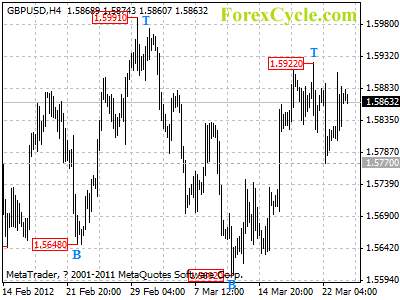
GBPUSD’s upward movement had completed at 1.5922

GBPUSD’s upward movement had completed at 1.5922. Another fall would likely be seen later today. Support is at 1.5770, a breakdown below this level could signal resumption of the longer term downtrend from 1.5991, then further decline to test 1.5602 could be expected. On the other side, a break above 1.5922 will indicate that the pair remains in uptrend from 1.5602, then further rise towards 1.5991 previous high could be seen.

gbpusd

Forex Signals