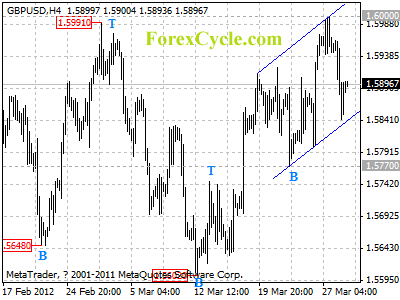
GBPUSD pulled back from 1.6000

After touching 1.5991 previous high resistance, GBPUSD pulled back from 1.6000, suggesting that a cycle top is being formed on 4-hour chart. Initial support is at the lower line of the price channel, and the key support is at 1.5770, as long as this level holds, uptrend from 1.5602 could be expected to resume, and another rise towards 1.6300 is still possible. On the other side, a breakdown below 1.5770 will indicate that the uptrend has completed at 1.6000, then deeper decline to test 1.5602 support could be seen.

gbpusd

Daily Forex Forecast

Daily Wrap: March 28, 2012

Stocks fell into negative territory today, led by materials and energy shares. On the economic front, durable good orders rose 2.2 percent, according to the Commerce Department.

Aussie Dollar Falls Whilst Greenback Sees Gains

Source: ForexYard

printprofile

A drop in Chinese equities saw the Australian dollar fall to a new year low.

The Aussie Dollar dropped 0.7% to $1,0375 right back to the rate it was traded at the beginning of the year.China, the worlds second largest economy receives a large amount of exported commodities from Australia, and thus its no surprise that the Australian currency will take a hit with negative news coming out of China.

The Euro suffered losses against the US Dollar amid concerns that the Euro-zone leaders could possibly increase the size of the rescue fund.

Wednesday’s trading saw the U.S dollar making some hard fought gains over the Euro. The Euro fell to $1,3298 from $1,3331 during North American Trading late Tuesday, as euro-zone finance ministers apparently discussing a plan to boost the region’s firewall in order to contain the debt crisis.

The Greenback also showed its strength by trading up against 16 of its Major Counterparts due to concerns of slowdown in global growth, causing investors to turn to the safe-haven currency.

Forex Market Analysis provided by ForexYard.

© 2006 by FxYard Ltd

Disclaimer: Trading Foreign Exchange carries a high level of risk and may not be suitable for all investors. There is a possibility that you could sustain a loss of all of your investment and therefore you should not invest money that you cannot afford to lose. You should be aware of all the risks associated with Foreign Exchange trading.

How to Use Stochastic and MACD

Source: ForexYard

printprofile

Two of the most common indicators used by traders when performing technical analysis is the Stochastic and the MACD. Below is the description for how these two indicators work and how to read them.

Stochastic:
The Stochastic has two sub-features, Slow and Fast. Slow Stochastic is generally used as it provides much more dependency. Fast Stochastic usually clutters the traders screen with too much information, which is why it generally isn’t used by many.

The core use of the Stochastic is to determine when an upward or downward move is going to occur by seeing where the two lines cross. The most important thing to know about this indicator is that it tells the trader absolutely nothing until the lines cross below or above the 20 and 80 markers on the indicator. There should be lines drawn on the indicator itself at these markers.

In the picture below, you can see at Point 1 that the two lines have gone below the 20 line and crossed each other. This is what’s called a Bullish Cross. It indicates that an upward movement is imminent, as you can see in the direction which followed. Point 2 shows the two lines crossing above the 80 line. This is called a Bearish Cross. It signals an imminent downward movement, as you can see.

stochastic
Can you find the Bullish and Bearish Crosses in between Points 1 and 2? Do you see the movements of the price which followed? This is how the Stochastic works. The size of the predicted movement will vary, but the movement will almost always occur.

MACD:
The Moving Average Convergence/Divergence (MACD) operates pretty much the same way as the Stochastic. There is a central line at the level of 0.0. The red bars show relative strength of the current trend, but don’t tell the trader much of anything useful.

The important aspect of this indicator is the two lines floating around very close to one another. When these two lines cross one another above or below the 0.0 line, it signifies a reversal to the recent trend. You can see the results in the chart below.

macd
Again, can you find the other 2 instances in which there are significant crosses and pick out their respective impact?

Forex Market Analysis provided by ForexYard.

© 2006 by FxYard Ltd

Disclaimer: Trading Foreign Exchange carries a high level of risk and may not be suitable for all investors. There is a possibility that you could sustain a loss of all of your investment and therefore you should not invest money that you cannot afford to lose. You should be aware of all the risks associated with Foreign Exchange trading.

National Bank of Belarus Drops Rate 200bps to 36.00%


The National Bank of the Republic of Belarus cut its refinancing rate by 200 basis points to 36.00% from 38.00%; continuing to unwind a string of aggressive rate hikes.  The Bank said [translated]: “The National Bank carries out a gradual decline in interest rates against a background of strengthening positive trends in the economy and the monetary sphere. So, steadily slowing inflation, steady growth in ruble deposits of the population, improving the state of foreign trade… Further dynamics of the refinancing rate will be determined primarily by the intensity of inflation processes and the situation in the economy and the monetary sphere.”

The bank also dropped the rate by 500 basis points and 200 basis points last month, and last hiked the rate by 500 basis point for the third time in a row in December last year.  The bank increased the rate a total of 3450 basis points in 2011.  Belarus reported consumer price inflation at hyperinflationary levels of 107.4% in February, down from 109.7% in January this year, up from 92.3% in October, up from 79.6% in September, and 36.2% in the year to June, according to the National Statistic Committee.  


Senior Bank officials have previously noted a desire to reduce the rate to around 20% this year.  The USD-Belarussian ruble (BYR) exchange rate has doubled on the black market, rising to as much as 7,000 per dollar (approx. 6,000 in July), and currently trades around 8050 (5350 in September) against the US dollar, according to quotes from Yahoo Finance.

Daily Dividend Report: FCX, NI, RBN, ACG, CMC

This morning, Freeport McMoran (FCX) declared its quarterly dividend of 31.25 cents per share, an increase of 25% over its prior dividend. Based on the current stock price, investors can expect a yield of about 3.4% going forward.

Wednesday 3/28 Insider Buying Report: SD, ESL

Bargain hunters are wise to pay careful attention to insider buying, because although there are many various reasons for an insider to sell a stock, presumably the only reason they would use their hard-earned cash to make a purchase, is that they expect to make money. Today we look at two noteworthy recent insider buys.

Beat Any Bear Market with Dividend Stocks


Beat Any Bear Market with Dividend Stocks

Trying to time the market is a fool’s game. Instead, here is a time tested (yet underappreciated) method for riding out volatile markets.

On Sunday, I was on a plane traveling across the country. With lots of time on my hands, I did something I haven’t done for years. I read every section of the Sunday New York Times. It was a great way to spend the day as the hours on the plane just flew by.

One article, in particular grabbed me. Paul Lim discussed whether or not we were in an old bull market or a new bull market.

To sum up the arguments, they went like this:

Old bull – In order for a bull to become a bear, the market has to drop 20% on a closing basis. The largest decline (on a closing basis) since the bull started in March 2009 was 19.4%. Therefore, the bull is still in effect.

New bull – On October 3, the market was down 20% from the highs on an intraday basis (though it didn’t close that low). Additionally, over the past six months, small cap stocks have outperformed large caps. That is typical behavior of new bull markets.

I say it’s all bull.

Not that I don’t believe we’re in a bull market. I do…

It’s just that I don’t really care whether we’re in a new or old bull market. It’s not going to impact my investing decisions or recommendations.

In my active trading services, I’m going to react to the market that’s right in front of me. I’m not going to try to figure out if we have a few months or a few years of the bull ahead.

In the Ultimate Income Letter’s Perpetual Income Portfolio, which is designed to generate a high level of income both now and over the long term, I don’t worry about bulls or bears – just great stocks with a track record of raising their dividend payments year after year, providing members with more income than they received the year before.

Investors in The Oxford Club’s Gone Fishin’ Portfolio also don’t concern themselves with whether the market is in a bull or bear phase. The positions in that portfolio have consistently beaten the market for years, during all kinds of cycles and environments.

It is incredibly difficult to time the stock market. Even those “experts” who made great calls right before the markets tanked haven’t been able to duplicate their previous success. When was the last time you heard from any of the prophets who correctly called the ’87 crash?

Trying to time the market, particularly with your long-term portfolio is a fool’s game. Instead, here is a time tested (yet underappreciated) method for riding out volatile markets.

Perpetual Dividend Raisers

Look for stocks that are what I call “Perpetual Dividend Raisers”. These are stocks that have a track record of raising the dividend every year. For most stocks, that will keep ahead of inflation and the high yield will provide a buffer in a market downturn.

For example, let’s say you’re invested in Darden (NYSE: DRI), the operator of Olive Garden, Red Lobster and LongHorn Steakhouse restaurants. It currently pays a 3.4% dividend yield. Darden has raised the dividend every year for seven years. Over the past five years the average raise was 28% per year.

If the company’s dividend growth rate slows down to 14% per year, the yield would still climb to 5.6% in five years and swell to 10.7% in ten years.

And if you don’t need the income today and can reinvest those dividends, the numbers get even more impressive. Assuming the stock performs according to the historical average of the stock market, your yield would grow to 6.5% in year five and 15.9% after a decade. Even more impressive is that your compounded annual growth rate would be 11.5% after five years and 12.2% after ten.

But what if one of these market prophets calls for the end of the bull market and is right? What happens to your Darden shares then?

As long as the company continues to raise the dividend, the yield numbers mentioned above will stay the same. And there’s no reason to think they can’t do it. Darden even raised the dividend significantly during the Great Recession of 2008 – 2009.

If the stock market experiences a protracted bear market, you can still make a lot of money on your Darden stock by reinvesting the dividends.

As the market falls, reinvested dividends buy more stock. So if the market fell 5% per year every year and you had invested $10,000 in Darden, you’d be down about $100 after five years (not bad considering the overall market would be down by 25%. However, after ten years, you’d be up over $4,000 because of the power of compounding dividends, particularly when shares are cheap.

So for an investor who is reinvesting dividends, as long as they don’t need to sell anytime soon, a bear market is actually their best friend.

Owning Perpetual Dividend Raisers and especially reinvesting those dividends allows you to ignore all of the chatter about bulls and bears as your portfolio will grow no matter which creature is in control of the market.

Good Investing,

Marc Lichtenfeld

Article by Investment U