Forex Market Review 07/06/2010

Market Analysis by Finexo.com

Growing global fears over potentially stagnating in China’s and the U.S’s economic recovery as well as mounting concerns over the overall health of the Euro Zone’s banking system have pushed investors to seek refuge in safe haven currencies- mainly the Yen. The Japanese currency approached a seven month high against the greenback as forex traders flocked to the currency amid concerns that the dwindling global economic recovery will discourage central banks from withdrawing their stimulus measures. The Dollar stabilized yesterday after falling last week on a disappointing job report; however, it still has not regained its appeal as the most favored safe haven currency. Distress over the state of the U.S. economy resurfaced after Friday’s job report showed weak hiring in the private sector, fueling concerns that the world’s largest economy could be headed for a double dip recession.

EUR/USD
The Euro dropped to $1.2482 in this morning’s session, but managed pull back up above $1.2557 and is continuing towards last week’s six week high of $1.2613. With no major Euro impact news today, the main focus remains on yesterday’s comments made by European officials regarding the stress tests to be conducted on Euro zone banks. Investors are looking for proof that these tests will be conducted objectively, and that credible back-stops are put forth by policy makers in case of a fall-out. Although the EUR/USD seems to have found solid support above the 1.25 level, failure to address these rising concerns could have a negative impact on the Euro.

AUD/USD

The Aussie successfully erased all initial declines following the Australian Reserve Bank’s announcement to hold interest rates unchanged. This morning, as predicted, RBA Governor Glenn Stevens opted to hold the overnight cash rate at 4.5% for a second month in a row. With its decision to hold the interest rate unchanged, the RBA has joined central banks in the U.S., Europe and parts of Asia in keeping key interest rates unchanged to better gauge the affects of the European sovereign debt crisis on the global economic recovery. The AUD/USD touched on 0.8391, up from 0.8370 at the time of the RBA decision.

Forex Market Review & Analysis by Finexo.com

Disclaimer: Trading the foreign exchange (Forex) carries a high level of risk, and may not be suitable for all investors. All information and opinions contained on this website are to be used for general informational purposes only and do not consitute investment advice.

EUR and AUD Gain on Positive RBA Outlook

The Reserve Bank of Australia (RBA) left its cash rate steady at 4.50% as expected, saying the global economy had continued to expand, albeit unevenly, with growth in Asia very strong and signs of China moderating to a more sustainable rate.

The EUR and Australian dollar (AUD) rebounded from early losses against the dollar and yen on Tuesday after a statement by the RBA helped dispel some gloom about the economic outlook, which led to short-covering. The Aussie stood 0.4% higher on the day at $0.8437 after earlier dropping to test a support line at $0.8315, a low point set last week.

Against the yen it climbed 0.6% on the day at 74.08 after sliding as far as 72.73. Global risk appetite has taken a beating in the past few weeks on growing worries about the health of the euro zone’s banking system, a slowdown in China and risks of a double-dip recession in the United States.

Forex Market Analysis provided by Forex Yard.

© 2006 by FxYard Ltd

Disclaimer: Trading Foreign Exchange carries a high level of risk and may not be suitable for all investors. There is a possibility that you could sustain a loss of all of your investment and therefore you should not invest money that you cannot afford to lose. You should be aware of all the risks associated with Foreign Exchange trading.

Euro, Euro Stocks: Poised For a Move Lower – July 6, 2010

euro stoxx 50, stoxx, stoxx 50, euro sotcks, stock market, stock trading, online trading

Good Tuesday everyone! On today’s canvas is the daily chart of the Euro Stoxx 50. for those who does not know, the Euro Stoxx 50 is a stock index of the 50 biggest blue-chip companies in the euro zone. Like the Dow of the US, the Stoxx 50 can also be used as a leading barometer of the euro zone’s economic health. Unlike the DAX (kindly see my colleague’s earlier post here), the Stoxx 50 is a couple of steps away from breaking down already. Its price action is actually very similar to FTSE, which my partner also posted earlier today (kindly check it here), since it is also showing a head and shoulders formation. But as mentioned, the Stoxx has not breached its neckline yet unlike the FTSE. If and when it breaks below the 2,200 level and the neckline, it could plunged all the way down 1,850. In fact, a couple of indicators suggest that it could indeed do so. First, the RSI has fallen below 50, suggesting that the index’s downward momentum is increasing. Second, the 50-day moving average has also crossed over below the 200-day MA, indicating a likely move downwards. Moreover, the MACD has also recently turned negative. On the upside, if buying interest returns and the neckline holds, the index could once again aim at least for the peak of its right shoulder. With the index now trading below the 50 and 200 MAs, however, it would need a lot of buying support to push itself upwards again.

With all the debt concerns that has been happening around the euro zone, particularly in Greece, it is understandable why a lot of investors have been losing faith in investing in euro stocks and even bonds. Just recently, Spain was also placed under the watch list by the international ratings agency, Moody’s. Several countries including Greece, Portugal, and Spain have their sovereign debt already downgraded. If this contagion spreads among the other member countries, investors will  all the more pull out their money from the Europe. And it is not as if the euro zone has been growing on a big scale as well. the euro zone only grew by a meager 0.2% during the first quarter of this year. With a drop in the retail sales in the months following and a continued lose of investor confidence, its growth for the second quarter will likewise be weak as well.

So how will a drop in equity demand affect the euro? Remember that most of the investments in the euro zone, the equities and bonds, are priced in euros. One has to exchange their money into euros first before being able to invest in these instruments. A slide in equities due to a lack of demand, therefore, will also cause a dip in the demand for the currency. In short, if and when the euro stoxx index sinks, the valuation of the euro currency would likely decline as well.

More on LaidTrades.com

Volatility Expected in First Day Back Following Long Weekend

Source: ForexYard

The EUR dropped some of its gains against the dollar and the yen in thin trading as U.S. markets were closed yesterday. A lack of high impact data on the economic calendar kept currencies in a tight range. However, this should change today with influential economic data expected to be released from the U.S. and European interest rates due out.

Economic News

USD – Strong Economic Data Needed to Prevent Double Dip Recession

With U.S. markets closed for the 4th of July holiday, many of the major players in the currency markets were away from their trading desks. Low liquidity prevailed throughout the day as the dollar failed to make any significant move.

The EUR/USD dropped to a low of 1.2521 after trading as high as 1.2565. The USD/JPY was unchanged at 87.88. The GBP/USD fell to 1.5163 before closing at 1.5180.

The dollar was able to hold modest gains despite Friday’s weaker than expected unemployment data. The U.S. reported Non-Farm Employment losses of 125k. Market expectations were for a loss of 110k jobs.

It appears the market is beginning to shift its focus from the fiscal issues in the euro zone to the struggling U.S. economic recovery. Economists worry of a potential double dip recession for the U.S. economy and a ballooning U.S. deficit. Today’s data release of the ISM Non-Manufacturing PMI at 14:00 GMT may help to support or dispel the double dip theory.

The next support and resistance lines for the EUR/USD rest at 1.2470 and 1.2650 respectively. This resistance level also coincides with a 23.6% retracement level from the long term bearish trend that began in December of 2009.

EUR – Traders Eye EU Interest Rate Decision

Yesterday’s European trading session was just as quiet as the New York trading session. With the U.S. out on holiday, the major currencies were caught in tight trading ranges as major players in the FX market were away from their desks. Today’s trading will prove to be more volatile with the institutional desks returning to full staff.

The major event traders are eying for this week is Thursday’s European Central Bank (ECB) interest rate announcement. Most economists expect the ECB to hold rates steady at 1.00% but are looking for upbeat comments from ECB President Jean-Claude Trichet concerning the management of the European debt crisis along with future direction of EU monetary policy.

The ECB continues to purchase EU government bonds, particularly those of Greece that are the most illiquid securities. The purchases of the government debentures are slowly increasing the money supply in the euro zone. This is raising further concerns over the euro’s long term valuation versus the dollar and the pound.

JPY – Aussie Interest Rate Forecasted to Hold Steady

Today’s Asian trading session will be highlighted by the release of the Australian Cash Rate followed by the accompanying statement from the Reserve Bank of Australia (RBA). Economists forecast the RBA to hold interest rates steady at 4.50%. Previously the RBA took a pause from the last 6 consecutive interest rate increases. The interest rate decision will be released at 04:30 GMT followed by comments from RBA Chief Glenn Stevens.

Further economic data from Australia will be released on Thursday in the form of employment data that is forecasted to deteriorate from the previous data release.

The Aussie dollar has slumped recently with the falling prices of commodities. This is despite recent dollar weakness in most of the major pairs. Continued downward movement may be seen in the AUD/USD with the next support lines resting at 0.8260 and 0.8070. Should the RBA surprise the market with an interest rate hike, the pair could rise to its next resistance level at 0.8570.

Crude Oil – Double Dip Fears Weigh on Spot Crude Oil Trading

Fears of a double dip recession are causing spot crude oil prices to decline as the price of the commodity has fallen in the early morning hours of the Japanese trading session.

Spot crud oil prices are currently trading at $71.50, the lowest price the commodity has seen since the first week of June.

Traders are concerned that another downturn in the U.S. economy could slow future demand for crude oil. As such, spot crude oil prices have fallen almost 10% over the past 7 trading days. This is despite a slumping dollar which is down 3% versus the euro. Typically the price of spot crude oil rises when the dollar weakens as this allows holders of foreign currencies to buy crude oil cheaper.

Positive economic data may help to lift the price of spot crude oil. Today’s release of the U.S. ISM Non-Manufacturing PMI at 14:00 GMT could support a lift in prices to the resistance level of 72.50.

Technical News

EUR/USD

The pair has recorded much bullish behavior in the past several days. However, the technical data indicates that this trend may reverse anytime soon. For example, the daily chart’s Stochastic Slow signals that a bearish reversal is imminent. . Going short with tight stops might be a wise choice.

GBP/USD

There is a fresh bearish cross forming on the daily chart’s Slow Stochastic indicating a bearish correction might take place in the nearest future. The downward direction on the hourly chart’s Momentum oscillator also supports this notion. Going short with tight stops might be the right strategy today.

USD/JPY

The USD/JPY cross has experienced a bearish trend for the past month. However, it seems that this trend may be coming to an end. The RSI of the daily chart shows the pair floating in the oversold territory, indicating that an upward correction will happen anytime soon. Going long with tight stops might be a wise choice.

USD/CHF

The pair has recorded much bearish behavior in the past several days. However, the technical data indicates that this trend may reverse anytime soon. For example, the daily chart’s Stochastic Slow signals that a bullish reversal is imminent. An upward trend today is also supported by the hourly chart’s Slow Stochastic. Going long with tight stops may turn out to pay off today.

The Wild Card

Crude oil

Crude oil prices are once again dropping, and it is currently traded around $71.85 a barrel. And now, the daily chart’s Slow Stochastic is giving bullish signals, indicating that oil prices might go up. This might give forex traders a great opportunity to enter a very popular trend.

Forex Market Analysis provided by Forex Yard.

© 2006 by FxYard Ltd

Disclaimer: Trading Foreign Exchange carries a high level of risk and may not be suitable for all investors. There is a possibility that you could sustain a loss of all of your investment and therefore you should not invest money that you cannot afford to lose. You should be aware of all the risks associated with Foreign Exchange trading.

Forex Daily Market Review July 06, 2010

By eToro – The Euro edge higher on light volume due to the US independence holiday.  The EUR/USD should continue to grind higher toward resistance at 1.2670. Click here to read the full daily Review

Forex Market Analysis provided by eToro

Disclaimer: Trading in the Foreign Exchange market might carry potential rewards, but also potential risks. You must be aware of the risks and are willing to accept them in order to trade in the foreign exchange market. Don’t trade with money you can’t afford to lose.

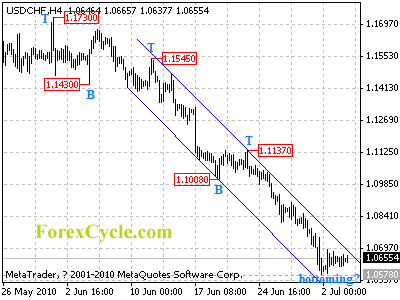
USDCHF is forming a cycle bottom at 1.0578

USDCHF might be forming a cycle bottom at 1.0578 level on 4-hour chart. Key resistance is at the upper border of the falling price channel, now at 1.0685, a clear break above the channel resistance could confirm the cycle bottom, then further rise could be seen to 1.0750-1.0800 area. As long as 1.0800 level holds, the bounce from 1.0578 is treated as consolidation of downtrend from 1.1730, one more fall to 1.0450 is still possible.

usdchf

Daily Forex Forecast

EUR Hits Five-Week High

By Anton Eljwizat – The EUR rallied to a five-week high above 1.25 last week, while the dollar fell broadly after disappointing data heightened worries the U.S. economic recovery is stalling.

Concerns about euro zone debt and liquidity problems eased further on Thursday after Spain successfully sold 3.5 billion EUR of a five-year bond, adding to positive sentiment a day after European banks borrowed less money than expected from a European Central Bank (ECB) tender.

Gains in the single European currency accelerated after the EUR broke key technical resistance levels around 1.25.

As for the week ahead, the most significant news publication seems to be the Minimum Bid Rate, which is the euro zone’s interest rate announcement for July. Analysts expect the ECB to leave rates at 1.00%; however, any rate manipulations are likely to have a sharp impact on the market. Traders should also follow every publication regarding the European debt crisis as this issue continues to be the main reason for the weak Euro.

Technical Analysis

The EUR has dropped significantly versus the CHF in the past few months, and it is currently traded around 133.20. And now, as evident in the data below, the weekly chart is giving bullish signals, indicating that EUR/CHF pair might go up.

– Below is the weekly chart of the EUR/CHF currency pair
– The technical indicators that are used are the Relative Strength Index (RSI), and Slow Stochastic.
– Point 1: The Slow Stochastic indicates an impending bullish cross, signaling that the next move may be in an upward direction.
– Point 2: The Relative Strength Index (RSI) indicates that the price of this cross currently floats in the oversold territory, signaling upward pressure.

EUR/CHF – Weekly Chart

Forex Market Analysis provided by Forex Yard.

© 2006 by FxYard Ltd

Disclaimer: Trading Foreign Exchange carries a high level of risk and may not be suitable for all investors. There is a possibility that you could sustain a loss of all of your investment and therefore you should not invest money that you cannot afford to lose. You should be aware of all the risks associated with Foreign Exchange trading.

USD/CHF Awaiting Correction?

By Greg Holden – The USD/CHF appears to be anticipating a bullish correction, and a number of technical indicators support this notion.

– Below is the USD/CHF daily chart provided by ForexYard. The indicators used are the Stochastic (slow), the Relative Strength Index (RSI), and the MACD/OsMA.

– Point 1: The Stochastic (slow) is giving off multiple bullish crosses, indicating that the next move could be in an upward direction.

– Point 2: The RSI is showing the price floating deep within the over-sold territory, but also seems to signal that the indicator is turning upward, highlighting a growing level of upward pressure.

– Point 3: The MACD/OsMA is showing the lines in a descending pattern, but a bullish cross is impending. Once the cross takes place an upward correction may occur.

– Traders can try to anticipate when this bullish correction will occur and jump in for some quick, short-term profits.

USD/CHF – Daily Chart

Forex Market Analysis provided by Forex Yard.

© 2006 by FxYard Ltd

Disclaimer: Trading Foreign Exchange carries a high level of risk and may not be suitable for all investors. There is a possibility that you could sustain a loss of all of your investment and therefore you should not invest money that you cannot afford to lose. You should be aware of all the risks associated with Foreign Exchange trading.

Forex: Speculators short Euro positions vs Dollar edge higher, Yen longs jump

By CountingPips.com

The latest COT data out on Friday showed that futures speculators bets for the U.S. dollar against the euro were higher for a second straight week as of June 29th, according to the Commitments of Traders (COT) data released by the Chicago Mercantile Exchange.

Non-commercial futures positions, those taken by hedge funds and large speculators, were net short the euro against the U.S. dollar by -73,670 contracts after being net short the euro by -70,974 contracts the week before on June 22nd.

The COT report is published every Friday by the Chicago Mercantile Exchange (CME) and shows futures positions as of the previous Tuesday. It can be a useful tool for traders to gauge investor sentiment and to look for potential changes in the direction of a currency or commodity. Each currency contract is a quote for that currency directly against the U.S. dollar, where as a net short amount of contracts means that more speculators are expecting that currency to fall against the dollar and net longs expect that currency to rise versus the dollar.

Other major currencies net short in the CME futures market against the dollar as of June 29th were the British pound and the Swiss franc while the Australian dollar, New Zealand dollar, Japanese yen, Canadian dollar and Mexican peso all had a net long amount of contracts against the dollar.

The British Pound Sterling net shorts decreased to -34,771  from a total of -46,346
that were reported net short on June 22nd while the Swiss franc positions were net short -12,848 contracts after -10,265 net shorts the week before.

The New Zealand dollar futures positions rose over to the long side with 822 long contracts last week and increased to 2,486 long contracts as of June 29th. The Japanese yen net long contracts surged to 27,427 as of June 29th following 3,630 long contracts on June 22nd. Investors have reversed their yen positions substantially from being short by 65,612 contracts on May 4th.

The Australian dollar futures positions were net long by 12,854 contracts as of June 15th, edging higher after totaling net 11,806 long contracts on June 22nd and down from a total of 80,674 net longs on April 13th.

The Canadian dollar long positions fell to net 15,894 contracts and after 26,353 net longs the week before while the Mexican peso long contracts moved higher for a third straight week to 42,496 longs from 35,639 longs the prior week.

COT Data Summary (vs. the US Dollar) as of June 29th

Australian dollar net long on June 29 increase to 12,854 contracts from 11,806
British pound sterling futures contracts were net short by -34,771 from -46,346
Canadian dollar net long contracts fell to 15,894 from 26,353
Euro net short positions declined for a second straight week to -73,670 from -70,974
Japanese yen futures contracts after turning net long last week at +3,630 registered long contracts of 27,427
New Zealand dollar long positions increased to 2,486 on June 29 from net long of 822 contracts on June 22
Mexican peso long contracts increased for third week in a row to 42,496 from 35,639 on June 22
Swiss franc short contracts dipped on June 29 to -12,848 from -10,265 on June 22

Go to the Commitment of Traders CME futures data

Technical and Fundamental Look on Japan – July 5, 2010

nikkei, nikk, $nikk, japan economy, japanese economy, stock trading, stock market, online trading

Good day forex and stock fans! Earlier today I presented my commentary on the recent price action of Shanghai Composite Index (kindly see my previous post here). Now, it’s Japan’s turn to be heard so here it is. On today’s canvas is the daily chart of the Nihon Keizai Shimbun Stock Market Index or the Nikkei 225 Index for short. In case you do not know, the Nikkei is the leading stock market in Japan which comprises the top 225 companies that are listed in the Tokyo Stock Exchange. The index gives a good indication of financial and economic conditions in Japan, as well as Asia. The Tokyo Stock Exchange, by the way, is ranked number 2 among the largest t stock exchanges in the world in terms of market capitalization behind the NYSE. For a long time, Japan had also been the second-largest economy in the world behind the US. Though, the Land of the Rising Sun had been overtaken by China in 2009 when the latter posted a whopping 11.9% jump in its GDP during the fourth quarter of the year. In any case, the Nikkei is still one of the most followed indices in the world.

So looking at the Nikkei’s daily chart, it seems to be on the verge of breaking down from a head and shoulders formation as well. The index is now hanging by a thread as it trades just above the 9,200.00 psychological number. The index would easily fall down to 9,000.00 if 9,200 breaks. But if the support at 9,000.00 gives way, it could further slide until it meets its minimum downside target of 7,750.00. The 50-day moving average has just crossed below the 200-day MA, suggesting a likely move downwards. The MACD has also made a bearish crossover signal with its histogram recently turning negative. On the upside, if the 9,000.00 holds, then the index could continue with its sideways movement.

Fundamentally, despite being ranked as the number 3 largest economy in the world, Japan has also been plagued with many heartaches. To top the list is its problem regarding deflation. In May, Japan reported a 1.3% year-over-year decline in the Tokyo core CPI. With the country’s household spending also dipping by 0.7% during the same month, it is pretty obvious that domestic demand in Japan is nowhere near to pull its CPI back in the positive territory. While falling prices may sound good at first, it indicates a lack of consumption in the country which by the way takes up about 57% of the country’s GDP. In fact the Bank of Japan is anticipating that the country will stay in this environment for at least five more years.

The appreciation of the yen due to the risk aversion in the market is also not helping Japan’s cause. Japan is also an export-based country. And as the yen gets stronger Japan’s exports become relatively more expensive as well, placing a downward pressure on demand. With the debt crisis in Europe and the recent weak economic showing of the US and China, the market has been covering a lot of their short yen positions. Remember that the Japanese yen, due to its low interest rate of 0.10%, is used to fund investments in equities and other higher yielding assets.

Regarding Japan’s GDP, it’s no secret now why the country contracted by 5.0% for the whole of 2009. Consumption was bleak as evidenced in the country’s inflation numbers. Japan’s exports had also been receiving a lot of downward pressure due to the rapid rise of the yen. Now, without those massive spending by the government, the country would have sunk by more. Of course, the government’s huge spending caused its public debt to surge to 192.1% of its GDP in 2009. Despite the already high level of debt, the government was still pushing for a record ¥92.3 trillion budget for the next fiscal year. In my opinion, if the country does not improve its consumption and organically grows, it could be a good candidate for a debt downgrade down the line since it needs to pay off whenever part of their debt comes due.

More on LaidTrades.com