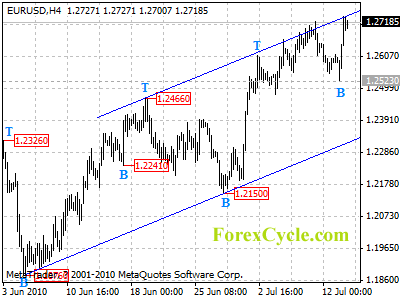
EURUSD has formed a cycle bottom at 1.2523

EURUSD has formed a cycle bottom at 1.2523 level on 4-hour chart. Further rally would more likely be seen later today and next target would be at 1.2800 area. On the downside, the pair is facing the upper border of a price channel again, if the channel resistance holds, pullback to test 1.2523 key support is possible, below this level will indicate that the rise from 1.2150 is complete, then the following downward movement could bring price back to the lower border of the channel.

eurusd

Daily Forex Signals

Forex Daily Market Commentary

By GCI Forex Research

Fundamental Outlook at 1400 GMT (EDT + 0400)

The euro appreciated sharply vis-à-vis the U.S. dollar today as the single currency tested offers around the US$ 1.2735 level and was supported around the $1.2520 level. The common currency reached its highest level since 12 May as dealers positioned themselves ahead of the U.S. corporate earnings season that many dealers believe will evidence strong results for the second quarter.  Alcoa, the U.S. aluminum production giant, reported better-than-expected earnings results.  Dealers also moved into the euro after Greece sold €1.625 billion in 26-week Treasury bills at a yield of 4.65% – below the 5% rate the European Union lent funds at in its bailout package to Greece.  The euro easily absorbed news that Portugal’s credit rating was reduced two notches to A1 by Moody’s on account of that country’s expanding debt position and weaker economic growth.  Eurozone finance ministers convened yesterday and Dutch finance minister de Jager reported eurozone banks “will get a certain period to refinance themselves in the market, but the countries will immediately announce that there is a certain backstop.”  European regulators are conducting stress tests on 91 different banks to evaluate their ability to withstand losses on sovereign bond holdings.  Data released in the eurozone today saw the EMU-16 July ZEW economic sentiment survey come in weaker-than-expected at 10.7, down from the prior reading of 18.8, while Germany’s ZEW economic sentiment survey fell to 21.2 and the current situation sub-index improved to 14.6.  Other German data saw the June wholesale price index decline 0.2% m/m and climb 5.1% y/y.  Other data released today saw French June consumer price inflation up 0.0% m/m and 1.5% y/y while the harmonized components were up 0.0% m/m and 1.7% y/y.  In U.S. news, traders are waiting to see if the U.S. Senate achieves a final passage of the financial overhaul legislation on 15 July.  The Federal Reserves sold US$ 2.12 billion of term deposits in its third test auction today, a new tool the Fed may use to absord excess liquidity from the banking system.  Data released in the U.S. today saw June NFIB small business optimism recede while the May trade balance deficit worsened to –US$ 42.3 billion.  Many data including retail sales will be released tomorrow along with minutes from the most recent Federal Open Market Committee meeting.  Euro offers are cited around the US$ 1.2830 level.

¥/ CNY

The yen appreciated vis-à-vis the U.S. dollar today as the greenback tested bids around the ¥88.00 figure and was capped around the ¥88.85 level.  Bank of Japan’s Policy Board is expected to keep its overnight call rate target unchanged at 0.10% when its interest rate announcement is made tonight.  BoJ Governor Shirakawa last week noted Japan’s economy is “likely to stay on a recovery trend” with improving domestic demand.  The central bank will likely retain some policy tools ready to deploy in case the situation in Europe deteriorates further or deflation worsens in Japan.  BoJ is likely to be pressured by the government following this weekend’s election loss, the yen’s ongoing strength, and unstable equity markets.  Last month, BoJ unveiled details about its new ¥3 trillion lending program to stimulate lending to companies.  Data released in Japan overnight saw May industrial production up 0.1% m/m and 20.4% y/y with May capacity utilization up 0.8% m/m.  Also, June consumer confidence improved to 43.6 from the prior print of 42.7.  The Nikkei 225 stock index lost 0.11% to close at ¥9,537.23. U.S. dollar bids are cited around the ¥86.29 level.   The euro moved higher vis-à-vis the yen as the single currency tested offers around the ¥112.35 level and was supported around the ¥110.65 level.  The British pound moved higher vis-à-vis the yen as sterling tested offers around the ¥134.05 level while the Swiss franc moved higher vis-à-vis the yen and tested offers around the ¥84.00 figure. In Chinese news, the U.S. dollar appreciated vis-à-vis the Chinese yuan as the greenback closed at CNY 6.7725 in the over-the-counter market, up from CNY 6.7711.  Data to be released in China tomorrow night include Q2 GDP growth, June producer prices, June consumer prices, June retail sales, and June industrial production.  The economy is expected to have expanded an annualized 10.5% in the second quarter.

£

The British pound appreciated sharply vis-à-vis the U.S. dollar today as cable tested offers around the US$ 1.5190 level and was supported around the US$ 1.4965 level.  Data released in the U.K. today saw June consumer price inflation up 0.1% n/n and 3.2% y/y while the core index came in much stronger-than-expected at 3.1%, up from the prior result of 2.9%.  DCLG May house prices were up 11.0% y/y and June Nationwide consumer confidence will be released tonight followed by jobless data tomorrow.  Sterling climbed higher after the release of the CPI data on the premise that additional Bank of England Monetary Policy Committee members will vote for higher interest rates.  BoE’s Main Bank Rate target currently stands at 0.50%.  MPC member Sentance reported the MPC’s rate decision should support the private sector and said rate-setting is becoming more difficult.  MPC member Bailey said U.K. banks that are experiencing difficulties should restructure their debts.  Cable bids are cited around the US$ 1.4620 level.  The euro appreciated vis-à-vis the British pound as the single currency tested offers around the £0.8390 level and was supported around the £0.8315 level.

CHF

The Swiss franc appreciated vis-à-vis the U.S. dollar today as the greenback tested bids around the CHF 1.0515 level and was capped around the CHF 1.0645 level.  Data released in Switzerland today saw June producer and import prices decline 0.4% m/m and climb 0.9% y/y.  Swiss National Bank President Hildebrand last week said he is “closely monitoring” the franc, adding its fluctuation has “clearly increased.”  Most dealers believe SNB has been forced to intervene less on account of all of the euro-denominated assets on its balance sheet but some note the SNB will likely continue to intervene at opportune levels.  U.S. dollar offers are cited around the CHF 1.0980 level.  The euro appreciated vis-à-vis the Swiss franc as the single currency tested offers around the CHF 1.3400 figure while the British pound moved higher vis-à-vis the Swiss franc and tested offers around the CHF 1.6055 level.

Forex Daily Market Commentary provided by GCI Financial Ltd.

GCI Financial Ltd (”GCI”) is a regulated securities and commodities trading firm, specializing in online Foreign Exchange (”Forex”) brokerage. GCI executes billions of dollars per month in foreign exchange transactions alone. In addition to Forex, GCI is a primary market maker in Contracts for Difference (”CFDs”) on shares, indices and futures, and offers one of the fastest growing online CFD trading services. GCI has over 10,000 clients worldwide, including individual traders, institutions, and money managers. GCI provides an advanced, secure, and comprehensive online trading system. Client funds are insured and held in a separate customer account. In addition, GCI Financial Ltd maintains Net Capital in excess of minimum regulatory requirements.

DISCLAIMER: GCI’s Daily Market Commentary is provided for informational purposes only. The information contained in these reports is gathered from reputable news sources and is not intended to be U.S.ed as investment advice. GCI assumes no responsibility or liability from gains or losses incurred by the information herein contained.

Gold Pops Following Portugal Downgrade

By Fast Brokers – Gold has popped past previous July highs after news hit that Moody’s is downgrade Portugal’s debt by two notches.  However, intraday gains are being capped by a relatively successful auction of Greek bonds, encouraging investors that Greece will not default on its debt.  Regardless, the Portugal downgrade gives investors uncertainty a bit of a boost and gold is benefitting.  Gold seems to have locked back into its uptrend in the process, though we will have to see if the precious metal can get beyond near-term downtrend lines.  If not, gold could be in for heavier losses.  We tend to err on the side of optimism since gold has shown it can benefit from both good times and bad.  Meanwhile, we’ll keep an eye on technicals and gold’s reaction to upcoming data and earnings.

Technically speaking, gold multiple uptrend lines in place and $1200/oz becomes a technical cushion once again.  Gold also has technical supports in the form of intraday and 7/7 lows.  As for the topside, gold faces technical barriers in the form of 6/1 and 6/30 highs.

Present Price: $1215.75/ oz
Resistances: $1216.85/oz, $1219.35/oz, $1221.01/oz, $1223.52/oz, $1225.55/oz, $1228.03/oz
Supports:  $1214.57/oz, $1212.49/oz, $1210.39/oz, $1208.55/oz, $1206.43/oz, $1203.77/oz
Psychological: $1200/oz, July highs and lows

(click chart to enlarge)

Market Commentary provided by Fast Brokers.

Disclaimer: FastBrokers’ market commentary is provided for information purposes only and under no circumstances should be regarded neither as an investment advice nor as a solicitation or an offer to sell/buy any financial product. FastBrokers assumes no responsibility or liability from gains or losses incurred by the information herein contained.

Risk Disclosure: There is a substantial risk of loss in trading futures and foreign exchange. Please carefully review all risk disclosure documents before opening an account as these financial instruments are not appropriate for all investors.

AUD/USD Tests Upper Bands of Consolidation

By Fast Brokers – The Aussie is testing the upper bands of its recent consolidation pattern as the EUR/USD and Cable run higher in the wake of a successful debt auction in Greece.  Investors have shrugged off weak EU economic data and a Moody’s downgrade of Portugal’s debt and are instead focusing on Greece’s oversubscribed debt auction and a solid earnings report from blue-chip Alcoa.  Australia was relatively quiet on the data wire today, although business confidence did decline by a basis point.  Meanwhile, the Aussie looks set to perform well should investor sentiment continue to improve around the globe.  Recent economic data from Australia has been encouraging, including yesterday’s stronger than expected home loans figure.  Investors should also keep in mind that last week’s employment data topped estimates and the RBA expressed confidence in the sustainability of Australia’s economic recovery.  Hence, if the environment continues to improve in the EU and U.S. then the RBA has little reason to loosen monetary policy and more incentive to tighten in the future, a positive for the Aussie.  However, we will have to see how the week unfolds with key economic data from China, the EU, and U.S. over the coming days along with U.S. corporate earnings.

Technically speaking, the Aussie faces technical barriers in the form of 7/8 and June highs.  Additionally, the highly psychological .90 level could serve as a sufficient barrier should it be tested.  Therefore, the Aussie does have limited room to the topside unless it receives another strong fundamental or psychological boost.  As for the downside, the Aussie has multiple near-term uptrend lines working in its favor along with intraday lows and its psychological .85 level.

Price: .8779
Resistances:  .8789, .8804, .8828, .8858, .8879, .8902
Supports:  .8760, .8743, .8726, .8710, .8690, .8670, .8646
Psychological:  .90, .85, June highs and July lows

(click chart to enlarge)

Market Commentary provided by Fast Brokers.

Disclaimer: FastBrokers’ market commentary is provided for information purposes only and under no circumstances should be regarded neither as an investment advice nor as a solicitation or an offer to sell/buy any financial product. FastBrokers assumes no responsibility or liability from gains or losses incurred by the information herein contained.

Risk Disclosure: There is a substantial risk of loss in trading futures and foreign exchange. Please carefully review all risk disclosure documents before opening an account as these financial instruments are not appropriate for all investors.

Forex Econ Update: US Trade Deficit increases 4.8% in May

By CountingPips.com

The United States trade deficit increased to its highest level in over a year as demand for imports rose in May, according to a release by the Commerce Department today. The U.S. trade deficit rose by 4.8 percent as the deficit registered $42.3 billion in May following a revised deficit of $40.3 billion in April. This brings the trade deficit to its highest level since November of 2008.

Market forecasts were expecting the deficit to edge lower to approximately $39.2 billion for the month.

The U.S. had a total of $152.3 billion worth of exports in May which was an increase of $3.5 billion over April’s total of $148.7 billion. May imports rose by $5.5 billion to a total of $194.5 billion from $189.0 billion in April.

Contributing to the higher trade deficit was an increase in the imports of goods by $4.9 billion for the month. The U.S. had a trade deficit in goods by $1.9 billion in May while a U.S. surplus in services stood almost unchanged at $12.2 billion.

The U.S. politically sensitive trade deficit with China increased to $22.3 billion from a deficit of $19.3 billion in April while other notable U.S. trade deficits were with the European Union at a $6.2 billion, Japan at $3.6 billion, Mexico at $6.2 billion, OPEC at $7.8 billion and Germany at $2.9 billion.

U.S. trade surpluses with other countries included Australia at $1.1 billion, Hong Kong at $1.6 billion, Singapore at $0.9 billion and Egypt at $0.3 billion.

Time to Buy the Norwegian Kroner (NOK)?

By Greg Holden – A clear descending triangle pattern has developed on the daily chart of the USD/NOK and many analysts are now expecting a bearish breakout in the coming days. A descending triangle formation historically represents a bearish signal.

The chart shown below is the USD/NOK daily chart provided by ForexYard. Support and resistance lines are indicated by corresponding letters and numbers (R = resistance; S = support).

– We can see that the latest candlestick on the chart is a doji candlestick, which represents a reversal to the previous movement. This means we may expect a short uptick before any bearish breakouts can occur.

– The moment to watch for is the breakout beyond the lower level of the descending triangle. The price of 6.3200 marks this lower border.

– Below this price level we have a number of psychological barriers which may indicate profitable targets. The first support line sits at 6.2500, followed by 6.1500, and ending around 6.0600.

USD/NOK – Daily Chart

Forex Market Analysis provided by Forex Yard.

© 2006 by FxYard Ltd

Disclaimer: Trading Foreign Exchange carries a high level of risk and may not be suitable for all investors. There is a possibility that you could sustain a loss of all of your investment and therefore you should not invest money that you cannot afford to lose. You should be aware of all the risks associated with Foreign Exchange trading.
EUR/GBP Expected to Go Bearish

By Anton Eljwizat – The volatile of the EUR/GBP pair continues to be affected by the volatile forex market. The last two weeks has seen a lot of bullish strength in the EUR/GBP pair. However, as I demonstrated below, it seems that the pair’s bullish run may have run out of steam, and a bearish correction could be underway soon. This might be a good opportunity for forex traders to enter the trend at a very early stage and at a great entry price.

• The technical indicators that are used are the William Percent Range, Relative Strength Index (RSI), and Slow Stochastic.

• Point 1: There is a “doji” candlestick that has formed on the chart, indicating that a reversal should take place.

• Point 2: The Slow Stochastic indicates a bearish cross, signaling that the next move may be in a downward direction.

• Point 3: The Relative Strength Index (RSI) indicates that the price of this cross currently floats in the overbought territory, signaling downward pressure.

• Point 4: The Williams Percent Range shows that this pair was heavily over-bought peaked near the highest mark it could reach, and then turned a corner and now stands in a bearish posture.

EUR/GBP Daily Chart

Forex Market Analysis provided by Forex Yard.

© 2006 by FxYard Ltd

Disclaimer: Trading Foreign Exchange carries a high level of risk and may not be suitable for all investors. There is a possibility that you could sustain a loss of all of your investment and therefore you should not invest money that you cannot afford to lose. You should be aware of all the risks associated with Foreign Exchange trading.

Will The U.S. Trade Balance Report Support The Dollar Today?

Source: ForexYard

Due to renewed concerns regarding the Euro-Zone’s debt crisis and due to the beginning of earning season in the U.S, the Dollar slightly strengthened against the Euro yesterday. However, what will determine the direction of the Dollar today is likely to be the economic data which is expected from the U.S. and the Euro-Zone, especially the U.S. Trade Balance report. Will the Dollar see another day of rising trend?

Economic News

USD – Dollar Strengthens As Second-Quarter Earnings Season Begins

The Dollar rose against most of its major counterparts during yesterday’s trading session. The Dollar strengthened against the Euro and the Pound, and the GBP/USD pair dropped to the 1.4950 level.

The Dollar gained against most of the major currencies as renewed concerns regarding European debts drove investors to look far safer assets such as the Dollar and the Yen. In addition, the start of the U.S. second-quarter earning season has supported the Dollar as well. There is currently pessimism about corporate outlooks as U.S. companies begin reporting second-quarter results this week. The combination of concerns regarding the economic condition of several Euro-Zone nations, combined with the pessimism in U.S. corporations’ profits has reduced risk appetite in the market. This was concluded with modest gains for the Dollar.

Looking ahead to today, many interesting publications are expected from the U.S. economy. The report which might have the strongest impact on the market seems to be the Trade Balance. The Trade Balance measures the difference between imported and exported goods and services. Analysts have forecasted that the U.S. trade deficit has narrowed to 39.3B during May, from 40.3B on April. If the end result will beat expectations, the Dollar could rise further. In addition, traders are advised to follow the Federal Budget Balance. Current expectations are that the federal government’s deficit narrowed to 70.0B on June, from 135.9B on April. If the actual result will be similar, the Dollar might strengthen as a result.

EUR – Euro Tumbles on Concerns Stress Tests Won’t Ease Investors

The Euro weakened on Monday against most of the major currencies. The Euro dropped against the Dollar and the Pound and saw a 100 pips loss against the Yen, as the EUR/JPY pair fell to the 111.20 level.

The Euro dropped yesterday on speculations that tests that are made to demonstrate the resilience of the Euro-Zone’s banking system will fail to ease investors. The biggest concerns regarding the stress tests results appear to be about the transparency of the data. Investors fear that they will not receive the details that they’re looking for. This boots the already high uncertainty that exists in the markets, and turns investors to look for safer assets, such as the Dollar and the Yen. The main issue continues to evolve around the Euro-Zone’s debt problems. It seems that until investors will receive solid data to believe that economies such as Greece and Spain will manage to recover, the Euro might see further bearishness.

As for today, a batch of data is expected from the Euro-Zone. The most intriguing economic publications will probably be the German ZEW Economic Sentiment which is scheduled for 09:00 GMT. It is a survey that asks German institutional investors to rate the next 6-month economic outlook for Germany. Analysts have forecasted that the German Economic Sentiment has dropped in June to 25.2 from 28.7 on May. If the actual result will be similar, this will mark the third consecutive drop of this survey, and has potential to weaken the Euro further.

JPY – Yen Rises as Risk Aversion Increases

The Yen rallied yesterday against most of the major currencies. The Yen gained about 70 pips against the Dollar and about 120 pips against the Euro and the Pound, correcting some of last week’s losses.

The Yen strengthened yesterday on concerns that the Euro-Zone’s deficit may worsen. There are speculations that the stress tests that are made to check the European banking system’s condition will lack to deliver all the required data, and as a result will fail to assure investors. This has reduced risk appetite in the market, and has supported the Yen, which is considered to be a relatively safe asset. It currently seems that for as long that the Euro-Zone will fail to deliver recovering signals, and for as long that the U.S. economy will provide negative data, the Yen might appreciate further.

Looking ahead to today, the Yen will be absent from the economic calendar. Traders are advised to follow Japanese equity markets as they are highly correlated with Yen movements. Traders should also follow the main publications from the U.S. and the Euro-Zone as negative data has potential to boost the Yen further.

OIL – Crude Oil Drops To $75.50 a Barrel

Crude oil tumbled during yesterday’s trading session. Crude oil began this week’s trading at $76.30 a barrel. However on Monday oil saw a sharp drop and a barrel of oil was traded at a daily low of $74.50.

The main reason for the depreciation of crude oil seems to be the strengthening Dollar. Crude oil is valued in Dollars, and thus whenever the Dollar strengthens, crude oil tends to fall as a result. In addition, the renewed concerns regarding the Euro-Zone’s debt crisis have created speculations about a reduced demand for energy, which also weighed on crude oil.

As for today, traders are advised to follow the main publications from the U.S. and the Euro-Zone, as they tend to have a large impact on crude oil trading. Traders should pay attention to the U.S. Trade Balance report and the German ZEW Economic Sentiment, as these publications look to have the largest affect on the market today.

Technical News

EUR/USD

The price of this pair appears to be floating in the over-bought territory on the daily chart’s RSI indicating a downward correction may be imminent. The downward direction on the hourly chart Slow Stochastic also supports this notion. When the downwards breach occurs, going short with tight stops appears to be preferable strategy

GBP/USD

The 4-hour chart is showing mixed signals with its RSI fluctuating at the neutral territory. However, there is a fresh bearish cross forming on the hourly chart’s Slow Stochastic indicating a bearish correction might take place in the nearest future. Going short might be a wise choice.

USD/JPY

The pair is floating at the key level of 88.55, which is a very strong support level on the 4 hour chart. If the pair will manage to breach through that level, a much stronger bearish move is likely to break forth, with a target potential of 87.95. Going short with tight stops might be the right strategy today.

USD/CHF

There is a very distinct bearish channel forming on the 4H chart as the pair is now floating in the middle of it. A double doji formation on the daily chart is suggesting that another sharp movement is forthcoming. Traders should wait for the breach and swing.

The Wild Card

Crude Oil

This commodity is giving a strong bearish signal on the 4 H and hourly charts. The negatively sloped RSI and Momentum support this bearish notion. The Slow Stochastic is also giving a strong signal that this Crude’s next move will probably be bearish. Therefore this gives forex traders the perfect opportunity to catch an early downward correction on an early stage.

Forex Market Analysis provided by Forex Yard.

© 2006 by FxYard Ltd

Disclaimer: Trading Foreign Exchange carries a high level of risk and may not be suitable for all investors. There is a possibility that you could sustain a loss of all of your investment and therefore you should not invest money that you cannot afford to lose. You should be aware of all the risks associated with Foreign Exchange trading.

Time to Buy the Norwegian Kroner (NOK)?

printprofile

A clear descending triangle pattern has developed on the daily chart of the USD/NOK and many analysts are now expecting a bearish breakout in the coming days. A descending triangle formation historically represents a bearish signal.

The chart shown below is the USD/NOK daily chart provided by ForexYard. Support and resistance lines are indicated by corresponding letters and numbers (R = resistance; S = support).

– We can see that the latest candlestick on the chart is a doji candlestick, which represents a reversal to the previous movement. This means we may expect a short uptick before any bearish breakouts can occur.

– The moment to watch for is the breakout beyond the lower level of the descending triangle. The price of 6.3200 marks this lower border.

– Below this price level we have a number of psychological barriers which may indicate profitable targets. The first support line sits at 6.2500, followed by 6.1500, and ending around 6.0600.

USD/NOK – Daily Chart
USDNOK - Daily Chart

For more Scandinavian news, read my article “Swedish Currency in Position for Muted Gains.”

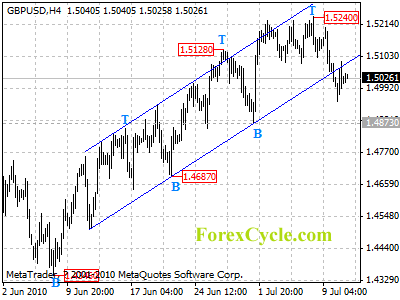
GBPUSD broke below price channel

GBPUSD broke below the rising price channel on 4-hour chart and reached as low as 1.4948 level, suggesting lengthier consolidation of uptrend from 1.4346 is underway. Rang trading between 1.4873 and 1.5240 is expected in a couple of days. As long as 1.4873 support holds, price action from 1.5240 is treated as consolidation of uptrend and one more rise towards 1.5522 (Apr 15 high) is still possible.

gbpusd

Daily Forex Forecast