| Title: | EUR/USD – Sideways Trend |
| Story: | Trend is sideways in EUR/USD currency pair. So far we have seen well stretched rally. We could get more upside in EUR/USD currency pair. Cluster of resistance levels starting from 1.3123 to 1.3171 which provides good area to short the rallies in EUR/USD currency pair. A break below 1.2949 support will start the down trend in EUR/USD currency pair. |
 Read Full Elliott Wave Forecast – Click Here…. | |
Forex Market Review: Daily Forex Analysis 2010-08-02
Forex Market Review by Finexo.com
On Friday, the U.S Dollar tumbled against the majority of its currency counterparts as a government report showed that U.S. economic growth slowed in the second quarter. According the Department of Commerce, the U.S. economy grew 2.4% in the second quarter after a revised 3.7% increase in the first three months of the year. Unfortunately for the U.S, this disappointing report was just one of many in a long string of weaker-than-expected figures for July. The news  pushed the U.S. dollar to drop to an 8-month low against the Yen and a 6-month low against the Swiss Franc.
Up ahead this week, trading is expected to be dominated by interest rate announcements from the central banks of Europe, Britain and Australia. Moreover, all eyes will be on Friday’s Non-Farm Payroll. Investors continue sell the Dollar, as the string of the souring US economic reports have made market participants distrustful of the greenback’s “safe haven” status.
EUR/USD
The Euro rallied against the dollar, in its first monthly advance since November, as concerns began to ease that the single currency region’s debt crisis will worsen and spread to the global economy. The Euro rose 6.7% to $1.3052 on Friday, from $1.2238 on June 30. Moreover, the 16-nation currency has rallied over 10% from its four-year low of $1.1877 on June 7. According to analysts, the Euro’s recent turnaround is due to the surprisingly strong European data and the recent weak U.S figures.
Up ahead, this week there are several key European announcements, including that the minimum bid rate, published on Thursday. While, the ECB is expected to continue to hold the key rate at 1.0%, forex traders are advised to listen to ECB president Trichet’s speech. At last month’s meeting, Trichet’s credibility received a boost when he laid out the positive news occurring in the EU economy and how the central bank is working to prevent further financial problems. However, this time around expectations are higher and if the ECB and Trichet sound too conservative, the Euro’s recent rally could come to a screeching halt.
USD/CAD
The Canadian Dollar appreciated against its U.S. counterpart in July, its first monthly gain since April, as rises in equities and commodities boosted the appeal of currencies tied to growth. The Canadian currency was up against the U.S Dollar, after a report showed that despite slowing economic growth in both nations, the Bank of Canada will continue to raise the its key overnight lending rate. On Friday, Stats Canada reported that the nation’s growth edged up in May by 0.1%, in line with market expectations, after unexpectedly stalling in April.
Forex Market Review & Analysis by Finexo.com
Disclaimer: Trading the foreign exchange (Forex) carries a high level of risk, and may not be suitable for all investors.
Forex News: USD at 3-Month Low
By ForexYard – The US dollar has been pushed bearish by concerns over the US economy following a series of recent economic data, undershot market expectations. Meanwhile, European numbers and many company results have been stronger — keeping investors buying riskier assets.
The dollar-index hit a 3-month low today, hurt by concerns that the American economy’s recovery is losing momentum, while the high-yielding Australian dollar (AUD) reached a 3-month high, lifted by a rise in Asian equities this morning.
The perceived better-risk-sentiment outside of the United States was unlikely to be maintained if the world’s biggest economy continues to underperform. If today’s release of American ISM Manufacturing PMI and Prices comes in below expectations, we should expect a continuation of this counter-dollar trading behavior, pushing the EUR/USD upwards in the direction of 1.3110.
Forex Market Analysis provided by Forex Yard.
© 2006 by FxYard Ltd
Disclaimer: Trading Foreign Exchange carries a high level of risk and may not be suitable for all investors. There is a possibility that you could sustain a loss of all of your investment and therefore you should not invest money that you cannot afford to lose. You should be aware of all the risks associated with Foreign Exchange trading.
Riskier Currencies on Top Following Market Opening
Source: ForexYard
Riskier currencies like the EUR and U.K. pound made significant gains against both the Yen and U.S. Dollar in overnight trading, as the markets prepare for a heavy trading week. Traders will want to pay attention to a number of news events today, and should keep in mind that the all-important U.S. Non-Farm Employment Change is set to be released on Friday.
Economic News
USD – Dollar Remains Low vs. European Currencies
While the USD has halted its most recent slide against the Yen, it is still tumbling against both the British Pound and EUR. Since the market opened for the week, EUR/USD has gone up some 30 pips, and is currently trading around the 1.3080 level. Analysts attribute the Dollar’s losses to a continuous stream of negative U.S. news events. That trend seems likely to persist, as we take a look at some of the economic indicators likely to impact Dollar pairs today.
The U.S. ISM Manufacturing PMI, set to be released at 14:00 GMT today, is forecasted to show a drop in the expansion of the manufacturing industry from last month. While the PMI is still expected to show industry growth, a drop from last month will likely negatively impact investor confidence in the U.S. economic recovery. Should the report come in at its predicted figure of 54.2, the Dollar may see further losses.
Shortly after the PMI figure is set to be released, Fed Chairman Bernanke is scheduled to give a speech regarding the challenges facing the U.S. economy. While no major announcements are forecasted, even the slightest indication about where the economy is heading could create heavy volatility for Dollar pairs. Traders will want to pay close attention to the speech. Should the Fed Chairman give a positive economic assessment, the Dollar may be able to recoup some its most recent losses.
EUR – Euro Looks to Prolong Gains against the Dollar
As markets opened for the week, the EUR shot up against the safe haven Dollar and Yen, while taking steep losses against the Aussie. EUR/USD and EUR/JPY are up 30 and 40 pips respectively since markets opened. EUR/AUD on the other hand, is down about 50 pips in the same amount of time.
Analysts are quick to point out that the EUR gains have more to do with the troubles in the U.S. economy, and less to do with any positive European economic indicators. What this means for traders, is that any gains the EUR has made on the Dollar or Yen are tentative at best. With a busy trading week just getting started, any economic indicator that could come in above or below expectations could cause volatility for the EUR.
Today, EUR traders will want to pay attention to the manufacturing PMI’s from both the U.K. and U.S. Both PMI’s are forecasted to show expansion in their respective manufacturing industries. If the reports come in as predicted, the EUR may be able to extend its recent gains as investor confidence is likely to be boosted. At the same time, an unexpected drop in either PMI figure could lead to a wave of risk aversion, and may boost the Dollar.
JPY – Yen Erases Most of Last Week’s Gains
Starting off the week, the Yen gave up most of its recent gains as riskier currencies have begun to assert themselves in the marketplace. The U.K. Pound has moved up close to 50 pips against the Yen since markets opened, while AUD/JPY had gone up over 60 pips before staging a slight correction. USD/JPY has been trading at a relatively steady rate since late last week, and will likely continue to do so as long as risk taking dominates the market place.
Today, Yen traders will want to pay attention to both the U.S. ISM Manufacturing PMI, as well as Fed Chairman Bernanke’s speech. While neither of these indicators directly affects the Japanese economy, their results will heavily influence the status of safe haven currencies like the Yen.
Crude Oil – Oil Prices Continue to Move Up
The weak Dollar has prompted more investment in Crude Oil, leading to steadily increasing prices for the commodity over the last few days. Currently, crude is trading around the 79.20 level, up from around 77.10 on Friday. As the Dollar continues to fall against many of its main currency rivals, traders can expect oil prices to rise.
Today, Crude prices will largely be determined by the Fed Chairman’s speech, scheduled to be given at 14:15 GMT. Should the speech paint an optimistic picture of the U.S. economy, oil prices may drop if investors decide turn back towards the Dollar. On the other hand, if the Fed chairman decides to highlight the continued challenges facing the U.S. economic recovery, oil will likely increase its gains in the marketplace.
Technical News
EUR/USD
Friday’s trading left the pair in a doji candlestick pattern highlighting traders’ inability to push the pair higher. However, the bears were also contained by a short term trend line that began on July 1st. A rising wedge pattern has formed on the hourly chart. Traders may want to target the upper line of the wedge near the price of 1.3120.
GBP/USD
The currency continues to move higher and is showing signs of a pair that is trending higher. The ADX (14) reads 45, indicating a pair that is in a trending phase. Also the 20-day moving average line is sloping up, indicating that the trend is higher. Traders should be long on the pair with a first target the 1.5820 resistance level on the daily chart.
USD/JPY
The pair is also trading in a strong trending environment, supported by a perfect order. The currency is trading below the 200-day simple moving average (SMA), followed by the 100 SMA, 50 SMA, 20 SMA, and 10 SMA in that order. As such, traders should be shorting the pair. Since a breakout of the bearish flag pattern, the pair breached below the support level of 86.25 and fell to a low of 85.93, but traders were unable to make a close below the support level. The next support for the pair comes in at the November 2009 low at 84.90. This should serve as the next target for traders
USD/CHF
While the pair has been range trading for quite some time now, some upward movement may be expected today. A bullish cross is evident on the hourly chart’s Slow Stochastic while the RSI for the pair is floating in the oversold territory on the 4 hour and 8 hour charts. Furthermore the MACD for the pair is the lower range on the 2 and 4 hour charts. Going long with tight stops may be advised for the day.
The Wild Card
AUD/NZD
After a steep rise over the past few days, the pair may be seeing some downward correction during today’s trading. The RSI for the pair is floating in the overbought territory on the 4 hour, 8 hour and daily charts while a bearish cross is evident on the daily chart’s Slow Stochastic. Furthermore, a breach of the upper Bollinger Band is evident on the daily chart, indicating an imminent downward movement. Forex traders may be advised to go short for the day.
Forex Market Analysis provided by Forex Yard.
© 2006 by FxYard Ltd
Disclaimer: Trading Foreign Exchange carries a high level of risk and may not be suitable for all investors. There is a possibility that you could sustain a loss of all of your investment and therefore you should not invest money that you cannot afford to lose. You should be aware of all the risks associated with Foreign Exchange trading.
Forex Daily Market Review Aug 2, 2010
By eToro – The week capped of a powerful performance for equity markets. Strong earnings drove the S&P 500 Index up approximately 6.7% for July, while the NASDAQ index increased more than 7%. For the week, the S&P 500 declined by approximately 1 point, as investors digested a plethora of economic data points.
Click here for the full review
Forex Market Analysis provided by eToro
Disclaimer: Trading in the Foreign Exchange market might carry potential rewards, but also potential risks. You must be aware of the risks and are willing to accept them in order to trade in the foreign exchange market. Don’t trade with money you can’t afford to lose.
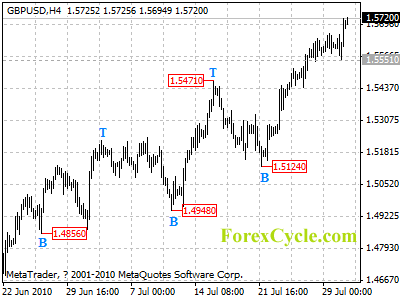
GBPUSD continues its upward movement from 1.5124
GBPUSD continues its upward movement from 1.5124 and the rise extends to as high as 1.5726 level. Key support is at 1.5551, as long as this level holds, further rise to 1.5800-1.5900 to reach next cycle top on 4-hour chart is still possible. On the other side, a breakdown below 1.5551 support will indicate that a cycle top has been formed, then pullback to 1.5400-1.5500 area could be seen.
Technical Analysis Basic Charting Techniques
By Sylvain Vervoort – Technical analysis starts with the graphical representation of stock prices in a chart. Although there are many chart types, the ones used most often are the line chart, the bar chart and the candle chart which is the preferred one because it provides the most information.
A line chart is not used that much anymore. It was the basic chart used prior to the advent of the personal computer. Stock price data was registered manually, and only closing prices were registered. The line chart was created connecting the closing prices.
For a bar chart, the highest and the lowest prices in a given period (minutes, hours, days, weeks, or months) are connected with a vertical bar. The opening price is represented by a tick mark at the left side; the closing price is represented by the tick mark at the right side. The bottom and the top of the vertical bar represent the lowest and highest prices of the period, respectively. The bar chart is used mostly in Western technical analysis.
The candle chart has its roots in the Far East. Steve Nison introduced the candle chart to the Western world in his book, Japanese Candlestick Charting Techniques (Nison, 1991).
Candle charts clearly depict price development in a trading period. The body of the candle represents the move between the opening and closing price. If the price closes above the opening price, the candle body is blank (white). If the stock price closes below the opening price, the candle body is filled (black). A candle can be either a body or a body with long or short wicks, called shadows that reach to the highest and lowest prices in the trading period. The recognition of candle-chart patterns is a study unto itself.
Looking at price moves of 100% and more it may be a good idea to use a logarithmic scaling on the vertical price axis of the chart. If you are using a division of five points on a linear scale, a price change from $20 to $40 comprises four divisions, whereas a price change from $40 to $80 comprises eight divisions. This means that the distance on the vertical axis from $40 to $80 is twice as large as the one from $20 to $40. On the other hand, a price change from $20 to $40 or from $40 to $80 equals the same 100% price increase. A price moving from $5 to $10 or from $100 to $105 is the same distance on a linear scale. Clearly, this does not provide a good visual impression of what the price movement really represents.
Moving from $5 to $10 equals a 100% price increase, but moving from $100 to $105 equals only a 5% increase. To have the same distance on the vertical scale representing equal percent changes, you can use logarithmic scaling. This means that the distance on the vertical axis from $40 to $80 is now the same as the one from $20 to $40, namely a 100% price increase. This gives a much better visual impression on charts with large price moves.
When there are large price moves, applying a linear scale can be a disadvantage. It may simply not be possible to draw a linear trend line under an up or down-moving trend. However using a logarithmic trend line probably will give you the support levels you need to see. Nevertheless, most people will use linear scaling on daily price charts, which is fine as long as the price moves within limits. More often, logarithmic scaling is applied to longer-term charts, such as weekly or monthly charts, mainly because the price moves are much more significant. The right solution is to use logarithmic price charts with logarithmic trend lines all the time.
About the Author
Interested in technical analysis? You can find a lot of learning material about basic technical analysis techniques for free at my website: http://stocata.org under the Technical Analysis Menu item. Sylvain Vervoort is a regular contributer of technical analysis articles in Stocks & Commodities magazine.
Is Trading With Technical Analysis Profitable?
By Sylvain Vervoort – What is technical analysis and is trading based on technical analysis profitable?
Lets start with my definition of what I consider is technical analysis of financial price data. Technical analysis is using graphical charts to identify buy and sell patterns every possible way. With statistics proving that using these patterns gives a better chance for successfully trading the stock market. Let’s have a look at what kind of information we are looking for on the chart.
A first basic pattern is the breaking of a trend line and is a very powerful indication that the trend is reversing. A closing price breaking a downtrend line is generally a confirmation that the last turning point is a trend reversal.
A second basic pattern for making buying or selling decisions is the breaking of a horizontal resistance level, or a price turning at the level of a horizontal support line found at price turning points.
A third possibility is making use of more complex reversal and continuation price patterns like a head and shoulders reversal pattern, a triangle, rectangle or diamond continuation pattern, and so on.
A fourth possibility is using the Eastern candlestick chart instead of the normal Western bar chart. Candlesticks show a number of bottom and top reversal patterns and some continuation patterns that can be used successfully for entering or exiting a trade. These patterns have exotic names like bullish and bearish engulfing patterns, doji, harami, hanging man, evening and morning star and much more.
A fifth possibility is counting Elliott impulse and correction waves. Ideally you can enter an up move just after the start of a medium to longer term impulse wave 3, generally after an ABC correction wave for the creation of correction wave 2. Most of the time a 3-wave has an extension with another impulse wave of a lower degree.
A sixth possibility is using oscillators and indicators looking at overbought and oversold areas and specifically at normal and hidden price/indicator divergences announcing trend reversals or previous trend continuations.
Can you imagine the decision making power you have for buying or selling a stock combining all of these techniques? Most reversals in price are announced by more of the previous mentioned techniques. But there is more than just the technical analysis.
Before we can answer the question, “is trading based on technical analysis profitable?” we have beside the use of technical analysis to define entry and exit points, the need for good money and risk management. First let’s talk about money management. Personally I prefer the method that has proven to be the most profitable with the best results in every test I made. That is using a limited fixed number of stocks where every stock gets an equal part of the capital at the start, but there is no profit or loss sharing between the stocks. It has also the big advantage that it is so much more easy to follow-up just a small number of stocks with detailed technical analysis.
Risk management makes sure that the risk-to-reward ratio is in favor of the reward. Opening a trade you must limit the risk and make sure that the first reward target is better than the risk. Future price projection techniques will give you an estimate as to where price can go. Once an open position, you must also use a trailing stop method to make sure you keep the profit and that you will close the trade if standard technical analysis fails. Future price estimates can be made using Fibonacci projections crossing pitchfork channels and a number of other techniques.
It should be clear by now that the pure technical analyst does not look for fundamental data about the stock he is trading. You could basically leave out the name and even the time period from the chart and the technical trader will still be able to do the job. Because price data moves in a fractal way you can basically trade with the same rules in any time frame, from bar charts using minutes, hours, days or weeks.
So, the big question again, is trading based on technical analysis techniques profitable? YES it is! The easiest way for me to prove this is using an automatic trading system based on technical analysis to buy and sell. The SATS2 auto-trading-system I am using is now about 2 years old, does not use any optimizing and is still giving good results over the last 7 months before today’s date of October 27, 2009. Since the start of the test period on March 13, 2009 and closing on October 23, 2009, or about 7 months, it generates a profit of 156% using my own 38 US stocks selection that I am following-up closely.
Since this is an automated system, it has its limitations and is certainly not as intelligent as you can be, looking at the chart yourself. It is clear that making manual buy and sell decisions should still give an even much better result. But I just wanted to make my point here that trading based on technical analysis is profitable.
In this article I tried to answer the question of what is technical analysis and is trading based on technical analysis profitable. I hope I have convinced you that yes it can be very profitable.
About the Author
Want to learn everything about technical analysis? You can find free articles at my website: http://stocata.org/. Sylvain Vervoort is a trader and the author of a new book “Capturing Profit with Technical Analysis” and a regular contributor to Stocks & Commodities magazine.
New Bull Market for Uranium Ahead?
New Bull Market for Uranium Ahead?
By Justice Litle, Editorial Director, Taipan Publishing Group
Uranium soared from $10 a pound in 2000 to a stunning $136 a pound in 2007 – and then the bottom fell out. After three lean years, could another bull market be ahead?
According to the Ux Consulting Company, which tracks the price of uranium, the July 26 weekly spot price for U308 was $46 per pound. That is a 15% spike from the February lows around $40 per pound.
So does uranium at $46 per pound count as cheap, or expensive? That depends on how you look at it…
In the year 2000, uranium was well and truly dirt cheap. Thanks to a seemingly endless supply from decommissioned nuclear stockpiles, no one wanted the stuff… and the price of U308 (a standard mix of uranium oxides) fell to just $10 per pound.
Seven years on, however, uranium was at the pinnacle of a stunning bull run, riding a wave of increased demand for nuclear power plants around the globe. By the year 2007, U308 had hit an incredible $136 per pound – more than a 1,200% price increase from the bear market lows.
But then the bottom fell out for uranium prices – again – as hard assets got abandoned in the great financial meltdown. So now, in the mid-$40s, the uranium spot price is well off its year-2000 lows, but merely a third of bull market highs. Does that make it cheap?
China seems to think so…
Do You Know What Commodity You Should Be Buying INSTEAD of Gold?
I know it might sound crazy, but there’s another commodity out there even better than gold. It’s not oil, silver or platinum.
In fact, you’ve probably never thought about buying a single ounce of this… But if the market collapses, it could be even more valuable to you than gold.
Follow this link to find out what commodity is better than gold.
The Dragon Inhales
“China is buying unprecedented amounts of uranium,” Bloomberg reports, “signaling that prices are poised to rebound after three years of declines. The nation may purchase about 5,000 metric tons this year, more than twice as much as it consumes, building stockpiles for new reactors…”
Keep in mind, too, that China is buying at the “long-term price,” which is higher than the spot price. A few weeks back, the dragon agreed to lock in uranium purchases of “more than 10,000 tons over 10 years” from blue chip miner Cameco (CCJ:NYSE).
“China’s demand is insatiable,” says analyst Dave Dai in Hong Kong. “They will have to take almost whatever is available.”
India is hungry too. Jagdeep Ghai, the finance director for Nuclear Power Corp., reports that India’s uranium needs could grow tenfold in the coming years.
The name of the game now is locking in supply. In a world where the flow of oil is uncertain – and emerging market energy demand is certain to surge – nuclear power is a critical fallback. And that means more nuclear reactors in the works.
According to the World Nuclear Association (WNA) , China alone has 24 reactors under construction – and may have 200 reactors in play by the year 2030. Russia is building another 10… South Korea six… and India four. There are also new reactors under construction in places like Finland, France, Japan, Argentina, and even the United States.
(If you would like to read more of my investment commentary on other topics, sign up for Taipan Daily.)
A Unique Market
Uranium is not like most other commodities. As one might expect, the “nuclear” tie-in makes it a highly regulated market. Not anyone can just buy it or sell it. (Although there is a uranium “ETF” of sorts – Uranium Participation Corp (U:TSE) – trading on the Toronto Stock Exchange.)
The supply profile for uranium is also unique. In the short run, there appears to be plenty of uranium to go around. The long run, though, is another question entirely. With all the new reactors slated for construction – and the price of oil a wildcard – forward-thinking players like China are thus happy to start stockpiling uranium more aggressively here and now, “just in case” demand gets out of hand later. Nor is China the only country to be thinking this way.
Another factor unique to the uranium market is what one might call the “Cold War effect.” The reason uranium became absurdly cheap a decade or so ago was because of massive Cold War era stockpiles. For a time the world had uranium coming out of its ears as Soviet-era warheads were scrapped. Even today there is still Cold War supply to work through – but that supply will not always be there.
In fact, were all the Cold War uranium to be used up tomorrow, prices would head into the stratosphere. Current uranium demand outstrips new production by a huge margin – something on the order of 100 million pounds per year – and it’s only the dwindling stockpiles (those old warheads again) that make up the shortfall.
In addition to finite Cold War supply, uranium has its own version of the “peak oil” profile. Virtually all the cheap and easy uranium deposits have been tapped. As with crude, what’s left are the hard and dangerous deposits located in politically unstable parts of the world, like Kazakhstan and Niger. This is another factor that could push uranium prices higher.
The Large-Scale Alternative
When disaster unfolded in the Gulf, we wrote that the BP oil spill would be a game changer for alternative energy. That assessment still holds true. But it may prove out that the biggest “alternative” winner of all, in respect to deepwater drilling fallout, is nuclear energy.
The main trouble with wind power, solar power and the like, is the challenge of large-scale deployment. With each passing day the underlying technology improves – which moves us closer to getting the economics right – but there is still a long way to go.
Ready for the Financial Thrill Ride of Your Life?
At this moment, a hot niche market is cranking out stunning returns of 7,100%… 12,300%… even 13,900% in a single day.
Find out how you can get your share of this profitable financial market.
Nuclear power, in contrast, is already tested and proven. It has already been deployed on a massive scale. Take modern-day France, for example, a country known for (among other things) bucolic landscapes and old-world farming techniques. Roughly 79% of France’s electricity is produced by nuclear power, the highest percentage in the world.
Nuclear energy has more or less been embraced as a vital, large-scale alternative to fossil fuels. Even aggressive green advocates, who have grumbled over safety and waste disposal issues with nuclear in the past, now grudgingly admit that nuclear power has clear advantages in reducing air pollution and C02 emissions (both serious problems in China).
Combine this reality with good prospects for oil back above $100 per barrel before too long, and you have political “safe passage” for the upcoming nuclear renaissance. Put it all together, and it’s not hard to accept the assessment of RBC Capital Markets that uranium could rise another 32% in price next year. That makes a number of companies in the mining and reactor space worth exploring.
Don’t forget to follow us on Facebook and Twitter for the latest in financial market news, investment commentary and exclusive special promotions.
About the Author:
Justice Litle is the Editorial Director of Taipan Publishing Group, Editor of Justice Litle’s Macro Trader and Managing Editor to the free investing and trading e-letter Taipan Daily. Justice began his career by pursuing a Ph.D. in literature and philosophy at Oxford University in England, and continued his education at Pulacki University in Olomouc, Czech Republic, and Macquarie University in Sydney, Australia.
Stock Trading: We analyze Akamai Technologies AKAM
By Adam Hewison
This stock looks lower based on a classical technical pattern
This is the first time I have looked at this particular stock and it appears to chart beautifully. The stock I am referring to and analyzing today is Akamai Technologies Inc. The symbol for this stock is AKAM and it is traded on the NASDAQ.
In this short video I share with you a classic chart pattern that I’ve seen thousands of times before in different markets. The pattern is very reliable and seems to work well most of the time. Some people believe in this type of technical analysis, however, some folks feel that it may as well be voodoo.
For myself, I believe that history and markets repeat themselves based on human nature, which has not changed in thousands of years.
All the best,
Adam Hewison
President of INO.com
Co-founder of MarketClub
To see more of Adam’s Videos click here or sign up for Adam’s Free 10-part Professional Trading Course.
