Euro Continues to Rise Over the Greenback – August 3, 2010

EURUSD august 3, EUR, USD, US dollar, euro, fx, forex, forex trading, forex market, trading forex, dialy forex picks, daily fx picks, forex forecast, forex analysis

Good day FX maniacs! Here’s an update on the fiber or the EURUSD pair. As you can see, the pair has managed to bounce off the 1.3000 support and the uptrend line which I noted in my previous post (kindly see it here) to mark a new 3-month high. You see, the pair has been rising since it bottomed out back in June 7. And in the process of doing so, it also broke out from a inverted head and shoulders and escaped from its downtrend line, placing it back on the bullish track. If you look at its present chart, you will see that it has recently achieved its minimum upside target (gauged by projecting the height of the pattern from the point of breakout) which I mentioned way back when it had just broken out from the inverted head and shoulders. Still, the pair could be up for a retracement soon. For one, there is a resistance around 1.3270. Moreover, the stochastics is already indicating that conditions are overbought. In case it weakens, it could fall back down to 1.3000 or 1.2750. On the positive side, a break above 1.3270 could propel it higher towards 1.3750.

Fundamentally, the 1.99% jump in the Dow Jones Industrial Average (DJIA) yesterday led investors to dump the US dollar in favor of the higher yielding assets which consequently pushed the anti-dollar currencies like the EUR higher. Corporations in the US like the Coca Cola Company and Chevron topped the market’s second quarter earnings forecast, lifting the confidence of the general investors and the market as a whole. A bunch of second and third tier US forms are scheduled to release their financials this week. Now if most of them post some handsome profits for the same period again, then the equities markets together with the non-dollar currencies could still rise. Missed profits, on the other hand, coupled with some profit taking actions could, however, temporarily push the equities and the likes of the euro down.

More on LaidTrades.com

End of the Euro’s Rally Versus the Swissy? – August 2, 2010

EURCHF, EUR, CHF, EUR/CHF, euro, swiss franc, swissy, fx, forex, forex market, forex trading, currency trading, online trading, daily forex picks, daily fx picks, forex forecast, forex analysis

Hiyo FX men and women! Welcome to another week and month of forex trading! On today’s canvas is the daily chart of the EURCHF pair. As you can see, the euro has rallied against the Swiss franc after it hit a new historical low at on July 1. Notice that the pair has since traded within a rising channel. However, it appears that it has met some resistance at the 1.3800 market and at the 50% Fibonacci retracement line the I drew. If the pair falls below the support of the rising channel, it could once again revisit its historical low. But if the euro buying continues and the pair clears 1.3800, the 1.4000 price could be its next target. Though with the stochastics in the overbought region, I would be very cautious in buying the pair at this point. But that’s just me.

Well, the rally in the euro was pretty much fueled by a combination of profit taking on short euro positions, good economic data from the euro zone, and better-than-expected second quarter earnings of firms in the US and Europe. But with the lack of positive catalyst coming from the euro zone this week, the euro’s run could be cut short. Switzerland, on the other hand, will publish its year-over-year retail sales figure for the month of June today at 7:15 am GMT. Switzerland’s sales are seen to have grown by another 4.1% which is better than the 3.8% gain that it had during the previous month. Such growth or better would reflect positive on the Swiss economy and the Swissy.

Let’s see how it goes. Stay tuned!

More on LaidTrades.com

GBP/USD Currently Overvalued

By Anton Eljwizat – The GBP/USD has recorded much bullish behavior in the past several days. However, the technical data indicates that this trend may reverse anytime soon. For example, as I demonstrate below, the 8 hour chart signals that a bearish reversal is imminent, and it might have the potential of reaching towards 1.5700 in the coming days. This might be a good opportunity for forex traders to enter the trend at a very early stage and a great entry price.

• Below is the 8-hour chart of the GBP/USD currency pair.

• The technical indicators that are used are the Slow Stochastic and Relative Strength Index (RSI).

• Point 1: There is a “doji” candlestick formed in the chart, indicating that a reversal should take place.

• Point 2: The Slow Stochastic indicates a bearish cross, signaling that the next move may be in a downward direction.

• Point 3: The Relative Strength Index (RSI) indicates that the price of this cross currently floats in the overbought territory, signaling downward pressure.

GBP/USD 8-Hour Chart

Forex Market Analysis provided by Forex Yard.

© 2006 by FxYard Ltd

Disclaimer: Trading Foreign Exchange carries a high level of risk and may not be suitable for all investors. There is a possibility that you could sustain a loss of all of your investment and therefore you should not invest money that you cannot afford to lose. You should be aware of all the risks associated with Foreign Exchange trading.

Will the US Dollar Continue its Decline?

Source: Forex Yard

Yesterday’s trading was characterized with high optimism regarding global recovery. This optimism has boosted the European currencies, such as the euro and the pound, and weakened the relatively safer currencies – the US dollar and Japanese yen. As long as the leading economies continue to provide positive data, this trend has potential to remain. Today’s publications, especially from the US, are likely to determine whether the trend can continue today as well.

Economic News

USD – US Dollar Tumbles as Risk Appetite Rises

The US dollar fell against most of the major currencies during yesterday’s trading session. The greenback dropped about 120 pips against the euro and about 150 pips vs. the British pound. The EUR/USD pair is now trading near the 1.3180 level.

The dollar fell yesterday after a better-than-expected result was published about the US Manufacturing Purchasing Managers’ Index (PMI) report. The survey showed that manufacturing in the US expended to 55.5 in July, beating expectations for a reading of 54.2 points.

This has provided another signal that the US economy continues to recover and that global recovery may follow. As a result, investors turned to riskier assets such as the euro and the pound. For now it seems that positive data from the US is likely to depreciate the dollar, as it is interpreted as an indication for global recovery, and thus boosts risk appetite in the market.

As for today, a batch of data is expected from the US economy. The publication that looks to have the largest impact on the market is the Pending Home Sales figure. This report measures the change in the number of homes under contract to be sold that are awaiting the closing transaction. Analysts have forecast a 0.5% rise in July. If the end result will provide a positive figure, the greenback may weaken further. Traders are also advised to follow the Personal Spending and the Factory Orders publications.

EUR – Euro Traded Near 3-Month High against Dollar

The euro soared against most of the major currencies on Monday, gaining about 120 pips vs. the US dollar. The EUR/USD pair is trading near a 3-month high as a result. The euro gained about 100 pips against the Japanese yen as well.

The euro strengthened yesterday as positive signs regarding global recovery has boosted demand for riskier assets. The euro rose as global equity markets continued to advance.

In general, the recent positive data from the major economies such as the US, Japan and the European nations, is boosting optimism for global recovery. As a result, investors are looking for relatively riskier assets, such as the euro and the British pound. Both of these currencies rose significantly yesterday, and are likely to rise further as long as risk appetite remains strong in the market.

Looking ahead to today, many interesting economic publications are expected from the euro zone. Traders are advised to follow the European Producer Price Index (PPI) report. This PPI figure measures the change in the price of finished goods and services sold by producers. Analysts have forecasted that the indicator has risen by 0.4% in July. Such a result is likely to have a positive impact on the euro by further boosting risk appetite.

JPY – Yen Drops against Majors as Risk Aversion Decreases

The Japanese yen fell against most of the major currencies during yesterday’s trading session. The JPY fell to nearly an 11-month low vs. the euro and also dropped about 150 pips against the British pound.

The yen dropped against most of the major currencies following a report that measures the cost of insuring against losses in the Standard & Poor’s 500 Index fell to its lowest level since May. In addition, the recent positive data from the US and euro zone have boosted risk appetite in the market, and turned investors to look for riskier assets, such as the euro and the pound.

While the Yen is considered to be a relatively safe investment, in times of market optimism, the Japanese currency tends to weaken against the major currencies.

As for today, traders are advised to follow the Japanese equity markets. Traders should notice that the yen tends to drop while Japanese equities rises, as such rises usually indicate that the economy is recovering, and boosts demand for riskier assets as a result.

Crude Oil – Crude Oil Reaches $81.70 a Barrel

A barrel of crude oil was traded at $81.70 during yesterday’s trading. Crude oil breached the $80.00 level for the first time in 3 months, following a 300 pips gain on Monday.

Crude oil soared yesterday as expectations for an economic recovery have boosted global equities. Oil rose for the third day following a better-than-expected release of the US Manufacturing Purchasing Managers’ Index (PMI) survey. The survey reached 55.5 points, beating expectations for a reading of 54.2. In addition, companies such as HSBC Holdings Plc have reported higher than expected earnings.

The world-wide positive data creates speculations that global demand for energy will increase, and as a result boosts crude oil prices. It seems that for as long that the US and euro zone will continue to deliver positive data, crude oil might rise further as the dollar weakens.

Looking ahead to today, traders are advised to follow the leading publications from the US and the euro zone as these tend to have the largest impact on crude oil prices. Special attention should be given to the US Pending Home Sales report, which seems to be today’s leading publication. A positive figure is likely to support crude oil prices further.

Technical News

EUR/USD

The pair has recorded much bullish behavior in the past several days. However, the technical data indicates that this trend may reverse anytime soon. For example, the daily chart’s Stochastic (slow) signals that a bearish reversal is imminent. A downward trend today is also supported by the 4-hour chart’s Stochastic (slow) indicator. Going short with tight stops may pay off today.

GBP/USD

The price of this pair appears to be floating in the over-bought territory on the daily chart’s RSI, indicating a downward correction may be imminent. The downward direction on the 4-hour chart’s Momentum oscillator also supports this notion. When the downward breach occurs, going short with tight stops appears to be the preferable strategy.

USD/JPY

The pair has been range-trading for a while now, with no specific direction. The daily chart’s Stochastic (slow) is providing us with mixed signals. All oscillators on the 4-hour chart do not provide a clear direction either. Waiting for a clearer sign on the hourlies might be a good strategy today.

USD/CHF

The 4-hour chart is showing mixed signals with its RSI fluctuating in neutral territory. However, there is a fresh bullish cross forming on the daily chart’s Stochastic (slow) indicating a bullish correction might take place in the nearest future. Going long might be a wise choice today.

The Wild Card

Crude Oil

Crude Oil prices rose significantly yesterday and peaked at $81.70 a barrel. However, the 8-hour chart’s RSI is floating in the over-bought territory suggesting that the recent upward trend is losing steam and a bearish correction may be impending. This might be a good opportunity for forex traders to enter the correction at a very early stage.

Forex Market Analysis provided by Forex Yard.

© 2006 by FxYard Ltd

Disclaimer: Trading Foreign Exchange carries a high level of risk and may not be suitable for all investors. There is a possibility that you could sustain a loss of all of your investment and therefore you should not invest money that you cannot afford to lose. You should be aware of all the risks associated with Foreign Exchange trading.

Forex Market Review: Daily Forex Analysis 2010-08-03

Forex Market Review & Analysis by Finexo.com

EUR/USD

The Euro eased slipped from a 3-month high against the Dollar this morning, as concerns eased over the strength of the U.S. economic recovery.  Yesterday, Federal Reserve Chairman Ben S. Bernanke stated that the economy “is now expanding at a moderate pace.” The Fed Chairman went on to say, at the Southern Legislative Conference, that while the U.S. has “a considerable way to go” for a full recovery, “rising demand from households and businesses should help sustain growth” and that rising wages will most likely propel household spending in the next few quarters. The single European fell to $1.3149 during the late Asian session, a daily low.

Up ahead today, the U.S National Association of Realtors will release the number pending home sales. Last month, the number plunged by 30%, after a government homebuyer tax credit expired. This time around, a correction is expected – which could provide a boost to the weakened Dollar.

AUD/USD

The Australian Dollar fell against all its major currency counterparts after the Australian central bank opted to hold interest rates steady for a third consecutive month. RBA Governor Glenn Stevens held the overnight cash rate at 4.5%, in line with market expectations, after slower inflation and reduced financial risks abroad left the central bank with little need to further tighten its monetary policy. Following the announcement, the Aussie slipped to $0.9112, down 0.1% from the day’s opening price, but up from $0.9095 before the decision. Two government reports, released before the rate announcement, showed that building approvals unexpectedly fell in June and retail sales rose less than predicted.

Forex Market Review & Analysis by Finexo.com

Disclaimer: Trading the foreign exchange (Forex) carries a high level of risk, and may not be suitable for all investors.

Forex Daily Market Review Aug 3, 2010

By eToro – A solid European PMI, combined with strong US economic numbers pushed the Euro above 1.3150, above 1.3090 resistance.  The Euro is likely to test the 1.3300. Click here to read the full daily Review

Forex Market Analysis provided by eToro

Disclaimer: Trading in the Foreign Exchange market might carry potential rewards, but also potential risks. You must be aware of the risks and are willing to accept them in order to trade in the foreign exchange market. Don’t trade with money you can’t afford to lose.

EURUSD runs in a price channel

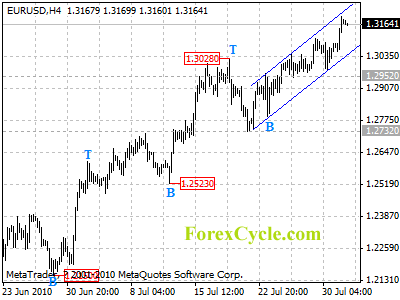
EURUSD runs in a price channel on 4-hour chart. Support is now at the lower border of the channel, now at 1.3045, as long as the channel support holds, uptrend from 1.2732 is expected to continue and next target would be at 1.3350 area. Only a clear break below the channel support could indicate that a cycle top is being formed, and the uptrend from 1.2732 is complete, then pullback to 1.3000 area could be seen.

eurusd

Daily Forex Signals

GOLD, a store of wealth

King Midas and the Golden Touch

King Midas wished everything he touched would turn to gold but after Dionysus granted him his wish, Midas soon saw the foolishness of his wish and asked Dionysus to release him the curse. To do so, Dionysus had Midas wash in the Pactolus River (in modern day Turkey). This is the mythological source of the real gold present in the river

Gold has been the subject of many myths and legends throughout history and it is clear that it has always been considered very valuable. Historically gold was often used as a currency and when paper money was introduced it was regarded as a receipt convertible to fixed quantities of gold. In the monetary system known as the Gold Standard, the value of gold was used as a standard for many currencies. In 1934 a troy ounce of gold was valued at $35 US. At this rate, foreign governments and central banks were able to exchange dollars for gold. Bretton Woods established this system of payments based on the dollar, in which all currencies were to be defined in relation to the dollar, itself convertible into gold. The U.S. currency was now effectively the world currency, the standard to which every other currency was pegged. The gold standard was abandoned in the 1970s and gold was left to find its own free market level. Nowadays banks still hold gold reserves as a store of value but currencies no longer need to be backed by gold.

Gold is no longer used as currency and is now classified as a commodity. A commodity is generally defined as a good which is the same regardless of who produces it . Thus oil, gold, wheat are commodities whereas stereos are not. However. gold is not being priced as a commodity, people will pay a lot more for Gold than its commodity value.

WHY BUY GOLD?

Since 2001 Gold has tripled in value versus the USD. but gold is not defined as a currency. It is not classified as an energy resource, or a foodstuff. It does look good as jewelry and in assorted ornaments and generally everyone agrees that it is valuable. Yet with traders so willingly investing such huge amounts of money in Gold, what are they buying exactly?

Gold is not consumed like petrol or foodstuff. It is not “useful” like aluminum and copper. It is estimated that in the history of mankind about 161,000 tonnes of gold have been mined just enough to fill 2 olympic- sized swimming pools. For the past 30 years the rate of growth of gold extractions from mines has matched the rate of the world’s population (roughly 2000 tonnes/year). Gold quantities remain constant because gold is not truly “consumed” . It simply gets recycled again and again because it has always been too valuable.

What are the investors buying exactly?

Like any other commodity the price of gold is determined in large part by supply and demand. However the demand for Gold is not the same as the demand for oil and copper. The increase in the demand for Gold invariably indicates that the more conventional types of investments are not producing the kind of returns needed to protect the wealth of investors. Investors do expect a certain after tax return on their investments, and if it cannot be obtained in one type of investment they will seek it in another. The idea being always that once inflation and taxes are factored into the equation, an investor must see a positive return on his investment otherwise he would see his assets and purchasing power steadily diminishing in value and that is,of course, untenable in the long run.

Gold as a “store of wealth”

While it is true that inflation, the stock market and foreign exchange rates affect the price of Gold, this is true in a certain given investment context. One has to refrain from being too literal in this interpretation. Hence just because the cost of automobiles has quadrupled in the past 30 years it does not mean that the price of gold must also quadruple to offer a hedge against inflation.

The demand for gold is a demand for a hedging instrument against inflation and the collapse in value of other types of investments. Gold fulfills this unique function by allowing investors to invest in an instrument that protects their wealth and purchasing power. The increase in the price of Gold is not haphazard. It is not simply a case of gold “fever” or speculation that drives up the price of gold. Gold plays a unique role in protecting the investors’ capital against devaluation and as such its price will increase in the amount needed to preserve an investor’s purchasing power

CONTROLLED EUPHORIA

The price of gold can increase and increase a lot, however it is always in a controlled fashion. if that were not the case then gold would not play the role it plays in the preservation of investors’ purchasing power. Because gold is a hedge against inflation and the loss in value of other assets, the price of gold must move in a direction opposite that of other assets. Because gold is there to preserve the value of investors capital when other investments classes are losing value, its price has to vary inversely to that of the main types of financial assets.

The required yield theory states that the after tax return earnings on investments must be viewed as minimum return equal to the GBP/capita long term growth rate plus expected inflation rate.The 1.5% constant turns out to be the long-run average real GDP/capita growth rate in major developed economies. In the US the historical long-term average GDP/capita growth has been 2.03% from 1929-2006. (see http://papers.ssrn.com/sol3/papers.cfm?abstract_id=520382)

Now a decrease in the stock market alone is not sufficient to drive investors to invest in gold. However a decrease in stock market earnings combined with high inflation and taxes would certainly incite investors’ to consider investing into gold. The increase in the price of gold is imminent only if the combination of high inflation and taxes and a decrease in earnings from the other main investment types are present. Gold increases in price only to the extent that its function is to preserve the wealth and purchasing power of investors, and anything else would defeat its purpose. The exception to this rule occurs in the case of war and when some countries default on their payments, However the effect there is merely temporary.

About the Author

Article courtesy of The Parrotster Forex & Currency Trading

USD/JPY Technical Analysis

By Russell Glaser – The USD/JPY illustrates a pair that is trading in a trending environment and is testing new lows following a breakout move last week.

As shown on the daily chart below, the USD/JPY is trading in a perfect order. Prices are not only trading below the major simple moving averages (SMA), but the SMAs are currently aligned in an order by their respective timeframe from longest to shortest. The 200-day simple SMA is on top, followed by the 100 SMA, 50 SMA, 20 SMA, and 10 SMA in that order. As such, this identifies a strong trending environment.

Forex Market Analysis provided by Forex Yard.

© 2006 by FxYard Ltd

Disclaimer: Trading Foreign Exchange carries a high level of risk and may not be suitable for all investors. There is a possibility that you could sustain a loss of all of your investment and therefore you should not invest money that you cannot afford to lose. You should be aware of all the risks associated with Foreign Exchange trading.