| Title: | EUR/USD – Down Trend |
| Story: | Trend is currently bearish and we have a clear break below previous low (1.3115). Now, I expect more decline in EUR/USD currency pair. I am also expecting a medium term top in EUR/USD daily time frame as well. |
 | |
| Read Full Elliott Wave Forecast – Click Here…… | |
Forex Market Review: Daily Forex Analysis 2010-08-11
By Finexo.com – In an attempt to curb the staggering economy, the Federal Reserve FOMC announced yesterday its decision to reinvest proceeds from its swelling mortgage bond portfolio to buy long-term treasury bonds. Interest rates were maintained at current low values. Coming after weeks of less than promising indicators that have demonstrated the lackluster performance of the US economy, this slight easing is meant to encourage borrowing to further stimulate  the economy.
As expected, the dollar slipped significantly following the Fed’s decision. However, the greenback countered some of its downward momentum following the release of Japan’s weak forecast on business spending, coupled with the poor performance of Asian equity markets spreading fears of a widespread downturn.
EURUSD
Following the Fed’s decision the EURUSD was expected to reach new multi-month highs after weaknesses across the board. However, after achieving a high of 1.3230 and gaining 150 pips from its lows, the pair nearly reversed all of its daily gains. On a positive note, the pair held slightly above yesterday’s low of 1.3080. Forex traders will be watching the pair to see if this level holds or if it is merely short-term support.
GBPUSD
Two reports released today will affect the GBPUSD, the Claimant Changes (change in number of people claiming unemployment benefits) and the BoE Inflation Report; both are expected to cause volatility on the pair. Recent budget cuts by the new UK parliament have received mostly favorable results among forex traders, but it is unknown how these measures will impact the recovery of the British economy. Today’s reports should shed light on this issue as well as speculate how and when the central bank will apply further spending cuts.
GOLD
Prior to the Fed’s decision, gold prices slumped following a strong dollar. Following the announcement, gold prices rallied above $1,200/oz, as investors sought security against a weakened dollar. Fears of a bigger deficit, more money being injected into the economy, and the devaluation of the dollar following the Fed’s plan to buy government debt, should support higher gold prices.
Forex Market Review & Analysis by Finexo.com
Disclaimer: Trading the foreign exchange (Forex) carries a high level of risk, and may not be suitable for all investors.
USD/JPY Looks to Breach Below 85
Source: ForexYard
The U.S. currency hovered within sight of a 15-year low versus the Japanese yen on Wednesday after the Federal Reserve announced plans to boost a flagging economy by reinvesting money from maturing mortgage bonds and government debt. The U.S. central bank acknowledged economic growth had slowed in recent months and reiterated its intention to hold benchmark interest rates at record lows for an extended period of time.
Economic News
USD – Dollar Pares Gains on Fed’s Economic Outlook
The U.S. dollar fell against the Japanese yen and erased most of its gains versus the euro after the Federal Reserve said it will reinvest principal payments on its mortgage holdings into long-term Treasuries to bolster the economy.
The dollar dipped 0.1% to 85.37 yen, edging back toward an 8 month low of 85.02 yen hit last week. A drop under November’s low of 84.82 yen would take the dollar to a 15-year low.
The dollar was more buoyant against the euro. The U.S. currency rose 0.2% to 1.3156 having pulled back from last week’s 3 month low of 1.3334.
Policy makers took a small step to ease monetary policy again to help promote the economic recovery by reinvesting proceeds from maturing mortgage debt back into the government bonds as many analysts had expected. Analysts said that the more dovish Fed statement might keep the dollar on the defensive in the short term, as the markets push back their estimates for the eventual Fed tightening.
EUR – Euro Falls vs. Dollar to Session Low
The European currency extended losses against the U.S. dollar to trade more than 1% lower on Tuesday as the greenback was boosted by a growing view the Federal Reserve is unlikely to announce any aggressive easing measures at the end of its policy meeting later in the day.
Sterling declined against the U.S. dollar to its lowest level in more than a week after data signaled Britain’s economic recovery may be slowing. The Cable has been overbought in recent weeks and now we should have a correction, analysts said.
The pound also dropped versus the Japanese yen after a U.K. housing- market gauge showed the first decline in prices in a year in July. The U.K. currency was little changed at 83.14 pence per euro.
The pound may extend its 1.4% decline against the dollar over the past two days, should the Bank of England’s Inflation Report today at 9:30 GMT add to evidence the economic recovery is slowing.
JPY – Yen Rises Broadly vs. Counterparts
The Japanese yen strengthened versus all 16 major counterparts after the Federal Reserve said the U.S. recovery will be slower than expected and reports today showed U.K. consumer confidence dropped and Japan’s machine orders rose less than analysts forecast.
The yen climbed to 112.14 per euro from 112.58 yesterday, after rising to 111.70, the highest since July 23. The yen traded at 85.45 per dollar from 85.44.
A dollar drop below 84.82 yen could trigger more market speculation about the possibility of Japanese intervention. Traders think the yen will eventually test those levels as Japan is unlikely to intervene to curb the yen unless the dollar/yen falls closer to 80 yen, or its moves become more volatile.
OIL – Crude Trades near a 7 Day Low
Crude Oil prices dropped 1.5% yesterday as the department said the U.S. economy lost momentum heading into the second year of the recovery from the recession. Crude pared losses after Federal Reserve policy makers announced their first attempt to bolster growth since March 2009.
Oil hovered around $80 a barrel on Wednesday after data showed a rise in U.S. crude imports was offset by steps taken by the Federal Reserve to shore up the economic recovery.
Even though U.S. oil demand is expected to end a 4 year-old decline this year by rising 0.7%, analysts remain skeptical. Economic growth in the world’s second-largest energy consumer is slowing slightly, although still remains robust as the government steers credit growth back to normal.
Technical News
EUR/USD
The pair saw high volatility with light volume yesterday as the pair fell to a low of 1.3075. However, the drop in the value of the pair was limited by the minor rising trend line that began on June 29th. Going long close to a trend line can be a a opportunity to enter into a trending market.
GBP/USD
Sentiment in the Cable appears to be shifting. Monday’s trading had the pair forming a bearish engulfing pattern and yesterday the pair closed near its opening price forming a rickshaw man. The long upper and lower shadows of yesterday’s candle show indecision on the part of traders. As this candlestick appears at the top of an uptrend, it could signal a top in the recent bullish move. Support and resistance lines are found at 1.5700 and 1.5960.
USD/JPY
This pair appears to have entered an over-sold region on a number of indicators. The hourly and daily RSI both show over-sold, indicting potential upward pressure on this pair today. The 4-hour Stochastic (slow) also appears to be forming a bullish cross, which supports this notion. Going long may be today’s preferred strategy.
USD/CHF
The long-term indicators on this pair appear to be suggesting an impending upward movement; which could be a breach of its current flat range. The hourly and weekly RSI are floating just inside the over-sold territory, and the weekly Stochastic (slow) is showing a fresh bullish cross. Taking a long position on this pair for the mid- to long-term could be a wise move.
The Wild Card
EUR/CHF
The short-term indicators for this pair seem unified in their representation of an impending upward movement. The pair has been trading within a bullish channel for a few weeks now and signals seem to support the notion that this trend will continue. The hourly RSI is in the over-sold region; the hourly and 4-hour Stochastic (slow) have both formed what appears to be a bullish cross as well. Forex traders should take advantage of this running trend and join in while there is still momentum.
Forex Market Analysis provided by ForexYard.
© 2006 by FxYard Ltd
Disclaimer: Trading Foreign Exchange carries a high level of risk and may not be suitable for all investors. There is a possibility that you could sustain a loss of all of your investment and therefore you should not invest money that you cannot afford to lose. You should be aware of all the risks associated with Foreign Exchange trading.
Forex Daily Market Review Aug 11, 2010
By eToro – The Fed kept rates unchanged and reassured the markets that rates will remain low for an extended period. This pushed the Euro higher, even though it was lower for the day. The Euro is should continue to grind higher.
Click here to read the full daily Review
Forex Market Analysis provided by eToro
Disclaimer: Trading in the Foreign Exchange market might carry potential rewards, but also potential risks. You must be aware of the risks and are willing to accept them in order to trade in the foreign exchange market. Don’t trade with money you can’t afford to lose.
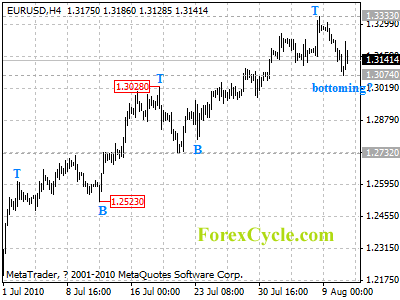
EURUSD may be forming a cycle bottom at 1.3074
EURUSD may be forming a cycle bottom at 1.3074 level on 4-hour chart. Range trading between 1.3074 and 1.3333 is expected in a couple of days. Support is at 1.3074, as long as this level holds, we’d expect uptrend to resume and one more rise to 1.3500 area is still possible after consolidation. However, a break below 1.3074 will indicate that lengthier consolidation of uptrend from 1.1876 (Jun 7 low) is underway, then deeper decline could be seen to 1.2900-1.3000 area.
Forex Daily Market Commentary
By GCI Forex Research
Fundamental Outlook at 1400 GMT (EDT + 0400)
€
The euro depreciated vis-à-vis the U.S. dollar today as the single currency tested bids around the US$ 1.3075 level and was capped around the $1.3235 level. As expected, the Federal Open Market Committee kept its federal funds target rate unchanged at 0.25% and the Federal Reserve Bank of New York reported it will keep the Fed’s balance sheet at US$ 2.054 trillion. The FOMC reported “Information received since the Federal Open Market Committee met in June indicates that the pace of recovery in output and employment has slowed in recent months. Household spending is increasing gradually, but remains constrained by high unemployment, modest income growth, lower housing wealth, and tight credit. Business spending on equipment and software is rising; however, investment in nonresidential structures continues to be weak and employers remain reluctant to add to payrolls. Housing starts remain at a depressed level. Bank lending has continued to contract. Nonetheless, the Committee anticipates a gradual return to higher levels of resource utilization in a context of price stability, although the pace of economic recovery is likely to be more modest in the near term than had been anticipated. Measures of underlying inflation have trended lower in recent quarters and, with substantial resource slack continuing to restrain cost pressures and longer-term inflation expectations stable, inflation is likely to be subdued for some time. The Committee will maintain the target range for the federal funds rate at 0 to 1/4 percent and continues to anticipate that economic conditions, including low rates of resource utilization, subdued inflation trends, and stable inflation expectations, are likely to warrant exceptionally low levels of the federal funds rate for an extended period. To help support the economic recovery in a context of price stability, the Committee will keep constant the Federal Reserve’s holdings of securities at their current level by reinvesting principal payments from agency debt and agency mortgage-backed securities in longer-term Treasury securities. The Committee will continue to roll over the Federal Reserve’s holdings of Treasury securities as they mature. The Committee will continue to monitor the economic outlook and financial developments and will employ its policy tools as necessary to promote economic recovery and price stability.” Kansas City Fed President Hoenig dissented, arguing “he believed that continuing to express the expectation of exceptionally low levels of the federal funds rate for an extended period was no longer warranted and limits the Committee’s ability to adjust policy when needed.” On the balance, the FOMC’s statement was relatively bearish and a downward trajectory is expected to continue in market rates. Data released in the U.S. today saw July NFIB small business optimism decline to 88.1 from the prior reading of 89.0. Also, Q2 non-farm productivity was off 0.9%, down from +3.9% in Q1, and Q2 unit labour costs were up +0.2%, up from -3.7% in Q1. Finally, June wholesale inventories came in at +0.1%, down from +0.5%. In eurozone news, German headline consumer prices were up 0.3% m/m and 1.2% y/y with the harmonized components up 0.3% m/m and 1.2% y/y. Also, the July wholesale price index was off 0.3% m/m and up 5.3% y/y. Other data released today saw French June manufacturing production off 1.3% m/m and up 5.0% y/y while June industrial production was off 1.7% m/m and up 5.7% y/y. European Central Bank member Stark reported monetary policy remains “very accommodative” and said inflation pressures remain contained in the medium-term. Euro offers are cited around the US$ 1.3505 level.
¥/ CNY
The yen appreciated vis-à-vis the U.S. dollar today as the greenback tested bids around the ¥85.65 level and was capped around the ¥86.20 level. As expected, Bank of Japan’s Policy Board kept its monetary policy unchanged today with the unsecured overnight call rate target unchanged at 0.10%. Bank of Japan Governor Shirakawa reported “We are well aware that the yen’s strength is a downside risk for corporate sentiment. On the other hand, we have to assess the currency’s effect on the economy in a well-balanced manner.” Many dealers believe the central bank will not ease policy further unless the yen’s advances become disruptive and push the economy back toward a recession. Similarly, a change in policy by the Fed could place more upward pressure on the yen and require a policy response. Traders are still focused on this ¥85 handle as a possible area where Japanese monetary authorities may conduct yen-selling intervention. Finance minister Noda verbally intervened today, saying the yen’s movements have been “one-sided” and “excessive.” The government today also maintained its assessment of the economy as unchanged. Japanese legislators are reportedly urging BoJ officials to discuss their policies in an open debate, possibly increasing the chances of a more expansionary policy. Data released in Japan overnight saw Q2 housing loans climb 3.6% y/y while July machine tool orders were up 144.8% y/y. Data to be released tonight include June machine orders and the July domestic corporate goods price index. The Nikkei 225 stock index lost 0.22% to close at ¥9,551.05. U.S. dollar bids are cited around the ¥85.30 level. The euro moved lower vis-à-vis the yen as the single currency tested bids around the ¥112.25 level and was capped around the ¥113.75 level. The British pound moved lower vis-à-vis the yen as sterling tested bids around the ¥135.00 figure while the Swiss franc moved lower vis-à-vis the yen and tested bids around the ¥81.00 figure. In Chinese news, the U.S. dollar appreciated vis-à-vis the Chinese yuan as the greenback closed at CNY 6.7721 in the over-the-counter market, up from CNY 6.7684. Data released in China overnight saw the July trade balance expand to US$ 28.73 billion from the prior reading of US$ 20.02 billion. Data to be released tonight include July producer prices, consumer prices, retail sales, and industrial production. The yuan depreciated the most in five weeks after the People’s Bank of China established a lower reference rate. Central Huijin Investment plans to start selling CNY 190 billion in bonds this month.
£
The British pound depreciated vis-à-vis the U.S. dollar today as cable tested bids around the US$ 1.5710 level and was capped around the US$ 1.5905 level. Data released in the U.K. today saw the July RICS house price balance decline 8%, down from the revised prior release of +8. Also, the June total trade balance narrowed to -£3.260 billion from the prior reading of -£3.818 billion. Also, June DCLG house price growth narrowed to +9.9% from +10.6%. July Nationwide consumer confidence data will be released overnight. Unemployment and earnings data will be released in the U.K. tomorrow along with the Bank of England Quarterly Inflation Report. The central bank is expected to trim its economic growth forecast tomorrow. Cable bids are cited around the US$ 1.5640 level. The euro depreciated vis-à-vis the British pound as the single currency tested bids around the £0.8300 figure and was capped around the £0.8360 level.
CHF
The Swiss franc depreciated vis-à-vis the U.S. dollar today as the greenback tested offers around the CHF 1.0615 level and was supported around the CHF 1.0480 level. Data released in Switzerland today saw the July SECO consumer confidence measure climb to +16 from the prior reading of +14. July producer and import prices data will be released on Friday. Data released in Switzerland last week saw the July unemployment rate tick lower to 3.6% from the prior level of 3.7%. S&P last week withdrew its short-term ratings of “AAA/A-1+” on Swiss National Bank on account of the lack of rated debt outstanding. U.S. dollar offers are cited around the CHF 1.0980 level. The euro depreciated vis-à-vis the Swiss franc as the single currency tested bids around the CHF 1.3830 level while the British pound moved lower vis-à-vis the Swiss franc and tested bids around the CHF 1.6580 level.
Forex Daily Market Commentary provided by GCI Financial Ltd.
GCI Financial Ltd (”GCI”) is a regulated securities and commodities trading firm, specializing in online Foreign Exchange (”Forex”) brokerage. GCI executes billions of dollars per month in foreign exchange transactions alone. In addition to Forex, GCI is a primary market maker in Contracts for Difference (”CFDs”) on shares, indices and futures, and offers one of the fastest growing online CFD trading services. GCI has over 10,000 clients worldwide, including individual traders, institutions, and money managers. GCI provides an advanced, secure, and comprehensive online trading system. Client funds are insured and held in a separate customer account. In addition, GCI Financial Ltd maintains Net Capital in excess of minimum regulatory requirements.
DISCLAIMER: GCI’s Daily Market Commentary is provided for informational purposes only. The information contained in these reports is gathered from reputable news sources and is not intended to be U.S.ed as investment advice. GCI assumes no responsibility or liability from gains or losses incurred by the information herein contained.
US Dollar Slips After Fed Decision
By ForexYard – The USD lost some ground against its major counterparts Tuesday after the Federal Reserve left interest rates unchanged, and renewed its pledge to keep them low for an extended period. The USD is currently trading lower against the EUR by nearly 80 pips at 1.3195. It is also trading lower against the GBP and JPY.
As expected, the Fed kept its target for its federal funds rate set at a range of zero to 0.25%. The decision to reinvest mortgage bond proceeds, an effort to keep market-set borrowing costs down, represents a significant policy shift for a central bank that just a few months ago had been avidly debating an exit strategy from the extraordinary stimulus delivered during the financial crisis.
Tomorrow, in a day that forex traders cannot afford to overlook, a batch of data is expected from the leading economies. Both the US Trade Balance and Crude Oil Inventories will be released on the same day, promising an extremely volatile trading day. Traders should take advantage of this unique opportunity and use the volatile market in order to capitalize profits.
Forex Market Analysis provided by ForexYard.
© 2006 by FxYard Ltd
Disclaimer: Trading Foreign Exchange carries a high level of risk and may not be suitable for all investors. There is a possibility that you could sustain a loss of all of your investment and therefore you should not invest money that you cannot afford to lose. You should be aware of all the risks associated with Foreign Exchange trading.
EUR/USD Targets 200-Day Moving Average
By Russell Glaser – The EUR/USD has been testing the 200-day moving average line. Following yesterday’s decline in the price combined with using multiple time periods, an opportunity exists to enter the market with this target in mind.
The daily chart below shows the failure of the EUR/USD to close above the 200-day simple moving average. This level can be used as a target for long positions in the pair (R1 1.3265). Support for the pair comes in at the 38.2% Fibonacci retracement level from the December high at 1.3120.
A buy signal is given on the 4-hour chart as the Slow Stochastic oscillator has formed a bullish cross, indicating a potential move higher in the price of the pair.
Using multiple time periods, traders can find an opportunity to go long on the EUR/USD with a relatively nice profit to risk ratio of 2:1.


Forex Market Analysis provided by ForexYard.
© 2006 by FxYard Ltd
Disclaimer: Trading Foreign Exchange carries a high level of risk and may not be suitable for all investors. There is a possibility that you could sustain a loss of all of your investment and therefore you should not invest money that you cannot afford to lose. You should be aware of all the risks associated with Foreign Exchange trading.
Daily Elliott Wave Forex Forecast-10-August-2010
| Title: | EUR/USD – Sideways – Possible Decline |
| Story: | Trend is currently sideways and a break below 1.3115 support level will provide us an intermediate term decline in EUR/USD currency pair. The daily time frame is providing over bought readings. I am expecting a possible top in EUR/USD. |
 | |
| Read Full Elliott Wave Forecast – Click Here…… | |
Swedish Krona Champion of Summer-Time Growth?
By Greg Holden – Which currency would you claim as the strongest in Europe these past three months? Only forex traders familiar with the variety of instruments available in Europe would think to guess Sweden’s krona (SEK). It’s not that the SEK is the strongest in the region, but that it has potentially outpaced most others in its bullishness, and is no doubt a contender for summer-time champion of value gained.
This Scandinavian currency has, in fact, gained 7.75% against the USD since early June, and 4% versus the euro. The krona and British pound appear to be in a close race for most ground gained this summer. And that’s not all…
Sweden’s economy is growing; and faster than many expected. Second quarter GDP was posted at 3.7%, year-on-year. Sweden’s central bank expects annual growth for 2010 to be 3.8%, and 3.6% for 2011; even though the government offered a less optimistic forecast with 3.3% in 2010, and 3.8% in 2011. Lastly, over 80% of Swedish businesses reported better-than-expected earnings. Compared to a similar figure of roughly 65% for Germany, and Sweden’s recent growth, put into that perspective, suddenly appears more favorable than some of Europe’s other major economies.
Now the major question is whether Sweden can continue such growth. The Riksbank was one of the first major European economies to raise interest rates following the recent financial crisis and recession. But some analysts worry that it may have acted too soon. Whatever the outcome of such monetary measures, the first round of results appears to be in: Sweden 1, market pessimists 0.
Technical Analysis
EUR/SEK Fails to Breach Resistance Level – Looks to Resume Bearishness
• The chart below is the EUR/SEK 4-hour chart provided by ForexYard.
• For the past week the pair has rebounded from its recent low of 9.3335, and is currently trading around the 9.3950 level.
• The Fibonacci Retracement lines show that the pair tested the 23.6% line for several times, yet failed to breach it.
• The Slow Stochastic has recently completed a bearish cross, suggesting that a bearish move could be expected.
• The MACD has completed a bearish cross as well, further indicating that a down-trend might take place soon.
• The pair has potential to drop towards the 0% support level, which is located around the 9.3500 level.
EUR/SEK – 4-Hour Chart

Forex Market Analysis provided by ForexYard.
© 2006 by FxYard Ltd
Disclaimer: Trading Foreign Exchange carries a high level of risk and may not be suitable for all investors. There is a possibility that you could sustain a loss of all of your investment and therefore you should not invest money that you cannot afford to lose. You should be aware of all the risks associated with Foreign Exchange trading.
