Forex Daily Market Review Aug 12, 2010

By eToro – A flight to quality boosted the dollar across the board, pushing the Euro down almost 3 big figures.  The Euro broke support at the 20-day moving average, and will likely consolidate around this area.
Click here to read the full daily Review

Forex Market Analysis provided by eToro

Disclaimer: Trading in the Foreign Exchange market might carry potential rewards, but also potential risks. You must be aware of the risks and are willing to accept them in order to trade in the foreign exchange market. Don’t trade with money you can’t afford to lose.

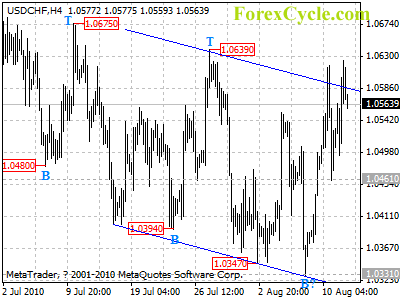
USDCHF breaks above upper border of price channel

USDCHF breaks above the upper border of the price channel. Further rally to test 1.0675 key resistance could be seen later today, a break above this level will indicate that the downtrend from 1.1730 (Jun 1 high) has completed at 1.0331 already, then the following upward movement could bring price back to 1.1200 or even higher. Support is at 1.0461, only break below this level could trigger another fall towards 1.0331 previous low.

usdchf

Daily Forex Analysis

Forex Daily Market Commentary

By GCI Forex Research

Fundamental Outlook at 1400 GMT (EDT + 0400)

USD

The FOMC decision to keep the Fed balance sheet elevated initially led to broad-based dollar weakness against other G10 currencies. But the greenback recovered against the euro and sterling during the Asia session, while the yen held onto its gains. The Fed shied away from policy normalization at this stage on the grounds that “the pace of economic recovery is likely to be more modest in the near term than had been anticipated.” While the term QE2 has been used to describe the decision to reinvest maturing principal payments from agency debt and agency MBS into longer-dated Treasurys, it is important to note that there is no net new money creation. Fed officials aim to maintain the face value of holdings at ~$2.054 trn. Although it is difficult to ascertain how much MBS is maturing and Fed officials do not specify how long they will keep the balance sheet elevated, we do know that there is about $50 bn of agency debt that matures by the end of 2011. The dollar should remain weak in the near term relative to the yen and the Swiss franc as the Fed has effectively pushed out the beginning of policy normalization. Risk sentiment should remain supported as policy remains stimulative and the higher beta commodity currencies should benefit. The euro could also benefit, but H2 2010 should give the Eurozone its own reasons to worry on growth.

EUR

German CPI for July was above expectations at 1.2% y/y and 0.3% m/m. The increase was mainly due to rising energy and food prices. In France, industrial output was lower at -1.7% (cons. -0.1%, prev. 1.7%). However, overall industrial production rose by 0.8% in the second quarter.

ECB Executive Board member Stark sees no major downward risks to price stability in the foreseeable future, and said inflation risk from money supply and credit growth will play a major role in determining future policy. The ECB only settled €9 mn worth of bonds as part of the bond-buying program last week, which represents a significant fall-off from the €81 mn settled the week before. Given that the ECB settled €16.5 bn worth in the week immediately after the scheme’s introduction in May, the ECB is clearly backing away from bond purchases. The fact that Eurozone sovereign bond spreads continue to tighten in spite of this is certainly a euro-positive development but second half growth is expected to be softer.

JPY

The FOMC decision renewed downward pressure on USDJPY after the BoJ voted unanimously to keep the policy rate unchanged at 0.1% and did not announce further easing measures. USDJPY has managed to hold in above 85. Finance Minister Noda was on the wires for a third successive day, noting that “Currency moves after the Fed’s decision appear a little one-sided. Excessive foreign exchange moves are bad for the economy, so I will keep closely monitoring the market”. Yesterday marked a significant escalation of rhetoric when Noda suggested that the government and the BoJ should cooperate on the strengthening yen, a clear hint that the government would prefer to use BoJ easing as a tool to limit yen strength, rather than resort to actual FX intervention.

Vice Banking Minister Otsuka echoed these sentiments during the Asia session, saying that that government and the BoJ must cooperate to prevent a rapid rise in the yen adding to deflationary pressures, and went on to say that solo FX intervention by Japan would have little effect on currency markets. Otsuka said that the BoJ will need to act if FX moves have a big impact on the economy. Although he does not have authority over FX matters, his views offer a useful insight into government opinion.

GBP

The Bank of England is likely to present its new growth and inflation outlook as part of the publication of the inflation report. While growth for 2011 and 2012 is likely to be revised notably downwards the rate of inflation for 2011 is likely to be revised upwards. This demon-strates once again the difficult situation the BoE finds itself in. The weaker economic outlook points towards a continuation of the expansionary monetary policy. The higher rate of inflation on the other hand would justify moderate tightening. However the uncertainty regarding the economic outlook is high and the BoE is likely to place the emphasis on a more pessimistic economic outlook. The British government’s fiscal consolidation is likely to slow the recovery which in the end is likely to dampen inflation. The higher inflation is mainly due to the VAT increase and thus can be interpreted as transitory. This suggests that the central bank will maintain its expansionary monetary policy for some time yet to come. All in all the inflation report is likely to paint a depressing picture of the British economy, putting pressure on Sterling. Prior to that, the labour market data is due for publication. In June jobless claims are likely to have fallen once again, which is likely to provide moderate support for Sterling.

AUD

Australian consumer confidence strengthened again in August, a result our Australia economists ascribe to the RBA remaining on hold for a third successive meeting. The level of the confidence index is now only 3.8% below the record high in a times series that began in 1974.

TECHNICAL OUTLOOK

EURUSD BULLISH While support at 1.2990 holds, expect recovery towards 1.3334 ahead of 1.3511 Fibonacci level.

USDJPY BEARISH Bearish pressure holds above 84.83; break of this level would expose next support at 81.85 and 79.95 key support level. Near-term resistance holds at 86.66 ahead of 88.12.

GBPUSD BULLISH Pullback is seen as a correction, but holding 1.5665 support. Initial resistance is defined at 1.5999 ahead of 1.6458 key high.

USDCHF NEUTRAL Recovery has room to run toward 1.0676 with 1.0866 Fibonacci resistance next. Support holds at 1.0332 for now.

AUDUSD BULLISH Upside potential held at 0.9222 ahead of 0.9389. Near-term support comes in at 0.9033 ahead of 0.8896.

USDCAD NEUTRAL Model is neutral; 1.0587 and 0.9931 mark the key directional triggers.

EURCHF NEUTRAL The gains are expected to move towards 1.4010/41 with scope for 1.4231 next. Initial support lies at 1.3730 ahead of 1.3511.

EURGBP NEUTRAL Momentum is slowing; 0.8532 and 0.8068 have now become the key directional triggers.

EURJPY NEUTRAL Model is neutral; sustained break of 110.02 will put odds in favour of bearish trend. 115.19 defines the near-term resistance.

Forex Daily Market Commentary provided by GCI Financial Ltd.

GCI Financial Ltd (”GCI”) is a regulated securities and commodities trading firm, specializing in online Foreign Exchange (”Forex”) brokerage. GCI executes billions of dollars per month in foreign exchange transactions alone. In addition to Forex, GCI is a primary market maker in Contracts for Difference (”CFDs”) on shares, indices and futures, and offers one of the fastest growing online CFD trading services. GCI has over 10,000 clients worldwide, including individual traders, institutions, and money managers. GCI provides an advanced, secure, and comprehensive online trading system. Client funds are insured and held in a separate customer account. In addition, GCI Financial Ltd maintains Net Capital in excess of minimum regulatory requirements.

DISCLAIMER: GCI’s Daily Market Commentary is provided for informational purposes only. The information contained in these reports is gathered from reputable news sources and is not intended to be U.S.ed as investment advice. GCI assumes no responsibility or liability from gains or losses incurred by the information herein contained.

Stock Market Investing –The Latest News About Volatility and the VIX

By Richard Gunderson – By its very nature, stock investment involves dealing with volatility. For many, the term “volatility” has a negative connotation particularly when it pertains to financial assets. The dictionary definition of volatility is readily understood. In the world of stock market investing, the meaning is not as clear. For the person sitting on the sidelines asking “how do I start to invest my money“, the presence of volatility in the stock market looks like “shark infested waters”. For the experienced investor, volatility is often considered a good thing that can be used to the investor’s advantage.

This article will clarify what volatility is all about when investing in stocks.

Definitions:

Webster’s Dictionary defines volatility as “likely to shift quickly and unpredictably; unstable; explosive”.

When it comes to stock investments, there are two forms of volatility: historical volatility and implied volatility.

Historical volatility is considered a measure of stock price swings over time. Large variations in price over time is considered high volatility. Small variations in price over time is considered low volatility.

Implied volatility is the volatility as currently estimated by a stock’s option price. High implied volatility means the market expects the stock to continue to be volatile (ie. to continue to make large moves). Low implied volatility means the market believes the stock price moves will be conservative. In the options world, implied volatility has a bearing on changes to the option value. This is beyond the scope of this article.

One key factor about volatility is that it is not a directional indicator. Whether the volatility is high or low, any measure of volatility is not an indicator of the direction a stock price will move. However, taking other factors into consideration, volatility may help to predict the future direction of movement of a stock’s price.

The Chicago Board Options Exchange defines the Volatility Index (VIX) as “a key measure of market expectations of near-term volatility conveyed by S&P 500 stock index option prices. Since its introduction in 1993, the VIX has been considered by many to be the world’s premier barometer of investor sentiment and market volatility“. The VIX is used by many investors as a measure of risk and they refer to it as the “investor fear gauge”.

To better understand volatility, we need to look at it from a bigger picture point of view.

Volatility Is A Fact Of Life:

Frank Holmes, CEO and Chief Investment Officer of US Global Investors, recently reported that, “in the past 400 years, there have been 47 major credit currency crises”.

However, we must differentiate volatility from crises. Volatility, in the context of large price variation, exists independently from financial crises. Volatility exists to some degree in all market conditions, independent from crises. In fact, most stocks and stock indexes exhibit consider swings in price variation multiple times every year.

According to Frank Holmes, 70% of the time over the past ten years, the rolling 12 month price action exhibited the following price swings:

  • +/- 15%…………..gold bullion
  • +/- 19%…………..S&P 500 Index
  • +/- 23%…………..Russell 2000 Index
  • +/- 40%…………..emerging markets
  • +/- 40%…………..gold mining stocks

What causes this major movement in prices? Many factors such as changes in economic policy (regulatory changes, taxes) geopolitical news (wars, rumors of wars, terror), and financial news (unemployment, foreclosures, the bursting of bubbles, corporate news).

As Frank Holmes put it “You have to learn to live with volatility”.

Emotions:

As the stock market, or individual stocks, go through volatile swings up, then down, and back up again, there are many different emotions that surface. As prices move up, investors experience emotions that are increasingly positive. As the price moves down, investors experience emotions that are increasingly negative.

However, consider the fact that investors may be at the peak of positive emotions when stock prices are most vulnerable. The peak of prices is usually the peak of risk. It’s this emotional impact that often causes investors to buy at the top, when they are happiest about their financial investments. Likewise, emotions often cause investors to sell at the bottom when they actually should be buying.

Mean Reversion:

Volatility is evidenced by price swings over time. Because these price swings are cyclical, at some point in time prices will peak and begin moving back down. At another point in the cycle, prices will bottom and begin moving back up. This is related to the concept of mean reversion. Prices will always tend to move toward some mean or average price.

It’s interesting to note that the S&P 500 Index peaked at 1576.09 on October 11, 2007 and it hit bottom at 666.79 on March 6, 2009. The mean between those two extremes is 1121.44. As I write this article, the S&P 500 Index is at 1121.64. The S&P 500 Index has reverted to its mean.

Profit Opportunity:

There is a strong “good news story” regarding volatility. Because volatility produces swings in prices from the mean, to high, to mean, to low, to mean again, investors that understand volatility can make very good profits if they synchronize their investments such that they sell when the price is high and buy when the price is low.

After dropping approximately 58% from October 2007 to March 2009, the S&P 500 Index rose approximately 80% during the 12 month period ending in March 2010. During that upward move, more than 1000 stocks doubled in price. That’s a great example of making volatility work for you.

Is Volatility Getting Worse?

At a July 2010 financial conference, Karim Rahemtulla, Investment Director Mount Vernon Research, reported that “there have been more market events [financial crises] in the past 37 years than there were in the previous 200 years.” His conclusion is that market crashes [crises] will likely continue fairly frequently and we need to recognize them and be equipped to respond to them.

How To Interpret The Volatility Index:

The high of the VIX prior to 2008 was 48. During this time period it was believed that anytime the VIX approached 48, this was a time to buy. In 2008, the VIX broke a record and reached 88. How to interpret this “new peak” will take time before anybody really knows.

Karim Rahemtulla recommended the following new guidelines for interpreting the VIX:

  • At 80,…….buy it all
  • At 60,…….start buying
  • At 40,…….start nibbling
  • At 20 to 30, neutral
  • Under 20,….get nervous
  • Under 15,….start selling
  • Under 10,….sell it all

Summary:

Volatility is not new, it’s not bad, and it isn’t something to be feared in the world of stock investments. It is, however, a fact of life. It does need to be respected. Regardless of experience, with some quality training and a good sense of judgment, any investor can make volatility work for them.

About the Author

Richard Gunderson is President of Trader Training Schools. He has 30 years of business and business training experience. His investment training and years of online trading experience have resulted in a solid understanding of the challenges beginners face in learning to invest with minimal risk. For more information, click on learn to invest money.
The Economic Crisis No One Saw Coming: A Convenient Untruth

By Elliott Wave International

The single most convenient untruth about the 2008 (and counting) financial crisis is that it was unforeseen. For two years policymakers have insisted “There was no way to know ahead of time” that the liquidity boom would come to a screeching halt. Back in November 2008, in fact, the usually tight-lipped Queen of England herself publicly described the turmoil of international markets as “awful” and openly asked a panel of experts from the London School of Economics “Why did nobody notice?

Her Majesty is right: Most financial authorities did NOT notice the crisis before it was too late. Comedy Central’s “The Daily Show with Jon Stewart” of all places provided the most poignant evidence: A March 2009 video montage shows executives and economists from the world’s leading financial firms repeatedly forecasting continued upside strength in stocks, plus renewed bull market growth in financials — right as debt markets came unhinged and the US stock market headed into a 50%-plus selloff.

Dubbed the “8-Minute Rap” (after the “18-Minute Gap” of Nixon’s Watergate tapes), the Daily Show video feature sent an equally powerful message, as the clip below makes plain.

Yet even as the mainstream authorities failed to detect the economic earthquake moving below their own feet, somebody did “notice” well in advance. That person was EWI’s president Bob Prechter.

The clip below is from a 2007 Bloomberg interview. Clear as PLAY, the foreseeable nature of the crisis emerges from Bob’s October 19, 2007 interview.

As the historic trend change began to unfold, Bob issued this timely insight:

“We’ve seen the first crack in the credit structure with a huge drop in commercial paper… These are the harbingers of a change toward the downside for the stock market, commodities including oil, and the debt market itself.”

Don’t believe the convenient untruths. Get objective market analysis today. Download this free report that contains valuable market forecasts directly from the desk of Bob Prechter.

This article, The Economic Crisis No One Saw Coming: A Convenient Untruth, was syndicated by Elliott Wave International. EWI is the world’s largest market forecasting firm. Its staff of full-time analysts lead by Chartered Market Technician Robert Prechter provides 24-hour-a-day market analysis to institutional and private investors around the world.

Stock Trading: This Trendline is Crucial Support for the S&P 500

By Adam Hewison – This is going to be a short video (see video below), but one I believe is important to all traders and investors.

The video runs two minutes and 18 seconds and shows you one key element that I think can make or break the S&P 500 market.

Please feel free to comment on our blog with your thoughts on this market.

All the best,
Adam Hewison
President of INO.com
Co-founder of MarketClub.com

To see more of Adam’s Videos click here or sign up for Adam’s Free 10-part Professional Trading Course.

Video Analysis: Disecting The World Cup Portfolio

By Adam Hewison – Today we are going to take a look at MarketClub’s World Cup Portfolio
that has been tracking six markets for the past three years. I think it is fair
to say that the last 36 months have presented one of the most challenging
trading environments in recent memory.

So how did we do?

I put together this very short video which is only 1 minute 45 seconds
long and gives you all the information that you need to decide whether
or not this approach is one that could work for you. Bear in mind that
the World Cup Portfolio is a leveraged portfolio unlike our “Perfect
Portfolio” which is not leveraged.

I think you will find this video very informative and educational.

All the best,
Adam Hewison
President of INO.com
Co-founder of MarketClub


To see more of Adam’s Videos click here or sign up for Adam’s Free 10-part Professional Trading Course.

Fundamentals and Technicals Turn Bearish for GBP/USD

By Russell Glaser – The UK economy is showing signs of higher inflation along with a slowing housing market. Grumblings have been heard of an economic picture with stagflation on the horizon. At the same time, the Cable shows signs of a pair that is failing to move higher in its current uptrend.

Yesterday, the Nationwide Consumer Confidence number dipped to its lowest level since May of last year. The data was reported at 56, on market expectations of 60. The previous reading for the indicator was higher at 63. One of the causes of the drop in confidence numbers is due to consumer disparity over the British economy, persistent unemployment, and low wages.

Other data released this week shows a weakening housing market in the UK. The RCIS House Price Balance fell 8% on expectations of a 5% rise. This is a sharp contrast between market expectations and the reality on the ground. This is also the first drop in home prices in over a year, certainly a worrisome figure.

Inflation is also becoming a concern in the UK. VAT is expected to rise 20% in January, which could increase an already high rate of inflation in Britain. Fuel prices and wheat prices are also on the rise.

Future tax hikes are expected to come as Prime Minister David Cameron’s new government is focused on cutting the national deficit and implementing fiscal austerity. This strict adherence to limited spending could shave a few points off of UK growth rates.

Following high inflation and slowing growth of the British economy, a combination of these two factors could lead to a period stagflation. This will not be positive for the pound.

Technical factors for a reversal in the bullish trend have already begun to show on the charts. The weekly chart shows the pair has failed to breach a resistance level at 1.5960. This price level coincides with a 61.8% Fibonacci retracement level from the high of last August. Support for the pair comes in at the October low at 1.5700.

The daily chart displays Monday’s trading had the pair forming a bearish engulfing pattern and yesterday the pair closed near its opening price forming a rickshaw man. The long upper and lower shadows of yesterday’s candle show indecision on the part of traders. As this candlestick appears at the top of an uptrend, it could signal a top in the recent bullish move.

Forex Market Analysis provided by ForexYard.

© 2006 by FxYard Ltd

Disclaimer: Trading Foreign Exchange carries a high level of risk and may not be suitable for all investors. There is a possibility that you could sustain a loss of all of your investment and therefore you should not invest money that you cannot afford to lose. You should be aware of all the risks associated with Foreign Exchange trading.

US Dollar Remains in a Funk – August 11, 2010

USDX august 2010, US dollar index, USD, US dollar, $, US$, FX, forex market, forex, forex trading, trading forex, currency trading, online trading, Fed, interest rate, quantitative easing, FOMC, daily forex picks, daily fx picks, forex analysis, forex forecast

Good day forex peep! In today’s fx special is the US dollar index. As you can see from its 4-hour chart, the index, which weighs the valuation of the greenback against a basket of currencies like the euro, pound, yen, Canadian dollar, Swedish krona, and Swiss franc, has been on a downward slope for quite some time now. Just recently, though, the index has temporarily rebounded after it hit a low just above 80.000. At present, it is trading just above 81.000. But since the channel is still very much intact, the index as well as the dollar itself will most likely head lower. However, if the USD buying makes a comeback and the index breaks the downtrend resistance and the 82.000 marker, it can reach 83.000.

Yesterday’s dollar trading was quite volatile because of the Fed’s monetary policy decision. The USDX rose by almost 1% ahead of the decision but it was suddenly sold off to finish with only a modest 0.2% gain. The reason? Well, the Fed, aside, from keeping its interest rate constant at 0.25%, surprised the market with its plans to reinvest again the principal payments it receives from agency debt and agency mortgage-backed securities in US treasuries. This action spurred some speculation that the Fed could be lining up for another set of quantitative easing to support consumption in the US. Quantitative easing, of course, would dilute the greenback, hence, weakening its valuation.

If the FOMC indeed decides to do another set of QE, then the USD would most likely dip in the short to medium run until the market rebounds which consequently will increase the demand and the valuation of the US dollar in the longer run.

More on LaidTrades.com

EUR/JPY Provides Bullish Signals

By Anton Eljwizat – The EUR has dropped significantly versus the JPY in the past several days, and is currently traded around 111.55. And now as evident in the data below, the 4 hour chart is giving bullish signals, indicating that EUR/JPY pair might go up. Forex traders can take advantage of this impending movement by having their Entry Orders in place to capture this reversal.

• Below is the 4-hour chart of the EUR/JPY currency pair.

• The technical indicators that are used are the William Percent Range, Relative Strength Index (RSI), and Slow Stochastic.

• Point 1: The Slow Stochastic indicates a bullish cross, signaling that the next move may be in an upward direction.

• Point 2: Point 1: The Relative Strength Index (RSI) indicates that the price of this cross currently floats in the oversold territory, signaling upward pressure.

• Point 3: The Williams Percent Ranges is showing that this pair is heavily over-sold and may be experiencing strong upward pressure.

EUR/JPY 4-Hour Chart

Forex Market Analysis provided by ForexYard.

© 2006 by FxYard Ltd

Disclaimer: Trading Foreign Exchange carries a high level of risk and may not be suitable for all investors. There is a possibility that you could sustain a loss of all of your investment and therefore you should not invest money that you cannot afford to lose. You should be aware of all the risks associated with Foreign Exchange trading.