EUR/USD – New Bearish Trend

By Russell Glaser – During the past two weeks’ trading we have seen a shift in the technicals of the EUR/USD to the downside.

Last Friday’s trading saw a sharp drop in the value of the pair by 0.7%. This made significant inroads into shifting technicals for the pair, causing a breach of the long term trend line on the weekly chart. The pair rose as high as the 20-week exponential moving average before heading lower. The moving average line is now downward sloping, indicating the trend has moved to the downside

This same level could once again serve as resistance as the upward sloping trend line comes in at the same price of 1.2890. Following a breach below a rising trend line, the price has a tendency to move back to the trend line which can act as a resistance level.

Support for the EUR/USD comes in at 1.2645, the 23.6% Fibonacci retracement level from the November high, followed by the support at 1.2470.

Forex Market Analysis provided by ForexYard.

© 2006 by FxYard Ltd

Disclaimer: Trading Foreign Exchange carries a high level of risk and may not be suitable for all investors. There is a possibility that you could sustain a loss of all of your investment and therefore you should not invest money that you cannot afford to lose. You should be aware of all the risks associated with Foreign Exchange trading.

US Dollar Index Breaks Out! – August 23, 2010

USDX august 2010, US dollar index, USD, US$, $, US dollar, fx, fx market, fx tradinf, forex, forex market, forex trading, trading forex, currency trading, daily forex picks, daily fx picks, forex forecast, forex analysis

Welcome to another week of FX trading! In today’s fx feature is an update of the US dollar index. In my last post, I took specific note of the inverted head and shoulders pattern that was brewing at that time (please see my previous blog here). And guess what, the index has broken out from the formation already! You see, the index had been trading on a downward slope for quite some time. Though as you can see from its chart, it already moved above the said downtrend and had recently reversed as well. Given this recent price action, I can say that the index and the US dollar (versus the other currencies) itself will most likely head higher in the days to come. The USDX’a minimum upside target is seen to be somewhere around 86.00 (estimated by projecting the height of the formation from the point of breakout). Still, the index can go lower though neckline of the pattern should prevent it from falling any further.

The week will kick off in the US with the release of its exiting homes sales for the month of July tomorrow (August 24). Existing home sales are seen to fall slightly to 4.66 million after it tallied a score of 5.37 million the other month. New home sales for the same month are projected to have reached 355,000, better than the 350,000 that was marked previously. If the US logs in a weak existing home sales then the new home sales for the month could come out frail as well. Durable goods orders, which unexpectedly contracted in June, are projected to have increased in July. The core figure is expected to have gained by 0.6% after sliding by 0.9%. The headline figure is also anticipated to have gained expanded by 3.0% after dipping by 1.2%.  But since last month tally was suddenly changed to worse, July’s figure could fall below the market’s consensus. If any or all of these accounts fail to impress, risk aversion could rise which then could send investors to the safety of the greenback.

More on LaidTrades.com

USD/DKK May Finally Be Set For a Downward Correction

By Dan Eduard – The U.S. dollar has steadily been making gains against the Danish krone since the first week of August. In the last 3 weeks or so, the pair has gone up around 2600 pips. As we will illustrate through a number of technical indicators, the USD/DKK pair may finally be set for a bearish correction.
We will be looking at the 8-hour chart for USD/DKK, provided by Forexyard. The technical indicators used are the Relative Strength Index (RSI), Williams Percent Range and MACD/OsMA.
1. As we can be seen, the RSI is currently right around the 70 level, which typically indicates the pair is right on the edge of entering into overbought territory. Traders can take this as a sign that a bearish correction could occur in the near future.
2. Further supporting our theory, the Williams Percent Range is currently right at the -20 level. Anything above the -20 level is generally taken as a sign that the pair is in the overbought region, meaning downward movement is likely to occur.
3. Finally, in a clear sign of impending downward movement, the MACD/OsMA shows a cross has already formed well above any resistance levels. Analysts take this as a sign that the krone may finally be set to make some serious gains on its U.S. counterpart.

Forex Market Analysis provided by ForexYard.

© 2006 by FxYard Ltd

Disclaimer: Trading Foreign Exchange carries a high level of risk and may not be suitable for all investors. There is a possibility that you could sustain a loss of all of your investment and therefore you should not invest money that you cannot afford to lose. You should be aware of all the risks associated with Foreign Exchange trading.

Will The Dollar And The Yen Continue To Strengthen?

By Dan Eduard – Last week began with positive releases from the U.S. economy. The data had created speculation that the U.S. economic recovery is advancing, and that global recovery will follow as well. As a result the U.S. dollar fell on all fronts. However, two disappointing publications from the U.S. on Thursday were enough to reverse the trend, boosting the dollar and yen as a result. It seems that fears of a potential slow down in the global economic recovery are currently driving the market from riskier assets like the euro and U.K. pound.

This trend is likely to continue for the foreseeable future, and considering the heavy news week ahead, traders should be able to generate several profitable positions.

Here are today’s leading economic publications:

• 07:30 GMT, German Flash Manufacturing PMIServices PMI – This is a purchasing managers’ index (PMI), which attempts to reveal the current market conditions in Germany. Analysts’ expectations for both indicators are just a little above average. If the end results will beat expectations, the euro might be supported as a result.

• 08:00 GMT, Euro-Zone Flash Manufacturing PMIService PMI – These PMI’s are for the entire euro-zone, not just Germany. These releases tend to have a smaller market impact, however an unusual result could create volatility. If the end result will beat expectations, the euro may rise as a result.

Forex Market Analysis provided by ForexYard.

© 2006 by FxYard Ltd

Disclaimer: Trading Foreign Exchange carries a high level of risk and may not be suitable for all investors. There is a possibility that you could sustain a loss of all of your investment and therefore you should not invest money that you cannot afford to lose. You should be aware of all the risks associated with Foreign Exchange trading.

Dollar and Yen Strengthen As a New Trading Week Begins

Source: ForexYard

After four days in which the euro and British pound had dominated the market, the trend markedly reversed by last Thursday. Several negative economic reports from the U.S. have added to concerns regarding the global economic recovery, boosting risk aversion. Both the U.S. dollar and yen saw gains as a result. Will the dollar and the yen continue to strengthen this week as well?

Economic News

USD – Dollar Finishes Volatile Week with Green Signals

The U.S. dollar finished a rather volatile trading week with modest gains against most of the major currencies. The dollar began last week’s trading down about 150 pips against the euro, but eventually closed the session with a 70 pip gain. A similar trend took place against the British pound.

The dollar weakened against most of the major currencies until last Thursday, as reports showed that the U.S. economy is recovering faster than expected. The global demand for long-term U.S. financial assets rose in June from a month earlier as investors abroad bought treasuries and agency debt and sold stocks. Net buying of long-term equities, notes and bonds totaled $44.4 billion for the month, beating expectations for $36.3 billion, and well above $35.3 billion in May. In addition, the U.S. Producer Price Index (PPI) rose for the first time in 4 months in July. This has eased concerns for deflation in the U.S. and was interpreted as another signal that the U.S. economic recovery is advancing, and that a global recovery might quicken it’s pace as well. As a result, investors looked for higher-yielding assets, such as the euro and the pound.

However, disappointing data from the U.S. economy released on Thursday had turned the trend around. The weekly Unemployment Claims showed that 500,000 individuals filed for unemployment insurance for the first time during the past week, failing to reach expectations for 478,000 requests. In addition, the Philly Manufacturing Index showed that manufacturing in the Philadelphia region unexpectedly shrank in August for the first time in a year. These reports have crated uncertainty regarding the recovery of the U.S. economy, and as a result turned investors to open long positions on the safe-haven dollar.

As for the week ahead, many interesting economic releases are expected from the U.S. Traders are advised to focus on the Existing Home Sales, Core Durable Goods Orders, New Home Sales, weekly Unemployment Claims and the Preliminary Gross Domestic Product publications, as there are likely to have the largest impact on the dollar.

EUR – Euro Tumbles Due To Disappointing Data

The euro dropped against most of its major counterparts during last week’s trading session. The euro began last week with a rising trend, yet finished it with a 70 pip loss against the U.S. dollar and a 120 pips loss against the Japanese yen.

The euro fell last week as negative data from the euro-zone’s leading economies have increased concerns regarding the pace of recovery for the region. The German ZEW Economic Sentiment, a survey of German institutional investors and analysts who are asked to rate the 6-month outlook for Germany, dropped more than expected, and reached a 16-month low. This has been the 4th consecutive decline for this survey, suggesting that German economic growth may be slowing down. In addition, the euro-zone’s Current Account, an indicator which measures the difference between imported and exported goods and services was released with a negative figure, the 3rd in a row. The negative report has decreased risk-appetite in the market, and turned investors to look for safe-haven currencies such as the yen.

Looking ahead to this week, traders are advised to follow the major economic releases from Germany, as it is the biggest economy in the euro-zone. Special attention should be given to the German Business Climate report, which will also try to detect the German economic outlook for the next 6 months. This week’s euro trading will be largely affected by the result of this publication.

JPY – Yen Rises to 7-Week High Vs. The Euro

The Japanese yen rallied against most of the major currencies during last week’s trading session. EUR/JPY tumbled about 100 pips, causing the pair to hit a 7-week low. The yen gained about 100 pips against the British pound as well.

The yen strengthened last week as economic reports from the U.S. and the euro-zone have signaled that the global economic recovery is slowing. Reports showed that the unemployment situation in the U.S. continues to deteriorate, as 500,000 people have filed for unemployment insurance for the first time during the past week. The euro-zone has provided negative data as well, as the German ZEW Economic Sentiment report, which attempts to predict the economic outlook of Germany for the next 6 months, has declined for the 4th consecutive time.

The disappointing economic data from both the U.S. and the euro-zone are the main reason that concerns regarding the global economic recovery are taking place. These concerns are driving investors to open long position on the yen, which is considered to be a relatively safe investment. As long as the leading economies will continue to provide negative signals, the yen is likely to strengthen further.

As for this week, a batch of data is expected from the Japanese economy. Traders are advised to follow the Japanese Trade Balance and the Tokyo Core Consumer Price Index, as these reports tend to have a large impact on the yen.

OIL – Crude Oil Drops To $73.45 a Barrel

Crude oil continued to tumble during last week’s trading session. A barrel of crude oil was trading at around $75.70 at the beginning of the week, and eventually dropped to around $73.85 a barrel by Friday.

The main reason for crude oil’s decline seems to be the negative data from the U.S, the biggest oil consuming nation. The weekly Unemployment Claims rose by 12,000 to 500,000 in the past week, the highest figure since November 2009. In addition, the Federal Reserve Bank of Philadelphia said that its general economic index slipped to -7.7 on August, also signaling a possible contraction of the U.S. economy. It seems that as long as the U.S. economy continues to provide negative data, demand for gasoline in the U.S. is likely to decrease, and as a result crude oil prices will continue to decline.

Looking ahead to this week, traders are advised to continue following the major economic updates from the U.S. and the euro-zone, as these seem to have the largest impact on oil prices. Most significantly, traders should follow the U.S. Crude Oil Inventories report, scheduled for Wednesday, as this publication tends to have an instant affect on crude oil prices.

Technical News

EUR/USD

The pair has been experiencing some very bearish behavior in the past week, as it currently stands between the 1.2700-1.2730 levels. The main oscillators of the daily chart indicate this trend may continue into the near future. However, the 4-hour Slow Stochastic reveals that a bullish cross is about to occur anytime soon, indicating that a bullish correction may be imminent. Now may be a ripe time to take advantage of the situation at an early stage.

GBP/USD

The cross has received increasing support as of late, as this pair approaches new highs. The continuation of the bullish trend is supported by the 1-day and 1-week charts’ MACD. On the other hand, the 4-hour and 1-day charts’ Slow Stochastic seems to contradict this. It may be wise to open a long position with tight stops before the bullish trend comes to an end.

USD/JPY

The pair has been going through much bearish behavior in the past several days. The MACD of the 1-hour chart fails to show a clear signal as to the future direction of this pair. However, the 1-day Stochastic Slow and RSI show that this pair is still likely to go lower before making a bullish correction. Traders should take advantage of this bullish trend now while it still carries steam.

USD/CHF

This pair’s recent drop has pushed the price into the over-sold territory on the RSI of both the hourly and 4-hour charts, signaling an upward correction could be in the making. With a bullish cross recently occurring on the 4-hour chart’s Slow Stochastic, this move may indeed be imminent. Going long might be a good choice.

The Wild Card

Gold

Gold prices have been increasing rapidly lately, as they stand at over $1229per ounce. The 1-day and 1-week chart shows that this bullish trend is set to continue. This is also supported by the 1-hour and 4-hour MACD oscillator. It may be a wise move for forex traders to enter this very popular trend.

Forex Market Analysis provided by ForexYard.

© 2006 by FxYard Ltd

Disclaimer: Trading Foreign Exchange carries a high level of risk and may not be suitable for all investors. There is a possibility that you could sustain a loss of all of your investment and therefore you should not invest money that you cannot afford to lose. You should be aware of all the risks associated with Foreign Exchange trading.
Forex Weekly Market Review Aug 23, 2010

By eToro – Riskier assets performed poorly this week as investors moved out of equities and commodities and moved into safe havens such as government bonds and the dollar. Gold was a standout commodity, where oil bore the brunt of investor’s fear that the global economies are beginning to slow down.

Click here to read the full review

Forex Market Analysis provided by eToro

Disclaimer: Trading in the Foreign Exchange market might carry potential rewards, but also potential risks. You must be aware of the risks and are willing to accept them in order to trade in the foreign exchange market. Don’t trade with money you can’t afford to lose.

Will The Dollar And The Yen Continue To Strengthen?

printprofile

Last week began with positive releases from the U.S. economy. The data had created speculation that the U.S. economic recovery is advancing, and that global recovery will follow as well. As a result the U.S. dollar fell on all fronts. However, two disappointing publications from the U.S. on Thursday were enough to reverse the trend, boosting the dollar and yen as a result. It seems that fears of a potential slow down in the global economic recovery are currently driving the market from riskier assets like the euro and U.K. pound.

This trend is likely to continue for the foreseeable future, and considering the heavy news week ahead, traders should be able to generate several profitable positions.

Here are today’s leading economic publications:

• 07:30 GMT, German Flash Manufacturing PMIServices PMI – This is a purchasing managers’ index (PMI), which attempts to reveal the current market conditions in Germany. Analysts’ expectations for both indicators are just a little above average. If the end results will beat expectations, the euro might be supported as a result.

• 08:00 GMT, Euro-Zone Flash Manufacturing PMIService PMI – These PMI’s are for the entire euro-zone, not just Germany. These releases tend to have a smaller market impact, however an unusual result could create volatility. If the end result will beat expectations, the euro may rise as a result.

USDCHF stays below a downtrend line

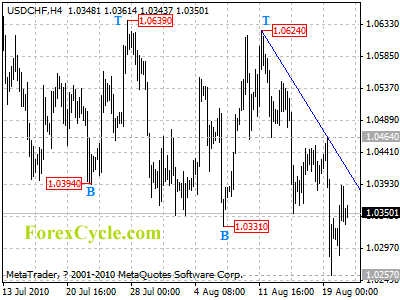
USDCHF stays below a downtrend line from 1.0624 to 1.0464 and remains in downtrend. As long as the trend line resistance holds, downtrend is expected to continue and next target would be at 1.0200 area. On the other side, a clear break above the trend line resistance (now at 1.0415) will indicate that a cycle bottom has been formed at 1.0257 already and the fall from 1.0624 has completed, then further rally could be seen to 1.0500-1.0600 area.

usdchf

Daily Forex Forecast

Forex Demo Accounts – Are Practice Accounts Really a Good Thing?

By Paul Bryan – Free FX demo accounts are a service that are loved by some yet hated by others, why is this so? Surely a free demo account can be nothing but a good thing?

Not exactly so, it does have its benefits but also has it’s pitfalls, in this article we will examine the pros and cons of such an account.

Let’s start off by looking at the demo account. For those who may not be aware, the free demo account does exactly what it says on the tin, it lets you demo FX trading for free, sounds great for a newbie trader and in many ways it is.

The brokers who offer a free FX demo account do so to help get people interested in FX, nothing wrong with that since they exist to expand the number of traders in the market and on their platform. It’s also a great way for the new trader to begin to learn FX trading.

Currency trading is no simple click and go experience, several brokers have introduced no frills platforms with low minimum deposits to get the virgin trader started and one or two have taken it a step further and allowed people to open a free demo account where you can begin trading with make-believe money until you have the confidence and knowledge to risk your own hard-earned cash.

That’s were the main pro of the demo account lies, in being able to learn the FX market and key functions of trade without risking a penny! However, this is not always good news.

When trading with ‘virtual’ money suddenly the risk becomes less, in fact risk is non-existent as you have an endless stream of make-believe money this means you may be more likely to risk on trades you know you shouldn’t and wouldn’t make in the real world. This can lull you in to a false sense of security.

Lets say you make en extravagant risk with demo money and it comes off, so you make another big risk and that comes off too, all of a sudden your confidence is up and you feel you can start playing with your own money and taking uncalculated risks.

The FX market has suddenly become very very appealing, if you can make this much money in the demo area imagine how well off you would be if you were using real money? This is where things go wrong, you then go ahead and open a real FX account and deposit your own cash.

Your confidence is up and you feel like you know what you are doing. You make a risky trade with your own cash and it fails, suddenly your FX career is over and you are sat looking at a significant loss, it seems when its your own ‘real’ money the demo you got with virtual cash counted for nothing.

Of course if you take things slowly and carefully you can avoid this and become a successful trader, but you have to have that self control. demo accounts are very useful, but only if you carry out trades exactly as you would if it was real money. Never make a trade in a demo account that you wouldn’t make with your own cash!

To help get around this several brokers now offer mini-accounts with deposits as low as $25. This is virtually a demo account anyway with such low deposits, however, its still your own cash so you are more likely to make realistic trades and not risk big time trades.

At Investawise we feel this is the best option, sure use a free demo account for a week or two while you learn the basics of FX trading, but then open an account and start with low funds, never jump both feet first into currency trading, success comes from patience, awareness, and discipline.

About the Author

Simply a 10 years old child could understand this FX trading system which is extremely accurate and highly profitable, Download Now. You can learn how forex hoster work in forex trading here.

Reversal Patterns in Stock Charts

By Sylvain Vervoort – Chart patterns are part of buying and selling rules in technical analysis trading. Chart patterns give an important confirmation for the next trend move. The art is to distinguish that you are dealing with a continuation pattern, after which the price will continue its previous trend or a reversal pattern leading to a trend reversal.

The head and shoulders formation belongs with an accuracy of about 90% to the most reliable reversal patterns. The price moves in an uptrend. Only after the pattern has formed, you will recognize the left shoulder after price falling back generally to the support of an up-going trend line. This will be a first point for the creation of the neck line. From here, the price makes a last move up, often with lower volume compared to the left shoulder. This will be the head of the pattern. Next the price drops through the up-going trend line and falls back to the level of the neck line, creating the second reference for the neck line. After that, the price will move up again to form the right shoulder. From here the price will drop below the neck line making lower lows. The shoulders and the neck line in the head and shoulders formation should be at about the same price level and at about the same distance in time from the head.

The head and shoulders pattern is confirmed when the price falls below an up-trending neck line or after the right shoulder in case of a down-trending neck line. In approximately half of the cases, there is a bounce back up to the neck line or even up to between the neck line and the right shoulder.

With the head and shoulders formation you can basically also calculate a price target. You measure the distance from the top of the head till the lowest point of the neck line and project this distance downwards. This will give you a theoretical price target.

Mirroring the head and shoulders top reversal pattern gives a head and shoulders bottom reversal pattern. Shoulder bottoms should be at around the same price level and at about the same distance from the head. The head and shoulders bottom reversal pattern with a descending neck line is confirmed breaking the resistance of this neck line, while an ascending neck line is confirmed when price turns up after the right shoulder.

A complex head and shoulders top reversal pattern will have more shoulders or more heads, but rarely both. The shoulder tops are around the same price level and at approximately the same distance from the head. The complex head and shoulders pattern is confirmed when the price falls below an up-trending neck line or after the internal right shoulder in the case of a down-trending neck line. Mirroring the complex head and shoulders top reversal pattern gives you a head and shoulders bottom reversal pattern.

Triple tops and bottoms are a variation of the head and shoulders theme. The difference is that tops or bottoms are at approximately the same level. Triple tops and bottoms offer a reliable pattern with an accuracy of about 80%. A triple top is confirmed when the price falls below the lowest valley in the pattern. A triple bottom formation is confirmed when the price rises above the highest top of the pattern.

A double top reversal pattern is formed with a large demand during the formation of the first top and a lack of demand with the second top. With daily price bars, tops are separated by about two up to eight weeks and should only have a small difference in price level. The in between reaction should have a price drop of about 10% on average. With an accuracy of 80%, this pattern is very reliable. The pattern is confirmed when the price falls below the level of the middle reaction.

For a double bottom, the reasoning is analogue to that of a double top. The trend is down, and a double bottom pattern is formed as an indication that the trend will probably reverse. With daily price bars, bottoms are separated by about two up to eight weeks and should only have a small difference in price level. The in between reaction should have an average price rise of about 10%. With 80% reversals, this pattern is very reliable. The pattern is confirmed when the price rises above the level of the middle reaction.

A rounding bottom pattern appears on daily and weekly bar charts. This pattern takes time to complete. The price can peak halfway through the pattern, but usually it retraces most of it quickly. Rounding bottoms are becoming rare because of today’s high volatility of the markets as a result of the information society. Rounding bottoms lead to a price reversal 90% of the time. The pattern confirms when the price closes above the highest peak of the pattern. There may be a saucer lip when the price drops temporarily before continuing the uptrend.

A V-formation bottom reversal creates a V-character; a top reversal creates an inverted V-character. The price at the start of the V-formation will form a one-day reversal, an island reversal, or a spark. A V-formation start can be recognized most of the time when it breaks the last possible steep trend line, together with a candle stick reversal pattern and a one-day island or spark reversal. A one-day top reversal arises if the price makes on the same day a new high, reverses and closes below the closing price of the previous day. A one-day top reversal in a candle chart is a black candle and often is part of a candlestick pattern. An island reversal occurs when a number of price bars are isolated by a window at the beginning and end of the island pattern. The island is confirmed if the second window is formed. The windows should be more or less at the same price level. The bottom V-formation spark reversal pattern arises if the price makes on the same day a very big positive move compared to the previous bars. In a candlestick chart this will be a big white candle at a bottom and a big black candle at a top. The big candle itself is the buying signal at a bottom and the selling confirmation at a top.

About the Author

Want to learn more and see some examples about stock chart reversal patterns? You can find a lot of material about basic technical analysis techniques for free at my website: http://stocata.org. Sylvain Vervoort is a trader and author with regular contributions in Stocks & Commodities magazine.