Forex Daily Market Review Aug 24, 2010

By eToro – The Euro continued to move lower as worse than expected German and EMU PMI helped softed the EUR/USD currency pair. The Euro broke through 1.27 and is likely to test the 1.25 level.

Click here to read the full review

Forex Market Analysis provided by eToro

Disclaimer: Trading in the Foreign Exchange market might carry potential rewards, but also potential risks. You must be aware of the risks and are willing to accept them in order to trade in the foreign exchange market. Don’t trade with money you can’t afford to lose.

Buy Signals on CAD/CHF

By Anton Eljwizat – The CAD has dropped significantly versus the CHF in the past several days, but few traders are concerned since many indicators are pointing toward an impending correction. As can be seen below, the daily chart is giving bullish signals, indicating that CAD/CHF pair might go up. Forex traders can take advantage of this impending movement by having their Entry Orders in place to capture this reversal.

• Below is the daily chart of the CAD/CHF currency pair.

• The technical indicators that are used are the William Percent Range, Relative Strength Index (RSI), and Slow Stochastic.

• Point 1: the Stochastic (slow) on this chart appears to be providing us with an impending bullish cross, indicating that the next major movement may be in an upward direction.

• Point 2: The Relative Strength Index (RSI) indicates that the price of this cross currently floats in the oversold territory, signaling upward pressure.

• Point 3: the Williams Percent Range has the price indicator near the -100 mark, indicating the price is over-sold and should see some upward pressure.

CAD/CHF Daily Chart

Forex Market Analysis provided by ForexYard.

© 2006 by FxYard Ltd

Disclaimer: Trading Foreign Exchange carries a high level of risk and may not be suitable for all investors. There is a possibility that you could sustain a loss of all of your investment and therefore you should not invest money that you cannot afford to lose. You should be aware of all the risks associated with Foreign Exchange trading.

US Dollar Rising on Risk Aversion

By Greg Holden – The US dollar appears to be on the rise since the end of last week. Climbing against most of its currency counterparts, the greenback has been gaining ground due to a rise in risk aversion. Should today’s figures from the US and Canada provide hints of a slowing economic growth, we could continue to see this risk flight gain momentum and drive safe-havens, such as the USD and JPY, slightly higher.

Today’s leading news events:

12:30 GMT: CAD – Retail Sales and Core Retail Sales

Retail sales measures the percentage change in sales of retail goods in a country since the preceding month. As this data comprises a large portion of a nation’s consumption and demand, it has a direct correlation with the strength of that nation’s currency. If Canada’s retail sales figures come in line with expectations for growth, the CAD should see some bullishness.

14:00 GMT: USD – Existing Home Sales

The sale of existing homes is one aspect of the housing market in the United States. With the housing market still recovering from the crash of 2007-2008, these figures have grown in significance for forex traders. With an expected decline in existing home sales this month, there is a chance that further investment will flee riskier assets and move towards safe havens, which seems to have become commonplace since the middle of last week. If the figures do come in line with expectations today, the USD could actually see a rise in value as a result of a flight away from risk.

Forex Market Analysis provided by ForexYard.

© 2006 by FxYard Ltd

Disclaimer: Trading Foreign Exchange carries a high level of risk and may not be suitable for all investors. There is a possibility that you could sustain a loss of all of your investment and therefore you should not invest money that you cannot afford to lose. You should be aware of all the risks associated with Foreign Exchange trading.

Dollar and Yen Rising on Market Uncertainty and Slowing Growth

Source: ForexYard

A consensus seems to be forming that risk aversion is returning to the market. Despite the sporadic release of positive data in various parts of the world, the overall trend appears to indicate a slow-down in recovery and growth. This has led to an increase in fears about the potential for a speedy recovery, which in turn has fueled the mass flight away from riskier assets and into the safety of the US dollar and Japanese yen.

Economic News

USD – US Dollar Making Strong Gains on Flight from Risk

The US dollar has been on the upside for the past several trading days. Against its primary rivals, the greenback has made modest growth. The EUR/USD pair has slid from its recent high of 1.2900 to currently trade just over 1.2600, and there doesn’t seem much in the way of slowing this movement. Against the British pound, the dollar has made remarkable gains to push the pair back towards 1.5400 from recent highs around 1.5700.

A consensus seems to be forming that risk aversion is returning to the market. Despite the sporadic release of positive data in various parts of the world, the overall trend appears to indicate a slow-down in recovery and growth. This has led to an increase in fears about the potential for a speedy recovery, which in turn has fueled the mass flight away from riskier assets and into the safety of the US dollar and Japanese yen.

Today’s news events from the United States are focused primarily on existing home sales and minor manufacturing data from the Richmond Federal Reserve office in Virginia; covering the District of Columbia, Maryland, North and South Carolina and the Virginias. Both of these figures are forecast to show a decline, which will likely feed the sentiment of risk aversion currently dominating trading, pushing the USD higher against its rivals.

EUR – Euro Positive Even in Adverse Market; But Will it Last?

The euro has recently made an upward movement against many of its currency rivals, except for the US dollar and Japanese yen. The 16-nation single currency gained over 130 pips against the British pound, and is currently trading at 0.8181. Against the Aussie, the EUR is up from a recent low of 1.4140, presently trading at 1.4230.

While the euro appears to have made some solid gains this morning, many analysts do not expect the momentum to hold. Sentiment in the euro zone has taken a dive from recent estimates showing an expected stall in regional and global growth. These pessimistic reports have begun to weigh on the euro, and this morning’s gains should be understood in that context.

Today’s news cycle appears to have only two important economic events emanating from the euro zone. The first is an industrial orders figure, which is expected to highlight the stall in economic growth with a weak reading. The second is a business sentiment report from Belgium which is also predicted to present a negative reading. This news only highlights the recent weakness of the EUR and potential for a reversal of recently earned gains.

JPY – Does Recent JPY Boost Raise Probability of BOJ Intervention?

The Japanese yen has made strong gains against all of its currency rivals these past few trading days. This growth is likely due to the sudden spike in risk aversion, similar to the growth being witnessed in the US dollar currently. Market forecasts, which have been consistently predicting a global slow-down, have scared investors away from riskier assets and back into the safety of the dollar and yen.

The result of this risk flight has been to pull the JPY in the direction of record highs against its counterparts, which only increases the possibilities of a Bank of Japan (BOJ) intervention. Speculation is running high at the moment, but with little news being released from Japan speculation seems to be the only game in town. For the time being, risk aversion and the safe-haven status of the yen appear to be in control of the JPY’s value.

OIL – Oil Price Persists in Downward Movement on Strengthening USD

The strengthening US dollar has been putting steady pressure on the value of commodities this past week. Spot crude oil prices have been falling since August 6th, and little news events appear to be capable of slowing this movement. Most forecasts this week are predicting a continued decline in market sentiment, pushing more and more traders into safety assets like the greenback. As a result, the price of commodities, such as oil, is expected to remain in a bearish pattern.

With the price currently hovering just under $73 a barrel, down from as high as $83 a barrel, the market would require a sharp reversal in recent data to bring the price of oil back towards the $80 mark. As already mentioned, without such momentum-shifting news, oil is likely to persist in its downtrend.

Technical News

EUR/USD

The pair continues to move lower, crashing through support at the 23.6% Fibonacci retracement level from the December to June bearish trend which lies at 1.2640. Yesterday’s low was set just above the 50% Fibonacci retracement at 1.2610 for the June to August bullish correction. Downward movement looks set to continue as the daily Momentum (14 ) is pointing to the downside. Supports of 1.2520 and 1.2470 should be tested in the near term. Resistance comes in at 1.2730.

GBP/USD

The Cable fell sharply yesterday, finding support in the area of 1.544 just above the 50-day exponential moving average. The pair looks to continue its move lower with a short term target the support level of 1.5330, the 38.2% Fibonacci retracement from the May low to the high in August.

USD/JPY

The bearish trend continues for the pair as yesterday’s trading ended with the pair at the 85.00 level. Selling opportunities may appear close to the 20-day exponential moving average. Traders should be targeting the near term low of 84.70.

USD/CHF

The USD/CHF cross experienced bullish behavior yesterday. However, there is technical data that supports a bearish move for today. The RSI of the daily and 4-hour charts indicates that the pair floats in the overbought territory, leading to the conclusion that a downward correction is imminent. Going short with tight stops may turn out to pay off today.

The Wild Card

Oil

Crude oil prices have dropped significantly in the last 3 weeks with a low at $72.75 per barrel. However, on the daily chart the RSI is floating in oversold territory which suggests that a bullish correction is impending. This might be a great opportunity for forex traders to enter the trend at a very early stage.

Forex Market Analysis provided by ForexYard.

© 2006 by FxYard Ltd

Disclaimer: Trading Foreign Exchange carries a high level of risk and may not be suitable for all investors. There is a possibility that you could sustain a loss of all of your investment and therefore you should not invest money that you cannot afford to lose. You should be aware of all the risks associated with Foreign Exchange trading.

How Will the Federal Reserve’s Next Move Affect the USD?

printprofile

If at the beginning of the year the Federal Reserve was talking about starting to tighten monetary policy and exit strategies, abundance of negative economic data in recent months has led the Fed to discuss possible future actions to push the flailing American economy back to life.

While the Federal Reserve’s early actions, mainly reducing the interest rate to almost zero and engage in massive securities buying programs have kept the U.S economy out of a deeper recession, the recovery seems to be much slower than anticipated, with unemployment rates remaining at uncomfortably high levels and inflation a whole 1% below the target rate. These two issues are also the main concern areas for the Fed; one of Bernanke’s main goals is to avoid deflation, a decrease in general price level of goods and services.  

Another major issue dragging down recovery is the housing market. Housing led the U.S. out of seven of the last eight recessions; however, home sales collapsed after a federal tax credit for buyers expired in April, dragging down the manufacturing led expansion, which began in the second half of 2009.

The Federal Reserve’s next meeting will be taking place this weekend in Jackson Hole, Wyoming. The most controversial issue expecting them is the decision of whether or not to print more money and extend their securities purchases. These two actions will expand the Fed’s portfolio’s further; the portfolio is the Fed’s major monetary tool. Another issue is how quickly to act? And if it does decide to act, should it take small, cautious steps or large, dramatic ones? While the Fed and most private forecasters still expect faster growth in 2011, and few economists are predicting outright deflation, few if any economic indicators in recent months support this assumption.

Federal Reserve governors seem to be quite divided over how and when to act next. Some even question whether to act at all.  Richard Fisher, president of the Dallas Fed, and others expressed a concern that Fed moves might be ineffective, arguing that businesses weren’t using already ample, cheap credit to fund investments because they were uncertain about many other problems, including government deficits and new financial regulations.

Investors should pay close attention to the next few meetings as they will likely have great affect on the USD. The greenback has been gaining recently on return to safety as it is considered a safe haven currency. The USD has been gaining despite negative economic data as investors shied away from riskier assets. Furthermore, as the U.S is the world’s largest economy, any economic slowdown is likely to affect global recovery, slowing it down as well. It is expected that if the poor economic conditions continue, the USD will continue to strengthen versus riskier counterparts, however, in case the Fed does decide to expand its monetary easing program this trend may reverse. Excess amounts of currency flooding the markets tend to be very negative for the currency. With shaky economic fundamentals, any excessive intervention by the Fed may hurt the greenbacks status.

It will be interesting to see the developments over the next few months as they will likely have profound effects on the US economy and subsequently global economic recovery as well.

If You Like Gold’s Rally, Silver May Not Be Far Behind

If You Like Gold’s Rally, Silver May Not Be Far Behind

By Jared Levy, Editor, Smart Investing Daily

Last week I wrote about how gold may not only be a great investment for the short term (it’s up another $20 since my article) but also has excellent prospects for the long term because of its beauty, versatility, industrial use and inflation hedge. Silver has many of these properties as well and at a much lower price, but before you get all excited about gold and silver, there are some things you need to know about these two precious metals and how they are related.

A Little History on Gold and Silver

While they may both be precious metals and move in tandem in terms of price movement, gold obviously is in far less supply than silver. A total of 165,000 tonnes or roughly 5.3 billion troy ounces of gold have been mined in human history, as of 2009. Sources vary slightly, but average total production of silver throughout history is about 46 billion troy ounces.

Silver, which has been mined for thousands of years, has seen over 50% of its production in the past 40 years. This means that silver, which trades for about $18, is about 1/68 the price of gold, which is trading for about $1,225. This ratio is extremely high; there have been times in the past when the ratio was much lower; for centuries, 16 ounces of silver got you 1 ounce of gold.

Even though more silver has been mined and the price is considerably lower, it does have a ton of exposure to industry and when economies are booming and factories are producing everything from electronic goods to clothing (silver is used in clothing in two basic forms as a bacteria inhibitor), the price of silver will tend to move higher even faster than gold. Remember gold is considered more of a “safe haven” dollar investment, so it may remain strong when the U.S. dollar is weakening.

Gold and silver have a long history with one another and tend to be highly correlated, meaning when one is moving up, the other is as well and vice versa, with gold usually being the leader. I personally don’t think the price of gold is getting back down below $1,000 any time soon, so what about that ratio between the two?

Gold Versus Silver Prices Chart
View Larger Chart

Silver does, however, tend to be more volatile than gold, so if gold is up 10%, silver might be up 15-20%. The bottom line is that silver, like gold, can make a great investment if you feel that industrial demand will return, but inflation may be a problem. I certainly feel that silver still looks attractive at these levels and has not participated in the huge gains that gold has; it should catch up.

In my mind, that gap may need to be filled and that would mean silver moves higher by the end of the year! Just keep in mind that if the gold price corrects, the silver price may do so as well, but it may look worse, so be prepared that you may have to weather a little storm before silver moves to higher levels.

Aside from that, silver is a great long-term investment and a partial inflation hedge as well.

So How Do You Invest in Silver? Buy the Silver ETF

Just like gold and the GLD, everyday stock investors who want to take ownership in silver have an option called the iShares Silver Trust ETF (SLV:NYSE), which is also an actual trust that owns silver and then sells shares of that silver to the public (just like GLD does for gold). It trades just like a stock and is easily bought and sold in your account.

Because of silver’s lower cost, the SLV trades right around the actual price of silver, which is currently about $18. There are small fees associated with SLV, but they are minimal and shares can be bought right through your broker and held in your retirement account. SLV is one of my favorite ETFs along with GLD for buying commodities, and it’s optionable for all you option traders out there.

Do You Know What Commodity You Should Be Buying INSTEAD of Gold?

I know it might sound crazy, but there’s another commodity out there even better than gold. It’s not oil, silver or platinum. In fact, you’ve probably never thought about buying a single ounce of this…

But if the market collapses, it could be even more valuable to you than gold. Find out what commodity is better than gold right here…

Consider Silver Coins

Another similarity that silver has to the yellow stuff is its history as a currency (remember silver certificates?). Silver coins can also be extremely collectable and can command values far and above their metal weight and/or face denomination. They can be stored in your home safe or other secure storage and are typically less volatile investments.

First Federal Coin has a new silver coin offer they just told us about; they’re China Silver Pandas. You even could walk away with a tray of these China Silver Panda Dollars in mint-supplied packaging.

But you should know that First Federal Coin only has 350 of these original Mint-supplied trays… so you need to act fast. I also need to remind you that we do have an advertising relationship with First Federal Coin, and we could profit from any sales. But considering the China Mint strikes fewer than one million of these coins, they could offer you a profitable strategy. Take a few minutes and learn about these China Silver Panda Coins.

Buy Silver Miners

The companies that mine and sell silver can be another great way to participate in the rise in price of silver; two of my favorites are the two largest companies in the sector by market capitalization: Silver Wheaton Corp. (SLW:NYSE) and Pan American Silver Corp. (PAAS:NASDAQ). If you want to really step on the gas and amplify returns, buying a silver miner may be another choice. Remember that the amplification works both to the upside and to the downside.

Take a look at the SLV ETF versus SLW stock over the past year… SLW is up 110%, with the price of silver up about 28%. The trends are very similar though.


View Larger Chart

In summary, you have three different ways that you can invest in silver and it too may offer you the diversification you need in your investment portfolio in this uncertain marketplace!

Don’t forget to follow us on Facebook and Twitter for the latest in financial market news, investment commentary and exclusive special promotions.

About the Author

Jared Levy is Co-Editor of Smart Investing Daily, a free e-letter dedicated to guiding investors through the world of finance in order to make smart investing decisions. His passion is teaching the public how to successfully trade and invest while keeping risk low.

Jared has spent the past 15 years of his career in the finance and options industry, working as a retail money manager, a floor specialist for Fortune 1000 companies, and most recently a senior derivatives strategist. He was one of the Philadelphia Stock Exchange’s youngest-ever members to become a market maker on three major U.S. exchanges.

He has been featured in several industry publications and won an Emmy for his daily video “Trader Cast.” Jared serves as a CNBC Fast Money contributor and has appeared on Bloomberg, Fox Business, CNN Radio, Wall Street Journal radio and is regularly quoted by Reuters, The Wall Street Journal and Yahoo! Finance, among other publications.

EURUSD: Prices should stay below (1.29110) in order to maintain the bearish outlook

By 4X Eagle Eye

Down Trend

Prices should stay below (1.29110) in order to maintain the bearish outlook.. EURUSD is facing a selling pressure pushing it down as long as it remains below (1.29110) any four hours close below (1.25433) will open the way for the instrument to test the next support level at (1.24920). Any four hours bare close above (1.29110) will change instrument`s direction. Traders should consider selling each rally with a stop loss at (1.29110).

Important Price Levels
Resistance1.270731.275871.280301.287131.29150
Support1.259471.254331.249201.244071.23893

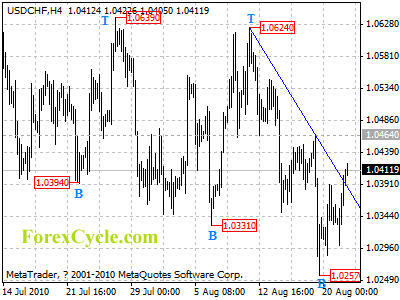
USDCHF broke above the downtrend line from 1.0624 to 1.0464

USDCHF broke above the downtrend line from 1.0624 to 1.0464, suggesting that a cycle bottom is being formed at 1.0257 on 4-hour chart. Key resistance is at 1.0464, a break above this level will confirm the cycle bottom and indicate that the fall from 1.0624 had completed, then the following upward movement could bring price to 1.0550-1.0600 area. Support is at 1.0257, only break below this level could trigger another fall to 1.0200 zone.

usdchf

Daily Forex Forecast

Forex: Speculators increase short Euro positions for first time in seven weeks, Pound positions fall short

By CountingPips.com

The most recent Commitments of Traders (COT) report released on Friday showed that futures speculators increased their bets for the U.S. dollar against the euro for the first time in seven weeks. The COT data as of August 17th, released by the Chicago Mercantile Exchange showed that non-commercial futures positions, those taken by hedge funds and large speculators, were net short the euro against the U.S. dollar by -14,627 contracts. This is an increase of 10,896  contracts after being net short the euro by -3,731 contracts the week before on August 10th. Euro short positions had declined for six consecutive weeks and on August 10th marked their best showing since the week of December 8, 2009 when positions were short by -511 contracts.

The COT report is published every Friday by the Chicago Mercantile Exchange (CME) and shows futures positions as of the previous Tuesday. It can be a useful tool for traders to gauge investor sentiment and to look for potential changes in the direction of a currency or commodity. Each currency contract is a quote for that currency directly against the U.S. dollar, where as a net short amount of contracts means that more speculators are betting that currency to fall against the dollar and net long position expect that currency to rise versus the dollar.

The euro and the British pound sterling were the only major currencies on the short side against the dollar last week in the CME futures market. The Australian dollar, New Zealand dollar, Japanese yen, Swiss franc, Canadian dollar and Mexican peso all continued to have a net long amount of contracts.

The British pound sterling numbered 4,431 short positions as of August 17th after being on the long side on August 10th with 5,021 long positions. The turn back to a net total of short positions reverses five straight weeks of improvements for British pound positions against the dollar.

Swiss franc long positions, which moved over to the long side against the dollar in the middle of June, rose to 11,750 long contracts as of August 17th after falling to 10,901 long contracts the week prior.

The Japanese yen net long contracts edged lower last week to 49,969 from 52,478 net long contracts on August 10th. Yen positions have made a substantial rise from May after being short by -65,612 contracts on May 4th.

The Australian dollar futures positions continued to advance and gained for sixth straight week. Aussie contracts were net long by 57,697 contracts as of August 17th following a net of 54,370 long contracts on August 10th. New Zealand dollar futures positions edged lower for second week with 12,139 long contracts after a total of 12,544 long contracts as of August 10th.

The Canadian dollar long positions fell to a net of 29,514 long contracts after 41,179 net longs the week before while Mexican peso long contracts also dipped after gaining for five straight weeks to 70,553 longs from 72,369 longs the week prior.

COT Data Summary (Net Positions vs. the US Dollar) as of August 17th, 2010

Euro: 14,627 short contracts from 3,731 shorts on August 10th
British pound sterling: 4,431 short contracts from 5,021 long contracts
Australian dollar: 57,697 long contracts from 54,370
Canadian dollar: 29,514 long contracts from 41,179
Japanese yen: 49,969 long contracts from 52,478
Mexican peso: 70,553 long contracts from 72,369
New Zealand dollar: 12,139 long contracts from 12,544
Swiss franc: 11,750 long contracts from 10,901

Go to the Commitment of Traders CME raw futures data

Could A Guru Boost Your Trading?

By Jonathan Dayan – Visualize a professional financial trader who was so good at what he or she did that they actually outperformed the world’s best investment funds. Imagine that it was possible for you to recruit this talented individual as your personal trading guru who you could learn from, interact with and even copy: trade for trade. Now imagine that doing so wouldn’t cost you a cent. That’s the potential opportunity that several social trading networks are now dangling in front of new recruits. If it sounds too good to be true then you should definitely read on.

The ability to recruit a “guru” who you can use as a model for your trading decisions is one of the key advantages offered by social trading networks. By using a social trading network you can see how every other member of the social trading community is investing, learn for yourself how successful individual traders are proving and even decide to directly copy the trades of any trader you choose. This is a powerful tool for traders at all levels of ability because frankly who wouldn’t want a guru to help show them the way, particularly if the privilege doesn’t cost you anything.

Choose Your Own Expert

These days, a lot of people out there seem to regard themselves as financial experts. Every month seems to bring ever more books and blogs advertising the latest sure-thing tip for better financial trading. As consumers and traders, however, what guarantees do we have that the experts we’re being asked to believe in are actually any more effective as financial trader than we are ourselves? Social trading networks offer the opportunity to actually see their top traders ranked right before your eyes. With a whole heap of usable statistics available on social trading websites like eToro’s OpenBook it becomes much easier for you to see for yourself how your potential gurus shape up. There are now thousands of traders active on social trading networks, and more all the time, as a result you now have the opportunity to select for yourself any trader or collection of traders to be your personal guru/s simply by reviewing the performance of the members of the social trading community.

Follow Your Guru

It’s now easier than ever before to follow the trading activity of traders you respect. Social trading networks offer sophisticated monitoring and alert tools which let you know what your chosen traders are trading and when they’re trading it. Better still, they give you the ability to keep tabs on their success rates so you can learn for yourself which parts of their trading strategies are yielding the most success and which are proving to be ineffective.

What You Can Learn About Your Guru Through A Social Trading Network:

  • Which country they’re from
  • The assets they’re trading
  • The direction they’re trading in
  • The success ratio of their trades
  • The risk level they take in their trades
  • When they open and close their positions
  • What others are writing about them

Observe, Interact, Copy

At the center of the appeal which social trading networks offer is the ability to get to the heart of how other people trade the financial markets. With the range of trading tools that the social trading networks offer you can see every aspect of the trading of any financial trader you choose to observe. With messaging features bundled into most of the social trading networks you also have the ability to contact your chosen traders and ask them questions about their trading strategies or for advice in your own trading. Of course there is no guarantee that they’ll respond but those that do can offer you valuable hints and tips to help you improve your financial trading. Perhaps the most powerful ability offered by social trading networks is the capacity to directly copy any of the trades which other traders execute. The value of this is hard to overstate – particularly for first time traders, because it offers you the opportunity to profit from the financial markets together with the best traders on the network. Picture the situation: you’ve trawled through the trader rankings, picked out the trader you want to follow and now you have the opportunity to copy in real-time any or all of the trades which they execute – this unprecedented ability makes social trading networks a uniquely powerful tool for financial traders.

More Guru Power, No Cost

Just how powerful a tool social trading networks are for traders who are seeking to get the benefit of other traders’ wisdom is made crystal clear when you compare the kind of access you get to your potential guru through a social trading network with the access you get to a fund manager when you subscribe to an investment fund. Aside from the first and very obvious difference that you pay to get the benefit of a fund manager whereas social trading networks like the eToro OpenBook are completely free to join there are a number of other differences.  Firstly, whereas as mentioned before you can see every aspect of a potential gurus trading behavior through a social trading network, when you invest in a fund you only get intermittent and limited reports on the activity of the fund as a whole. Secondly, when deciding to copy the trades of a potential guru the final choice whether to invest or not by following a particular trade is always your own. An investment fund, however, requires you to sign off on all the investment decisions made by the portfolio manager which takes away from you the freedom to query their judgment on a case by case basis or to follow them in only those parts of their strategy where they’re strong.

In conclusion here’s a lot to be said for the guru concept and for social trading networks in general. Information is power in financial trading and social trading networks supply it by the barrel load. In particular they give you the tools to see for yourself how other traders are performing, information which you can use to follow and even copy the trades of those traders you most respect. As a result, you earn the opportunity to recruit the power of a trading superstar to help boost your trading without it costing you money or the freedom to ultimately decide how you trade for yourself.

Forex Market Analysis provided by eToro

Disclaimer: Trading in the Foreign Exchange market might carry potential rewards, but also potential risks. You must be aware of the risks and are willing to accept them in order to trade in the foreign exchange market. Don’t trade with money you can’t afford to lose.