GBP/CHF Bullish Correction May be in the Making

Anton Eljwizat – The GBP has dropped significantly versus the CHF in the past 3 weeks, and it is currently traded around 157.35. And now as evident in the data below, the 4-hour chart is giving bullish signals, indicating that GBP/CHF pair might go up. Forex traders can take advantage of this impending movement by having their Entry Orders in place to capture this reversal.

• Below is the 4-hour chart of the GBP/CHF currency pair.

• The technical indicators that are used are the William Percent Range and Slow Stochastic.

• Point 1: The Slow Stochastic indicates an impending bullish cross, signaling that the next move may be in an upward direction.

• Point 2: The Williams Percent Range has peaked near at the -100 marker, which means that there may actually be a strong level of upward pressure.

• The volatile downward movement which occurred prior to this upward correction has generated these indicators, and there appears to be room for this correction to continue.

GBP/CHF 4-Hour Chart

Forex Market Analysis provided by ForexYard.

© 2006 by FxYard Ltd

Disclaimer: Trading Foreign Exchange carries a high level of risk and may not be suitable for all investors. There is a possibility that you could sustain a loss of all of your investment and therefore you should not invest money that you cannot afford to lose. You should be aware of all the risks associated with Foreign Exchange trading.

Yen Continues to Strengthen

Source: ForexYard

The Japanese yen made another bullish move against the majors as the steps taken by the Bank of Japan to weaken the yen only served to increase traders’ resolve to increase bullish bets on the Japanese currency.

Economic News

USD – Dollar Stronger Following Lower Equities

The dollar traded higher versus the euro and the pound but weaker versus the yen in illiquid trading conditions. Much of today’s trading revolved around negative sentiment for an increase in economic activity in the global economy.

The EUR/USD was trading lower at 1.2655 after opening the day at 1.2737. The GBP/USD was also down at 1.5470, from an opening day price of 1.5526. The USD/JPY was lower at 84.55 after opening at 85.38.

The US Commerce Department released a report showing that personal spending was in line with economists’ expectation of an increase of 0.4% over the previous month. However, US Consumer Income rose only 0.2% on expectations of a 0.3% increase.

The Dow Jones Industrials Average finished lower by 1.39% on light trading. The New York Stock Exchange recorded its lowest trading volumes of the year. Only 3.2B shares traded hands yesterday. On average over 5B shares are traded on a daily basis. August is known to be a slow month as many traders are away from their trading desks on vacation. Also not helping the volumes was a banking holiday in London. Low volumes allow for price movements to be exaggerated in illiquid trading conditions.

Consumer data will once again be back in the spotlight as the CB Consumer Confidence index will be released today at 14:00 GMT. The report carries significant weight as consumer spending makes up a majority of US GDP.

The EUR/USD has broken out from a bearish flag pattern and will likely test the support level at 1.2610. A breach below this line could send the pair to its next support level at 1.2465.

EUR – Euro Weaker on Light Volume

The euro was down across the board but fell significantly versus the Japanese yen. A lack of liquidity was seen in today’s trading as London banks were closed in observance of the summer bank holiday.

The EUR/GBP was down at 0.8180, after opening the day at 0.8202. The EUR/JPY was sharply lower at 107.08, from an opening day price of 108.76.

Driving the yen higher versus the euro was the market’s lack of enthusiasm towards the Bank of Japan’s program to expand liquidity by increasing loans to banks. Traders were looking for more concrete action by the BOJ to actively intervene in the currency markets to halt the strengthening yen.

Traders will be following the release of the German unemployment change due to be released at 09:00 GMT. Economists have forecasted a drop of 19K jobs over the previous month for Europe’s largest economy.

JPY – Yen Continues to Strengthen Despite BOJ Easing

The Bank of Japan’s (BOJ) attempt to stem the yen’s strengthening looks to be in vain as traders continue to bid up the Japanese currency. Continued risk aversion has traders moving into the yen as a safe haven, pushing the yen to a 15-year high.

The USD/JPY was down sharply at 84.55 after opening the day at 85.38.

The BOJ announced that it will offer Japanese financial institutions 10 trillion yen of loans in new 6-month loans at the basement interest rate of 0.1%. This comes on top of the 20 trillion yen 6-month loans the BOJ had previously been offering.

Despite the new policy that is mean to weaken the yen, the market did not react positively and continued to buy the yen. Traders will now be looking for direct intervention in the currency markets by the BOJ to weaken the yen. Until now, Japan’s tough talk and new liquidity provisions have not impressed the markets. The yen should continue to strengthen below its 15-year low versus the dollar at 84.00.

OIL – Crude Oil Snaps 3-day Win Streak

Spot crude oil prices fell yesterday as traders reduced their exposure to risky assets. This snapped a 3-day streak of rising prices for the commodity. Pushing the price of crude oil down were weak equity markets and lackluster consumer data released from the US.

The price of spot crude oil fell to $74.05, following an opening day price of $75.16. At one point in the day the price of spot crude oil fell to $70.77, the lowest price the commodity has traded since early June.

Traders will want to eye tomorrow’s CB Consumer Confidence index, along with Wednesday’s weekly crude oil inventory data. These two data pieces will be the main influencers this week. Traders should also be mindful of movements in the major equities indexes, such as the Dow Jones Industrials Average. Lately spot crude oil prices have been taking price moves from fluctuations in the equity markets. The next resistance level for spot crude oil rests at $75.50.

Technical News

EUR/USD

The cross has experienced much bearishness yesterday, and currently stands at the 1.2650 level. There is much evidence in the chart’s oscillators that supports a possible bullish correction today. This is supported by the 4-hour chart’s Slow Stochastic. Going long with tight stops may turn out to bring big profits today.

GBP/USD

The daily chart is showing mixed signals with its RSI fluctuating at the neutral territory. However, the 8-hour Chart’s RSI is already floating in the oversold territory indicating that a bullish correction might take place in the nearest future. When the upwards breach occurs, going long with tight stops appears to be preferable strategy.

USD/JPY

The pair has recorded much bearish behavior in the past several days. However, the technical data indicates that this trend may reverse anytime soon. For example, the 4-hour chart’s Stochastic Slow signals that a bullish reversal is imminent. An upward trend today is also supported by the 2-hour chart’s Slow Stochastic. Going long with tight stops may turn out to pay off today.

USD/CHF

The USD/CHF has gone increasingly bearish yesterday, and currently stands at the 1.0240 level. The 8-hour chart’s Slow Stochastic supports this currency cross to fall further today. However, the 4-hour chart’s RSI signals that a bullish reversal will take place today. Entering the pair when the signs are clearer seems to be the wise choice today.

The Wild Card

USD/CAD

This pair’s sustained upward movement has finally pushed its price into the over-bought territory on the 4-hour chart’s RSI. Not only that, but there actually appears to be a bearish cross on the Slow Stochastic pointing to an imminent downward correction. Forex traders have the opportunity to wait for the downward breach on the hourlies and go short in order to ride out the impending wave.

Forex Market Analysis provided by ForexYard.

© 2006 by FxYard Ltd

Disclaimer: Trading Foreign Exchange carries a high level of risk and may not be suitable for all investors. There is a possibility that you could sustain a loss of all of your investment and therefore you should not invest money that you cannot afford to lose. You should be aware of all the risks associated with Foreign Exchange trading.

BOJ Easing Program Fails to Halt the Yen’s Appreciation

By Russell Glaser – The Bank of Japan pledged 10 trillion worth of new loans in the local currency to Japanese financial institutions. However, traders scoffed at this initiative and continued to bid up the yen. Perhaps only direct intervention by the BOJ will provide some respite for Japanese exporters who are feeling the sting of a strong local currency.

Today’s Major Data Releases:

EUR – German Unemployment Change – 07:55 GMT
Expected: -19K. Previous: -20K.
Germany is Europe’s largest economy and therefore has the most influence on the direction of the euro.

CAD – GDP m/m – 12:30 GMT
Expected: 0.2%. Previous: 0.1%.
America’s largest trading partner is reports Q2 GDP today. Expectations aren’t high with only 0.2% growth forecasted due to the slump in oil prices.

USD – CB Consumer Confidence – 14:00 GMT
Expected: 50.7. Previous: 50.4.
Consumer spending is the engine of the US economy. Strong numbers should be favorable for the greenback

EUR/USD – The pair has broken out of a bearish flag pattern. The 1.2610 support should be tested today. A breach below this level could send the pair to the 1.2465 support level.

Yen – Until the BOJ starts selling yen on the open market, there is no reason to be short on the Japanese currency.

Spot Crude Oil – 3 days of consecutive gains were snapped yesterday, but this shouldn’t stop the rising price. The next resistance level for spot crude oil rests at $75.50.

Forex Market Analysis provided by ForexYard.

© 2006 by FxYard Ltd

Disclaimer: Trading Foreign Exchange carries a high level of risk and may not be suitable for all investors. There is a possibility that you could sustain a loss of all of your investment and therefore you should not invest money that you cannot afford to lose. You should be aware of all the risks associated with Foreign Exchange trading.

Forex Daily Market Review Aug 31, 2010

By eToro – Weaker than expected retail PMI combined with a retreat to a safe haven currencies, bolstered the dollar and weakened the Euro. The Euro declined below 1.27 and will test trend line support below.

Click here to read the full daily Review

Forex Market Analysis provided by eToro

Disclaimer: Trading in the Foreign Exchange market might carry potential rewards, but also potential risks. You must be aware of the risks and are willing to accept them in order to trade in the foreign exchange market. Don’t trade with money you can’t afford to lose.

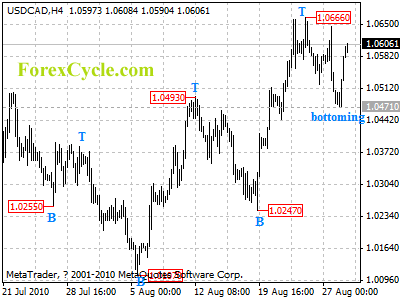
USDCAD rebounded strongly from 1.0471

USDCAD rebounded strongly from 1.0471, suggesting that a cycle bottom is being formed on 4-hour chart. Another rise to test 1.0676 (Jul 6 high) key resistance is possible in a couple of days, a break of this level will confirm the cycle bottom, then further rise to 1.0750 could be seen. Key support is now at 1.0471, below this level will indicate that the uptrend from 1.0107 has completed at 1.06666 already, then the following downward movement could bring price back to 1.0200 zone.

usdcad

Daily Forex Signals

Forex Daily Market Commentary

By GCI Forex Research

Fundamental Outlook at 1400 GMT (EDT + 0400)

The euro depreciated vis-à-vis the U.S. dollar today as the single currency tested bids around the US$ 1.2670 level and was capped around the $1.2765 level.  Today’s intraday high was right around the 23.6% retracement of the $1.3335 – 1.2580 range.  Liquidity was reduced on account of the Bank holiday in the U.K. and market holidays elsewhere.  The media reported the European Central Bank will likely extend its emergency aid program for the banking system into 2011.  There is increasing speculation the U.S. economy is heading toward a double dip recession that could dim Europe’s economic recovery.  Data released in the eurozone today saw the EMU-16 August business climate indicator tick lower to 0.61 from the revised print of 0.63 while August consumer confidence improved to -11 from from the prior reading of -12.  August industrial confidence was unchanged at -4 and August services confidence ticked higher to +7.  Data to be released in the eurozone tomorrow include the EMU-16 flash August estimate and the EMU-16 July unemployment rate.  In U.S. news, data released today saw July personal income up 0.2% while July personal spending came in at +0.4%, more-than-expected and up from the prior reading of 0.0%.  Also, the July PCE deflator was up 1.5% y/y and July core PCE was up 0.1% m/m and 1.4% y/y.  Finally, the Dallas Fed’s August manufacturing activity index improved to -13.5.  Data to be released in the U.S. tomorrow include the August Chicago PMI survey, August consumer confidence, and June CaseShiller home prices data.  Minutes from the Federal Open Market Committee’s 10 August meeting will also be released tomorrow and closely scrutinized given the Fed’s decision to reinvest maturing mortgage-backed securities proceeds into the U.S. Treasury market.  Dealers are still talking about Fed Chairman Bernanke’s comments on Friday regarding how the Fed could ease policy further if required including shifting the composition of its bond reinvestment strategy.  Euro offers are cited around the US$ 1.3240 level.

¥/ CNY

The yen appreciated vis-à-vis the U.S. dollar today as the greenback tested bids around the ¥84.55 level and was capped around the ¥85.90 level. The pair briefly traded above the ¥85.80 level, representing the 23.6% retracement of the ¥92.85 – 83.60 range.  As expected by many Bank of Japan-watchers, the central bank held an emergency Policy Board meeting and expanded its bank lending program – the first time it has added new monetary stimulus since March.  BoJ is increasing the amount of funds in the facility by ¥10 trillion to a total of ¥30 trillion.  BoJ Governor Shirakawa indicated the central bank is poised to take more action if required and cited “downside risks” to Japan’s ongoing economic recovery.  Shirakawa left the Fed’s Jackson Hole symposium early to attend the meeting in Tokyo amid increasing pressure from the government to enact more monetary easing.  More traders, however, are speculating the change in policy will not have a major impact on the economy or on the yen.  Vice finance minister Ikeda welcomed the central bank’s “swift response.”  There is no indication that Japanese monetary authorities are any closer to conducting unilateral yen-selling intervention than they were last week.  Consumer prices have been on the decline for seventeen months, household spending remains weak, and gross domestic product growth is decelerating.  Former BoJ Policy Board member Nakahara said the central bank’s easing today is “too little and too late” and argued they are “meaningless and can’t stop the yen’s advance.”  Nakahara added “Lowering the policy rate to zero is a must to stem the yen’s gains.  The BoJ should also boost outright purchases of bonds by another ¥500 billion.  Increased bond purchases would enable the government to generate funds for more public works spending.  As a whole, Japan can’t live without spending by companies and the government.”  Prime Minister Kan reported he will consider a supplementary budget if necessary.  Data to be released in Japan overnight include July industrial production and July retail trade.  The Nikkei 225 stock index climbed 1.76% to close at ¥9,149.26.  U.S. dollar bids are cited around the ¥84.60 level.   The euro moved lower vis-à-vis the yen as the single currency tested bids around the ¥107.25 level and was capped around the ¥109.55 level.  The British pound moved lower vis-à-vis the yen as sterling tested bids around the ¥130.95 level while the Swiss franc moved lower vis-à-vis the yen and tested bids around the ¥82.15 level. In Chinese news, the U.S. dollar appreciated vis-à-vis the Chinese yuan as the greenback closed at CNY 6.8033 in the over-the-counter market, up from CNY 6.7980.  Data to be released in China Wednesday include August PMI manufacturing numbers followed by August PMI services data on Friday.  The yen fell significantly after a rumour circulated that People’s Bank of Governor Zhou may have defected on account of a possible US$ 430 billion loss on U.S. Treasury bond holdings.  The rumours likely represent a power struggle within the Communist Party.  PBoC adviser Xia Bin called for a floating interest rate mechanism for bank deposits and noted economic growth is expected to slow this year.

£

The British pound depreciated vis-à-vis the U.S. dollar today as cable tested bids around the US$ 1.5455 level and was capped around the US$ 1.5575 level.  Data released in the U.K. last night saw the August Hometrack housing survey off 0.3% m/m and up 1.5% y/y.  Data to be released in the U.K. tonight include the GfK August consumer confidence survey and it is expected to print around -24.  Net consumer credit and mortgage lending data will be released tomorrow.  Bank of England Chief Economist Bean spoke at Jackson Hole and said “The deleveraging process is incomplete, the recovery remains fragile, and a considerable margin of spare capacity is yet to be worked off, while further policy action may yet be necessary to keep the recovery on track.”  Cable bids are cited around the US$ 1.5385 level.  The euro depreciated vis-à-vis the British pound as the single currency tested bids around the £0.8160 level and was capped around the £0.8215 level.

CHF

The Swiss franc appreciated vis-à-vis the U.S. dollar today as the greenback tested bids around the CHF 1.0235 level and was capped around the CHF 1.0310 level.  Swiss National Bank member Jordan said the central bank is closely monitoring the Swiss franc “very closely” and said Switzerland’s monetary policy situation remains “very complex.”  Jordan also cited a “small” short-term risk of deflation.   Some traders believe SNB may be forced to resume its franc-selling intervention to stop the euro’s sharp decline on the cross.  The July UBS consumption indicator will be released tomorrow followed by August PMI on Wednesday, Q2 GDP and July retail sales on Thursday, and August consumer price inflation on Friday.  U.S. dollar offers are cited around the CHF 1.0980 level.  The euro depreciated vis-à-vis the Swiss franc as the single currency tested bids around the CHF 1.2980 level while the British pound moved lower vis-à-vis the Swiss franc and tested bids around the CHF 1.5840 level.

Forex Daily Market Commentary provided by GCI Financial Ltd.

GCI Financial Ltd (”GCI”) is a regulated securities and commodities trading firm, specializing in online Foreign Exchange (”Forex”) brokerage. GCI executes billions of dollars per month in foreign exchange transactions alone. In addition to Forex, GCI is a primary market maker in Contracts for Difference (”CFDs”) on shares, indices and futures, and offers one of the fastest growing online CFD trading services. GCI has over 10,000 clients worldwide, including individual traders, institutions, and money managers. GCI provides an advanced, secure, and comprehensive online trading system. Client funds are insured and held in a separate customer account. In addition, GCI Financial Ltd maintains Net Capital in excess of minimum regulatory requirements.

DISCLAIMER: GCI’s Daily Market Commentary is provided for informational purposes only. The information contained in these reports is gathered from reputable news sources and is not intended to be U.S.ed as investment advice. GCI assumes no responsibility or liability from gains or losses incurred by the information herein contained.

Forex: Speculators increase short Euro positions for a second week

By CountingPips.com

Following six straight weeks of improvement in the euro futures positions that coincided with a rise for the EUR/USD pair over 1.3300, forex speculators have increased their short positions for the euro against the US dollar for a second consecutive week. The latest Commitments of Traders (COT), released by the Chicago Mercantile Exchange, showed that non-commercial futures positions, those taken by hedge funds and large speculators, were net short the euro against the U.S. dollar by -21,603 contracts as of August 24th. This is an increase of almost 7,000 short contracts after speculators were net short the euro by -14,627 contracts on August 17th. Euro short positions had shown improvement for six consecutive weeks before the recent turnaround and marked their best showing on August 10th since the week of December 8, 2009 when positions were short by -511 contracts.

The COT report is published every Friday by the Chicago Mercantile Exchange (CME) and shows futures positions as of the previous Tuesday. It can be a useful tool for traders to gauge investor sentiment and to look for potential changes in the direction of a currency or commodity. Each currency contract is a quote for that currency directly against the U.S. dollar, where as a net short amount of contracts means that more speculators are betting that currency to fall against the dollar and net long position expect that currency to rise versus the dollar.

The euro and the British pound sterling were the only major currencies on the short side against the dollar last week in the CME futures market. The Australian dollar, New Zealand dollar, Japanese yen, Swiss franc, Canadian dollar and Mexican peso all continued to have a net long amount of contracts.

The British pound sterling numbered -4,365 short positions as of August 24th after being on the short side on August 17th with -4,431 positions. Pound sterling positions had improved for five straight weeks before last week’s decline that saw British pound futures reach 5,021 long positions on August 10th.

The Japanese yen net long contracts edged higher last week to 51,069 from 49,969 net long contracts reported on August 17th. Yen positions have continued to stay around the +50,000 level for the past four weeks after being short by -65,612 contracts on May 4th.

Swiss franc long positions increased for a second straight week to 13,868 long contracts as of August 24th after rising to 11,750 long contracts the week prior.

The Australian dollar futures positions declined to a net amount of 47,017 long contracts as of August 24th following six straight weeks of increases. New Zealand dollar futures positions edged lower for third straight week with 10,683 long contracts after a total of 12,139 long contracts as of August 17th.

The Canadian dollar long positions fell for a second consecutive week to a net of 16,147 long contracts after 29,514 net longs the week. Mexican peso long contracts also dipped for a second week after gaining for five straight weeks to 59,370 longs from 70,553 longs the week prior.

COT Data Summary as of August 24th, 2010

Large Speculators Net Positions vs. the US Dollar

Euro: 21,603 short contracts from 14,627 shorts on August 17th
British pound sterling: 4,365 short contracts from 4,431 short
Australian dollar: 47,017 long contracts from 57,697
Canadian dollar: 16,147 long contracts from 29,514
Japanese yen: 51,069 long contracts from 49,969
Mexican peso: 59,370 long contracts from 70,553
New Zealand dollar: 10,683 long contracts from 12,139
Swiss franc: 13,868 long contracts from 11,750

Go to the Commitment of Traders CME raw futures data

Is the Euro’s Short Rally Over? – August 30, 2010

eurusd, fiber, euro, eur usd, euro usd, usd eur, usd euro, forex, forex market, forex trading, trading forex, currency trading, daily forex picks, forex forecast, forex analysis

Good day to you my Forex friends! Here’s an update on the EURUSD or the fiber as what they call it on Wall Street. The last time I covered the pair (please see my previous post here), it had just broken down from a head and shoulders formation. Since then, the pair has rallied to form what appears to be a rising wedge pattern. In case you do not know, a wedge is generally a continuation pattern as it just represent a short term rebound in prices. Such rally could be due to profit taking or short covers. At present, the pair is encountering some resistance at the neckline of the head and shoulders. If it’s unable to move past the neckline and it falls below the support of the rising wedge, it could slip at least back to 1.2600 level. Further weakness could push it all the way down to the previous low at 1.2150.

The highlight of the week for the euro zone will be the the European Central Bank’s monetary policy decision on Thursday (September 2). The ECB is expected to hold its interest rates again at 1.00% following a drop in German yields. 30-year yield, for your information, have dropped to below 3.00%. And despite the “cheap” borrowing costs, inflation at least in Germany remains subdued. In fact, the latest month-over-month German CPI reading reads at 0.00%. With consumption and inflation low, the ECB would likely be a little dovish about its short term forecast on the euro zone’s economy as a whole. Such could then send investors back to the safety of the USD.

More on LaidTrades.com

The S&P 500 and the US Economy on Shaky Ground – August 30, 2010

S&P 500 2010, $SPX, SPX, us economy, us market, stock marekt, stock trading, stock market trading, double dip recession

Welcome to another week of stock trading my friends! Last week I noted the possibility of a breakdown in the Dow Jones Industrial Average (please see it here). Well, guess what. The broader S&P 500 appears to confirm where the Dow and the US economy are heading. As you can see from the $SPX’s weekly chart, the index has been forming a head and shoulders pattern. Remember that a couple of month’s ago it already attempted to breakdown but failed. Of course, it was a good thing that that did not happen. The question is, will it be able to avoid a breakdown this time around? Well, the S&P 500 rebounded very well last Friday with a gain 1.66% to close at 1064.59. It, however, would need to print a lot more than that to be completely out of the woods. You see, a a break below the formation’s neckline around the 1,000.00 region could send the broader index just below 850.00. Notice also that both the RSI, which is already below 50, and the MACD, which is in the negative region, are now indicating that the index’s downside move is starting to pick up speed. Let’s just just hope that the index is able to rebound and move past the peeks of the two shoulders and the head to resume its uptrend.

Existing home sales sunk by 27.2% to a 3.83 million seasonally adjusted annual rate which was below the market forecast of 4.72 million in July. This marks the accounts lowest tally since 1999! New home sales also weakened significantly to 276,000 from 315,000. Last year, sales were supported by the government’s tax credits. Sales, however, became subdued when this program expired. As I’ve mentioned in my previous post, perhaps the government could support the industry by re-introducing the same program to encourage home buyers.

Last Friday, Fed Chairman Bernanke’s said that he foresees a rebound in the US economy in 2011. He added that the Fed is prepared to use another set of “unconventional measures” if the economy does not pick up as desired in the near term. Do I hear quantitative easing? Well, the Fed’s benchmark interest rate is already at 0.00-0.25% so the next thing that the Fed can do is to do another set of QE and/or reduce the financial institution’s reserve ratio to provide more liquidity in the market.

In my opinion, both the Congress and the central bank should work hand in hand in order to prevent the economy from collapsing again. Because if it does collapse, the average Joes would find themselves in worse shoes. Unemployment would almost certainly pick up with a deterioration in market confidence. This would not only affect the US but would also send shockwaves across the globe. There is no such thing as a perfect decoupling because of globalization and trade. Hence, if the US sinks, other economies, even the emerging ones would find themselves in a very difficult situation.

Anyway, the week will kick off for the US with the release of the Conference Board sentiment index on tomorrow (August 31). The CB consumer sentiment is forecasted to rise slightly to 50.9 from 50.4. Though the market’s confidence as of late has been obviously dampened due to the disappointing home sales figures. ADP employment change results and the ISM manufacturing index are also due on Wednesday (September 1). The ISM index is seen to have softened a bit to 53.3 from 55.5. Remember, however, that the latest tally of the Philadelphia Fed Manufacturing index showed a drastic drop to -7.7 from 5.1. Such could also reflect in the ISM’s number. On Thursday, pending home sales, which are anticipated to have dipped again by -1.5% after already losing by 2.6%, will be reported. still, a worse-than-projected count could happen given the previous results of the new and existing home sales. The spotlight, of this week though will be the NFP report of Friday. Firms are seen to have slashed another 101,000 jobs which could push the economy’s unemployment rate to 9.6% from 9.5%.

Given the recent data and the present market forecast, worse-than-expected results are very much likely in at least one of the accounts. Such could send the market back to risk aversion mode which then could send the major indices into critical levels. Still, anything is possible. Let’s just hope for the best and prepare for the worse. But given the uncertainties, I suggest that you at least lighten your positions in equities.

More on LaidTrades.com

Gold Set for a Bearish Correction

By Dan Eduard – Gold prices have been rising substantially over the last few weeks, as the commodity is being seen more and more as a safe haven while the pace of the global economic recovery is being questioned. As we will show through a number of technical indicators, prices may have reached a saturation point, meaning a downward correction could take place.

For our analysis, we will be looking at the 8-hour chart for gold, provided by Forexyard. The technical indicators being used are the Relative Strength Index (RSI), the Williams Percent Range and the MACD.

1. As can be seen, the RSI is currently trading right above the upper resistance line, at the 70 level. This is typically seen as a sign that gold is in overbought territory and a bearish correction is likely to take place.

2. The Williams Percent Range is trading right at the -20 level. Anything above this level is considered to be overbought, and is usually considered to be a sign of impending downward movement.

3. The MACD has formed a cross well above the moving signal in a clear indication that the commodity has reached a saturation point in the market. Traders can expect downward movement, as investors are likely to begin selling off their positions.

Forex Market Analysis provided by ForexYard.

© 2006 by FxYard Ltd

Disclaimer: Trading Foreign Exchange carries a high level of risk and may not be suitable for all investors. There is a possibility that you could sustain a loss of all of your investment and therefore you should not invest money that you cannot afford to lose. You should be aware of all the risks associated with Foreign Exchange trading.