Forex: US Dollar Falls, Stocks rise on manufacturing data. ADP Employment declines in August

By CountingPips.com

The US dollar has been trading lower against most of the major currencies in the forex markets as positive manufacturing data has boosted risk appetite today. The positive investor mood has pushed the higher yielding currencies as well as the US stock markets to higher trading levels in the afternoon of the US trading session. The dollar has been decreasing on the day versus the euro, British pound sterling, Australian dollar, New Zealand dollar, Swiss franc and the Canadian dollar while trading higher against the Japanese yen.

The US stock markets, meanwhile, have surged higher on the first trading day in September with the Dow Jones industrial average increasing by over 200 points, the NASDAQ up by over 50 points and the S&P 500 higher by over 25 points at time of writing. Oil has risen by $2.12 to the $74.04 level while gold has fallen by $4.70 dollars to trade at the $1243.60 level.

ISM Manufacturing data increases for 13th month

U.S. Manufacturing data activity surpassed market forecasts and rose for the 13th straight month in August, according to today’s report by the Institute for Supply Management. The ISM Report On Business index reading for economic activity was at a 56.3 score in August following July’s reading of 55.5. A score above 50 is considered to be growth and less than 50 is considered to be contraction in that sector.

Market forecasts were predicting a decline for the month of August and a reading of 52.8 in the index.

Norbert J. Ore, chairman of the ISM Business Survey Committee, commented in the report that, “Manufacturing activity continued at a very positive rate in August as the PMI rose slightly when compared to July. In terms of month-over-month improvement, the Production and Employment Indexes experienced the greatest gains, while new orders continued to grow but at a slightly slower rate. August represents the 13th consecutive month of growth in U.S. manufacturing.”

The customers inventories and prices indexes both rose by over 4.0 percentage points in August, according to the report. Production increased by 2.9 percent, employment rose by 1.8 percent while the backlog of orders index fell by 3.0 percent. Exports declined by 1.0 percent while imports edged higher by 4.0 percent to round out the data.

August ADP employment data reverses six months of gains

U.S. employment data released today in the form of the ADP National Employment Report showed that U.S. private employment declined unexpectedly in the month of August. The nonfarm private employment fell by 10,000 workers in August following the revised increase of 37,000 jobs in July. The jobs data for July was revised slightly lower from the original estimate of 42,000 jobs gained. ADP private employment had risen for six consecutive months from February to July before the August decrease.

Today’s job report was a surprise to market forecasters that were expecting an approximate increase of 15,000 jobs for the month.

The service-providing sector registered an increase of 30,000 jobs in August while the goods-producing sector fell by 40,000 jobs. Manufacturing had a loss of 6,000 jobs, construction jobs fell by 33,000 workers and the financial services sector  decreased by 5,000 workers. Construction and financial services jobs have now both continued to decline for over three years straight, according to the ADP report.

Medium-size businesses shed 6,000 workers in August while small businesses or companies with less than 50 workers registered a decrease of 6,000 workers. Large businesses or companies with more than 500 workers saw employment payrolls virtually unchanged for the month.

The market-moving US Nonfarm Payrolls report for August is to be released Friday at 12:30 pm GMT with early market forecasts predicting a loss of approximately 105,000 jobs following a decline of 131,000 workers in July.

3 Reasons Now is Not the Time to Speculate in Stocks

Sometimes the investment weather forces you to ‘buy a coat,’ says Robert Prechter

By Elliott Wave International

When it’s sunny, you head outside without a thought, but when it’s rainy, you look for your umbrella.

When the markets are trending up, you don’t worry about your investments much, but when the markets turn bearish … what do you do?

In an interview with Jeff Sommer of The New York Times in July 2010, Robert Prechter said that he is convinced that a “market decline of staggering proportions” is on its way, and that individual investors should get out of the market and into cash and cash equivalents, such as Treasury bills.

“I’m saying: ‘Winter is coming. Buy a coat,'” Prechter said. “Other people are advising people to stay naked. If I’m wrong, you’re not hurt. If they’re wrong, you’re dead. It’s pretty benign advice to opt for safety for a while.”

Read some of the latest nuggets directly from Elliott Wave International President Robert Prechter’s desk — FREE. Click here to download a free report packed with recent analysis and forecasts from Prechter’s Elliott Wave Theorist.

For more specific advice as to why now is not the right time to speculate in stocks, here’s an excerpt from chapter 20 of Prechter’s business best-selling book, Conquer the Crash — You Can Survive and Prosper in a Deflationary Depression, 2nd edition 2009.

* * * * *

Should You Speculate in Stocks?

Perhaps the number one precaution to take at the start of a deflationary crash is to make sure that your investment capital is not invested “long” in stocks, stock mutual funds, stock index futures, stock options or any other equity-based investment or speculation. That advice alone should be worth the time you spent to read this book.

1. Stocks May Go to Near Zero

In 2000 and 2001, countless Internet stocks fell from $50 or $100 a share to near zero in a matter of months. In 2001, Enron went from $85 to pennies a share in less than a year. These are the early casualties of debt, leverage and incautious speculation. Countless investors, including the managers of insurance companies, pension funds and mutual funds, express great confidence that their “diverse holdings” will keep major portfolio risk at bay. Aside from piles of questionable debt, what are those diverse holdings? Stocks, stocks and more stocks. Despite current optimism that the bull market is back, there will be many more casualties to come when stock prices turn back down again.

2. Stock Mutual Funds Will Fall, Too

Not only will many stocks fall 90 to 100 percent, but so will a substantial number of stock mutual funds, which cannot exit large equity positions without depressing prices and which have the added burden to you of one percent (or more) annual management fees. The good news is that we will finally find out who the few truly good fund managers are and which ones were heroes by virtue of being around for a bull market.

3. The Fed Won’t Be Able To Save the Stock Market

Don’t presume that the Fed will rescue the stock market, either. In theory, the Fed could declare a support price for certain stocks, but which ones? And how much money would it commit to buying them? If the Fed were actually to buy equities or stock-index futures, the temporary result might be a brief rally, but the ultimate result would be a collapse in the value of the Fed’s own assets when the market turned back down, making the Fed look foolish and compromising its primary goals, as cited in Chapter 13. It wouldn’t want to keep repeating that experience. The bankers’ pools of 1929 gave up on this strategy, and so will the Fed if it tries it.

Read some of the latest nuggets directly from Elliott Wave International President Robert Prechter’s desk — FREE. Click here to download a free report packed with recent analysis and forecasts from Prechter’s Elliott Wave Theorist.

This article was syndicated by Elliott Wave International and was originally published under the headline 3 Reasons Now is Not the Time to Speculate in Stocks. EWI is the world’s largest market forecasting firm. Its staff of full-time analysts led by Chartered Market Technician Robert Prechter provides 24-hour-a-day market analysis to institutional and private investors around the world.

Gold Testing All-Time High, Again

By Russell Glaser – Spot gold prices have surged and are closing in on their all-time high. Negative risk sentiment surrounding the recovery of the global economy and renewed inflation fears have caused traders to once again begin to bid the price of gold higher.

The price of spot gold yesterday up at $1,246.75, after opening the day at $1,236.75.

Spot gold prices have climbed off of their lows of $1,156. The rebound in the price comes as fears of a double dip recession and slowing global economic growth are weighing on the market, influencing traders to buy gold as a safe haven asset.

Negative fundamentals from the US housing sector may be influencing traders. A lack of confidence and spending has ensued since the US government ended the subsidies it enacted to support the lagging housing sector.

Yesterday’s release of the Federal Reserve Open Market Committee (FOMC) meeting minutes provided an insight into the Fed’s thought. The Fed voted 9-1 to keep the Fed’s balance sheet at its current level by purchasing treasuries as the MBS that the Fed hold on its books expire. Dissent was voiced during the 2 days meeting as many FOMC members felt deflation was not an issue. However, they did express their views that higher inflation could return if the Fed did not drain the excess liquidity from the money supply.

Other factors that may be moving the price of spot gold higher are heavier trade volumes as traders return to their trading desks from the summer holidays. Also wedding season in India during the fall months typically spurs an uptick in the demand for gold.

Turning to the weekly chart, a rising trend line begins at the end of September of 2009 with the price making 3 points of contact with the trend line. This indicates this is a significant trend line. Momentum points to a price move higher as the Momentum (7) is sloping higher.

The all-time high of $1,265 looks to be in range with support appearing at $1,224, (S1) followed by $1,156 (S2).

Forex Market Analysis provided by ForexYard.

© 2006 by FxYard Ltd

Disclaimer: Trading Foreign Exchange carries a high level of risk and may not be suitable for all investors. There is a possibility that you could sustain a loss of all of your investment and therefore you should not invest money that you cannot afford to lose. You should be aware of all the risks associated with Foreign Exchange trading.

GBP/USD – Moving Average MACD Combo Trade

By Russell Glaser – The Cable continues to move lower and is setting up an opportunity to short the pair and enter into a trend at the beginning of the move.

Since the August high the price of the GBP/USD has fallen. The long term trend line has been broken and the trend has shifted to the downside. Now the GBP/USD is ripe for an entry short.

The trade setup uses the 50 and 100 day exponential moving averages (EMA) along with the MACD. The trade can also use a simple moving average, but the goal is to enter into a trend at the early stages in order to capture the most from the directional move. The exponential moving average adds more weight to the most recent close. This should help to get into the trade quicker.

Once the price falls below the farthest moving average by more than 10 pips, an entry short should be made. Currently the 100 day EMA is trading at 1.5335. Today the low for the GBP/USD was 1.5326, 1 pip shy of triggering our trade. It is apparent that the 100-day EMA is acting as a significant support level.

A filter for the trade is the MACD histogram. The MACD histogram is currently trading at -34. If the histogram had not moved into the negative territory, the trade would be rejected.

A stop can be placed at the 5-day high of 1.5600 to limit losses if the price goes against the trade.

Profits should be taken at 2x risk, or roughly the early June high at 1.4770.

Forex Market Analysis provided by ForexYard.

© 2006 by FxYard Ltd

Disclaimer: Trading Foreign Exchange carries a high level of risk and may not be suitable for all investors. There is a possibility that you could sustain a loss of all of your investment and therefore you should not invest money that you cannot afford to lose. You should be aware of all the risks associated with Foreign Exchange trading.

Will Crude Oil Reach A 2-Month Low?

By Yan Petters – The sharpest trend that was observed during yesterday’s trading is bearish crude oil. Crude oil has erased almost all of this week’s gains, and has bottomed at $71.52 a barrel. Crude oil is dropping due to concerns that the U.S. economy, the world’s largest oil consumer, is not recovering as fast as it should. Several leading economic publications from the U.S. have recently failed to reach expectations, and it is now commonly agreed that the recovery pace is slower than estimates.

However, this trend might reverse today, as a heavy news day, especially from the U.S. economy is expected.

Here are today’s leading news events:

• 08:30 GMT, British Manufacturing Purchasing Managers’ Price Index (PMI – It is a survey of about 600 purchasing managers who are asked to rate their current business conditions. If the end result will beat expectations for 57.1, the GBP might be supported.

• 12:15 GMT, U.S. ADP Non-Farm Employment Change – It is an estimation of the Non-Farm Payrolls release which is expected by Friday. The ADP forecast is considered to be very reliable, and thus tends to have a large impact on the market. If the end result will be positive, the dollar might be boosted as a result.

• 14:00 GMT, U.S. ISM Manufacturing Purchasing Managers’ Index (PMI) – This indicator is similar to the British one. Analysts have forecasted that the result will be 53.2. A higher result might support the dollar.

Forex Market Analysis provided by ForexYard.

© 2006 by FxYard Ltd

Disclaimer: Trading Foreign Exchange carries a high level of risk and may not be suitable for all investors. There is a possibility that you could sustain a loss of all of your investment and therefore you should not invest money that you cannot afford to lose. You should be aware of all the risks associated with Foreign Exchange trading.

Forex Daily Market Review Sep 01, 2010

By eToro – The Euro consolidated near 1.27 as better than expected housing numbers and strong Asian data kept the Euro from retreating. The market is waiting for a deluge of European and US data expected during the balance of the week.

Click here to read the full daily Review

Forex Market Analysis provided by eToro

Disclaimer: Trading in the Foreign Exchange market might carry potential rewards, but also potential risks. You must be aware of the risks and are willing to accept them in order to trade in the foreign exchange market. Don’t trade with money you can’t afford to lose.

ADP Non-Farm Employment Change on Tap ‎

Source: ForexYard

After the U.S. dollar corrected some of its gains yesterday, a new trading day, packed with significant ‎economic publications is ahead. Most attention should be given to the U.S. ADP Non-Farm Employment ‎Change, which attempts to estimate Friday’s release of Non-Farm Payrolls. Current expectations are for a ‎positive result, will the dollar erase yesterday’s losses?‎

Economic News

USD – Dollar Weakens Despite Positive Consumer Confidence Report

The U.S. dollar fell against most of the major currencies during yesterday’s trading session. The dollar ‎began yesterday’s trading with a sharp 100 pips loss vs. the euro, which was slightly corrected later on. The ‎dollar saw a mild drop against the Japanese yen as well.‎

The dollar fell yesterday after the Institute for Supply Management Chicago said that U.S. business activity ‎grown at a slower pace than expected. The business activity in the U.S. expanded this month at the ‎lowest rate this year as the business barometer dropped to 56.7 on August, the lowest since November, ‎failing to reach expectations to 57.3. The dollar’s fell came despite a surprising positive release of the ‎Consumer Confidence report. The Consumer Confidence is a survey of about 5,000 households which are ‎asked to rate their current and future economic conditions. The survey showed that the consumer ‎confidence improved unexpectedly in August to 53.5, from 51.0 in July, well above expectations for 50.7. It ‎currently seems that investors still have concerns regarding the growth of the U.S. economy, and as a ‎result the dollar is continues to weaken against the yen.‎

Looking ahead to today, a batch of data is expected from the U.S. economy. The most significant news ‎releases looks to be the ADP’s prediction of this month Non-Farm Payrolls figures. The estimate is that the ‎employment condition has improved during the recent month. Such a result might correct some to the ‎dollar’s losses against the euro and the yen.‎

EUR – Euro Strengthens On Positive Global Data

The euro soared today against most of its major counterparts. The EUR/USD pair climbed over 100 pips ‎towards the 1.2740 level during early trading, yet eventually closed the trading day around the 1.2685 level. ‎The euro gained about 100 against the British pound and about 50 pips versus the Japanese yen.‎

The European currency strengthened yesterday as economic publications from the U.S. and the Euro-‎Zone have eased concerns regarding a global economic slowdown. Report showed today that home ‎prices in 20 U.S. cities rose more than expected in June from a year earlier. In addition, the U.S Consumer ‎Confidence survey unexpectedly rose for the first time in three months. Positive data was published from ‎the Euro-Zone as well today. The European Consumer Price Index Flash Estimate showed that inflation in ‎the Euro-Zone grew by 1.6%, according to expectations. The inflation in the Euro-Zone grows in a stabile ‎pace for several months now, indicating that the European economies are stabilizing.‎

The positive global data has increased risk-aversion in the market, and turned investors to look for risker ‎assets, such as the euro. It seems that further positive signals of global economic recovery might boost ‎the euro further.‎

As for today, the most significant economic release from the Euro-Zone looks to be the German Retail ‎Sales, which is scheduled for 06:00 GMT. Analysts have forecasted that retails sales in Germany slightly ‎rose in July. If the end result will be similar, the euro might extend its bullish trend today.‎

JPY – Yen Continues To Strengthen Vs. The Majors

The Japanese yen rose today against most of the major currencies during yesterday’s trading. The yen ‎gained about 140 pips against the British pound. The yen also saw a 90 pips rise vs. the U.S. dollar on early ‎trading.‎

Positive data from the Japanese economy has supported the yen yesterday. The Average Cash Earnings ‎report, which measures that change in the total value of employment income collected by workers, rose ‎by 1.3% on July, beating expectations for a 0.9% rise. In addition, the Housing Starts report showed that ‎the number of new residential buildings that began construction grew by 4.3% on July, reaching well ‎above expectations for a 2.5% rise. The positive figures have supported estimations that the Japanese ‎economic recovery is advancing, and as a result boosted the yen.‎

Looking ahead to today, no significant publications are expected from the Japanese economy. Traders are ‎advised to follow the major publications from the U.S. economy, and to follow U.S. and Japanese equity ‎markets. Traders should take under consideration that positive signals might increase risk-aversion, and as ‎a result weaken the yen.‎

OIL – Crude Oil Drops To $71.52 a Barrel

Crude oil dropped for the second consecutive day today. Crude oil fell about 250 pips during yesterday’s ‎trading session. A barrel of oil was traded for around $74.15 during yesterday morning, and dropped to a ‎daily low of $71.52 a barrel.‎

Crude oil prices fell yesterday as investors are concerned that oil demand in the U.S. will recover during ‎the second quarter of the year, following a lower than expected consumption in the first quarter. The U.S. ‎economy is the biggest oil consumer in the world, and recent reports have suggested that the U.S. ‎economic recovery is slowing down. It seems that for as long that until the U.S. economy will provide clear ‎signals of improvement, crude oil prices might continue to decline.‎

As for today, the U.S. Crude Oil Inventories is scheduled for 14:30 GMT. Traders are advised to follow this ‎report, as its publication tends to have an instant impact on crude oil prices. Traders are also advised to ‎follow the major publications from the U.S. economy, especially the ADP Non-Farm Employment Change ‎release.‎

Technical News

EUR/USD

The daily chart is showing mixed signals with its RSI fluctuating in the neutral territory. However, the 4-‎hour chart’s Slow Stochastic is indicating a fresh bullish cross suggesting that an upward correction might ‎take place in the nearest time frame. When the upward breach occurs, going long with tight stops appears ‎to be the preferable strategy. ‎

GBP/USD

The pair has been range-trading for a while now, with no specific direction. The daily chart’s Slow ‎Stochastic provides us with mixed signals. All oscillators on the 4-hour chart do not provide a clear direction ‎as well. Waiting for a clearer sign on the hourlies might be a good strategy today. ‎

USD/JPY

The price of this pair appears to be floating in the over-bought territory on the hourly and daily RSI, ‎suggesting downward pressure. There also appears to be a fresh bearish cross on the 4-hour and daily ‎Slow Stochastic, indicating that the next movement will likely be down. Going short might be a wise choice ‎today. ‎

USD/CHF

There is a fresh bullish cross forming on the 4-hour chart’s Slow Stochastic, indicating bullish correction ‎might take place in the nearest future. The upward direction on the weekly chart’s Momentum oscillator ‎also supports this notion. Going long with tight stops might be the right strategy today.‎

The Wild Card

NZD/JPY

The recent upward mobility of this pair has pushed most of its indicators into a downward corrective ‎position. With the RSI on the hourly and 4-hour charts showing over-bought, mixed with fresh bearish ‎crosses on these charts’ Slow Stochastic, an imminent downward correction may not be far off the mark. Forex traders can take advantage of this impending move by entering their short positions now and riding ‎out the wave as it descends to a more stable price level. ‎

Forex Market Analysis provided by ForexYard.

© 2006 by FxYard Ltd

Disclaimer: Trading Foreign Exchange carries a high level of risk and may not be suitable for all investors. There is a possibility that you could sustain a loss of all of your investment and therefore you should not invest money that you cannot afford to lose. You should be aware of all the risks associated with Foreign Exchange trading.

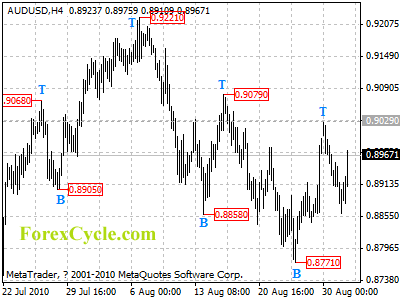
AUDUSD formed a cycle top at 0.9029

AUDUSD formed a cycle top at 0.9029 level on 4-hour chart. Range trading between 0.8771 and 0.9029 is expected in a couple of days. Key resistance is at 0.9029, a break above this level will indicate that the fall from 0.9221 has completed at 0.8771 already, then further rise towards 0.9221 previous high could be seen, only break below 0.8771 could trigger another fall to 0.8600 area.

audusd

Daily Forex Forecast

Forex Daily Market Commentary

By GCI Forex Research

Fundamental Outlook at 1400 GMT (EDT + 0400)

USD

The dollar was a touch higher overnight as figures released in the US were generally considered acceptable, especially in light of the recent downturn in expectations. However, the focus will be on the Fed in the coming months as investors remain concerned about the prospect of a double-dip. Equity markets are still trading on a soft note as Asian markets followed the US weaker. Yesterday’s data included personal income and spending and PCE figures. Consumption was a tad stronger than consensus while income rose a little less than consensus estimates. But the report did show a stronger gain in private wages and salaries, which is an important support for a sustainable recovery. Core PCE prices were inline with expectations. That said, there are several headline releases this week and the next round includes the S&P/CaseShiller data, the Conference Board consumer confidence index, Chicago PMI and the FOMC minutes. Housing has been a very weak point as of late but the S&P/CaseShiller index lags changes in price trends. FOMC minutes will not likely be surprising as Fed Chairman Bernanke and other Fed officials have already explained the rationale for the latest policy adjustments. And the Conference Board figure could reflect the recent weakening trend in claims data. EURUSD traded 1.2633-1.2672, USDJPY 84.13-85.67.

EUR

The Eurozone sentiment surveys were largely in line with expectations. Consumer confidence was slightly better on the month (-11 vs. -12 cons.) and the business climate indicator dipped to 0.61 (cons. 0.70).

Following Trichet’s unsurprising comments at Jackson Hole last week, we, along with consensus, expect an unchanged policy rate and do not expect officials to announce any new measures. While we will get some final PMI readings in the Eurozone along with retail sales and CPI estimates, data in the US will be the main driver for EURUSD.

JPY

Data released overnight was better than expected for Japan, industrial production increased by 0.3% in July (cons. -0.2%) while retail sales also strengthened by 0.7% on the month. Nevertheless the market remains focused on the potential course of action to stem the JPY’s strength from the BoJ/MoF, due to be announced this week.

USDJPY dipped during the New York session though at a slower pace than the overnight session. Investors remain sceptical on the latest BoJ easing measures and US data will likely remain a key driver for USDJPY. PM Kan is still expected to announce some steps for fiscal stimulus but investors are likely to keep USDJPY heavy until they get further clarity as to what exactly “decisive action” on FX actually constitutes.

CAD

The Q2 current account deficit was slightly larger than expected at -C$11.0bn, with lower exports to the US a key drive and the data could dampen expectations for the upcoming Q2 GDP figure. While Q2 GDPis expected to be less robust than Q1, consensus estimate is still +2.5% annualized. The near-term outlook will likely be more rangebound as investors try and gauge the US economic outlook given the significant trade ties between the US and Canada but Canada’s relatively less expansionary policies, improving fiscal deficit and sounder financial sector should mitigate some of the overhang from concerns on the global growth backdrop.

AUD

Figures released overnight in Australia showed stronger retail sailes (+0.7%m/m) and building approvals (2.3%m/m). Net exports also came in stronger than expected at 0.4% of GDPq/q. Our team notes that the figures released today suggest a decent start to Q3. Though home prices have stalled and credit growth subdued, ‘real growth’ looks to be proceeding.

TECHNICAL OUTLOOK

EURUSD BEARISH While resistance holds at 1.2933, expect loses to target 1.2588 with scope for 1.2434 Fibonacci retracement level.

USDJPY BEARISH Approaches 83.60 trend low, move below the level would expose 79.75 key support. Short-term resistance is defined at 85.91 intraday high.

GBPUSD NEUTRAL Motion is sideways; while 1.5713 and 1.5324 mark the key near-term directional triggers, a move above 1.5999 is required to resume the bull trend.

USDCHF BEARISH Clearance of 1.0131 would open up the way towards 0.9918. On the upside resistance holds at 1.0466 ahead of 1.0676.

AUDUSD NEUTRAL Model has turned neutral; 0.9222 and 0.8771 act as the next bull and bear triggers respectively.

USDCAD BULLISH As long as support at 1.0248 holds, expect the gains to target 1.0680 with scope for 1.0853 next.

EURCHF BEARISH The cross continues to define fresh trend lows. Next support lies at 1.2742 ahead of 1.2403. Near-term resistance comes in at 1.3146.

EURGBP BEARISH Focus is on 0.8068; break of the level would expose 0.7974. Short-term resistance is defined at 0.8247 ahead of 0.8363.

EURJPY BEARISH Momentum is negative; the pair targets 105.44 with scope for 100.00 next. Near-term resistance is defined at 111.11 ahead of 114.74.

Forex Daily Market Commentary provided by GCI Financial Ltd.

GCI Financial Ltd (”GCI”) is a regulated securities and commodities trading firm, specializing in online Foreign Exchange (”Forex”) brokerage. GCI executes billions of dollars per month in foreign exchange transactions alone. In addition to Forex, GCI is a primary market maker in Contracts for Difference (”CFDs”) on shares, indices and futures, and offers one of the fastest growing online CFD trading services. GCI has over 10,000 clients worldwide, including individual traders, institutions, and money managers. GCI provides an advanced, secure, and comprehensive online trading system. Client funds are insured and held in a separate customer account. In addition, GCI Financial Ltd maintains Net Capital in excess of minimum regulatory requirements.

DISCLAIMER: GCI’s Daily Market Commentary is provided for informational purposes only. The information contained in these reports is gathered from reputable news sources and is not intended to be U.S.ed as investment advice. GCI assumes no responsibility or liability from gains or losses incurred by the information herein contained.