Forex Daily Market Commentary

By GCI Forex Research

Fundamental Outlook at 0800 GMT (EDT + 0400)

USD

The main risk event ahead is today’s FOMC announcement. Although the prospect of further quantitative easing has been highlighted for this meeting, our analysts do not think that will be the case. They expect little change to the statement language describing the current conditions or the outlook. On the growth outlook, however, our team notes that Fed officials may alter the phrase that near-term growth will be “more modest…than had been anticipated” in order to avoid implying a further downgrade. While there is a possibility that the Fed might signal increased readiness to ease its balance sheet policy further, our analysts do not believe that the medium-term outlook has deteriorated enough to warrant the change. If no further quantitative easing is announced, the USD should be supported as expectations of further quantitative easing being priced in weighed on the USD last week.


EUR

Sovereign bond yields rose across the peripherals in the European session over fears that Portugal may not be able to meet its fiscal targets. Both Portuguese and Irish 10y spreads vs. Germany reached record highs, widening to 375 and 412 basis points, respectively. This followed news on Friday, where a headline in an Irish newspaper warned that Ireland was “perilously close” to calling in the IMF. The government described the article as “a local misinterpretation of a research report”, and the IMF said it does not foresee its assistance being needed in Ireland.
Ahead of today’s Irish bond auction, in an attempt to calm the market, Irish Prime Minister Cowen and Finance Minister Lenihan held a press conference in which PM Cowen said that he had the full support of his colleagues and Finance Minister Lenihan said that bond markets are not influenced by minor political disputes.
Both ECB Governing Council Members Nowotny and Mersch opined on the future of the ECB’s liquidity tenders, a topic that has proven to be a significant driver of the euro in recent weeks. Nowotny noted that some parts of the Eurozone banking system are “addicted” to ECB liquidity, and that the problem should be solved primarily by governments. Mersch said he saw “no need to hold onto full allotment”, noting that “short term rates can be very easily controlled via competitive tenders”.
JPY

With Japan on holiday, USDJPY was relatively quiet and range bound on Monday despite an early dip, suggesting the BoJ has not been active in FX markets since Wednesday.
Speculation is mounting that a bill aimed at incorporating an explicit inflation target into BoJ Law could soon be presented to Japan’s Diet. We are sceptical of claims that a change to the Law is imminent on two counts: first, parliamentary time in the immediate future is likely to focus on agreeing the terms of the budget for the coming fiscal year; second, a change to BoJ Law would require the approval of both the upper and lower houses of parliament. With no party holding a majority in the upper house, at the very least this would likely complicate and delay the passage of any such bill. The next parliamentary session is expected to begin in early October.
GBP

M4 money supply fell by 0.2% m/m, leaving the annual rate at a record low of 1.8%. Mortgage backed approvals in August fell roughly in line with consensus at 45k, an indication that the recent housing market recovery may have been exhausted.
AUD

RBA Governor Stevens offered a relatively hawkish assessment, noting that. “the fall in inflation over the past two years won’t go much further.” However, he did acknowledge that the global growth outlook was uncertain and that although global growth will be “reasonable” next year, it would not be as strong as the current year. Stevens also identified three key risks to Australia: a deeper than expected slowdown in China, a US double-dip, and the return of market turmoil.


CAD

Finance Minister Flaherty said Canada’s fiscal stimulus measures would expire as planned in March 2011.
Ahead today is Canada August CPI. The July CPI had a jump at the headline due to provincial tax changes. The August read in expected to be more subdued and the focus will be on the core CPI read relative to the BoC’s forecast. Our economists expect core CPI to tick up 0.1% m/m leaving the year-on-year rate unchanged at 1.6%.

TECHNICAL OUTLOOK


EURCHF resistance at 1.3391.
EURUSD NEUTRAL Need a break above 1.3334 to trigger bullish trend. Support holds at 1.2919.
USDJPY NEUTRAL Momentum is slowing; while resistance is at 85.93, support comes in at 85.20 ahead of 84.05 retracement level.
GBPUSD BULLISH While support at 1.5297 holds, expect recovery to target 1.5999 with scope for 1.6258 next.
USDCHF BEARISH Clearance of 0.9933/18 would expose 0.9786 next. Near-term resistance comes in at 1.0278 ahead of 1.0466.
AUDUSD BULLISH Expect gains to target 0.9500 ahead of 0.9850. Near-term support is at 0.9309 ahead of 0.9196.
USDCAD NEUTRAL 1.0509 and 1.0108 mark the key near-term directional triggers.
EURCHF NEUTRAL Recovery found resistance at 1.3391 ahead of 1.3482 retracement level. Near-term support comes in at 1.2991.
EURGBP NEUTRAL Trading within 0.8532 and 0.8142 which have now become the key directional triggers.
EURJPY NEUTRAL Break of 114.74 would put odds in favour of positive tone. Next resistance at 116.68. Support holds at 107.73 ahead of 105.44 key low.

Forex Daily Market Commentary provided by GCI Financial Ltd.

GCI Financial Ltd (”GCI”) is a regulated securities and commodities trading firm, specializing in online Foreign Exchange (”Forex”) brokerage. GCI executes billions of dollars per month in foreign exchange transactions alone. In addition to Forex, GCI is a primary market maker in Contracts for Difference (”CFDs”) on shares, indices and futures, and offers one of the fastest growing online CFD trading services. GCI has over 10,000 clients worldwide, including individual traders, institutions, and money managers. GCI provides an advanced, secure, and comprehensive online trading system. Client funds are insured and held in a separate customer account. In addition, GCI Financial Ltd maintains Net Capital in excess of minimum regulatory requirements.

DISCLAIMER: GCI’s Daily Market Commentary is provided for informational purposes only. The information contained in these reports is gathered from reputable news sources and is not intended to be U.S.ed as investment advice. GCI assumes no responsibility or liability from gains or losses incurred by the information herein contained.

Markets Cautious Ahead of FOMC Meeting Statements

Source: ForexYard

The Dollar is under pressure ahead of the Federal Reserve meeting statements later today, as the possibility of further quantitative easing measures by the Fed weigh on the greenback.

Economic News

USD – Markets Await the FOMC Meeting Statements

The U.S Dollar fell against most counterparts Monday over concerns ahead of today’s Federal Reserve meeting. Speculations regarding another round of economic stimulus put investors in a cautious mood. The FOMC meeting minutes has overshadowed lingering Euro-Zone sovereign-debt issues, allowing the EUR and other counterparts to advance versus the USD as the possibility of additional asset purchasing programs weighed on the Dollar.

The U.S. Dollar did make gains on the U.K Pound, gaining around 0.5%, after Bank of England lending data measuring broad money supply for July was flat and mortgage approvals dropped to the lowest level since April 2009.

Investors were exercising caution ahead of an FOMC announcement and most currencies remained within narrow ranges. While it is not expected that more quantitative easing programs will be announced, there is the possibility the Fed will surprise the markets and be more proactive.

While the FOMC statement is the most highly anticipated news release for today, traders should also follow the release of the Building Permits and Housing Starts, both due at 12:30 GMT. The housing market remains one of the most important and highly followed indicators as a measure of economic recovery.

EUR – Renewed Sovereign Debt Concerns Weigh on EUR

The single currency came under modest pressure at the end of last week as worries about European sovereign debt increased. The EUR’s strength will be further tested this week with Irish and Portuguese debt auctions Tuesday and Wednesday, respectively.

The Pound fell against the EUR and the greenback after a report showed mortgage approvals dropped to the lowest level since April 2009. The GBP declined versus all of its major counterparts as signs the U.K.’s housing market weakened, threatened to undermine the country’s recovery from the recession.

Late Monday, the EUR was at $1.3064 from $1.3039 from late Friday and at 111.96 Yen from 112.89 Yen. The U.K. Pound was at $1.5547 from $1.5626.

The EUR/USD pair is currently trading within a tight range and is likely to remain between $1.30 and $1.31 ahead of the FOMC meeting minutes.

JPY – The AUD at a 2 year high

A Japanese holiday Monday kept Yen trading light as investors still keep an eye out for more Japanese intervention.

The Australian Dollar, a growth linked currency, gained more than 1% against the greenback. Reserve Bank of Australia Governor Glenn Stevens’s strong assessment of the Australian economy boosted the AUD higher versus the Dollar. The hawkish remarks lifted expectations of an impending interest rate hike boosting the currency.
The Australian Dollar Monday hit a series of two-year highs, topping out at $0.9495 from $0.9372 late Friday.

Crude Oil – Crude Recovers on Rising Equities

Crude Oil futures settled higher Monday as rising U.S. equities boosted optimism about the economic outlook. Light, sweet Crude for October delivery settled $1.20 higher at $74.86 a barrel on the New York Mercantile Exchange after trading as high as $75.45 earlier in the session. Spot crude is currently trading around $76 a barrel. The October crude contract is due to expire at the end of trading today.

Future economic growth and demand remain the main drivers behind oil prices. For today the focus will be on economic data as well as comments from the Federal Reserve. With Oil Inventories remaining high, the strength of the U.S economy is the most valuable tool to gauge future oil demand.

Technical News

EUR/USD

The EUR/USD cross has experienced a bullish trend for the past week. However, it seems that this trend may be coming to an end. For example, the daily chart’s Stochastic Slow signals that a bearish reversal is imminent. A downward trend today is also supported by the hourly chart’s Slow Stochastic. Going short with tight stops may turn out to pay off today.

GBP/USD

There is a bearish cross forming on the daily chart’s Slow Stochastic indicating a bearish correction might take place in the nearest future. The downward direction on the hourly chart’s Slow Stochastic also supports this notion. When the downward breach occurs, going short with tight stops appears to be preferable strategy.

USD/JPY

The 4-hour chart is showing mixed signals with its Slow Stochastic fluctuating at the neutral territory. However, a bearish cross forming on the daily chart’s Slow Stochastic implies that downwards correction might take place in the nearest time frame. Going short with tight stops might be the right strategy today.

USD/CHF

The typical range trading on the hourly chart continues. The daily chart Slow Stochastic is floating in neutral territory. However, the 4-hour Chart’s RSI is already floating in the oversold territory indicating that a bullish correction might take place in the nearest future. Going long with tight stops might be the right strategy today.

The Wild Card

Gold

Gold prices rose significantly in the last week and peaked at $1283 an ounce. However, the daily charts’ RSI is floating in an overbought territory suggesting that a recent upwards trend is loosing steam and a bearish correction is impending. This might be a good opportunity for forex traders to enter the trend at a very early stage.

Forex Market Analysis provided by ForexYard.

© 2006 by FxYard Ltd

Disclaimer: Trading Foreign Exchange carries a high level of risk and may not be suitable for all investors. There is a possibility that you could sustain a loss of all of your investment and therefore you should not invest money that you cannot afford to lose. You should be aware of all the risks associated with Foreign Exchange trading.

Short Term Technical Analysis for Majors (08:00 GMT)

EUR/USD

Undergoes consolidation mode following yesterday’s upside rejection at 1.3156, just under 1.3186, trendline resistance. Correction has reached 1.3018 low and this now marks an initial support, as triangle is forming. Upside break will open 1.3156 for retest and above here to expose 1.3186/1.3227. Loss of 1.3020, however, would warn of fresh weakness and risk 1.2975/50 instead.

Res: 1.3095, 1.3120, 1.3156, 1.3186
Sup: 1.3020, 1.2975, 1.2955, 1.2920

GBP/USD

Extends correction off 1.5728, 17 Sep high, breaking below 1.5535/11, 16/20 Sep lows/50%retracement of 1.5295/1.5728 upleg. This opens way for further retracement, and opens 1.5461, 61.8% level.

Res: 1.5595, 1.5621, 1.5652, 1.5684
Sup: 1.5480, 1.5461, 1.5449, 1.5389

USD/JPY

Moving lower off congestive tops at 85.90 zone, with break below yesterday’s spike low at 85.50 exposing risk towards 85.21. Loss of the latter would weaken the structure, while regain of 85.80/92 will hint fresh gains and expose 86.38 next.

Res: 85.80, 85.92, 86.38, 86.89
Sup: 85.21, 85.00, 84.72, 84.50

USD/CHF

Continues to trend lower following reversal off 1.0181, and upside rejection at 1.0116, with more than 61.8% being retraced so far, at 1.0019. This confirms a negative near-term structure for retest of 0.9998/31. Only regain of 1.0116 would ease the bear pressure.

Res: 1.0073, 1.0086, 1.0116, 1.0149
Sup: 0.9998, 0.9965, 0.9931, 0.9916

Markets Cautious Ahead of FOMC Statement

printprofile

Today’s main news events are both from the United States. Following the recent wave of negative U.S. news, investors are eager to see whether today’s indicators will generate momentum for the global economic recovery.

Here is a roundup of the day’s main events.

Housing Starts/Building Permits – USD – 12:30 GMT

The housing market remains one of the major drivers behind the economic recovery and as such, is one of the major economic indicators in the U.S. economy. The indicators measure the number of new building permits issued and new buildings under construction respectively. After the expiration of the housing credits last month, all housing related numbers have dropped and have proven to be very volatile publications. Any number below expectations will likely boost the USD as investors will shy away from riskier currencies in favor of the safe haven greenback.

FOMC Statement – USD – 18:15

The FOMC statement tends to generate great anticipation and market volatility. Today’s meeting is particularly interesting as the recent wave of negative economic data has fueled speculations that the Fed will resume its asset purchases program, known as quantitative easing. This puts pressure on the USD since continuation of the program will basically mean pumping more dollars into the economy, a step that typically weakens the greenback. Whether or not the Fed will resume quantitative easing is yet to be seen, but the recent stagnation in the U.S. economic recovery does require some action and investors are eagerly awaiting news of the meeting minutes.

Investors will be following closely for any clues of future monetary policy moves by the Fed as well as their assessment of the strength of the U.S economic recovery.

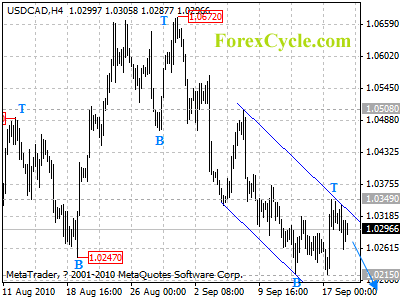
USDCAD pulled back from 1.0349

Being contained by the upper boundary of the falling price channel on 4-hour chart, USDCAD pulled back from 1.0349, suggesting that a cycle top is being formed. Further fall towards 1.0215 would more likely be seen later today, a break below this level will indicate that the downtrend from 1.0672 has resumed, then next target would be at 1.0150 area. However, a break above 1.0349 will suggest that the downward move from 1.0672 has completed at 1.0215 already, then the following uptrend could bring price back to 1.0600 zone.

usdcad

Daily Forex Forecast

How Will Today’s FOMC Meeting Affect the USD?

printprofile

With the FOMC meeting minutes expected to be published today at 18:15 GMT, the main question is whether or not the Fed will hold off from further purchasing securities or decide to expand the stimulus further and thus its balance sheet. With the economy showing signs of slowing for the past two quarters and unemployment enduring at 9.5% or higher for the past year, speculations began to surface the Fed will resume its quantitative easing program in order to stimulate the flailing economy. The negative economic indicators that were published over the past few weeks reinforced this assumption. The Fed is also trying to avoid deflation. The Core CPI, U.S. consumer prices excluding food and energy, rose 0.9% in July from a year earlier, the smallest increase in four decades.

It seems, however, that there is much debate within the Central Bank as well as among investors on how the Fed should continue. Members of the Federal Open Market Committee are divided over whether to renew quantitative easing which is essentially a large-scale asset purchase program. Several members believe the Fed has already done enough and that there are impediments to growth unrelated to monetary policy such as uncertainty regarding taxes and regulatory policy as well as the lagging housing sector.

The Federal Reserve has kept the benchmark interest rate at almost zero since December 2008 and bought about $1.7 trillion in securities. Additional quantitative easing can have adverse effects on inflation in the longer run as this move essentially pumps cash into the economy.

Analysts are also divided in their assumptions, largely due to the fact that the latest data has been slightly better than expected. Manufacturing in August expanded at a faster pace than forecast as factories added workers and increased production. Private employers increased payrolls by 67,000 last month, exceeding economists’ estimates.

The Federal  Reserve’s move is important not only for the USD but for other currencies as well, particularly the JPY as the Bank of Japan has recently intervened in the market in order to weaken the Yen. Japan’s economy is highly dependent on export and therefore a strong currency can hinder its economic recovery. However, due to speculation of further monetary easing by the Fed, Bank of Japan Governor Masaaki Shirakawa’s attempts may be hindered as quantitative easing contributes to a weaker USD.

Swedish Election Leads to SEK Gains

By Dan Eduard – Following an election day shakeup in Sweden, in which the Prime Minister’s party failed to secure the necessary votes to form a parliamentary majority, the Swedish krona was able to make modest gains against both the US dollar and euro. The currency market typically experiences a lot of fluctuation in times of political turmoil, and today was no different.

USD/SEK dropped over 700 pips since markets opened for the week before staging a very modest correction. Currently the pair is trading around the 7.0190 level. EUR/SEK dropped almost 600 pips in the same amount of time and is currently trading around the 9.1950 level. It appears that until a government is formed, the SEK is likely to move back and forth against its main currency rivals. At the moment, the currency is most definitely in a bullish trend.

The other Scandinavian currencies have not been as profitable as their Swedish counterpart. The Norwegian krone has seen decidedly mixed results against the US dollar and euro, and is currently bearish against both. The Danish krone on the other hand has seen steady gains against the US dollar as of late. USD/DKK has tumbled almost 1900 pips over the last week, and is currently trading around the 5.6840 level.

The Scandinavian kroner is likely to see another volatile week, as significant economic publications are forecasted from both the US and euro-zone. Traders will want to pay attention to the most recent US Federal Funds Rate statement on Tuesday, as well as a batch of French and German news being released on Thursday. Should any of the news boost investor come in at or above expectations, the Scandinavian currencies are likely to see mid-week gains.

Forex Market Analysis provided by ForexYard.

© 2006 by FxYard Ltd

Disclaimer: Trading Foreign Exchange carries a high level of risk and may not be suitable for all investors. There is a possibility that you could sustain a loss of all of your investment and therefore you should not invest money that you cannot afford to lose. You should be aware of all the risks associated with Foreign Exchange trading.

Forex Daily Market Commentary

By GCI Forex Research

Fundamental Outlook at 1400 GMT (EDT + 0400)

The euro appreciated vis-à-vis the U.S. dollar today as the single currency tested offers around the US$ 1.3120 level and was supported around the $1.3035 level.  There are multiple themes being focused on by traders today.  First, the Federal Open Market Committee’s interest rate decision will be released tomorrow.  The Fed is expected to keep monetary policy unchanged following its decision on 10 August to reinvest maturing mortgage debt back into the U.S. Treasury market.  Second, many larger institutional investors are predicting U.S. market interest rates will be significatly lower in Q1 2011 with some forecasts calling for a 1.75% U.S. Treasury note yield.  Third, there are renewed financial strains in the eurozone.  Yields on credit default swaps for some peripheral economies like Ireland and Greece remain elevated.  Some dealers are speculating the Irish government will be forced to seek bailout assistance from the International Monetary Fund or the European Union.  ECB member Honohan called on the Irish government to reduce its budget deficit at a quicker pace to bolster investor confidence.  Fourth, some traders are anticipating the Fed could cut its economic forecast in the short-term.  Growth projections may be reduced by the central bank before the end of the year.  In anticipation of a more pessimistic Fed outlook, two-year U.S. Treasury yields are near all-time lows.  Bundesbank reported Germany’s economic recovery remains intact but added its growth dynamic has slowed “markedly.”  European Central Bank member Nowotny said the ECB’s “exit policy is to be discussed only at a later stage.”  Nowotny said concerns over sovereign debt “may be overblown.” Former Bundesbank President Poehl said voting rights at the ECB should be weighted by members’ strength.  In U.S. news, data to be released today include the September NAHB housing market index and it is expected to tick higher to +14.  Tomorrow’s data include August housing starts and August building permits and a marginal increase in activity is anticipated.  More housing data will be released on Thursday and Friday along with capital goods orders.  Euro bids are cited around the US$ 1.2995 level.

¥/ CNY

The yen appreciated vis-à-vis the U.S. dollar today as the greenback tested bids around the ¥85.50 level and was capped around the ¥85.75 level.  The Japanese government conducted a major yen-selling intervention last week that traders have estimated as much as ¥1.86 trillion in size.  Details about the size of the intervention will be released on 30 September.  Finance minister Noda verbally intervened late last week and said Japan needs to explain its exchange rate policy “persistently to other nations.”  Notably, the intervention has apparently remained unsterilized in the Japanese money market, signifying Bank of Japan was also utilizing the intervention as de facto monetary easing.  The government will maintain pressure on the central bank to expand its monetary policy, most probably by increasing its monthly purchases of Japanese government bonds.  Foreign governments including the Obama administration are unlikely to join Japan’s foray into yen-selling intervention.  U.S. Congressional officials last week were critical of Japan’s actions, as were European finance and monetary officials.  Bank of Korea Governor Kim Choong Soo this weekend reported Japan “cannot resolve the problem of the strong yen alone. Japan will need policy coordination with others, including the U.S. and China.  The effect is limited when one country tries to handle the issue by market intervention.” Data to be released in Japan overnight include the July coincident index, July leading index, and August machine tool orders.  Japanese financial markets will reopen tonight.  The Nikkei 225 stock index gained 1.23% on Friday to close at ¥9,626.09.  U.S. dollar bids are cited around the ¥84.60 level.   The euro moved higher vis-à-vis the yen as the single currency tested offers around the ¥112.35 level and was supported around the ¥111.70 level.  The British pound moved lower vis-à-vis the yen as sterling tested bids around the ¥133.35 level while the Swiss franc moved higher vis-à-vis the yen and tested offers around the ¥85.40 level. In Chinese news, the U.S. dollar depreciated vis-à-vis the Chinese yuan as the greenback closed at CNY 6.7141 in the over-the-counter market down from CNY 6.7250.  People’s Bank of China official Li Daokui called on China to increase domestic consumption.  He added “Pressure for yuan appreciation is just starting and far from ending.  China faces challenges including the housing price surge that’s impeding progress in urbanization.”  A central bank survey reported more Chinese households expect increasing inflation.

£

The British pound depreciated vis-à-vis the U.S. dollar today as cable tested bids around the US$ 1.5570 level and was capped around the US$ 1.5685 level.  Bank of England released its quarterly bulletin today and reported the pound’s appreciation may reflect improved confidence in the outlook for U.K. public finances.  Monetary Policy Committee member Dale reported “doubts remain about the durability and speed of the global economic recovery going forward.” BoE Governor King spoke last week and acknowledged the bank made mistakes that led to the financial crisis, adding the economic recovery “will not be straight.”  Monetary Policy Committee member Posen last week reported the central bank’s secondary plan should be private asset purchases.  Data released in the U.K. tonight saw September Rightmove house prices off 1.1% m/m and up 2.6% y/y.  Also, August mortgage approvals ticked lower to 45,000 and the August M4 money supply was off 0.2% m/m and up 1.8% y/y.  Cable bids are cited around the US$ 1.5320 level.  The euro appreciated vis-à-vis the British pound as the single currency tested offers around the £0.8410 level and was supported around the £0.8330 level.

CHF

The Swiss franc appreciated vis-à-vis the U.S. dollar today as the greenback tested bids around the CHF 1.0030 level and was capped around the CHF 1.0120 level.  The KOF Institute released its September economic forecast today in which it suggested the Swiss economy will expand faster-than-expected in 2010 on account of surging export growth.  KOF now sees 2010 economic growth around 2.7% and around 1.8% in 2011.  Data to be released tomorrow in Switzerland include the August trade balance and August M3 money supply.  Last week, Swiss National Bank kept its three-month franc Libor target rate unchanged at 0.25%. SNB Chairman Hildebrand reported the economy is expected to “slow” in the second half of the year.  As expected, the Swiss government last week raised its economic growth forecast for this year and now sees GDP growth of 2.7% in 2010, up from the previous forecast of 1.8% from June.  The government also sees 2011 GDP growth of 1.2%, down from the previous forecast of 1.6%.  U.S. dollar offers are cited around the CHF 1.0290 level.  The euro depreciated vis-à-vis the Swiss franc as the single currency tested bids around the CHF 1.3135 level while the British pound moved lower vis-à-vis the Swiss franc and tested bids around the CHF 1.5640 level.

Technical Outlook at 1230 GMT (EDT + 0400)

(Bid Price) (Today’s Intraday Range)

EUR/ USD      1.3097                1.3120, 1.3033
USD/ JPY        85.60                  85.76,   85.50
GBP/ USD      1.5599                1.5684, 1.5572
USD/ CHF      1.0044                1.0118, 1.0028
AUD/USD       0.9452                0.9468, 0.9360
USD/CAD       1.0300                1.0345, 1.0289
NZD/USD       0.7297                0.7310, 0.7250
EUR/ JPY       112.16                112.34, 111.72
EUR/ GBP      0.8395                0.8409, 0.8330
GBP/ JPY       133.54                134.43, 133.35
CHF/ JPY         85.22                  85.38,   84.66

Support                       Resistance                  Support                    Resistance

EUR/ USD                                                           USD/ JPY

L1.       1.2925                         1.3225                            84.35                          86.70

L2.       1.2780                         1.3505                            81.80                          87.90
L3.       1.2575                         1.3890                            77.20                          89.45

GBP/ USD                                                        USD/ CHF

L1.       1.5465                         1.5865                         0.9880                         1.0345

L2.       1.5230                         1.6040                         0.9760                         1.0600

L3.       1.5010                         1.6210                         0.9620                         1.0820

AUD/ USD                                                        USD/ CAD

L1.       0.9135                         0.9460                         1.0155                         1.0585

L2.       0.8970                         0.9555                         1.0005                         1.0810

L3.       0.8645                         0.9675                         0.9735                         1.1060

NZD/ USD                                                        EUR/ JPY

L1.       0.6910                         0.7220                         103.40                         108.90

L2.       0.6590                         0.7445                         101.15                         113.25

L3.       0.6265                         0.7585                           99.90                         118.05

EUR/ GBP                                                       EUR/ CHF

L1.       0.7870                         0.8320                         1.2845                         1.3330

L2.       0.7785                         0.8535                         1.2650                         1.3615

L3.       0.7415                         0.8745                         1.2430                         1.3985

GBP/ JPY                                                         CHF/ JPY

L1.       132.34                         136.70                           82.20                          86.20

L2.       129.80                         138.40                           80.35                          90.05

L3.       126.70                         141.30                           78.35                          93.60

Forex Daily Market Commentary provided by GCI Financial Ltd.

GCI Financial Ltd (”GCI”) is a regulated securities and commodities trading firm, specializing in online Foreign Exchange (”Forex”) brokerage. GCI executes billions of dollars per month in foreign exchange transactions alone. In addition to Forex, GCI is a primary market maker in Contracts for Difference (”CFDs”) on shares, indices and futures, and offers one of the fastest growing online CFD trading services. GCI has over 10,000 clients worldwide, including individual traders, institutions, and money managers. GCI provides an advanced, secure, and comprehensive online trading system. Client funds are insured and held in a separate customer account. In addition, GCI Financial Ltd maintains Net Capital in excess of minimum regulatory requirements.

DISCLAIMER: GCI’s Daily Market Commentary is provided for informational purposes only. The information contained in these reports is gathered from reputable news sources and is not intended to be U.S.ed as investment advice. GCI assumes no responsibility or liability from gains or losses incurred by the information herein contained.

Daily Elliott Wave Forex Forecast-20-Sep-2010

Title:EUR/USD – Sideways / Possible Top
Story:Trend is sideways in EUR/USD currency pair. However; the hourly RSI is showing bearish divergence. So, we could get a possible top in EUR/USD currency pair and a decline towards 1.2700 price level.
EUR/USD              Chart- Please enable images in your email

Will The Yen’s Bearish Momentum Continue?

Source: ForexYard

A very fascinating event took place last week as the Japanese leadership decided to intervene in the national currency’s trading. As planned, the Japanese yen fell against all the major currencies. At the moment, Japan is promising to fight the strong yen, and admits that further interventions could take place. Is the yen likely to fall further?

Economic News

USD – Positive U.S. Economic Data Spurs Demand for Risky Assets and Weakens the Dollar

The U.S. dollar fell against most of the major currencies during last week’s trading session. The dollar fell about 400 pips against the euro, and the EUR/USD pair is once again trading above the 1.3000 level. The dollar fell about 200 pips against the British pound as well.

The greenback fell last week as several economic publications signaled that the U.S. economy is recovering. This in turn boosted investor confidence in the global economic recovery. The Unemployment Claims report showed that applications for unemployment benefits unexpectedly fell last week to the lowest level in two months, indicating that the labor market is improving. In addition, the Long-Term Purchases report, released on Thursday, showed that global demand for U.S. stocks, bonds and other long-term financial assets was stronger than forecast in July. Net buying of equities, notes and bonds totaled $61.2 billion in July compared with net buying of $44.4 billion in June. The positive data has boosted optimism for risker assets, and as a result decreased demand for the dollar, which is considered to be a relatively safe investment.

Looking ahead to this week, the most significant release from the U.S. economy looks to be the Federal Funds Rate, which is scheduled for Tuesday at 18:15 GMT. This is in fact the U.S. Interest Rates announcement for the next month. Analysts expect the Fed to leave rates at a record low of less than 0.25%. However, if the Fed will surprise and hike rates, unusual volatility will likely take place as a result.

EUR – Euro Bullish On All Fronts

The euro saw a bullish trend against all the major currencies during last week’s trading. The euro gained about 400 pips against the U.S. dollar and about 600 pips against the Japanese yen. Additionally, EUR/GBP went up about 100 pips.

The euro shot up despite several rather disappointing economic releases from the euro-zone. The most significant publication from the euro-zone last week was the German ZEW Economic Sentiment survey. In the survey, about 350 German institutional investors and analysts rate the economic outlook for Germany, which holds the largest economy within the euro-zone. The survey showed that investor confidence fell more than economists had predicted, and in fact, reached a 19-month low in September. The drop in confidence is believed to be the result of budget cuts across the region and slowing global growth.

Despite the negative data, the euro gained against the major currencies. The euro’s bullishness however was the direct result of better-than-expected U.S. releases, especially regarding the employment situation. Investors are confident that solid U.S. economic trends will eventually make their way to Europe.

As for this week, a batch of data is expected from the euro-zone, with the most interesting trading day likely to be on Thursday, when several significant economic indicators will be released from Germany and France. Analysts currently have rather gloomy expectations, but if the end results will provide better figures, the euro could strengthen further against the majors.

JPY – Central Bank’s Intervention Succeeds In Weakening the Yen

Last week’s most significant development in global currencies was without a doubt the Bank of Japan’s (BoJ) decision to intervene in the national currency’s trading for the first time since 2004. As a result, the yen fell about 150 pips vs. the U.S. dollar, and about 500 pips against both the euro and the British pound.

The Bank of Japan’s decision came after the yen reached a 15-year high against the U.S. dollar. The Japanese economy largely depends on its export industry, which is hit hard when the yen is overvalued. Experts say that the BoJ has ordered to sell as much as 1.8 trillion yen ($21 billion). As a result, the yen had its biggest weekly decline against the greenback since April. In addition, Finance Minister Noda said that the government will continue to intervene if necessary, hinting that Japan will take actions to prevent the yen from reaching record highs again.

As for the week ahead, investors are curious as what the long term effects of the BoJ intervention will be. Will the yen continue to weaken, or will investors try to fight off the aggressive sell off? In case the yen will begin to erase last week’s losses, traders are advised to ready themselves for additional intervention from the Japanese government.

Crude Oil – Crude Oil Halts Is Fall at $75 a Barrel

Crude oil dropped sharply during last week’s trading session. Crude began last week’s trading at $77.30 a barrel, and then promptly dropped to as low as $74.05 a barrel. However, the commodity managed to slightly correct its losses, and is currently trading around $75.00 a barrel.

Crude oil prices fell last week after the U.S. announced on Friday the restart of Enbridge’s Line 6A pipeline, which carries up to a third of Canada’s U.S. bound crude oil shipments. The expected larger amount of supplies has decreased demand for oil, causing prices to fall.

Looking ahead to this week, traders are advised to follow the main publications from the U.S. and the euro-zone, as those tend to have a large impact on oil prices. In addition, traders are advised to follow the U.S. Crude Oil Inventories report, scheduled for Wednesday, as it tends to have an instant impact on the market.

Technical News

EUR/USD

Technical indicators show that this pair, after trading above the 1.3000 level for some time, may be ready for a downward correction. The Stochastic Slow on the daily chart shows a cross has formed above the resistance line, indicating downward movement is likely to occur. The Relative Strength Index on the 8-hour chart is above the 70 level, which means downward pressure is predicted. Traders may want to go short with tight stops today.

GBP/USD

Technical data is showing mixed signals for this pair at the moment. While both the Relative Strength Index and Williams Percent Range on the 8-hour chart show the pair in overbought territory, the Stochastic Slow on the same chart is trading in neutral territory. Indicators on the daily chart are following a similar pattern. Traders may want to take a wait and see approach for this pair today.

USD/JPY

Following the jump this pair made last week, technical indicators are showing it may finally have reached overbought territory. The Relative Strength Index on the 8-hour chart is currently around the 80 level, well above the upper resistance line. Furthermore, the Williams Percent Range on the daily chart is at around -5. Typically, anything above -20 means the pair will face downward pressure. Traders may want to go short in their positions today.

USD/CHF

Technical indicators across the board are showing this pair trading in neutral territory at the moment. Typically, this means that no clear direction for the pair exists at the moment. Traders will want to take a wait and see approach for this pair, as the trend is likely to change later in the day.

The Wild Card

Silver

After last week’s spike in silver prices, the commodity may have finally reached overbought territory. The Williams Percent Range on the daily chart is around the -5 level, while the Relative Strength Index on the same chart has been trading above the upper resistance line for some time. Forex traders may want to go short in their positions today, as a bearish correction is likely.

Forex Market Analysis provided by ForexYard.

© 2006 by FxYard Ltd

Disclaimer: Trading Foreign Exchange carries a high level of risk and may not be suitable for all investors. There is a possibility that you could sustain a loss of all of your investment and therefore you should not invest money that you cannot afford to lose. You should be aware of all the risks associated with Foreign Exchange trading.