| Title: | EUR/USD – Up Trend |
| Story: | Trend is bullish in EUR/USD currency pair. We got a top in EUR/USD pair but that was just a short term top and the bullish trend resumed. Now, I expect more upside in EUR/USD currency pair. |
 | |
USD/JPY Declines Below 85 yen
Source: ForexYard
The U.S. dollar continued to decline in early morning trading Wednesday, buying less than 85 Japanese yen after the U.S. Federal Reserve said it was ready to take further action to boost the economy.
Economic News
USD – Dollar Falls Broadly on Fed’s Comments
The U.S. dollar hit its lowest level in seven weeks against a basket of currencies, following the FOMC statement Tuesday night. Furthermore, the USD dropped below 85.00 yen, which in turn generated speculation that Japanese authorities may intervene to curb yen gains after the BoJ resumed intervention for the first time since 2004 last week.
The dollar fell about 1% against the euro on Tuesday, after the Federal Reserve said it would provide additional accommodation if needed to support the economy. The FOMC also said inflation is currently running below its target and sounded gloomier on its growth outlook, laying the groundwork for quantitative easing. Quantitative easing is considered by many economists as akin to printing money and therefore weakens a country’s currency.
Against the Japanese yen the dollar fell to its weakest level since Japan intervened last week, fueling speculation further Japanese intervention in the marketplace. Some market players do not rule out another push by Japanese authorities to try and send the greenback above 86 yen. Many doubt they would let the dollar fall below 84.00. That being said, the prospect of quantitative easing from the Fed does not bode well for a bullish USD/JPY pair.
EUR – Euro Near 6 Week High vs. USD
The euro rose against the greenback on Tuesday, largely due to solid demand at sales of peripheral euro zone debt. At the same time, expectations that the U.S. Federal Reserve may debate more monetary easing kept investors away from the greenback. Irish, Greek and Spanish government debt auctions attracted decent demand, easing concerns about whether the euro zone’s highly indebted countries can obtain the funding they need.
Analysts said that the fact that the auctions were relatively well-received helped the euro develop some bullish momentum and it has broken through resistance at $1.3120.
The euro rose as high as $1.3312 in overnight trading, up 0.4%, after climbing 1.5% on Tuesday. It climbed through its 200-day moving average on Tuesday and chartists have said the next target is its August high of $1.3334.
JPY – Yen Gains After Fed Statement
Japan’s Nikkei average slipped 0.5 percent on Wednesday, as the yen edged higher after the Federal Reserve’s latest statement on the U.S. economy intensified speculation that it would take more quantitative easing steps later this year. The yen rose above the 85 level vs. the greenback, with market players saying that uncertainty about the likelihood of more intervention was keeping investors sidelined, particularly ahead of a Thursday holiday in Japan.
Despite the gains made against the dollar, the yen continues to fall against the euro. The EUR/JPY pair has shot up some 85 pips since yesterday afternoon. Following the news of euro-zone debt, it appears that investors are willing to bet on the European currency vs. the safe haven yen.
Crude Oil – Oil Weakens before Inventories Report
Crude oil prices fell for the 5th time in six days on Tuesday, amid high oil inventories and the Federal Reserve’s continued concern about the sluggish economic recovery. Oil prices failed to garner any support from a weak dollar, which can lift dollar-denominated crude oil prices because it makes the commodity less expensive in countries using currencies other than the greenback.
An analyst survey ahead of the API report had yielded a forecast for crude inventories to be down 1.9 million barrels last week because of lower imports from Canada. This is largely due to the Enbridge pipeline outage and the stormy weather that hindered oil tankers navigation. Oil traders are now waiting for the first glimpse of the prior week’s crude inventories. The U.S. Energy Information Administration will release its oil inventory data on Wednesday at 14:30 GMT. An increase in inventories is expected, which if true, would likely pull prices further down.
Technical News
EUR/USD
Virtually all technical indicators are showing this pair in overbought territory. The Williams Percent Range on the 8-hour chart is currently at the -5 level. Typically anything above the -20 level is a sign that the pair could experience downward pressure. The Stochastic Slow on the daily chart has formed a bearish cross, meaning a correction could take place in the near future. Traders are advised to go short with tight stops today.
GBP/USD
Most technical indicators are showing this pair in overbought territory, meaning the possibility of a downward correction is likely. The Williams Percent Range on the 4-hour chart is currently at -10, while the Relative Strength Index is approaching the upper resistance line. Traders may want to go short in their positions today.
USD/JPY
Technical indicators are currently mixed for this pair. While the Stochastic Slow on the daily chart shows that a bearish cross has formed, the Williams Percent Range on the 8-hour chart shows the pair in the oversold region, meaning an upward correction could occur. Traders are advised to take a wait and see approach for this pair today.
USD/CHF
Most technical indicators are showing this pair in the oversold region. The Williams Percent Range on the daily chart is at the -90 level, meaning upward pressure is likely. The Stochastic Slow on the 8-hour chart is showing a bullish cross forming right now. Traders are advised to go long with tight stops today, as an upward correction may occur.
The Wild Card
Silver
Technical indicators on the daily chart including the Stochastic Slow and Relative Strength Index show that silver is currently in overbought territory. The Williams Percent Range on the 8-hour chart confirms this theory. Forex traders may want to go short with tight stops today, as a downward correction is likely to occur.
Forex Market Analysis provided by ForexYard.
© 2006 by FxYard Ltd
Disclaimer: Trading Foreign Exchange carries a high level of risk and may not be suitable for all investors. There is a possibility that you could sustain a loss of all of your investment and therefore you should not invest money that you cannot afford to lose. You should be aware of all the risks associated with Foreign Exchange trading.
Short Term Technical Analysis for Majors (07:30 GMT)
EUR/USD
Fresh strength has emerged from a 3-day bull pennant, en-route to 1.3332, key resistance level. Break here open way for a continuation of short-term uptrend off 1.1875 and expose 1.3365, 03 May, possibly 1.3417/22, 27/22 Apr highs. Downside, 1.3156 should contain corrective dips.
Res: 1.3332, 1.3365, 1.3417, 1.3422
Sup: 1.3250, 1.3232, 1.3200, 1.3156
GBP/USD
Yesterday’s downside rejection at 1.5502 has triggered a fresh rally, to nearly fully retrace the latest 1.5728/1.5502 downleg. Clearance of 1.5728 is needed to resume correction off 1.5295 higher low and expose 1.5820 next. Failure under 1.5728, however, risks lower top and fresh weakness towards 1.5502.
Res: 1.5728, 1.5760, 1.5820, 1.5860
Sup: 1.5600, 1.5585, 1.5569, 1.5535
USD/JPY
Continues to move lower after completing the latest 82.86/85.92 ascend, with market’s renewed attempt at 84.72 now under way. Loss of the latter will focus 84.48/36 next, with retest of 82.86 not ruled out. Upside, reclaim of 85.92 would signal fresh strength.
Res: 85.17, 85.51, 85.80, 85.92
Sup: 84.72, 84.48, 84.36, 84.05
USD/CHF
Has fully retraced the latest 0.9931/1.0181 upleg, with favored break below 0.9931 to open key medium-term pivot at 0.9916. Break here will confirm the long-term bear flag and open 0.9870 next. Upside, 0.9980/1.0014 offers immediate cap.
Res: 0.9980, 1.0014, 1.0060, 1.0073
Sup: 0.9931, 0.9916, 0.9887, 0.9870
British Meeting Minutes Highlight Today’s FX Trading

The British MPC meeting minutes will be the main event for a busy day in the FX markets; with US oil inventories figures dominating the New York trading session. Here’s an outlook for the major events in today’s trading.
08:30 GMT: GBP- MPC Meeting Minutes
The last rate decision by the Monetary Policy Committee didn’t bring any news – the rate remained at 0.50%. But inflation refuses to fully return into the 1-3% target. It will be interesting to see if there’s still one member, Andrew Sentance that wants a rate hike. If others join in his concern of high inflation and vote for a rate increase, the GBP/USD could rise above the short term high of 1.5730.
13:00 GMT: EUR- Belgium NBB Business Climate
This wide survey of 6000 businesses has improved in recent months but remains negative, meaning that the business conditions are expected to worsen. The previous output was -5.1 points. The survey will probably edge up, but still remain in negative territory at -5.0. EUR/USD support rests 1.3160. Resistance is found at the height of the June to August bullish move at 1.3333.
14:30 GMT: USD – Crude Oil Inventories
This data influences the price of petroleum products which affects inflation, but also impacts growth as many industries rely on oil to produce goods. Oil prices might decline to $74.30 before a government report that may show U.S. refineries operated at their lowest rate in five months, signaling less demand for crude to process into fuels.
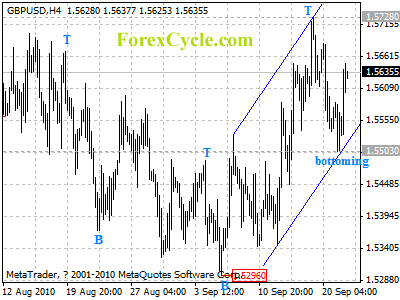
GBPUSD rebounded from 1.5503
Being supported by the lower border of the price channel on 4-hour chart, GBPUSD rebounded from 1.5503, suggesting that a cycle bottom is being formed. Now the rise from 1.5503 could possibly be resumption of uptrend from 1.5296, further rally is in favor and next target would be at 1.5800-1.5850 area. Support is at 1.5503, only break below this level could indicate that the rise from 1.5296 has completed at 1.5728 already, then the following downward move could bring price back to re-test 1.5296 previous low support.
Has the price of Gold reached its zenith?
By Adam Hewison – Today we are going to be looking at gold and analyze the recent run-up that has created a great deal of excitement and fear for many investors and traders.
We’re also going to be looking at some upside measurements that we have for this market. Conversely, we are also looking at an area that should provide support should the gold market pull back from its current levels.
In this new video we are going to be focusing on our “Trade Triangle” technology and what it means for traders. We will explore short-term, intermediate-term, and long-term trading in this precious metal. This will all be done using our “Trade Triangles.”
To see more of Adam’s Videos click here or sign up for Adam’s Free 10-part Professional Trading Course.
All the best,
Adam Hewison
President of INO.com
Co-founder of MarketClub
How Will Today’s FOMC Meeting Affect the USD?
By Natalie R. – With the FOMC meeting minutes expected to be published today at 18:15 GMT, the main question is whether or not the Fed will hold off from further purchasing securities or decide to expand the stimulus further and thus its balance sheet. With the economy showing signs of slowing for the past two quarters and unemployment enduring at 9.5% or higher for the past year, speculations began to surface the Fed will resume its quantitative easing program in order to stimulate the flailing economy. The negative economic indicators that were published over the past few weeks reinforced this assumption. The Fed is also trying to avoid deflation. The Core CPI, U.S. consumer prices excluding food and energy, rose 0.9% in July from a year earlier, the smallest increase in four decades.
It seems, however, that there is much debate within the Central Bank as well as among investors on how the Fed should continue. Members of the Federal Open Market Committee are divided over whether to renew quantitative easing which is essentially a large-scale asset purchase program. Several members believe the Fed has already done enough and that there are impediments to growth unrelated to monetary policy such as uncertainty regarding taxes and regulatory policy as well as the lagging housing sector.
The Federal Reserve has kept the benchmark interest rate at almost zero since December 2008 and bought about $1.7 trillion in securities. Additional quantitative easing can have adverse effects on inflation in the longer run as this move essentially pumps cash into the economy.
Analysts are also divided in their assumptions, largely due to the fact that the latest data has been slightly better than expected. Manufacturing in August expanded at a faster pace than forecast as factories added workers and increased production. Private employers increased payrolls by 67,000 last month, exceeding economists’ estimates.
The Federal Reserve’s move is important not only for the USD but for other currencies as well, particularly the JPY as the Bank of Japan has recently intervened in the market in order to weaken the Yen. Japan’s economy is highly dependent on export and therefore a strong currency can hinder its economic recovery. However, due to speculation of further monetary easing by the Fed, Bank of Japan Governor Masaaki Shirakawa’s attempts may be hindered as quantitative easing contributes to a weaker USD.
Forex Market Analysis provided by ForexYard.
© 2006 by FxYard Ltd
Disclaimer: Trading Foreign Exchange carries a high level of risk and may not be suitable for all investors. There is a possibility that you could sustain a loss of all of your investment and therefore you should not invest money that you cannot afford to lose. You should be aware of all the risks associated with Foreign Exchange trading.
Forex: Speculators cut short Euro positions for a 2nd week in a row.
By CountingPips.com
The latest Commitments of Traders (COT) report, released on Friday by the Chicago Mercantile Exchange, showed that futures speculators cut their euro short positions for the second straight week. Non-commercial futures positions, those taken by hedge funds and large speculators, were net short the euro against the U.S. dollar by -9,644 contracts as of September 14th. This is a decrease of over 14,000 short contracts after speculators were net short the euro by -23,699 contracts on September 7th.

The COT report is published every Friday by the Chicago Mercantile Exchange (CME) and shows futures positions as of the previous Tuesday. It can be a useful tool for traders to gauge investor sentiment and to look for potential changes in the direction of a currency or commodity. Each currency contract is a quote for that currency directly against the U.S. dollar, where as a net short amount of contracts means that more speculators are betting that currency to fall against the dollar and net long position expect that currency to rise versus the dollar. Open interest is the number of open contracts that have not been closed by a transaction or by delivery.
The euro and the British pound sterling were the major currencies on the short side against the dollar last week in the CME futures market while the Australian dollar, New Zealand dollar, Japanese yen, Canadian dollar, Swiss franc and Mexican peso all continued to have a net long amount of contracts.
The British pound sterling short positions fell to -9,127 as of September 14th after being short on September 7th by -16,068 positions. Pound sterling short positions had increased for two straight weeks before a turnaround in the latest data.

The Japanese yen net long contracts edged lower last week to 47,642 from 52,183 net long contracts reported on September 7th. Yen positions have continued to stayed above the 47,000 level for the past six weeks.

The Canadian dollar positions rose for a second consecutive week to a net of 17,695 contracts after totaling just 452 net longs on September 7th.

Swiss franc long positions fell after gains for four straight weeks to 14,236 long contracts as of September 14th after 16,627 long contracts the week prior.

The Australian dollar positions edged very slightly lower to a net amount of 56,669 long contracts as of September 14th from 56,966 long contracts on September 7th.

New Zealand dollar futures positions jumped higher to a total of 16,839 long contracts after a total of 9,377 long contracts and increased for a second consecutive week.

Mexican peso long contracts edged higher as of September 14th after four straight weeks of decline to 14,957 total long positions from for 14,064 longs the week prior.

COT Data Summary as of September 14th, 2010
Large Speculators Net Positions vs. the US Dollar
Euro: -9,644 short contracts from -23,699 shorts on September 7th
British pound sterling: -9127 short contracts from -16,068 shorts
Australian dollar: 56,669 long contracts from 56,966 longs
Canadian dollar: 17,695 long contracts from 452 longs
Japanese yen: 47,642 long contracts from 52,183 longs
Mexican peso: 14,957 long contracts from 14,064 longs
New Zealand dollar: 16,839 long contracts from 9,377 longs
Swiss franc: 14,236 long contracts from 16,627 longs
Go to the Commitment of Traders CME raw futures data
COT Resources from around the web:
Australian Dollar To Rise By 10% Against the Yen?

It’s another manic week Forex friends! In today’s FX feature I present to you the daily chart of AUDJPY. As you can see, the pair has recently broken out (upside) from a nice symmetrical triangle formation. This breakout could swing the pair towards its previous high near the 88.00 marker. Projecting the base of the triangle from the point of breakout, the resulting upside target would be at 88.00 as well. The Aussie’s run, however, may be tempered for awhile because conditions are already overbought. The pair could range or retrace shortly before heading north again. And given it’s recent spike, it could potentially form a flag or a pennant pattern. At present, the AUDJPY pair is trading just above 80.00. Therefore, if it reaches 88.00, that would be a sweet 10% gain (1:1 margin).
The recent rally in the global equities market and gold’s rush towards fresh all-time high (see my recent post here) have helped the commodity dollars like the AUD. For this week, no high impact economic reports are due from Australia. The major releases, though, from the US, Canada, and New Zealand would more likely sway the Aussie’s short term movement. The US Fed, of course, will have its monetary policy decision on September 21. Building permits, new and existing home sales plus durable goods orders are due as well from the US. In Canada, the country’s CPI and retail sales accounts are on deck on September 21 and 22. New Zealand, Australia’s neighbor, will likewise publish its second quarter GDP growth. Risk appetite, resulting from one or all the these accounts could benefit the non-dollar currencies like the Aussie. The opposite, however, would weigh on it. Watch out for these reports!
More on LaidTrades.com …
Nasdaq May Have Peaked as Technical Data Predicts Bearish Movement
By Dan Eduard – The Nasdaq 100 has been seeing a steady upward trend over the last several weeks as a series of economic indicators have pushed up CFD’s along with other riskier assets. As will be shown through a number of technical indicators, the Nasdaq has been trading in overbought territory for some time and is overdue for a downward correction.
We will be looking at the 8-hour chart for the Nasdaq 100, provided by Forexyard. The technical indicators being used are the Stochastic Slow, Relative Strength Index (RSI) and Williams Percent Range.
1. The Stochastic Slow shows that a bearish cross is close to forming right around the 80 level. Typically, a cross formed above the 80 line indicates a downward correction is likely to take place.
2. The Relative Strength Index is trading well above the upper resistance line, and has been for some time. This indicates that the CFD has been overbought for an extended period, and is likely to drop in the very near future.
3. Finally, the Williams Percent Range is currently right around the -5 level. Anything above the -20 mark is generally considered to be in the overbought region, meaning the Nasdaq is likely to experience heavy downward pressure.

Forex Market Analysis provided by ForexYard.
© 2006 by FxYard Ltd
Disclaimer: Trading Foreign Exchange carries a high level of risk and may not be suitable for all investors. There is a possibility that you could sustain a loss of all of your investment and therefore you should not invest money that you cannot afford to lose. You should be aware of all the risks associated with Foreign Exchange trading.
