Swiss Franc, Pausing Before Making Another Move North?

CHFJPY september 2010, swiss franc, swissy, japanese yen, fx, forex, forex market, forex trading, daily forex picks, forex forecast, forex analysis

Hiyo FX friends! Here’s my short and sweet technical view on the CHFJPY pair. As you can see from its daily chart, the pair has broken out from a rare inverted head and shoulders continuation pattern. You see, an inverted head and shoulders pattern is generally a bullish reversal pattern although it can occur as a continuation from time to time as in this case. In any case, the upside target for the pair, judging by the height of the pattern and projecting it from the point of breakout, would be somewhere below 88.00. Sustained buying interest could push it over to that marker. At present, though, the pair’s move up north could take a halt given its overbought condition. Given this, it is possible for the pair to range or even retrace for awhile. If ever it weakens, the neckline of the previous formation should keep it afloat. Still, I could more or less say that things are looking up for the Swiss franc in the near term. Long Swiss franc anyone?

More on LaidTrades.com

GBP/USD Technical Forecast

By Russell Glaser – Price action combined with a Fibonacci retracement level that coincides with a big round number should serve as traders’ target for the GBP/USD.

Looking at the weekly chart, traders should notice a few things from the recent price action. The bullish correction from May to August made a 61.8% retracement of the previous bearish trend that begins at the height of the pair in August 2009. The pair failed to breach this level twice and fell back to the 38.2% retracement level at 1.5300.

Following the drop to the 38.2% level, the GBP/USD made a bullish engulfing candlestick pattern the previous week and closed just shy of the 50% Fibonacci retracement level.

Barring any surprises on Friday, we should get a close above the 50% Fibonacci level at 1.5635.

This will allow for a potential price move to the 61.8% Fibonacci level and a target at the height of the May to August move at 1.5600. Many traders are psychologically drawn to big round numbers and therefore will set their sights as well as take profit levels near this area.

Support levels can be found in a range near 1.5520 followed by the 38.2% Fibonacci retracement level at 1.5300.

Forex Market Analysis provided by ForexYard.

© 2006 by FxYard Ltd

Disclaimer: Trading Foreign Exchange carries a high level of risk and may not be suitable for all investors. There is a possibility that you could sustain a loss of all of your investment and therefore you should not invest money that you cannot afford to lose. You should be aware of all the risks associated with Foreign Exchange trading.

Forex Daily Market Commentary

By GCI Forex Research

Fundamental Outlook at 0800 GMT (EDT + 0400)

USD

Yesterday was a quiet NY trading session. The EURUSD continued to experience downward pressure from both disappointing data and sovereign risk concerns. The Euro Area PMIs came in weaker than expected today. In addition, Q2 Ireland GDP was disappointing, driving the 10 year government bond yield spread between Ireland and Germany wider. Thus, the markets moved into slightly risk-averse territory. On the US data front, initial jobless claims bounced up to 465k from 450k for their latest weekly read. August existing home sales came in very close to the consensus estimate at 7.6% m/m and, as a result, did not prompt much of a USD reaction. Headlines reported that President Obama stressed to China’s Premier Wen the “need for China to do more” on the currency issue. Ahead today, President Obama will meet with Prime Minister Kan. USDJPY traded 84.26-84.67. EURUSD traded in a range 1.3303-1.3413. The S&P 500 finished down 0.83% and the DJIA was down 0.72%.


EUR

Mixed news from Ireland as two T-Bill auctions came in with strong demand, while GDP data was disappointing. Bid-Cover ratios on the Feb 2011 and April 2011 auctions were 4.08 and 11.7, respectively. This again follows the trend of bond and CDS spread widening in between auctions, while the auctions themselves show relatively strong demand. The Irish 10y-Bund spread reached an historical high overnight, widening 21 bps on the back of comments from the Director of Ireland’s National Asset Management Agency that the subordinated debt of a prominent Irish commercial lender lacked guarantees.
Ireland Q2 GDP figures were well below consensus of +0.5%, registering a quarterly decline of (-)1.2% and casting further doubt on Irish policymakers. Q1 growth was revised down on the back of this from 2.7% to 2.2%. Portuguese spreads followed Irish spread movements, also posting record highs of 400 bps.
The PMIs for the Euro Area came in under expectations. The September PMI composite came in at 53.8 vs. expectations of 55.7 and down from 56.2 in August. Euro Area PMI in the manufacturing sector came in at 53.6 after 55.1 previously — a significant decline. Euro Area PMI in the service sector came in at 53.6 after 55.9. Again, the result was lower than expected and a significant decline. Ahead Friday is the German Ifo.

.
JPY

USDJPY suddenly spiked 80 pips at 04:15 GMT. Vice Finance Minister for International Affairs Tamaki said he had no comment on whether Japan had intervened. Finance Minister Noda also declined to comment. Earlier, Japan Prime Minister Kan met with US President Obama. Although no official announcement was made after the meeting, that in itself was significant. Clearly, we have yet to hear any official condemnation of Japanese intervention from the fiscal or monetary authorities in the US, silence which could be interpreted as an implicit green light for further intervention.

TECHNICAL OUTLOOK


USDJPY rebounds towards 85.93.
EURUSD NEUTRAL There is scope for move towards 1.3509 and 1.3818 next. Near-term support comes in at 1.3268 ahead of 1.3159.
USDJPY NEUTRAL The pair rebounds towards 85.93 with scope for 86.70 next. Support holds at 84.05 ahead of 82.88.
GBPUSD BULLISH Following the break of 1.5729, expect gains to extend towards 1.5999 key high. Support is defined at 1.5503 ahead of 1.5297.
USDCHF BEARISH Break through 0.9933/18 region reinstates the bearish trend. Next support lies at 0.9786 ahead of 0.9625. Resistance at 0.9983 intraday high.
AUDUSD BULLISH Bounce-off from 0.8771 found resistance at 0.9600, psychological level, ahead of 0.9850 key high. Near-term support is at 0.9442 ahead of 0.9309.
USDCAD NEUTRAL Choppy action holds between 1.0108 and 1.0509.
EURCHF NEUTRAL 1.3391 and 1.2991 mark the key near-term directional triggers.
EURGBP NEUTRAL Upside potential held below 0.8609 ahead of 0.8774. Support defined at 0.8463 ahead of 0.8390.
EURJPY NEUTRAL Eyes 114.74 with scope for 116.68 next. Support holds at 110.66 ahead of 107.73.

Forex Daily Market Commentary provided by GCI Financial Ltd.

GCI Financial Ltd (”GCI”) is a regulated securities and commodities trading firm, specializing in online Foreign Exchange (”Forex”) brokerage. GCI executes billions of dollars per month in foreign exchange transactions alone. In addition to Forex, GCI is a primary market maker in Contracts for Difference (”CFDs”) on shares, indices and futures, and offers one of the fastest growing online CFD trading services. GCI has over 10,000 clients worldwide, including individual traders, institutions, and money managers. GCI provides an advanced, secure, and comprehensive online trading system. Client funds are insured and held in a separate customer account. In addition, GCI Financial Ltd maintains Net Capital in excess of minimum regulatory requirements.

DISCLAIMER: GCI’s Daily Market Commentary is provided for informational purposes only. The information contained in these reports is gathered from reputable news sources and is not intended to be U.S.ed as investment advice. GCI assumes no responsibility or liability from gains or losses incurred by the information herein contained.

Gold Hits near $1295 Level

By Anton Eljwizat Gold prices rose significantly in the last two months and peaked at $1293 an ounce. However, the daily chart is suggesting that the recent up trend is loosing steam and a bearish correction is impending. Forex traders involved with commodities like this can take advantage of this knowledge by going short on crude oil now, and at a great entry price!

• Below is the daily chart for gold by ForexYard.

• The technical indicators used are the Slow Stochastic, RSI and Williams Percent Range.

• Point 1: There is a “doji” candlestick formed in the chart, indicating that a reversal should take place.

• Point 2: The Slow Stochastic indicates a bearish cross, signaling that the next move may be in a downward direction.

• Point 3: The RSI signals that the price of this pair currently floats in the over-bought territory, suggesting downward pressure.

• Point 4: Williams Percent Range also supports the downward direction.

Gold-Daily Chart

Forex Market Analysis provided by ForexYard.

© 2006 by FxYard Ltd

Disclaimer: Trading Foreign Exchange carries a high level of risk and may not be suitable for all investors. There is a possibility that you could sustain a loss of all of your investment and therefore you should not invest money that you cannot afford to lose. You should be aware of all the risks associated with Foreign Exchange trading.

EUR to Benefit from American and Japanese Bank Moves?

Source: ForexYard

With rising fears about additional monetary easing by the Federal Reserve, speculators have begun to exit many of their USD positions in favor of higher yielding assets. Bank intervention in Japan also has many investors weary of entering yen positions in the near future, but poor fundamentals out of Europe have traders just as concerned about their investments in the euro zone, but have the added benefit of less government tinkering. The EUR’s best bet for the moment could be to lie low and reap the benefits of a rapidly dropping USD and JPY.

Economic News

USD – USD Stable despite Monetary Easing Speculations

The US dollar has been holding steady against most of its currency rivals, despite fundamentals showing a shift away from the safety of the greenback. A positive jobs report pushed the USD/CAD towards 1.0380, while conflicting reports out of Europe have the EUR/USD stalling at 1.3340 and the GBP/USD appearing to consolidate just below 1.5700.

With rising fears about further monetary easing by the Federal Reserve, speculators have begun to exit many of their USD positions in favor of higher yielding assets. A narrowing of the yield gap between the US and Japanese bonds also put pressure on the greenback as traders exited their carry trades, adding downward momentum to the dollar.

Today’s durable goods orders out of the United States have a chance to add modest support to the USD if the figure is in line, or above, expectations. Rising durable goods orders is representative of increased demand for US manufacturing goods and services, which has a residual effect across the American economy.

EUR – EUR Gaining Amid Global Monetary Changes

The euro’s rise continued in today’s Asian trading sessions, but some analysts have begun to anticipate a softening of the EUR in the hours ahead. The EUR/USD saw a healthy 60 pip gain since the opening of the Asian session, currently trading at 1.3350. The EUR/GBP also rose modestly, sitting just above 0.8505.

Bank intervention in Japan has many investors weary of entering yen positions in the near future, but poor fundamentals out of Europe have traders just as concerned about their investments in the euro zone. Today’s German Ifo Business Climate report could show a minor decline in economic sentiment in the region’s largest economy. However, most analysts do not expect the Ifo report to carry much weight given the load of speculation emerging from the US and Japan.

With Japanese bank interventions and potential monetary easing by the US Federal Reserve, the euro’s best chances of weathering the storm may be to lie low and do what it can to downplay its negative data releases. No news may be the best news for the euro zone’s single currency for the moment.

JPY – JPY on Shaky Ground; Traders Awaiting Second Wave of Bank Intervention

The Japanese yen slumped against the US dollar and the EUR in today’s early trading on speculation Japan is selling its currency after intervening in the market last week. The yen slid 1% to 85.22 per dollar from 84.38 in New York yesterday, however, it since stabilized back around $85.

Japan has yet to express satisfaction at the current value of its currency. This has led many speculators to anticipate a second wave of bank intervention sometime in the near future. The speculation alone has helped drop the yen against many of its currency counterparts. But should the Bank of Japan (BOJ) intervene in the market once more, traders are likely to see a very sharp drop in the value of the yen, primarily against the US dollar.

With no news expected out of Japan before the weekend’s close, European and American reports will likely control today’s movements, setting the pace for early next week. Traders would be wise to follow today’s two leading events, the German Ifo Business Climate and the US Core Durable Goods Orders report.

Crude Oil – Crude Oil Fundamentals Could Be Weaker than Many Expected

The price of Crude Oil continues to float between $73.50 and $76.50 as markets digest the impact of Japan’s bank interventions and speculation about further monetary easing in the United States. The summer driving season in Europe and America did little to support oil prices this year. Fundamentals remain weak for Crude Oil, and few expect growth levels to return to pre-2007 levels anytime soon.

With the current price of Crude Oil trading just below $75.00 a barrel, there appears to be technical pressures mounting to push the price higher in today’s trading. Retreating optimism in Europe and a possible boost to American manufacturing growth both provide fundamental support to oil prices, but the specter of additional quantitative easing in the United States remains overhead.

Traders appear weary of purchasing the dollar, and the expected result should be a rise in oil prices. On the contrary, though, the support currently being experienced seems softer than expected and has many analysts concerned that fundamentals are in fact weaker than most have forecast.

Technical News

EUR/USD

The price of this pair has been floating in the over-bought territory on the daily RSI for some time now, suggesting strong downward pressure. A fresh bearish cross on the daily Stochastic (slow) supports this notion. As the price tests an important psychological barrier near 1.3350, going short may be a wise tactic for fast profits today.

GBP/USD

The recent uptick on this currency pair has just pushed the price into the over-bought territory on the daily RSI, suggesting an increase in downward pressure today. The price has also recently turned downward and exited the over-bought territory on the weekly RSI, suggesting that a cascading downward movement may have already been initiated on a larger time-scale. Going short may turn out to be the preferred strategy before the weekend’s close.

USD/JPY

The price on the USD/JPY has recently shifted into an upward direction on the weekly RSI, also just exiting the over-sold territory, suggesting a rise in upward momentum. With impending bullish crosses on the daily and weekly MACDs, it may turn out that bullishness is on the way. Traders may want to take advantage of this movement by entering long positions on this pair throughout the day.

USD/CHF

This pair continues to decline, pushing the price into the over-sold region on the daily RSI, and even deeper into the weekly RSI, indicating that an upward correction is expected. An impending bullish cross on the daily Stochastic (slow) supports this notion. Going long may not be a bad idea.

The Wild Card

CHF/JPY

The movements of this pair seem to suggest that the price has reached a recent high which is unsupported. The 4-hour, daily and weekly RSI show the price as over-bought, while the daily Stochastic (slow) and MACD have impending bearish crosses. Forex traders may want to evaluate their positions on this pair, especially since it appears that a bearish correction may be imminent. Going short on this pair could turn out to be an excellent gamble before the weekend’s close.

Forex Market Analysis provided by ForexYard.

© 2006 by FxYard Ltd

Disclaimer: Trading Foreign Exchange carries a high level of risk and may not be suitable for all investors. There is a possibility that you could sustain a loss of all of your investment and therefore you should not invest money that you cannot afford to lose. You should be aware of all the risks associated with Foreign Exchange trading.

Short Term Technical Analysis for Majors (08:10 GMT)

EUR/USD

Corrects lower following the recent surge through 1.3332 resistance that peaked at 1.3438 on 22 Sep. Market has so far retraced 38.2% of 1.3028/1.3438 upleg at 1.3285, with further consolidation seen preceding the fresh strength towards 1.3510, 50% of 1.5144/1.1875 downleg and 1.3523, 20 Apr high. Downside, 1.3285/32 zone offers immediate support.

Res: 1.3363, 1.3379, 1.3419, 1.3438
Sup: 1.3285, 1.3266, 1.3232, 1.3185

GBP/USD

Correction off 1.5295, 07 Sep low, has seen renewed attempt at 1.5728, 61.8% retracement of 1.5997/1.5295 downleg, with 1.5740 seen so far, but failed to sustain gains. Break above the latter is required to resume near-term gains and expose 1.5822, 11 Aug high, next. Downside, 1.5610/03 offers support and potential break here to allow stronger reversal towards 1.5503.

Res: 1.5714, 1.5728, 1.5740, 1.5760
Sup: 1.5640, 1.5610, 1.5603, 1.5585

USD/JPY

Bounced strongly off 84.25, 22/23 Sep double dip, to reach 85.38, ahead of reversal. The upside rejection warns of possible return to 84.49/25, break of which would resume the near-term downtrend off 85.92. Upside, regain of 85.38 improves the tone for 85.92 retest.

Res: 85.38, 85.64, 85.80, 85.92
Sup: 84.49, 84.25, 84.05, 83.75

USD/CHF

Continues to trend lower, following reversal off 1.0181, with break below 0.9916, 2009 low, extending losses to 0.9803 so far. Minor correction from here is nearly over and break through 0.9803 to expose 0.9875, Mar 2008 lows net, with possible test of 0.9630, all-time low, not ruled out. Upside, 0.9880/98 caps for now.

Res: 0.9880, 0.9898, 0.9931, 0.9980
Sup: 0.9803, 0.9785, 0.9700, 0.9630

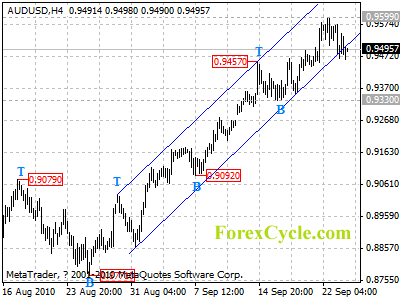
AUDUSD broke below price channel

AUDUSD broke below the lower border of the rising price channel on 4-hour chart, suggesting that consolidation of uptrend is underway. Sideways movement in a range between 0.9430 and 0.9599 would more likely be seen. As long as 0.9330 key support holds, uptrend is expected to resume, and another rise to 0.9700-0.9750 area is still possible.

audusd

Daily Forex Signals

Deflation: The Trend That’s Become Too Obvious To Ignore

By Elliott Wave International

As the biggest credit bubble in history continues to shrink, consumer prices have stayed flat over the past several months, meaning there is no sign of inflation to come, despite growing commitments from the U.S. government.

So what’s keeping inflation at bay, given all the stimulus money promised? The answer: Deflation — an overwhelming urge for consumers to liquidate their assets for cash. And this new economic phase is finally becoming too obvious to ignore, as explained in recent commentary from the world’s largest technical analysis firm.

“The economy is moving into a critical new phase, an outright deflation in which ‘prices fall because people expect falling prices.’ Obviously, this implies an element of recognition, as efforts to protect against indebtedness and falling prices contribute to further declines. We can tell deflation is entering a new stage because of the language and ideas that financial observers now use to describe it.”
— The Elliott Wave Financial Forecast (September 2010)

Get an independent look at the future of the U.S. economy by reading Robert Prechter’s FREE Deflation Survival Guide now. Newly updated for 2010, Prechter’s 90-page ebook on deflation reveals the biggest threat to your money right now. You’ll learn not only how to prepare for deflation and adapt during it; you’ll also learn how to survive it and — most important — prosper during it, so you’ll be ready for the buying opportunity of a lifetime at its end. Click Here to Download Your Free 90-Page Deflation eBook Now.

Here are a few recent comments about the new economic reality:

  • “[New Jersey Governor] Christie spelled out the details of his proposal Tuesday. They include: repealing an increase in benefits approved years ago; eliminating automatic cost-of-living adjustments; raising the retirement age to 65 from 60 in many cases; reducing pension payouts for many future retirees; and requiring some employees to contribute more to their pensions.” — Associated Press (Sept. 15)
  • “U.S. Home Prices Face Three-Year Drop as Inventory Surge Looms” — Bloomberg (Sept. 15)
  • “Atlanta Awash in Empty Offices Struggles to Recover From Building Binge” — Bloomberg (Sept. 14)
  • “The world economy faces a long, hard slog toward recovery and could slide into deflation and financial instability if leaders fail to deliver on promises of reform.” — Reuters (Sept. 10)
  • “Deflation seems to have the upper hand lately in the debate among investors about inflation versus deflation.” — Marketwatch (Sept. 8)
  • “With the release of the August sales figures, one thing is clear for car shoppers — it’s a buyer’s market.” — Edmunds (Sept. 2)
  • “20 Funds to Guard Against Deflation” — Smartmoney (Aug. 29)
  • “Dividend-Yield Signal Screams Deflation” — Forbes (Aug. 25)

The word “deflation” also started appearing more in the financial media around 2002, but Robert Prechter, president of technical analysis firm Elliott Wave International and author of the 2002 New York Times best-seller Conquer the Crash, added in the updated 2009 edition of his book that the deflation references back then were in an entirely different context:

“The rarely used word deflation has become fashionable in financial discussion. … It is fashionable, however, not to predict its occurrence but primarily to dismiss the idea that it has any serious likelihood of occurring. The president of the Federal Reserve Bank of Dallas said in May [2004] that there is ‘maybe one chance out of four’ that deflation will occur.”
— Conquer the Crash, 2nd edition (2009)

And Prechter says the opinion from the Federal Reserve Bank of Dallas was not an isolated outlook at the time. Here’s another quote from around the same time:

“Not one economist [of 67 surveyed] said it was ‘very likely’ the economy would slip into deflation, and only 6% said it was ‘somewhat likely.’ About 95% said deflation was ‘not very likely’ to happen.” — Barron’s (2003)

In hindsight, we know that economists — in the aggregate — were dead wrong about their deflation predictions.

As we saw above, references to “deflation” are increasing now — because it’s obvious.

So if economists were unable — or worse, unwilling — to warn you in advance about the threat of deflation a few years ago, what are they not warning you about now?

Get an independent look at the future of the U.S. economy by reading Robert Prechter’s FREE Deflation Survival Guide now. Newly updated for 2010, Prechter’s 90-page ebook on deflation reveals the biggest threat to your money right now. You’ll learn not only how to prepare for deflation and adapt during it; you’ll also learn how to survive it and — most important — prosper during it, so you’ll be ready for the buying opportunity of a lifetime at its end. Click Here to Download Your Free 90-Page Deflation eBook Now.

This article was syndicated by Elliott Wave International and was originally published under the headline The “Outright Deflation” Economy Enters A “Critical New Phase”. EWI is the world’s largest market forecasting firm. Its staff of full-time analysts led by Chartered Market Technician Robert Prechter provides 24-hour-a-day market analysis to institutional and private investors around the world.

Why You Can Do Better Than Bonds

Why You Can Do Better Than Bonds

By Sara Nunnally, Editor, Smart Investing Daily

The U.S. 10-Year Treasury bond is a safe investment… right? For the most part, yes. The U.S. government — for all its flaws — is not likely to go bust tomorrow.

But yields have been sliding for nearly 30 years, and we haven’t yet seen the bottom. At the same time, bond prices have been climbing in near bubble-like fashion. That means investors are spending more for a lower yield, all in the name of safety.

Yesterday, Bloomberg reported, “Goldman Sachs Group Inc. economist Sven Jari Stehn says the Fed could buy ‘at least’ $1 trillion in Treasury notes, and ‘sizeable purchases of Treasury securities’ will begin later this year or early next year.”

So yields could continue to drop through the rest of the year, and maybe even into next year.

Now, bonds play a part in any balanced investment portfolio, but if you’re looking for steady extra income, you can do better.

Much better.

As of midday yesterday, the yield on a 10-Year Treasury note was 2.69%. But the annual dividend yield for AT&T, Inc. (T:NYSE) is 6%! That’s an extra $1.68 a share…

You could get $110,000 back for every $10,000 you invest!

Apple’s iPhone became the mega-hit that it is because of its Touch-Sensitive Screen Technology. I’ve found a brilliantly run $470 million enterprise that has practically cornered the market for Touch-Sensitive Technology.

Get the astounding facts in 4 seconds…

Unsung Portfolio Heroes

Investors looking for value in the stock market sometimes discard companies that offer regular dividends. In many cases, these investors would rather see that cash pumped back into the company.

But dividend stocks, over the long term, have outperformed non-paying stocks. According to Ned Davis Research and Income Stock Report, “dividend stocks on the S&P 500 generated a total return of 10.19% per year compared to the 4.39% generated from non-dividend stocks” over the past 30 years through November 2009.

And the difference between the two has been widening over the past couple years.

That could mean that in times of economic uncertainty, dividend-paying stocks are a better choice for all types of investors. When you’re looking for steady gains in the stock market, rather than the fast appreciation of a company’s share price, dividend-paying companies shine all the more.

Dividends can help you determine the fundamental health of the company, because dividends are paid to investors from “leftover” earnings.

A company paying regular dividends, even in a bearish market climate, is ensuring investor confidence, and lowering volatility. This is because investors tend to hold dividend-paying stocks through bear markets, according to Bloomberg Businessweek.

So not only do dividend-paying stocks take some volatility out of your investment portfolio, but these companies pay you money for being an investor…

A Peek Behind the Dividend Yield Curtain

Dividend yield is calculated by dividing the annual dividend per share by the stock’s share price. Simple enough, right? By this calculation, the higher the yield, the more attractive the dividend stock.

But let’s take a closer look at this equation.

Let’s assume that Company X, which is trading for $20 a share, keeps its dividend, of $1.00 annually, steady as the market turns against it. At this point, the annual dividend yield is 5%. If Company X’s share price falls to $15, the annual dividend yield becomes 6.67%.

The dividend is still $1 a share… The difference is that Company X has dropped in share price. In other words, a high dividend yield isn’t the only thing you should look for in a dividend-paying company.

(Do you like my breakdown on dividend stocks? Sign up for Smart Investing Daily and let me and my fellow editor Jared Levy simplify the stock market for you with our easy-to-understand investment articles.)

Forbes has compiled a list of the top 10 dividend-yielding stocks from the Dow Jones Industrial Average.

You can find the list here, but besides the companies listed, take a look at the other parameters Forbes took into consideration:

  • Price-to-Earnings Ratio
  • Price-to-Book Ratio
  • Free Cash Flow
  • Market Cap
  • Profit Margin
  • Revenue

Notice anything about this list? The first three are the same key statistics we used on Friday, Sept. 3, to determine value in a cheap market.

And lastly, take a look at the company’s share price.

Let’s take AT&T, for example…

Learn How to Legally “Trick” a Mutual Fund Into Paying for Your Retirement

You could “siphon” thousands of dollars a month from the profits of the mutual fund industry.

Find out more here.

Great Value, Great Dividend

Here are the statistics:

AT&T, Inc (T:NYSE)Verizon (VZ:NYSE)
1. Price/Earnings
2. Price/Book
3. Debt/Equity
4. Free Cash Flow
5. PEG Ratio
** 52-Week Price Change
** Dividend Yield
13.10
1.60
0.59
$13.41 Billion
1.89
5.28%
6.00%
119.44
2.23
0.66
$17.49 Billion
2.27
-0.55%
6.30%

This is a comparison of AT&T and Verizon. As you can see, both companies offer a great dividend yield.

But AT&T is clearly the better value with a much lower P/E ratio, lower Debt-to-Equity ratio, and lower PEG ratio. Now look at the difference in each company’s share price over the past year. AT&T has climbed more than 5%, while Verizon is slightly under par for the past 52 weeks.

That means had you invested in AT&T a year ago, you’d be sitting on a gain of 11.87%, much better than the 10-Year Treasury bond.

But even if AT&T hadn’t made any share price gains over the past year, you’d still be raking in 6% from that dividend… more than double the T-bond’s 2.69%. In fact, AT&T could have dropped to $25.60 in a year, and you would’ve still come out ahead of the Treasury’s yield.

The long and short of all this is that you can do much better that the declining yield in government bonds. High-yielding dividends can even help eliminate some downside risk of investing in stocks. If you add dividend stocks to your value criteria, the combination can really pay off, as it has for AT&T over the past year.

Don’t forget to follow us on Facebook and Twitter for the latest in financial market news, investment commentary and exclusive special promotions.

About the Author

Sara is Co-Editor of Smart Investing Daily. As Senior Research Director and global correspondent, Sara Nunnally’s diverse resume includes studies in art history, computer science and financial research. She has appeared on news media such as Forbes on Fox, Fox News Live, and CNBC’s Squawk Box, as well as numerous radio shows around the country.

As Senior Research Director, global correspondent and co-editor of Smart Investing Daily, Sara has traveled all over the world in search of the best investment opportunities to recommend to her readers, be they in developed economies like France and Italy, in emerging markets like the Czech Republic and Poland, or in frontier terrain like Vietnam and Morocco. Her unique “holistic” approach of boots-on-the-ground research has given her an edge in today’s financial marketplace as she searches for the next investment opportunities in hot sectors like alternative energy, currency markets and commodities.

The THREE Things You Must Do to Be a Successful Investor

The THREE Things You Must Do to Be a Successful Investor

By Jared Levy, Editor, Smart Investing Daily

In over 15 years of trading, investing and risk management, I realized the three things that make the real difference between a successful investor and one who struggles have nothing to do with technology, strategy or even a personality type (although some personalities have an easier time applying them).

I mean, when you think about the multitude of successful strategies and investments that are made every day, there may be some common threads between them, but with all the diverse and sometimes conflicting methods used, how can they all be the key to successful investing?

They can’t…

Here are a few smart investing ideas for you to remember:
(And by the way, none of these ideas are the three strategies you have to follow to be truly successful.)

  • Acquire stocks when they seem to be cheap (or more importantly, valuable) on a fundamental and technical basis. This is sometimes achieved when the rest of the market is in a panic selling mode.
  • Buy bonds when yields are high (when monetary policy is tight, but expected to loosen).
  • Purchase soft commodities when they are at relative historical low values (perhaps at the end of an economic contraction) and increased demand is on the horizon.
  • Buy gold and dollar-denominated commodities like oil when increased inflation is on the horizon and before certain seasonal rallies.
    • Gold before September
    • Oil before spring and summer (ahead of driving & hurricane season)
  • Diversify your portfolio, not just with stocks in different industry sectors, but with stocks that have different Betas (Beta tells you how volatile a stock is in relation to the market) as well as a blend of defensive and cyclical stocks when appropriate.
    • Of course, a further mixture of commodities, bonds and options in your portfolio will add even more levels of diversity and increase your chances of beating the biggest fat cat fund managers (most of them can barely beat the S&P).

All of these techniques, plus the multitude of tactics and trades that Sara and I offer in Smart Investing Daily, will give you an edge. (That said, if you’d like to receive our advice, sign up for our easy-to-understand investment articles.) But even following these practices I’m sorry to say you can still lose. Because without the following three covenants, you are surely doomed. Let me explain…

How Gov’t-Sponsored “pShares” Could Hand YOU 808% Gains Within the Next 12 Months

As the U.S. government continues to funnel money into an industry most folks have foolishly left for dead… little-known “pShares” are shooting up as much as 808%.

Here’s how to claim your share of these govenment-sponsored options.

#1 – DON’T FORGET TO TAKE PROFITS!

Far and away, the most important thing you can do as an investor is to have an END to your trade, preferably a profitable one! Most novice traders jump into a trade with good intentions, but don’t have a goal to reach.

When you buy any investment, set a target for yourself (be realistic) and once you reach that target (or if the market seems to be changing) exit the trade! Even with all the great techniques listed earlier, they all mean nothing until the profits are booked in your account!

Use Trailing Stops to Help

A relatively new “order type” that most brokers offer nowadays is called a trailing stop. It can help mechanize your trade and assist in taking profits for you, especially if you have a hard time hitting the “sell” button. Think of it as a stop-loss order that follows your stock price up, but not down.

How It Works

Let’s assume I buy a stock at $40 and place a $1 trailing stop below it. If the stock moves up to $45, the stop moves up with it and is still $1 below the current stock price (the stop is now at $44). If the stock drops, the trailing stop locks in place and my stop loss will trigger at $44, taking me out of the trade for a profit! Cool, right?

#2 & 3 – DON’T BE GREEDY AND FOLLOW YOUR PLAN!

Call them the “trifecta to profit” or whatever you need to remember them, because they might just save you some dollars.

A Friend Who Broke All the Rules

I have a close friend who has been an extremely successful trader on Wall Street for many years. He has made a living his entire life trading his own account.

He called me on Friday, Sept. 3, to discuss a bullish option swing trade (swing trades usually last one to three days) he had on in CREE. He was up about 20% in the trade in less than a week (which is about 1,000% annualized, but let’s not go there). I urged him to sell it, which he did and he was more than happy with his realized return and that his profit target was reached.

Charting Guru Shows You How to Turn $5,000 Into $1.2 Million in 5 Simple Trades!

Hidden in the shadows of the stock and mutual fund markets… a little-known sub-niche is generating gains of 4,233%… 5,760%…even 7,285% in a single trade! Act now, and you could see a cool $1.2 million in five simple trades.

Get all the details in this investment research report.

And Then…

The day after Labor Day, CREE dropped from $57 to $54 and boy, was he happy. Seeing dollar signs and ignoring his rules, he jumped all in with a position that was twice the size of what he just took off. He did this when the charts were NOT looking bullish at all and ADDED RISK!

On Wednesday, he now had a big problem, because the stock was trading down to $49 and he was long the equivalent of 10,000 shares at a much higher price.

Now the tide shifted – he went from being in complete control to hoping, wishing and praying the stock would move higher and feeling bitter because he just made a great return in the stock. Luckily, the stock rallied a bit and he was able to trade his way out for a little better than breakeven.

The moral of the story is that his first trade was a successful one, because he executed his plan, used good money management (controlled greed), and took a profit when he reached his goal and the stock was looking weak.

The second trade was done in an excited, uncontrolled state of mind with no plan and poor money management.

In your own account, monitor how much money you put into any investment and don’t be afraid to take a profit if you are happy with your returns. There will always be another trade!!!

Don’t forget to follow us on Facebook and Twitter for the latest in financial market news, investment commentary and exclusive special promotions.

About the Author

Jared Levy is Co-Editor of Smart Investing Daily, a free e-letter dedicated to guiding investors through the world of finance in order to make smart investing decisions. His passion is teaching the public how to successfully trade and invest while keeping risk low.

Jared has spent the past 15 years of his career in the finance and options industry, working as a retail money manager, a floor specialist for Fortune 1000 companies, and most recently a senior derivatives strategist. He was one of the Philadelphia Stock Exchange’s youngest-ever members to become a market maker on three major U.S. exchanges.

He has been featured in several industry publications and won an Emmy for his daily video “Trader Cast.” Jared serves as a CNBC Fast Money contributor and has appeared on Bloomberg, Fox Business, CNN Radio, Wall Street Journal radio and is regularly quoted by Reuters, The Wall Street Journal and Yahoo! Finance, among other publications.