Platinum Hits Another Record High

By Rita Ruvinski – Platinum advanced to a new record high, as prospects for a further decline in the dollar ‎boosted investor demand for precious metals as alternative holdings. Platinum prices jumped ‎‎$10.10 to $1,632 an ounce on Monday reaching its highest level since May 18th. Technical ‎indicators show there are good chances platinum prices will increase further with a potential ‎price of $1675.00 in sight. ‎
The chart below is the Platinum 4-hour chart:

‎- The technical indicators used are the Bollinger Bands, the MACD , the Relative Strength Index ‎‎(RSI) and Fibonacci retracement lines.‎
As we can see in the chart, the price is currently testing the 100% Fibonacci retracement level ‎and may possess the momentum to break past.‎
‎- The RSI is above 60. It could either mean that the price is in a lasting uptrend or just ‎overbought, in which case a correction could occur (look for bearish divergence in this case). ‎
‎- The MACD is positive and above its signal line. The configuration is positive. ‎
– A tightening of the chart’s Bollinger Bands confirms the bullish volatility in the pair.‎
‎- The next resistance levels are placed at the 1675.5 and the 1692.5 levels.
‎- The next support levels are placed at the 1620.50 and the 1609 levels.‎

Forex Market Analysis provided by ForexYard.

© 2006 by FxYard Ltd

Disclaimer: Trading Foreign Exchange carries a high level of risk and may not be suitable for all investors. There is a possibility that you could sustain a loss of all of your investment and therefore you should not invest money that you cannot afford to lose. You should be aware of all the risks associated with Foreign Exchange trading.

Will The Bank of Japan Take Further Action to Halt Yen’s Bullishness?

Source: ForexYard

As speculations that last week’s spike in yen value was the result of another intervention from the Bank of Japan remain unconfirmed, Governor Shirakawa says that the BoJ is prepared to take appropriate action if needed. Despite Japanese efforts, the yen continues to strengthen. Is another intervention simply a matter of time?

Economic News

USD – Positive U.S. Data Boosts Risk Appetite and Weakens the Dollar

The U.S. dollar fell against most of the major currencies during last week’s trading session. The dollar lost about 450 pips against the euro. The EUR/USD pair is currently heading towards the 1.3500 level. The dollar dropped about 200 pips against the British pound and about 150 pips vs. the Japanese yen.

The dollar’s downfall came after several positive U.S. economic indicators were released last week. The U.S. sales of previously owned homes rose in August to a 4.13 million, up from 3.84 million in July. The result was above the predicted result of 4.11 million. In addition, the total value of new purchase orders placed with manufacturers for durable goods, excluding transportation items, climbed in August by 2.0%, beating expectations for a 0.9% rise. The positive data provided another signal that the U.S. economy will manage to evade another slowdown. This has increased optimism in the global economic recovery, and as a result boosted risk appetite in the market. The dollar, which is considered to be a relatively safe asset, weaned as a result.

As for the week ahead, many interesting economic releases are expected from the U.S. The publications which are likely to have the largest impact on the dollar are the Consumer Confidence report, the weekly Unemployment Claims and the Manufacturing Purchasing Managers’ Index. Traders are advised to closely follow these releases, as any one of them has the potential to impact the dollar’s trading.

EUR – Euro Is Trading At A 5-Month High against the Dollar

The euro saw a bullish trend against most its major counterparts during last week’s trading session. The euro gained about 450 pips vs. the U.S. dollar. Currently the EUR/USD pair is closing in at a 5-month high, after reaching the 1.3494 level earlier today. The euro rose about 200 pips against the British pound and about 150 pips vs. the Japanese yen.

The euro’s bullishness followed positive European economic releases, which indicated that the euro-zone is likely to overcome the economic slowdown. The most significant publication was the German Business Climate survey. The survey showed that German business unexpectedly rose to its highest level in more than three years in September, suggesting that companies can sustain a weaker demand from abroad as the global economic recovery slows. The survey rose to 106.8, beating expectations for an increase of around 106.3. That’s the highest since June 2007. The report, along with other positive indications from the euro-zone’s leading economies, have decreased risk-aversion, and convinced investors to open long positions with the euro and pound.

Looking ahead to this week, a significant batch of data is expected from the euro-zone. Traders are advised to follow the leading publications, especially from Germany, which holds the largest and strongest economy within the euro-zone. Further positive indicators are likely to boost the euro further, mainly against the dollar and the yen.

JPY – Yen Strengthens Despite Speculations of Bank Intervention

The Japanese yen strengthened against most of the major currencies during last week’s trading session. The yen gained about 150 pips against the U.S. dollar and the USD/JPY pair is trading near the 84.00 level. The yen gained about 100 pips vs. the British pound as well.

After strengthening throughout the first half of the week, the yen fell sharply against the major currencies, on what was believed to be another intervention by the Bank of Japan (BoJ). However as doubts crept in about whether the Japanese leadership was indeed responsible for the yen’s losses, the currency managed to correct itself.

In addition, earlier today the BoJ’s Governor Masaaki Shirakawa said that the central bank is closely watching the effect the yen’s appreciation is having on the Japanese economy, and is prepared to take appropriate action if needed. This has fueled speculation that another BoJ intervention is only a matter of time.

As for this week, traders are advised to be extra cautious while trading the yen. The Japanese currency continues to be one of the strongest currencies within the majors. At the same time, another intervention looks to be a real possibility at the moment.

Crude Oil – Crude Oil Remains Volatile

Crude oil saw another week of range-trading, in which the commodity remained between $73 and $77 a barrel. Crude oil began last week’s session with a sharp rise towards $76.50 a barrel. However by Tuesday, the commodity dropped to $73 a barrel, only to jump back to $76.75 before the weekend.

The recent appreciation of crude oil comes as a result of the weak U.S. dollar. The decline of the dollar supports demand for commodities as an alternative investment. Furthermore, the fact that crude oil is valued in dollars means it is now more attractive to foreign buyers. It seems that as long as the dollar continues to weaken against the major currencies, crude oil prices have the potential to rise further.

Looking ahead to this week, traders are advised to follow the leading publications from the U.S. and the euro-zone, as these tend to have the largest effect on crude oil’s trading. In particular, traders should follow the U.S. Crude Oil Inventories report, which is scheduled for Wednesday, as this release usually has a significant impact on the market.

Technical News

EUR/USD

The pair peaked at the 1.3494 level on Friday, and has been correcting its gains since then. Currently, a bearish cross on the 4-hour chart’s Slow Stochastic suggests that the pair might fall further, with potential to reach towards the 1.3380 level.

GBP/USD

After rising 200 pips on Friday, the cable saw two failed attempts to cross the 1.5842 level. A bearish cross has formed on the daily chart’s MACD, meaning the pair may correct Friday’s gains today. Going short with tight stops might be a good strategy today.

USD/JPY

After Friday’s spike, the pair resumed its bearish trend with full steam, and is currently trading near the 84.20 level. As all indicators on the daily chart are pointing down, the pair looks to drop further, with a key-target at the 83.50 level.

USD/CHF

There is a very distinct bearish channel forming on the 4-hour chart, and the pair is now floating in the middle of it. Currently, the RSI on the 1-hour chart has dropped below the 70 line, suggesting that further bearishness may take place today. Going short with tight stops may be the preferred strategy.

The Wild Card

Gold

After failing to reach $1,300 an ounce on Friday, gold appears to be on its way to cross that level today. Currently, a bullish cross on the daily chart’s MACD indicates that gold still has plenty of upward momentum. If the metal will cross the $1,300 level it will mark a new all-time record. Analysts are not forecasting a downward correction in the near future. This may be a great opportunity for forex traders to join a very popular trend.

Forex Market Analysis provided by ForexYard.

© 2006 by FxYard Ltd

Disclaimer: Trading Foreign Exchange carries a high level of risk and may not be suitable for all investors. There is a possibility that you could sustain a loss of all of your investment and therefore you should not invest money that you cannot afford to lose. You should be aware of all the risks associated with Foreign Exchange trading.

Short Term Technical Analysis for Majors (08:00 GMT)

EUR/USD

Maintains positive structure after completing an hourly bull flag and breaking above 1.3438, 22 Sep previous high. Market has so far reached 1.3493, just under 1.3510 target, 50% of 1.5144/1.1875. Clearance of the latter to expose 1.3523/85 zone next. Downside, 1.3402/1.3368 supports, while loss of 1.3285 would delay.

Res: 1.3494, 1.3510, 1.3523, 1.3586
Sup: 1.3435, 1.3402, 1.3368, 1.3304

GBP/USD

Broke higher on Friday to test 76.4% retracement of 1.5997/1.5285 downleg. Sustained break here will open 1.5860 first, with possible retest of 1.5997, 06/09 Aug highs, not ruled out. Initial support lies at 1.5740/28, while break below 1.57 zone delays.

Res: 1.5842, 1.5860, 1.5910, 1.5997
Sup: 1.5805, 1.5771, 1.5740, 1.5728

USD/JPY

Maintains negative near-term tone off 85.92, with renewed attempt higher failure leaving a lower high at 85.38. Break below 84.10/03, 24 Sep low/61.8% retracement of 82.86/85.92 upleg, is needed to trigger fresh weakness and open way for possible retest of 82.86. Upside, 85.38 caps for now and only break here to firm the near-term tone.

Res: 84.75, 84.90, 85.21, 85.38
Sup: 84.10, 84.03, 83.75, 83.60

USD/CHF

Continues to trend lower, following reversal off 1.0181. Break below 0.9916, 2009 low, and 0.9803, 23 Sep previous low, has so far reached 0.9777, looking for test of all-time low of 0.9630, near-term. Upside, 0.9880/98 caps for now.

Res: 0.9880, 0.9898, 0.9931, 0.9980
Sup: 0.9809, 0.9777, 0.9700, 0.9630

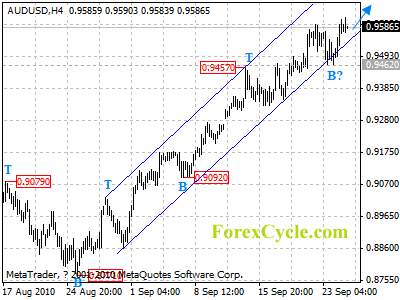
AUDUSD continues its upward movement

After consolidation, AUDUSD continues its upward movement from 0.8771 and reaches as high as 0.9622 level. Further rise is still possible in a couple of days and next target would be at 0.9700-0.9750 area. Key support is now at 0.9462, as long as this level holds, uptrend could b expected to continue. However, a breakdown below 0.9462 will indicate that a cycle top has been formed on 4-hour chart, then pullback to 0.9300 area could be seen to follow.

audusd

Daily Forex Reports

USDCAD’s downward move extended to 1.0191

USDCAD’s downward move from 1.0672 extended to as low as 1.0191. Key resistance is now at 1.0378, as long as this level holds, downtrend from 1.0672 is expected to continue and one more fall towards 1.0107 support is possible next week. On the other side, the pair may be forming a cycle bottom at 1.0191 level on daily chart, a break above 1.0378 key resistance will confirm the cycle bottom and indicate that the fall from 1.0672 has completed, then another rise to re-test 1.0676 resistance could be seen.

For long term analysis, USDCAD formed a cycle top at 1.0852 level on weekly chart. Rang trading between 0.9930 and 1.0852 would more likely be seen in next several weeks.

usdcad

Weekly Forex Forecast

Durable Goods fall more than expected in August. New home sales flat. US Dollar declines in Forex Trade.

By CountingPips.com

Durable goods orders fell more than expected in August while new home sales were unchanged for the month, according to separate reports released by the U.S. Commerce Department today. New orders for durable goods orders declined by 1.3 percent or by $2.5 billion to a seasonally adjusted total of $191.2 billion in August. Today’s report follows a revised decrease of 0.7 percent in new orders for July and marks a third decline in the last four months. Contributing to the slowdown in orders was a 10.3 percent decrease in orders for transportation equipment.

Durable goods are assets that are generally considered to last more than three years.

Today’s data came in worse than market forecasts that were expecting durable goods orders to decrease by approximately 1.0 percent for the month.

New orders for durable goods, excluding transportation, came in better than expected and rose by 2.0 percent in August following a decrease by 2.8 percent in July. Market forecasts were predicting an increase of 1.0 percent in durable goods minus transportation.

Shipments of durable goods fell by 1.5 percent after two months of increases while unfilled orders fell by 0.1 percent. Durable good inventories increased for the eighth consecutive month with a rise of 0.4 percent. August nondefense orders for new goods declined by 0.9 percent and defense orders for capital goods fell by 1.5 percent to a total of $9.4 billion.

New Home Sales are flat after declining to a new low

New Home Sales in the United States were unchanged in August after registering a new record low level the month before, according to a separate report released by the Department of Commerce today. Purchases of new single family homes remained unchanged in August at an annual rate of 288,000 new homes sold. The July data originally showed an annual rate of 276,000 homes sold but was revised higher to 288,000. This revised number still remains the lowest level on record since the government started keeping records in 1963.

Market forecasters were expecting an increase by 6.9 percent in the monthly sales level for an annual rate of 295,000 new homes sold. On an annual basis, August’s rate of new homes sold was 28.9 percent lower than the August 2009 sales level.

Leading the decrease in August was a 26.1 percent drop in new homes sold in the the Midwest while the South registered a 10.8 percent decline in sales. Sales in the Northeast rose by 16.7 percent while the West saw an advance by 54.3 percent from July to August.

On an annual basis, all four regions had declining sales levels from the August  2009 period with the Midwest showing the largest decrease by 38.2 percent over that time. The Northeast’s annual sales level was down by 5.4 percent while the West is lower by 33.6 percent and the South is lower by 28.2 percent.

FOREX: US Dollar on the decline today, Stocks rising higher

The U.S. dollar has been mostly lower in forex trading today against the other major currencies while the U.S. stock markets have been higher by close to 2 percent for the day. The dollar has fallen today versus the euro, British pound sterling, Canadian dollar, Japanese yen, Australian dollar and the New Zealand dollar, according to currency data by Oanda. The Swiss franc is currently trading close to unchanged versus the American currency in forex trading action.

The U.S. stock markets, meanwhile, have gained sharply so far today with the Dow Jones rising by nearly 200 points, the Nasdaq increasing almost 50 points and the S&P 500 up by over 20 points at time of writing. Oil has advanced by $1.18 to $76.36 while gold has made a new record high today and edges closer to that $1,300 per ounce level with the current price at the $1,296.30 per ounce level.

Let the Carnival begin with this Brazil ETF!

By Adam Hewison – Here is a market that we like a lot more than the US market. We really
like the way its acting and it looks set to take out the highs that were
seen in December of 2009. If that is the case, then we could see this
market make all-time highs pretty quickly. You definitely want to have
this one on your radar screen.

In this new short video, I show you what I’m looking at and how we
showcased this market last week when we did our last webinar. This
webinar is set to be rebroadcast on Friday, September 24th at 5pm
EST/9pm GMT.

This market is still looking good and looking strong. Pay very close to
it this Friday because if it closes well, it should bode well for the
following week.


All the best,

Adam Hewison
President of INO.com
Co-founder of MarketClub

EURO To Rise By A Whopping 1,250 Pips Against the US Dollar?

EURUSD september 2010, eur usd, euro usd, usd eur, usd euro, euro, USD, EUR, fx, fx market, forex, forex market, forex trading, forex forecast, forex analysis, daily forex picks,

Hiyo FX peeps! Did I get your attention? Yes. I believe that its very likely that the EURUSD pair could gain by about 1,250 pips. Now that’s a lot! As you can see from its daily chart, the fiber has recently broken out from a very nice cup and  handle formation. At present, the pair is trading just above the neckline of the pattern. With the stochastics in the overbought territory, it could exchange in a range-bound fashion for awhile before moving north. Now, a move past the 1.3500 resistance could send it on the way towards its minimum upside target (computed by projecting the height of the pattern from the point of breakout at 1.4750.  If all go well, it could achieve this target in about 6 months which is also the time that it took to form the pattern.

Despite the recent dip in Europe’s Purchasing Managers’ Indices (PMIs), the business climate in Germany as measured in the German Ifo Business Climate Index surprisingly jumped to its highest score in more than three years this month. The index came in at 106.8 which is over the market’s 106.3 estimate. This rise indicates that German companies can withstand the weaker international demand. On the other side of the globe, in the US, the Fed’s inclination to place another set of stimulus programs to support the slowing growth in the US’s economy has of course weakened the greenback to the benefit of the other non-dollar currencies like the EUR. This plus the rally in the US equities markets have also urged investors to move away from the USD in exchange of the higher yielding assets and anti-dollars like the euro.

Just now, the US’s core durable orders for the month of August have grown by 2.0%, which is almost twice of the 0.9% forecast. The previous month’s change was also positively revised to -2.8% from -3.8%. These numbers signify that the chances of the earlier threat of a double dip recession in the US economy have gotten lesser and lesser.

For next week, the CB Consumer Confidence in September is seen to fall to 52.5 from 53.5. But given the strong rally in the global equities markets for the past two weeks which show the manifestation of consumer confidence in the markets, it is therefore possible for the index to have a better-than-expected result. A better-than-projected mark, as we know, could spur some risk taking and EUR buying.

More on LaidTrades.com

Why Government Reports Aren’t the Only Indicators of Economic Health

Why Government Reports Aren’t the Only Indicators of Economic Health

By Jared Levy, Editor, Smart Investing Daily

When I am not traveling to New York City, Philly or Chicago, I work mostly from my home office. I tend to look out the window while I write and trade. I get a nice view of the Dallas skyline and trees, but I also have a fairly clear view of the neighborhood dry cleaner, whom I have been going to for many years. Over the past year, I have noticed the parking lot fairly empty and the drive-through window not as busy as it used to be.

Observing this for months, I thought I would visit Joseph, the owner of the dry cleaner (and friend), and ask how he was doing. Usually I just drive through and pick up and drop off my dry cleaning with one of his friendly staff and give Joe a wave, but this time, I wanted to know how Joe (and his business) was doing.

Joseph, who is young and extremely involved in his small — but usually busy and integral part of my diverse neighborhood — business, is a very personable and smart man who has his finger on the pulse of the local economy here in Dallas.

He has to, because in the dry-cleaning/alterations business, the profit margins are relatively low, which means that changes in flow of customers and/or articles of clothing can have a profound impact on business and this can happen in a relatively short period of time.

This dry cleaner serves a community of multimillionaires from Highland Park to college students from SMU and everything in between. The neighborhood has a large, dense base of young white-collar professionals, which is Joe’s bread and butter.

Joe mentioned that he has been in a lull for a while and mentioned that every day still, long-time customers of his are losing their jobs. He said this with a surprised and concerned look in his eyes. Always positive, Joe did mention that things seemed to be picking up, possibly as people go back to school and back to work after summer vacations.

He did agree when I asked if the average customer was increasing their wash/wear cycles, trying to get the most of that $1.99+ it costs to clean a garment. So maybe Americans do not smell as good in the recession as they did at the beginning of 2007 — that could be another economic indicator.

Three little-known stocks that could turn $10,000 into a $1.2 million portfolio — get in before your friends or Wall Street spot them

You could change your life with one calculation: buying these three stocks. I don’t care if you’ve lost money in the past; now is the time that could correct all that. But you have to act now. Hitting that $1 million figure is indeed possible.

Get all the detail in my free investment report.

Listen to the Stories of Small-Business Owners

Even though this anecdotal evidence may seem to have minimal merit when analyzing the health of the U.S. economy, it may actually have more credence than you think. Many of these Americans are on the front lines and have the highest sensitivity to changes in consumer health.

The web now allows us to watch and read news and data from all over the U.S. (and globe for that matter). While I always say that looking out your front door and talking to people can usually be the best way to gauge sentiment, you can also look at the headlines, blogs and editorials that are published in major cities around the country to see what it happening out there and make sure that it jives with data that is being released.

(Investing doesn’t have to be complicated. Sign up for Smart Investing Daily and let my fellow editor Sara Nunnally and I simplify the stock market for you with our easy-to-understand investment articles.)

Checking Up on the American Consumer

How can you get a gauge on the health of the American consumer? We all hear about the unemployment rate, which can be misleading not only because of the different types (groups) of unemployment, but also due to changes in something called the “labor force,” which basically is the number of Americans ready, willing and able to work.

The unemployment rate helps give a very macro view, but here are two other points (among others) you will want to check up on:

Consumer Credit

Each and every month (around the 5th) the Federal Reserve releases a report on the total amount of consumer credit outstanding in America. Think about it as the total outstanding credit card and loan debt, which can be used to pay for everything from motorcycles and education to washing machines and cruises. If this number is declining, fewer Americans are borrowing and perhaps spending as well.

If this number is on the decline, chances are that credit is tight, either because of banks not willing to lend or consumers not having the credit or both. It could also mean that Americans are saving their money and paying off debt because they are scared of not having a job next week.

I have a feeling that right now, it’s a bit of all three. In July alone, revolving consumer credit decreased at an annual rate of 6.25%.

Consumer Spending

Consumer spending (incl. healthcare) accounts for about 70% of our GDP, so this data set is extremely important used in conjunction with consumer credit to gauge our fellow Americans’ fiscal health. This report is also combined with consumer income, so we can see how much the average American is earning. The last report showed that consumer spending rose 0.4% in July from the previous month, after staying flat in June. If you adjust for inflation, spending grew only 0.2%.

Do You Know What Commodity You Should Be Buying INSTEAD of Gold?

I know it might sound crazy, but there’s another commodity out there even better than gold. It’s not oil, silver or platinum. In fact, you’ve probably never thought about buying a single ounce of this…

But if the market collapses, it could be even more valuable to you than gold. Find out what this commodity is today…

Joseph Was Right After All

That weak consumer spending number is not good because American businesses need the consumer to spend for them to survive, and what is even scarier is that in that same time frame spending actually outpaced the savings rate, which tells me that Americans are NOT earning enough and obviously many are still out of work.

President Obama addressed this in his town hall meeting on CNBC Monday, noting “the average middle-class American’s income dropped 5.1% from 2001-2009.” Unfortunately, for those Americans out of work or struggling, he offered no real immediate solution to this issue.

Don’t forget to follow us on Facebook and Twitter for the latest in financial market news, investment commentary and exclusive special promotions.

About the Author

Jared Levy is Co-Editor of Smart Investing Daily, a free e-letter dedicated to guiding investors through the world of finance in order to make smart investing decisions. His passion is teaching the public how to successfully trade and invest while keeping risk low.

Jared has spent the past 15 years of his career in the finance and options industry, working as a retail money manager, a floor specialist for Fortune 1000 companies, and most recently a senior derivatives strategist. He was one of the Philadelphia Stock Exchange’s youngest-ever members to become a market maker on three major U.S. exchanges.

He has been featured in several industry publications and won an Emmy for his daily video “Trader Cast.” Jared serves as a CNBC Fast Money contributor and has appeared on Bloomberg, Fox Business, CNN Radio, Wall Street Journal radio and is regularly quoted by Reuters, The Wall Street Journal and Yahoo! Finance, among other publications.