GBPUSD moves sideways

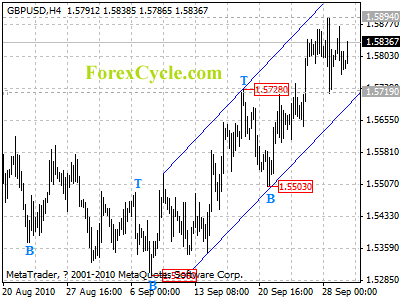
GBPUSD moves sideways in a range between 1.5719 and 1.5894. The price action in the trading range is treated as consolidation of uptrend from 1.5296. Support is at the lower border of the rising price channel, now at 1.5690, uptrend is expected to resume after touching the channel support. However, a clear break below the lower border will indicate that the uptrend from 1.5296 has completed at 1.5894 already, then the following downward move could bring price to re-test 1.5296 previous low support.

gbpusd

Daily Forex Reports

Why Some Investment Styles Are No Better Than Gambling

By Sara Nunnally, Editor, Smart Investing Daily, TaiPanPublishingGroup.com

I’ve been to Las Vegas a few times in my life: Once on a cross-country road trip after college, once for a bachelorette party, and once to present at an investors’ conference.

Now, I’m back for Taipan Publishing Group’s annual Global Opportunities Summit, and we’re in an apt place to talk about investing.

Vegas is a world of its own. I’m not a big gambler, but I can understand the draw of potentially winning a mountain of cash. And it got me thinking about how some investment philosophies are no better than putting a “C-note” down at the roulette table.

In a way, you could consider many types of investing a gamble. There’s always the potential for most investments to lose value.

The trick is to know the odds, and limit the potential losses, and there are very good ways to do that, such as stop-losses, dollar-cost averaging, hedging and a number of other methods.

We’ve told you about some of them here at Smart Investing Daily.

But for some investors, chasing that next ten-bagger is too tempting to ignore.

A more aggressive investment portfolio tends to be for more risk-tolerant investors. Knowing your risk tolerance is a must when you’re dabbling in high-yield/high-risk assets. These investment portfolios can also require increased monitoring by you, so you need to know if you even have the time to take on some of the more aggressive investment portfolio tactics.

If you meet these criteria, here are some tips to help keep your head above water.

(Remember, investing doesn’t have to be complicated. Sign up for Smart Investing Daily and let me and my fellow editor Jared Levy simplify the stock market for you with our easy-to-understand investment articles.)

Learn How to Legally “Trick” a Mutual Fund Into Paying for Your Retirement

You could “siphon” thousands of dollars a month from the profits of the mutual fund industry.

Get all the details from New Growth Investor.

Beware of Fad Stocks

Fad stocks can give your investment portfolio a much-needed boost, but they can also turn on a dime.

Take CROCS (CROX:NASDAQ), for example. Back in 2006, this stock traded for $13.70… Then it went gangbusters, climbing as high as $68.98 in 2007. A fantastic gain of 403%!

But during the global financial crisis, CROCS fell to just over $1 a share. This massive drop wasn’t just because the economy was tanking. It was because CROCS had been bid up so high as investors jumped into the fad.

Aggressive investors may look at that +400% gain, and say, “Hey, it’s worth the risk.” But you have to know when to get out.

Watch for short-sellers entering into the market. When a stock gets too hot, the short-sellers’ mouths start watering, and once the stock turns, this could send fad stocks lower hard and fast.

Use Stop-Losses for Global Markets

With the globalization of the financial markets, trading has become a 24/7 business. This is a good thing, and investors all over the world have access to both major and growing markets.

The thing is, you need to be up on what’s happening in the farthest reaches of the world, and that might require you to actually “be up” into the wee hours of the morning keeping trades under your watchful eye… And that’s not always practical.

That’s why stop-losses are so important. Not only do they allow you to get some sleep if you’re watching the currency markets and the Japanese yen, they help you limit the amount of money you put at risk.

This method is good for both day traders and “buy and hold” investors. It’s a great tactical maneuver, and if your understanding of whatever financial asset you’re investing in is very tuned in, you can place these losses in very key points to save gains and protect your investment from turning against you.

URGENT: China’s 98% Monopoly on This Resource Is Causing Panic at the Pentagon!

China has seized a near total monopoly on supplies of a natural resource treasure that is 100% mission critical to just about every piece of military technology – from satellites to smart bombs.

Learn what these materials are… why they are so critical… and how a pending Department of Defense report could make you gains of 20-to-1 in this URGENT FREE REPORT.

Stash Some Cash

Never underestimate the value of liquid net worth.

Some portfolio managers suggest that those investors close to retirement or already retired hold two to five years’ worth of living expenses as cash.

Aggressive investors may opt to hold much less. But they should at least hold some. By holding cash, you have a lot more flexibility when timing your investments. You can react to new investment ideas very quickly, which can allow you to take advantage of more gains than someone who has to worry about liquidating some assets before they invest in something new.

Holding cash is also important for when your investments turn against you, especially since many aggressive investors don’t live off their portfolio’s returns.

Of course, the ratio of cash in your investment portfolio is a completely individual choice, but maintaining some balance is always a smart idea.

At our annual summit, all of Taipan Publishing Group’s editors are presenting different ideas of what you should do with your money. Some ideas are for buy-and-hold investors, and some are for those aggressive traders.

But regardless of what type of investment portfolio you have, today’s financial markets require you to be alert and nimble.

Cash, stop-losses and timing are key components for every investment strategy.

Don’t forget to follow us on Facebook and Twitter for the latest in financial market news, investment commentary and exclusive special promotions.

About the Author

Sara is Co-Editor of Smart Investing Daily. As Senior Research Director and global correspondent, Sara Nunnally’s diverse resume includes studies in art history, computer science and financial research. She has appeared on news media such as Forbes on Fox, Fox News Live, and CNBC’s Squawk Box, as well as numerous radio shows around the country.

As Senior Research Director, global correspondent and co-editor of Smart Investing Daily, Sara has traveled all over the world in search of the best investment opportunities to recommend to her readers, be they in developed economies like France and Italy, in emerging markets like the Czech Republic and Poland, or in frontier terrain like Vietnam and Morocco. Her unique “holistic” approach of boots-on-the-ground research has given her an edge in today’s financial marketplace as she searches for the next investment opportunities in hot sectors like alternative energy, currency markets and commodities.

A Trader Walks Into A Bar… Pattern: HOP-portunity On Tap

A free Club EWI resource reveals how bar patterns signal high-probability trade setups

By Elliott Wave International

There’s a little known joke among the trading community that goes like this: “A trader walks into a bar… pattern: ‘Ouch!’ “

Fact is, if you don’t know what you’re doing, price bar analysis can be a bit “painful.” Finding a discernable pattern in their grouping can feel like finding a hair in a hay stack.

But if you have the right teacher — say someone who has used bar pattern analysis for twenty-plus years to signal dramatic moves in some the world’s most watched markets — well, then the discipline is invaluable. And right now, EWI is offering just that, free: the 15-page eCourse Book titled “How To Use Bar Patterns To Spot Trade Set-ups” by EWI’s chief commodity analyst and Futures Junctures Service editor Jeffrey Kennedy.

In this free 15-page resource, Jeffrey Kennedy shows you the top 6 bar patterns from his personal repertoire. He provides each pattern with a definition, illustrations of its form, lessons on its application and how to incorporate it into Elliott wave analysis, and historical examples of its occurrence in major commodity markets.

Take, for instance, the eBook’s section on “Popgun” bar chart patterns. Jeffrey defines this configuration as a “two-bar pattern composed of an outside bar preceded by an inside bar.” (See chart below.) From its namesake (the old-fashioned cork-and-string toy gun), popguns introduce swift tradable moves (“the cork flying”) that are ultimately retraced (“the string pulling the cork back”).

For a real-life example, see the September 27 Daily Futures Junctures, where Jeffrey presents this daily chart of December Coffee that clearly identifies a “Popgun” at the May 2010 low.

As for the remaining 5 bar patterns featured in Jeffrey’s eBook — look no further than the complete, free15-page eBook. You can read “How To Use Bar Patterns To Spot Trade Setups” now with an instant, free Club EWI membership.

In this comprehensive collection, Jeffrey provides each pattern with a definition, illustrations of its form, lessons on its application and how to incorporate it into Elliott wave analysis, historical examples of its occurrence in major commodity markets, and ultimately — compelling proof of how it identified swift and sizable moves.Best of all is, you can read the entire, 15-page report today at absolutely no cost. You read that right. The How To Use Bar Patterns To Spot Trade Setups is available with any free, Club EWI membership.

This article was syndicated by Elliott Wave International and was originally published under the headline A Trader Walks Into A Bar… Pattern: HOP-portunity On Tap. EWI is the world’s largest market forecasting firm. Its staff of full-time analysts led by Chartered Market Technician Robert Prechter provides 24-hour-a-day market analysis to institutional and private investors around the world.

How to Trade the Stock Market

By Owen Trimball – Investing in the Stock Market can be one of the most profitable skills you’ll ever master. Whether you’re trading indices, foreign currency, stocks, commodities or options – there are some vital matters you must understand before you can even begin to make money.

The Stock Market is one of the largest markets in the world, so it is going to be around for a long time. This means that if we can master a few strategies that bring consistent profits, it is not inconceivable that we could set ourselves up with a reliable income stream. The fact is, one of the most profitable skills we can ever master, is the skill of trading.

But trading the markets can also be very stressful. Many an optimistic graduate from some guru’s course, has become disillusioned with the passage of time, as they watch their hard earned capital draining away to the point where further trading is no longer viable. Sometimes this even accompanies a career being neglected, as professional development gives way to an obsession with “finding a way” to make it work. Every spare minute is spent swamped in the markets. Newsletters, bulletin boards, forums, articles, books, courses, software, even tipping services – all become the new learning path.

Trading can be the fastest way to go broke. The market doesn’t do the same things all the time. So one day a particular tactic will work, the next day it won’t. Compare this with a normal everyday function like walking down the street. If you walk into a lamp post, you soon learn that you need to walk round them. But in the market-place, the lamp posts keeps moving as you approach them, you can never be sure that you can get round them. But what you can do is develop the mental discipline so that even when you do bump into them it’s OK.

You have to learn trading skills, which ultimately are about 95% of this game. In the end, it’s not about the markets – it’s all about YOU. You are the essential element behind the way you trade.

Markets move from extreme to extreme across all time frames. They are a manifestation of human psychology, driven by fear and greed. Peaks are driven by greed, troughs by fear. This is obvious in the very long-term extremes. At the extremes the key point is that price is stretched unrealistically. Why is this? Because traders and / or investors are paying too much, selling too cheaply, because it is an emotional decision.

To win you must put yourself outside that emotion.

The big question here is whether you can develop the discipline if you do not have it naturally. I believe that the answer is “yes, you can,” but you must have the necessary commitment to do so.

Clearly self discipline is going to be a requirement even to start the process. However, the market itself is going to be helpful, although not as helpful as it might be. Ultimately undisciplined behavior is going to be punished by the market, either by direct losses or by the loss of profits which would otherwise have been available. But the market does not help as much as it might because of the principle of random reinforcement. This is the market’s tendency to reward bad behavior from time to time. What works one day may not work the next and this applies to the “best” trading practice. Similarly , bad habits do bring rewards from time to time.

This crucial fact is one of the reasons that it takes so long to learn how to trade. It is important then to discover techniques designed to develop and enhance your discipline and to recognise when you have let your discipline slip. You’ll be amazed at how much easier your trading becomes when you master this.

MONEY MANAGEMENT

Money Management is what makes your analysis/system work, not the other way around. Money Management is far more important than analysis. It is not your entry which is that important – it is your exit. Your exit determines your overall risk, your overall profit and your overall control. Your entry cannot wipe you out – but the way you exit can. Your entry does not make you a profit – the way you exit can.

RISK MANAGEMENT

The traders who win are those who minimize risk. This is another key lesson and cannot be overemphasised.Those who do not minimize risk inevitably pay the price and get wiped out.

Risk Control includes the following:- (1) Not trading in too big a size, thus reducing the risk of a wipe out. (2) Not holding overnight unless you have a profit buffer in place. (3) Not holding over the weekend, subject to the same as reason “2”. (4) Taking appropriate action prior to major news items. This means not normally opening positions, maybe reducing position size if already positioned – although it does depend on your trading objectives.

DESIGNING A SYSTEM

First, you must define the aim of your system. What do you want it to do? Do you want it to catch trends? Do you want to trade ranges? How much risk do you want to incur? What success ratio are you looking for? Primarily you can look to trade ranges or you can look to trade trends. Trading ranges means looking for extremes and entering when such extremes are reached. Trading trends means looking to catch trends and entering once your system indicates that a trend is in place. You can also combine these two approaches.

In both cases you need to define your trading conditions. You need to define a range or a trend. Once you define what you are looking for, you simultaneously define how to catch it.

You can define trends in many different ways. First you have to decide over what time frame you wish to define the trend. You must then use that time frame to give your trending signal, for example if you feel that you want to day-trade trends then you must in some way define the trend using charts of a few minutes.

Once you have defined the trend you will have your trend indicator. So if you decide that a higher high on a 5-minute bar chart means that you have an uptrend then that is your indicator.

There are 7 fundamental components of a successful trading system and every one of them must be in place before you can hope to become profitable. We have covered 2 of them (define your objectives and trending signal) and touched on a third (risk) and I hope you found them useful.

For further information, visit this link:The Way to Trade

About the Author

Owen has traded options for many years and writes for “Options Trading Mastery” – a popular site about option trading and all the best option trading strategies.

The Decade of the Philippine Peso?

usdphp 2010, usd, php, philippine peso, peso, us dollar, fx, fx market fx trading, forex, forex market, forex trading, trading forex, currency trading, daily forex picks. forex forecast, forex analysis

A lot of people are asking, will the Philippine peso continue to strengthen against the US dollar? Based on its monthly chart, I’d say that there’s a good chance that it will especially if the USDPHP pair breaks the 43.668 support. If and when it does, the next obvious support would not be at 42.00 as some financial analyst predict but at 40.00. Say the peso buying in tandem with the dollar selling continues and the 40.00 marker gets breached as well, then the pair’s next downside stage would be at 37.50. Actually, I do not want to alarm those who are highly leverage in the greenback. Notice, however, the huge head and shoulders pattern that could be forming already. If this pattern gets validated by a break below 40.00 then it is quite possible that the peso could recover its former glory back in its hay day and trade near the 26.00 versus the USD once again.

The question is, will the Banko Sentral ng Pilipinas (Central Bank of the Philippines) allow the Philippine Peso to appreciate that much? Well, the BSP is not a rookie in protecting the peso. It already defended the peso’s increase in valuation in the past to protect the country’s export industry, foreign direct investments, and the money that the Overseas Filipino Workers (OFWs) are sending back. Hence, it is possible for the BSP to do the same. If it does, the the greenback could rally back towards 46.00 or even 48.00 versus the peso. Still, the global has the bigger influence regarding the peso. So continued increase in remittances, which by the way takes up a good chunk of the country’s total income, plus the broad-based weakness in the USD (this was explained in my recent post, please see it here) would benefit the PHP. Companies all over the world are expected continue to lessen their operating costs, thus, supporting the Philippines’ BPO industry and its FDIs in general. Such would also reflect positively in the peso.

Would a higher peso valuation benefit the Philippines? The Philippines is not really an export-based country so even if the country’s export sector gets negatively affected, it would not reflect badly on its overall output. For the longest time, majority of the country GDP is from domestic consumption. Hence, an increase in the peso’s valuation would even encourage more consumption as imports would then be cheaper. Cheaper imports of course would allow local companies to better access and purchase technology that were once scarce, making the processes of the local industries more efficient. Such could also allow local companies to develop their technology which would mark the country’s move from a ‘third world’ country to at least second. Now, will that scenario happen within the next decade? Only time will tell. Still, I’m optimistic that it will.

More on LaidTrades.com

The Currency Crisis of 2010-2011

Michael Sankowski, Editor, Currency Profits Trader, TaiPanPublishingGroup.com

Financial markets in the last two years have been absolutely nuts. Huge moves in currencies, bonds, stocks, commodities – every market went crazy as the world nearly fell into a dark age. Yes, it was very close to “guns, ammo and water” time, much closer than any of the CNBC pundits would let on.

The financial markets seem a bit calmer over the past few months. Even with people flooding into U.S. government bonds because of safety concerns, the markets aren’t making the huge moves they made in 2008 and 2009. Yes, investors are avoiding the stock market, but it isn’t like there is panic in the streets, like there was until May of this year. The markets have calmed a bit.

Now for some bad news: These calm times aren’t going to last. Soon, people are going to be talking about the currency crisis of 2010-2011 – as we live through it, blow by blow.

But the biggest part of it will be due to the titanic clash of wrongheaded economics clashing with real-world facts.

When the financial markets realize this, there is going to be huge, unprecedented moves that rock all markets – and the calm times will be over.

We need a way to understand what might happen in the next year and profit from it.

Competitive Devaluations of Currencies

The currency crisis of 2010-2011 will be about two big ideas: recognizing losses from the housing market and a double-dip recession. But profiting from the currency crisis will be about one huge idea: competitive devaluation of currencies. During 2010 and 2011, the biggest topic will be how countries are competing to make their currencies less valuable, not more valuable.

The reason for this is simple – according to standard economic theory, the only way for an economy to grow is to make stuff for rich people and sell it to them. Nearly every economy in the world is export-driven except the United States. A weak currency is great for exports.

So during the next year, as the world economy falls off a cliff, countries will be fighting for the crumbs from an ever-smaller pie. There is really only one choice here – the way to economic growth in this situation is to be the cheapest supplier of goods.

In these lean times, companies are already running with the minimum staff possible. An easy way to make your goods cheaper is to make your currency less valuable than it was.

We’ve seen this already – countries are bickering about weakening their currencies. China is holding its currency artificially weak against the U.S. dollar and has for years. Japan just had a meeting on how they are going to intervene and make their currency weaker. But Germany is in the best situation of all.

You’ve heard about the problems with the euro – the euro currency is down nearly 25% from its highs because people are worried that some countries in the eurozone could default on their debt. But for German exporters, this low euro is great news. It is like a 25%-off sale, but they magically get the same number of euros to pay their workers. And they don’t have to spend a euro to make their currency weaker.

Germany recorded 2.1% growth in one quarter – that’s nearly 9% growth over a year – largely because the euro is so undervalued right now. The only problem is that this growth is coming at the expense of another country’s growth.

It’s actually a long list of other countries that want this growth. You can bet that Japan, China, Australia, the U.K, and the rest of the world took notice of that smoking-hot quarter. I bet they are all wishing they had a currency crisis too right now – 9% growth transforms a weak currency into a strong domestic economy.

But one country’s growth is another country’s lost growth. The competition to weaken currencies will be fierce, and governments will spend hundreds of billions to support their domestic economies.

The next few years are going to be defined by currency interventions and plots to manipulate the currency market. Most of these interventions will be unsuccessful, but some will succeed. China has been extremely successful in pegging its currency for several years, so a country with enough money can make it happen. But in any case, when countries intervene, Forex markets get hot.

Recovery for the Global Economy?

The global economy never recovered from the shadow banking crisis of 2008. While today people are talking about government spending, the reason the world blew up in 2008-2009 didn’t have anything to do with governments. The crisis was due to investment banks blowing up – because they lost hundreds of billions of dollars. People forget this, but it was excessive speculation that started the crisis.

Then governments around the world made a huge, huge mistake. The U.S. government decided to save the banking system, thinking that it was lending that drove the real world economy. Really, it’s the other way around – our real world economy is what drives real economic growth and the creation of wealth.

Of course, our government spent several trillion dollars on this stupid idea of supporting banks – at the expense of throwing real people and businesses off the bridge. You can see the shoddy results: 9.5% unemployment, trillions of dollars of new debt, horrible consumer sentiment, low economic growth – a grand slam of bad outcomes. And it has all been caused by a failure of an economic paradigm that doesn’t recognize how money is actually created.

Now we are stuck with a situation where governments have absorbed much of the private sector losses in the crisis through a variety of programs. But the problem is that although those losses might have changed hands, they didn’t go away.

Now, there are really only two ways for losses of this magnitude to go away. One, they can be written off and recognized by the banks, companies, and people who made the bad business decisions. That isn’t happening at all – these banks have done everything possible to push the losses off on U.S. citizens, or pretend they don’t exist. Two, they can be inflated away. That isn’t happening either. Inflation is the lowest it has been in my lifetime. And inflation expectations over the next 10 years are very, very low.

(By the way, regular Taipan Daily editors Adam Lass and Justice Litle will be back this week. Sign up to receive their investment commentary.)

Moves in the Global Currency Market

So what is going to happen? We’re not recognizing the losses, and we’re not inflating the losses away. We’re facing persistent low inflation in the U.S., Japan, and the eurozone, which is about 60% of the world’s economy. And competitive devaluations have already started – that’s a fact.

Well, there are five possibilities:

  1. Banks are forced to recognize additional losses because of more real estate losses, causing a second banking crisis.
  2. The euro loses another 20% due to the sovereign debt crisis but the eurozone economy is white hot.
  3. One country decides to end its own crisis by inflating away the losses, and also benefits through resulting currency devaluation. Other countries follow suit and inflation once again takes hold.
  4. Countries decide to attempt to stimulate their way out of the second recession with additional government spending and are unsuccessful.
  5. Countries decide to stimulate their way out of the second recession with middle-class tax cuts and are successful.

These are the most-likely scenarios for the next year – and every single one involves large moves in the currency markets.

That’s why I expect huge market moves in 2010 through 2011 across the globe, most likely resulting in massive currency moves.

Don’t forget to follow us on Facebook and Twitter for the latest in financial market news, investment commentary and exclusive special promotions.

About the Author

Michael Sankowski is the Editor of Taipan Publishing Group’s Currency Profits Trader. He has worked as a financial trader and analyst for the past 13 years in over 60 financial markets, beginning as runner on the floor of the Chicago Board of Trade in 1994 and working his way up to become a trader. Michael has traded for a $250 million hedge fund, which required him to trade all over the world, including the United States, Europe and Asia. He has also worked as a product designer for U.S. Futures Exchange, where he focused on trading in Forex, futures, options and fixed-income cash markets.

Michael holds the prestigious CFA Charterholder and Chartered Alternative Investment Analyst (CAIA) designations. The CFA charter is a certification for finance and investment professionals, particularly in the fields of investment management and financial analysis of stocks. The CAIA designation establishes a standard for those who specialize in the area of alternative investments, such as hedge funds, venture capital, private equity and real estate investment. Michael’s solid background and certifications in financial trading make him the best man to share his expertise and Forex recommendations with the readers of Taipan Publishing Group’s Currency Profits Trader.
Forex Daily Market Commentary

By GCI Forex Research

Fundamental Outlook at 0800 GMT (EDT + 0400)

USD

FX price action was generally subdued during the Asia session, but the dollar clearly remains on the defensive after a series of weak US data reports yesterday, which markets see as bolstering the case for further Fed QE. USDJPY and USDCHF in particular remain heavy, and the risk of further intervention by Japan’s MoF is consequently growing. EURUSD traded 1.3556-1.3596, USDJPY 83.68-84.09. Equities registered some gains with the S&P500 closing +0.5% ahead. The S&P/Case Shiller composite 20 home price index dipped as expected to +3.18% y/y but the Conference Board consumer confidence figure and the Richmond Fed missed expectations. The Conference Board index fell to 48.5 vs. consensus 52.1 and the drop mostly reflected the expectations index rather than assessments of the present situation. Other confidence measures have been mixed in September.
Meanwhile, regional surveys, including the Richmond data, have suggested some slowing in manufacturing output growth, on balance, in September. Fed Governor Warsh alluded to the ongoing media debate about competitive devaluations noting that, while a weaker dollar would be good for US exporters, the willingness of foreign investors to invest in the dollar must also be protected. Atlanta Fed President Lockhart said that he does not expect deflation to develop, but also cautioned that “the risk of deflation cannot be dismissed”. Several other Fed officials, including 2011 voters Plosser and Kocherlakota, are due to speak today. The dollar remains under pressure from further easing concerns but several upcoming risk events in the Eurozone could keep EURUSD upside in check.


EUR

The euro had been under pressure heading into the New York session due to talk of potential Eurozone sovereign downgrades but the ECB’s Stark’s comment that the ECB is “in the process of phasing out some of the non-standard measures [of support]” helped it regain some ground and EURUSD then pushed higher following dovish BoE comments and US data.
A major rating agency had previously put Spain on review for a possible downgrade from AAA in June with a 3-month review process that comes to an end this week. Given that the other major agencies already have Spain at least one notch lower, it seems likely that the downgrade will go ahead this week. Concerns over Ireland remain, with another ratings agency suggesting it might cut the credit rating in the wake of concerns over a prominent Irish bank and wider issues over political instability. While dollar weakness is supporting EURUSD, sovereign concerns could provide a near-term cap, especially with a statement on a nationalized Irish bank and the expiry of the 12m ECB tender this week.
JPY

The Q3 Tankan was broadly in line with consensus and had no impact on the USDJPY. However, earlier the disappointing US data ensured that USDJPY stayed heavy.
Our Analysts team notes that the increase in the headline index – the large manufacturing business conditions index – reflected earnings improvement despite the rising yen.
GBP

BoE policymakers aired their differences over the newswires but investors focused on the more dovish Adam Posen’s comments. Posen advocated further monetary easing as he envisions CPI falling well below target. He said additional stimulus should begin in the form of additional QE gilt purchases and if that did not work, then it would be time for further fiscal stimulus and corporate debt purchases. Posen again stressed, though, that this was not a foregone conclusion.
Policymaker Sentance, the lone MPC dissenter, wrote in a paper that he sees no need to restart quantitative easing as it would give the wrong impression on the state of the economy. Neither policymaker said anything markedly different from their current positions but with the prospect of further Fed easing, investors are even more closely attuned to central bank comments.

TECHNICAL OUTLOOK


USDJPY focus back on 82.88.
EURUSD BULLISH Climb through 1.3511 yesterday exposes 1.3692. Near-term support comes in at 1.3381 ahead of 1.3287.
USDJPY BEARISH The break of 84.05 brings our focus back on the downside at 82.88. Resistance remains at 84.50 ahead of 85.40.
GBPUSD BULLISH Continues to trade higher; expected to target 1.5999 key high with scope for 1.6253 next. Support is defined at 1.5719 ahead of 1.5503.
USDCHF BEARISH Break of 0.9780 support exposes 0.9625. Resistance at 0.9983.
AUDUSD BULLISH There is little resistance till 0.9850 key high with initial support defined at 0.9559 ahead of 0.9463.
USDCAD BULLISH While support at 1.0192 holds, expect recovery towards 1.0509 and 1.0673.
EURCHF NEUTRAL Trading within 1.3391 and 1.2991 range. Break below 1.2991 would expose 1.2766 key low.
EURGBP BULLISH Sharp recovery yesterday held in front of 0.8606/0.8609 tough resistance area. Next resistance lies at 0.8736.
EURJPY BULLISH Momentum is positive; clearance of 114.74 would expose 116.68 and 119.33. Near-term support comes in at112.67 ahead of 110.66.

Forex Daily Market Commentary provided by GCI Financial Ltd.

GCI Financial Ltd (”GCI”) is a regulated securities and commodities trading firm, specializing in online Foreign Exchange (”Forex”) brokerage. GCI executes billions of dollars per month in foreign exchange transactions alone. In addition to Forex, GCI is a primary market maker in Contracts for Difference (”CFDs”) on shares, indices and futures, and offers one of the fastest growing online CFD trading services. GCI has over 10,000 clients worldwide, including individual traders, institutions, and money managers. GCI provides an advanced, secure, and comprehensive online trading system. Client funds are insured and held in a separate customer account. In addition, GCI Financial Ltd maintains Net Capital in excess of minimum regulatory requirements.

DISCLAIMER: GCI’s Daily Market Commentary is provided for informational purposes only. The information contained in these reports is gathered from reputable news sources and is not intended to be U.S.ed as investment advice. GCI assumes no responsibility or liability from gains or losses incurred by the information herein contained.

Crude Oil – Range Trading Continues

By Yan Petters – For the past 3 weeks crude oil prices have been fluctuating between $73.50 a barrel to $78.00 a barrel. This means that the market has acknowledged that for the time being, this price represents the real value of crude oil. Currently, crude oil is floating in the middle of the range, trading at $76.60 a barrel.

• The chart below is the crude oil 4-hour chart by ForexYard.
• The flat form of the MACD is a great reflection of the steady trading of crude oil. Once the MACD will begin moving towards a certain direction, it will signal that the range might be coming to an end.
• In the meantime, a bullish cross of the Slow Stochastic is indicating that crude oil might see a bullish move today.
• The next significant resistant level is located at the $77.15 price. If crude oil will cross the $77.15 level, it is likely to reach towards the $78.00 as well.
• If crude will fail to cross the $77.15 level, it might drop to the $76.00 support level.
• The next support levels are at the $75.50, $74.60 and $73.55 levels.
• Traders are also advised to pay special attention at 14:30 GMT, when the U.S. Crude Oil Inventories report is scheduled to be released. Usually this release creates heavy volatility in crude oil trading, and traders should be prepared.

Forex Market Analysis provided by ForexYard.

© 2006 by FxYard Ltd

Disclaimer: Trading Foreign Exchange carries a high level of risk and may not be suitable for all investors. There is a possibility that you could sustain a loss of all of your investment and therefore you should not invest money that you cannot afford to lose. You should be aware of all the risks associated with Foreign Exchange trading.

USD Tumbles Against Rivals Following Disappointing News

Source: ForexYard

A disappointing US consumer confidence report released yesterday, caused the ‎greenback to take heavy losses against virtually all of its main currency rivals. The ‎dollar appears to have stabilized in overnight trading, but only after it hit a more ‎than 2-year low against the Swiss franc. Analysts are doubtful about whether the ‎USD can bounce back from these losses in the near future.‎

Economic News

USD – Greenback Falls Among Rumors of Fed Intervention

A worse than expected consumer confidence report released yesterday has sparked ‎rumors that the Fed will take definitive steps in order to help stimulate the ailing ‎US economy. The CB Consumer Confidence report came in at 48.5, well below the ‎predicted figure of 52.5. The steps, which are commonly referred to as quantitative ‎easing, have yet to be implemented. That being said, even the possibility of a new ‎Fed stimulus plan has sent the dollar down. ‎

USD/CHF dropped to its lowest level since March of 2008. Currently the pair is ‎trading steadily around the 0.9760 level. Meanwhile, the greenback has hit a new ‎low against the yen since the Bank of Japan moved in to devalue the JPY earlier ‎this month. USD/JPY currently stands at 83.87, down over 30 pips from yesterday ‎afternoon. ‎

Today, most analysts are forecasting the dollar’s bearish trend to continue. While ‎the Swiss KOF Economic Barometer, set to be released later today, is forecasted to ‎come in below last month’s levels, the USD is unlikely to see major gains as a result. ‎As long as investors feel that quantitative easing is still a plausible move by the Fed, ‎the dollar will likely remain low, making riskier currencies more attractive.‎

EUR – EUR Makes Big Gains in Dramatic Trading Day

Rumors that the Fed will take new measures to boost the struggling US economy ‎sent riskier currencies soaring during trading yesterday, with the euro making some ‎of the most dramatic gains. With the value of the US dollar low, and still dropping, ‎higher yielding currencies remain attractive to investors looking for short term gains ‎in the currency market. ‎

The EUR/USD pair approached the 1.3600 level yesterday, soaring almost 200 pips ‎in the span of a few hours. The pair has since only staged a marginal correction, ‎and is currently trading around the 1.3580 level. Against the yen, the euro saw ‎gains of over 100 pips during the same time frame yesterday. The EUR/JPY pair ‎currently remains steady around the 113.85 level.‎

Today, analysts are forecasting further gains for the euro, as a lack of significant ‎global economic news will likely keep dollar prices low. Traders will want to watch ‎out for any surprise announcements from the Fed regarding the falling greenback. ‎Any news about a fresh US stimulus plan could send the euro up once again.‎

JPY – Yen Continues to Make Gains on the US Dollar

The USD/JPY pair dropped well below the 84.00 level yesterday, marking a fresh ‎low for the pair since the Bank of Japan (BoJ) intervened to devalue the yen earlier ‎this month. While the main catalyst for the drop was yesterday’s disappointing US ‎consumer confidence report, the dollar has been falling consistently against the yen ‎over the past few weeks. Further gains by the yen are likely to fuel investor ‎concerns that the BoJ will step in once again to drive the Japanese currency down. ‎Japan’s economy is largely export based, meaning a weak yen is in the country’s best ‎interests.‎

Barring any major moves from the BoJ today, the yen will likely continue to make ‎gains on the dollar, especially if the rumors of a Fed stimulus package persist. At ‎the same time, the JPY took substantial losses against the euro and Swiss franc ‎yesterday. Should investor risk taking continue to dominate market sentiment, the ‎yen will likely remain low against its riskier counterparts.‎

Crude Oil – Oil Sees Heavy Fluctuations Ahead of Inventories Report

Over the last few days, the price of crude oil has been bouncing back and forth ‎between around $75.50 a barrel and $77.00 a barrel. While prices have been ‎somewhat influenced by the value of the US dollar, the commodity has not been ‎able to establish a clear trend. In yesterday’s trading alone, oil jumped around 150 ‎pips, followed by a steep drop of around 70 pips, and finally by another upward ‎correction. ‎

This trend may change later today when the latest US Crude Oil Inventory figure is ‎released. Analysts are forecasting a drop in US inventories from last week. Should ‎today’s figure come in at the predicted level of -0.4M, oil may restart the bullish ‎trend it experienced throughout last week. At the same time, traders will want to ‎pay attention. If the figure comes in above the predicted level, prices may fall in ‎afternoon trading. ‎

Technical News

EUR/USD

Most technical indicators show this pair in overbought territory, meaning a downward ‎correction is likely to take place. The RSI on the 8-hour chart is right on the border of ‎the upper resistance line, while the Stochastic Slow on the 4-hour chart is very close to ‎forming a bearish cross. Traders may want to go short on this pair today.‎

GBP/USD

After a heavy trading day yesterday, most technical indicators show this pair in ‎neutral territory. These include the Williams Percent Range on the 4-hour chart, and ‎the Stochastic Slow on the 8-hour chart. Traders may want to take a wait and see ‎approach with this pair today, as a clearer picture is likely to present itself later on.‎

USD/JPY

The Relative Strength Index and Williams Percent Range on both the 4 and 8-hour ‎charts are showing this pair well into oversold territory. Typically this means that a ‎bullish correction is likely to occur in the very near future. Traders may want to go ‎long with tight stops in their positions today.‎

USD/CHF

After a steep drop yesterday, technical indicators show that this pair may be poised ‎for an upward correction. The Williams Percent Range on the 4-hour chart and the ‎MACD on the 8-hour chart both show the pair in oversold territory. Going long may ‎be the preferred strategy today.‎

The Wild Card

Dow Jones Industrials ‎

After making some fairly significant gains yesterday, technical indicators are showing ‎that the Dow Jones may be due for a downward correction. The Stochastic Slow on ‎the 4-hour chart is close to forming a bearish cross, while the Williams Percent Range ‎on the 8-hour chart is well into overbought territory. CFD traders may want to go ‎short in their positions today. ‎

Forex Market Analysis provided by ForexYard.

© 2006 by FxYard Ltd

Disclaimer: Trading Foreign Exchange carries a high level of risk and may not be suitable for all investors. There is a possibility that you could sustain a loss of all of your investment and therefore you should not invest money that you cannot afford to lose. You should be aware of all the risks associated with Foreign Exchange trading.

Swiss KOF Barometer on Tap Today

printprofile

The US dollar continued to trade bearish against its main currency rivals yesterday, as worse than predicted economic indicators renewed suspicions that the Fed will soon begin a stimulus program to boost the greenback. Following the disappointing news, the USD/CHF pair fell to its lowest level since March of 2008. Today, news from both Switzerland and the US may give the dollar a chance to recoup some of its earlier losses.

Here is a roundup of the day’s main news events:

09:30 GMT: CHF KOF Economic Barometer

The KOF Economic Barometer is a monthly indicator designed to predict the direction the Swiss economy will take over the next six months. It is widely considered to be a highly significant economic release, and consistently leads to volatility among CHF pairs.

This month, analysts are forecasting a slightly lower figure from last month’s release. Should the barometer come in around its predicted level 2.12, the greenback may be able to regain some of the substantial losses it took against the franc yesterday.

14:30 GMT: USD Crude Oil Inventories

After seeing some fairly significant gains last week, crude prices have fluctuated over the past few days. Today’s US inventory figure may help oil prices move up again. Most analysts are forecasting a decrease in US stockpiles from last week, which if true, means that demand is up. Typically higher demand equals higher prices. Should the report come in at its predicted level of around -0.4M, traders may want to enter into some long positions with oil.