Gold Hits Record High

By Anton EljwizatGold hit a record high of $1,315 an ounce this week, extending a two-week rally of fresh records on concerns over an economic recovery. Gold has made a significant upward correction, which can be directly correlated with the bullish trend of the EUR/USD cross. As I will demonstrate below, the price of gold may very well be heading for a reversal. This recent activity has raised the stakes for traders. From here on, the forex and commodity markets will see very high volatility indeed.

• The technical indicators used are the Slow Stochastic, Relative Strength Index (RSI) and Williams Percent Range.

• Point 1: There is a “doji” candlestick that has formed on the chart, indicating that a reversal should take place.

• Point 2: The Slow Stochastic indicates a bearish cross, signaling that the next move may be in a downward direction.

• Point 3: The RSI signals that the price of this pair currently floats in the over-bought territory, indicating downward pressure.

• Point 4: The Williams Percent Ranges is showing that this pair is heavily over-sold and may be experiencing strong upward pressure.

Gold Daily Chart

Forex Market Analysis provided by ForexYard.

© 2006 by FxYard Ltd

Disclaimer: Trading Foreign Exchange carries a high level of risk and may not be suitable for all investors. There is a possibility that you could sustain a loss of all of your investment and therefore you should not invest money that you cannot afford to lose. You should be aware of all the risks associated with Foreign Exchange trading.

Forex Daily Market Commentary

By GCI Forex Research

Fundamental Outlook at 0800 GMT (EDT + 0400)

USD

The dollar-positive effects of yesterday’s stronger US data began to wear off during the Asia session. The greenback surrendered some ground after FOMC voter Pianalto said policy options to get the Fed on the path to achieving price stability are being investigated. A better than expected China PMI reading temporarily supported the AUD. EURUSD traded 1.3604-1.3667, and USDJPY 83.37-83.58. Jobless claims fell slightly more than anticipated to 453k and the renewed downturn cautions against extrapolating the mid-summer soft patch in economic activity. Chicago PMI rose to 60.4 and details were strong but the Milwaukee PMI fell to 50. And Q2 real GDP growth was revised up to a 1.7% annual rate. Price data was little revised, with core PCE to 1.0% from 1.1%. The positive data may have given investors pause in their expectation for further easing but easing concerns will persist unless we see continued data improvement. And it will be key how Treasury yields react to the data releases, as higher yields could provide some respite for the dollar. University of Michigan confidence, ISM Manufacturing, core PCE and deflator data for August are due.
EUR

The euro remained relatively stable after overcoming the latest risk events. The Irish government announced that the domestic banking system will require further government-sponsored capital injections, the size of which were broadly in line with expectations. Finance Minister Lenihan said that holders of subordinated debt of a nationalized bank would be expected to make a significant contribution to the bailout. The euro initially fell on the news, but a recovery soon ensued as Irish sovereign spreads over bunds began to tighten. The euro drew further strength from reduced demand for ECB cash at the latest tender, and a better than expected fall in German unemployment numbers. The anticipated Moody’s downgrade of Spain also passed quietly – Spain fell only a single-notch in the rankings, and the outlook was set to stable.
The Irish central bank announced that the domestic banking system will required further government-sponsored capital injections. The Irish Finance Minister said that holders of subordinated debt of a nationalized bank would be expected to make a significant contribution to the bailout.
JPY

CPI excluding fresh food improved slightly, as expected, to -1.0% (prev. -1.1%). Prime Minister Kan said, in a clear reference to next week’s policy meeting, that he hopes the BoJ will take further necessary steps to beat deflation. Both he and Finance Minister Noda also said that Japan will continue to take decisive steps as needed to counter the yen’s rise.
Ministry of Finance data revealed that Japan undertook JPY2.1249tn of FX intervention in the month of August 28-September 28 (approximately $25bn). This was broadly inline with market estimates and suggests that intervention was limited to a single day.
GBP

The UK data calendar was light with the Nationwide house price index increasing 0.1% m/m, ahead of consensus of -0.3%. Cable moved higher in the overnight session but then fix-related selling pressured sterling.
Prior to the New York open, BoE policymaker Posen said he could be talked out of his opinion of further QE. The MPC appears more fragmented between Posen’s pro-QE approach, Sentance’s dissent and the rest of the committee.


CAD

July monthly GDP was negative as expected and BoC Governor Carney again cautioned on the economic outlook, similar to the latest BoC statement. He stressed the unusual uncertainty surrounding the outlook and reiterated that future monetary policy moves would have to be carefully considered. The BoC raised the policy rate at its last meeting but the concerns of further Fed easing have tempered expectations for the BoC’s policy rate path, which has weighed on the Canadian dollar.

TECHNICAL OUTLOOK


EURCHF breaks 1.3391.
EURUSD BULLISH Upside potential eyes 1.3692 with scope for 1.3896 next. Near-term support comes in at 1.3381 ahead of 1.3287.
USDJPY BEARISH Focus is back on the downside; break of 82.88 would expose 79.75. Resistance remains at 84.50 ahead of 85.40.
GBPUSD BULLISH Bull stalls in front of 1.5999 key high; key reversal lower has support at 1.5503.
USDCHF BEARISH Next support below 0.9625 lies at 0.9500 psychological level. Resistance at 0.9918 breakout low.
AUDUSD BULLISH The pair is expected to target 0.9850 with scope for 1.000 psychological resistance next. Support is at 0.9559 ahead of 0.9463.
USDCAD NEUTRAL 1.0509 and 1.0108 mark the near-term directional triggers.
EURCHF BULLISH Following the break of 1.3391 model had turned bullish. Need a break above 1.3924 to confirm the positive trend.
EURGBP BULLISH As long as support at 0.8463 holds, expect the pair to target 0.8736 ahead of 0.8808.
EURJPY BULLISH Momentum is positive; clearance of 114.74 would expose 116.68 and 119.33. Near-term support comes in at112.67 ahead of 110.66.

Forex Daily Market Commentary provided by GCI Financial Ltd.

GCI Financial Ltd (”GCI”) is a regulated securities and commodities trading firm, specializing in online Foreign Exchange (”Forex”) brokerage. GCI executes billions of dollars per month in foreign exchange transactions alone. In addition to Forex, GCI is a primary market maker in Contracts for Difference (”CFDs”) on shares, indices and futures, and offers one of the fastest growing online CFD trading services. GCI has over 10,000 clients worldwide, including individual traders, institutions, and money managers. GCI provides an advanced, secure, and comprehensive online trading system. Client funds are insured and held in a separate customer account. In addition, GCI Financial Ltd maintains Net Capital in excess of minimum regulatory requirements.

DISCLAIMER: GCI’s Daily Market Commentary is provided for informational purposes only. The information contained in these reports is gathered from reputable news sources and is not intended to be U.S.ed as investment advice. GCI assumes no responsibility or liability from gains or losses incurred by the information herein contained.

Flurry of US Economic Data Impacts Forex Market

Source: ForexYard

The end of the month brought a volatile trading day as US GDP and weekly unemployment numbers were released. Irish Banking woes continue to weigh on the markets but failed to slow a strong month for equities.

Economic News

USD – ISM Manufacturing PMI on Tap

Today’s trading was swamped with positive economic data on the calendar. However, the better than expected data did not help the US dollar increase versus its rivals. US Final GDP was better than expected at 1.7% on expectations of 1.6%. Weekly unemployment claims were also better than forecasted. Only 453K new jobless claims were reported on expectations of 458K. Positive data from the business sector was also released as the Chicago PMI index climbed to 60.4 from a previous reading of 56.0.

Despite the strong economic numbers, traders showed little interest in pushing the US dollar higher. The EUR/USD traded in a range between 1.3680 and 1.3560. The USD/JPY was unchanged from its opening day price of 83.56. The dollar did show strength versus the British pound and the Swiss franc. The GBP/USD dropped to its lowest level of the week at 1.5668 while the USD/CHF rose as high as 0.9843 after opening at 0.9774.

US equities were weaker on the day as the Dow Jones Industrials Average posted a loss of 0.4%. September was a good month for US stocks as the Dow rose 7.7%, the largest gain in September trading since 1939. September is typically considered a gloomy month for stocks. The catalyst for the gains in the Dow was positive US economic data that reduced the risk of a double dip recession.

The market’s expectations for improving economic data will be tested today with the release of the US ISM Manufacturing PMI. Better than expected data could continue the recent trend of dollar weakness. The EUR/USD could rise to the resistance level of 1.3820.

EUR – Euro Shrugs Off Negative News

European financial woes are reemerging following the bailout of Allied Irish Banks and the downgrade of Spanish sovereign debt by Moody’s.

Ireland will need to fork over 34 Bn euros to shore up failing Allied Irish Banks. The recapitalization of the bank will most likely affect the Irish budget which should reflect a higher debt to GDP ratio.

Moody’s investor services downgraded Spanish sovereign debt by one notch to Aa1 from Aaa and held the outlook stable. Moody’s is the last of the major ratings agencies to downgrade Spanish sovereign debt. The move was largely expected by the market and did not come as a big surprise.

Despite the negative news, the euro has shrugged off the publicity and continues to strengthen against its rivals. Yesterday the rate of the EUR/USD was largely steady, but the EUR/GBP was up sharply at 0.8679. This is up from an opening day price of 0.8583.

British Manufacturing PMI data will be the catalyst for today’s EUR/GBP trading. The next resistance level for the EUR/GBP rests at 0.8770.

JPY – USD/JPY Continues to Weaken

The downtrend of the USD/JPY continues and has shown few signs of slowing since the Japanese Ministry of Finance intervened in the forex markets over two weeks ago. Traders are once again testing the resolve of the ministry and the Bank of Japan (BOJ) to intervene.

There is no said line that is drawn in the sand that once crossed the BOJ will begin selling yen on the open market. But it appears traders are targeting the recent low for the USD/JPY at 82.86.

A glimpse of hope for a reversal in the trend lies in the ascending wedge pattern that has formed on the monthly chart. A rise in the price could test the resistance level at 90.80. A close above this on a monthly basis would confirm a breakout to the upside.

However, there is always a chance the pair will continue and break to the downside. Traders should eye a breach below the 82.80 level for a sign of a continuation of the downtrend.

Oil – Oil Prices Rise on Positive Economic Data

The price of oil rose sharply yesterday by 3.4% on the heels of positive US economic data. The rise in the price left crude oil with a strong performance for the month of September that coincides with a strong month for US equities.

The release of rising US GDP numbers, better than expected weekly unemployment data, and a rising Chicago PMI all helped to influence traders to become more bullish on the economic recovery.

Momentum for spot crude oil appears to be to the upside as the MACD histogram shows a rising trend. This may signal further gains in the price of spot crude oil. The next resistance level for the pair is found at $83.00.

Technical News

EUR/USD

Momentum continues to increase to the upside with the 20-day simple moving average sloping higher. As such, traders should favor trades in that direction. A bullish channel has formed on the daily chart, beginning at the September 12th low. Traders should target the upper line of the channel which coincides with the March high of 1.3820.

GBP/USD

Traders should be cautious with the pair following yesterday’s selloff. The long red candlestick follows three days of consecutive doji candlesticks. The halt in the uptrend occurs at 1.5870 which coincides with the 61.8% Fibonacci retracement level from the November 2009 high. All of this may signal a reversal of the trend or at least a period of a consolidation.

USD/JPY

A distinct declining wedge pattern has formed on the monthly USD/JPY chart that could signal a reversal of the downward trend. As the long term trend is clearly to the downside, traders will need to be extra patient before taking a long position and wait for a clear signal that a breakout to the upside has occurred. This month the price could test the resistance level at 90.80. A close above this on a monthly basis would confirm the breakout. However, there is always a chance the pair will continue to the downside. Traders should eye a breach below the 82.80 level for a sign of a continuation of the downtrend.

USD/CHF

Two days of appreciation in the pair may present a sell opportunity to enter into the downtrend. The price of the pair rose as high as the 0.9840 level where it then proceeded to head lower. This may be the time enter short with a target at the 2008 low of 0.9632.

The Wild Card

Crude oil

Crude oil is showing signs that momentum is to the upside. The 7-day Momentum indicator is sloping sharply higher and the MACD histogram is also rising. Yesterday the price breached above the resistance level of $80. Forex traders should be targeting the next resistance level at $83.00.

Forex Market Analysis provided by ForexYard.

© 2006 by FxYard Ltd

Disclaimer: Trading Foreign Exchange carries a high level of risk and may not be suitable for all investors. There is a possibility that you could sustain a loss of all of your investment and therefore you should not invest money that you cannot afford to lose. You should be aware of all the risks associated with Foreign Exchange trading.

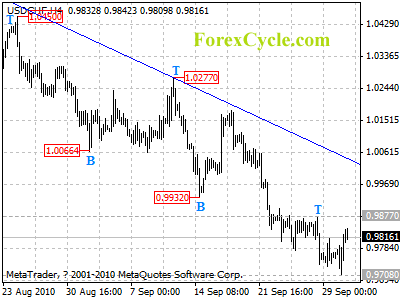
USDCHF stays below a falling trend line

USDCHF stays below a falling trend line from 1.0624 to 1.0277 and remains in downtrend. As long as the trend line resistance holds, downtrend from 1.1730 (Jun 1 high) is expected to continue and another fall towards 0.9634 (2008 low) is still possible after a minor consolidation. Resistance is now at 0.9877, a break above this level will indicate the a cycle bottom has been formed at 0.9708 level on 4-hour chart, then lengthier consolidation of downtrend could be seen and further rally towards the trend line resistance is possible.

usdchf

Daily Forex Signal

Three Common Mistakes People Make When Trading the Markets

By Owen Trimball – One of the attractive things about trading the stock market is, that when looking at a chart of the stock, it is known to have reliable patterns which most of the time are good predictors of future direction. Whether it be a “head an shoulder” reversal pattern or simply riding the directional momentum on the basis that “the trend is your friend”, a good trader can do very well – and with the availability of leveraged instruments such as options and CFDs, can earn a very good living.

In fact, it has been said that one of the most profitable skills you can ever master, is the art of trading.

But every so often, the market does the unpredictable. It makes a strong move in the wrong direction, just when all the signs looked like it should go the other way. This is usually due to some news item that has been released and the market, in its usual efficient manner, reacts accordingly. If the news is sensational enough, the investing public can behave quite irrationally, driven by fear (if it’s bad news) or greed (if the news is positive). The momentum of the price move takes on a life of its own and continues until it either blows itself out, or in the case of a downward move, fear is replaced by the perception that a bargain is on offer.

While markets are moving in predictable directions based on well established and generally reliable price patterns, all seems well. It’s the unexpected moves that come out of left field that a disciplined trader needs to be prepared for.

So let’s take a look at the three most common mistakes traders make, which separates those who make a lot of money from those who end up losing it all.

1 – Bad Risk Management

It is critical before you even think about trading, that you have a risk management plan. You have a certain amount of capital to trade with and it is essential that you preserve it intact, otherwise you’re out of the game.

One of the most common mistakes is investing too much on any one trade. You might feel very confident that price direction will go as expected, but this could be one of those exceptions already mentioned. You either lose a large percentage of your available capital, or you get stuck in a trade, hoping it will turn around – and in the meantime, miss out on all those other opportunities that could’ve made you some great profits.

So it is essential to only invest a small portion – no more than 10 percent but preferably 5 percent – on any one trade. This is particularly the case if you’re using leveraged instruments such as options, futures or CFDs.

Losing 20 percent of 10 percent of your available capital traded on one trade is the equivalent to only 2 percent of your entire trading bank. Psychologically, this is easier to handle. But the law of averages will mean that you also have other capital available for other trades whose profits will far outweigh the loss on one bad trade.

2 – Staying in Too long

Once your trade has realized a target profit, it is far better to close out a trade and bank the money, than hold on in the hope that it will make a lot more. Too often, the good fortune will reverse without notice and your unclaimed profit will turn into a loss. You need to develop a mindset that, even if the trade were to blast off into stellar profits after you exited, that at least you can be content that you achieved some of it – and that the strong movers are more the exception than the rule.

The above is especially true with the likes of short term option trading. Better to take 30 – 50 percent profit on a good trade than be disheartened when your leverage turns around and works against you because you stayed in for too long.

3 – Not Having a System

When trading the markets you can’t afford to make emotional decisions. In the end, you must realize that it’s only a numbers game. The first mistake a lot of traders make is approaching the market without any plan in place. You must define the aim of your system. Do you want to trade the extremes of ranges, or do you want to catch trends – or both? What success ratio do you need to be profitable? In connection with this success ratio, what must your percentage profit be in relation to percentage losses on any one trade for your success ratio to work?

What indicators or form of analysis will you use? What time frame do you wish to trade – day trading or longer term? Once you decide this, what chart periods will you focus on – 5 minute, hourly, daily or weekly?

If you don’t have a plan of your own, it would be wise to follow someone else’s trading system, providing it is tried and tested over years and is known to achieve consistently profitable results.

About the Author

One of the world’s most profitable option traders is Kim Reilly. His system is simple yet powerful and made him over a million dollars. You can learn to trade options from him with confidence.

US GDP growth revised higher to 1.7 percent in 2Q. Jobless Claims fall. Dollar mixed in Forex Trading.

By CountingPips.com

The U.S. economy expanded in the second quarter of 2010 for a fourth straight quarter at a slightly quicker pace than previously reported, according to a release by the U.S. Commerce Department. The third government estimate showed that the U.S. Gross Domestic Product grew on an annualized basis by 1.7 percent in the April to June quarter following a real 3.7 percent growth rate in the first quarter.

The first estimate for the second quarter, released in July, had shown GDP growth by 2.4 percent but was revised lower to a 1.6 percent growth rate in the second estimate released in August. The second quarter is the fourth consecutive quarter of U.S. economic growth after the GDP had fallen for four straight quarters over the second half of 2008 and the first half of 2009.

The latest data was boosted by an uptick in consumer spending to 2.2 percent from the last estimate that registered a 2.0 percent increase in consumer spending.

Today’s GDP news surpassed market forecasts that were expecting GDP growth to be steady at 1.6 percent for the quarter.

The first estimate for the third quarter GDP data is scheduled for October 29th.

Weekly Jobless Claims fall by 16,000

U.S. weekly jobless claims decreased by more than expected in the week that ended on September 25th, according to a release by the U.S. Labor Department today. New jobless claims fell by 16,000 workers to a total of 453,000 unemployed workers. The 4-week moving average of unemployed workers decreased by 6,250 workers from the previous week to a total of 458,000.

Market forecasts were expecting jobless claims to edge down to 460,000 workers following the prior week’s 469,000 revised number of claims.

Meanwhile, workers seeking continuing claims for unemployment benefits for the week ending September 18th also decreased for the week. Continuing claims declined by 83,000 workers to a total of 4,457,000 unemployed workers.

Continuing claims also came in better than market forecasts that were expecting a total of 4,473,000 claims. The four week moving average of continuing claims dropped by 5,500 workers to a total of 4,526,750.

US dollar mixed in Forex Trading, Stocks lower

The U.S. dollar has been mixed in forex trading today against the other major currencies while the U.S. stock markets have been slightly lower for the first half of the day. The dollar has been increasing today versus the euro, British pound  sterling, Swiss franc, Australian dollar and the New Zealand dollar, according to currency data by Oanda. The American currency has been on the defensive so far today against the Canadian dollar and the Japanese yen.

The U.S. stock markets, meanwhile, have been negative so far today with the Dow Jones declining by nearly 50 points, the Nasdaq decreasing almost 20 points and the S&P 500 down by over four points at time of writing. Oil has advanced by $0.89 to $78.75 while gold has fallen by approximately $7.00 to near the $1,300 per ounce level with the current price at the $1301.50 per ounce level.

Forex Daily Market Commentary

By GCI Forex Research

Fundamental Outlook at 0800 GMT (EDT + 0400)

USD

The dollar managed to stage a mild recovery during the Asia session as economic data in Australia, New Zealand and Japan took a turn for the worse. EURUSD traded 1.3593-1.3647, USDJPY 83.48-83.82. Nevertheless, the potential for a further round of Fed quantitative easing remains a dominant influence on price action. San Francisco Fed President Yellen and nominee Ruskin were confirmed by the Senate, and will now be able to take their places on the Fed’s Board of Governors. Several Fed officials also spoke. Boston Fed President Rosengren, a 2010 FOMC voter, said the Fed should vigorously and creatively use policy options to combat a slow recovery and “undesirably low” inflation. But he also warned that benefits of unconventional policies are harder to track and more easing should depend on incoming data. Minneapolis Fed President Kocherlakota was slightly more middle-of-the road as he envisions “muted” effects from further asset purchases on Treasury yields. He remained open-minded on which tool the Fed could use next but said the US needs to get its fiscal side in order in the longer run. And Philadelphia Fed President Plosser worried about the downside effects of further easing though he would back it if deflationary expectations emerge, which he does not expect. Kocherlakota and Plosser are voting members in 2011.
The varying opinions suggest the FOMC will wait and watch data for now. But officials do seem more in agreement on labour market concerns and on the need for more fiscal moves. The second revision of Q2 GDP is due along with jobless claims and Chicago PMI. Fed Chairman Bernanke testifies on regulatory reforms.
EUR

Our analysts believe the French 2011 Financial Bill represents the first step on a long journey but they note that the proposed deficit is still far from sustainable. Sovereign deficits continue to weigh on investor sentiment and EU Commission President Barroso said Portugal needs to show it is serious about tackling its deficit issues.
The Irish central bank announced that the domestic banking system will required further government-sponsored capital injections. The Irish Finance Minister said that holders of subordinated debt of a nationalized bank would be expected to make a significant contribution to the bailout.
JPY

Key August economic data was weak with retail sales softer than expected, rising only +1.4% m/m (cons. +1.9%, prev. +0.7%). Industrial production rose by +15.4% y/y, considerably short of expectations of +16.9% y/y. The yen weakened very slightly on the numbers, demonstrating that US yields continue to be the principal driver in the pair.
CAD

Canadian Finance Minister Flaherty said the economy is on track for the year even if the upcoming July GDP print may turn out to be negative, which is in line with consensus expectations. But at this stage, the US recovery is a larger driver and has kept the CAD under pressure versus the rest of the G10. Even if the Canadian recovery remains on track, the BoC policy rate outlook could be tempered given the Fed’s potential to ease further.


AUD

The Australian Dollar came under mild selling pressure after some weak economic data. Building approvals fell -4.7% m/m (cons 0.0%, prev. 0.1%) and the annualized figure rose by less than expected at +4.4% y/y (cons. +10.8%, prev. +11.1%). Private lending growth also disappointed coming in at +0.1% m/m (cons. +0.3%, prev. +0.3%). Our analysts team believes that this is further evidence of weakness in forward-looking indicators of housing activity. They continue to expect the RBA to start the next phase of the hiking cycle this year, most likely October, but it could be November.

TECHNICAL OUTLOOK


USDCHF next support at 0.9625.
EURUSD BULLISH The gains are expected to move towards 1.3692 and 1.3896 next. Near-term support comes in at 1.3381 ahead of 1.3287.
USDJPY BEARISH The break of 84.05 brings our focus back on the downside at 82.88. Resistance remains at 84.50 ahead of 85.40.
GBPUSD BULLISH Bullish pressure held at 1.5895 ahead of 1.5999 key high; scope for 1.6253 next. Support is defined at 1.5719 ahead of 1.5503.
USDCHF BEARISH Next support below 0.9625 lies at 0.9500 psychological level. Resistance at 0.9918 breakout low.
AUDUSD BULLISH Upside potential is expected to target 0.9850 with scope for 1.000 psychological resistance next. Support is at 0.9559 ahead of 0.9463.
USDCAD NEUTRAL 1.0509 and 1.0108 mark the near-term directional triggers.
EURCHF NEUTRAL Trading in a choppy manner within 1.3391 and 1.2991 range.
EURGBP BULLISH Break through 0.8606/0.8609 resistance area exposes 0.8736 ahead of 0.8808.
EURJPY BULLISH Momentum is positive; clearance of 114.74 would expose 116.68 and 119.33. Near-term support comes in at112.67 ahead of 110.66.

Forex Daily Market Commentary provided by GCI Financial Ltd.

GCI Financial Ltd (”GCI”) is a regulated securities and commodities trading firm, specializing in online Foreign Exchange (”Forex”) brokerage. GCI executes billions of dollars per month in foreign exchange transactions alone. In addition to Forex, GCI is a primary market maker in Contracts for Difference (”CFDs”) on shares, indices and futures, and offers one of the fastest growing online CFD trading services. GCI has over 10,000 clients worldwide, including individual traders, institutions, and money managers. GCI provides an advanced, secure, and comprehensive online trading system. Client funds are insured and held in a separate customer account. In addition, GCI Financial Ltd maintains Net Capital in excess of minimum regulatory requirements.

DISCLAIMER: GCI’s Daily Market Commentary is provided for informational purposes only. The information contained in these reports is gathered from reputable news sources and is not intended to be U.S.ed as investment advice. GCI assumes no responsibility or liability from gains or losses incurred by the information herein contained.

Dollar Falls to a 5-Month Low

Source: ForexYard

The US dollar reached its lowest level against the euro in five months Wednesday, as investors anticipated a Federal Reserve move to boost the ailing economy by renewing spending policies.

Economic News

USD – Dollar Continues to Slide

The US dollar fell for a fourth straight session on Wednesday, hitting a fresh five-month low against the EUR, as traders brace for more weakness amid growing prospects for further U.S. monetary easing. By yesterday’s close, the USD fell against the EUR, pushing the oft-traded currency pair to 1.3630. The dollar experienced similar behavior against the JPY and closed at 83.50 level.

Generally weak U.S. economic data has fueled speculation the Federal Reserve could embark on a second round of quantitative easing, which would be negative for the dollar. That drove the greenback to a two-year low against the Australian dollar and a 2-1/2-year low versus the Swiss franc.

Investors may expect unusual price volatility to continue for the EUR/USD as the pair attempts to stabilize and find new support and resistance lines. Large price jumps such as these are not common place and present terrific opportunities to take advantage of price swings for large profitable gains.

Looking ahead to today, the most important economic indicator scheduled to be released from the U.S. is the Unemployment Claims at 12:30 GMT. Analysts are forecasting this figure to increase from its previous reading. Traders will be paying close attention to today’s announcement as a stronger than expected result may boost the USD in the short-term. Traders are also advised to follow Federal Reserve Chairman Ben Bernanke’s Speech at around 18:30 GMT. This speech is very important and is very likely to impact the dollar.

EUR – EUR Strongly Advances against Dollar

The EUR strengthened against most of the major currencies yesterday as gains in commodities prompted investors to wade into riskier currency trades. The 16 nation currency extended gains to hit a fresh five-month high against the dollar and closed at around 1.3630. The EUR experienced similar behavior against the JPY as the pair rose from 113.45 to 114.15 by days end.

At the same time, the UK pound was near its weakest in more than four months against the EUR, as a report showed U.K. mortgage lending fell for a fourth month in August, adding to signs the recovery is faltering. The British currency slipped for a second day versus the EUR and closed around 0.8620.

Lenders granted 47,372 loans to buy homes, compared with a revised 48,346 in July, the Bank of England said today in London. Economists forecast that approvals would decrease to 47,000 from an initially reported 48,700 in July. The British currency was close to its strongest versus the dollar in six weeks on speculation the Federal Reserve will loosen monetary policy to shore up growth.

Looking ahead to today, the Euro-Zone and Britain are set to publish a number of important data releases. These include the British Nationwide HPI at 6:00 GMT and the German Unemployment Change at 7:55 GMT. These figures are likely to determine the GBP and EUR’s strength going into the end of this week’s trading.

JPY – Yen Experiences Mixed Results against Major Currencies

The Yen completed yesterday’s trading session with mixed results versus the other major currencies. The JPY was broadly unchanged versus the GBP yesterday and closed its trading session at around the 132.40 level. The JPY also saw bearishness against the EUR and closed at 114.15.

The JPY’s trends will be affected by the rallies of its primary currency pairs today. It seems that the USD and EUR are expected to continue a volatile trading session today, especially against the Japanese currency. Traders should keep a close look on the news coming from the U.S. and Europe as these economies will be the deciding factors in the JPY’s movement today. It is also advisable for traders to follow any unexpected comments coming from key Japanese governmental figures, as this will also likely to lead to further JPY volatility.

Crude Oil – Oil Recovers, Rises Above $77.50 a Barrel

Crude oil rose to a seven-week high after a U.S. government report showed an unexpected decline in gasoline supplies as refiners cut operating rates to the lowest level since April. Oil also increased as the dollar fell to a five-month low against a basket of currencies.

Oil and other commodities denominated in dollars for global trading tend to rise when the U.S. currency falls as they become cheaper for holders of other currencies. A move away from dollar-based pricing of the world’s leading commodity could further weaken the greenback.

As for today, traders are advised to watch carefully the leading stock markets and the major economic indicators which will be published from the U.S. and euro-zone in order to predict the next movements in oil prices.

Technical News

EUR/USD

The EUR/USD cross has been experiencing much bullish behavior in the past 3 weeks. However, there is technical data that supports a bearish move for today. The RSI on the daily and 4-hour charts indicates that the pair floats in overbought territory, leading to the conclusion that a downward correction is imminent. Going short with tight stops may turn out to pay off today.

GBP/USD

The price of this pair appears to be floating in overbought territory and the daily chart’s RSI indicates a downward correction may be imminent. The downward direction on the hourly chart’s Momentum Oscillator also supports this notion. When the downwards breach occurs, going short with tight stops appears to be preferable strategy.

USD/JPY

The USD/JPY cross has experienced bearish movement for the past 2 weeks, however it seems that this trend may be coming to an end. The RSI of the daily chart shows the pair floating in the over-sold territory, indicating that an upward correction will happen soon. Going long with tight stops might be a wise choice.

USD/CHF

The cross has been dropping for the past month now, and it now stands at the 0.9770 level. However, the weekly chart’s RSI is already floating in oversold territory indicating that a bullish correction may take place in the near future. Going long with tight stops may turn out to be the right choice today.

The Wild Card

AUD/USD

This pair’s sustained upward movement has finally pushed its price into overbought territory on the 8-hour chart’s RSI. Not only that, but there actually appears to be a bearish cross on the Slow Stochastic indicating an imminent downward correction. Forex traders have the opportunity to wait for the downward breach on the hourlies and go short in order to ride out the impending wave.

Forex Market Analysis provided by ForexYard.

© 2006 by FxYard Ltd

Disclaimer: Trading Foreign Exchange carries a high level of risk and may not be suitable for all investors. There is a possibility that you could sustain a loss of all of your investment and therefore you should not invest money that you cannot afford to lose. You should be aware of all the risks associated with Foreign Exchange trading.

USD/JPY – Declining Wedge Pattern

By Russell Glaser – A distinct declining wedge pattern has formed on the monthly USD/JPY chart that could signal a reversal of the downward trend.

The wedge pattern is defined as a triangle pattern with both trend lines that are pointed in the same direction. This falling wedge has both lines pointed to the downside with the upward boundary line falling at a faster slope than the lower boundary.

When a declining wedge pattern forms, it indicates the shorts are weakening in strength and perhaps the bulls will take over with a reversal of the trend. Because this is a declining wedge, we should expect the price to breakout to the upside.

As the long term trend is clearly to the downside, traders will need to be extra patient before taking a long position. There is a need to wait for a clear signal that a breakout to the upside has occurred. Next month the price could test the resistance level at 90.80. A close above this on a monthly basis would confirm the breakout.

However, there is always a chance the pair will surprise the market and break to the downside. Traders should eye a breach below the 82.80 level for a sign of a continuation of the downtrend.

Forex Market Analysis provided by ForexYard.

© 2006 by FxYard Ltd

Disclaimer: Trading Foreign Exchange carries a high level of risk and may not be suitable for all investors. There is a possibility that you could sustain a loss of all of your investment and therefore you should not invest money that you cannot afford to lose. You should be aware of all the risks associated with Foreign Exchange trading.