Trade the YM or ES Emini Contract

By David Adams – The “big” money in emini trading is in the ES (S and P) contract and most traders relish the idea of cashing on the allure this contract holds. And it’s true, the ES contract commands a tremendous amount of participation, results in a huge number of contracts traded every day. For the average trader, slippage is not a real worry on the ES contract because of the overwhelming volume traded in this contract.

The YM contract, on the other hand, seems diminutive in volume stature when compared to the ES contract. And while you can easily trade 100 contracts at a time on the ES (which I personally never have), 100 contracts would stretch the liquidity of the YM contracts volume. One quick note, all of the open interest is not correctly reported on both contracts, as some firms use stealth type technology to conceal a portion of the volume they are trading.

Just the same, the ES is certainly the granddaddy of the emini contracts. As I have mentioned in other articles, the futures markets are a zero-sum game, which is to say that for every winner there is a corresponding loser. This contrasts to the NYSE where unmatched trades are covered by market makers who make sure there is a trading market in their respective stock regardless of the short or long volume.

Did I mention that some of the best traders in the world trade the ES, and they are, in essence, your opponents in the emini trading game? Further, there has been, in recent years, rampant speculation by black box systems on the ES, which many blame for some of the irrational behavior the contract exhibits from time to time. I will leave conspiracy theories for you own judgment, but the ES can, at times, be a frustrating contract to trade.

The YM contract on the other hand, is a more genteel contract to trade. I have watched many traders fail miserably on the ES and switch to the YM with astounding results. In my opinion, the YM is an easier contract to trade as it more accurately reflects theh real market action occurring in the contract. It seems more unfettered by random and inexplicable price action you can often find on the ES. Though the market may seem a bit thin, at times, I have never had serious slippage issues trading ten contracts, and have heard similar comments from fellow traders.

So if the ES has been a problem to trade, try switching to the YM for a while and see if your results don’t improve.

About the Author

I write mainly about financial topics, specifically daytrading the emini contract, and many of my more technical techniques can be found at my blog, The Fractal Futures Trader.

More Room to Move Up for the Euro Versus the US Dollar

eurusd october 2010, eur, usd, us dollar, euro, eur usd, euro usd, usd euro, usd eur, fx, fx marekt, fx trading, forex, forex market, forex trading, trading forex, currency trading, daily forex picks, forex forecast, forex analysis

Hello FX friends! Last September 24, I specifically noted the Euro’s potential to gain in valuation (kindly see that post here). At that time, the EURUSD pair or the fiber had just broken out from a cup and handle formation. So if you took my cue and went long there and then, you would have been up by almost 600 pips already! While you might have missed the first the EUR’s initial move, technically speaking, there’s still a chance to ride this train. For one, Elliot Wave Theory states that the third wave is usually the longest wave of a 5-wave cycle. In some instances, though, the third only equals the length of the first wave. But even if this is the case, notice that the present wave 3 still falls short of wave 1, suggesting that there could be more space for the pair to move higher. Secondly, the pair’s upside target (gauged by projecting the height of the pattern from the point of breakout) has not yet been met.

Earlier today, the European Central Bank (ECB) left its interest rate unchanged at 1.00% for the 17th straight month. During the global financial crisis and the recent credit troubles in the Euro zone, the ECB was forced to lends banks with cheap cash and to support this until the whole bloc recovers. While the economy has been rebounding, it remains to be fragile and pulling the central bank’s lifeline would endanger the economy once again. Despite the ECB’s decision to hold rates, the euro continues to trade strongly against the greenback because of the overall bias against the USD.

Tomorrow, the US’s NFP report will be published. Expect an increase in volatility around the time of the data’s release. In any case, firms in the US are seen to have added 3,000 jobs after they laid about 54,000 during the previous month. An increase in employment, as we know, would be beneficial for the economy and, thus, would spark some risk taking. A jump in optimism then would lead investors to more US dollar selling which in turn props up the valuation of the euro.

More on LaidTrades.com

Stock Market Leaders Are Now Lagging?

Wednesday’s session closed mixed on the day. The DOW posted a third of a percent gain while the tech sector closed down almost nine tenths of a percent. While technology stocks have been leading the market higher in the recent months, today they took the back seat while the DOW took control.

Take a look at the intraday chart of the SPY price action compared to the tech sector. It’s clear the tech stocks where not in favor today. Some tech stocks that really took a beating today were FFIV, NTAP, APKT and AKAM.

On another note, we are entering earning season and I am wondering if we are going to see a “Sell the New” type of thing again.

The broad market is experiencing a 36 day down cycle which has played a very dominant roll in the market this year. It topped out 9 days ago so we should expect sideways chop or some selling over the next 9 trading session. Because the market is trending up, pullbacks should be shallow.

The market continues to grind its way higher on relatively light volume. I have been waiting several weeks now for the volume to come back into the market but its just not happening. The majority of shares being traded are from banks, funds and day traders as the average investor’s not taking part because of the uncertainty looming. The lack of volume (commitment) to the market from the masses is making the market internals swing from one extreme to another on virtually weekly basis making it more difficult to take advantage of short term extreme sentiment levels.

The current market environment has traders shifting gears to more of a momentum trading strategy to take advantage of trends and this is what I am going to start implementing again as the market expands.

Market Conclusion:
In short, the equities market is in an up trend but looks to be overbought. Also with the downward cycle I don’t think the market will expand here and take off. Rather it will most likely chop around and burn off time until some earnings are released and the cycle bottoms. Unless we get a really sharp reversal down which we have yet to see on the SP500 or DOW, nibbling on small long positions or staying in cash is what I am doing right now.

As for gold, silver, the dollar and oil… Well the dollar continues to lose value on a daily basis which in turn is boosting metals along with crude oil. All four of those investments are over extended but they are trending and not really looking like they want to reverse just yet.

Chris Vermeulen
www.TheGoldAndOilGuy.com

Get More Free Reports and Trade Ideas Here for Free: FREE SIGN-UP

The Greek Debt Crisis: A Must-Read for Forex Traders!

printprofile

Today, FOREXYARD’s Chief Market Analyst Greg Holden releases his much anticipated study of this year’s Greek debt crisis. From his unique Forex analyst perspective, Greg has been able to provide stimulating insights into how traders managed to ride the economic wave to secure sizeable profits.

Economic analysis is difficult without an understanding of the bigger picture. As a trader, you want access to the most up-to-date market news you can get your hands on. But even with all that information, you find that you still don’t understand the bigger picture. This in-depth analysis on the “European Debt Crisis of 2010” (PDF) will give you precisely what you are looking for.

What factors gave rise to the Greek crisis, and how did it spread? What sort of risk was the euro zone facing exactly? Has this crisis come to an end, or is it continuing to spread? These are all questions which you’ll be better able to answer after downloading and reading this analysis.

But how does this help you, a forex trader, to make profits through your home trading platform? Not only will you understand the history of this crisis, but you will also have a better understanding about important trading elements such as long-term trends, normal vs. abnormal market trading, risk averse markets, as well as a better feel for how the major currencies trade in times of crisis.

If you have ever looked for that one article to put the past year’s major economic events into perspective, this is it.

Greg Holden, Chief Market Analyst at FOREXYARD, walks readers through the issues and climates that gave rise to this debt crisis and how it spread. Holden said, “I’ve attempted to put before you a chronological description of the events, and the punditry surrounding those events, which helped spread the panic and create an environment where savvy Forex traders were able to make serious profits.”

Included in this analysis is a short description of the other major European economies hit by the debt crisis. These major European nations, which compose the odious acronym PIIGS (Portugal, Ireland, Italy, Greece, and Spain), all received their fair share of economic worries following the sudden panic fueled by Greece’s debt crisis, but were affected in different ways. By knowing the risks these countries faced, and continue to deal with in their own way, you will also have a much better grasp of the news coming out of each of these countries today.

Holden continued, “My team and I have laid out interesting trends and explanations to show how the panic made things worse than they should have been. Whilst we at FOREXYARD believe that economic education is the key to success in this market, there’s nothing like the opportunity to analyze previous events from a ‘that could have been me’ perspective.”

This In-Depth Analysis does just that, by understanding how traders made money on the last major economic quake, traders can be better equipped to take advantage of the next.

So download your copy of this in-depth analysis today and learn how to finally trade like the professionals.

About FOREXYARD

Since formation over 4 years ago, FOREXYARD has utilized the experience of professional forex traders, as well as internet and financial sector specialists, in order to successfully establish itself as one of the premier online brokerages operating in today’s market. We offer a secure, dynamic trading platform which provides superior order execution, advanced reporting and analytical tools, yet remains intuitive and user-friendly.

Forex daily analysis: 07-10-2010

Highlights

GBP/USD

On the short term, the pair still doesn’t follow any direction or trend. The resistance 1.5896 seems to be very strong and the currency succeeds only in testing the resistance without breaking it. Those two signs show a bearish trend, and may indicate an opportunity for a “short” trade. Today’s anemic candle may indicate the future trend.

GBP/USD

Daily graph: http://www.real-forex.com/charts-daily/071010/GBP_DAILY_071010.JP

gbp-daily

On the short term, the pair still doesn’t follow any direction or trend. The resistance 1.5896 seems to be very strong and the currency succeeds only in testing the resistance without breaking it. Those two signs show a bearish trend, and may indicate an opportunity for a “short” trade. Today’s anemic candle may indicate the future trend.

One-hour graph: http://www.real-forex.com/charts-daily/071010/GBP_1H_071010.JPG

gbp-1h

The goal is to identify a descending configuration. Such a thing will happen only once the support level 1.5833 will be broken downward.

Potential trade

If the support is broken, we suggest you the following operation:

  • “Limit” order on “Short” position in case of 10 pips breach of the support 1.5823 downward.
  • “Stop Loss” order will be placed on the last high occurred – 1.5914.
  • “Take Profit” : 1.5760

The pair is very likely to keep its current movement for an additional session but, in case of change, this is our trading suggestion. Please pay attention to the fact we are talking about short term trade since middle term trend is upward.
USD/CAD

Daily graph: http://www.real-forex.com/charts-daily/071010/CAD_DAILY_071010.JPG

cad-daily

The pair reached today a very important support at 1.0111.

Currently, the pair is about 20 pips below the support. By the end of today’s session, we’ll confirm a test or a real breach, depending whether the pair is above or below the support.

In case of test, we suggest to trade “Long” with a “Take Profit” at 1.020.

Have a profitable day!

Real Forex Team.

Forex Daily Market Commentary

By GCI Forex Research

Fundamental Outlook at 0800 GMT (EDT + 0400)

USD

Dollar performance was somewhat mixed during the Asia session. Modest gains were made against the euro, but the yen continued to strengthen with USDJPY breaking below the Sept 15 pre-intervention low to new 15-year lows without a response from the BoJ. The AUD stole the show after a stellar employment report that sent AUDUSD much higher until it bounced off the July 2008 high. Friday’s payrolls report is already coming into focus after a disappointing ADP data print encouraged investors to continue to price in easing expectations. Gold made another new high at $1355.85/oz. EURUSD traded 1.3898-1.3940, USDJPY 82.82-83.07. The ADP estimate of private payrolls was -39k versus consensus +20k and the report suggests some downside risk to September payrolls. However, ADP has recently been running much lower than the official Bureau of Labor Statistics (BLS) estimates and our economists do not see a particularly precise signal of the monthly change in the official BLS data on private payrolls. They maintain their forecast of +100k for private payrolls and -20k for overall payrolls, which will be depressed by government layoffs (mainly temporary Census workers). Upcoming releases include initial jobless claims and Fed presidents Hoenig and Fisher speak.
EUR

Positive German data and Fed QE fears helped the euro despite new warning signs for sovereigns. The European Commission cautioned that 2006-09 Greek debt and deficit figures might be revised upwards. Eurostat had already made this clear months ago, but yesterday’s timely reminder seemed to catch the market off guard.
Fitch downgraded Ireland’s credit rating to A+, the lowest among the three major agencies. Fitch has Ireland on a negative outlook due to economic and political concerns and it cited “exceptional” costs of the government bank aid as part of the move.
We are with consensus in expecting the ECB rate decision to be a non-event. We do not expect surprises during the press conference. The tone could continue to change slightly from dovish towards neutral, but would still be far too small to suggest any monetary policy change soon. It will be interesting if ECB President Trichet comments on euro levels. He has not said much on it but EURUSD was 1.2825 at the last ECB meeting
JPY

USDJPY hit 82.76 during the US session, breaching the pre-intervention Sept 15 low. But there was no sign of any official action. Prime Minister Kan says Japan will take decisive steps on FX as needed, and that he wants to cooperate appropriately with the G7 on FX. Then, intriguingly, Vice Finance Minister Igarashi said Japan will not join a “currency devaluation race” but could conduct “smoothing operations”. This comment does suggest a change in strategy could be in the offing, especially given the approach of Friday’s G7 meeting.
The IMF said the euro and yen were in line with medium-term fundamentals in its World Economic Outlook.
GBP

We expect the BoE decision to be a non-event, as policy should be unchanged. But the prospect of further QE has certainly reopened with increasing commentary by both Fed and BoE officials. Our UK economist notes the MPC is now almost certain to be split three ways at this meeting but that split will only be known two weeks later when the minutes are published on Oct 20, the same day the Chancellor sets forth the government spending plans. We are cautious on sterling in the medium-term as we think fiscal austerity will keep BoE policy accommodative.
CAD

The Ivey PMI surprisingly increased in September to 70.3, the highest since 2006. The gain was unexpected as officials had cautioned that the Canadian recovery might be tempered over the remainder of the year. USDCAD pushed down to a session low of 1.0063, according to Bloomberg, before coming back to the 1.01 area, as QE fears in the US and the accompanying risk-seeking sentiment seem to have renewed investor interest in the CAD.


AUD

The AUD climbed quickly after yet another stellar employment report. The headline employment figure for September was very strong, rising by +49.5k (cons. +20k). The August figure was also revised up slightly to +31.6k from +30.9k. However, our Australian economics team notes the leading indicators of jobs have peaked, which points to a moderation in jobs growth ahead. Nevertheless they continue to expect a +25bp hike to the cash rate in November.

TECHNICAL OUTLOOK


EURUSD next resistance at 1.4194.
EURUSD BULLISH Break of 1.3896 favours the extension of bull trend towards 1.4194. Near-term support holds at 1.3799 ahead of 1.3637.
USDJPY BEARISH Bearish trend remains intact; break of 82.88 exposes 79.75. Resistance remains at 83.99 ahead of 85.40.
GBPUSD BULLISH Sustained break of 1.5999 and 1.6069 would expose 1.6276. Support at 1.5670 ahead of 1.5503.
USDCHF BEARISH Pressure on 0.9590 with scope for 0.9500 next. Resistance at 0.9739 ahead of 0.9918 breakout low.
AUDUSD BULLISH Recovery today pressures 0.9850 key resistance; break of the level would expose 0.9905. Initial support defined at 0.9694 ahead of 0.9542.
USDCAD BEARISH Move below 1.0108 opens up the way towards 0.9931 with scope for 0.9820 next. Resistance comes in at 1.0167 ahead of 1.0380.
EURCHF NEUTRAL Motion is sideways; while resistance is at 1.3467, support is defined at 1.3265 ahead of 1.3165.
EURGBP BULLISH After breaching 0.8738 upside potential targets 0.8808 ahead of 0.8894. Support holds at 0.8689 ahead of 0.8563.
EURJPY BULLISH Expect gains to extend towards 116.68 and 119.33 next. Near-term support comes in at 112.98 ahead of 115.53.

Forex Daily Market Commentary provided by GCI Financial Ltd.

GCI Financial Ltd (”GCI”) is a regulated securities and commodities trading firm, specializing in online Foreign Exchange (”Forex”) brokerage. GCI executes billions of dollars per month in foreign exchange transactions alone. In addition to Forex, GCI is a primary market maker in Contracts for Difference (”CFDs”) on shares, indices and futures, and offers one of the fastest growing online CFD trading services. GCI has over 10,000 clients worldwide, including individual traders, institutions, and money managers. GCI provides an advanced, secure, and comprehensive online trading system. Client funds are insured and held in a separate customer account. In addition, GCI Financial Ltd maintains Net Capital in excess of minimum regulatory requirements.

DISCLAIMER: GCI’s Daily Market Commentary is provided for informational purposes only. The information contained in these reports is gathered from reputable news sources and is not intended to be U.S.ed as investment advice. GCI assumes no responsibility or liability from gains or losses incurred by the information herein contained.

Is Gold Really Trading at Record Highs?

By Yan Petters – After seeing the headline, most of you must have thought that this was a rhetorical question – of course gold is trading in historical highs, it’s trading near $1,350 for the first time, isn’t it? Well actually, the answer is no – gold is not trading at real historical highs.

Back in January 1980 gold was traded at the level of $879 an ounce. $879 in today’s terms is worth approximately about $2,400; way above the current value of gold, which fluctuates near $1,350 an ounce. Remember, the nominal value of an asset is very easy for measurement, and can create awfully dramatic news releases, but there are several adjustments to make before you can claim its real value. Does this mean that we should all disregard the recent nominal highs of gold? Definitely not.
First of all there is the psychological effect. Over the years the market has determined an agreeable historic high.

Sometimes there is real economic logic behind it, and sometimes not, but the general acceptance of the top barrier is broadly understood. A breach of such an historical high – be it merely a nominal high – means that something broke; the market is no more relying on this top barrier, and usually there could only be one outcome: a massive bullish trend.

How massive you ask? Since the beginning of the year, gold gained over 20% of its value. Moreover, gold is about to complete a 10th consecutive yearly rise – its largest streak in almost 100 years.

The reason for this unusual trend (20% appreciation in less than a year is indeed quite unusual) is very clear, and widely known: in times of uncertainty, when fears from recession are dominating, investors tend to find gold as a safe investment. Especially now, when global markets are flooded with highly sophisticated financial instruments, the simplicity of gold appears to be quite appealing. This proves to be a self-fulfilling prophecy; gold is boosted almost on a daily basis.

It is almost impossible to find a long-lasting trend with hardly any corrections, but guess what, since October 2008 gold has been rising, and rising and rising… From $682 an ounce to almost $1,350 an ounce in merely 2 years.

Just to clarify, which date was that again? October 2008? Pretty much when the global economic crisis began, is it not?

Now we all must ask ourselves, what is the conclusion? What’s next? Well, the answer isn’t as easy as you may want it to be. In general, everything indicates that gold’s value can only strengthen during the next year, and $2,000 an ounce doesn’t seem to be an abnormal development any more. In fact, chances are that gold might reach $1,500 an ounce before 2012. The most significant risk factor is a series of positive data from the U.S. economy. Once fear from another recession is faded, gold is very likely to correct a big portion of its gains. In addition, when it comes to gold, a big part of the trend is psychologically based. This is why the bullish trend can last for so long, but this is also why the trend can reverse without any real economic logic to explain it.

Forex Market Analysis provided by ForexYard.

© 2006 by FxYard Ltd

Disclaimer: Trading Foreign Exchange carries a high level of risk and may not be suitable for all investors. There is a possibility that you could sustain a loss of all of your investment and therefore you should not invest money that you cannot afford to lose. You should be aware of all the risks associated with Foreign Exchange trading.

Aussie Dollar Moves Closer to Parity

By Russell Glaser – Strong employment data from Australia helped to lift the Aussie dollar as the AUD/USD eyes the 1.00 level. An interest rate differential between Australia and the US has given traders reason to continue buying the Aussie Dollar. As the Fed mulls further easing of monetary policy the gains in the pair should continue.

Today’s Market Events:

GBP – MPC Rate Statement and Asset Purchase Facility – 11:00 GMT
Expectations: 0.5%, 200Bn. Previous: 0.5%, 200Bn.

Economists are not expecting any changes to British interest rates or to the levels of quantitative easing by the Bank of England. Inflation expectations and comments on the British government’s talk to lower government spending could make waves. The next target for the GBP/USD is the 1.6000.

EUR – Minimum Bid Rate – 11:45 GMT
Expectations: 1.00%. Previous: 1.00%.

No change is expected in the European Central Bank interest rate but President Trichet may put further support behind the euro while encouraging further buying. Now that the EUR/USD has taken out the March resistance at 1.3817, the 2010 high of 1.4578 may come into play.

USD – Unemployment Claims – 12:30 GMT
Expectations: 454K. Previous: 453K.

If yesterday’s ADP unemployment data was a preview of what the weekly unemployment numbers will look like, the dollar may be in for further selling today. The USD/JPY could continue to fall towards its all-time low of 79.70.

Forex Market Analysis provided by ForexYard.

© 2006 by FxYard Ltd

Disclaimer: Trading Foreign Exchange carries a high level of risk and may not be suitable for all investors. There is a possibility that you could sustain a loss of all of your investment and therefore you should not invest money that you cannot afford to lose. You should be aware of all the risks associated with Foreign Exchange trading.

USD Continues to be Sold

Source: ForexYard

The US dollar was weaker again as high yielding currencies performed well. The euro was up sharply versus the dollar and global bourses were higher following yesterday’s strong trading session in the Dow.

Economic News

USD – Dollar Continues to Struggle

The slide in the value of the dollar continued today following weaker than expected ADP Non-Farm Employment change. The report showed job losses of -39K. Economists had expected the report to come in at a positive 23K. The payrolls company said the slide in private sector jobs confirms a pause in the economic recovery already evident in other data. Employment fell in all major sectors.

Dollar weakness was prevalent with sharp losses occurring versus the euro. The EUR/USD was trading higher at 1.3920, up from an opening day price of 1.3846. The USD/JPY was lower at 83.00, after opening the day at 83.17. The AUD/USD was higher at 0.9765 from 0.9713. The Dow Jones Industrials Average was up 0.21% today. This follows yesterday’s rally of 1.8%.

Traders will be focused on central bank meetings today with interest rate decisions to come from both Europe and Britain. On the data front, US weekly unemployment claims will be released today. If yesterday’s ADP report was any precursor, today’s data should prove to be dollar negative. Support and resistance for the EUR/USD are found at 1.3800 and 1.4020.

EUR – Euro Rally May Have Room to Run

The euro continues to outperform, rising past a key technical barrier. In trade yesterday the EUR/USD moved above 1.3890, the 61.8% Fibonacci retracement level from the December 2009 high. This marks a positive development for euro bulls. Many analysts had previously written off the euro, predicting its demise following the European fiscal crisis over the summer. Now the euro is the hottest currency against the dollar.

The euro’s comeback was not derailed following yesterday’s announcement by Fitch Ratings which reduced Ireland’s credit rating to the lowest by any of the major ratings agencies. Fitch also noted that there is a risk of a further cut in the rating. Ireland’s credit rating now stands at A+, down from AA- due to the large costs for bailing out the Irish banking system.

Traders will be eyeing interest rate decisions from both the European Central Bank (ECB) and the Bank of England (BOE). Both are expected to hold interest rates steady while the BOE should keep its asset purchase facility at its present level of 200Bn. The GBP/USD continues to move higher and its next resistance level rests at 1.5920, followed by a target at the August high of 1.6000.

JPY – Aussie Dollar Moves Towards Parity

The Aussie dollar continues its rapid appreciation and brings the currency closer to parity with the US dollar. In early morning hours, Australia released its Employment Change data that showed the Australian economy added 49.5K new jobs in the month of September.

The rise in employment numbers is the 7th straight gain in Aussie jobs data. The unemployment rate held steady at 5.1%. Much of the job growth has been in the mining industry which conducts a majority of its business with China.

In a surprise move earlier in the week the Australian central bank held rates steady at 4.50%. The market had previously priced in a rise of 0.25%. This may be enough evidence to convince the Australian central bank to continue to raise interest rates next month.

Some of the gains in the Aussie dollar can be attributed to the interest rate differential with the US. The US has interest rates at a low of 0.50% and is rumored to be enacting further loosening of monetary policy.

Traders may want to eye the 1.0000 level as the target for the AUD/USD pair.

Oil – Bullish Streak Continues

The price of oil rose to a 5-month high following the release of weekly crude oil inventory figures. The data report showed a large increase in overall stockpiles but a larger than expected drawdown in gasoline stocks. Also affecting the price of spot crude oil was a weakening dollar.

Traders will be eying employment data both today and tomorrow. Today’s weekly unemployment numbers may be negative given the poor ADP Non-Farm Jobs data that was released yesterday. Friday will bring the Labor Department’s Non-Farm Payrolls report. Expectations are for an increase of 3K. Traders should eye the high in May as a target of $87.

Technical News

EUR/USD

The pair continues its move higher and crossed major milestone yesterday closing above 1.3890 the 61.8% Fibonacci retracement level from the December 2009 high. Traders should be eyeing the resistance levels of 1.4025, 1.4200 and the 2010 high of 1.4578 as the next targets.

GBP/USD

Yesterday’s pullback in the price may present an opportunity to go long. The pair recently made a close above 1.5870 the 61.8% Fibonacci retracement level from the November 2009 high but has since moved back below the key price area. Traders may want to watch for a second move above this price level and target the August high of 1.6000.

USD/JPY

Yesterday’s trading showed a bearish signal for the pair. A shaved top formed on the candlestick of yesterday’s daily chart. This indicates a strong selling sentiment that may hint that the bearish trend has room to run. Traders should be targeting the all-time low of 79.70.

USD/CHF

The pair is showing signs of trading in a trending environment as the moving averages are aligned in a perfect order. This occurs in a downtrend when the 200 day simple moving average is above the 100, 50, 20, and 10 day simple moving averages in that order. Further evidence of a trending environment is given by the ADX indicator which is currently at 57. Anything above 25 is considered a trending environment. Anything above 40 is considered a strong trending environment. Traders should only be trading this pair short.

The Wild Card

Oil

A recent sharp appreciation in the price may have the ability to carry the price of spot crude oil past a significant resistance level into a breakout play. The resistance level lies in a range between the 76.4% Fibonacci level at 82.40 and the August high of $83. Should the price make a close above this level, CFD traders should place their next target for spot crude oil at the May high near $87.

Forex Market Analysis provided by ForexYard.

© 2006 by FxYard Ltd

Disclaimer: Trading Foreign Exchange carries a high level of risk and may not be suitable for all investors. There is a possibility that you could sustain a loss of all of your investment and therefore you should not invest money that you cannot afford to lose. You should be aware of all the risks associated with Foreign Exchange trading.

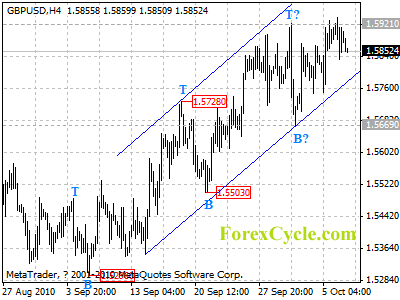
GBPUSD stays in a rising price channel

GBPUSD stays in a rising price channel and remains in uptrend from 1.5296. Further rise to test 1.5997 (Aug 6 high) resistance would more likely be seen. Support is at the lower border of the price channel, now at 1.5775, as long as the channel support holds, uptrend could be expected continue. Key support is at 1.5669, only fall below this level will indicate that the uptrend from 1.5296 has completed, then another fall towards 1.5296 previous low could be seen to follow.

gbpusd

Daily Forex Forecast