The Greek Debt Crisis: A Must-Read for Forex Traders!

By Natalie R. – Today, FOREXYARD’s Chief Market Analyst Greg Holden releases his much anticipated study of this year’s Greek debt crisis. From his unique Forex analyst perspective, Greg has been able to provide stimulating insights into how traders managed to ride the economic wave to secure sizeable profits.

Economic analysis is difficult without an understanding of the bigger picture. As a trader, you want access to the most up-to-date market news you can get your hands on. But even with all that information, you find that you still don’t understand the bigger picture. This in-depth analysis on the “European Debt Crisis of 2010(PDF) will give you precisely what you are looking for.

What factors gave rise to the Greek crisis, and how did it spread? What sort of risk was the euro zone facing exactly? Has this crisis come to an end, or is it continuing to spread? These are all questions which you’ll be better able to answer after downloading and reading this analysis.

But how does this help you, a forex trader, to make profits through your home trading platform? Not only will you understand the history of this crisis, but you will also have a better understanding about important trading elements such as long-term trends, normal vs. abnormal market trading, risk averse markets, as well as a better feel for how the major currencies trade in times of crisis.

If you have ever looked for that one article to put the past year’s major economic events into perspective, this is it.

Greg Holden, Chief Market Analyst at FOREXYARD, walks readers through the issues and climates that gave rise to this debt crisis and how it spread. Holden said, “I’ve attempted to put before you a chronological description of the events, and the punditry surrounding those events, which helped spread the panic and create an environment where savvy Forex traders were able to make serious profits.”

Included in this analysis is a short description of the other major European economies hit by the debt crisis. These major European nations, which compose the odious acronym PIIGS (Portugal, Ireland, Italy, Greece, and Spain), all received their fair share of economic worries following the sudden panic fueled by Greece’s debt crisis, but were affected in different ways. By knowing the risks these countries faced, and continue to deal with in their own way, you will also have a much better grasp of the news coming out of each of these countries today.

Holden continued, “My team and I have laid out interesting trends and explanations to show how the panic made things worse than they should have been. Whilst we at FOREXYARD believe that economic education is the key to success in this market, there’s nothing like the opportunity to analyze previous events from a ‘that could have been me’ perspective.”

This In-Depth Analysis does just that, by understanding how traders made money on the last major economic quake, traders can be better equipped to take advantage of the next.

So download your copy of this in-depth analysis today and learn how to finally trade like the professionals.

About FOREXYARD

Since formation over 4 years ago, FOREXYARD has utilized the experience of professional forex traders, as well as internet and financial sector specialists, in order to successfully establish itself as one of the premier online brokerages operating in today’s market. We offer a secure, dynamic trading platform which provides superior order execution, advanced reporting and analytical tools, yet remains intuitive and user-friendly.

Forex Market Analysis provided by ForexYard.

© 2006 by FxYard Ltd

Disclaimer: Trading Foreign Exchange carries a high level of risk and may not be suitable for all investors. There is a possibility that you could sustain a loss of all of your investment and therefore you should not invest money that you cannot afford to lose. You should be aware of all the risks associated with Foreign Exchange trading.

EUR/CAD Expected to go Bearish

By Anton Eljwizat – A bullish move in the EUR/CAD cross hasn’t received much support as of late. Below, I will demonstrate that the EUR/CAD pair has already commenced a downward trend for today, and the cross may tumble another 40-100 pips during the day. Traders are strongly advised to take advantage of the trend at an early stage.

• Below is the 4-hour chart of the EUR/CAD currency pair.

• The technical indicators that are used are the Williams Percent Ranges, Relative Strength Index (RSI), and Stochastic Slow.

• Point 1: The Slow Stochastic indicates a bearish cross, signaling that the next move may be in a downward direction.

• Point 2: The Relative Strength Index (RSI) indicates that the price of this cross currently floats in the overbought territory, signaling downward pressure.

• Point 3: The Williams Percent Range shows that this pair was heavily over-bought peaked near the highest mark it could reach, and then turned a corner and now stands in a bearish posture.

EUR/CAD 4-Hour Chart

Forex Market Analysis provided by ForexYard.

© 2006 by FxYard Ltd

Disclaimer: Trading Foreign Exchange carries a high level of risk and may not be suitable for all investors. There is a possibility that you could sustain a loss of all of your investment and therefore you should not invest money that you cannot afford to lose. You should be aware of all the risks associated with Foreign Exchange trading.

Forex Daily Market Commentary

By GCI Forex Research

Fundamental Outlook at 0800 GMT (EDT + 0400)

USD

The dollar started the session significantly weaker before investors pared back positions ahead of Friday’s payrolls report. The ECB and BoE decisions provided no surprises and Fed easing expectations remained a weight on the dollar as EURUSD breached 1.40. But then it sharply dropped back and the dollar made up a lot of lost ground and then some versus most of the G10. Gold set an all-time high around $1365 before settling back to $1334.75 at the time of writing and equities finished flat. EURUSD traded 1.3857-1.4027, USDJPY 82.12-83.03.

Kansas City Fed President Hoenig, the lone FOMC dissenter in 2010, reiterated his opposition to further easing measures as he is concerned on long-term implications of current policy. Dallas Fed President Fisher said investors should not assume the Fed is on the path for further easing and he is doubtful on the effectiveness of additional asset purchases. Fisher will be a FOMC voter in 2011. Comments aside, the upcoming payrolls print will be significant for the Fed outlook. Our analysts expect +100k on private payrolls and -20 on headline with no change in the unemployment rate. If the payroll report comes in broadly in line with consensus, then investors’s pricing in of further Fed easing is unlikely to change dramatically and the dollar will remain under pressure. But a strong positive surprise could boost Treasury yields and benefit the dollar and dollar-bloc currencies, given their correlation with US equities. A negative surprise will further weaken the dollar versus the yen and the Swiss franc via lower Treasury yields.
EUR

ECB President Trichet did not offer any new insights in the press conference following the unchanged policy rate. His comments largely echoed his September remarks and he continued to sound cautious as uncertainty persists. Trichet said improvement in liquidity conditions and Euriobr rates was a sign of normalization, rather than any policy signal, which our economists had anticipated he would say. The only comment Trichet offered on FX was that he opposed excess volatility and disorderly moves. His lack of opinion on current euro levels gave an implicit signal that the ECB is not at the point yet where currency levels are concerning to them.
The IMF’s Strauss-Kahn said that a sluggish European recovery is a concern and their base case does not call for a double-dip in the US.
GBP

The BoE decision was a non-event as expected and investor focus now shifts to the release of the MPC minutes on October 20 to see how the votes panned out. That same day the Chancellor of the Exchequer will provide details of the government spending plans. We remain cautious on sterling ahead of then.
At 0.3% m/m and 6.0% y/y, manufacturing output was better than expected and industrial production was inline with consensus at 0.3% m/m and 4.2% y/y. Our economists note PMI and CBI point to continued growth in manufacturing. Halifax house prices declined more than expected on a monthly basis in September at -3.6%.
CAD

Labour data is due in Canada. The net change in employment is expected to dip to 10.0k from 35.8k and the unemployment rate is forecast to remain at 8.1%. Even though nonfarm payrolls in the US will dictate USDCAD movements, the Canadian data will influence relative value via the non-USD crosses as the disappointing building permits did at -9.2% m/m versus consensus -2.0% m/m.

TECHNICAL OUTLOOK


EURUSD 1.3799 Support.
EURUSD BULLISH Break of 1.3896 favours the extension of bull trend towards 1.4194. Near-term support holds at 1.3799 ahead of 1.3637.
USDJPY BEARISH Bearish trend remains intact; break of 82.88 exposes 79.75. Resistance remains at 83.99 ahead of 85.40.
GBPUSD BULLISH Sustained break of 1.6069 would expose 1.6276. Support at 1.5670 ahead of 1.5503.
USDCHF BEARISH Next support below 0.9500 lies at 0.9078. Resistance at 0.9739 ahead of 0.9918 breakout low.
AUDUSD BULLISH Sharp rise through 0.9850 and 0.9905 exposes 1.000 psychological resistance. Support comes in at 0.9773.
USDCAD BEARISH Recovery has resistance at 1.0380. Violation of 1.0108 shifts focus to 0.9931 with scope for 0.9820 next.
EURCHF NEUTRAL Pressure on 1.3482 Fibonacci resistance, with scope for 1.3697 measured objective. Support at 1.3265.
EURGBP BULLISH Pressure on 0.8808 with next resistance at 0.8894. Support holds at 0.8689 ahead of 0.8563.
EURJPY BULLISH Expect gains to extend towards 116.68 and 119.33 next. Near-term support comes in at 113.89 ahead of 111.47.

Forex Daily Market Commentary provided by GCI Financial Ltd.

GCI Financial Ltd (”GCI”) is a regulated securities and commodities trading firm, specializing in online Foreign Exchange (”Forex”) brokerage. GCI executes billions of dollars per month in foreign exchange transactions alone. In addition to Forex, GCI is a primary market maker in Contracts for Difference (”CFDs”) on shares, indices and futures, and offers one of the fastest growing online CFD trading services. GCI has over 10,000 clients worldwide, including individual traders, institutions, and money managers. GCI provides an advanced, secure, and comprehensive online trading system. Client funds are insured and held in a separate customer account. In addition, GCI Financial Ltd maintains Net Capital in excess of minimum regulatory requirements.

DISCLAIMER: GCI’s Daily Market Commentary is provided for informational purposes only. The information contained in these reports is gathered from reputable news sources and is not intended to be U.S.ed as investment advice. GCI assumes no responsibility or liability from gains or losses incurred by the information herein contained.

Forex daily analysis for 08-10-10

GBP/USD

Daily graph: http://www.real-forex.com/charts-daily/081010/GBP_DAILY_081010.JPG

gbp-daily

One – Hour graph: http://www.real-forex.com/charts-daily/081010/GBP_1H_081010.JPG

gbp-1h

The pair finally crossed the resistance 1.5896 upward after 4 days of anemic candles. However the resistance was crossed back downwards a few hours later. Such a behavior can indicate a very strong reversal trend. Now we suggest you to look for a descending configuration on the one-hour graph in order to start a “Short” Transaction.

Potential Trade

According to our opinion, the descending configuration will happen when the pair will cross the support level of 1.5817. Once this level crossed, we suggest you to enter the following orders for the potential trade:

  • “Limit” order on “short” position in case of 10pips breach downward of the support: 1.5817
  • “Stop Loss” on the last high occurred: 1.5882.
  • We suggest you not to enter a “Take Profit” order, but rather follow the movement of the pair on a one-hour graph.

AUD/USD

Daily graph: http://www.real-forex.com/charts-daily/081010/AUD_WEEKLY_081010.JPG

aud-daily

Please pay attention to these two points:

  • During the last session, the pair crossed a critical weekly resistance, and crossed it back downward.
  • The pair moved several hundred pips during the last months.

This may indicate a reversal trend. The period of correction resulting from this reversal, can create an opportunity of “Short “transaction. We suggest you to follow the movement of the pair on a one-hour graph and look for the descending configuration which will indicate the opportunity to “Short”.

We wish you a profitable day and a great week end

Real-Forex team: real-forex

A Temporary Rally Seen in the US Dollar

usdx october 2010, usd index, us dollar index, usd. us dollar, $, ron acoba, laidtrades, laid trades, fx, fx market, fx trading, forex, forex market, forex trading, trading forex, currency trading, forex forecast, forex analysis

Welcome to another day of Forex trading! In today’s FX feature, I present to you an update on the US dollar index (USDX). A little more than a week ago I already warned the dollar bulls of a likely take over by the bears (kindly see it here). And guess from, since September 28, the USDX has already fallen from 79.57 to 77.34. The 77.00 support, however, had kept the index from falling. Given this and its oversold condition, the index may range for awhile or even rally before continuing its descent. A move south in the near term is likely since the downside target (estimated by projecting the height of the head and shoulders pattern from the point of breakout) has not yet been achieved. Moreover, the length of its recent down move has still to equal the length of the head of the previous pattern. A break of the 77.00 level would push the index down to around 74.00.

Later at 12:30 pm GMT, a high level of volatility is expected to hit the market because of the release of the non-farm payrolls (NFP) report in the US. For the month of September, US firms are seen to have added 1,000 jobs. During the previous month, about 54,000 were laid off. If the number of employment has indeed improved, then expect a rise in optimism which, however, would be detrimental for the greenback. But based on ADP’s estimate which was published earlier this week, US firms had surprisingly cut about 39,000 jobs as against the 23,000 forecasted increase in hiring. The ADP’s estimate is not always accurate but if a decrease in employment is printed, optimism would diminish which would attract investors back to the safety of the USD in the short term.

More on LaidTrades.com

EUR/USD – Technical Update

By Russell Glaser – Now that the EUR/USD has closed above a retracement level from the December 2009 high, a bearish sign has developed on the daily chart. This may allow for a consolidation pattern to form or a worst case scenario a reversal of the uptrend.

A close above 1.3890 the 61.8% Fibonacci retracement was a significant milestone in the recovery of the pair. Now that this technical barrier has been achieved, new resistance levels are found.

Resistance should be located at the December 2009 lows near 1.4210 (R1) and the mid-January high of 1.4580 (R2).

Support for the EUR/USD will be found at the March high of 1.3820 (S1).

Today the EUR/USD pushed as high as 1.4028 only to lose those gains and fall as low as 1.3856. The pair has come back and is currently trading at its opening day price.

This could be a bearish signal. If the price closes at its currently level, the daily candlestick will form a longed legged doji which may signal a pause in the uptrend or at the worst a reversal.

Forex Market Analysis provided by ForexYard.

© 2006 by FxYard Ltd

Disclaimer: Trading Foreign Exchange carries a high level of risk and may not be suitable for all investors. There is a possibility that you could sustain a loss of all of your investment and therefore you should not invest money that you cannot afford to lose. You should be aware of all the risks associated with Foreign Exchange trading.

U.S. Non-Farm Payrolls Expected Today at 12:30 GMT

Source: ForexYard

Yesterday’s trading was filled with exciting developments; the dollar ended a bearish run against the euro and the British pound on one hand, and reached a 15-year low against the Japanese yen on the other hand. In addition, crude oil saw a very irregular daily loss of over 300 pips. That being said, today’s trading promises to be no less exciting, largely due to the U.S. Non-Farm Payrolls release scheduled for 12:30 GMT. This is the most significant indication of the U.S. employment situation, and unusual volatility is often observed following its release.

Economic News

USD – Dollar Weakens Ahead Of Non-Farm Payrolls

The U.S. dollar fell against most of the major currencies during yesterday’s trading session. The dollar’s most notable depreciation took place versus the Japanese yen. As a result the USD/JPY pair is now trading at the 82.30 level, near a 15 year low.

The dollar continued its bearish trend against the major currencies today due to speculations that the Federal Reserve will debase the greenback by advancing purchases of government debt to in order to support the economic recovery. Later on the dollar erased some of its losses following better than expected employment data from the U.S. The weekly Unemployment Claims report showed that applications for U.S. unemployment insurance unexpectedly dropped last week to its lowest level in three months. Jobless claims fell to 445,000, beating expectations for 454,000 claims for unemployment benefits. In general it appears that as long as speculations regarding further stimulus from the Fed take place, the dollar has potential to drop even further, especially against the euro and the yen.

As for today, the most exciting trading day of the month is expected as the U.S. Non-Farm Payrolls release is scheduled for 12:30 GMT. This report measures the change in the number of employed people during September. In normal times this report has an unusual effect on the market due to its early release. However, considering the fragile condition of the U.S. labor sector, today’s release is likely to have an enhanced impact on the national currency.

EUR – Euro Correcting Gains after EUR/USD Crosses the 1.4000 Barrier

The euro reached an 8-month high against the U.S. dollar during yesterday’s trading session. Early in the day, the euro continued its recent bullish run and the EUR/USD pair went as high as the 1.4028 level. However the currency erased most of its gains later on, and the pair is currently trading near the 1.3920 level.

The euro was boosted during early trading following a positive Industrial Production figure from Germany. The report showed that the total value of output produced by manufacturers rose in August by 1.7%, well above expectations for a 0.4% rise.
However, the euro then corrected its trend and erased most of its losses. The currency fell due to speculations that today’s U.S. employment report will provide better than expected data. In addition, the general sentiment in the market after the EUR/USD crossed the 1.4000 level was that the euro’s rally reached its peak. Investors responded by closing their long positions.

Looking ahead to today, traders are advised to follow the British Producer Price Index release, which is scheduled for 08:30 GMT. Traders should also pay attention at 12:30 GMT when the U.S. Non-Farm Employment Change data will be released. Heavy volatility is likely to influence euro pairs.

JPY – Yen Trades Near 15-Year High against the Dollar

The Japanese yen continued to strengthen against all the major currencies during yesterday’s trading session. The yen’s rally against the dollar has now taken it near a 15-year high, and the pair is trading around the 82.30 level. The yen’s rally also included around a 100 pip gain vs. the euro and British pound.

It appears that investors are betting that despite Japan’s desire to devalue the national currency in order aid its export industry, the international criticism following its last intervention will prevent the Japanese government from acting again. In addition, the Japanese Finance Minister Yoshihiko Noda said yesterday that last month’s intervention was not intended to signal a long-term campaign to target a specific level. This has added to speculation that the BoJ will not step in again, giving further bullish pressure to the JPY.

As for today, no significant economic releases are expected from the Japanese economy. Traders are advised to follow the major economic publications from the U.S. and euro-zone, especially the Non-Farm Payrolls release, as heavy market volatility is expected.

Crude Oil – Crude Oil Sharply Drops To $81.00 a Barrel

Crude oil saw a sharp drop during yesterday’s trading session. Early in the day, crude was trading near $84.50 a barrel, marking a 5-month high. A sudden decrease in value took place early in the afternoon, pulling the commodity as low as the $81.00 level.

Crude fell yesterday after the U.S. dollar rebounded against the euro and the British pound. The dollar erased some of its recent losses following a better than expected weekly unemployment report. In addition, a daily decline in U.S. equities has added to the downward pressure on crude oil. As a result, the commodity erased most of this week’s gains.

Looking ahead to today, traders are advised to follow the major economic releases from the U.S, especially the Non-Farm Unemployment data, which is scheduled for 12:30 GMT. This is the most reliable indicator of the U.S. employment condition, and tends to have a significant impact on the market.

Technical News

EUR/USD

After it peaked at the 1.4028 level, the EUR/USD pair promptly corrected its gains, and sharply fell to the1.3856 level. Currently a bullish cross on the Slow Stochastic in the 4-hour chart indicates that the bearish correction is over. Going long might be the preferable choice today.

GBP/USD

The pair managed to cross the 1.6000 resistance level yesterday, yet shortly after dropped to the 1.5825 level. At the moment, as the weekly RSI is pointing up, the pair looks to resume its bullish trend, with the potential to reach the 1.6000 level yet again. Traders may want to go long with tight stops today.

USD/JPY

The pair reached an astonishing 15-year low yesterday, after falling to the 82.10 level. All the technical indicators on the weekly chart continue to provide bearish signals, suggesting that the pair can still drop further. Going short is still the preferable option.

USD/CHF

The pair’s bearish channel was broken yesterday after it climbed 150 pips in a single day and reached the 0.9700 level. In addition, a bullish cross on the 4-hour chart’s MACD has taken place, indicating that the upward correction has room to grow. Going long with tight stops might be the preferable strategy today.

The Wild Card

Gold

Up until yesterday, gold’s bullish trend was one of the safest bets in the market. However, after peaking at $1,364 an ounce, gold dropped as low as $1,325. Currently the RSI on the daily chart is pointing down, and about to cross the 70 line. This means that gold has potential to drop further. This might be a good opportunity for forex traders to catch the trend at its beginning. Going short is the recommended choice.

Forex Market Analysis provided by ForexYard.

© 2006 by FxYard Ltd

Disclaimer: Trading Foreign Exchange carries a high level of risk and may not be suitable for all investors. There is a possibility that you could sustain a loss of all of your investment and therefore you should not invest money that you cannot afford to lose. You should be aware of all the risks associated with Foreign Exchange trading.

A Common Mistake Traders Make When Day Trading

By David Adams – Anyone who watches daytime television is well aware of several news networks that broadcast nonstop financial news. Generally speaking, these networks parade a variety of experts in front of the camera who spout all sorts of interesting and apparently insightful information about market conditions during the day. Early in my career, many years ago, I faithfully listened to all the rumors and innuendo the financial news network’s reported. At some point in my career, I learned to turn the television off and simply trade the chart in front of me.

This is not to say that day traders should not be aware of the daily economic announcements the government and government subsidiaries publish. These are very important announcements and should warrant your attention. However, the never-ending stream of talking heads that grace your television screen are not worthy of your attention. Often times they spread information that is unsubstantiated and rumor, which can affect your trading strategy and trading timing in an adverse way. Let’s face it, the really successful traders do not appear on television and divulge their trades for the rest of the world to duplicate.

Aside from the misinformation, there is an even more important dynamic to consider when watching the Financial News Networks. The announcers and individuals being interviewed can have a decided effect upon your psychological outlook on the market movement during the days session. It is important to keep a tight rein on your emotions when trading, as an outside stimulus, like spurious news reporting, can often cause your trading to become biased. This bias can have very unfortunate and costly ramifications and you’re trading. For that reason alone, I generally listen to music while I trade. In short, I make an earnest attempt to avoid any outside influences on how I view the market and reserve my judgments for the information I glean from the trading chart.

This may seem a little nitpicky at first glance, but a steady diet of news that amounts to speculation and innuendo can cause you to take trades or establish positions that may not concur with the information on your chart. Yet because you have heard certain information on the television you may feel comfortable in taking these contrarian positions based upon the conclusions of the television personalities. To be truthful, there have been several occasions where I have found myself in this exact position and made unwise trading decisions based upon recommendations and conclusions television personalities have expressed during the course of the day. To my disappointment, none of these prognostications became reality and I was the unfortunate recipient of a losing trade. About 10 years ago, I learned to turn the television off and my trading improved. The television is one distraction that is simply not necessary. Using proper support and resistance along with sound trading methodology is all that is required to be a successful trader. The talking heads on television certainly are not an asset to your trading experience.

Oddly enough, I seem to enjoy listening to the television personality’s blather on about various happenings in the market for entertainment. Unfortunately, I learned that at a subconscious level I was gathering information and incorporating it into my trading decisions, despite the fact that I was well aware that the information was of minimal value. My point is a simple one; use trading methodology and the chart in front of you, along with the daily government and government agency announcements to formulate your trades throughout the course of the day. There is no reason bias your thinking by exposing ourselves to the random meanderings the financial television personalities spew forth.

In summary, I think it’s important to trade based upon the price action and trading methodology you have learned and see little value in the rumor and speculation the financial networks disseminate throughout the course of the day. To be sure, once you have established a sound methodology you can depend on that methodology to trade without the input of your television.

About the Author

Learn to trade from a full time trader. All active members may attend FREE daily trading room and receive nightly market recap video (a $495 value). Click here and get your free videos and FREE live trading room.

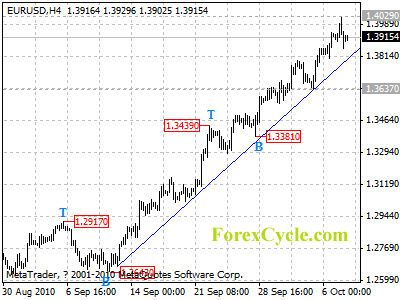
EURUSD continues its bullish movement from 1.2643

EURUSD continues its bullish movement from 1.2643 and reached as high as 1.4029, and the subsequent pullback is treated as consolidation of uptrend. Support remains at the rising uptrend line on 4-hour chart, now at 1.3803, uptrend is expected to resume after touching the trend line support. However, a clear break below the trend line support will indicate that lengthier consolidation of uptrend is underway, then deeper decline to test 1.3637 key support could be seen.

eurusd

Daily Forex Reports

The Woodward Report: Dollar Doomsday?

In this edition of the Woodward Report, we went from Wall Street to Hong Kong to try and answer the question: What is the future of the US Dollar?

To help, we spoke to Bob Lenzer of Forbes Magazine, Economist Robert Hodrick at Columbia University and Francis Cheung of CLSA.  Senior Strategist from Jyske Bank, Ib Fredslund Madsen joins us, too, to provide perspective – whether your dollars lie in your pocketbook or your portfolio.