USD/SEK at 2-Yr Low after Fiery Speech from Riksbank

printprofile

The Swedish krona has undergone one of its strongest rallies in recent memory these past few days after the Riksbank Deputy Governor Barbro Wickman-Parak delivered a hawkish statement last Thursday. The SEK climbed to a 2-year high against the US dollar following Wickman-Parak’s fiery call for interest rate increases in the near future.

The USD/SEK fell to 6.5129 last week, but has rallied to as high as 6.8017 at the close of New York trading yesterday. Wickman-Parak’s speech highlighted the growing need for Sweden to boost rates before it’s too late, but also put the spotlight on the potential reasons behind the decision to hold rates where they are. This has put some downward pressure on the SEK alongside a rising USD.

In a similar turn of events, the Norwegian krone (NOK) appears to be falling out of favor with foreign investors specifically because Norges Bank is perceived to be stalling on interest rate hikes as well. The USD/NOK has come off a 6-day high; the pair is climbing towards 5.9425 from as low as 5.7000 seen just two days ago.

Technical Analysis

If we look at the USD/SEK daily chart we can see some relatively clear indications of what’s happening on a technical level. The pair has been trading in a downward trend for some time now, but has only recently pared some of its losses to reach back up towards its predominant, overhead trendline.

We can see the price reaching back and just recently touching the 23.6% Fibonacci line. The price could meet some mild resistance there and turn downwards, but the RSI and Stochastic (slow) seem to suggest otherwise; as does the overhead trendline. It appears there could be more bullish room for this pair to run. If the price breaches above 6.8500, then traders may want to anticipate an upward breach which could climb as high as 6.9750 if the Riksbank doesn’t step in on the fundamental side.

USD/SEK Daily Chart
USDSEK - Daily Chart

Are Investments in Emerging Markets Good for Your Portfolio?

By Sara Nunnally, Editor, Smart Investing Daily, TaipanPublishingGroup.com

Back in mid-August, I told you about new growth in investments in emerging markets. I even noted a couple exchange-traded funds that might benefit from such growth.

I talked about the iShares MSCI Turkey Investable Market ETF (TUR:NYSE) and the Market Vectors Indonesia ETF (IDX:NYSE), and since Aug. 12, 2010, I’ve been keeping track of these two. The IDX has climbed 18.94% as of Friday’s close, and the TUR has jumped 31.15%!

When I mentioned TUR and IDX, I noted that investor cash would be a huge driver in these markets.

But is this true for all emerging markets, or just select ones?

Are there still emerging markets that you should be wary of?

There is still a lot of fear surrounding the U.S. dollar and the stability of the American economy, and that’s pushing a lot of investors outside of U.S. markets. That’s what’s been supporting such big gains in emerging markets.

Some investors are taking gains off the table.

On Sunday, Bloomberg reported, “[Morgan Stanley] lowered its recommended “overweight” in developing-nation stocks to 4 percent from 6 percent and added to holdings of cash.”

The broker said investors should start to “scale back” their holdings in emerging market stocks.

Morgan Stanley gave emerging markets an “overweight” rating back in late May, and since then, says Jonathan Gardner for the broker, valuations have returned to “long-run average levels.”

On the other hand, China’s Shanghai Composite climbed for the eighth day — the longest rally in 11 months. And late last night, MarketWatch reported that Caterpillar, Inc. (CAT:NYSE) would form a joint venture with China’s AVIC Liyuan Hydraulics Company.

Clearly there are still some opportunities in emerging markets.

And the Shanghai index is trading at 16 times earnings, which, according to Bloomberg, is near record lows.

So how do you determine which emerging markets are viable investments for your portfolio?

There are some key principles you should keep in mind when looking at international markets.

Learn How to Legally “Trick” a Mutual Fund Into Paying for Your Retirement

You could “siphon” thousands of dollars a month from the profits of the mutual fund industry.

Follow this link for all the details…

Does This Market Have a Dynamic Financial System?

This question is crucial from two points of view. First, can you, the investor, access it easily without issues of illiquidity or the need to jump through too many hoops? The large and growing number of international exchange-traded funds and the availability of ADRs and GDRs make it ever easier for individual investors to explore opportunities on a global platform.

Second, does the country’s financial system have the ability to adapt to changing market conditions? Is it diverse enough to weather a drop in, say, commodity prices, or a shock to its financial institutions? The more diverse the system, the more developed the economy, so this can be a good gauge of where the country is compared to other emerging or developed markets.

(Investing doesn’t have to be complicated. Sign up for Smart Investing Daily and let me and my fellow editor Jared Levy and I simplify the stock market for you with our easy-to-understand investment articles.)

Does This Market Have Large Cash Reserves?

When the recession hit global markets, cash suddenly was thrust to the forefront as the safe haven. Emerging markets with substantial sovereign wealth funds are likely to be stronger than those that rely just on foreign direct investment to inject cash into its economy.

China was able to inject more than half a trillion into its economy, and this emerging market is expected to grow 9.9% this year. Abu Dhabi’s Investment Authority holds $627 billion, and Singapore’s Temasek has $133 billion. These guys have the ability to invest in themselves — to stabilize and grow their own markets with this cash… But they can also take this money global and make huge investments in international markets for greater returns.

Breaking Investment News: At this moment, 7 “mega-trades” are emerging on the horizon.

Get in now, and you could cram 10 years of wealth-building into the next 12 months.

Learn more about this investment opporunity here.

Does This Market Have Political and Economic Freedom?

The recent news about the Nobel Prize winner for peace, Liu Xiaobo, remaining in prison in China for circulating a petition known as Charter ’08 demanding civil liberties, judicial independence and political reform, calls into question how much political freedom China allows, and how this affects its relationship with the rest of the world.

India’s government restricts the economy through overly strict regulations that deter some investments and business startups. And state institutions still dominate some markets, such as the banking industry. Corruption is also a concern.

These things make investing in an overall market a holistic endeavor. You are subject to all these risks and you have to determine if the growth potential is worth it for you.

Fortunately, global markets give us a number of different ways to invest in emerging markets. There are ETFs that allow you to invest in a market across a number of sectors, but there are also ADRs that allow you to strategically position yourself in a specific company in a particular market.

These three key principles should be fulfilled with either investment strategy, though, unless you’re preparing to short a market or ADR, and can be applied to every emerging market available for investment.

Don’t forget to follow us on Facebook and Twitter for the latest in financial market news, investment commentary and exclusive special promotions.

About the Author

Sara is Co-Editor of Smart Investing Daily. As Senior Research Director and global correspondent, Sara Nunnally’s diverse resume includes studies in art history, computer science and financial research. She has appeared on news media such as Forbes on Fox, Fox News Live, and CNBC’s Squawk Box, as well as numerous radio shows around the country.

As Senior Research Director, global correspondent and co-editor of Smart Investing Daily, Sara has traveled all over the world in search of the best investment opportunities to recommend to her readers, be they in developed economies like France and Italy, in emerging markets like the Czech Republic and Poland, or in frontier terrain like Vietnam and Morocco. Her unique “holistic” approach of boots-on-the-ground research has given her an edge in today’s financial marketplace as she searches for the next investment opportunities in hot sectors like alternative energy, currency markets and commodities.

Using Calendar Spreads to Play a Short Term Top in Gold

Recent price action in stocks and commodities reinforces the “don’t fight the Fed” mantra. What would our central bank be doing if it were not devaluing our currency, attempting to create inflation, and openly manipulating financial markets through a series of supposedly calculated open-market operations? I do not have any market prophecies; my crystal ball is on permanent vacation. The only certainty that presents itself is that the market pundits, the academics, and the analysts do not know exactly what is going to happen in the future.

We are in uncharted territory regarding government manipulation. We watch as our federal government actively and openly manipulates financial data in an attempt to boost asset prices with the hope that if Americans feel richer they will spend money more freely. What is going to be the catalyst to drive growth when the federal government and the Federal Reserve run out of manipulations?

By now the secret is out, the expected weakening of the U.S. dollar has propelled commodities and stocks higher in short order. The easy trade has likely passed and there are a few warning signs that are being largely ignored by the bullish masses. Business insiders are selling heavily while few are accumulating positions. The banks have not broken out and were under pressure for most of the trading day during Wednesday’s big advance. If the banks do not rally with the broad market, caution is warranted. We are approaching an uncertain period of time regarding earnings and the upcoming elections and we all know that financial markets hate uncertainty.

Additionally, the U.S. dollar is at key support and should that support level fail, stocks and commodities could continue their ascent in rapid fashion. If the level holds, the U.S. dollar could have a relief rally to work off the oversold condition, however a bounce will likely be short lived and the dollar will test and likely fail at that level. The chart below is the weekly price chart of the U.S. Dollar Index.

As the chart above indicates, the U.S. dollar is trading at critical support which offers traders a defined risk level. That being said, gold and silver have literally gone parabolic and are due for a pullback. With risk crisply defined on the other side of the dollar’s support level, a short trade on GLD is warranted. The only problem facing a directionally biased trade is that the November monthly options have nearly five weeks before they expire. Expiration is too far away to utilize an iron condor or butterfly spread, but a different option strategy might make sense.

After considering a few option construction strategies, a calendar spread makes a lot of sense. A calendar option trade, also known as a horizontal spread, is constructed using the same underlying, same strike price, but different expirations. A neutral strategy can be used where the primary profit engine is Theta (time) decay with no real price action expectation. Bull or Bear calendar spreads can be created through the purchase and sale of calls/puts that are out-of-the-money.

Since I expect the price of gold to decline due to a subsequent bounce in the U.S. dollar, I am utilizing a Bear Calendar Spread. The trade construction consists of selling the GLD October Weekly 134 puts (expire 10/22) and the simultaneous purchase of the GLD November 134 puts (expire 11/19). For our example, I will be using the Thursday (10/14) closing prices to illustrate this trade.

The GLD October Weekly 134 puts closed around $130 (bid) per contract (1.30) while the GLD November 134 puts closed trading at $320 (ask) per contract (3.20). The trade would represent a debit of $190 per side (1.90) not including commissions. The chart below illustrates the GLD Put Calendar spread. Please note that the maximum profit for this spread is always at expiration when the price of the underlying is at the strike price selected.

The profitability of the trade based on the Thursday closing price would be a maximum gain of $125 dollars per side assuming GLD’s price closed next Friday at exactly $134/share. The profitability range at Friday’s close is from $131.14 – $137.08. This trade takes on a maximum risk of $190 per side not including commissions. The profit potential based on risk is over 60% if price should close next Friday around 134.

But wait; there is more! The trader has additional choices after the trade has been placed. If GLD’s price stays relatively stable through the October weekly option expiration, the trade could be closed for a profit.

As mentioned above, the expectation is that the price of gold will decline as the dollar has a relief rally to work off the massively oversold condition. With that in mind, the trader could allow the GLD October Weekly 134 to expire next Friday or close that leg of the option trade keeping the long GLD November 134 put in place. After the October weekly contract is closed, the trader has the ability to put on a vertical spread or another calendar using the next week’s options.

In our case, we expect price to decline in the short term on GLD, so we could sell the GLD November 131 put and further reduce our overall cost of the GLD November 134 put that we are long. While this may sound a bit confusing, the main idea is that we are utilizing Theta (time) decay to reduce the cost of the long put we purchased. The further we are able to reduce the cost of the put, the more profitable a downward move in the GLD price becomes.

As an example, let us assume that we were able to close the GLD October weekly 134 put for a profit of $60. The profit reduces our overall cost on the GLD November 134 put by $60 and places the cost to us at $260. Assuming price stays relatively close to the Thursday close on GLD, we likely would be able to sell the GLD November 131 put for around $130 (estimate) depending on price action and volatility levels over the next week. Assuming we were able to sell the November 131 put at $130, we have now reduced our cost of the November 134 GLD put down to only $130 per side. The profitability chart below represents what the trade would look like.

Now we have a directionally biased trade on GLD and we are only risking $140 per side for the exposure. The maximum gain on this trade at the November expiration would be $160 per side assuming GLD’s closing price was $131/share or lower at the November expiration.

The primary risk that this trade undertakes in relation to volatility would be a volatility crush, or collapse. If overall market volatility probes lower or the implied volatility declines on the underlying (GLD), it can cause a potentially damaging impact on this trade. With every trade there are inherent risks, but great traders understand the risk and manage it accordingly through the use of stop orders and proper position sizing (money management).

If GLD does sell off, it is likely that the implied volatility would increase on GLD which would benefit this trade tremendously. However, option traders must always be aware of implied volatility as it relates to the underlying being utilized in their specific trades. Ignoring implied volatility when trading options is like diving into a swimming pool head first without knowing how deep the water is.

While the longer term prospects for gold are quite constructive, in the short term it would be healthy for a pullback, even if only for a few days. This trade carries more risk than most strategies I have presented previously; however option traders need to be familiar with various methodologies that address current market conditions. Keep in mind, risk reducing strategies using contingent stop orders that are based on the U.S. Dollar index allow us to crisply define the risk in this trade. In closing, I will leave you with the insightful muse of Adam Smith, “The problem with fiat money is that it rewards the minority that can handle money, but fools the generation that has worked and saved money.”

If you would like to receive more options trading education or trade ideas join our free newsletter: http://www.thetechnicaltraders.com/newsletters/options-trading-signals/

J.W. Jones

Forex Daily Market Commentary

By GCI Forex Research

Fundamental Outlook at 0800 GMT (EDT + 0400)

USD

The dollar was volatile during the Asia session, but supportive comments by Treasury Secretary Geithner ultimately helped it recover some ground. Geithner said no country can devalue its way to prosperity and that the US will not engage in such practice. He added that he does not see a time in our lifetime when the dollar will cease to be the world’s key reserve currency. EURUSD traded 1.3918-1.4004, USDJPY 81.21-81.47. Equities closed positive as a major US financial institution reported good earnings despite missing on revenues. Treasury yields moved lower and gold and oil all gained as Atlanta Fed President Lockhart, who is not a FOMC voter until 2012, said he may support more quantitative easing. But Dallas Fed President Fisher again said the Fed cannot help the economy on its own and said QE2 is not a done deal. In data, industrial production for September was as we expected but weaker than consensus at -0.2%. However, other manufacturing data have been more constructive. The housing market index rose more than expected in October and other housing indicators have also been positive this month. Several Fed officials are due to speak though we have heard from most of them and do not expect any significant deviations from previous stances. But we could finally hear Fed Governor Elizabeth Duke’s public opinions on easing prospects. We also get housing starts and building permits data and two major US banks report earnings.
EUR

Eurogroup Chairman Juncker said finance ministers discussed FX rates and that FX volatility has negative effects on a global scale. He reiterated that FX rates must reflect economic fundamentals. Juncker also said he is confident that Greece will meet its deficit targets.
German ZEW data should show an increase in the current situation index but the economic sentiment portion is expected to drop. While our European economists think that recent price action in EURUSD has not been enough to prompt them to cut GDP estimates, we think recent euro levels could weigh on sentiment indexes like the ZEW.
AUD

The RBA minutes from the Oct. 5 policy meeting struck a hawkish note. Although the AUD initially strengthened, a broad-based dollar revival subsequently took AUDUSD lower again. The text revealed that the decision to pause was “finely balanced” and that a case could have been made to increase the cash rate at that meeting. Instead, the board opted to wait, pending the evaluation of further information “at the next meeting”. Clearly the Q3 CPI estimate due on Oct 27 is likely to be a key input to the final decision. Most significantly, it was noted that the stronger AUD, which had risen 4% since the previous meeting, had already caused “a tightening of domestic financial conditions”. Our Australian economists still expect a rate hike in November, and we expect AUD to remain supported as investors look for yield.
Treasurer Swan is still opposed to FX intervention, both in general and in the case of the AUD in particular. He said that greater AUD flexibility is key to global rebalancing, and that Australia will be a big loser if protectionism takes hold.
CAD

We think the BoC will keep the policy rate unchanged due to recent dovish commentary by BoC officials, disappointing domestic data and persistent Fed easing expectations. All economists surveyed by Bloomberg are also looking for no change, which will keep the CAD relatively contained versus the other dollar-bloc currencies.

TECHNICAL OUTLOOK


USDCHF little support till 0.9225.
EURUSD BULLISH Pullback from 1.4159 eyes 1.3775, reaction low. However, broader trend is bullish, next resistance at 1.4373 Fibonacci level.
USDJPY BEARISH Stalled at 80.88; next support at 79.75 ahead of 77.91. Resistance at 81.85 ahead of 83.03.
GBPUSD BULLISH While support at 1.5606 holds, view pullback as correction. Upside capped at 1.6107 ahead of 1.6201.
USDCHF BEARISH There is little support till 0.9225. Resistance at 0.9729 ahead of 0.9918 breakout low.
AUDUSD BULLISH Move above 1.0004 would expose 1.0166. Initial support defined at 0.9709 ahead of 0.9542, reaction low.
USDCAD BEARISH Recovery eyes 1.0273; but overall model is bearish. Sustained break of 0.9981/31 region would expose 0.9820 ahead of 0.9712.
EURCHF BULLISH Upside potential holds below 1.3494; break of the level would expose 1.3665. Initial support lies at 1.3265 ahead of 1.3072.
EURGBP BULLISH Recent pullback pressured 0.8689 support but focus is back on the upside with initial resistance defined at 0.8840 ahead of 0.8894 and 0.9039.
EURJPY BULLISH As long as support at 111.77 holds, expect recovery towards 115.68 ahead of 116.68 Fibonacci resistance.

Forex Daily Market Commentary provided by GCI Financial Ltd.

GCI Financial Ltd (”GCI”) is a regulated securities and commodities trading firm, specializing in online Foreign Exchange (”Forex”) brokerage. GCI executes billions of dollars per month in foreign exchange transactions alone. In addition to Forex, GCI is a primary market maker in Contracts for Difference (”CFDs”) on shares, indices and futures, and offers one of the fastest growing online CFD trading services. GCI has over 10,000 clients worldwide, including individual traders, institutions, and money managers. GCI provides an advanced, secure, and comprehensive online trading system. Client funds are insured and held in a separate customer account. In addition, GCI Financial Ltd maintains Net Capital in excess of minimum regulatory requirements.

DISCLAIMER: GCI’s Daily Market Commentary is provided for informational purposes only. The information contained in these reports is gathered from reputable news sources and is not intended to be U.S.ed as investment advice. GCI assumes no responsibility or liability from gains or losses incurred by the information herein contained.

Future Fed QE Move has USD Traders Cautious

Source: ForexYard

With a week relatively light on US data, investor eyes will be squarely zeroed in on Federal Reserve speakers. The Fed could offer clues about a possible plan to stimulate the US economy through a fresh round of asset purchases this week; discussion of which has weighed on the dollar lately. 

Economic News

USD – USD Under Pressure following QE Assessment

After falling to a low of $1.3829 yesterday, as a wave of profit-taking that began on Friday continued into Monday, the pair recovered overnight, briefly breaching the $1.4000 level. The dollar has since recovered with the pair currently trading around $1.3906.

Despite an overall bearish sentiment on the dollar, analysts are saying that the downside looked limited as short dollar positions were extended and the euro faced strong resistance at $1.40. Investors are more certain there will be further easing after Fed Chairman Ben Bernanke on Friday offered his most explicit signal yet the US central bank was set to relax monetary policy further. The question now is the amount.

With a week relatively light on US data, investor eyes will be squarely zeroed in on Federal Reserve speakers. The Fed could offer clues about a possible plan to stimulate the US economy through a fresh round of asset purchases this week; discussion of which has weighed on the dollar lately.

EUR – EUR Sees Mixed Results after Trichet’s Weekend Comments

The EUR experienced mixed results yesterday against its currency counterparts. Against the Japanese yen the euro had fallen, but pared its losses to currently trade little-changed at 113.26 as of this morning. Against the British pound, the 16-nation single currency rose modestly, climbing towards 0.8800, but falling just short before turning back downwards.

The euro lost somewhat against the US dollar yesterday after weekend comments from European Central Bank (ECB) President Jean-Claude Trichet supported the bank’s purchase of government bonds issued by weaker euro zone members. Trichet’s remarks contrasted with those of the head of the German central bank, who last week said the ECB should wrap up its bond-purchasing program.

Today traders are expecting the release of the ZEW economic sentiment report from Germany and the region in general. Forecasts are for a decline in both figures, which will no doubt put sell pressure on the EUR going into a light news week.

JPY – Yen Little Changed against Currency Rivals

The Japanese yen bounced back against the EUR yesterday as ECB President Trichet’s remarks over the weekend caused modest bearish pressure on the European currency. The pair dropped as low as 112.40 before paring those losses and climbing back towards 113.60 in yesterday’s late trading sessions.

The JPY was little changed against the dollar, however, as the pair stagnated around the 81.20 price level. Concerns about another Japanese monetary intervention appear to have passed into the background this week as many analysts are expecting few such maneuvers ahead of this weekend’s G20 meetings. Traders may be expecting a sharp revaluation following the weekend’s meetings, but for the moment the JPY appears to be holding steady against most currencies.

Crude Oil – Oil Prices Higher as Analysts Debate its Forecasted Direction

Crude Oil prices spiked yesterday as the US dollar weakened against a basket of currencies. After falling as low as $80.50 a barrel, the price of oil quickly ascended over $3 in value to currently trade at $83.71. The rapid price swings experienced by oil lately have many analysts at odds over the direction of crude prices.

With OPEC claiming that production is where it should be and oil fundamental picking up, many were expecting a steady range-trading behavior by oil. This expectation was shattered, however, as the USD began to plummet against all of its currency rivals and driving commodity prices higher. Expectations now appear confused as oil prices are continuing to reach upward.

Technical News

EUR/USD

There appear to be fresh bearish crosses on the weekly Stochastic (slow) and daily MACD, both suggesting a downward movement is imminent for this pair. As the price floats in the over-bought region of the weekly RSI, short positions appear to be growing in relevance.

GBP/USD

This pair has been experiencing mild downward movements over the past 48 hours and long-term technical appear to be pointing in that direction. The weekly Stochastic (slow) shows a fresh bearish cross, as does the daily MACD. Going short may be a wise tactic today.

USD/JPY

After such a long and sustained bearish movement this pair’s technical indicators are beginning to consolidate into a signal for an upward correction. The daily and weekly MACD suggest bearish crosses are impending, and the price seems to be floating deep within the over-sold region of the daily and weekly RSI. Going long may turn out to be a favorable position as the day wears on.

USD/CHF

The price of this pair appears to be floating deep within the over-sold region of the weekly RSI, highlighting upward pressure. A recent bullish cross on the weekly Stochastic (slow) supports this notion. Going long appears to be preferable.

The Wild Card

AUD/JPY

This pair’s recent flat trading behavior has allowed downward momentum to build up, according to a number of indicators. The weekly Stochastic (slow) shows a recent bearish cross and the weekly RSI has the price beginning to descend out of the over-bought region. The daily MACD also appears to be indicating a fresh bearish cross. All of these signals appear to be suggesting that now may be a great entry price for forex traders looking to short this pair.

Forex Market Analysis provided by ForexYard.

© 2006 by FxYard Ltd

Disclaimer: Trading Foreign Exchange carries a high level of risk and may not be suitable for all investors. There is a possibility that you could sustain a loss of all of your investment and therefore you should not invest money that you cannot afford to lose. You should be aware of all the risks associated with Foreign Exchange trading.

Forex daily analysis 19-10-2010

USD/CAD

Daily graph: http://www.real-forex.com/charts-daily/191010/CAD_DAILY_191010.JPG

USD/CAD daily

One-Hour graph: http://www.real-forex.com/charts-daily/191010/CAD_1H_191010.JPG

USD/CAD 1H

An important support at 1.0163 was crossed downward a few days ago. We can identify a small breach of the support during last session but it was only a test. The pair kept its current trend downward. This small test confirms the fact that the support became a resistance.

The current trend creates the opportunity for a “Short” trade which could be open by the identification of a decreasing configuration on one – hour graph.

Potential trade

Our analysts estimate the creation of the opportunity once the support of 1.0136 will be broken downward. Our transaction once the support will be broken:

  • “Limit” order on “Short” position 10 pips below the mentioned the support, meaning: 1.0126.
  • “Stop Loss” on the last high occurred: 1.0160
  • “Take Profit” order on the next support: 1.0091

AUD/CAD

Weekly graph: http://www.real-forex.com/charts-daily/191010/AUD_WEEKLY_191010.JPG

AUD/CAD

The pair crossed a very important resistance at 0.9867 during the last 2 weeks, followed by an intensive increase in the currency.

Since the level the pair just crossed is the highest ever reached, our analyses estimate a very high probability for the current trend to increase. Such estimation suggests a great opportunity for a “Long” trade.

In order to catch the opportunity, our analysts suggest observing how the pair will behave with the resistance.  If a small reversal happens, followed by a small correction, but still stopped above the resistance, the opportunity for a “Long” will be created.

We estimate a great potential for this transaction since the highest level ever reached was just crossed.

Have a profitable day!

Real forex team. logo

USDCHF has reached the upper border of the price channel

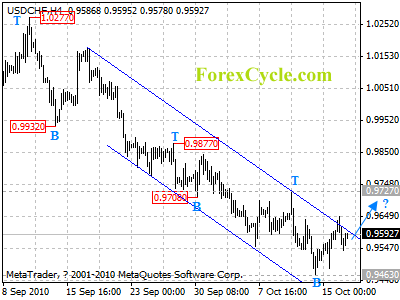
USDCHF has reached the upper border of the price channel on 4-hour chart, suggesting that a cycle bottom has been formed at 0.9463 level. Further rally towards 0.9727 is still possible later today, a break above this level will indicate that the fall from 1.0277 has completed at 0.9463 already, then the following upward move could bring price to 1.0000 zone. However, as long as 0.9727 key resistance holds, downtrend is expected to resume, and another fall to 0.9300 is expected.

usdchf

Daily Forex Analysis

Aussie Poised to Make Another Run Against the Loonie

AUDCAD october 2010, AUD, CAD, australian dollar, aussie, canadian dollar, loonie, ron acoba, laidtrades, laid trades, fx, fx market, fx trading, forex, forex market, forex trading, trading forex, currency trading, daily forex picks, forex analysis, forex forecast

Welcome to another week of FX trading! Contrary to my post last October 5 (kindly see it here), the AUDCAD did not encounter any resistance at its previous high at 0.9200. Instead, it broke right above it to form an ascending triangle pattern. In such pattern, buyers are deemed to be the more aggressive than the sellers. Here, buyers continue to buy the Australian dollar despite the increase in its price while the sellers only sell it at a specific price level. Therefore, a break out to the upside is more likely. If it does, it could spring by another 200 pips or so to even surpass the AUDCAD-parity marker (1.0000). The pair’s present uptrend is also suggesting the probability of a move higher. But in case the 1.0000 level proved to be tough to break through and the pair breaks down from the triangle, the previous high at 0.9900 and the uptrend line should provide some support.

On the fundamental side, remember that Australia was one of the very few major economies that escaped a recession. It’s central bank, the Reserve Bank of Australia (RBA), was also the first to raise its interest rates, making 2009 the year of the Aussie. The first quarter of this year, however, belonged to Canada when it posted improvements in its consumption and labor market. And as a result, the Loonie took the driver seat against as the most favored currency at least at that time away from the AUD. The gains, though, in both economies are starting to abate. So between the two, who should the market favor?

You see, Australia has China to back its economy. In case you do not know, Australia is one of China’s major suppliers of raw materials. I would like to mention as well that one of these input materials happens to be gold which is now trading at an all time high. So with China’s economy expanding by 10.3% during the second quarter and is seen to have grown again by another 9.3% during the third, Australia’s export industry at the very least should not have any problem. Now juxtapose this with Canada and the US. It’s been in the news for more than a week now that the Fed is planning to flood the market with more dollars in order to bring down the market interest rate to encourage more lending and spending, thus, stimulating business activity. This only means that the present business condition in the US are very much anemic. Such would of course negatively affect Canada since the US its major trading partner. In other words, poor business condition in the US would also mean the same for Canada.

Aside from the impact of Canada’s and Australia’s major trading partners in their respective economy, the currencies’ interest rates also play a big part why I’m more bullish on the Aussie than the Loonie. The Aussie has a 4.5% interest rate while the Loonie only has 1.00%. This means that if one goes long on the AUDCAD, he could also net 3.5% in interest rate differential as a bonus aside from the potential to have capital gains.

More on LaidTrades.com

Forward Contracts – How SMEs Can Beat Currency Fluctuations

By Corporate Fx

The current perceived instability of the currency markets have left some SMEs shaken. Fearful to enter a market perceived as continuously fluctuating and risky, over 50% of SMEs suggest that currency fluctuations seriously influence their abilities to trade overseas and 42% of those that do trade overseas suggest currency fluctuations also effect profitability of the business. It is clear that SMEs feel the burn of currency risk.

However despite these fears, the untapped foreign markets are seen as integral to Britain’s recovery via the export market. Encouraging SMEs to forgo the risks of currency fluctuations is an important step in developing Britain’s export market and doing so requires an explanation about methods to tackle the fluctuations. So what can SMEs do when it comes to trading overseas? One option is to agree an acceptable rate of currency and trade on that currency at an agreed point in the future after the transfer of products or conclusion of the service has been carried out. Or put more simply arrange a “forward contract”.

By definition a foreign exchange forward contract is a way to enable a seller to lock a buyer into a selling price for an asset with the transaction set in the future. It relies on both a buyer and a seller to agree on a fixed price point, this price can be influenced by additional factors depending on what is being traded, and the date of settlement.     Whilst this method could be applied to any transaction that might be influenced by fluctuations in the product’s value, currencies have a certain affinity with this method of trading and as such forward contracts are seen as a way of managing the risk of a fluctuating currency.

So why should you care about forward contracts? Apart from the fact that they can avoid the pitfalls of a fluctuating currency market they can also enable you to protect your profit margin. For example, let’s say that you are a UK based small retail business interested in selling apparel to Australian markets. You have a distributor who is interested in your stock however you want to ensure that the trade happens at a favourable rate. By setting the rate of exchange based on today’s rate you can ensure that your profit will remain the same despite the actual date of trade. In the event of a fall in value for GBP vs AUD you can ensure that you retain exactly the same rate as previously agreed upon and thus a locked profit margin. Of course the same occurs for when the value drops – you retain a static rate of exchange and thus have a protected profit margin.

It is clear why you should use a forward contract if you are worried about the effect of a fluctuating currency market on the ability to trade, however one question remains: how do you actually set up a forward currency contract?

In the example above if you were selling your product then you could set up a forward contract with a Forex dealer to sell currency at a set point in the future. This enables you to trade your product at a set price with your foreign client in their currency. Funds from your client would go to your forex dealer who would then honour the forward contract essentially buying the currency from you at a rate that was defined in the forward contract at the date agreed.

Forward contracts are the simplest solution against currency fluctuations and as such offer SMEs the opportunity to trade in foreign markets with a certain sense of ease. To find out more about forward contracts simply visit a corporate foreign exchange specialist.

About Corporate FX

Corporate FX is a privately owned company. Registered in 2001 and based on Cornhill in the City of London since 2007, we are a market leader in supplying commercial forex trading services and hedging strategies including trading Forex Spot.

Forex: Speculators trim Euro, Yen, Aussie long positions in currency futures

By CountingPips.com

The latest Commitments of Traders (COT) report, released on Friday by the Chicago Mercantile Exchange, showed that futures speculators slightly pared their bets in favor of the euro and the other major currencies against the US dollar. Non-commercial futures positions, those taken by hedge funds and large speculators,were overall net short the US dollar by $29 billion against the other major currencies, down from a total short position of $30.5 billion on October 5th, according to data published by Reuters.

Currency speculators were net long the euro against the U.S. dollar by 41,511 contracts as of October 12th. This is a decline of nearly 7,000 contracts following net long positions of 48,243 contracts on October 5th and breaks a string of five straight weeks of improving positions for the euro.

The COT report is published every Friday by the Chicago Mercantile Exchange (CME) and shows futures positions as of the previous Tuesday. It can be a useful tool for traders to gauge investor sentiment and to look for potential changes in the direction of a currency or commodity. Each currency contract is a quote for that currency directly against the U.S. dollar, where as a net short amount of contracts means that more speculators are betting that currency to fall against the dollar and net long position expect that currency to rise versus the dollar. Open interest is the number of open contracts that have not been closed by a transaction or by delivery.

The British pound sterling had been the last major currency on the short side against the dollar in the CME futures market but in early October the British currency positions changed to a positive net amount of contracts. The euro, Australian dollar, New Zealand dollar, Japanese yen, Canadian dollar, Swiss franc and Mexican peso all continued to have a net positive amount of contracts.

The British pound sterling positions fell slightly to a net of 8,066 contracts after being long on October 5th by 9,403 positions. The latest data interrupts a streak of four straight weeks of improvement for the British pound future positions and brings positions off the best showing for GBP contracts in over a year.

The Japanese yen net long contracts decreased slightly to 48,285 as of October 12th from 49,206 net long contracts reported on October 5th. Yen positions had climbed for two straight weeks after a notable decline on September 21st as many speculators may have decreased their yen long positions due to the Bank of Japan’s currency intervention.

The Canadian dollar positions increased higher for a second straight week to a net total of 43,786 contracts after totaling 42,678 net longs on October 5th and rose to their highest level since May.

Swiss franc long positions declined to 19,947 long contracts as of October 12th after totaling a net of 22,599 long contracts on October 5th. This reverses three straight weeks of increases that brought the Swiss franc positions to their highest level since early in December 2009 when long contracts totaled 24,725.

The Australian dollar positions edged very slightly lower for second straight week after reaching their highest level since April on September 28th. AUD futures contracts declined to a net amount of 67,691 long contracts as of October 12th from 69,036 long contracts on October 5th.

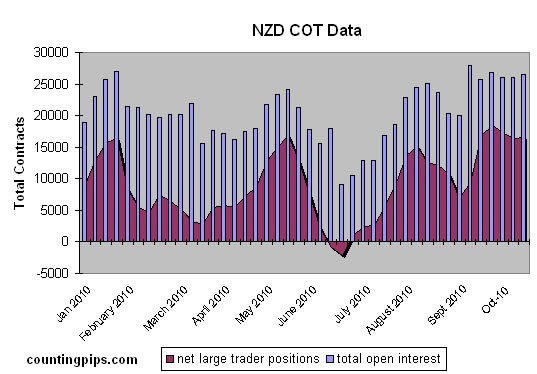
New Zealand dollar futures positions edged slightly higher to a total of 16,573 long contracts after a total of 16,334 long contracts the week before.

Mexican peso long contracts also edged just slightly higher as of October 12th to 86,218 net long positions from 85,764 longs the week prior. Peso positions are at their highest since May and have now risen for five consecutive weeks.

COT Data Summary as of October 12th, 2010
Large Speculators Net Positions vs. the US Dollar

Euro: +41,511 contracts from +48,243 contracts on October 5th
British pound sterling: +8,066 contracts from +9,403 contracts
Australian dollar: +67,691 contracts from +69,036 contracts
Canadian dollar: +43,786 contracts from +42,678 contracts
Japanese yen: +48,285 contracts from +49,206 contracts
Mexican peso: +86,218 contracts from +85,764 contracts
New Zealand dollar: +16,573 contracts from +16,334 contracts
Swiss franc: +19,947 contracts from +22,599 contracts

Go to the Commitment of Traders CME raw futures data

Further COT Resources from around the web:

Forecast The FX Market With The COT Report

The Only Indicator You Will Ever Need