Forex daily analysis 21-10-2010

GBP/USD

Daily graph: http://www.real-forex.com/charts-daily/211010/GBP_DAILY_211010.JPG

GBP/USD daily

3 sessions after a vain breach due to reversal candle on a daily graph, the pair started to decrease very sharply and intensively. Until now, a technical correction of exactly 50% occurred. Since the different candles are very strong, the bearish trend should continue, creating opportunities for “Short” trades.

Our prognostics may be confirmed by the identification of a decreasing configuration on a one-hour graph.

Notification: If a hammer appears, it could be possible to start the transaction immediately but, it is always better being careful and wait for the configuration to occur.

Potential trade

One-hour Graph: http://www.real-forex.com/charts-daily/211010/GBP_1H_211010.JPG

GBP/USD 1H

The required configuration did not appear for the moment. If the resistance of 1.5881 is crossed upward, it could be better not to enter the transaction. Trade suggestion:

  • The “Stop Loss” should be placed at 1.5881.
  • “Limit Order” 10 pips below the closest support.

USD/CAD

Daily graph:  http://www.real-forex.com/charts-daily/211010/CAD_DAILY_211010.JPG

USD/CAD daily

The bullish power is strengthened by the long candle from two sessions ago. This candle reached the resistance zone around 1.0376 GBP.

33% of the uptrend started a few sessions ago has been corrected during yesterday’s session. This classical case of correction suggests a high probability for the preceding trend to be renewed. Therefore, our analysts estimate that the pair may reach the following resistance at 1.0513.

This estimation should be confirmed if an increasing configuration is created on a one-hour graph.

Have a profitable day!

Real-Forex team. logo

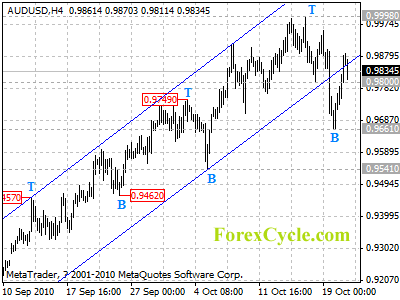
AUDUSD broke below price channel

AUDUSD broke below the lower border of the rising price channel on 4-hour chart and reached as low as 0.9661 level, suggesting that the uptrend from 0.8771 has completed at 0.9998 already. Another fall to 0.9500 area is expected in next several days. Resistance is now at 0.9998, only break above this level could trigger another rise to 1.0100-1.0200 area.

audusd

Daily Forex Forecast

The Big Bullish Picture for Stocks

By themarkettrendforecast.com

Back in late February 2009 I decided enough was enough, and I stuck my neck out and called for a massive bull market in stocks. I based this prediction purely on Elliott Wave patterns I identified as bottoming and the sentiment gauges were off the charts bearish. We had not seen sentiment that negative since the 2002 lows.  The re-tracement of the SP 500 over the eight odd years was a textbook Elliott Wave pattern, and frankly I think I was the only person who noticed the significance of the 666 low as it related to the 1974 SP 500 lows to 1999/2000 highs.  Why was that 666 number so significant and a key indicator of a major bear market cycle low?  Well the reason is that marked a clear wave 2 elliott wave bottom both in price, and sentiment, and time all at once.

At that level, the SP 500 believe it or not,  had retraced an exact 61.8% Fibonacci retracement of the 1974 lows to the 1999 highs.  That was very significant in that the market bottomed right there, and then began rallying upwards.  At that point, it confirmed what I predicted in February of 2009, that we would begin a massive bull market up in stocks.  The correction from the 1999-2000 highs lasted about 8 fibonacci years roughly, and retraced 61% (Fibonacci golden ratio) of the 25 year advance.  Everyone was bearish at the lows, again, a confirming piece of evidence to get long in the winter of 2009. That brings us forward in this new bull market to October, 2010.  Clearly, we bottomed in March of 2009 at 666, but it was not random at all.

We are now in the early stages of a big wave 3 up in the markets.  Wave 1 ended in April 2010 (A 5 wave structure completes a large wave 1 pattern).  Then wave 2 corrected in A B C fashion, which had a 38% fibonacci retracement of the prior 13 month rally.  That  completed wave 2 down into July 1st, and sentiment again was horrible at the recent 1040 pivot.

Now, a wave 3 structure (5 total waves) to the upside begins at 1010 on July 1st with a move to 1130, then a wave 2 to 1040, and now a wave 3 up still in progress to 1220 if I’m right.  Bottom line is the long term trends are bullish until the wave patterns materially change. Once 1220 is hit, we likely get a pullback wave 4 down, then a 5th wave up to new highs past the April 2010 highs.

Subscribers to our TMTF are educated as much as possible by me on Elliott Wave Theory, but everyone who is an investor should consider reading up on the basics of the subject so you have a base understanding.  There are many free sources online to google. Consider joining my TMTF service now and stay ahead of the bull and bear moves in the market, and profit! Go to www.themarkettrendforecast.com to sign up.

Below is the simplest of SP 500 charts with some basic Elliott Wave labels. Getting complex with Elliott Wave forecasting is not a good idea: Best to you and your trading!

Article Courtesy of themarkettrendforecast.com

The #1 Reason Why Gold Collapsed

By Adam Hewison – Following the gold market as we do here at MarketClub, it was amazing that nobody, and I mean nobody, was bearish on this market. This always creates a problem as the markets tend to reverse when everyone is on one side and there’s no one else left to buy.

Another tip-off was on Fox Business News and also on CNBC indicating that gold was going to hit $1400 almost immediately. Well after Tuesday, we know what was to happen to the price of gold. If gold were so strong, should it really have gone down almost $70 in 4 days?

This is where technical analysis and Japanese candlestick charts really shine in my opinion. What happened in gold was a classic candlestick formation that any trader, whether they trade gold or other markets, should be aware of.

In this short video, I illustrate how this formation occurred and how it was confirmed the next day – and I don’t mean on Tuesday.

I also have a free candlestick book that I’m making available along with this video, be sure to stay tuned at the end of the video or visit:


All the best,
Adam Hewison
President of INO.com
Co-founder of MarketClub

AUD/USD Moves Closer to Parity

By Rita Ruvinski – The AUD/USD made a sharp fall after the Chinese central bank announced a rate hike. Despite ‎the Australian positive data released earlier, the news from China had a negative impact on ‎the pair. Although the pair is now supported in its lower levels, our technical analysis shows it ‎could be just a temporary retracement and AUD/USD parity is sure in sight. ‎

After the pair fell from around 0.9900 to around 0.9650 on the Chinese move, it now bounced ‎back above 0.9700. This line, 0.9650, served as a resistance line when the Aussie was climbing ‎higher, and now worked as strong support after other lines collapsed.‎

We will be looking at the daily chart for AUD/USD. The technical indicators being used are the ‎Bollinger Bands, MACD and Relative Strength Index (RSI).‎

‎-‎ The RSI, while not quite in the oversold region yet, is pointing downward and is ‎approaching the lower support line. Should the indicator move below the 30 level, ‎traders can take this as a sign that the pair may see a bullish correction.‎
‎-‎ The MACD is positive and above its signal line. The configuration is bullish. ‎
‎-‎ The Bollinger Bands are tightening which confirms the bullish volatility in the pair.‎
‎-‎ Although the upward potential is likely to be limited by the resistance at 0.9800 once ‎the pair breaches, its traders can expect a further upside with 0.9840 and 0.9915 in ‎sight.‎

Forex Market Analysis provided by ForexYard.

© 2006 by FxYard Ltd

Disclaimer: Trading Foreign Exchange carries a high level of risk and may not be suitable for all investors. There is a possibility that you could sustain a loss of all of your investment and therefore you should not invest money that you cannot afford to lose. You should be aware of all the risks associated with Foreign Exchange trading.

Crude Oil Inventories Report Expectations

printprofile

Crude Oil prices have been on a tear this month. Yesterday in New York, Crude Oil fell more than 4%, the biggest one-day percentage decline in seven months. Since then, however, it has already managed to regain at least half of its losses, mainly on signs that U.S. fuel stockpiles are shrinking and speculation that China’s economy will continue to drive oil demand.

At the moment Crude Oil is trading around $80.75 per barrel. Now, a couple of hours ahead of the U.S. Oil Inventories Report we will focus on two major drivers of instability in Oil prices for the last month, the U.S. and China.

The U.S. Energy Department may report today that gasoline stockpiles fell 1.5 million barrels last week. With China, things are, as usual, a bit more complicated. Recently China surprised markets by raising interest rates for the first time in nearly three years, but as time passed by, concern eased that an unexpected rate increase by China’s central bank will harm fuel consumption in the world’s largest energy user.

China has been the main driver of oil demand growth so far this year, although it still uses far less than the top consumer, the United States. It’s also expected to raise retail fuel prices effective Thursday. China’s demand for oil remains strong and their interest rate hike does not prove to be of a magnitude that would change or harm fuel consumption. On the contrary, analysts even speculate that China’s net Crude Oil imports may reach 310 million metric tons just 5 years from now. That is indeed a ‘vote of confidence’ that can take Oil prices to new highs.

The U.S. is also not dragging behind. Fuel demand in the States is also rebounding from last year’s slump. U.S. gasoline demand rose 2.7% last week, the largest week-to-week jump since May 28. Oil also gained support from a weak dollar, which dipped against a basket of currencies. A falling dollar makes oil and other dollar-denominated commodities cheaper for holders of other currencies.

Therefore, traders may firmly speculate that if indeed today’s U.S. Oil Inventories report will meet expectations, there might be quite a sharp jump in Oil prices.

Oil Under Sell Pressure but Technicals Suggest Upturn Impending

The price of Crude Oil has recently entered a mild bearish channel following its sharp upward spike a few days ago. On the technical side, we can see what appear to be parallel trend lines, with a clear median line between them.

With a price just under $81 a barrel, the price of oil is beginning to come under pressure from faltering economies in Europe, as well as a dampening of value from a rapidly appreciating USD.

Looking at our chart below, we can see our relevant support and resistance levels (marked as S# and R#, respectively). The way our indicators currently look gives one the impression that there may still be room for the current trend to continue.

Our MACD shows a descending pattern that is preparing to enter the over-sold region (below the 0 line marked in red). Our Stochastic (slow) reveals a similar pattern. This suggests that pressure remains downward, but that an upturn may be in the making.

Our next major support level (S1) rests at $79.50 a barrel, and signals indicate we could see the price turn towards that mark after touching R1 at $81.50. But it seems to be that a bullish cross will be forming on both of our indicators and will therefore suggest an upturn is impending, with a target near R2 at $83.50 a barrel.

Crude Oil – 8-Hour Chart
Crude Oil - 8-Hour Chart

Forex Daily Market Commentary

By GCI Forex Research

Fundamental Outlook at 0800 GMT (EDT + 0400)

USD

Risk appetite finally stabilized during the Asia session in the aftermath of yesterday’s surprise policy hike by China. EURUSD traded 1.3698-1.3811, USDJPY 81.32-81.67. The dollar has been slowly giving back yesterday’s gains ever since Shanghai equities opened and quickly recovered their poise. Although several Fed officials spoke, there was little market impact given that many of their views on further easing were already known. Fed Presidents Evans, Dudley and Lockhart continued to support further easing while Fisher and Kocherlakota continued to sound caution on more action. Lockhart, a 2011 FOMC alternate and 2012 voter, mentioned a pace of $100 bn of purchases a month is among the range of considerations. Chairman Bernanke did not offer any new insights. Fed Governor Duke reminded markets that a further round of easing on Nov. 3 is not yet a done deal, and that lowering the interest rate paid on excess reserves is another policy option. Investors expectations for more easing remain in place but calibration of those expectations is key, as the quantity and duration of more easing are moving targets. Press reports that a large US asset manager and the New York Fed are looking to put-back bad mortgages to a major US bank contributed to the atmosphere of risk aversion earlier, and mixed data did little to help investor sentiment as housing starts were better than expected and housing permits fell more. Between now and the Nov. 3 FOMC meeting, we expect pressure to remain squarely on the dollar.
EUR

ECB Executive Board Member Stark noted that there are risks associated with the ECB’s bond purchases, and that the ECB must avoid intervening in functioning markets. He said that the bond buying program risks becoming ‘quasi fiscal’ in nature, and that low interest rates reduce the incentive for fiscal consolidation. These comments bring Stark a little closer to ECB Governing Council Member Weber’s stance on the matter, but for now Weber is the only policymaker who has publicly called for the program to be disbanded.
Stark added that he sees clear signs of normalization in money markets and cautioned that while there is no apparent currency war yet, there is the risk that ample liquidity could trigger more defensive responses. Weber said it is too early to call an end to the crisis, echoing Trichet’s comments at the latest press conference, but his comments focused more on regulatory issues than monetary policy.
The German ZEW survey was much stronger than expected at 72.6. However, the boost to the euro was limited as markets continue to assess whether QE2 is now fully priced and reduced risk-seeking worked against the euro.
GBP

Broader dollar strength kept sterling under pressure but the currency has its own obstacles to come in the next 24 hours. The BoE MPC minutes should show if a 3-way split has occurred, with policymakers Posen and Sentence possibly on opposite ends of the policy spectrum, and headlines from the Comprehensive Spending Review will be watched as fiscal austerity could hamper growth and weigh on sterling.
BoE Governor King said monetary policy is still a potent weapon but that policy must balance risks to inflation and the MPC is conscious of risks to inflation expectations. He saw upside and downside risks to inflation though he did say it could be some time before inflation falls to target. King also said the weaker pound supports rebalancing of the economy and that the G7 willingness to work together “has ebbed.” He also mentioned that M4, pay and demand growth are likely better guides to future inflation. M4 data is also due today.
JPY

BoJ Deputy Governor Nishimura observed that the yen’s rise is a major downward risk to the economy, and that it may contribute to deflationary forces. IMF First Managing Director Lipsky met with Finance Minister Noda, and said that the BoJ’s recent easing was a welcome move. Noda said that FX intervention was not discussed at the meeting. Deputy Cabinet Secretary Fukuyama said there has been no change in Japan’s position on FX intervention.
Nishimura added that China’s rate hike yesterday is a good decision that would help ensure long and stable growth.
CAD

The BoC kept its policy rate unchanged as expected and revised down its growth outlook for 2010 and 2011, also in line with expectations. But the decision to tune down inflation forecasts was less expected, as the BoC pushed back its time-frame for when it sees the output gap closing. The BoC kept in place its policy guidance, saying again that further reductions in monetary stimulus would have to be “carefully considered” and seemingly expanded its view of downside risks. With the BoC on hold for now, the CAD will continue to lose luster to the other dollar-bloc currencies as a relative value G10 play. The BoC Monetary Policy Report will be released and should echo the changes outlined in the policy statement.

TECHNICAL OUTLOOK


USDCAD 1.0380 tough resistance.
EURUSD BULLISH Break of 1.3775 reaction low exposes 1.3637/1.3559 support zone.
USDJPY BEARISH Next support at 79.75 ahead of 77.91. upside potential capped at 83.03.
GBPUSD BULLISH Room toward support at 1.5606, but as long as it holds, view pullback as correction.
USDCHF BEARISH Rise through 0.9729 exposes 0.9918 breakout low. Next big support below0.9463 at 0.9225.
AUDUSD BULLISH Sharp decline yesterday exposed 0.9542 reaction low. Momentum is picking up; expect recovery towards 1.0004 trend high.
USDCAD BEARISH Tough resistance in 1.0380/1.0407 area. Initial support at 1.0162 ahead of 0.9981.
EURCHF BULLISH Upside potential holds below 1.3494; break of the level would expose 1.3665. Initial support lies at 1.3265 ahead of 1.3072.
EURGBP BULLISH Momentum is positive; expect gains to target 0.8840 with scope for 0.8894 and 0.9039 next. Near-term support holds at 0.8689.
EURJPY BULLISH Move below 111.77 exposes 110.66 ahead of 107.73. Upside capped at 115.68.

Forex Daily Market Commentary provided by GCI Financial Ltd.

GCI Financial Ltd (”GCI”) is a regulated securities and commodities trading firm, specializing in online Foreign Exchange (”Forex”) brokerage. GCI executes billions of dollars per month in foreign exchange transactions alone. In addition to Forex, GCI is a primary market maker in Contracts for Difference (”CFDs”) on shares, indices and futures, and offers one of the fastest growing online CFD trading services. GCI has over 10,000 clients worldwide, including individual traders, institutions, and money managers. GCI provides an advanced, secure, and comprehensive online trading system. Client funds are insured and held in a separate customer account. In addition, GCI Financial Ltd maintains Net Capital in excess of minimum regulatory requirements.

DISCLAIMER: GCI’s Daily Market Commentary is provided for informational purposes only. The information contained in these reports is gathered from reputable news sources and is not intended to be U.S.ed as investment advice. GCI assumes no responsibility or liability from gains or losses incurred by the information herein contained.

USD/SEK at 2-Yr Low after Fiery Speech from Riksbank

By Greg Holden – The Swedish krona has undergone one of its strongest rallies in recent memory these past few days after the Riksbank Deputy Governor Barbro Wickman-Parak delivered a hawkish statement last Thursday. The SEK climbed to a 2-year high against the US dollar following Wickman-Parak’s fiery call for interest rate increases in the near future.

The USD/SEK fell to 6.5129 last week, but has rallied to as high as 6.8017 at the close of New York trading yesterday. Wickman-Parak’s speech highlighted the growing need for Sweden to boost rates before it’s too late, but also put the spotlight on the potential reasons behind the decision to hold rates where they are. This has put some downward pressure on the SEK alongside a rising USD.

In a similar turn of events, the Norwegian krone (NOK) appears to be falling out of favor with foreign investors specifically because Norges Bank is perceived to be stalling on interest rate hikes as well. The USD/NOK has come off a 6-day high; the pair is climbing towards 5.9425 from as low as 5.7000 seen just two days ago.

Technical Analysis

If we look at the USD/SEK daily chart we can see some relatively clear indications of what’s happening on a technical level. The pair has been trading in a downward trend for some time now, but has only recently pared some of its losses to reach back up towards its predominant, overhead trendline.

We can see the price reaching back and just recently touching the 23.6% Fibonacci line. The price could meet some mild resistance there and turn downwards, but the RSI and Stochastic (slow) seem to suggest otherwise; as does the overhead trendline. It appears there could be more bullish room for this pair to run. If the price breaches above 6.8500, then traders may want to anticipate an upward breach which could climb as high as 6.9750 if the Riksbank doesn’t step in on the fundamental side.

Forex Market Analysis provided by ForexYard.

© 2006 by FxYard Ltd

Disclaimer: Trading Foreign Exchange carries a high level of risk and may not be suitable for all investors. There is a possibility that you could sustain a loss of all of your investment and therefore you should not invest money that you cannot afford to lose. You should be aware of all the risks associated with Foreign Exchange trading.

Will the USD Be Able to Maintain Yesterday’s Gains?‎

Source: ForexYard

Following yesterday’s volatile trading session, in which the US dollar gained around ‎‎300 pips against the euro, analysts are questioning whether the dollar gains were a ‎temporary occurrence or the beginning of a larger trend. Today, news out of the UK ‎and Canada will likely determine which direction the market moves.‎

Economic News

USD – USD Gains Big Following Surprise Chinese Rate Hike

Yesterday, the dollar saw significant gains against virtually all of its main currency ‎rivals, following a surprise Chinese interest rate hike that led to increased risk aversion ‎among investors. The dollar was able to gain approximately 300 pips against both the ‎euro and UK pound. Currently the EUR/USD pair is trading around the 1.3755 level, ‎while the GPB/USD pair stands at 1.5715. While the greenback initially made gains ‎vs. the fellow safe-haven yen, the USD/JPY pair has since fallen and is currently ‎around the 81.30 level.‎

Analysts are unsure regarding how long the USD will be able to maintain these gains. ‎Any future moves by China to tighten economic policy will likely benefit the ‎greenback, as investors are likely to revert to safe-haven currencies as a result. That ‎being said, with the Fed set to unveil its latest quantitative easing measures as early as ‎next month, investor confidence in the US economy is quite low. As long as the US ‎continues to release negative economic indicators, investors are likely to keep opening ‎short positions for the greenback.‎

Today, a lack of significant economic indicators out of the US means that dollar ‎values will likely be determined by news from the UK and Canada. Traders are ‎advised to pay attention to the UK Spending Review and the Canadian BOC Press ‎Conference, scheduled for 11:30 and 15:15 GMT respectively. Both sterling and the ‎loonie took losses against the dollar yesterday. Positive news today will likely help ‎either currency recoup its losses. ‎

EUR – EUR Set to Reverse Yesterday’s Losses

In addition to the 300 pip drop the EUR/USD took yesterday, the safe-haven yen was ‎able to record significant gains against the 16-nation single currency. EUR/JPY ‎plummeted some 210 pips yesterday before staging a minor recovery in the overnight ‎session. Currently the pair is trading around the 111.90 level. Analysts attribute the ‎drop to a decrease in risk taking following China’s surprise interest rate hike ‎announcement. ‎

Whether or not this trend will continue today is unknown, but traders will want to pay ‎careful attention to any major announcements out of China just in case. In addition, ‎news out of the UK is likely to influence the euro today. The EUR/GBP pair dropped ‎close to 100 pips yesterday. Today’s UK Spending Review is expected to reveal that ‎the Bank of England is set to inject a significant amount of capital into the economy, ‎while keeping interest rates at their record low. If so, investor confidence in the UK ‎economy will likely remain low, and could lead to significant gains for the euro in ‎afternoon trading. Traders may want to jump on this impending trend before it is too ‎late. ‎

JPY – Yen Manages to Gain on USD in Overnight Trading

After losing close to 60 pips against the US dollar in yesterday’s trading, the yen has ‎managed to correct itself and is currently trading around the 81.40 level. ‎Additionally, the Japanese currency has gained some 130 pips against the UK pound, ‎and 75 pips against the Swiss franc. Analysts attribute the yen’s gains to a return to ‎risk aversion following the surprise announcement out of China yesterday. Whether ‎or not these gains are temporary depends on a number of factors.‎

First, today’s UK Spending Review is unlikely to help generate investor confidence in ‎the British economy. Should the Bank of England announce a new stimulus plan, as ‎predicted, the safe-haven yen is likely to see more gains. At the same time, traders ‎always want to pay attention to any moves the Bank of Japan may make in order to ‎devalue its currency. The yen’s recent gains have not been good for Japan’s export ‎industry, and a move by the BoJ is not out of the question. ‎

Crude Oil – Oil Prices Tumble As the USD Moves Up

Crude oil prices fell close to 400 pips in trading yesterday, as investors abandoned the ‎commodity in favor of the safe-haven dollar. While oil managed to stage a slight ‎correction in overnight trading, the trend is still very much down. Currently prices ‎stand at $80.55 a barrel. Crude oil is typically viewed as an alternative investment to ‎the US dollar. It appears for as long as the dollar is making gains, oil has the potential ‎to drop down further.‎

Today, in addition to the direction the USD takes, traders will want to pay attention ‎to the US Crude Oil Inventories figure, set to be released at 14:30 GMT. Analysts are ‎forecasting an increase in inventories this week. Should the figure come in at its ‎forecasted level of 1.5M, crude has the potential continue its bearish trend. Typically, ‎an increase in inventories signals a decrease in demand which causes oil to fall, at least ‎in the short term. ‎

Technical News

EUR/USD

Following yesterday’s downward spiral, the Williams Percent Range on the 8-hour ‎chart indicates this pair is in oversold territory. This theory is supported by the ‎Stochastic Slow on the 4-hour chart, which has formed a bullish cross. Traders are ‎advised to long with tight stops today.‎

GBP/USD

The Relative Strength Index on the 8-hour chart indicates that this pair is in oversold ‎territory and may see an upward correction. In addition, the Stochastic Slow on the ‎same chart shows that a bullish cross has formed. Now may be a good time for ‎traders to open up some long positions in order to jump on the impending upward ‎trend.‎

USD/JPY

Virtually every technical indicator shows this pair trading in neutral territory at the ‎moment. Usually this means that a clear direction has not yet presented itself for the ‎day. Traders may want to take a wait and see approach in order to better judge which ‎way the pair is moving. ‎

USD/CHF

The Relative Strength Index on the 8-hour chart shows this pair entering overbought ‎territory, meaning that a downward correction could occur today. Traders may want ‎to go short with tight stops today, as a bearish correction may take place.‎

The Wild Card

Platinum

After tumbling in trading yesterday, technical indicators are showing that the ‎commodity may be due for an upward correction. The Slow Stochastic on the 8-hour ‎chart has formed a bullish cross, while the Relative Strength Index on the 4-hour chart ‎is in oversold territory. Forex traders may want to go long with tight stops for some ‎potentially serious profits today.

Forex Market Analysis provided by ForexYard.

© 2006 by FxYard Ltd

Disclaimer: Trading Foreign Exchange carries a high level of risk and may not be suitable for all investors. There is a possibility that you could sustain a loss of all of your investment and therefore you should not invest money that you cannot afford to lose. You should be aware of all the risks associated with Foreign Exchange trading.

Forex daily analysis 20-10-2010

USD/CHF

Daily graph: http://www.real-forex.com/charts-daily/201010/CHF_DAILY_201010.JPG

USD/CHF daily

The pair briefly stopped its long downtrend started a few weeks ago, and corrected it by about 33% until the level of 0.9757. Our analysis estimate a high probability for the correction to stop here and the decrease to come back, creating an opportunity for a “Short” transaction.

A deceasing configuration on 1-hour graph should appear in order to confirm our estimates.

One – Hour graph: http://www.real-forex.com/charts-daily/201010/CHF_1H_201010.JPG

USD/CHF 1H

Potential trade:

The required configuration should appear once the support 0.9692 crossed down ward.

  • “Limit” order on “Short” position 10 pips below the mentioned support – 0.9682.
  • “Stop Loss” on the last high occurred – 0.9723.
  • “Take Profit” on the next support level – 0.9651.

Notice: There is a possibility for the trend to keep decreasing for about 10 pips and then a correction of 50% to 61.8% may occur.

USD/CAD

Daily graph: http://www.real-forex.com/charts-daily/201010/CAD_DAILY_201010.JPG

USD/CAD daily

As opposed to our estimations, the uptrend didn’t stop and last session’s candle was quite long and relevant. This candle just reached the resistance 1.0376.

Please pay attention to the following points:

  • The intensity of the last two sessions.
  • Regarding several weeks ago, the pair doesn’t follow any specific trend.

Those facts suggest the pair won’t be stopped by the mentioned resistance but will break it and reach the next resistance at 1.0513.

Such an event may occur after a light technical correction, and once the resistance crossed upward on one-hour graph. For those who believe the pair will not be stopped at 1.0513 but later, our estimations suggest an additional resistance at 1.0674.

No matter how long you believe the current trend will last, we suggest several levels of “Take Profit” on the way.

Have a profitable day!

Real-Forex team. logo