Silver prices rose significantly in the last week and peaked at $27.75 an ounce. However, the 8-hour chart is suggesting that a recent upwards trend is loosing steam and a bearish correction is impending. Forex traders involved with commodities like this can take advantage of this knowledge by going short on silver now, and at a great entry price!
• Below is the 8-hour chart for silver by ForexYard.
• The technical indicators used are the Slow Stochastic, RSI and Williams Percent Range.
• Point 1: There is a “doji” candlestick formed in the chart, indicating that a reversal should take place.
• Point 2: The Slow Stochastic indicates a bearish cross, signaling that the next move may be in a downward direction.
• Point 3: The RSI signals that the price of this pair currently floats in the over-bought territory, suggesting downward pressure.
• Point 4: Williams Percent Range also supports the downward direction.
Disclaimer: Trading Foreign Exchange carries a high level of risk and may not be suitable for all investors. There is a possibility that you could sustain a loss of all of your investment and therefore you should not invest money that you cannot afford to lose. You should be aware of all the risks associated with Foreign Exchange trading.
n Monday, an old friend sent me a link to a now virally famous cartoon clip via YouTube. The clip is a depiction of the Federal Reserve’s second round of quantitative easing in a simplified, humorous manner and has been viewed over 1.6 million times, not to mention it had a front and center showing on CNBC.
It comically poses questions that pretty much sum up the entire state of our economy right now. Is this some kind of a nightmare? Are we in an episode of TheTwilight Zone?
Please watch the clip before you continue.
I couldn’t have said it better myself.
Quantitative easing, in theory, should put money into consumers’ hands to spend and into companies’ hands to hire. The Federal Reserve is worried about deflation.
But is this really the case?
Let’s take a look at prices of the things over the past year that we use every day and see…
A party in Beijing’s Great Hall of the People could be worth four times your money
China’s domestic security “national champion” was recently given preferred status in the building of the most expensive, technologically advanced police state in the history of civilization.
Now, a “secret” deal with this company could potentially give one senior Communist official a million-dollar retirement.
Act immediately, and you could make four times your money off this China investment.
Energy Prices Are Up…
Crude oil futures were trading in the upper $70s in November of 2009 and in early November 2010 spiked up to over $87. That’s a roughly 13% jump. In the world of natural gas, we’re looking at a very similar story in our cost as consumers. Even though natural gas futures were flat(ish) compared to last year, you as the end user have been paying higher prices from April up until September.
And Are Is Electricity Prices…
According to the EIA (U.S. Energy Information Association), our average cost in cents per kilowatt-hour for 2009 was $11.55. Up until August of this year the average was $11.53, but don’t forget that September, October and November are still relatively high usage months for many homes, so expect that number to rise as well.
Getting to and from your job or job interviews and running errands is definitely costing you more: The average price of a gallon of gasoline is up 26.3 cents from a year ago, which represents an almost 9% increase in cost.
AAA says that the average driver travels 15,000 miles per year. Assuming two drivers per household getting an average of 20 mpg, that’s 1,500 gallons of fuel. If fuel jumps another quarter, we are talking a $750 per year increase for the average couple with no kids.
And — You Guessed It — So Are Food Prices…
I always found it humorous when analysts strip out food and energy when looking at consumer prices! As a human being, I need to keep myself at a certain temperature and eat and drink just to stay alive! While energy costs are moving higher, feeding your family is really costing more than it did last year.
Raw commodities alone are through the roof!
Wheat was around $4.90 a bushel a year ago, now it’s about $6.50, +33%.
Corn was trading for $4 a bushel, today $5.50, +27%.
Cotton, sugar, coffee, metals are all soaring to record highs.
Raw commodity price increases translate to final product costs. According to a survey published on Nov. 14 by MKM partners, the price of an 86-item average grocery list at Walmart (the nation’s largest discount retailer) was up 0.6% in only two months, which would put prices up almost 4% a year from now…
The BLS (Bureau of Labor Statistics) in its latest report noted a 1.4% increase in food and beverage consumer prices, a 4.8% increase in transportation costs and a 3.4% rise in medical costs. Apparel was moderately lower, down 1.2%. Check out the full report from the Bureau of Labor Statistics.
(By the way, investing doesn’t have to be complicated. Sign up for Smart Investing Daily and let me and fellow editor Sara Nunnally simplify the market with our easy-to-understand articles.)
The Other Necessities: Employment and Housing
Currently, 9.6% of the workforce (not population) is unemployed; this is down just slightly from a year ago. Since December 2009, employment in the private sector has risen by only 1.1 million, or less than 0.4%. QE1 did little to help incentivize companies to bolster employment. Drops in unemployment have been much greater in the past with no QE.
So What About the Things That Should Be Rising?
For most Americans, the biggest asset and source of comfort, pride and shelter is a home. While the stock market is up and mortgage rates are low, (30-year rates are down about 62 basis points in the past year according to Freddie Mac), banks are still struggling to let go of their cash. They are hoarding their cash in record amounts and making it harder than ever to get a loan. Home prices are actually down an average of 0.2%
Americans aren’t seeing huge gains in salary!
I don’t know of many folks getting big raises in the past year, but according to the BLS, average hourly earnings rose 0.7% (seasonally adjusted, which can be tricky) from October 2009 to October 2010. They did note that the average worker is putting in 1.8% more hours per week (that could be because the average company is trying to squeeze every last bit of productivity from its existing workers to stave off hiring new ones that cost money).
Do You Know What Commodity You Should Be Buying INSTEAD of Gold?
I know it might sound crazy, but there’s another commodity out there even better than gold. It’s not oil, silver or platinum. In fact, you’ve probably never thought about buying a single ounce of this…
But if the market collapses, it could be even more valuable to you than gold.
Inflation is present, prices are rising and the statements made in the video are correct to an extent.
The Federal Reserve’s actions are forcing us to make hard asset purchases (gold, silver, housing, commodities, etc.) in order to protect ourselves from inflationary pressures. The problem is that we the consumers are struggling to not only feed ourselves and our families, but make ends meet with the ever-increasing costs of goods and services. Many families either are scared or can’t afford (or qualify for) a mortgage, or can’t afford to buy assets. And these rising costs are inhibiting our spending, not fueling it.
The Federal Reserve defends its actions by stating that quantitative easing funds won’t make it to the money supply and cause inflation. But I think it IS the average American’s money supply that needs boosting right now.
If you have the means, look at distressed housing, protect yourself by balancing your portfolio with hard assets, but don’t overload — we now have China’s monetary tightening to contend with…
P.S. If you want to break free from whatever’s been holding you back and killing your dreams — and achieve all your goals faster — then you need to get your hands on a copy of Michael Masterson’s new book The Pledge: Your Master Plan for an Abundant Life. Click here to get all the details.
About the Author
Jared Levy is Co-Editor of Smart Investing Daily, a free e-letter dedicated to guiding investors through the world of finance in order to make smart investing decisions. His passion is teaching the public how to successfully trade and invest while keeping risk low.
Jared has spent the past 15 years of his career in the finance and options industry, working as a retail money manager, a floor specialist for Fortune 1000 companies, and most recently a senior derivatives strategist. He was one of the Philadelphia Stock Exchange’s youngest-ever members to become a market maker on three major U.S. exchanges.
He has been featured in several industry publications and won an Emmy for his daily video “Trader Cast.” Jared serves as a CNBC Fast Money contributor and has appeared on Bloomberg, Fox Business, CNN Radio, Wall Street Journal radio and is regularly quoted by Reuters, The Wall Street Journal and Yahoo! Finance, among other publications.
Ireland appears closer to an acceptable agreement regarding an EU/IMF jointly sponsored bailout package to assist its financial bodies with debt. Concern over a debt contagion spreading to the other peripheral economies of Spain, Portugal, and Greece, have grown over the past few weeks, with a bearish EUR resulting from risk aversion.
Economic News
USD – USD Losing Ground as Traders Price in EUR Gains
Forex traders appear to have taken their profits from shorting the EUR/USD last week. Speculation that a bailout for Ireland is near execution has lifted risk appetite out of the doldrums. The EUR/USD has bounced off the 1.3450 support line and risen back towards 1.3750 over the past two trading days.
The US dollar appears to also be in a bearish pattern against most of its currency rivals this morning. Against the Japanese yen, the greenback has leveled-off, losing about 25 pips in early trading. The USD/JPY looks to be trading within a flat range between 83.00 and 83.65. Versus the British pound the USD has given up more ground, moving from 1.5945 to as high as 1.6010 in late-Asian trading.
With no news expected out of the United States today, forex traders appear to have their attention focused on any news regarding the bailout of Ireland’s financial institutions. As commodity prices jumped this morning, trailing behind the expectations of a falling USD, investors appear to be pricing in a downturn for the greenback in this week’s trading. Forex traders should keep an eye on EUR news and commodity prices this week for an accurate gauge of sentiment towards the dollar.
EUR – EUR Bullish as Irish Debt Woes Ease
Ireland appears closer to an acceptable agreement regarding an EU/IMF jointly sponsored bailout package to assist its financial bodies with debt. Concern over a debt contagion spreading to the other peripheral economies of Spain, Portugal, and Greece, have grown over the past few weeks, with a bearish EUR resulting from risk aversion.
The euro was trading as low as 1.3447 against the US dollar; 111.03 versus the Japanese yen; and 0.8448 against its European counterpart, the British pound, by the middle of last week. However, the 16-nation single currency has pared much of those losses and currently sits between 0.4% – 0.9% higher against each of those currency rivals.
With a light news day expected, traders will be on the lookout for any further announcements regarding the acceptance by Ireland of the joint-sponsored bailout package. If no package can be agreed on then there’s a chance the EUR will enter another round of free-fall. But with acceptance of a bailout appearing to be around the corner, many traders are anticipating a bullish EUR by canceling their short positions and going long on the currency.
JPY – EUR/JPY Strongly Bullish on Recent Euro Gains
Asian stocks began to climb last Friday as global markets took positively to the potential Irish bailout. If the Irish finance minister proposes an acceptance of the EU/IMF bailout this week, we could see the EUR gaining strongly against its currency counterparts, including the JPY. The EUR/JPY was up strongly in trading this morning, gaining over 40 pips to trade at 114.70 this morning.
With the US dollar taking losses from profit-taking, and a shift into higher yielding assets among speculators, the USD/JPY appears to have turned downward this morning, falling slightly from 83.54 towards 83.30 in today’s early hours. With little market news being published today, these trends may hold steady for until Tuesday.
Crude Oil – Oil Prices Gaining from Resurgent EUR
The price of Crude Oil appears to have rebounded over the past few trading days as the US dollar weakens against the euro. With the possibilities for a bailout of the Irish economy in the days ahead, the EUR appears to be climbing against its principal rival – the USD – and this has driven commodity prices higher as a result.
With little news expected from the US and Europe in today’s trading, most speculators will be watching for any announcements as to the situation in Ireland. If the debt contagion appears to be spreading to Portugal and Spain we could see a correction to the EUR’s recent gains. However, if Ireland takes the bailout and the debt seems momentarily contained, the 16-nation single currency should continue rising, pushing commodity prices higher in the short term.
Technical News
EUR/USD
The price of this pair appears to have just entered the over-bought region on the weekly RSI, suggesting downward pressure is beginning to increase. If the pair approaches the 1.3800 resistance line today, we could see this pressure taking effect in the form of a correction back towards 1.3740. Going long with tight stops appears to be preferable at the moment.
GBP/USD
This pair appears to be consolidating at the 1.6000 price level on the daily chart. With most indicators floating in neutral territory, it seems the pair is awaiting a fundamental shift before deciding direction. Waiting for a clearer signal may be a wise move today.
USD/JPY
This pair continues to float deep within the over-bought region of the daily RSI, highlighting the significant level of bearish pressure. A recent bearish cross on the daily Stochastic (slow) supports the notion of a downward correction. Going short may turn out to be a good decision this week.
USD/CHF
With a price above the 80 line, high inside the over-bought region of the daily RSI, it appears downward resistance is mounting against this pair. A minor consolidation pattern seems to have formed on the daily chart, with a tip near 0.9915. There is a distinct possibility of a bearish turn this week with targets at 0.9800 and 0.9650.
The Wild Card
Gold
A long-term buildup looks to be mounting on the price of Gold this week. The weekly RSI has the price cascading downward and almost exiting the over-bought region. The weekly Stochastic (slow) has a similar movement. There also appears to be a head-and-shoulders candlestick formation near completion on the daily chart, suggesting an upward target of $1,380 could be within reach before forex traders have a brilliant opportunity to catch the massive impending downturn that tends to follow the formation of a head-and-shoulders. Downward targets after the formation’s completion could be as low as $1,320, with further room on the downside.
Disclaimer: Trading Foreign Exchange carries a high level of risk and may not be suitable for all investors. There is a possibility that you could sustain a loss of all of your investment and therefore you should not invest money that you cannot afford to lose. You should be aware of all the risks associated with Foreign Exchange trading.
This will depend on the risk tolerance, long-term goals, realistic expectations and margin.
In the currency market there is more liquidity for large gains and losses. Why? The currency market trades $3.2 trillion in volume each day vs. the U.S. Dow Jones Industrial, which would take them 60 days to match the volume. In the currency market we are riding the coat tails of the larger participants i.e. central banks, large governments, bond market and large sovereign buyers that can push the market in a single direction.
The risk tolerance for an investor is different according to each individual goal. This type of an investor can be measured by how sophisticated they are in diversification of multiple investments. There are many types of sophisticated investors who have a complete understanding in risk/reward ratio’s, which means they can handle and afford losses. In turn they know they can receive a large gain. These investors would typically use a minimum 20% of their portfolio to increase their assets. This would be considered a conservative diversification.
Long-term goals need to be addressed at the beginning of any investments this can be a 5 year, 10 year or longer. Using a longer term gives you peace of mind by using a discipline trading strategy.
Realistic expectations would be a 1% return each month conservatively with a 12% annual return on investment. This would give you peace of mind.
There are many different sizes in margin, for this topic we will use a 100:1 ratio. This would mean we would be using a $1,000 margin requirement for each unit. For this margin the pip value is $1. Also, using up to 10% of the equity for a discipline trading strategies – i.e. entry points, scalability, and exit points. In order to trade effectively and to have a conservative trading strategy a minimum $100,000 investment for this type of margin would minimize the risk exposure.
In summary, the currency market is the most liquid market based on the margin requirements. The sophisticated investor can handle and afford losses to reap a large gain. Long-term goals are in the best interest for the investor for peace of mind. Realistic expectations should be addressed at the beginning. A complete understanding on margin requirements will help minimize risk exposure for long-term gains.
Mark Baker as one of the most dedicated and hard working independent providers of forex managed funds to individuals from low to high wealth portfolios. We offer transparent real time platforms for peace of mind. Emerging Market Capital FX (EMCFX) can be your alternative source for forex managed funds. Find out more about how to minimize your losses in your portfolio and regain your wealth at http://www.emcfx.com
It’s 2010 and the US Oil market is now at its highest level since the falls from $147 in July 2008.
Despite the market being at a recent high, at the moment it continues to be a dangerous market to bet against. One must speculate that the appalling winter weather across the Northern Hemisphere might be depleting reserves more than forecast.
There is room to both the upside and also the downside and the markets are very volatile at the moment. This is particularly true around the weekly oil inventory numbers. Having said that, we recently saw that, for those who were very quick, there were opportunities on both sides of the market.
During a recent data release, the immediate reaction to the oil inventory data took the price $0.60 higher and then $1.50 lower in the next few minutes, only to reverse once again and rally $2.50 over the rest of the session.
If you are interested in the trading the oil markets then an increasingly common form of trading that many investors are turning to is spread trading. The speed at which you can trade as well as the easy access to markets like Oil, Gold and World Currencies make it worth investigating further.
There are downsides to all forms of investing and with spread trading you need to be careful because you can lose more than your initial investment.
Nevertheless, spread betting solves a lot of problems when it comes to tax, simplicity, speed and the range of options.
For example, there is no capital gains tax, no stamp duty and no income tax on spread betting*.
You can, of course, place crude oil spread bets online. You can also get that personal service over the phone. There is the added benefit that some of the most popular markets can also be traded outside normal market hours. For example, during the week, you can trade both US Oil and Brent Crude Oil 24-hours a day.
As mentioned, any form of speculative investment does have its risks but there are a few steps you can take to reduce your level of risk. Keeping small stake sizes is a useful risk management technique.
Also, adding a Guaranteed Stop Loss to your spread bet can help to reduce the risks. If you start losing money on a market and the market continues to move away from your position then your spread bet will be closed. So whilst you will have lost money on the trade, you won’t lose any further funds even if the oil market continues to move against your original trade.
Before you trade though, note that spread bets do carry a high level of risk. Before trading, ensure that spread betting matches your investment objectives. Familiarise yourself with the risks that are involved. If necessary, seek independent advice.
* According to current UK and Irish tax law. Tax law can be changed or may differ depending on your personal circumstances.
About the Author
A leading financial author based in the heart of London’s Financial District. Thomas Bainbridge is a respected commentator on the commodities markets.
About 3 weeks ago, an important decrease process started for the pair. About a week and a half, a very important breakdown of the support level of 1.3946 changed that support into a resistance.
During the last few trading sessions, the decrease was partially corrected until it reached the resistance of 1.3946. A vain breach of that resistance occurred, suggesting the end of the technical correction and the beginning of a new bearish trend.
In order to catch the created opportunity to go “Short”, an additional confirmation, which is the identification of a decreasing configuration on One-Hour graph, is required.
The required configuration should appear with the breakdown of the support 1.3900 (1H support). Following that breach, entry orders may be launched. Following is one option:
– “Limit” order on “Short” position 10 pips below the mentioned support, meaning 1.3890.
– “Stop loss” order on the last peak appeared, which is 1.3938.
– 1st degree for “Take Profit” on the following support, 1.3942.
After an important increasing process which last 2 months, the pair started to decrease back a few sessions ago. As part of the decrease, the pair clearly broke down the support of 0.9973 and currently, is making its way to the following support: 0.9661. When this support will be reached, three outcomes are possible:
1) Test of the support: Indication of close reversal, potential for “Long” trades.
2) Stop on the level: It could be better waiting for a “Parking” of about a session and a half, and then entering a “Long” order.
3) Clear and sharp breach of the support: It could be safer waiting for a small correction and, after the identification of a decreasing configuration on 1H graph, go “Short” along with the new trend.
If you are looking to trade crude oil then some of the most important data that affects both the US Crude Oil and UK Brent Crude Oil markets are the weekly inventories.
Every week US Oil inventories are released at 15.30 BST and the market often turns into a rollercoaster both before and after the data is released.
If you had been looking at the numbers recently you would have noticed that US Crude has broken through the $84 per barrel marker. In the futures markets it looked like traders hunted down weak short positions until there were none left.
Crude oil is now at its highest level since September 2008. We can certainly expect higher prices in the garages again.
The breaking effect of higher energy costs has not been factored in very much to growth prospects. However the implications for European and US growth are not exactly wonderful. On top of weakened bank lending capacity, higher personal taxation and impending public sector spending cuts we now also have oil climbing inexorably higher.
The UK is very dependent on the mobility of its workforce and commercial fleets. Every squeeze on the price of delivering this will impact growth further down the line.
The $82/84 resistance level for Crude Oil had stood firm for quite some time. At the moment we are grinding steadily higher. If that continues then there may be something of a scramble for commercial consumers to cover their forward risks, ie airlines, haulage etc. We may see prices accelerating higher in the short term.
This said inventories are still looking good. If demand does increase then the supply part of the equation will hopefully give us some leeway.
If you are looking to speculate on the crude oil markets then spread betting offers quick and simple access to both the US Crude Oil and UK Crude Oil (Brent) markets.
Being able to ‘short’ a market provides obvious opportunities. You do not have to speculate on markets to go up. If your analysis suggests that the US Oil market will go down you can speculate on it to go down. If your research indicates that the price of Brent Crude Oil will go up you can spread bet on it to go up.
Also note that spread betting is tax free. Trading profits do not incur stamp duty or capital gains tax*.
So where to trade? The Financial Services Authority regulates the spread betting companies based in the UK.
Note that a number of firms offer the usual benefits of letting you trade outside market hours. Some offer trades on thousands of global markets. Some companies, like InterTrader will also let you trade markets such as the FTSE 100, DAX 30, Crude Oil and Gold from Sunday evening all the way through to Friday evening. Genuine 24 hour trading.
Please note though, with spread betting you can lose more than your initial investment. Before trading, ensure that spread betting matches your investment objectives. Spread bets carry a high level of risk to your capital. Familiarise yourself with the risks involved. Seek independent advice if necessary.
* Based on current UK and Irish tax law. Tax laws may vary if you live outside of the UK or Ireland.
About the Author
A leading financial author based in the heart of London’s Canary Wharf. Thomas Bainbridge is a respected commentator on the crude oil spread betting markets.
Risk is the tolerance level an investor can handle or afford to lose. All investments have some risk including stocks, 401k, mutual funds, bonds, futures, options, derivatives, currency, forex, etc… For example, a 401k plan has lost nearly 40% in the past year. How will this affect the investor? Could he have done something to control or manage the loss in his 401k? The majority of investors rely on brokers’ or bankers’ knowledge to inform them on their losses. But in reality these brokers and bankers don’t mange their funds. They pool the funds and a fund manager manages these accounts. The investors will never be able to discuss their retirement with these fund managers. Only hear the excuses from the broker or banker.
Here is another example, the majority of day traders will buy only as many stocks as they can afford. When the stock they purchased goes against them the only thing they can do is hold the shares or stock certificates until they rebound. There is nothing else they can do until then. This is not a trading strategy but holding a share and hoping it goes up. But what if the stock goes against them for over a year or longer. All you can do is watch these shares or missed opportunities evaporate. Unfortunately, this happens every day by many.
There are day traders who will trade the currency market and over 90% of them lose their money on margin calls because they fail to realize or understand how margin requirements work. Opening too many positions over exposes these traders. Greed is the culprit. This is inexperience rather than a risky market sending these day traders to failure.
A fund manager understands how to manage risks and what risk tolerance an investor has. Some investors would like to see a better return on their investment or have a clear understanding of realistic expectations. They need to understand that there is no such thing as a guarantee of a 40% or 400% return each month. A more realistic expectation can be a 1% return on their investment each month.
Mark Baker as one of the most dedicated and hard working independent providers of forex managed funds to individuals from low to high wealth portfolios. We offer transparent real time platforms for peace of mind. Emerging Market Capital FX (EMCFX) can be your alternative source for forex managed funds. Find out more about how to minimize your losses in your portfolio and regain your wealth at http://www.emcfx.com
It doesn’t matter with what Singapore brokers or trading platforms you are trading. If you don’t have your own trading strategy, it will be very hard for you to make a constant profit on Forex market. Before you start trading with large amounts of your own funds, we recommend you to take your time and develop your own trading strategy using demo or mini real Forex account. Once you create a trading strategy and make sure that it works for you and let’s you make profit on Forex market, you can go ahead and invest your funds in trading.
Pay attention that almost every trading system is based on two main parts, that are crucial in online trading: the system of entry the market and exit from the market. In order to guarantee yourself success in trading Forex online the first thing you need to learn is when it is good to open the trading position and when to close it. This is exactly what you need to target while creating your own trading strategy. This knowledge about the market and the information when it is better to start your trade can be gained with the help of both technical and fundamental analysis and of course practice. In general your trading system must give you signals for certain actions that you have to follow. The purpose of the system is to help you find the market situation, when opening a position gives you the biggest potential for income with smallest risks.
When trading on Forex markets, every trader must look for the way to minimize his risks and at the same time make profits. The professional traders determine the risks by the levels of support or resistance. They usually use the stop-loss and take-profit orders to secure their trades. The stop-loss order must be set no closer than 20-30 points from the support and resistance levels on the condition that you don’t risk more than 5% of the total funds in one position. The take profit order must be set on the next level of support or resistance in the direction of price movement. After your position is opened you need to watch it and change your stop-loss and take profit orders if necessary. As the price moves your direction, you have to move the stop loss further from the losing area to the break-even zone and so on in order to guarantee you less losses and even profit in case if the market changes its direction. The most important factor using this strategy is to find the right entry point. Once you have found the right moment to open position, the market is in your pocket.
The purpose of the exit system is first of all the protection of your main capital and of course gaining profits. The successful trading system must be targeted for minimizing the risk of losses but not seeking for huge profits. If you learn how to minimize your risks while trading Forex, you will definitely make profits while trading Forex. Those trading systems that are based on the analysis of Elliott Waves, provide with an accurate way to find the optimal entry and exit points with the lowest risk or trading losses.
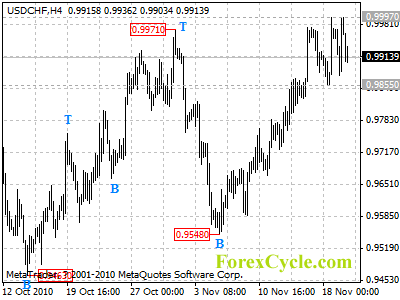
After touching 0.9971 resistance, USDCHF traded in a narrow range between 0.9855 and 0.9997. Key support is at 0.9855, a breakdown below this level will indicate that a cycle top has been formed at 0.9997 level on 4-hour chart, then another fall towards 0.9463 previous low could be seen. On the other side, above 0.9997 will indicate that the pair remains in uptrend from 0.9548, then next target would be at 1.0100 area.