Gold and Silver Expecting Cyclical Retracement?

By Greg Holden – We’ve been watching the price of precious metals soar over the past several months and many analysts will tell you to expect a continuation of this trend. We must not forget that global economies are still suffering financial concerns and that normalcy remains elusive to the current state of the world economy. In such an environment, safe haven investments – like Gold and Silver – tend to rise.

But to short-term, intraday traders there is yet another side to this story. While it is true that Gold and Silver are on the rise, and will likely remain so for some time, it is also true that every trading instrument moves in cyclical patterns.

Gold and Silver each possess a number of technical indicators which point to a buildup of bearish pressure. This is clearest on the Gold weekly chart (see below). A pattern has emerged on the price of Gold which is worth exploring in greater detail.

Stay tuned this week for a deeper look into the cyclical pattern of Gold which has developed over the past year-and-a-half, as well as its implications for other precious metals, such as Silver.

Gold – Weekly Chart

Forex Market Analysis provided by ForexYard.

© 2006 by FxYard Ltd

Disclaimer: Trading Foreign Exchange carries a high level of risk and may not be suitable for all investors. There is a possibility that you could sustain a loss of all of your investment and therefore you should not invest money that you cannot afford to lose. You should be aware of all the risks associated with Foreign Exchange trading.

Irish Debt Woes Continue to Weigh on the EUR

Source: ForexYard

The euro dropped on concern Ireland’s debt woes will spread to other euro-zone economies such as Portugal and Spain. The possibility of an election in Ireland also pressures the euro as it may hinder the nation’s aid talks with the European Union and the International Monetary Fund.

Economic News

USD – Dollar Rises as Investors Fear Spain, Portugal May soon Follow Ireland

The dollar rose against the euro Monday, continuing the trend during today’s Asian trading as investors turned their focus to other euro-zone nations that are facing debt problem and may require financial aid.

The dollar initially dropped after Ireland formally agreed to request aid from the International Monetary Fund and European Union to the sum of €80 billion to €90 billion ($109 billion to $123 billion), aimed to address the country’s budget deficit and banking system’s problems, reaching near $1.3800. However, after the initial euphoria, concerns regarding other euro-zone nations’ debt issues resurfaced and the EUR/USD pair soon sank below $1.3600. The pair reached a low of $1.3545 overnight and is currently trading around $1.3570.

Gold futures rose modestly Monday but a stronger dollar capped the gains. Gold futures for December delivery gained $5.50, or 0.4%, to settle at $1,357.80 a troy ounce on the Comex division of the New York Mercantile Exchange. Silver futures for December delivery rose 28.2 cents, or 1%, to $27.461 an ounce. The metal gained 7.7% in the previous three sessions.

A busy news day is expected today from the U.S heading towards Thanksgiving weekend; traders should follow the release of the Prelim GDP numbers at 13:30 GMT as well as the FOMC meeting minutes release at 19:00 GMT. Better than expected GDP numbers may help push the EUR/USD pair back towards $1.3500 and Gold towards $1355 an ounce.

EUR – EUR Drops below $1.3600 despite Initial Surge

The euro dropped against the dollar Monday, surrendering all gains made following Ireland’s official request for aid as investors turned to Spain and Portugal as the next possible euro-zone sovereign debt casualties. The Irish government Sunday said it had formally applied for tens of billions of euros in aid from the European Union and the International Monetary Fund.

Political uncertainty, brought on by Ireland’s Green Party’s call for new general elections in January added to the negative pressure on the common currency. The EUR dropped below $1.3600 after nearing $1.3800 earlier on Monday. It also dropped over 150 pips versus the JPY to currently trade around 113.00.

Commodities such as Gold and Silver have been benefiting from the uncertainty surrounding Irish government’s request for financial aid as well as other indebted euro-zone nations as the metals are perceived as an alternative investment with Gold reaching a high of $1367 Monday.

A busy news day is expected from the euro-zone today with the release of the French, German and euro-zone Manufacturing and Services PMI data at 8:00, 8:30 and 9:00 GMT respectively; better than expected numbers may provide a much needed boost for the euro.

JPY – JPY Gains versus EUR, GBP

The USD/JPY continues its recent range trading, staying comfortably between 83.00 and 83.60. The Japanese currency, however, made great gains versus the EUR and the Pound Monday, gaining over 150 pips against both currencies. The yes is perceived as safe haven currency and tends to benefit greatly in times of financial uncertainty as is the current situation in the euro-zone; with the euro dragging other riskier currencies down with it, the yen benefits.

With a bank holiday in japan today, no news is expected from the region. Traders should follow, however, any news release from the euro-zone and the U.S, as well as any new developments regarding the Irish debt crisis as these will likely have great effect on the JPY.

Crude Oil – Crude Declines Below $82 a Barrel

The January delivery contract during today’s early Asian trading dropped to $81.72 a barrel on the New York Mercantile Exchange. Earlier, it advanced as much as 0.4 % to $82.10.

Oil traded near $82 a barrel in New York yesterday after climbing Monday as analyst estimates showed crude inventories dropped for a third week in the U.S., the world’s largest energy consumer. Spot crude declined this morning as the dollar strengthened versus the EUR and is currently trading near $81.50 a barrel.

Despite the decline in inventories Oil prices remain under pressure over speculations that Europe’s debt crisis might spread, debilitating economic growth and thus reducing fuel demand. Traders are advised to follow any development from the region as any negative data will likely push oil prices back towards $80 a barrel.

Technical News

EUR/USD

Some upward movement may be expected for the pair as a bullish cross can be seen on the 4 hour chart’s Slow Stochastic while the RSI for the pair is floating in the oversold territory on the hourly and 2 hour charts. Going long with tight stops may be advised for the day.

GBP/USD

While the pair is range trading at the moment with most indicators floating gin neutral territory, some upward correction may be seen today as a bullish cross is evident on the 4 hour chart’s Slow Stochastic. Going long for the day may be advised.

USD/JPY

The pair is range trading at the moment between 83.10 and 83.60, with most indicators floating in neutral territory, waiting on a clearer direction for the pair may be advised

USD/CHF

While the par is currently range trading, with most indicators in neutral territory, it seems that there is still room for the downward momentum to continue as the daily and weekly RSI are floating in the overbought territory. Going short may be a good option for the day.

The Wild Card

GBP/CHF

The RSI for the pair is floating in the oversold territory on the 2 hour and 4 hour charts. A bullish cross is evident on the 4 hour chart’s Slow Stochastic while a doji candlestick is seen on the chart, indicating a possible reversal in direction. Forex traders may be advised to go long for the day.

Forex Market Analysis provided by ForexYard.

© 2006 by FxYard Ltd

Disclaimer: Trading Foreign Exchange carries a high level of risk and may not be suitable for all investors. There is a possibility that you could sustain a loss of all of your investment and therefore you should not invest money that you cannot afford to lose. You should be aware of all the risks associated with Foreign Exchange trading.

“Real-Forex” market review

**For the traders who entered the transaction suggested for the EUR/CAD, the pair reached the first degree for a “Take Profit”, at 48 pips.

USD/JPY

Daily graph: http://www.real-forex.com/charts-daily/November2010/JPY_DAILY_231110.JPG

USD/JPY daily

About three weeks ago, a serious increasing process started, however, for already 5 sessions, the pair is trying to cross a resistance at 83.60 without success. On larger view of the graph, we can see that zone used as a resistance about a month and a half ago.

Since this resistance is some kind of barrier for the pair, an opportunity to go “Short” might be created. In order to confirm that intuition, a decreasing configuration on 1H graph is required.

Potential trade

1H graph: http://www.real-forex.com/charts-daily/November2010/JPY_1H_231110.JPG

USD/JPY 1H

The required configuration should appear after the breakdown of the support 83.34 on a 1H scaled graph. This is the option chosen by our analysts to launch the transaction:

–        “Limit” order on “Short” position 10 pips below the mentioned support, meaning: 83.24

–        “Stop Loss” order on the last peak occurred which is: 83.56

–        1st  level of “Take Profit” on the following support: 83.14

NZD/USD

Daily graph: http://www.real-forex.com/charts-daily/November2010/NZD_DAILY_231110.JPG

NZD/USD daily

It is important to notice the pair is still uptrend oriented. The bullish envelope template, which is hypothetically supposed to indicate a close reversing trend, is not effective that time, since no one of the potential parameters required to confirm the template is applied: The template too distant from the next resistance and even more to the closest support, there was no technical correction preceding it.

Unless the feeling could be confirmed by a specific template or indicator, entering transaction against the current trend is not recommended at all.  Presently, the pair is getting closer and closer to the support of 0.7645 but not close enough to confirm the template we just spoke about.

 Once the pair will reach that support, three outcomes are possible:

  1. Clear breakdown of the support will indicate the end to the current uptrend and will require a new technical analysis.
  2. Stop on the level: It could be better waiting for a “Parking” of about a session and a half, and then launching a “Long” transaction.
  3. Clear and sharp breach of the support: It could be safer waiting for a small correction and, after the identification of a decreasing configuration on 1H graph, go “Short” along with the new trend.

Have a profitable day!

Real-Forex team logo

Gold Support at $1280 an Ounce

printprofile

The price of gold has been rising steadily for the past several months with what appears to be no end in sight, and has been range-trading widely between $1280 and $1400 these past few weeks. The expectation among many analysts seems to be that gold should continue trading in the $1300s through the month of November.

This flat trading behavior may then start to die out towards December when the steadily rising prices we’ve seen among the precious metals markets continues with full force.

A ray of sunshine for investors, however, is the predictable bouncing behavior we should see in gold prices for the next month or so. I’d expect to see gold bouncing against the $1280 price mark at least one time before continuing a strong uptrend heading into the global holiday shopping season. Entry orders for long positions around that price are to be expected; I would be surprised to see a major breach below that point as a result.

Below is the weekly chart of gold provided by ForexYard. I’ve drawn Fibonacci retracement lines over the chart to illustrate the support and resistance levels relevant.
It’s clear that at the 61.8% retracement level we have a very solid support line which has been tested in the past two months. This line is also on the price of $1280 an ounce which, as mentioned earlier, represents the lower border of our range-trading trend.

Once again when the rising trend has been identified, traders should only be long on gold. Entries and exit strategies should then be identified from the daily and hourly charts.

Gold Weekly Chart
gold 23-11-2010

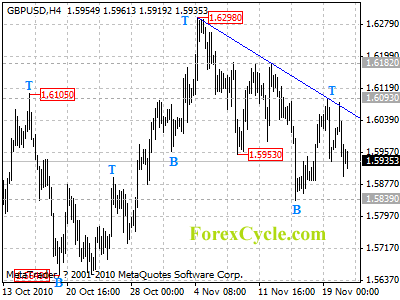
GBPUSD stays below a down trend line

GBPUSD stays below a down trend line from 1.6298 to 1.6182 and remains in downtrend from 1.6298. As long as 1.6093 key resistance holds, downtrend is expected to continue and another fall towards 1.5649 is possible. However, a break above 1.6093 resistance will indicate that the fall from 1.6298 has completed at 1.5839 already, then the following upward move could bring price to 1.6500 area.

gbpusd

Daily Forex Analysis

Robert Prechter Explains The Fed, Part II

The world’s foremost Elliott wave expert goes “behind the scenes” on the Federal Reserve
November 22, 2010

By Elliott Wave International

This is Part II of our three-part series “Robert Prechter Explains The Fed.” You can read Part I here — and come back later this week for Part III.

Money, Credit and the Federal Reserve Banking System
Conquer the Crash, Chapter 10
By Robert Prechter

… Let’s attempt to define what gives the dollar objective value. As we will see in the next section, the dollar is “backed” primarily by government bonds, which are promises to pay dollars. So today, the dollar is a promise backed by a promise to pay an identical promise. What is the nature of each promise? If the Treasury will not give you anything tangible for your dollar, then the dollar is a promise to pay nothing. The Treasury should have no trouble keeping this promise.

In Chapter 9 [of Conquer the Crash], I called the dollar “money.” By the definition given there, it is. I used that definition and explanation because it makes the whole picture comprehensible. But the truth is that since the dollar is backed by debt, it is actually a credit, not money. It is a credit against what the government owes, denoted in dollars and backed by nothing. So although we may use the term “money” in referring to dollars, there is no longer any real money in the U.S. financial system; there is nothing but credit and debt.

As you can see, defining the dollar, and therefore the terms money, credit, inflation and deflation, today is a challenge, to say the least. Despite that challenge, we can still use these terms because people’s minds have conferred meaning and value upon these ethereal concepts.

Understanding this fact, we will now proceed with a discussion of how money and credit expand in today’s financial system.

How the Federal Reserve System Manufactures Money

Over the years, the Federal Reserve Bank has transferred purchasing power from all other dollar holders primarily to the U.S. Treasury by a complex series of machinations. The U.S. Treasury borrows money by selling bonds in the open market. The Fed is said to “buy” the Treasury’s bonds from banks and other financial institutions, but in actuality, it is allowed by law simply to fabricate a new checking account for the seller in exchange for the bonds. It holds the Treasury’s bonds as assets against — as “backing” for — that new money. Now the seller is whole (he was just a middleman), the Fed has the bonds, and the Treasury has the new money.

This transactional train is a long route to a simple alchemy (called “monetizing” the debt) in which the Fed turns government bonds into money. The net result is as if the government had simply fabricated its own checking account, although it pays the Fed a portion of the bonds’ interest for providing the service surreptitiously. To date (1st edition of Prechter’s Conquer the Crash was published in 2002 — Ed.), the Fed has monetized about $600 billion worth of Treasury obligations. This process expands the supply of money.

In 1980, Congress gave the Fed the legal authority to monetize any agency’s debt. In other words, it can exchange the bonds of a government, bank or other institution for a checking account denominated in dollars. This mechanism gives the President, through the Treasury, a mechanism for “bailing out” debt-troubled governments, banks or other institutions that can no longer get financing anywhere else. Such decisions are made for political reasons, and the Fed can go along or refuse, at least as the relationship currently stands. Today, the Fed has about $36 billion worth of foreign debt on its books. The power to grant or refuse such largesse is unprecedented.

Each new Fed account denominated in dollars is new money, but contrary to common inference, it is not new value. The new account has value, but that value comes from a reduction in the value of all other outstanding accounts denominated in dollars. That reduction takes place as the favored institution spends the newly credited dollars, driving up the dollar-denominated demand for goods and thus their prices. All other dollar holders still hold the same number of dollars, but now there are more dollars in circulation, and each one purchases less in the way of goods and services. The old dollars lose value to the extent that the new account gains value.

The net result is a transfer of value to the receiver’s account from those of all other dollar holders. This fact is not readily obvious because the unit of account throughout the financial system does not change even though its value changes.

It is important to understand exactly what the Fed has the power to do in this context: It has legal permission to transfer wealth from dollar savers to certain debtors without the permission of the savers. The effect on the money supply is exactly the same as if the money had been counterfeited and slipped into circulation.

In the old days, governments would inflate the money supply by diluting their coins with base metal or printing notes directly. Now the same old game is much less obvious. On the other hand, there is also far more to it. This section has described the Fed’s secondary role. The Fed’s main occupation is not creating money but facilitating credit. This crucial difference will eventually bring us to why deflation is possible.

[Next: Prechter explains “how the Federal Reserve has encouraged the growth of credit.”]

Come back later this week for Part III of the series “Robert Prechter Explains The Fed.” Or, read more now in the free Club EWI report, Understanding the Federal Reserve System.”

This article was syndicated by Elliott Wave International and was originally published under the headline Robert Prechter Explains The Fed, Part II. EWI is the world’s largest market forecasting firm. Its staff of full-time analysts led by Chartered Market Technician Robert Prechter provides 24-hour-a-day market analysis to institutional and private investors around the world.

Forex: Currency Speculators decrease shorts vs US Dollar. Aussie longs fall for 7th week

By CountingPips.com

The latest Commitments of Traders (COT) report, released on Friday by the Chicago Mercantile Exchange, showed that futures speculators decreased their short bets  against the US dollar against the other major currencies. Non-commercial futures positions, those taken by hedge funds and large speculators, were overall net short the US dollar by $15.52 billion against other major currencies as of November 16th, down from a total short position of $21.85 billion on November 9th, according to data published by Reuters which calculates the dollar positions against the euro, British pound, Japanese yen, Australian dollar, Canadian dollar and the Swiss franc. Speculators have raised their bets for the dollar four out of the last five weeks.

On an individual currency basis, speculators added to their long positions for the British pound sterling, Canadian dollar, Mexican peso and the New Zealand dollar while cutting long positions in the euro, Japanese yen, Swiss franc and the Australian dollar compared to the week before.

EuroFx: Currency specs were net long the euro against the U.S. dollar by 8,606 contracts as of November 16th. This is a decrease of approximately 14,000 contracts following net long positions of 23,283 contracts on November 9th and the fourth straight week of declining euro long positions after touching a high of 48,243 on October 5th.

The COT report is published every Friday by the Chicago Mercantile Exchange (CME) and shows futures positions as of the previous Tuesday. It can be a useful tool for traders to gauge investor sentiment and to look for potential changes in the direction of a currency or commodity. Each currency contract is a quote for that currency directly against the U.S. dollar, where as a net short amount of contracts means that more speculators are betting that currency to fall against the dollar and net long position expect that currency to rise versus the dollar. Open interest is the number of open contracts that have not been closed by a transaction or by delivery.

GBP: The British pound sterling positions rose higher to a net of 23,771 contracts after being long on November 9th by 21,266 positions. The latest data is a third straight week of increasing pound positions.

JPY: The Japanese yen net long contracts declined for a second straight week to 22,858 long contracts as of November 16th from 36,654 net long contracts reported on November 9th.

CAD: The Canadian dollar positions advanced higher for a third straight week to a net total of 38,441 contracts after totaling 37,338 net longs on November 9th.

CHF: Swiss franc long positions decreased after being essentially unchanged for three straight weeks to a total of 7,803 long contracts as of November 16th after totaling a net of 12,615 long contracts on November 9th.

AUD: The Australian dollar positions decreased lower for the seventh straight week after reaching their highest level since April on September 28th. AUD futures contracts declined to a net amount of 36,202 long contracts as of November 16th from 47,616 long contracts on November 9th.

NZD: New Zealand dollar futures positions increased higher for a fourth straight week to their highest level all year at a total of 23,445 long contracts after a total of 22,250 long contracts the week before.

MXN: Mexican peso long contracts increased as of November 16th to 93,217 net long positions from 88,746 longs the week prior. The latest data marks three straight weeks of increases for the Mexican peso speculative positions.

COT Data Summary as of November 16th, 2010
Large Speculators Net Positions vs. the US Dollar

Euro: +8,606 contracts from +23,283 contracts
British pound sterling: +23,771 contracts from +21,266 contracts
Australian dollar: +36,202 contracts from +47,616 contracts
Canadian dollar: +38,441 contracts from +37,338 contracts
Japanese yen: +22,858 contracts from +36,654 contracts
Mexican peso: +93217 contracts from +88,746 contracts
New Zealand dollar: +23445 contracts from +22,250 contracts
Swiss franc: +7803 contracts from +12,615 contracts

Go to the Commitment of Traders CME raw futures data

Further COT Resources from around the web:

Gold & Silver Play Exhausted? Dollar testing breakout level in Forex Trading

By Chris Vermeulen, TheGoldAndOilGuy.com

The past few months it seems the gold and silver play has been getting a little crowed with everyone wanting to own gold. While I am a firm believer that these precious metals are a great hedge/investment long term, I can’t help but notice the price action and volume for both metals which looks to me like they are getting exhausted.

Silver – Daily Chart
The silver chart below shows an extremely high volume reversal candle in early November which typically leads to lower prices and some times a major change in the trend. That being said silver remains in an uptrend with the possibility of a bullish pennant forming. On the other hand there is a possible head and shoulders pattern forming. I will be looking for light volume sideways chop keeping a close eye for a possible neckline breakdown or a momentum thrust to the upside for a possible trade.

Gold – Daily Chart
Gold is forming a bullish and bearish pattern also giving us a mixed signal. I am currently neutral on gold and not really looking to take part until we get some type of clear price action.

US Dollar – 60 Minute Chart
The dollar has shown some strength recently. The US dollar play has been to take the short side, and a couple weeks ago we saw the dollar breakdown from yet another consolidation. It seems like everyone shorted the dollar yet again. That could have been a key pivot low for the dollar. On the weekly chart that bounce was off a major support trend line helping add some fuel to the rally I would think.

The chart below shows the recent rally and breakout to the upside. Currently the dollar is pulling back to test the breakout level (support). It will be interesting to see how this week unfolds. If the dollar bounces then we just may see metals break below their necklines to make another heavy volume drop.

Weekly Precious Metals Update:
In short, I have mixed feelings for gold and silver. Yes I think they are good long term plays, but after the run they have had it is also very possible a much deeper correction is about to take place and we may not see new highs for another year. That is a long time to have money sitting in an investment when it can be put to work in other investments. I know the herd (general public) is all head over heals in love with gold and silver which is one of the reasons why I think we are nearing a top if we didn’t already see it a couple weeks ago.

Don’t get me wrong I’m not saying to sell of go short metals… not yet anyways. They are both still in an up trend but some interesting things are unfolding which could cause big action in the coming weeks.

Join my trading newsletter and get my ETF trading signals, daily analysis and educational material: www.TheGoldAndOilGuy.com

Chris Vermeulen

Ireland Accepts Rescue Aid and Boosts the Euro

By ForexYard – The euro rallied against most of the major currencies on Monday morning. The euro’s most notable bullish move took place against the U.S. dollar, as the euro gained over 100 pips during this morning’s trading session. The EUR/USD pair is now trading near the 1.3740 level.

The euro gained today after Ireland sought an international bailout to prevail its debt crisis. Analysts estimate that the rescue package will total 95 billion euros ($130 billion). It now seems that investors will be looking for the specific details on how creditors will be treated in any burden sharing among bank stakeholders in order to reset their positions.

Looking ahead, traders are advised to follow the speech by European Central Bank Jean-Claude Trichet, which is scheduled for 16:00 GMT. Trichet is likely to discuss the Ireland aid plan, and heavy volatility might be observed during his speech.

Forex Market Analysis provided by ForexYard.

© 2006 by FxYard Ltd

Disclaimer: Trading Foreign Exchange carries a high level of risk and may not be suitable for all investors. There is a possibility that you could sustain a loss of all of your investment and therefore you should not invest money that you cannot afford to lose. You should be aware of all the risks associated with Foreign Exchange trading.

Forex Daily Market Commentary

By GCI Forex Research

Fundamental Outlook at 0800 GMT (EDT + 0400)

USD

Irish Prime Minister Cowen announced on Sunday that Ireland has formally requested financial assistance from the EU/IMF. The euro clearly benefited from the news during the Asia session, and the dollar in particular weakened steadily against both the euro and the AUD. EURUSD traded 1.3695-1.3768 and USDJPY 83.14-83.65. On Friday, the S&P 500 finished +0.7% higher, despite another 50bp hike to China’s reserve requirement ratio. ECB President Trichet said that a strong dollar relative to the other floating currencies is very important. New York Fed Executive Vice President Checki said that recent dollar weakness is a side-effect, rather than a goal of the Fed’s policy. He forecast that as US growth strengthens, the dollar should strengthen accordingly. US Treasury Secretary Geithner implied he would not support any attempt to change the Fed’s dual mandate so that it focuses exclusively on inflation. He said the existing dual mandate has “served the country well over time”. Minneapolis Fed President Kocherlakota, who is due to become an FOMC voter in January, is scheduled to speak later today. Last week, for the first time, Kocherlakota publicly expressed his support for the Fed’s latest round of quantitative easing.
EUR

The euro was boosted by Irish Prime Minister Cowen’s decision to formally request financial assistance from the EU/IMF. Cowen expects negotiations on the terms of the rescue to be concluded over the coming weeks. Finance Minister Lenihan said the whole package would be worth less than EUR100 bn. In a statement, Eurozone finance ministers welcomed the decision, adding that both the UK and Sweden would also consider participating by means of bilateral loans.
German Finance Minister Schaeuble said that he could not give a concrete figure for the cost of a possible Ireland rescue. He sounded optimistic that there would be no contagion from Ireland, but said that a better solution to debt crises must be set up from 2013.
CAD

BoC Governor Carney said the BoC would be prepared to “adjust policy” if the level of the CAD was such that it threatened the bank’s ability to achieve its inflation target. He said the bank has the tools to intervene in the FX market, but would use these only in extreme circumstances.

TECHNICAL OUTLOOK

AUDUSD support at 0.9652
EURUSD BEARISH Pullback from 1.4282 holds above 1.3363; a break here would expose 1.3265. Initial resistance at 1.3777.
USDJPY BULLISH Push through 83.99 would expose 85.93. Initial support at 82.40 ahead of 81.66 reaction low.
GBPUSD NEUTRAL Model is neutral; 1.6379 and 1.5840 mark the key near-term directional triggers.
USDCHF BULLISH Following the break of 0.9977, the pair has room for a run towards 1.0183. Near-term support at 0.9829.
AUDUSD NEUTRAL While support at 0.9652 holds, break of 1.0183 would leave little resistance till 1.1083.
USDCAD BULLISH Sustained break of 1.0380 required to confirm the bull trend. Initial support at 1.0070.
EURCHF BULLISH Recovery through 1.3834 would expose 1.3924 and 1.4041 next. Near-term support comes in at 1.3411 ahead of 1.3229.
EURGBP BEARISH Bearish pressure held at 0.8449 ahead of 0.8390. Initial resistance at 0.8638.
EURJPY BULLISH While support at 111.05 holds, require a break through 115.68 to confirm a bull trend.

Forex Daily Market Commentary provided by GCI Financial Ltd.

GCI Financial Ltd (”GCI”) is a regulated securities and commodities trading firm, specializing in online Foreign Exchange (”Forex”) brokerage. GCI executes billions of dollars per month in foreign exchange transactions alone. In addition to Forex, GCI is a primary market maker in Contracts for Difference (”CFDs”) on shares, indices and futures, and offers one of the fastest growing online CFD trading services. GCI has over 10,000 clients worldwide, including individual traders, institutions, and money managers. GCI provides an advanced, secure, and comprehensive online trading system. Client funds are insured and held in a separate customer account. In addition, GCI Financial Ltd maintains Net Capital in excess of minimum regulatory requirements.

DISCLAIMER: GCI’s Daily Market Commentary is provided for informational purposes only. The information contained in these reports is gathered from reputable news sources and is not intended to be U.S.ed as investment advice. GCI assumes no responsibility or liability from gains or losses incurred by the information herein contained.