Forex Weekly Market Review Jan 11, 10


The first week of the New Year was a positive one for global equity markets as the S&P 500 Index closed up by 2.68%. The FTSE 100 was up 2% and the Nikkei was finished with a 1.25% gain.  The week was filled will economic data, forcing traders to absorb new information regarding the state of the economy.

The week started off on a positive note as the Euro-zone showed a solid European manufacturing PMI reading.  For the euro zone as a whole the 51.6 headline hit a new 21 month high and was slightly better than expected.  Even though, the upside momentum may be slowing, France and Italy’s data beat expectations, while Germany was unchanged and Spain edged a touch lower.  This was followed by a better than expected US ISM number.

The U.S. manufacturing sector finished 2009 on a high note, helped by improving production and ordering activity.  The ISM’s manufacturing purchasing managers’ index rose to 55.9 last month, from 53.6 in November. December’s reading was above the 54.0 forecasted by economists. One must note that readings above 50 indicate expanding activity.

In addition, “The manufacturing sector grew for the fifth consecutive month in December as the PMI rose to 55.9, its highest reading since April 2006 when it registered 56,” said Norbert Ore, who directs the survey for the ISM.  The ISM’s new orders index increased to 65.5 last month, from 60.3 in November, while the production index rose to 61.8 from 59.9. Both indexes suggest orders and output were increasing strongly in December.

Factory employment also showed gradual improvement. The index stood at 52.0 in December, from 50.8 in November. The inventory index stood at 43.4 from 41.3 in November. Steep inventory drawdown’s subtracted from real gross domestic product growth for most of the recession. This restocking should have added strongly to GDP growth in the fourth quarter of 2009.

Housing data grabbed the center of attention on Tuesday.  The National Association of Realtors’ index for pending sales of previously owned homes plunged 16% to 96.0 in November from an upwardly revised 114.3 in October.  The decline is the first in 10 months and is more than triple than expected by analysts. Analysts were expecting pending sales t fall by just 5.0%.

The Realtors are expecting pending home sales to increase as a result of the government’s recent extension of its homebuyer tax credit program. But, “it will be at least early spring before we see notable gains in sales activity,” NAR Chief Economist Lawrence Yun said.  Still, the NAR pending home sales index in November was 15.5% higher than the 83.1 it was a year earlier.

The rest of the week was characterized by minor consolidation as investors prepared for Friday’s result. During the last day of the trading week, the Department of Labor released the US employment figures.  U.S. job losses were higher than expected in December of 2009 and the unemployment rate remained at a lofty 10%, a sign the labor market has still some way to recover.  November 2009 data was revised to show the U.S. economy added jobs for the first time since the recession began two years earlier.  According to the Labor Department, Non-farm payrolls fell by 85,000 last month, compared with a revised 4,000 gain in November.  The expectation by market participants was a payroll decrease of just 10,000. The November figure originally showed an 11,000 drop in payrolls.  The unemployment rate, calculated using a survey of households as opposed to companies, remained at 10% in December, the same level as the previous month. Economists were expecting the jobless rate to increase to 10.1%.

Forex

The pound was on the defensive side all week as traders had a lot of economic information to absorb. UK data was mixed as the PMI service sector data came out as expected at 56.8 in December. Nationwide consumer confidence fell to 69 in December from 74 in November vs. 72 expected.  The Bank of England’s Monetary Policy Committee kept its bond-purchase plan at £200 billion ($320.44 billion) and interest rates on hold at 0.5%. The decision to keep rates unchanged was widely expected.  Economists polled believed there would be no immediate change in bond purchases or in the key interest rate, which was left at a record low for the 11th straight month. So far, the BOE has made asset purchases worth £193 billion.  From a technical point of view The GBP/USD moved through the 200 day moving average at $1.61, a level which could act as resistance.

The possibility of an RBA rate hike may come back into the picture after the economy showed a stronger than expected retail sales figure and a narrower than expected trade deficit.  Retail sales rose at the fastest pace in 8 months or 1.4% m/m vs. 0.3% expected, while the trade deficit narrowed to AUD1.7 billion vs. AUD1.8 billion expected. These figures generated talks that the deficit may begin to narrow as global growth boosts exports. The data followed Tuesday’s stronger than expected building approvals and suggests that the rising borrowing costs and withdrawal of the government stimulus has not yet dampened the consumer or the housing market.   AUD/USD strength moved back into the market as the AUD/USD crossed back above 92 cents. From a technical point of view this pair is now trading above trend line support, but below major resistance

The Week Ahead

Next week the market participants will be watching the Japanese Trade Balance and Current account on Monday, followed by Australia Investment Lending and US Trade Balance on Tuesday.   On Thursday Australian Employment Change leads off.  Consensus is for a gain of 32 thousand jobs for December.  This will be followed by the ECB interest rate decision, and US Retail Sales. To date, many are expecting a no change scenario from the ECB despite the recent improvement in the Euro-zone’s situation. The week will finish with the EMU Consumer Prices, US Industrial Production and Capacity Utilization, and US Consumer Confidence.

Daily Forex Market Analysis provided by eToro

Disclaimer: Trading in the Foreign Exchange market might carry potential rewards, but also potential risks. You must be aware of the risks and are willing to accept them in order to trade in the foreign exchange market. Don’t trade with money you can’t afford to lose.

© 2009 eToro Blog.

GBP/USD May See Downward Correction

printprofile

On the technical charts, the GBPUSD is one of the first pairs to begin showing signs of a correction to last Friday’s sharp upward movement. The chart below is the hourly chart by ForexYard. The indicators used are the Relative Strength Index (RSI) and MACD/OsMA. The Fibonacci Retracement lines were also drawn to indicate significant support/resistance levels.

– Point 1: The pair has recently touched the significant 76.4% resistance level on the Fibonacci and hurriedly bounced off into a downward posture.

– Point 2: The RSI shows this pair currently floating just inside the over-bought territory, signaling downward pressure.

– Point 3: The MACD/OsMA shows a fresh bearish cross which may indicate an impending bearish movement.

– Note: the pair remains inside a bullish channel and has not yet breached. There is a possibility that the downward correction will still maintain this trend.

In this case, it would be wise to place tight Stops and Limits on the pair, but be ready to remove your Limit if this pair’s price drops outside of its uptrend as this may signal a much stronger downward movement.

GBPUSD Hourly

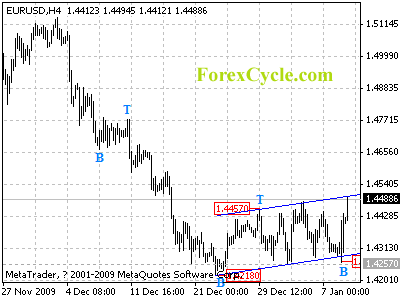
EURUSD formed a cycle bottom at 1.4266

EURUSD has formed a short term cycle bottom at 1.4266 level on 4-hour chart. Bounce to 1.4500 area to reach next cycle top is expected in a couple of days. The price action from 1.4218 is treated as consolidation of downtrend from 1.5144 (Nov 25, 2009 high), another fall is still possible after consolidation and a breakdown below 1.4257 key support will signal resumption of downtrend.

Daily Forex Forecast

USDCHF formed a a cycle top

USDCHF formed a a cycle top at 1.0507 level on daily chart and the subsequent pullback is treated as consolidation of uptrend from 0.9917. Rang trading between 1.0100 and 1.0507 is expected in a couple of weeks. Another rise towards 1.0700 is still possible after consolidation. Key resistance is now located at 1.0507, a break above this level will indicate that a cycle bottom has been formed on daily chart and uptrend from 0.9917 has resumed.

For long term analysis, USDCHF has formed a cycle bottom at 0.9917 level on weekly chart. Bounce towards 1.0700 to reach next cycle top is expected.

Weekly Forex Analysis

Fundamental Outlook at 1500 GMT (EDT + 0500)

By GCI Fx Research

The euro appreciated vis-à-vis the U.S. dollar today as the single currency tested offers around the US$ 1.4440 level and was supported around the $1.4265 level.  Euro bulls were emboldened by weaker-than-expected U.S. December non-farms payrolls data that saw December non-farm payrolls decline 85,000, compared with a revised 4,000 gain for November – the first gain in several months.  In contrast, October’s tally was downwardly revised and the December unemployment rate remained unchanged at 10.0%.  Manufacturing payrolls improved to -27,000 from a revised -35,000 and December average weekly hours were unchanged at 33.2.  Moreover, December hourly earnings were up 0.2% m/m and 2.2% y/y.  These data were definitely a setback for dollar bulls who thought the tide had turned in the exasperated U.S. labour market.  Economists are now wondering if the Obama administration will now steer fiscal stimulus towards projects that actually create jobs.  Additionally, today’s number could delay some rate hikes from the Federal Reserve.  Fed funds futures had been discounting higher rates by the March Federal Open Market Committee meeting but that now seems implausible. The Fed may be forced to delay its eventual rate hikes to later in the year.  Other data released today saw November wholesale inventories up 1.5% from a revised 0.6% in October and November consumer credit widened to a record –US$ 17.5 billion from a revised prior reading of –US$ 4.2 billion.  Richmond Fed President Lacker spoke and said the economy “may face an increasing risk of inflation edging upward.”  In eurozone news, EMU-16 November unemployment reached 10%, its highest level in eleven years.  French Prime Minister Fillon reported the Group of Twenty should focus on currency imbalances when they next convene.  Other data saw German industrial production rise 0.7% m/m and decline 8% y/y.  Additionally, EMU-16 gross domestic product growth was up 0.4% q/q and off 4% y/y in Q3 while the  German November trade surplus increased to €17.4 billion from €13.4 billion.  Euro bids are cited around the US$ 1.3885 level.

¥/ CNY

The yen appreciated vis-à-vis the U.S. dollar today as the greenback tested bids around the ¥92.25 level and was capped around the ¥93.75 level.  New finance minister Kan clarified his remarks from the day before, indicating it is his responsibility to respond to moves in the currency market but added the markets should determine rates.  On Thursday, Kan indicated the yen should be weaker whereas his predecessor, Fujii, green-lighted a stronger yen when he first took office last year.  Chief Cabinet Secretary Hirano said the government should not make any comments that could impact the markets.  Prime Minister Hatoyama said rapid exchange rate moves are “not good” and “unwelcome.” Most traders believe the Japanese government will probably try to orchestrate a weaker yen to help counter deflationary pressures and stimulate foreign trade.  Data released overnight saw foreign reserves decline to US$ 1.049 trillion at the end of December while the November leading indicator was up +1.8.  Also, the December trade surplus printed at ¥129.355 billion during the first twenty days of December.  The Nikkei 225 stock index climbed 1.09% to close at ¥10,798.32.   U.S. dollar offers are cited around the ¥94.75 level.  The euro moved lower vis-à-vis the yen as the single currency tested bids around the ¥132.45 level and was capped around the ¥134.10 level.  The British pound moved lower vis-à-vis the yen as sterling tested bids around the ¥148.05 level while the Swiss franc moved higher vis-à-vis the yen and tested offers around the ¥90.60 level. In Chinese news, the U.S. dollar appreciated vis-à-vis the Chinese yuan as the greenback closed at CNY 6.8276 in the over-the-counter market, up from CNY 6.8275.  Yesterday, People’s Bank of China guided interest rate expectations higher by selling three-month bills at higher rates for the first time in nineteen weeks.  This evidences the central bank’s attempt to tighten liquidity.   PBoC-watchers believe the central bank may lift interest rates for the first time in three years by September.  This week, People’s Bank of China yesterday reported it will support “relatively fast” economic growth and manage inflation expectations.  Additionally, PBoC noted it will target “moderate” loan growth in 2010.

The British pound appreciated vis-à-vis the U.S. dollar today as cable tested offers around the US$ 1.6110 level and was supported around the $1.5915 level. Data released in the U.K. today saw December producer price inflation up 0.5% m/m and 3.5% y/y at the output level while input was up 0.1% m/m and 6.9% y/y. Yesterday, Bank of England kept its main Bank rate unchanged at 0.5% and kept its bond purchase program unchanged at ₤200 billion, also as expected.  Policymakers have made it clear they will modify the asset purchase program as required. There are two major focuses for traders now. First, there is increasing speculation the central bank will not lift interest rates in 2010.  Second, there is a worsening political environment for Prime Minister Brown, including decreasing confidence among some in the Labour party.  Cable bids are cited around the US$ 1.5730 level. The euro gained ground vis-à-vis the British pound as the single currency tested offers around the ₤0.9005 level and was supported around the ₤0.8920 level.

CHF

The Swiss franc appreciated vis-à-vis the U.S. dollar today as the greenback tested bids around the CHF 1.0215 level and was capped around the CHF 1.0385 level.  Data released in Switzerland today saw the December unemployment rate increase to 4.4% from 4.2% in November.  Swiss National Bank is expected to keep interest rates unchanged for at least the next couple of months.  U.S. dollar offers are cited around the CHF 1.0615 level.  The euro came off vis-à-vis the Swiss franc as the single currency tested bids around the CHF 1.4740 level while the British pound moved lower vis-à-vis the Swiss franc and tested bids around the CHF 1.6370 level.

Daily Market Commentary provided by GCI Financial Ltd.

GCI Financial Ltd (”GCI”) is a regulated securities and commodities trading firm, specializing in online Foreign Exchange (”Forex”) brokerage. GCI executes billions of dollars per month in foreign exchange transactions alone. In addition to Forex, GCI is a primary market maker in Contracts for Difference (”CFDs”) on shares, indices and futures, and offers one of the fastest growing online CFD trading services. GCI has over 10,000 clients worldwide, including individual traders, institutions, and money managers. GCI provides an advanced, secure, and comprehensive online trading system. Client funds are insured and held in a separate customer account. In addition, GCI Financial Ltd maintains Net Capital in excess of minimum regulatory requirements.

DISCLAIMER: GCI’s Daily Market Commentary is provided for informational purposes only. The information contained in these reports is gathered from reputable news sources and is not intended to be U.S.ed as investment advice. GCI assumes no responsibility or liability from gains or losses incurred by the information herein contained.

AUD Gains After Release of Disappointing US Employment Data

By Ashley Smith – The AUD strengthened to 92.31 U.S cents versus the Dollar following the release of the U.S Employment Data. The report showed that The U.S. unexpectedly lost 85,000 jobs in December. The unexpectedly negative result dampened investors’ expectations of near term interest increases in the U.S as the result showed that the U.S economic recovery is still quite shaky. While the AUD lost some of its gains to currently trade at 91.98 cents versus the USD, it is still up for the day. While U.S and European economic recovery remains unsteady, Australia seems to be skating through the recession quite well, and presenting consistently positive economic data despite the increase in interest rate and the pullback in the economic stimulus funds.

Retail sales jumped 1.4% in November as households’ consumption surged. The growth was sustained by the recent surge in employment as the jobless rate fell to 5.7% in November from 5.8% in October. Consumer spending, which accounts for more than half of the Australian economy is strengthening despite the 3 consecutive interest rate increases by the central bank. This consistent growth in consumer spending is boosting speculations for further interest rate increases, lending support for the AUD against the USD as well as other higher yielding currencies such as the EUR and GBP whose economic recovery is less consistent.

Forex Market Analysis provided by Forex Yard.

© 2006 by FxYard Ltd

Disclaimer: Trading Foreign Exchange carries a high level of risk and may not be suitable for all investors. There is a possibility that you could sustain a loss of all of your investment and therefore you should not invest money that you cannot afford to lose. You should be aware of all the risks associated with Foreign Exchange trading.

USD/JPY Dips on Kan Remarks and Negative U.S. Jobs Data

By Fast Brokers – The USD/JPY was negated by our 3rd tier downtrend line and is sinking during the U.S. trading session as investors react to a weaker than expected U.S. Employment Change figure.  The pullback in employment data appears to be delivering a blow to the FX market as we witness Dollar weakness across the board.  Investors should keep in mind that the Dollar’s December rally was triggered by a turnaround in U.S. employment.  Hence, it’s understandable that investors are selling the Greenback in reaction to today’s data release.  In addition to the discouraging U.S. jobs data, Yen investors are also reacting to remarks from Finance Minister Kan.  Recall that yesterday’s pop in the USD/JPY was instigated by Kan stating that he may favor a weaker Yen to support Japan’s struggling manufacturing sector.  However, Kan revised his comments today and explained that currencies should be determined by market forces.  On the other hand, the government may intervene should the Yen reach abnormal levels.  Kan’s retreat is very similar to when Fuji clarified his own aggressive monetary comments after taking office last year.  In all, Kan’s more moderate monetary comment is cooling the USD/JPY’s upward momentum.

Technically speaking, the USD/JPY’s uptrend is still intact and the currency pair is setting higher lows.  Meanwhile, the USD/JPY faces topside technical barriers in the form of our multiple downtrend lines along with 1/07 highs.  Our 3rd tier downtrend line runs through August ’09 levels.  Hence, a clear breakout above this downtrend line could signal a more prolonged uptrend and a potential retest of the highly psychological 100 area over the medium-term.  As for the downside, the USD/JPY has multiple uptrend lines serving as technical cushions along with 1/7, 1/5, and 12/24 lows.  Furthermore, the psychological 90 area could serve as a technical cushion should conditions deteriorate.  Meanwhile, investors should monitor broad-based activity in the Dollar to determine whether today’s U.S. jobs data will have a large impact on the major Dollar pairs as the trading session progresses.

Present Price: 92.47

Resistances: 92.47, 92.63, 92.83, 93.21, 93.44, 93.77

Supports: 92.26, 92.04, 91.88, 91.45, 91.22

Psychological: 95, 90, January and September Highs

(click to enlarge)

Market Commentary provided by Fast Brokers.

Disclaimer: FastBrokers’ market commentary is provided for information purposes only and under no circumstances should be regardedneither as an investment advice nor as a solicitation or an offer to sell/buy any financial product. FastBrokers assumes no responsibility or liability from gains or losses incurred by the information herein contained.

Risk Disclosure: There is a substantial risk of loss in trading futures and foreign exchange. Please carefully review all risk disclosure documents before opening an account as these financial instruments are not appropriate for all investors.

Gold Rises in Reaction to Discouraging Jobs Data

By Fast Brokers – Gold popped off what is now our 3rd tier uptrend line after U.S. Employment Change data printed weaker than analyst estimates.  The pullback in employment data yielded knee-jerk selloff in the Dollar, a positive catalyst for gold since it is negatively correlated with the Greenback.  However, upward momentum in the EUR/USD and GBP/USD is tempering at the moment, so investors should monitor whether the Dollar continues its downward trajectory as the trading session progresses.  We wouldn’t be surprised to see the Dollar to add onto intraday losses considering the level of anticipation heading into today’s release.  Investors should keep in mind that the Dollar’s December rally was triggered by a turnaround in U.S. employment data.  Hence, today’s dip in employment has understandably resulted in Dollar weakness.  Meanwhile, gold is staring down previous January highs with the psychological $1150/oz level hanging nearby.

Technically speaking, gold has multiple uptrend lines serving as technical cushions along with intraday, 1/05, 12/30, and 12/22 lows.  On an encouraging note, gold continues to set consecutive higher lows after bottoming out in December, and we are currently unable to form a noteworthy downtrend line.  Therefore, gold could have some decent upward mobility should the Dollar weaken further.  As for the topside, gold faces technical barriers in the form of 12/17 and 11/18 highs along with the psychological $1150/oz level.

Present Price: $1137.13/oz

Resistances: $1138.89/oz, $1141.33/oz, $1144.84/oz, $1148.91/oz, $1153.17/oz, $1159.25/oz

Supports: $1133.56/oz, $1131.08/oz, $1128.24/oz, $1124.16/oz, $1119.47/oz, $1115.08/oz

Psychological: $1100/oz, $1150/oz, December highs and January lows

(click to enlarge)

Market Commentary provided by Fast Brokers.

Disclaimer: FastBrokers’ market commentary is provided for information purposes only and under no circumstances should be regardedneither as an investment advice nor as a solicitation or an offer to sell/buy any financial product. FastBrokers assumes no responsibility or liability from gains or losses incurred by the information herein contained.

Risk Disclosure: There is a substantial risk of loss in trading futures and foreign exchange. Please carefully review all risk disclosure documents before opening an account as these financial instruments are not appropriate for all investors.

GBP/USD Pops in Reaction to Weak U.S. Jobs Data

By Fast Brokers – The Cable is rallying in reaction to a weaker than expected Employment Change figure.  The Cable’s response is understandable considering the Dollar’s December rally was driven by a turnaround in employment data.  It will be interesting to see if the Cable can extend its intraday gains due to the level of anticipation prior to today’s data release.  We’re witnessing Dollar weakness across the board at the moment while the Pound exhibits a relative strength, as highlighted by a dip in the EUR/GBP.  The Pound is deriving its strength from a better than expected PPI figure in conjunction with yesterday’s encouraging Halifax HPI reading.  Hence, data from the UK has outperformed the EU during the first trading week of 2010.  Meanwhile, stability in prices gives the BoE a little breathing room come February’s monetary policy meeting in regards to maintaining a tighter monetary stance.  For the time being it will be interesting to see whether the Cable can piece together enough upward momentum to overtake the remainder of our downtrend lines.

Technically speaking, the psychological 1.60 level is serving as technical once again along with our multiple uptrend lines and 1/07 lows.  As for the topside, the Cable still faces multiple downtrend lines along with January highs.  Our 4th tier downtrend line could serve as a key technical barrier since it runs through 12/16 highs.  Meanwhile, our 1st tier uptrend line separates the Cable from a retest of December lows.

Present Price: 1.6072

Resistances: 1.6085, 1.6107, 1.6152, 1.6181, 1.6219, 1.6246

Supports: 1.6050, 1.6023, 1.5995, 1.5973, 1.5925, 1.5901

Psychological: 1.60, January highs and lows, December lows, September lows

(click to enlarge)

Market Commentary provided by Fast Brokers.

Disclaimer: FastBrokers’ market commentary is provided for information purposes only and under no circumstances should be regardedneither as an investment advice nor as a solicitation or an offer to sell/buy any financial product. FastBrokers assumes no responsibility or liability from gains or losses incurred by the information herein contained.

Risk Disclosure: There is a substantial risk of loss in trading futures and foreign exchange. Please carefully review all risk disclosure documents before opening an account as these financial instruments are not appropriate for all investors.

EUR/USD Strengthens Following Weak Employment Change Number

By Fast Brokers – The EUR/USD is strengthening in reaction to a weaker than expected Employment Change figure.  Since the Dollar rallied after the turnaround in employment data in December, it seems reasonable that the Greenback is falling across the board in reaction to today’s release.  Additionally, it will be interesting to see the EUR/USD log further gains today considering the level of anticipation heading into today’s data set.  On a positive note, the headline Unemployment Rate did remain at 10% and analysts were expecting a basis point increase to 10.1%.  As for the EU, the Union’s headline Unemployment Rate also printed at 10%, a basis point higher than analyst expectations.  Furthermore, German Industrial Production came in 4 basis points below analyst expectations.  Hence, EU economic data has started 2010 off on a sour note, and today’s data set has yielded a relative weakness in the Euro as exemplified by a dip in the EUR/GBP.  Regardless, the Dollar could remain under selling pressure across the board due to today’s negative development in regards to U.S. employment.

Technically speaking, the EUR/USD still faces multiple downtrend lines along with the psychological 1.45 level, 1/05, 12/23, and 12/18 highs.  Hence, some challenging near-term topside technicals are in place due to the EUR/USD’s downturn in December.  As for the downside, the EUR/USD has technical cushions in the form of our 1st and 2nd tier uptrend lines along with intraday and 1/04 and 12/22 lows.  The EUR/USD is still trading well below our 3rd tier uptrend line that runs through July lows.  However, it will be interesting to see whether today’s disappointing U.S. jobs data provides enough of a topside boost to get the EUR/USD back above our 3rd tier uptrend line.  On an encouraging note, the EUR/USD is setting higher lows, creating the possibility for a new base.

Present Price: 1.4333

Resistances: 1.4364, 1.4400, 1.4418, 1.4439, 1.4458, 1.4489

Supports: 1.4321, 1.4300, 1.4267, 1.4235, 1.4216

Psychological: 1.45, 1.40, December and September Lows

(click to enlarge)

Market Commentary provided by Fast Brokers.

Disclaimer: FastBrokers’ market commentary is provided for information purposes only and under no circumstances should be regardedneither as an investment advice nor as a solicitation or an offer to sell/buy any financial product. FastBrokers assumes no responsibility or liability from gains or losses incurred by the information herein contained.

Risk Disclosure: There is a substantial risk of loss in trading futures and foreign exchange. Please carefully review all risk disclosure documents before opening an account as these financial instruments are not appropriate for all investors.