USD Declines on Renewed Confidence regarding the Global Economic Recovery

Source: ForexYard

The U.S Dollar declined against major counterparts Monday as risk appetite returned on renewed confidence about an impending global economic recovery. The renewed optimism fueled demand for the EUR as well as currencies from commodities-rich countries such as the AUD and NZD.

Economic News

USD – USD Declines on Rise in Optimism

The Dollar was lower Monday, falling to the lowest level in 3 weeks against the EUR on speculations the U.S economic recovery will lag behind the rest of the world. Risk appetite increased following a better than expected surge in Chinese trade. The Dollar was further pressured by comments by a Federal Reserve official who stated that interest rates are likely to remain low for “quite some time”.

In today’s early trading the Dollar is at $1.4490 per EUR from $1.4513 in New York yesterday, when it declined to $1.4557, the weakest level since Dec. 16. The USD is at 92.00 Yen from 92.09.

The Dollar’s decline was prompted last Friday after the release of a disappointing Non Farm Payroll report, which showed payrolls dropped by 85,000 in December, as opposed to slight increase anticipated by investors. The disappointing data reduced expectations the Federal Reserve will raise interest rates sooner than expected. While negative mood regarding the U.S economy persists, Stronger than anticipated exports from China in December, fueled a rally in the EUR and other higher yielding currencies as optimism regarding the global economic recovery improved.

A slow news day is expected today from the U.S; however, the Trade Balance which I expected to be released at 13:30 GMT is likely to provide some volatility for the Dollar, possibly intensifying the current negative sentiment.

EUR – EUR Rises as Demand for Riskier Currencies Grows

The EUR extended Friday’s gains versus the Dollar following the release of Friday’s unexpected drop in U.S. Non Farm Employment data for December. Monday in New York, the EUR was at $1.4524 from $1.4414 late Friday and at Y133.78 from Y133.48. The U.K. Pound was at $1.6112 from $1.6034

The Dollar’s decline versus the EUR intensified Monday on speculation investors will increase carry trades with the greenback as the funding currency. Carry trades are trades in which investors sell a certain currency with a relatively low interest rate and use the funds to purchase a different currency yielding a higher interest rate. The U.S. benchmark rate of zero to 0.25% and the Dollar has become a popular choice for a funding currency along with the JPY. With the recent negative U.S economic data dampening expectations of imminent interest increases and an increase in risk appetite, demand for growth sensitive currencies such as the EUR and Australian and New Zealand Dollars is fueled at the expense of the U.S Dollar.

With no news expected from the Euro-Zone today, the EUR’s movements will likely be determined by movements in equities as well as news from the U.S. the release of the U.K Trade Balance at 9:30 GMT is likely provide some direction to the Pound, possibly pushing it higher versus the Dollar as it is expected to show improvement.

JPY – The Yen is higher against Major Counterparts

The Japanese Yen advanced higher against major currency counterparts in today’s early trading. The JPY is currently trading around 133.48 against the EUR and at 92.10 against the Dollar. It also advanced against the Pound to currently trade around 148.20. However, the outlook may not look so bright for the Yen as Japan’s new finance minister, Naoko Kan, stated shortly after taking over the position this week that he is in favor of a continued weakening of the Yen versus the U.S Dollar. With no news expected from Japan today, the Yen’s movements will likely be determined by data released from the U.S and Euro-Zone.

OIL – Crude Prices Decline on Prospects of Warmer Weather

Oil Prices declined Monday as forecasts that the recent streak of freezing temperatures in the U.S is soon ending. Light, sweet crude for February delivery settled 23 cents, or 0.3%, lower at $82.52 a barrel on the New York Mercantile Exchange, after touching an intraday high of $83.95 a barrel.
The frigid weather across the U.S, Europe and parts of Asia has been a key factor behind Oil’s rally to 15-month highs as a boost in heating oil demand boosted prices. However, after weeks of freezing temperatures, a January thaw is on the way for U.S. Northeast and Midwest as well as international regions; a return to normal temperatures is expected later this week in Shanghai and Beijing. These places represent the heaviest energy consumers. With milder weather outlook it seems that Oil looses its support as demand concerns resurface.

Technical News

EUR/USD

The recent bullish trend is losing its steam and the pair seems to be consolidating around the 1.4490 level. The 4 chart’s RSI is already floating in the over-bought territory suggesting that the upward trend may see a bearish correction soon. When the downwards breach occurs, going short with tight stops appears to be the preferable strategy.

GBP/USD

The hourly chart is showing mixed signals with its RSI fluctuating in neutral territory. However, the daily chart’s RSI is sitting near the bottom border, suggesting that the possible next move might be a bullish one. When the upwards breach occurs, going long with tight stops appears to be preferable strategy.

USD/JPY

The pair has been range-trading for a while now, with no specific direction. The Daily chart’s Slow Stochastic providing us with mixed signals. All oscillators on the 4 hour chart do not provide a clear direction as well. Waiting for a clearer sign on the hourlies might be a good strategy today.

USD/CHF

This pair is in the middle of a very intensive downtrend that started a week ago and shows great momentum that on a bigger scale appears to have more room to run. Currently, all oscillators on the daily chart are pointing down and it seems that going short will be the right choice today.

The Wild Card

Platinum

The Slow Stochastic on the 4 hour chart points towards a current bullish momentum. The daily Slow Stochastic strongly supports this notion. This might be a great opportunity for forex traders to join a very promising bullish trend.

Forex Market Analysis provided by Forex Yard.

© 2006 by FxYard Ltd

Disclaimer: Trading Foreign Exchange carries a high level of risk and may not be suitable for all investors. There is a possibility that you could sustain a loss of all of your investment and therefore you should not invest money that you cannot afford to lose. You should be aware of all the risks associated with Foreign Exchange trading.

Scandinavian Kroner Set for Downward Correction vs. EUR?

printprofile

The Norwegian Krone has continued its bull run against the Euro. Hitting fresh multi-week highs against the 16-nation currency, the NOK currently trades near 8.1550 versus the EUR. While the US Dollar made hefty gains versus the NOK in recent weeks, it appears that the Krone is back on its way to erasing those gains as of this week.

The NOK climbed as high as 5.5383 against the greenback before dropping as a result of the Dollar’s year-end run. As of this morning, the USD/NOK is reaching back towards 5.6200 with few signs of a correction impending.

Sweden’s currency, on the other hand, doesn’t seem to be fairing as well as its Norwegian neighbor. The Swedish Krona experienced similar losses against the greenback during its bullish run in December, but its ability to regain those losses appears muted.

It had reached as high as 6.7833 before plummeting against the buck, but has regained less than half of the price which it lost. However, the SEK was able to regain all of its losses made to the EUR at year-end, which seems to suggest that the SEK’s inability to regain losses made against the Dollar may be due more to the American economy than Sweden’s.

Price targets for the Swedish and Norwegian Kroner against the USD seem somewhat straight forward. Both appear to be on a bullish run against the greenback and may continue doing so for the coming week. A target of 100-150 pips from current price levels could be a safe bet. Against the EUR, on the other hand, both appear to be giving off hints of a downward correction and traders should anticipate this movement before going long on the Kroner against its European counterpart.

Technical Analysis

– As mentioned above, the SEK and NOK are giving off hints of a downward correction versus the EUR. This technical analysis will highlight those indications for the EUR/NOK pair.

– The chart below is the EUR/NOK daily chart by ForexYard.

– Point 1: A doji candlestick formation has apparently taken place yesterday, indicating a reversal may be imminent.

– Point 2: The Relative Strength Index (RSI) is showing that this pair is heavily over-sold and may be experiencing strong upward pressure.

– Point 3: There is a fresh bullish cross on the Stochastic (slow) which highlights the impending bullish move. The Stochastic also appears to have turned upwards, meaning this movement may in fact be underway.

EURNOK Daily

USDJPY broke below rising trend line

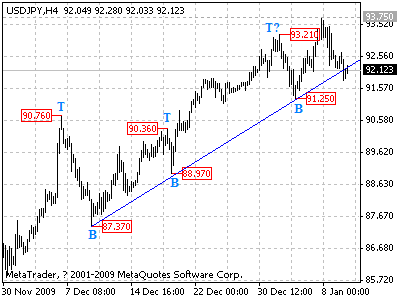
USDJPY broke below the rising trend line from 87.37 to 91.25. Deeper decline is expected to test 91.25 key support. A breakdown below this level could indicate that the uptrend from 98.37 has completed at 93.75 already, then further fall to 90.00-90.50 area could be seen. As long as 91.25 support holds, the price action from 93.21 is treated as consolidation of uptrend from 87.37, one more rise towards 95.00 is still possible.

Daily Forex Forecast

Fundamental Outlook at 1500 GMT (EDT + 0500)

By GCI Fx Research

The euro appreciated sharply vis-à-vis the U.S. dollar today as the single currency tested offers around the US$ 1.4555 level and was supported around the $1.4405 level.  The common currency was propelled higher on stronger-than-expected Chinese exports and imports data that helped support the view the global economy is continuing to recover.  The U.S. dollar fell on these news under the premise that the global economy will become less dependent on the U.S. economy, including the U.S. dollar’s net import balance.  Additionally, the common currency moved higher on dovish remarks from St. Louis Fed President Bullard who noted U.S. interest rates “may remain low for quite some time.”  Atlanta Fed President Lockhart speaks later in the North American session.  Friday’s weaker-than-expected and disappointing U.S. December non-farm payrolls data dented the view that the Fed may raise interest rates by the middle of the year.  European Central Bank President Trichet called on global governments to reduce excessive budget deficits to satisfy investors.  Trichet noted he sees a “progressive normalization of the economy” but called on market participants to “strengthen risk management significantly.”  ECB member Nowotny said new risk-taking by some market participants is a concern for central bankers and regulators and that risk-taking needs to be limited by increases in capital requirements.  Nowotny also confirmed there will be “sluggish” economic growth in the eurozone this year.  Data released in the eurozone today saw French November industrial output climb +1.1% and October’s print was upwardly revised.  In U.S. news, Bullard also noted the U.S. should maintain its purchases of mortgage-backed securities to provide liquidity to the markets, and stressed quantitative easing programs administered by the Fed have supported the market.  Data to be released in the U.S. tomorrow include November trade balance figures with estimates running around –US$ 34.5 billion.  Euro bids are cited around the US$ 1.3885 level.

¥/ CNY

The yen appreciated vis-à-vis the U.S. dollar today as the greenback tested bids around the ¥91.80 level and was capped around the ¥92.65 level.  Bank of Japan official Shinobu Nakagawa reported it is “possible” that official Japanese interest rates will remain near zero per cent until 2011 on account of the poor economic outlook.  Nakagawa also reported the appreciating yen helps to support demand for Japanese government bonds.  There is increasing speculation BoJ could increase its bond purchase activity to avert a relapse into another recession.  Currently, the central bank purchases around ¥1.8 trillion in Japanese government bonds every month and it may decide to up its purchases to counter intense deflationary pressures.  A new announcement could be made as early as H1 2010.  An anonymous Ministry of Finance official reported finance minister Kan and U.S. Treasury Secretary Geithner agree on exchange rate policy.   New finance minister Kan last week said it is his responsibility to respond to moves in the currency market but added the markets should determine rates.  Last Thursday, Kan indicated the yen should be weaker whereas his predecessor, Fujii, green-lighted a stronger yen when he first took office last year.  Chief Cabinet Secretary Hirano said the government should not make any comments that could impact the markets.  Prime Minister Hatoyama last week said rapid exchange rate moves are “not good” and “unwelcome.” Most traders believe the Japanese government will probably try to orchestrate a weaker yen to help counter deflationary pressures and stimulate foreign trade.  The Nikkei 225 stock index climbed 1.09% to close at ¥10,798.32.   U.S. dollar offers are cited around the ¥94.75 level.  The euro moved higher vis-à-vis the yen as the single currency tested offers around the ¥134.35 level and was supported around the ¥133.40 level.  The British pound moved higher vis-à-vis the yen as sterling tested offers around the ¥149.60 level while the Swiss franc moved higher vis-à-vis the yen and tested offers around the ¥91.05 level. In Chinese news, the U.S. dollar depreciated vis-à-vis the Chinese yuan as the greenback closed at CNY 6.8263 in the over-the-counter market, down from CNY 6.8276.   Last week, People’s Bank of China guided interest rate expectations higher by selling three-month bills at higher rates for the first time in nineteen weeks.  This evidences the central bank’s attempt to tighten liquidity.   PBoC-watchers believe the central bank may lift interest rates for the first time in three years by September.  There is increasing speculation that China’s economy could slow dramatically this year.  Last week, People’s Bank of China yesterday reported it will support “relatively fast” economic growth and manage inflation expectations.  Additionally, PBoC noted it will target “moderate” loan growth in 2010.  Data released in China overnight saw December exports climb 17.7% y/y, the latest evidence that China remains the key driver of global economic growth.  These data also mean that China has overtaken Germany as the world’s largest exporter.

The British pound appreciated sharply vis-à-vis the U.S. dollar today as cable tested offers around the US$ 1.6190 level and was supported around the $1.6045 level.  Former Bank of England Monetary Policy Committee member Buiter reported the central bank may start to raise interest rates by the middle of the year, possibly taking the Bank Rate to 0.75% to 1.00%.  Buiter suggested the BoE’s rate hike could come before the European Central Bank contemplates one.  The big news in the U.K. remains the general election that is scheduled to be called before June.  Prime Minister Brown is attempting to rally the Labour Party following widespread discontent from within his own ranks.  Tory opposition leader Cameron is pledging earlier and deeper deficit reductions.  CBI today reported the U.K. services sector evidenced its second consecutive increase in activity in the fourth quarter but projects business activity should slow in the coming months.  Cable bids are cited around the US$ 1.5730 level. The euro gained ground vis-à-vis the British pound as the single currency tested offers around the ₤0.9025 level and was supported around the ₤0.8970 level.

CHF

The Swiss franc appreciated vis-à-vis the U.S. dollar today as the greenback tested bids around the CHF 1.0130 level and was capped around the CHF 1.0240 level.  Data released in Switzerland today saw November real retail sales up 0.6%.  Swiss National Bank is expected to keep interest rates unchanged for at least the next couple of months.  U.S. dollar offers are cited around the CHF 1.0615 level.  The euro came off vis-à-vis the Swiss franc as the single currency tested bids around the CHF 1.4720 level while the British pound moved lower vis-à-vis the Swiss franc and tested bids around the CHF 1.6315 level.

Daily Market Commentary provided by GCI Financial Ltd.

GCI Financial Ltd (”GCI”) is a regulated securities and commodities trading firm, specializing in online Foreign Exchange (”Forex”) brokerage. GCI executes billions of dollars per month in foreign exchange transactions alone. In addition to Forex, GCI is a primary market maker in Contracts for Difference (”CFDs”) on shares, indices and futures, and offers one of the fastest growing online CFD trading services. GCI has over 10,000 clients worldwide, including individual traders, institutions, and money managers. GCI provides an advanced, secure, and comprehensive online trading system. Client funds are insured and held in a separate customer account. In addition, GCI Financial Ltd maintains Net Capital in excess of minimum regulatory requirements.

DISCLAIMER: GCI’s Daily Market Commentary is provided for informational purposes only. The information contained in these reports is gathered from reputable news sources and is not intended to be U.S.ed as investment advice. GCI assumes no responsibility or liability from gains or losses incurred by the information herein contained.

Gold Continues Rally on China’s Encouraging Trade Balance

By Fast Brokers – Gold charged past its psychological $1150/oz level today after solid Trade Balance data from China sparked a return to the risk trade.  The FX markets experienced a jolt in activity today with the Dollar selling off across the board, a positive catalyst for gold considering their negative correlation.  Gold has recovered nicely from December 2009 lows and continues to build upon its 2010 momentum.  However, the precious metal appears to be cooling off right now as it tops around $1160/oz, just shy of 12/8 highs.  We notice similar movements in the EUR/USD and GBP/USD, meaning gold’s correlative behavior is back in full swing.  Meanwhile, investors are looking ahead to tomorrow’s U.S. Trade Balance data.  It will be interesting to see what impact this data point has on the FX markets considering the Greenback has rallied recently on positive U.S. data.  Hence, solid U.S. Trade Balance data could place a speed bump in gold’s current uptrend.

Technically speaking, gold has multiple uptrend lines serving as technical cushions along with intraday, 1/8, 12/30, and 12/22 lows.  Meanwhile, gold’s psychological $1150/oz area could serve as a technical cushion.  As for the topside, gold faces technical barriers in the form of 12/7 and 11/18, 11/23, and 11/27 highs along with the psychological $1175/oz level.

Present Price: $1152.65/oz

Resistances: $1156.12/oz, $1160.50/oz, $1165.20/oz, $1168.96/oz, $1173.34/oz, $1178.36/oz

Supports: $1150.48/oz, $1146.72/oz, $1143.90/oz, $1139.51/oz, $1137.01/oz, $1130.43/oz

Psychological: $1175/oz, $1150/oz, December highs and January lows

(click to enlarge)

Market Commentary provided by Fast Brokers.

Disclaimer: FastBrokers’ market commentary is provided for information purposes only and under no circumstances should be regardedneither as an investment advice nor as a solicitation or an offer to sell/buy any financial product. FastBrokers assumes no responsibility or liability from gains or losses incurred by the information herein contained.

Risk Disclosure: There is a substantial risk of loss in trading futures and foreign exchange. Please carefully review all risk disclosure documents before opening an account as these financial instruments are not appropriate for all investors.

USD/JPY Remains Calm Despite Volatility Around the FX Market

By Fast Brokers – The USD/JPY is moving sideways today despite volatility around the FX market in response to China’s solid Trade Balance data.  The huge increase in China’s imports is certainly an encouraging sign for Japanese exporters and manufacturers.  One may expect the USD/JPY to decline with today’s return to the risk trade in most major Dollar pairs.  However, the USD/JPY is about where we left it on Friday while trading above 1/7 lows.  On the other hand, the USD/JPY may opt to participate with its broad-based Dollar correlation should the EUR/USD and GBP/USD extend their present gains beyond more topside technical barriers.  The USD/JPY’s resilience may stem from last week’s flip-flop from Japan’s new Finance Minister Kan.  Kan first sparked a rally by stating he favors a weaker Yen, yet revised his comments to display a preference for market-determined levels after the USD/JPY broke through December ’09 highs.  Hence, investors may be holding pat on the USD/JPY until they get a better idea of exactly where Kan stands.  Meanwhile, the USD/JPY could come back alive with tomorrow’s U.S. Trade Balance data.  Solid U.S. imports could further stoke optimism concerning a recovery in Japan’s economy.

Technically speaking, the USD/JPY’s uptrend is still intact and the currency pair is holding strong above previous January lows while setting higher lows.  Meanwhile, the USD/JPY faces topside technical barriers in the form of our multiple downtrend lines along with 1/07 highs.  Our 3rd tier downtrend line runs through August ’09 levels.  Hence, a clear breakout above this downtrend line could signal a more prolonged uptrend and a potential retest of the highly psychological 100 area over the medium-term.  As for the downside, the USD/JPY has multiple uptrend lines serving as technical cushions along with 1/7, 1/5, and 12/24 lows.  Furthermore, the psychological 90 area could serve as a technical cushion should conditions deteriorate.

Present Price: 92.44

Resistances: 92.47, 92.63, 92.83, 93.21, 93.44, 93.77

Supports: 92.26, 92.04, 91.88, 91.45, 91.22

Psychological: 95, 90, January and September Highs

(click to enlarge)

Market Commentary provided by Fast Brokers.

Disclaimer: FastBrokers’ market commentary is provided for information purposes only and under no circumstances should be regardedneither as an investment advice nor as a solicitation or an offer to sell/buy any financial product. FastBrokers assumes no responsibility or liability from gains or losses incurred by the information herein contained.

Risk Disclosure: There is a substantial risk of loss in trading futures and foreign exchange. Please carefully review all risk disclosure documents before opening an account as these financial instruments are not appropriate for all investors.

GBP/USD Moves Higher with Broad-Based Dollar Weakness

By Fast Brokers – The Cable bounced off of what is now our 1st tier uptrend line on solid volume as the Dollar experience broad-based weakness in the wake of solid Trade Balance data from China.  However, the Cable’s rally has currency stopped short of previous January highs as investors away UK BRC Retail Sales Monitor and RICH House Price Balance data during the evening session.  Regardless, the story dominating the headlines right now is China’s continued recovery from the nadir of the economic crisis.  Imports swelled and exports turned positive, indicating consumption in China and around the globe is recovering.  China’s imports outpaced exports, implied by a weaker than expected overall Trade Balance figure.  Hence, investors are feeling comfortable with heading back to the risk trade as demand for products outside of China is on the rise.  The UK will release Trade Balance data of its own during Tuesday trading session with investors expecting a deficit of -6.9 billion.

Technically speaking, today’s rally has created some breathing room between present price and the psychological 1.60 level once again.  However, the Cable still faces multiple downtrend lines along with previous January highs.  Furthermore, the 12/9-12/15 trading range could prove to be a solid barrier should it be reached.  Therefore, quite a few obstacles remain considering the extent of December’s downturn.  As for the downside, the Cable has multiple uptrend lines serving as technical cushions along with the psychological 1.60 level and previous January lows.
Present Price: 1.6129

Resistances: 1.6162, 1.6181, 1.6219, 1.6246, 1.6286, 1.6318

Supports: 1.6108, 1.6071, 1.6052, 1.6028, 1.5987, 1.5950

Psychological: 1.60, January highs and lows, December lows, September lows

(click to enlarge)

Market Commentary provided by Fast Brokers.

Disclaimer: FastBrokers’ market commentary is provided for information purposes only and under no circumstances should be regardedneither as an investment advice nor as a solicitation or an offer to sell/buy any financial product. FastBrokers assumes no responsibility or liability from gains or losses incurred by the information herein contained.

Risk Disclosure: There is a substantial risk of loss in trading futures and foreign exchange. Please carefully review all risk disclosure documents before opening an account as these financial instruments are not appropriate for all investors.

EUR/USD Pops Back to 1.45

By Fast Brokers – The EUR/USD has popped back to its psychological 1.45, backed by strong volume during the Asia trading session.  Investors sold off the Greenback across the board after China’s solid Trade Balance report.  Investors were encouraged by the huge increase in imports to China, a sign consumption in the country is heating up.  This is a positive development for struggling developed economies.  Furthermore, the Trade Balance signaled a sizable increase in exports, also a positive sign in terms of consumption around the globe.  The increase in imports did outpace the recovery in exports, implied by the weaker than expected overall Trade Balance figure.  The continuation of China’s brisk recovery has spurred a bit of speculation and this is why we saw the pop in the risk trade during the Asia trading session.

Meanwhile, the EU did print a better than expected French Industrial Production number, an encouraging development considering last week’s stream of EU data left something to be desired.  The EU should be relatively quiet on the wire until Thursday’s ECB monetary policy meeting.  Despite recent sluggish data, there is presently little reason to suspect that the ECB will remove its foot from the breaks of liquidity.  Hence, the Euro is experiencing a solid rally in anticipation that the ECB will either keep its policy unchanged or reign in another alternative liquidity program.  The EUR/USD’s rise back to the 1.45 range is a welcome occurrence for Dollar bears.  Furthermore, the EUR/USD is trading back above our 3rd tier trend line, an important measure since it runs through July 2009 lows.

Technically speaking, we’ve readjusted our downtrend lines to compensate for today’s nice topside breakout.  That being said, the EUR/USD does have quite a bit of room to make up for considering the extent of December’s decline.  Therefore, the EUR/USD does have some more obstacles to overcome, including 12/16, 12/14, and 12/11 highs.  Meanwhile, the EUR/USD has broken through previous January highs after building a solid based above December ’09 lows.  The EUR/USD has bought some more breathing room to the downside in the process, including multiple uptrend lines along with 1/8 and 12/22 lows.  Furthermore, the psychological 1.45 level could become a technical cushion should the EUR/USD piece together an extended intraday rally.

Present Price: 1.4506

Resistances: 1.4549, 1.4573, 1.4599, 1.4634, 1.4653, 1.4684

Supports: 1.4499, 1.4476, 1.4460, 1.4425, 1.4388, 1.4363

Psychological: 1.45, December highs and January lows

(click to enlarge)

Market Commentary provided by Fast Brokers.

Disclaimer: FastBrokers’ market commentary is provided for information purposes only and under no circumstances should be regardedneither as an investment advice nor as a solicitation or an offer to sell/buy any financial product. FastBrokers assumes no responsibility or liability from gains or losses incurred by the information herein contained.

Risk Disclosure: There is a substantial risk of loss in trading futures and foreign exchange. Please carefully review all risk disclosure documents before opening an account as these financial instruments are not appropriate for all investors.

GBP/USD May See Downward Correction

By Greg Holden – On the technical charts, the GBPUSD is one of the first pairs to begin showing signs of a correction to last Friday’s sharp upward movement. The chart below is the hourly chart by ForexYard. The indicators used are the Relative Strength Index (RSI) and MACD/OsMA. The Fibonacci Retracement lines were also drawn to indicate significant support/resistance levels.

– Point 1: The pair has recently touched the significant 76.4% resistance level on the Fibonacci and hurriedly bounced off into a downward posture.

– Point 2: The RSI shows this pair currently floating just inside the over-bought territory, signaling downward pressure.

– Point 3: The MACD/OsMA shows a fresh bearish cross which may indicate an impending bearish movement.

– Note: the pair remains inside a bullish channel and has not yet breached. There is a possibility that the downward correction will still maintain this trend.

In this case, it would be wise to place tight Stops and Limits on the pair, but be ready to remove your Limit if this pair’s price drops outside of its uptrend as this may signal a much stronger downward movement.

Forex Market Analysis provided by Forex Yard.

© 2006 by FxYard Ltd

Disclaimer: Trading Foreign Exchange carries a high level of risk and may not be suitable for all investors. There is a possibility that you could sustain a loss of all of your investment and therefore you should not invest money that you cannot afford to lose. You should be aware of all the risks associated with Foreign Exchange trading.
Dollar Tumbles Following Negative Non-Farm Payrolls Data

Source: ForexYard

After a relatively peaceful trading week, the shock took place on Friday. Very disappointing U.S. Non-Farm Employment Change data has created mayhem in the market, and took the EUR/USD pair above the 1.4500 level. The main question for this week is whether the Dollar will continue to weaken? Cam the EUR/USD reach the 1.4600 level once again?

Economic News

USD – Dollar Drops on Disappointing Employment Data

The Dollar’s bullish trend failed to proceed last week, and the Dollar dropped against most of the major currencies. The Dollar’s most significant drop was against the Euro. The EUR/USD pair rose over 200 pips, and is currently traded at the 1.4500 level.

The Dollar’s downtrend began on Tuesday, as the Pending Home Sales delivered a very negative figure. While expectations were that the number of homes awaiting the closing transactions has dropped on November by 2.3%, the report showed that is has dropped by 16.0%. This has created pessimism regarding the recovery of the U.S. economy. Then on Friday, the Dollar dropped on all fronts due to the extremely negative Non-Farm Employment Change figures. This report measured the change in the number of employed people during December, excluding the farming industry. Analysts forecasted that merely another 3,000 individuals has joined the unemployment circle during December, whereas the end result showed that 85,000 people have lost their jobs. This has ignited serious doubts regarding the U.S. economy and its ability to recover from the recession. The Dollar’s bearish trend was then inevitable.

As for the week ahead, several interesting publications are expected from the U.S. economy. Traders are advised to pay special attention to 3 leading publications; The Trade Balance on Tuesday, the Retail Sales reports on Thursday and the Consumer Price Indices on Friday. If the disappointing figures will continue to arrive from the U.S. the Dollar is likely to weaken further.

EUR – EUR Rises on All Fronts

The Euro saw an extremely bullish session during last week’s trading. The Euro gained over 200 pips against the Dollar, over 100 pips against the Pound, and the EUR/JPY has reached above the 134.00 level.

The Euro rose as a result of two different factors. The first reason is that the Euro-Zone continues to provide relatively solid economic data. The German economy, the largest and strongest economy in the Euro-Zone, in particular continues to show that it is indeed recovering. The German employment condition continues to improve, and on Tuesday, the German Unemployment Change showed that there were 3,000 more employed people in November as opposed to October. The second reason for the strengthening Euro is the poor U.S. employment data which were published on Friday. The U.S. Non-Farm Payrolls have delivered very disappointing figures, which have promptly weakened the Dollar. Considering that the Euro is the strongest rival of the Dollar, when the Dollar drops sharply, the Euro tends to soar in accordance.

Looking ahead to this week, a batch of data is expected from the Euro-Zone. Nevertheless, the most intriguing data will surely be the Minimum Bid Rate expected on Thursday. The Minimum Bid Rate is in fact the Euro-Zone Interest Rates for January. Analysts currently expect the European Centra1 Bank (ECB) to leave rates at 1.00%. However if the ECB will surprise and hike rates, it has the potential to strengthen the Euro even further.

JPY – Yen Sees Mix Results against the Majors

The Yen saw a very volatile session during last week’s trading, rising against the Dollar and the Pound but dropping against the Euro.

The Yen’s bearish trend from the past month was halted last week, much due to the positive data from the Japanese economy. The Monetary Base, which measures the change in the total quantity of domestic currency in circulation and current account deposits held at the Bank of Japan (BoJ), rose by 5.2%. Usually, when this indicator rises, it turns the BoJ to hike rates, in order to preserve the value of the Yen. Speculations regarding this issue have strengthened the Yen. In addition, the Leading Indicators, which is an index designed to predict the direction of the economy rose by 91.2%, also stating that the Japanese economy is showing signs for recovery. If the Japanese economy will continue to provide positive data, it is likely to support the Yen.

As for this week, many interesting news publications are expected from the Japanese economy. The most impacting data looks to be the Core Machinery Order on Wednesday. This is a leading indicator of production, and if the end result will be positive, it is likely to support the yen.

OIL – Crude Oil Reaches 15-Month High

Spot crude oil continues to rise on full steam. Crude oil rose significantly this week, and is currently trading at $83.50 a barrel, marking a 15-month record high for crude oil.

Oil is rising on speculations that fuel demand will increase as imports by China, the world’s second largest energy consumer, has reached a record annual total of oil consumption during December. In addition, the ongoing sentiment that a global economic recovery is in the making, creates speculations for rising demand for energy.
In addition, the weakening Dollar also contributes to the strengthening crude oil. Oil is traded in Dollars, and thus tends to rise is response to a weak Dollar.

As for the week ahead, traders are advised to follow the main publications from the U.S. and the Euro-Zone. Special attention should be given the Euro-Zone Interest Rates announcement on Thursday. In addition, traders should follow the Crude Oil Inventories report on Wednesday as this has proven to have an imminent impact on the market.

Technical News

EUR/USD

The pair looks to have resumed its long term bullish trend, breaking a bearish correction that was seen during the month of December. The weekly RSI has broken above the lower border and rising, indicating a potential buy signal. Traders who want to go long may want to do so with a target at the 1.4615 resistance line. We also see on the 4-hour chart a bearish cross on the Slow Stochastic and the RSI approaching the overbought zone. Traders may also want to take advantage of the potential short term correction before the pair resumes the bullish trend.

GBP/USD

The pair has stalled repeatedly at the 1.6110, but the pair is showing bullish signals on the daily chart. The Momentum oscillator has just crossed the 100 level and is pointing upwards. This leads us to believe the trend is accelerating and the pair could be poised for further gains. Traders may look to go long with a limit order to take profit at the 1.6250 resistance line.

USD/JPY

From the 4-hour chart, the pair looks to be correcting lower from its long term bullish trend. The pair began at the upper limit of the Bollinger Band and has crossed the middle line, indicating the potential to reach the lower band. The Bollinger Bands are also tightening, indicating the potential for a breach of the borders. Traders may want to go short with a limit at the lower Bollinger Band line, and then long at the same price as the pair could resume its long term bullish trend.

USD/CHF

The 4-hour chart is showing some bullish signals after the pair failed to break the 1.0130 support level. We could see a correction in the pair with a bullish cross forming on the chart’s Slow Stochastic, indicating the potential for an upward price movement. The Relative Strength Index has also moved into the oversold territory, supporting the potential rise in price.

The Wild Card

Oil

Being long on Spot Crude Oil has been one of the best trades as of recently but the bullish trend shows few signs of slowing. The 10-day Momentum indicator on the weekly chart continues to float above the 100 level, signaling the bullish trend may have some room to grow. However, the histogram on the MaCD/OsMA indicator on the daily chart is downward sloping. This tells commodity and forex traders the uptrend could continue, but the trend may begin to weaken.

Forex Market Analysis provided by Forex Yard.

© 2006 by FxYard Ltd

Disclaimer: Trading Foreign Exchange carries a high level of risk and may not be suitable for all investors. There is a possibility that you could sustain a loss of all of your investment and therefore you should not invest money that you cannot afford to lose. You should be aware of all the risks associated with Foreign Exchange trading.