Forex Weekly Market Review Feb 1st, 10


Last week was a terrible week for riskier assets.  Fears in the market about Greece’s fiscal situation continued to reek havoc on European bonds, currencies, commodities and the equity markets.  At one point, Greek 10 year yields moved up 51 basis points in less than one day, as investors preferred to shift their money out of the country’s government bonds.  Furthermore, the underlying fear that China is moving toward an interest rate tightening policy, continued to weigh on the equity markets, which pushed the S&P 500 down 18 points or 1.65% for the week.   Volatility also returned to the market.  The VIX volatility index reflected investor fear by rising from 22% to 28% by mid week.

The week started off slowly with the first bit of economic data coming out from the US.  Existing-home sales plunged in December, dropping lower than expected after three straight increases that were fed by the US government’s tax credit.  Home sales on existing houses fell by 16.7% to a 5.45 million annual rate from an unrevised 6.54 million in November, according to the National Association of Realtors.  On the positive side of the report, inventories of homes shrank, and prices rose year over year for the first time in more than two years.  The main culprit for the drop in sales was the expectation that the home buyer’s tax credit would not be renewed in December.  Economists expected an 11.6% decrease in sales during December, to a rate of 5.78 million. One must note, before the big drop last month, sales had gone up three straight times. For all of 2009, there were 5.16 million home sales, up 4.9% from 4.91 million in 2008. Furthermore, it was the first annual sales gain since 2005.

The markets continued to be on the defensive side throughout the week even after the UK economy emerged from six quarters of recession in Q409.  UK GDP rose to a positive 0.1% q/q, less than the expected 0.4%. Details suggest that the softer than expected report stemmed from gas and electricity use.  Germany’s January IFO continued its uptrend, rising to 95.8 (95.1 exp) from 94.6 with current conditions (91.2 vs. 90.4 in December and 91.3 expected) and expectations (100.6 from 98.9 and 99.1 expected) components also gaining.  French household consumption jumped 2.1% m/m in December (0.6% expected) boosting the annual rate to 5.9% (3.8% expected), the sharpest year-on-year gain since mid-2000 led by a sharp rise in auto sales (9.1% m/m) and durables (4.3%).

Market participants where again put on their heel when S&P cut the outlook for Japan’s credit rating but affirmmed its AA status.  It expressed concern about the outlook for fiscal policy.  The other rating agencies responded with Fitch and Moody’s affirming their stable outlook.  The S&P news quickly took the attention away from the BOJ meeting, which results were a no change in rates or QE measures.

On Wednesday the FOMC (Federal Open Market Committee) announced that interest rates would remain low for an extended period. Even though there weren’t any major surprises the interesting news out of the meeting was that there was one decent. Kansas City Fed President Thomas Hoenig dissented from the decision. Mr. Hoenig is now concerned the stimulus pumped into the system to fight the crisis, may stoke inflation.

Friday started off with EU inflation and employment figures. The annual inflation rate in the 16 countries that use the euro rose to an 11-month high of 1% in January, while unemployment hit an eleven-year high in December. The inflation reading from European Union statistics agency Eurostat is the highest since February last year, but it undershot the 1.3% penciled in by economists.  The rate of unemployment for the EU, rose to 10% in December from a revised 9.9% in November. The figure was below expectations and also indicated that although businesses continue to cut costs, they are doing so at a slower rate. Throughout Friday’s session the market focused on the U.S GDP.  The U.S. economy surged at the end of 2009, a larger-than-expected gain, which was driven by slower inventory liquidation rather than consumer spending.  Gross domestic product rose a seasonally adjusted 5.7% annual rate October through December, the Commerce Department said Friday in its first estimate of fourth-quarter GDP.  Economists were expecting a 4.8% GDP growth during the fall. GDP has gone up two straight quarters, rising 2.2% in the third quarter after a year of contraction. In all of 2009, GDP fell 2.4%.GDP rose 0.4% in 2008 and 2.1% in 2007.

Forex

The dollar experienced buying across the board last week as traders continued to unwind short dollar positions, and new traders looked for a safe haven.  The dollar index rallied 1.5%, and touched levels not seen since last July.  The index will probably test the 200 day moving average which is currently near 80.5.

The Euro continued to slide as investor fear of the Greek fiscal situation pushed to the EUR/USD below 1.40. This pair is now sitting on its 200 week moving average after plummeting below its 38.2% weekly Fibonacci level.

The Week Ahead

Next week the market will be watching the Australian Housing Price Index on Monday, follow by UK PMI and US ISM, Personal Income and Spending.  On Tuesday the Australian interest rate decision leads off.  The consensus is for a 25 basis point increase to 4 percent.

On Wednesday EMU PMI and Retail Sales lead off followed by US ADP Employment.  The consensus is for private job losses of 84 thousand jobs.  On Thursday both the BOE and EMU make their interest rate decisions.  Friday the markets will be watching the US employment report, and the Canadian employment report.

Major Economic Events

Daily Forex Market Analysis provided by eToro

Disclaimer: Trading in the Foreign Exchange market might carry potential rewards, but also potential risks. You must be aware of the risks and are willing to accept them in order to trade in the foreign exchange market. Don’t trade with money you can’t afford to lose.
© 2009 eToro Blog.

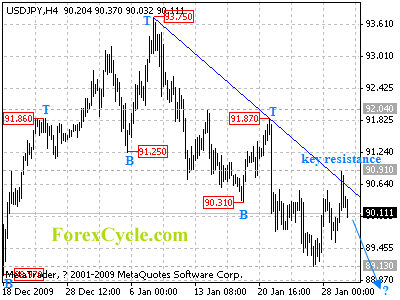
USDJPY pulled back from 90.91

After touching the falling trend line from 93.75 to 91.87, USDJPY pulled back from 90.91. One more fall towards 88.50 area is still possible in a couple of days. Key resistance is now at 90.91, only a break above this level will indicate that the fall from 93.75 has completed at 89.13 already, then the following uptrend could take price back to re-test 93.75 previous high resistance.

Daily Forex Signals

USDJPY stays in a falling price channel

USDJPY stays in a falling price channel on daily chart and remains in downtrend from 93.75. One more fall towards 88.50 area to reach next cycle bottom is possible next week. Resistance is at the upper border of the price channel and key resistance is located at 91.87, a break above this level will indicate that the fall from 93.75 has completed, then another rise towards 95.00-96.00 area could be expected.

For long term analysis, USDJPY has formed a cycle bottom at 84.82 level on weekly chart. Bounce towards 100.00 area is expected in next several weeks.

Weekly Forex Forecast

Gold Fluctuates as Investors Decipher Data

By Fast Brokers – Gold is fluctuating wildly today as investors react to the stronger than expected U.S. data set.  U.S. GDP, Chicago PMI, and UoM Consumer Sentiment data all printed stronger than analyst expectations.  While investors have reacted by buying up the Dollar and selling gold, the precious metal has been all over the place on the 1-hour and it seems investors are debating exactly how to play today’s development.  The outperformance in U.S. economic data has led investors to favor the Dollar as a safe haven amidst global economic uncertainty, a negative for gold considering correlative forces.  On the other hand, a boost in U.S. economic activity could also prove to be a positive development for the risk trade.  Hence the wild fluctuations in gold so far this session.  That being said, it seems the downside is winning the battle thus far, though we will have to wait and see how the session plays out.  Meanwhile, investors should keep an eye on the major Dollar pairs should there be another considerable technical move.

Technically speaking, gold has our 1st tier uptrend line serving as a technical cushion along with January lows should they be tested.  Our present uptrend lines run through August 2008 levels, highlighting the significance of the moment.  As for the topside, gold faces a few steep downtrend lines along with the highly psychological $1100/oz level.  Furthermore, intraday and 1/26 highs could serve as technical barriers should they be reached.

Present Price: $1078.05/oz

Resistances: $1078.92/oz, $1085.32, oz, $1090.07/oz, $1093.32/oz, $1096.91/oz, $1101.00/oz

Supports: $1074.44/oz, $1070.65/oz, $1063.28/oz, $1058.74/oz, $1054.86/oz, $1050.12/oz

Psychological: $1075/oz, $1100/oz, January lows

Market Commentary provided by Fast Brokers.

Disclaimer: FastBrokers’ market commentary is provided for information purposes only and under no circumstances should be regardedneither as an investment advice nor as a solicitation or an offer to sell/buy any financial product. FastBrokers assumes no responsibility or liability from gains or losses incurred by the information herein contained.

Risk Disclosure: There is a substantial risk of loss in trading futures and foreign exchange. Please carefully review all risk disclosure documents before opening an account as these financial instruments are not appropriate for all investors.

Forex Daily Market Commentary

By GCI Forex Research

Fundamental Outlook at 1500 GMT (EDT + 0500)

The euro depreciated vis-à-vis the U.S. dollar today as the single currency tested bids around the US$ 1.3900 figure and was capped around the $1.3985 level.  The common currency slumped following stronger-than-expected U.S. economic data that were released today including a 5.7% q/q annualized climb in fourth quarter 2009 gross domestic product, up from the prior reading of +2.2%.  The GDP price index was up less-than-expected at +0.6% while core personal consumption expenditures were up +1.4% q/q with the employment cost index up +0.5%.  Also, the Chicago Purchasing Managers index rallied to 61.5 from the prior reading of 58.7 and the final January University of Michigan consumer sentiment indicator improved to 74.4 from the prior reading of 72.8.  Generally speaking, today’s economic data were quite strong and evidenced a U.S. economy that remains in a jobless economic recovery for now. Employment aggregates continue to lag growth and activity data and most economists believe unemployment will moderate in 2010.  Federal Reserve Chairman Bernanke was reconfirmed to a second term at the helm of the Fed yesterday and Treasury Secretary Geithner remains under political attack from both sides of the aisle.  In eurozone news, EMU-16 unemployment escalated to 10% in December for the first time since the adoption of the euro in 1999.  Also, EMU-16 lending to the private sector stalled last month and financing constraints will likely have a negative impact on economic growth.  Additionally, EMU-16 inflation reached an eleven-month high last month and the December M3 money supply contracted 0.2%.  The common currency continues to weaken partially on account of escalating sovereign credit concerns in the eurozone.  Greek fiscal problems are being compounded by a similar situation in Portugal, Spain, Ireland, and elsewhere and there is ongoing chatter that the European Union may be forced to bail Greece out of its problems, despite strong German opposition. Euro bids are cited around the US$ 1.3740 level.

¥/ CNY

The yen depreciated vis-à-vis the U.S. dollar today as the greenback tested offers around the ¥90.90 level and was supported around the ¥89.60 level.  Many data were released in Japan overnight. First, December core consumer prices were off 1.3% y/y, in line with expectations, and these data evidence Japan’s ongoing bout with moderate deflationary pressures.  The government continues to pressure Bank of Japan to enact more monetary easing policies and these may eventually include more purchases of Japanese government bonds and more emergency lending plans.  Other data released today saw December overall housing starts off 15.7% y/y while December construction orders were up +0.6% y/y. The Nikkei 225 stock index lost 2.18% to close at ¥10,198.04. U.S. dollar offers are cited around the ¥94.75 level.  The euro moved higher vis-à-vis the yen as the single currency tested offers around the ¥126.65 level and was supported around the ¥124.80 level.  The British pound moved higher vis-à-vis the yen as sterling tested offers around the ¥146.20 level while the Swiss franc moved higher vis-à-vis the yen and tested offers around the ¥86.40 level. In Chinese news, the U.S. dollar depreciated vis-à-vis the Chinese yuan as the greenback closed at CNY 6.8267 in the over-the-counter market, down from CNY 6.8268.  People’s Bank of China Deputy Governor Zhu yesterday reported the U.S. carry trade is dangerous to the global economy and added China will continue to pursue a stable yuan.  China will likely feel a lot of pressure from Group of Eight officials convening in Canada in early February regarding China’s exchange rate.  PBoC reported Chinese property prices are up 21% from 2007’s levels and said corporate inventory growth is now decelerating.  PBoC also indicated managing the economy has become “more difficult” and said it will pursue “reasonable and sufficient” credit and money controls.

The British pound moved lower vis-à-vis the U.S. dollar today as cable tested bids around the US$ 1.6020 level and was capped around the $1.6180 level.  Data released in the U.K. today saw January Nationwide house prices up 1.2% m/m and 8.6% y/y.  U.K. Chancellor of the Exchequer Darling  yesterday said reform that has already been agreed-upon should be implemented.  Darling added the U.K. economic is “moving in the right direction”. Bank of England today announced it is abandoning its temporary swap lines with the Federal Reserve and said it has ended its asset purchase program of gilts.  Sterling picked up ground yesterday on comments from Bank of England Monetary Policy Committee member Sentance who said it will be difficult to keep inflation on target given sterling’s depreciation.  He also said data suggests the U.K. economy expanded more in Q4 than reported at +0.1%.  Tory leader Cameron today called for more powers to be given to Bank of England to oversee the economy.   Cable bids are cited around the US$ 1.5910 level.  The euro moved higher vis-à-vis the British pound as the single currency tested offers around the ₤0.8690 level and was supported around the ₤0.8630 level.

CHF

The Swiss franc depreciated vis-à-vis the U.S. dollar today as the greenback tested offers around the CHF 1.0550 level and was supported around the CHF 1.0480 level.  Data released in the U.S. today saw the January KOF leading indicator improve to +1.77 from +1.68 in December.  Swiss National Bank President Hildebrand spoke today and said the central bank continues to sell assets from the UBS Stability Fund and that he remains optimistic on the process. Finace minister Merz indicated he is “happy” with the euro/ franc exchange rate.  The euro came off vis-à-vis the Swiss franc as the single currency tested bids around the CHF 1.4645 level while the British pound depreciated vis-à-vis the Swiss franc and tested bids around the CHF 1.6870 level.

Forex Daily Market Commentary provided by GCI Financial Ltd.

GCI Financial Ltd (”GCI”) is a regulated securities and commodities trading firm, specializing in online Foreign Exchange (”Forex”) brokerage. GCI executes billions of dollars per month in foreign exchange transactions alone. In addition to Forex, GCI is a primary market maker in Contracts for Difference (”CFDs”) on shares, indices and futures, and offers one of the fastest growing online CFD trading services. GCI has over 10,000 clients worldwide, including individual traders, institutions, and money managers. GCI provides an advanced, secure, and comprehensive online trading system. Client funds are insured and held in a separate customer account. In addition, GCI Financial Ltd maintains Net Capital in excess of minimum regulatory requirements.

DISCLAIMER: GCI’s Daily Market Commentary is provided for informational purposes only. The information contained in these reports is gathered from reputable news sources and is not intended to be U.S.ed as investment advice. GCI assumes no responsibility or liability from gains or losses incurred by the information herein contained.

AUD/USD Sinks Back to .89 Amid Broad Dollar Strength

By Fast Brokers – The AUD/USD is heading lower amid high volatility as the Dollar strengthens across the board after a better than expected U.S. economic data set.  U.S. Advance GDP, Chicago PMI, and UoM Consumer Sentiment data all impressed and a Dollar buying spree has ensued as investors choose the U.S. economy as a safe harbor amid global economic uncertainty.  Meanwhile, gold is heading lower towards its psychological $1075/oz with investors debating where to send the Greenback.  Volatility has been at a heightened level thus far and it will be interesting to see where the Dollar ends up at the end of the day.  Thus far the Dollar is beating out higher risk currencies and it seems this trend may continue as the trading week draws to a close.  Meanwhile, the AUD/USD is having a tough time leaving behind .8900 level and is finding support in our present 1st tier uptrend line.  Our current uptrend lines run through April 2009 levels, or the .70 area, marking the importance of present supports.  The Aussie should remain active as next week kicks off.  China will begin the trading week by releasing Manufacturing PMI data.  We’ve witnessed the influence China’s more hawkish monetary policy had on the Aussie this week.  Therefore, we expect the currency to react to Monday’s key data release as well.  Australia will also begin the trading week with some data releases, including New Home Sales, HPI, and Quarterly Business Confidence.  Furthermore, the RBA will make its monetary policy decision during Tuesday’s Asia trading session.  Hence, the AUD/USD appears to have a busy week ahead of itself.

Technically speaking, the AUD/USD is currently fighting to stay above our 1st tier uptrend line with multiple uptrend lines hanging below.  Additionally, previous January lows and the psychological .8900 level could continue to serve as technical cushions for the time being.  As for the topside, the AUD/USD faces multiple downtrend lines along with 1/28 and 1/26 highs serving as technical barriers.  Furthermore, the .9000 area could serve as a psychological force should it be reached.

Price: .8900

Resistances:   .8901, .8912, .8933, .8949, .8959, .8984

Supports: .8884, .8870, .8857, .8842, .8822, .8812

Psychological: .90, January highs and lows

Market Commentary provided by Fast Brokers.

Disclaimer: FastBrokers’ market commentary is provided for information purposes only and under no circumstances should be regardedneither as an investment advice nor as a solicitation or an offer to sell/buy any financial product. FastBrokers assumes no responsibility or liability from gains or losses incurred by the information herein contained.

Risk Disclosure: There is a substantial risk of loss in trading futures and foreign exchange. Please carefully review all risk disclosure documents before opening an account as these financial instruments are not appropriate for all investors.

USD/JPY Pops on Strong U.S. Data Set

By Fast Brokers – The USD/JPY has popped past 1/22 highs in reaction to stronger than expected U.S. GDP, Chicago PMI, and Revised UoM data.  The altogether positive U.S. data set has resulted in broad-based Dollar strength and the USD/JPY is certainly partaking in the action.  The encouraging U.S. data comes in the wake of mixed econ data from Japan during today’s Asia trading session.  Although Household Spending came in hotter than expected, both the Tokyo Core CPI and Prelim Industrial Production printed below analyst expectations.  Hence, we can deduce that a stronger Yen has dragged prices lower, spurring consumption and decreasing demand for Japanese goods.  The key element of today’s data set is the decline in CPI to -2%.  Both the BoJ and DPJ have been vocal about combating deflationary pressures.  Hence, should deflation persist the BoJ may be inclined to take action, and it seems the USD/JPY is already pricing in this realization today.  Meanwhile, it will be interesting to see how the session plays out considering how volatile it has been thus far.  China will kick off next week by releasing Manufacturing PMI.  China’s economic performance has a large impact on Japan considering their close commercial relationship.  Hence, activity in the Yen could remain at a heightened state as next week’s trading session begins.

Technically speaking, the USD/JPY has multiple uptrend lines serving as technical cushions along with 1/19 and 1/22 lows.  As for the topside, the USD/JPY faces multiple downtrend lines along with intraday and 1/20 highs.  Furthermore, the .90 area could continue to have a psychological influence on the USD/JPY over the near-term should the USD/JPY’s upward momentum cool down as the session progresses.

Present Price: 90.74

Resistances: 90.75, 90.90, 91.05, 91.24, 91.43, 91.57

Supports: 90.57, 90.43, 90.27, 90.10, 89.90, 89.72

Psychological: 90, January highs and lows

Market Commentary provided by Fast Brokers.

Disclaimer: FastBrokers’ market commentary is provided for information purposes only and under no circumstances should be regardedneither as an investment advice nor as a solicitation or an offer to sell/buy any financial product. FastBrokers assumes no responsibility or liability from gains or losses incurred by the information herein contained.

Risk Disclosure: There is a substantial risk of loss in trading futures and foreign exchange. Please carefully review all risk disclosure documents before opening an account as these financial instruments are not appropriate for all investors.

GBP/USD Drops on Strong U.S. Data and Negative S&P Statement

By Fast Brokers – Standard and Poors sent the Pound lower today after it released a statement saying that UK banks aren’t the ‘most stable and low-risk’ in the world, comparing them to financial institutions in Chile and Portugal.  Standard and Poors bleak assessment of the UK’s financial industry has resulted in a comparative weakness in the Pound, highlighted by a pop in the EUR/GBP and emphasized by a large pullback in the Cable.  The Cable’s weakness has been exacerbated by stronger than expected U.S. economic data.  Strong U.S. GDP, Chicago PMI, and Revised UoM data has sent the Dollar higher across the board as the U.S. looks to be a viable safe haven amongst global uncertainty.  The Cable reacted to the U.S. data set by plunging below 1/22 lows and nearly testing the psychological 1.60 level.  However, the Cable seems to be finding strength in our 1st tier uptrend line and is attempting to stabilize to avoid another key technical setback considering our 1st tier runs through December lows, or the 1.585 area.  That being said it will be interesting to see how the session plays out considering the volatility we’ve witnessed thus far.  Will investors decide to head back to the risk trade, or stick with a strong Dollar theme as the week comes to a close?  As for the UK, the economy did get a piece of good news in that Nationwide HPI surpassed analyst estimates.  The data train will continue next week with the release of Manufacturing PMI and Net Lending to Individuals on Monday.

Technically speaking, the Cable has experienced a large setback today and is currently testing some key supports in the form of our 1st tier uptrend line and the psychological 1.60 area.  As we stated before, our 1st tier runs through December lows, or the 1.5850 area.  As for the topside, the Cable faces multiple downtrend lines along with 1/8 and intraday highs.

Present Price: 1.6034

Resistances: 1.6046, 1.6061, 1.6078, 1.6098, 1.6124, 1.6149

Supports: 1.6028, 1.6003, 1.5981, 1.5964, 1.5964, 1.5940, 1.5921

Psychological: 1.60,  December lows and highs

Market Commentary provided by Fast Brokers.

Disclaimer: FastBrokers’ market commentary is provided for information purposes only and under no circumstances should be regarded neither as an investment advice nor as a solicitation or an offer to sell/buy any financial product. FastBrokers assumes no responsibility or liability from gains or losses incurred by the information herein contained.

Risk Disclosure: There is a substantial risk of loss in trading futures and foreign exchange. Please carefully review all risk disclosure documents before opening an account as these financial instruments are not appropriate for all investors.

EUR/USD Glides Lower as Investors Snap up Dollar

By Fast Brokers – The EUR/USD is heading lower today as investors snap up the Dollar across the board in reaction to stronger than expected U.S. economic data.  U.S. Advance GDP printed 1.2% above analyst expectations, spurring a Dollar buying spree due to the comparative outperformance of America’s economy.  In addition to the positive GDP number the U.S. also released better than expected Chicago PMI and Revised UoM Consumer Sentiment Data.  The all around impressive U.S. data has sent the Dollar higher across the board while gold drops beneath $1075/oz.  Therefore, the EUR/USD’s correlations are sending sell signals.  However, today’s session has already been incredibly volatile and we’ll have to see how the remainder of the day plays out.  Meanwhile, the Euro is flexing a been of a relative strength today as EU officials come to the defense of Greece while attempting to negate speculation that Greece may need to leave the union.  That being said, the EU could be working on a bailout package to help ready the ship for a debt scare in Greece could spread to larger struggling nations such as Spain and Portugal.  Greece has already seen its bond interest rates fly higher this week and the EU may need to make a decision soon to prevent the weakness from spreading.  Therefore, investors should keep a wary eye on the newsier and monitor the EUR/USD for any sudden jerks while data releases are absent.  Speaking of data, the EU will be relatively quiet on the data wire next week until Thursday’s ECB meeting.  Therefore, activity in the currency pair should continue to flow with broad-based Dollar movements unless there is another key development concerning Greece.

Technically speaking, the EUR/USD faces topside technical barriers in the form of multiple downtrend lines along with 1/28 and 1/25 highs.  As for the downside, the EUR/USD has our 1st tier uptrend line (off scree) serving as technical cushions along with previous January lows.  Our 1st and 2nd tier uptrend lines could carry some weight since they run through April 2009 lows.  That being said, a failure of our 1st tier could send a fairly negative signal considering April 2009 lows are around the 1.30.

Present Price: 1.3924

Resistances: 1.3964, 1.3992, 1.4030, 1.4051, 1.4100, 1.4135

Supports:  1.3902, 1.3876, 1.3850, 1.3822, 1.3796, 1.3756

Psychological: 1.40, January lows

Market Commentary provided by Fast Brokers.

Disclaimer: FastBrokers’ market commentary is provided for information purposes only and under no circumstances should be regardedneither as an investment advice nor as a solicitation or an offer to sell/buy any financial product. FastBrokers assumes no responsibility or liability from gains or losses incurred by the information herein contained.

Risk Disclosure: There is a substantial risk of loss in trading futures and foreign exchange. Please carefully review all risk disclosure documents before opening an account as these financial instruments are not appropriate for all investors.

FOREX: US GDP grows more than expected in 4th Quarter. Dollar makes gains.

By CountingPips.com

The U.S. economy expanded by more than expected in the fourth quarter of 2009 and at the fastest pace in over 6 years according to a release by the U.S. Commerce Department today. The advance government report released today showed that the U.S. Gross Domestic Product grew on an annualized basis by 5.7 percent in the October to December quarter following a real 2.2 percent growth rate in the third quarter.

The fourth quarter GDP numbers advanced by the highest growth rate since 2003 and surpassed economic forecasts expecting growth of approximately 4.7 percent.

GDP has now increased for two straight quarters after contracting for four quarters in a row. The economy declined by 6.4 percent in the first quarter of 2009 and by 0.7 percent in the second quarter before the third quarter’s 2.2 percent rise. Overall for the calendar year of 2009, GDP decreased by 2.4 percent following a 0.4 percent increase for 2008 and a 2.1 percent growth rate in 2007.

Contributing largely to the gain in GDP for the fourth quarter was a slowdown in the cutbacks of business inventories. Inventories fell by just $33.5 billion in the fourth quarter after a decrease of $139 billion in the third quarter and a decrease of $160.2 billion in the second quarter. This slowdown in the slashing of inventories accounted for adding approximately 3.4 percent to the GDP increase.

Also contributing to the economic expansion was an increase in consumer spending which makes up roughly two-thirds of U.S. economic activity. Consumer spending rose by 2.0 percent in the quarter after an increase of 2.8 percent in the third quarter.

A gain in exports also contributed positively to the GDP numbers as exports of goods and services increased by 18.1 percent in the quarter while imports advanced by 10.5 percent. Equipment and software investment increased to show a gain of 13.3 percent in the fourth quarter after increasing by just 1.5 percent in the third quarter.

The advance estimate GDP data is subject to revision as the 2nd estimate version is released at a later date and is scheduled for February 26th.

US Dollar gains in Forex Trading

The U.S. dollar has been mostly stronger in forex trading today against the other major currencies so far today after the GDP report. The dollar has gained today versus the euro, British pound, Japanese yen, Swiss franc and the Australian dollar while the dollar is currently trading virtually unchanged against the Canadian dollar and New Zealand dollar at 12:45 pm EST according to currency data by Oanda.

The U.S. stock markets have been mixed so far today with the Dow Jones gaining by over 20 points, the Nasdaq decreasing over 5 points and the S&P 500 is just about unchanged at time of writing.  Oil has edged down by $0.32 to $73.32 while gold is down by $3.30 to trade at the $1,080.30 per ounce level.

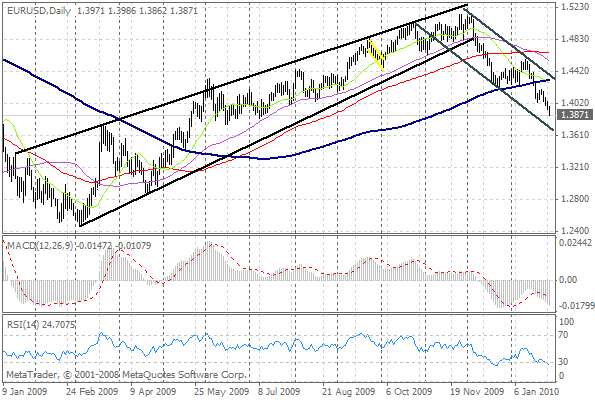
EUR/USD Daily Chart – The Euro continuing its decrease versus the US Dollar today in forex trading.  The EUR/USD has fallen to trading under the 1.3900 level, touching its lowest point since July 8th today. This pair has entered oversold territory on the Relative Strength Indicator (RSI) indicating extreme weakness on today’s daily chart.