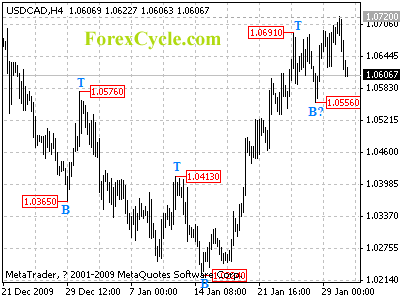
USDCAD’s bounce extended to 1.0720 only

USDCAD’s bounce from 1.0556 extended to as high as 1.0720 only. The subsequent pullback suggests lengthier consolidation of uptrend from 1.0224 is underway. More sideways movements are expected in a couple of days. As long as 1.0556 support holds, we’d expected uptrend to resume and one more rise towards 1.0800 is still possible. However, a breakdown below 1.0556 key support will indicate that the rise from 1.0224 has completed at 1.0720 level already, then the following downtrend could take price to 1.0450 area.

usdcad

Daily Forex Signals

Forex Daily Market Commentary

By GCI Forex Research

Fundamental Outlook at 1500 GMT (EDT + 0500)

The euro appreciated vis-à-vis the U.S. dollar today as the single currency tested offers around the US$ 1.3935 level and was supported around the $1.3850 level.  The common currency followed U.S. equities markets higher as increased risk demand jumped on speculation the global economic recovery will continue.  Dealers also lifted the common currency as it was reported that EMU-16 PMI improved to 52.4 in January from 51.6 in December, following Germany’s lead with its PMI improvement to 53.7.  A draft copy of the upcoming Group of Seven communiqué reports “Market volatility, in particular in the foreign exchange market, could destabilize the nascent global recovery by placing growth on an unbalanced path and trigger unwelcome protectionist reactions.”  G7 finance ministers will convene in northern Canada in early February and two hot topics are expected to be exit strategies from the provision of global stimulus and China’s currency.  ECB President Trichet this weekend said policymakers “will do whatever is necessary to give all our citizens…price stability.”  Trichet also noted U.S. policymakers have reassured him that they favour a strong U.S. dollar.  In U.S. news, President Obama released details of his latest US$ 3.8 trillion budget today and it calls for a broad US$ 1.9 trillion tax increase by returning to pre-2001 ordinary income tax rates for higher earners.  A US$ 1.5 trillion deficit is expected to materialize by the end of the next fiscal year and the budget also includes a US$ 100 billion job stimulus package that has not yet been passed by Congress.  The Federal Reserve today reported that fewer banks tightened lending standards in Q4 2009 as the economy continued to recover.  Data released in the U.S. today saw December personal income print at +0.4%, down from the revised +0.5% November reading, while personal spending fell to +0.2% from a revised +0.7%.  Also, the December PCE deflator came in at +2.1% y/y while the core PCE reading was up 0.1% m/m.  Additionally, the January headline ISM manufacturing index improved to 58.4 from the prior reading of 55.9, the sixth consecutive monthly increase, while the ISM prices paid sub-index rallied to 70.0 from the previous reading of 61.5.  Moreover, December construction spending was off 1.2% m/m.  Traders await the release of December pending home sales data tomorrow.  Euro bids are cited around the US$ 1.3740 level.

¥/ CNY

The yen depreciated vis-à-vis the U.S. dollar today as the greenback tested offers around the ¥90.95 level and was supported around the ¥89.85 level.  Bank of Japan Chief Economist Momma reported “the risk that the Japanese economy will fall off from a cliff is small, but there is still a long way to go.  Even if the global economy continues to recover, the spread of that to capital spending and the labour market will be limited.”  Momma also indicated capital spending will not indicate signs of a rebound until the fiscal year beginning in April 2011 and said the labour market will also remain weak.  Core consumer prices data that were recently released confirmed a 1.2% decline in December, the latest evidence of entrenched deflationary pressures. Momma predicted the pace of the decline in CPI will be around 1% for some time.  Many BoJ-watchers believe the central bank will introduce new emergency liquidity provision programs in Q1 or early Q2, possibly including an increase in its purchase of Japanese government bonds.  The markets continue to speculate that the downward trajectory of Japanese interest rates will continue with March 2010 Euroyen futures contracts indicating a rate of 0.420%, compared with 0.360% for September 2010.  The Nikkei 225 stock index climbed 0.07% to close at ¥10,205.02.  U.S. dollar offers are cited around the ¥94.75 level.  The euro moved higher vis-à-vis the yen as the single currency tested offers around the ¥126.50 level and was supported around the ¥124.65 level.  The British pound moved higher vis-à-vis the yen as sterling tested offers around the ¥144.80 level while the Swiss franc moved higher vis-à-vis the yen and tested offers around the ¥85.90 level. In Chinese news, the U.S. dollar appreciated vis-à-vis the Chinese yuan as the greenback closed at CNY 6.8275 in the over-the-counter market, up from CNY 6.8269.  People’s Bank of China adviser Fan Gang reported China’s “real worry” remains asset bubbles that could emerge as China’s economy emerges from a crisis period into a “boom time.”  Fan also noted moves by PBoC to reduce liquidity last month were “timely and necessary.”  There is speculation that PBoC may hike rates when consumer price inflation rises above 2.5%.  Data released in China today saw January PMI recede to 55.8 from 56.6 in December.

The British pound moved lower vis-à-vis the U.S. dollar today as cable tested bids around the US$ 1.5850 level and was capped around the $1.5975 level.  Many data were released in the U.K. today. First, January manufacturing PMI improved to 56.7 from 54.6, a fifteen-year high.  Second, December mortgage approvals decreased to 59,020.  Third, net lending to individuals rose by ₤1.2 billion in December.  Fourth, Hometrack January house prices were up +0.1%.  Bank of England is expected to keep interest rate policy unchanged this week.  There is some speculation, however, that Bank of England may pause its ₤200 billion bond purchase plan but maintain the option to extend it further.  Cable bids are cited around the US$ 1.5720 level.  The euro moved higher vis-à-vis the British pound as the single currency tested offers around the ₤0.8765 level and was supported around the ₤0.8680 level.

CHF

The Swiss franc appreciated vis-à-vis the U.S. dollar today as the greenback tested bids around the CHF 1.0565 level and was capped around the CHF 1.0625 level.   The media reported Swiss National Bank is unlikely to abandon its policy to keep a lid on the Swiss franc even though the domestic economy continues to improve.  Data released in Switzerland today saw January PMI improve to 56.0 from 53.7 in December.  Data released in Switzerland last week saw the December UBS consumption indicator fall to 1.2 from 1.26 in November.  Swiss National Bank President Hildebrand recently reported he is “extremely interested” in the Obama administration’s bank proposals.  The euro moved higher vis-à-vis the Swiss franc as the single currency tested offers around the CHF 1.4735 level while the British pound moved lower vis-à-vis the Swiss franc and tested bids around the CHF 1.6785 level.

Forex Daily Market Commentary provided by GCI Financial Ltd.

GCI Financial Ltd (”GCI”) is a regulated securities and commodities trading firm, specializing in online Foreign Exchange (”Forex”) brokerage. GCI executes billions of dollars per month in foreign exchange transactions alone. In addition to Forex, GCI is a primary market maker in Contracts for Difference (”CFDs”) on shares, indices and futures, and offers one of the fastest growing online CFD trading services. GCI has over 10,000 clients worldwide, including individual traders, institutions, and money managers. GCI provides an advanced, secure, and comprehensive online trading system. Client funds are insured and held in a separate customer account. In addition, GCI Financial Ltd maintains Net Capital in excess of minimum regulatory requirements.

DISCLAIMER: GCI’s Daily Market Commentary is provided for informational purposes only. The information contained in these reports is gathered from reputable news sources and is not intended to be U.S.ed as investment advice. GCI assumes no responsibility or liability from gains or losses incurred by the information herein contained.

FOREX: ISM Manufacturing data increases for 6th straight month. US Dollar mixed.

By CountingPips.com

U.S. Manufacturing data, released today by the Institute for Supply Management, showed that January’s manufacturing activity increased more than expected and grew for the sixth straight month. January’s ISM Report On Business index reading for economic activity rose to 58.4 from December’s reading of 55.9 and marked its highest level since 2004. According to the report, the overall U.S. economy expanded for the ninth straight month in January.

A score above 50 percent is considered to be growth and less than 50 percent is considered to be contraction in that sector. Market forecasts were predicting a reading of 55.6 for the month.

Norbert J. Ore, chairman of the ISM Business Survey Committee, stated in the report that, “The manufacturing sector grew for the sixth consecutive month in January as the PMI rose to 58.4 percent, its highest reading since August 2004 when it registered 58.5 percent. This month’s report provides significant assurance that the manufacturing sector is in recovery. Both the New Orders and Production Indexes are above 60 percent, indicating strong current and future performance for manufacturing.”

The indexes for new orders, production, employment, supplier deliveries, prices, imports, exports, backlog of orders and inventories all showed increases for January while customer inventories fell for the month.

The new orders index increased by 1.1 percentage points to a reading of 65.9 in January and has increased for seven consecutive months while production rose by 6.5 percentage points to a 66.2 score and has advanced for eight straight months.

US Dollar mixed in Forex Trading.

The U.S. dollar has been mixed in forex trading today against the other major currencies after the manufacturing data. The dollar has gained today versus the British pound and Japanese yen while falling against the euro, Canadian dollar, Swiss franc, New Zealand dollar and the Australian dollar at 1:15 pm EST according to currency data by Oanda.

The U.S. stock markets have been trading higher today with the Dow Jones rising by over 85 points, the Nasdaq increasing over 14 points and the S&P 500 up by over 10 points at time of writing.  Oil has edged higher by $1.00 to $73.89 while gold is up by $17.300 to trade at the $1,100.30 per ounce level.

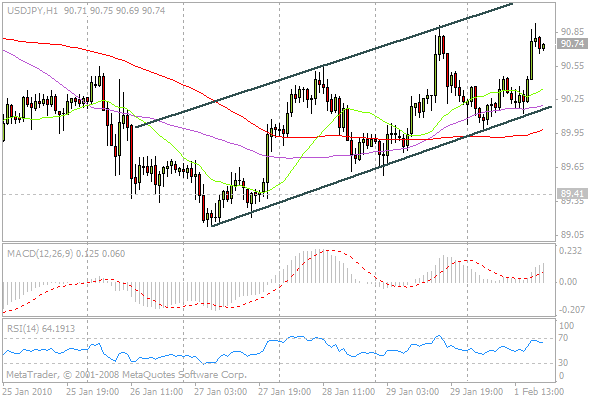
USD/JPY 1H Chart – The dollar gaining today versus the Japanese Yen today in forex trading.  The USD/JPY has risen today on increased risk appetite in the markets. This pair has ascended back above the 90.00 level after spending most of last week below this level.

AUD/USD Fights to Stabilize with the RBA on Deck

By Fast Brokers – The AUD/USD is staging a rally from intraday lows after continuing its decline in reaction to slightly weaker than expected Manufacturing PMI data from China.  Weakness in China implies a decline in demand for Australia’s commodities, a negative development for the Aussie.  However, the Dollar is depreciating across the board and gold is firming as investors await America’s Manufacturing PMI data.  It seems the Dollar is falling victim to overbought conditions right now and the AUD/USD is benefitting.  However, more fundamental data from the U.S. could illicit further volatility, particularly if the number prints above analyst expectations.  Friday’s strong U.S. data set yielded a broad-based rally in the Dollar and it wouldn’t be surprising to see this happen again considering uncertainty surrounding China, the EU and U.K.  However, attention will then shift to Australia with the RBA making its monetary policy decision during tomorrow’s Asia trading session.  Although a majority of analysts still expect a 25 point hike, recent liquidity tightening in China coupled with weak Australia PPI data may lead the RBA to pause its rate hikes as markets determine how China’s more hawkish monetary policy impacts markets.  Furthermore, recent uncertainty regarding Greece’s outstanding debt may also entice the RBA to take a wait-and-see approach.  That being said, tomorrow’s RBA decision could have a considerable impact on the AUD/USD due to rising investor uncertainty.  Furthermore, investors will also receive Pending Home Sales during tomorrow’s U.S. trading session followed by Australia’s Trade Balance on Wednesday.  Hence, the AUD/USD could remain active for the next 48 hours.

Technically speaking, the AUD/USD is currently fighting to stay above our 1st tier uptrend line with multiple uptrend lines hanging below.  Additionally, December 2009 lows could serve as a technical cushion should they be reached.  As for the topside, the AUD/USD faces multiple downtrend lines along with 12/24, 12/28 and 1/29 highs serving as technical barriers.  Furthermore, the .9000 area could serve as a psychological force should it be reached.

Price: .8848

Resistances:   .8851, .8863, .8870, .8887, .8907, .8923

Supports: .8822, .8810, .8796, .8779, .8765

Psychological: .90, January highs and December lows

Market Commentary provided by Fast Brokers.

Disclaimer: FastBrokers’ market commentary is provided for information purposes only and under no circumstances should be regardedneither as an investment advice nor as a solicitation or an offer to sell/buy any financial product. FastBrokers assumes no responsibility or liability from gains or losses incurred by the information herein contained.

Risk Disclosure: There is a substantial risk of loss in trading futures and foreign exchange. Please carefully review all risk disclosure documents before opening an account as these financial instruments are not appropriate for all investors.

USD/JPY Fluctuates Around 90

By Fast Brokers – The USD/JPY is hovering around its highly psychological 90 area as investors await America’s ISM Manufacturing PMI number.  The USD/JPY rallied in reaction to Friday’s stronger than expected U.S. economic data.  Therefore, another positive reading today could yield further topside movements in the currency pair.  However, the USD/JPY still faces a wealth of topside technical barriers and it has a ways to go to remove the grips of its downtrend.  Meanwhile, although China’s slightly weaker than expected Manufacturing PMI did illicit a little topside movement in the USD/JPY, the activity was not much to speak of.  However, volatility could pick up during tomorrow’s Asia trading session with the RBA making a monetary policy decision.  Though analyst are expecting a 25 basis point hike, the RBA could go either way since recent tightening from China and weak Australia PPI has placed a bit of pressure on the central bank.  Japan will also release Cash Earnings data during tomorrow’s Asia trading session and investors are expecting a decline of -2.6%.  Attention should remain on Australia and the U.S. for the next 24 hours with America also releasing Pending Home Sales tomorrow.

Technically speaking, the USD/JPY has multiple uptrend lines serving as technical cushions along with 1/28 and 1/22 lows.  As for the topside, the USD/JPY faces multiple downtrend lines along with 1/29 and 1/20 highs.  Furthermore, the .90 area could continue to have a psychological influence on the USD/JPY over the near-term.

Present Price: 90.28

Resistances: 90.46, 90.56, 90.67, 90.90, 91.04, 91.24

Supports: 90.22, 90.08, 89.97, 89.77, 89.58, 89.36

Psychological: 90, January highs and lows

Market Commentary provided by Fast Brokers.

Disclaimer: FastBrokers’ market commentary is provided for information purposes only and under no circumstances should be regardedneither as an investment advice nor as a solicitation or an offer to sell/buy any financial product. FastBrokers assumes no responsibility or liability from gains or losses incurred by the information herein contained.

Risk Disclosure: There is a substantial risk of loss in trading futures and foreign exchange. Please carefully review all risk disclosure documents before opening an account as these financial instruments are not appropriate for all investors.

GBP/USD Slides as Pound Underperforms

By Fast Brokers – It seems the Standard and Poor’s bearish statement on Friday in regards to the state of the UK’s financial industry has carried over into today’s trading session.  The Cable has been hit hard, plunging below its psychological 1.60 level and previous January lows as the Pound underperforms, highlighted by a solid pop in the EUR/GBP.  Weakness in the Pound comes despite stronger than expected Manufacturing PMI data.  Hence, UK manufacturing, employment, and home prices are all recovering nicely right now.  Such strong manufacturing data would normally be a positive catalyst for the Pound, yet it seems investors uncertainty surrounding the state of the global economy is overpowering more encouraging fundamental developments.  The Cable has now caught up with the EUR/USD and AUD/USD, which both logged larger losses last week.  Meanwhile, investors are awaiting America’s Manufacturing PMI number.  Furthermore, the markets will receive a monetary policy decision from the RBA during tomorrow’s Asia trading session followed by Halifax and construction PMI from the UK.  Additionally, investors should continue to monitor news concerning the Greece debt issue.  Should the EU make a decision in regards to how it wants to handle Greece, the FX markets could experience volatility across the board.  Momentum in the Dollar is clearly to the upside right now.  However, it will be interesting to see how the Cable handles December 2009 lows and whether the currency pair can make a rally back to its psychological 1.60 level.

Technically speaking, we’ve created some new uptrend lines for the Cable running from October and December ’09 lows.  Furthermore, these lows could serve as technical cushions should they be reached.  As for the topside, the Cable faces multiple downtrend lines along with 12/24 and 1/08 highs.  The psychological 1.60 area now becomes a psychological barrier.

Present Price: 1.5924

Resistances: 1.5932, 1.5953, 1.5979, 1.6005, 1.6024, 1.6046

Supports: 1.5912, 1.5895, 1.5876, 1.5863, 1.5849, 1.5832

Psychological: 1.60,  December and October lows

Market Commentary provided by Fast Brokers.

Disclaimer: FastBrokers’ market commentary is provided for information purposes only and under no circumstances should be regardedneither as an investment advice nor as a solicitation or an offer to sell/buy any financial product. FastBrokers assumes no responsibility or liability from gains or losses incurred by the information herein contained.

Risk Disclosure: There is a substantial risk of loss in trading futures and foreign exchange. Please carefully review all risk disclosure documents before opening an account as these financial instruments are not appropriate for all investors.

EUR/USD Stabilizes as Investors Await U.S. Data

By Fast Brokers – The EUR/USD is stabilizing around the 1.39 level as investors wait for America’s ISM Manufacturing PMI data.  Consolidation in the EUR/USD is a desirable development for Dollar bears since the Euro has been in a freefall the past couple weeks.  Investors were able to take the weekend to allow fears concerning Greece’s budget deficit to cool down a bit.  It now appears the EU will need to make a decision in regards to bailing out Greece.  The EU may have little choice but to lend a helping hand since the failure of an EU nation could have negative ramifications for the other member nations.  An EU decision could come as soon as this week and it’s uncertain what impact this will have on the Euro.  Therefore, investors should monitor the EU headlines closely since such an economic move could create volatility in the EUR/USD.  Meanwhile, China’s Manufacturing PMI data printed a bit shy of analyst expectations and the UK’s outperformed.  Hence, the risk trade has received a fuzzy picture to kick off the week.  Investors are now awaiting America’s own PMI number and the release could elicit some activity.  Volatility should pick up in the FX markets as the week progresses with the RBA making a monetary policy decision during tomorrow’s Asia trading session followed by U.S. Pending Home Sales.  The EUR/USD will release German Retail Sales and investors are expecting growth of 0.9%.  However, recent data from Germany hasn’t received too much of a response so focus will likely remain on the U.S. and Australia barring an EU decision regarding Greece.

Technically speaking, the EUR/USD faces topside technical barriers in the form of multiple downtrend lines along with 1/29 and 1/28 highs.  Furthermore, the psychological 1.40 level could serve as a technical barrier should it be tested.  As for the downside, the EUR/USD has our 1st tier uptrend line serving as technical cushions along with previous January lows.  The EUR/USD has more uptrend lines waiting in the distance, although they are sitting off screen right now.  Our 1st and 2nd tier uptrend lines could carry some weight since they run through April 2009 lows.  That being said, a failure of our 1st tier could send a fairly negative signal considering April 2009 lows are around the 1.30.

Present Price: 1.3909

Resistances: 1.3936, 1.3976, 1.4002, 1.4036, 1.4065, 1.4099

Supports:  1.3903, 1.3878, 1.3857, 1.3833, 1.3806, 1.3782

Psychological: 1.40, January lows

Market Commentary provided by Fast Brokers.

Disclaimer: FastBrokers’ market commentary is provided for information purposes only and under no circumstances should be regardedneither as an investment advice nor as a solicitation or an offer to sell/buy any financial product. FastBrokers assumes no responsibility or liability from gains or losses incurred by the information herein contained.

Risk Disclosure: There is a substantial risk of loss in trading futures and foreign exchange. Please carefully review all risk disclosure documents before opening an account as these financial instruments are not appropriate for all investors.

Steve Jobs, Apple, the iPad, and King Gillette – Video

By Adam Hewison – On Wednesday, after much hype and drama, Steve Jobs walked onstage and unveiled Apple’s latest creation – the iPad. Having watched almost every key address for Apple for many years I, like many others, were disappointed that the product didn’t live up to the hype. Nonetheless, Apple will sell a boatload of these products, but not as many as the iPhone.

Upon reflection, it occurred to me that Steve Jobs is changing the whole business model of Apple and I don’t believe anyone has caught on to this yet.

In all the reports I’ve read after the launch of the iPad, I think every writer /analyst missed this key point: Steve Jobs wants to be like King Gillette.

If you don’t know who King Gillette was, you may not old enough to shave. King Gillette started his business at the beginning of the century. His business model is what I believe Apple’s business model will be in the future.

Long ago, King Gillette decided to practically give the razor away at or below cost, but sell the razor blades separately.

So here’s what I think, I think Apple wants to give the iPhone and the iPad to as many people as possible at cost or with a small profit. Remember now, AT&T subsidized the iPhone and Apple gets a slice of the pie from every AT&T customer that has an iPhone. Now why would they do that you might ask?

The key reason, I would argue, is that Apple wants the magic of recurring revenues. This is the dream of many companies – to have millions of folks paying a small amount of money every month for using a service. What makes Apple stand out is the fact that they have an army of developers who are writing code for some very cool apps. Yes, there is an app for that. In fact, there is an app for almost every idea ever thought of.

Not only has the app store been widely successful, but Apple also has iTunes, and iBooks along with iTV coming down the road. So this is what I believe Apple’s business model is going to be: with 125 million people who have giving Apple their contact and credit card information, Apple has a huge base of customers much like the newspapers and magazines did in the ’60s and ’70s, but on a much smaller scale. Now Apple can upsell products to those customers at will. The genius part about all of this is the fact that other people are creating products to be sold through the Apple store. Apple just reinvented the King Gillette model in a thoroughly modern way. Hat’s off to you Steve.

That’s my take on Apple’s stealth business model.

Now let’s take a look at the stock.

In my short video, I explain to you some key factors I’m watching that I think will make the difference in this market. If you have a few minutes, please take the time to watch this juggernaut of a stock and what I think is ahead for the market in the next 2 months.

See the New Video Here…

As always videos are free to watch and there is no registration required.

The only request that we make is that if you find the video interesting or even disagree with the analysis, please comment on a blog. We would love to hear from you.

All the best,

Adam Hewison
President, INO.com
Co-creator, MarketClub

New EUR/USD Forex Trading Pattern

By Russell Glaser – Forex traders may have noticed recently a return to the traditional trading pattern for the EUR/USD; falling after the release of positive U.S. economic data and rising on negative U.S. news. The pair strengthened significantly after the release of Friday’s U.S. GDP numbers, much like the pair did after the better than expected November Non-Farm Payrolls. The market is showing signs of returning to normalcy once seen only prior to the financial crisis. This is reflected in the trading of the EUR/USD pair.

Prior to the financial crisis, the EUR/USD traded in a fairly predictable pattern. The pair would rise following the release of positive European economic news or negative U.S. economic news. The pair would then fall on negative European news or positive U.S. data.

After fall of the investment bank, Lehman Brothers, traders were hesitant to take positions in riskier, higher yielding currencies. As such traders flocked to the safety and stability of the USD, significantly strengthening the currency against the euro.

This has been the case since for the previous year and a half. But now we are witnessing a reversal back to the original trading trend. The USD has been strengthening on positive economic data.

The release of the November U.S. Non-Farm Payrolls report was the turning point. The report was expected to show a decline of 119K jobs for the month. However, the report came as a shock to traders, posting significantly better than expected results with only -11K new job losses.

Since the November Non-Farm Payrolls, the EUR/USD has fallen from 1.5091 to 1.3886, for a cumulative decline of 8%. The latest fall in the pair came last Friday as the U.S. reported 4th quarter GDP numbers that handedly beat economist’s expectations.

This shows the EUR/USD pair is beginning to trade as it once did prior to the financial crisis, falling on positive U.S. economic data.

Forex Market Analysis provided by Forex Yard.

© 2006 by FxYard Ltd

Disclaimer: Trading Foreign Exchange carries a high level of risk and may not be suitable for all investors. There is a possibility that you could sustain a loss of all of your investment and therefore you should not invest money that you cannot afford to lose. You should be aware of all the risks associated with Foreign Exchange trading.

US Inflationary Figures may Push USD Bearish

Source: ForexYard

The American economy is due to release a number of reports today which may have a moderately heavy impact on today’s trading. The Personal Spending and Personal Income reports due at 13:30 GMT will carry a level of significance in today’s market, but not nearly as much as the ISM Manufacturing PMI scheduled for 15:00 GMT. Forex traders won’t want to miss out on these reports especially since many are forecasting a short-term downward correction for the USD in today’s trading. These reports will either debunk or verify that notion.

Economic News

USD – Is the USD Expecting a Downturn Today?

The US Dollar has started this week off in a modestly bullish posture. Gaining steady ground against the EUR and GBP, the greenback, so far, has begun to test a number of psychological price barriers. Against the EUR, the dollar has climbed to 1.3860 and is holding steady as of this morning. The most ground, however, has been made against the British Pound. The buck steadily gained a solid 70 pips in the first few hours of trading today; the GBP/USD cross now trades near 1.5930, down from 1.6000.

The American economy is due to release a number of reports today which may have a moderately heavy impact on today’s trading. The Personal Spending and Personal Income reports due at 13:30 GMT will carry a level of significance in today’s market, but not nearly as much as the ISM Manufacturing PMI scheduled for 15:00 GMT. Forex traders won’t want to miss out on these reports especially since many are forecasting a short-term downward correction for the USD in today’s trading. These reports will verify that notion.

With commodity prices testing significant support lines, and with the USD’s continued strength, the notion that the greenback is facing downward pressure today is hard to miss. While a number of today’s economic figures seem less relevant than the American NFP report due this Friday, intra-day traders can take advantage of market expectations by following news events like today’s and banking on the small corrections that are being priced into the market around these expectations.

EUR – EUR News Absent from Today’s Trading

The EUR has seen better times in its recent past. Today, however, is a different story. The 16-nation currency has plunged against almost every major currency counterpart and currently sits in a bearish posture versus the majority of them still; the only exception being the British Pound, which the EUR apparently is outpacing despite its significant setback in fundamental data. The EUR/GBP pair is currently trading near the 0.8700 mark, up from its recent low of 0.8600 seen last Friday.

The financial problems of Greece are still weighing heavy on the Euro-Zone, but last week’s World Economic Forum (WEF) meetings helped shed some light on the approach the Euro-Zone’s financial leaders are taking towards that debacle.The EUR is scheduled to be nearly absent from today’s market news, however. With one minor release due towards market opening hours in Europe, the region will be strangely missing and the EUR may take a short-term fall as a result.

On the other hand, with a variety of reports due from Britain and the United States, there’s a chance that the EUR will benefit if these other countries provide negative data. Today’s important releases will be the Manufacturing PMI figures from Britain and the US, and the EUR will react to these reports in a way befitting the currencies of those countries following these releases.

JPY – JPY Bullish from Pacific Growth and Risk Aversion

The Japanese Yen has responded favorably to last week’s stream of reports coming from the island economy. Climbing steadily against all of its major counterparts, the JPY appears to be on track to be a big winner in today’s market. So far this morning, the Yen has climbed 50 pips against the USD to a price of 90.00; 70 pips versus the EUR to hit the 124.80 mark; and also 45 pips against the British Pound (GBP) to the new price of 143.60.

The positive economic growth being experienced in other Pacific countries like Australia and New Zealand are no doubt feeding the positive sentiment around countries like Japan. But growth in the Japanese Yen typically represents a decline in global economic sentiment and increase in risk aversion. Perhaps a combination of these two factors is what is driving the Yen so much higher against its major adversaries. Should today’s data disappoint, the JPY is likely to continue gaining ground today against these other currencies.

Crude Oil – Spot Crude Oil’s Next Target $68 a Barrel?

The price of spot crude oil is currently testing a significant support level at $72.50 a barrel. This is a price which the market has not seen since 16 December 2009. Declining inventories in major consumer countries like the United States has led some to conclude that demand for the black gold is continuing to fall, despite few clear signals that such a sentiment exists. One thing is certain is that if Crude Oil can break through its current price barrier then it may continue to drop to as low as $68 a barrel in the short- to medium-term.

This week’s data will be highly impacting on the value of the US Dollar, which always carries with it a dramatic change in the value of commodities like Crude Oil. Since many are expecting a downward correction in the USD later today, there is a chance that spot crude oil will fail to breach the barrier in today’s trading. However, should today’s reports prove positive for the USD, there is a chance that this barrier will indeed be breached and forex traders will have an opportunity to enter the downtrend and ride it out to its next target around $68 a barrel.

Technical News

EUR/USD

The Bollinger Bands on the 2H chart for this pair appear to be tightening in expectation of a volatile price movement. With a recent bullish cross on the 4-hour chart’s Slow Stochastic, this pair may be due for a strong upward correction. With the RSI of the 4-hour chart floating in the over-sold territory, going long may indeed be a wise choice today

GBP/USD

There appears to be a fresh bullish cross on the hourly chart’s Slow Stochastic, signaling a bullish correction may take place. As the price floats in the over-sold territory on the daily chart’s RSI, and the 4-hour chart’s Slow Stochastic shows fresh bullish crosses, going long with tight stops throughout the day may be a solid move.

USD/JPY

The technical oscillators on this pair primarily indicate neutrality as a clear direction is refusing to reveal itself. However, the price does appear to be floating near the over-sold territory on the daily chart’s RSI. Longer-term pressure may be upward and going long with tight stops may therefore be a good decision.

USD/CHF

The pair has breached through the Fibonacci key level of 1.0600, and all oscillators on the 4 hours chart are indicating further bullish movement. The 4H Bollinger Bands are showing that the price has crossed its upper border, signaling that the current trend should continue, as the pair’s new target price might be 1.0685.

The Wild Card

USD/CAD

It seems that the bullish momentum prevails as the pair is heading up with plenty of room to run. All of the technical oscillators on the hourly and the daily charts are giving a bullish signals and this pair’s target today might be the 1.0745 level. This gives forex traders a great opportunity to join the market at an excellent entry price.

Forex Market Analysis provided by Forex Yard.

© 2006 by FxYard Ltd

Disclaimer: Trading Foreign Exchange carries a high level of risk and may not be suitable for all investors. There is a possibility that you could sustain a loss of all of your investment and therefore you should not invest money that you cannot afford to lose. You should be aware of all the risks associated with Foreign Exchange trading.